
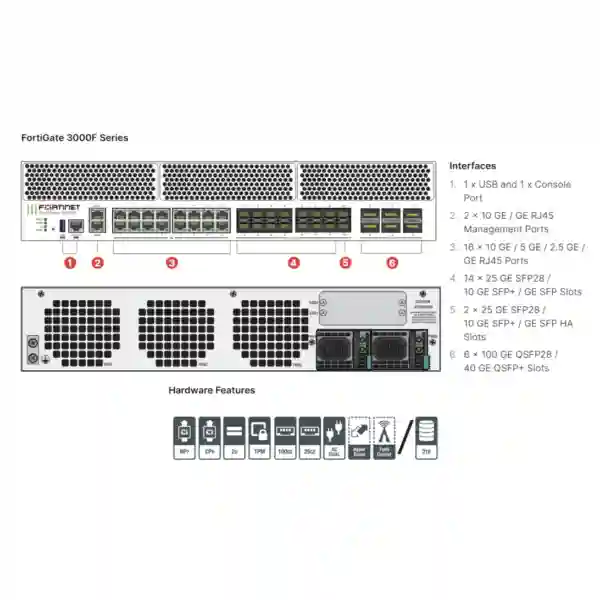
FortiGate 3000F Series Tanzania
The FortiGate 3000F Series is designed for organizations that need high-throughput next-generation firewalling at the data-center, campus-core and hybrid-IT edge. Fortinet positions the platform for security-driven networking and Hybrid Mesh Firewall architectures, combining FortiOS networking and security functions with purpose-built Security Processing Units. For Tanzanian enterprises planning data-center consolidation, high-capacity internet edges, private-cloud connectivity, branch aggregation or segmentation projects, the platform provides a strong foundation for inspecting large traffic volumes without treating security and networking as separate infrastructure decisions.
The family includes FG-3000F, FG-3000F-DC, FG-3001F and FG-3001F-DC. Fortinet publishes 36 Gbps IPS throughput, 34 Gbps NGFW throughput and 33 Gbps threat-protection throughput for the series under its stated test conditions. Interface options include six hardware-accelerated 100GE QSFP28/40GE QSFP+ slots, sixteen 25GE SFP28/10GE SFP+/GE SFP slots including two HA slots, sixteen accelerated multigigabit RJ45 data ports and two management ports. The FG-3001F variants add two 960GB SSDs. Buyers should validate performance against their own security profiles, packet sizes, SSL inspection requirements, application mix and enabled services rather than sizing from a single headline throughput figure.
Published enterprise-traffic-mix IPS throughput provides a useful reference point for large inspected environments.
Designed for high-capacity application control and intrusion-prevention workloads at enterprise boundaries.
High-speed QSFP28 connectivity supports modern core, data-center and aggregation designs.
FortiGate 3000F Series overview
FortiGate 3000F combines FortiOS with NP7 and CP9 acceleration to converge firewalling, routing, segmentation, SD-WAN and security services on one platform. Fortinet documentation states that the 3000F and 3001F use two NP7 processors connected through an integrated switch fabric, allowing supported traffic between front-panel data interfaces to be offloaded. This architecture matters when a design requires high interface density and sustained inspection across multiple zones, uplinks and server networks.
The appliance is a 2RU rack-mount platform with redundant hot-swappable power supplies. AC and DC variants allow procurement teams to align the appliance with facility power standards. High availability supports active-active, active-passive and clustering configurations. The correct design depends on failure-domain objectives, upstream and downstream redundancy, routing protocols, maintenance procedures and application availability requirements.
Security, SD-WAN and zero-trust capabilities
FortiOS enables security and networking policies to be managed within a common operating environment. Organizations can use the platform for application-aware controls, intrusion prevention, malware defenses, encrypted-traffic inspection, segmentation, IPsec VPN, Secure SD-WAN and ZTNA enforcement when appropriately configured and licensed. FortiGuard services extend the appliance with continuously updated security intelligence and inspection services. Subscription selection should be based on the actual protections required, renewal term, operational ownership and compliance needs.
For distributed businesses, Secure SD-WAN can help combine multiple WAN paths with application-aware steering and security policy. For hybrid work and private applications, ZTNA can support identity- and context-aware access patterns. These capabilities do not remove the need for sound architecture: teams should document application flows, identity sources, DNS dependencies, certificate requirements, routing behavior, logging destinations and rollback procedures before migration.
FortiGate 3000F Series technical specifications
| Specification | Published value |
|---|---|
| IPS throughput | 36 Gbps |
| NGFW throughput | 34 Gbps |
| Threat protection throughput | 33 Gbps |
| IPv4 firewall throughput | 397 / 389 / 221 Gbps for 1518 / 512 / 64-byte UDP |
| 100/40GbE slots | 6 QSFP28/QSFP+ |
| 25/10GbE SFP slots | 16 including 2 HA slots |
| Form factor | 2RU rack mount |
| FG-3001F storage | 2 × 960GB SSD |
Choosing FG-3000F or FG-3001F
The principal hardware distinction in the published ordering information is onboard storage: FG-3001F includes two 960GB SSDs while FG-3000F does not list onboard storage. Both are available in AC and DC variants. Procurement should therefore begin with the deployment architecture rather than a model-name preference. Determine whether local storage is needed, which power input matches the facility, how many high-speed optical links are required, what transceiver types are needed and whether the project will use a high-availability pair.
A complete bill of materials may include subscriptions, FortiCare support, optics, cables, rack accessories and integration work in addition to the appliance. Buyers should also confirm FortiOS release compatibility with required features and connected Fortinet components before finalizing a change window.
FortiGate 3000F Series Tanzania
Organizations searching for FortiGate 3000F Series in Tanzania are commonly planning security at a scale where architecture, interfaces and licensing are as important as the firewall appliance itself. Large enterprises, financial organizations, telecom environments, public-sector networks, universities, industrial operators and data-center teams may need to consolidate high-capacity internet connections, segment internal systems or secure traffic between private infrastructure and cloud services. The 3000F Series addresses these scenarios with high-speed interfaces and a security platform capable of combining routing, firewalling and advanced inspection.
For a Tanzania procurement exercise, start by documenting peak and expected three-to-five-year traffic, encrypted traffic percentage, number of security zones, internet and private WAN circuits, server uplinks and availability objectives. A firewall that appears oversized on raw bandwidth can become appropriate once SSL inspection, IPS, application control, VPN, logging and growth are considered together. Conversely, buying only from headline capacity can waste budget when the architecture does not need the interface density or session scale.
Power and rack planning are important for enterprise deployments. The 3000F is a 2RU appliance, and Fortinet specifies front-to-back forced airflow and redundant power. Data-center teams should verify rack depth, power feeds, cooling, optical transceivers and cable paths before delivery. For resilient designs, map both firewall nodes to independent switching and power domains where the wider infrastructure supports it.
Licensing should be quoted against the security outcomes required. FortiGuard packages, FortiCare terms and operational support choices can materially change lifecycle cost. Share the desired term, inspection functions and support level when requesting a quotation so competing proposals can be compared on equivalent scope. FourTeck can help structure the requirement around appliance variant, HA topology, subscriptions, optics and deployment services. See FourTeck Tanzania for related enterprise technology solutions and use the contact page for a project-specific quotation.
FortiGate 3000F Series Dar es Salaam
Dar es Salaam organizations evaluating FortiGate 3000F frequently have dense connectivity requirements: headquarters, data centers, internet gateways, private WAN aggregation and links to cloud or colocation environments. In such networks, the firewall must be evaluated as part of the core traffic path. The six 100/40GbE slots and multiple 25/10GbE interfaces make the series relevant where high-speed switching and routing infrastructure would otherwise be constrained by lower-capacity security appliances.
A useful design workshop should map north-south internet traffic and east-west application flows separately. Security teams can then decide where IPS, application control, malware inspection and segmentation are required and where trusted high-volume flows may follow different policy. This approach produces a more defensible sizing model than multiplying internet-circuit speed alone. It also exposes dependencies such as asymmetric routing, load balancers, upstream BGP, server VLANs and disaster-recovery paths.
For headquarters deployments, consider whether the appliance will terminate remote-access or site-to-site VPNs, participate in dynamic routing, enforce segmentation between departments, and feed centralized logging or SIEM. For data-center deployments, examine session concurrency, new-session rates, application architecture and maintenance requirements. High availability should be designed end to end; a firewall pair cannot deliver resilience if both nodes depend on the same switch, power feed or upstream circuit.
Before requesting a Dar es Salaam quotation, specify FG-3000F or FG-3001F preference, AC or DC power, quantity, HA requirement, FortiGuard subscription term, FortiCare level, optical interface speeds and required transceivers. Include migration and configuration scope if professional services are needed. This allows the commercial offer to reflect the actual project rather than an appliance-only estimate.
FortiGate 3000F Series Mwanza
For enterprises in Mwanza, FortiGate 3000F Series can be considered where a central site aggregates substantial branch, data-center or internet traffic and needs advanced inspection at enterprise scale. The buying question is not simply whether the firewall can pass traffic; it is whether it can sustain the required security services, encryption, session load and redundancy during normal operation and failure scenarios.
Organizations with geographically distributed sites should document WAN topology and application priorities. Secure SD-WAN can be relevant when multiple internet or private links are available and application steering is required, while IPsec VPN can protect site-to-site connectivity. The design should account for carrier diversity, routing convergence and what happens when a preferred circuit fails. Testing these scenarios before production reduces the risk of discovering policy or routing gaps during an outage.
Mwanza deployments serving industrial, logistics, education, healthcare or multi-site commercial operations may also require segmentation between users, servers, operational systems, guest networks and third parties. Segmentation policies should be based on documented business flows rather than broad allow rules. Where identity integration is used, directory availability and authentication dependencies should be included in the resilience plan.
Procurement teams should request a complete bill of materials that distinguishes appliance hardware, subscriptions, support, optics and services. Confirm rack and power requirements with the facility team, and decide whether onboard storage in FG-3001F is useful for the intended logging or operational design. A clear requirement enables accurate comparison and avoids later additions that were omitted from the initial budget.
FortiGate 3000F Series Arusha
Arusha businesses looking at the FortiGate 3000F Series may be supporting headquarters, hospitality groups, regional operations, institutions or service environments that depend on secure connectivity between users, applications and remote sites. At this scale, firewall selection should be tied to application criticality and growth. The 3000F Series provides substantial interface capacity, but the design still needs careful traffic and security-policy modeling.
Begin with an inventory of internet links, private WAN connections, server networks, cloud connections and branch tunnels. Identify applications that are latency sensitive, systems that require restricted access and traffic that must be inspected. Secure SD-WAN can help with path selection across multiple links, while FortiGate security policies can apply inspection and segmentation. If the environment uses public cloud, clarify whether connectivity is internet VPN, private connectivity or a combination, because routing and failover differ.
For organizations operating continuously, an HA pair is often part of the design discussion. Active-passive, active-active and clustering capabilities are published for the platform, but topology choice should follow operational requirements. Maintenance procedures, firmware upgrades, upstream switching and state synchronization all matter. Plan a controlled migration with configuration review, rollback criteria and post-change validation rather than treating installation as a simple hardware replacement.
When requesting pricing for Arusha, include the security subscription term and support requirement. Ask for the exact appliance and service SKUs so that renewal planning is transparent. If existing Fortinet components such as FortiSwitch, FortiAP or centralized management are involved, include their versions and intended integration in the project brief.
FortiGate 3000F Series Dodoma
Dodoma organizations considering FortiGate 3000F Series may include public institutions, large campuses, enterprises and service environments where security policy, availability and auditability are central requirements. A procurement specification should translate those requirements into measurable technical criteria: inspected throughput, interface types, VPN needs, segmentation, logging, high availability and support lifecycle.
The platform’s 100GbE and 25GbE connectivity can fit modern core and data-center architectures, while FortiOS provides integrated security and networking functions. However, interface speed alone should not determine the model. Security architects should estimate concurrent sessions, connection rates and encrypted traffic, then map enabled FortiGuard services. This helps ensure the design remains suitable when inspection is active.
For environments with formal change control, deployment documentation should include interface mappings, IP addressing, routing, objects, policies, NAT, VPNs, authentication, certificates, logging and monitoring. Establish configuration backup and rollback procedures before cutover. If high availability is required, test node failure, link failure and upstream failure separately so operational teams know expected behavior.
A Dodoma quotation request should identify whether the project needs AC or DC variants, one appliance or an HA pair, FG-3000F or storage-equipped FG-3001F, subscriptions, support and optics. This level of detail helps procurement compare equivalent offers and plan renewals instead of evaluating an incomplete hardware-only price.
FortiGate 3000F Series UAE
UAE procurement for FortiGate 3000F Series often involves data centers, regional headquarters and multi-country network hubs. Buyers should align appliance selection with high-speed switching, internet peering, private cloud connectivity and disaster-recovery architecture. The platform’s mix of 100, 40, 25 and 10GbE connectivity gives architects flexibility when connecting core switches, routers and server fabrics.
Regional projects should standardize licensing and support terms across sites where practical. Consistent subscription periods simplify renewal planning and reduce the risk of mismatched security services. For projects spanning Tanzania and the UAE, document which site terminates internet, cloud and inter-site traffic and size each firewall for its actual role rather than assuming identical requirements.
Optics and cabling deserve explicit attention. QSFP28, QSFP+, SFP28 and SFP+ requirements depend on connected equipment, distance and fiber type. Include exact transceiver requirements in the bill of materials and verify interoperability before deployment. For specialist regional information, visit FourTeck Fortinet UAE and FourTeck firewall solutions in Dubai.
A complete UAE-to-Africa procurement plan should also define shipping responsibility, support ownership, configuration standards and spare strategy without assuming stock or delivery times until confirmed in a quotation. This creates a repeatable enterprise security architecture while allowing local circuit and facility differences.
FortiGate 3000F Series Uganda
Ugandan enterprises evaluating the 3000F Series should focus on central-site traffic concentration, inspection requirements and WAN resilience. A large firewall is most valuable when its capacity aligns with the architecture: data-center interconnects, branch aggregation, cloud traffic, public services and internal segmentation all place different demands on the platform.
Secure SD-WAN and IPsec VPN can support distributed operations, but carrier and routing design remain essential. Map primary and secondary links, application priorities and failover behavior. If the firewall becomes a routing hub, document dynamic routing requirements and ensure change procedures account for convergence during maintenance.
Security subscriptions should reflect the threats and compliance controls the organization needs. Avoid comparing quotations solely on appliance price when one offer includes different FortiGuard or FortiCare terms. Standardize the requested term and services before commercial evaluation. Visit FourTeck Uganda for related regional technology information.
For cross-border groups operating in both Uganda and Tanzania, a shared policy framework can simplify operations, but local networks may require different interface counts, WAN paths and capacity. Build a common baseline and size each site independently.
FortiGate 3000F Series Kampala
Kampala headquarters and data-center environments may use a high-end firewall to aggregate internet, branch and application traffic while enforcing segmentation. The FortiGate 3000F Series offers the interface density and published security throughput needed for demanding designs, but project success depends on accurate flow mapping and operational preparation.
Identify critical applications, expected session volumes, SSL inspection scope and north-south versus east-west traffic. If public-facing services are hosted behind the firewall, document NAT, load balancing dependencies and DDoS architecture. If remote sites terminate VPNs centrally, estimate tunnel count and peak aggregate traffic.
High availability should include independent switch paths and power where possible. Test failover under representative load and confirm monitoring detects both node and link failures. Firmware lifecycle planning should be included from day one so security updates can be deployed through controlled maintenance windows.
Kampala buyers should request exact hardware, subscription, support and optics details. Include migration assistance if configuration translation, policy cleanup or cutover support is required. This creates a quotation that can be evaluated against business outcomes rather than a bare appliance.
FortiGate 3000F Series Arua
For Arua operations, the 3000F Series may be appropriate where a regional hub or major enterprise site concentrates traffic from multiple locations or hosts critical applications. Sizing should account for available and planned WAN capacity, security inspection and growth rather than simply matching today’s circuit speed.
Where connectivity options differ between sites, SD-WAN policies can be designed around link quality and application importance. Teams should define what happens when a preferred link degrades, not only when it fails completely. Monitoring thresholds and escalation procedures should be part of the operational plan.
Segmentation can separate corporate users, servers, guests, third parties and sensitive systems. Build rules from required flows and review them periodically. Central logging and alerting can improve visibility, but storage and retention requirements should be agreed before implementation.
For procurement, specify model, power type, subscriptions, support term, optics and installation scope. If an HA pair is required, quote both nodes and all associated connectivity so resilience is not compromised by missing components.
FortiGate 3000F Series Mbarara
Mbarara enterprises with centralized applications or multiple branch connections can evaluate FortiGate 3000F when security throughput and interface scale justify a high-end platform. A capacity worksheet should include internet, private WAN, inter-VLAN and VPN traffic because the firewall may process more than the public internet bandwidth suggests.
Application-aware policy and IPS can improve control at the network edge, while segmentation can limit unnecessary lateral access. If SSL inspection is planned, certificate deployment, exceptions and application compatibility require testing. Security features should be introduced with measurable acceptance criteria rather than enabled without operational validation.
Resilience planning should consider power, switching, routing and carrier diversity around the firewall. An HA pair protects against appliance failure but not every upstream dependency. Document failure scenarios and test them during commissioning.
A well-structured Mbarara request for quotation should include exact model variant, HA quantity, FortiGuard and FortiCare terms, interface optics and required professional services. This gives decision-makers a clearer view of acquisition and lifecycle requirements.
FortiGate 3000F Series Gulu
Gulu organizations planning secure regional infrastructure should first establish whether the 3000F Series matches their traffic concentration and growth profile. The appliance is built for high-performance environments, so the business case is strongest when high-speed interfaces, large session scale and advanced inspection are genuine requirements.
For branch aggregation, define tunnel architecture, routing and centralized services. For data-center use, map server segments, public services, backup traffic and east-west inspection. For internet-edge use, evaluate ISP capacity, BGP requirements, NAT and security services. These roles can overlap, but documenting them prevents hidden requirements.
Operational readiness matters as much as hardware. Establish administrator roles, configuration backups, logging, monitoring, firmware processes and incident procedures. If centralized management is planned, include it in the architecture and licensing review.
Gulu procurement should use a complete technical schedule rather than a model name alone. Include AC/DC power, storage requirement, optics, subscriptions, support and deployment scope, then validate availability and commercial terms at quotation time.
FortiGate 3000F Series Kenya
Kenyan enterprises and regional groups can use FortiGate 3000F Series in high-capacity data-center, campus and hybrid-cloud security designs. Cross-border organizations should standardize policy conventions and management practices while allowing each site to be sized for its own traffic and connectivity.
When Nairobi or other Kenyan infrastructure acts as a regional hub, consider inter-country VPN, cloud on-ramps, private WAN and disaster-recovery traffic in the capacity model. High-speed interfaces can prevent the firewall from becoming an artificial bottleneck between modern switching layers.
Licensing and support should be compared on equal terms, including service bundle and duration. For Kenya-specific technology information, visit FourTeck Kenya. Multi-country buyers can use consistent quotation templates covering hardware, subscriptions, optics and services.
Before migration, validate routing, NAT, VPNs, identity, certificates and logging. A staged cutover with rollback criteria is preferable for critical environments, particularly when replacing an existing firewall with different interface or policy behavior.
FortiGate 3000F Series Kuwait
Kuwait data-center and enterprise buyers evaluating FortiGate 3000F should align the appliance with high-speed core connectivity and security-service requirements. The platform supports dense 100/40/25/10GbE connectivity, making transceiver planning an important part of procurement.
Document whether the firewall will secure internet, private cloud, campus, branch aggregation or several roles. Estimate inspected traffic and encrypted sessions, then select subscriptions that correspond to required controls. Where HA is required, design independent paths through adjacent switches and power systems.
For regional information, FourTeck Kuwait can complement Tanzania project planning. Cross-region organizations should coordinate firmware baselines, policy naming, logging and renewal dates to reduce operational complexity.
Quotation requests should state exact variant, AC/DC requirement, quantity, support, FortiGuard term and optics. Do not assume price, stock or lead time until confirmed for the specific project and destination.
FortiGate 3000F Series Ghana
Ghanaian enterprises considering the 3000F Series can evaluate it for large security gateways, data centers and regional hubs where high throughput and interface flexibility are needed. Capacity planning should include growth and security inspection rather than raw link speed alone.
If multiple sites connect to a central location, assess VPN and SD-WAN design, routing convergence and application priorities. If the firewall protects hosted services, include session rates, public addressing, NAT and upstream dependencies. Security policies should follow documented application flows and least-privilege principles.
Visit FourTeck Ghana for related regional information. Groups operating in Ghana and Tanzania can create a common security architecture while maintaining site-specific capacity and carrier design.
A complete procurement brief should list model variant, power, HA, subscriptions, support, transceivers and implementation requirements. This improves commercial comparison and lifecycle budgeting.
FortiGate 3000F Series Nigeria
Nigeria’s large enterprise and service environments can present substantial traffic, session and connectivity requirements, making high-end firewall sizing a multi-dimensional exercise. FortiGate 3000F Series should be assessed against actual application flows, security services, encrypted traffic and redundancy objectives.
For organizations with many branches, central VPN aggregation and SD-WAN can create significant peak load. For data centers, east-west segmentation and high-speed server networks may matter more than internet bandwidth. Model both patterns and allow headroom for growth and failover.
For Nigeria-focused information visit FourTeck Nigeria. Regional enterprises can align configuration standards and subscription terms across countries while keeping local network design appropriate to each environment.
Procurement should identify FG-3000F versus FG-3001F, AC versus DC, HA quantity, FortiGuard services, FortiCare support and optics. Installation scope should include migration planning and testing when replacing production security infrastructure.
FortiGate 3000F Series Seychelles
Seychelles organizations considering FortiGate 3000F may have specialized requirements around centralized services, international connectivity, hospitality, government, financial services or data-center infrastructure. Because the platform is high capacity, validate that the interface and security-performance requirements justify the model.
Connectivity resilience can be particularly important for geographically isolated operations. Document primary and backup circuits, routing, VPN and application priorities, then test failover behavior. SD-WAN can provide policy-based path selection when multiple suitable links exist, but the surrounding carrier architecture determines the available resilience.
For critical systems, use segmentation and explicit access policies, centralize logs where appropriate and establish configuration backup procedures. High availability should be considered together with independent power and switching paths.
A Seychelles quotation should state exact model, power type, subscriptions, support, optics and professional-services needs. Regional sourcing should also clarify logistics and support responsibilities at quotation stage rather than relying on assumptions.
Related Fortinet and FourTeck solutions
A FortiGate 3000F deployment may connect to switching, wireless, centralized management, endpoint access and broader security infrastructure. Explore FourTeck Tanzania technology solutions, FourTeck Africa regional solutions, FourTeck enterprise solutions, FourTeck IT services and FourTeck UAE when planning multi-country infrastructure.
FortiGate 3000F quotation checklist
For a precise quotation, provide: preferred model or required capacity; AC or DC power; quantity and HA topology; FortiGuard security services; FortiCare support term; 100/40/25/10GbE port requirements; transceiver and cable requirements; expected internet and internal throughput; VPN and SD-WAN requirements; SSL inspection scope; logging and management requirements; rack environment; migration scope; target deployment window; and destination. Where the model is not yet selected, share the network requirements and allow the architecture to drive the bill of materials.
Frequently asked questions
What models are in the FortiGate 3000F Series?
Fortinet lists FG-3000F, FG-3000F-DC, FG-3001F and FG-3001F-DC. The 3001F variants include two 960GB SSDs, while AC and DC suffixes distinguish power options.
What is the published NGFW throughput?
Fortinet publishes 34 Gbps NGFW throughput for the series under its documented enterprise traffic mix test conditions. Real deployment performance varies with configuration, traffic and enabled inspection.
Does FortiGate 3000F support 100GbE?
Yes. Fortinet specifies six hardware-accelerated 100GE QSFP28 / 40GE QSFP+ slots, alongside 25/10GbE SFP and multigigabit RJ45 interfaces.
Should I buy one appliance or an HA pair?
That depends on availability objectives and surrounding infrastructure. Fortinet supports active-active, active-passive and clustering configurations. Critical deployments commonly evaluate redundancy, but the correct topology should be designed for the complete network.
Decision recap
FortiGate 3000F Series is suited to high-capacity enterprise, data-center and hybrid-IT security designs that require advanced inspection and high-speed interfaces. Select the model by validated traffic, security, interface, storage, power and availability requirements. Include subscriptions, support and optics in the lifecycle plan, and test migration and failure scenarios before production cutover.
Plan your FortiGate 3000F deployment
Share your traffic profile, interface requirements, security services, HA objectives and deployment location with FourTeck. A requirement-led quotation helps identify the appropriate 3000F variant, subscription term and supporting components without relying on unsupported assumptions about price or availability.




Reviews
There are no reviews yet.