
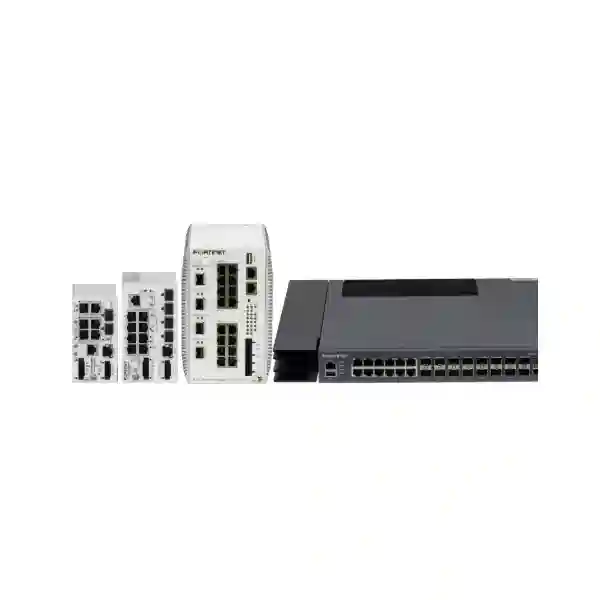
FortiSwitch Rugged Series
FortiSwitch Rugged Series is Fortinet’s industrial Ethernet switching family for locations where conventional office switching may not match the physical or operational environment. The range combines secure switching, ruggedized construction and Fortinet ecosystem integration for factories, utilities, transportation systems, remote infrastructure, surveillance networks and other operational technology deployments. FourTeck helps buyers translate site requirements into the right model, power design, fiber strategy and management approach rather than selecting a switch from port count alone.
Current Rugged Models
Fortinet currently lists FSR-108F, FSR-112F-POE, FSR-216F-POE and FSR-424F-POE in the FortiSwitch Rugged family. These span compact industrial access switching through higher-density multi-gigabit rugged switching.
Designed for OT
The Rugged portfolio is positioned for challenging environments and supports industrial networking capabilities such as IEEE 1588v2 Precision Time Protocol and, where applicable, redundancy technologies used in operational networks.
Secure Fabric Integration
FortiSwitch can integrate with FortiGate through FortiLink, allowing switching and security policy to be coordinated from the Fortinet environment. This can simplify visibility and segmentation in distributed deployments.
FortiSwitch Rugged Series Models and Selection
The FSR-108F provides six Gigabit Ethernet RJ45 ports and two Gigabit SFP slots and is suited to compact industrial edge locations where a small number of copper devices need fiber-capable uplinks. The FSR-112F-POE adds eight Gigabit RJ45 access ports with PoE capability plus fiber connectivity, making it relevant where cameras, access points, sensors or other powered endpoints must share an industrial switching platform. The FSR-216F-POE expands access density to sixteen Gigabit copper ports and includes higher-speed SFP+ uplinks, while the FSR-424F-POE addresses denser designs with multi-gigabit access and high-speed uplinks. Exact PoE budgets, environmental ratings, power inputs, mounting and protocol requirements should always be checked against the current Fortinet data sheet for the chosen model before procurement.
Model selection should start with the site. Count active endpoints and planned expansion ports, separate copper from fiber needs, identify every PoE load, determine uplink bandwidth, document the available power source and confirm ambient conditions. Industrial networks often have long asset lifecycles, so spare ports and suitable uplink headroom can be more valuable than choosing the smallest possible switch. Where FortiGate is already part of the architecture, the intended FortiLink topology and FortiSwitchOS compatibility should also be reviewed before deployment.
Industrial Features That Matter
Fortinet designs the family for demanding physical environments, with model-specific ingress protection and operating specifications that should be matched to the actual enclosure and site.
Passive cooling eliminates switch fans and moving fan components, useful in industrial spaces where dust, vibration and maintenance access can be concerns.
The Rugged data sheet highlights IEEE 1588v2 timing and industrial redundancy capabilities, supporting designs that require deterministic timing or resilient Ethernet behavior.
Plan the Whole Network, Not Only the Switch
A rugged switch is one layer of an OT architecture. For related design work, review FourTeck Tanzania’s network switching and LAN infrastructure guidance, firewall and VPN planning, Wi-Fi access point solutions, structured cabling and fiber planning, CCTV and IP camera integration, integrated IT lifecycle services and Tanzania project consultation. These areas matter because industrial switching commonly intersects with fiber, cameras, wireless, firewalls, UPS systems and segmented operational networks.
FortiSwitch Rugged Series Tanzania
Organizations evaluating FortiSwitch Rugged Series in Tanzania typically need more than a conventional office LAN switch. Industrial sites, processing facilities, utilities, transport environments, warehouses, security installations and remote operating locations can expose network equipment to heat, dust, vibration, electrical variation and difficult maintenance conditions. The practical purchasing question is therefore whether the selected rugged model fits the physical site as well as the traffic requirement. A Tanzania deployment should begin with an endpoint schedule covering controllers, cameras, wireless access points, operator terminals, sensors and upstream network devices. This identifies copper port count, PoE demand and fiber requirements before a quotation is prepared.
For a small industrial cabinet, FSR-108F may suit a low-density non-PoE edge where fiber uplinks are required. Sites powering Ethernet endpoints can evaluate PoE models such as FSR-112F-POE or FSR-216F-POE, while denser or multi-gigabit designs may lead to FSR-424F-POE. Selection should not be based solely on today’s connected devices. Spare ports, uplink capacity and expected additions should be considered because industrial infrastructure is often expanded gradually. The current Fortinet data sheet should be used to confirm environmental limits, power options, PoE budget and supported industrial functions for the exact model.
Tanzania buyers should also map the switch to the surrounding architecture. A FortiGate-managed design can use FortiLink to bring switching into the wider Fortinet management model. Segmentation can separate operational assets, surveillance, administrative users and other traffic according to the organization’s security policy. Fiber may be appropriate between buildings or across electrically noisy areas, while UPS and power conditioning decisions should reflect the site’s power characteristics. For multi-site organizations, a consistent naming, VLAN, addressing and configuration standard helps support teams troubleshoot remote facilities. FourTeck can use a bill of materials, site drawings and device list to help structure a quotation without assuming stock, lead time or compatibility before those items are confirmed.
FortiSwitch Rugged Series Dar es Salaam
Dar es Salaam organizations may encounter rugged switching requirements in port-linked operations, logistics, manufacturing, commercial compounds, warehouses, utilities, security networks and facilities where network cabinets are located outside climate-controlled office spaces. In these environments, the decision should consider cabinet location, heat exposure, dust, cable paths and the distance to the core network. A standard access switch may provide the right port count but still be a poor physical fit for an industrial cabinet. FortiSwitch Rugged gives network designers an option intended specifically for challenging deployment conditions while retaining Fortinet switching and security integration.
A useful Dar es Salaam procurement brief identifies every endpoint and its power requirement. IP cameras and wireless access points can consume PoE, while PLC-connected devices, control interfaces and terminals may only require data. The aggregate PoE budget must be checked, not merely whether ports carry a PoE label. Fiber uplinks are valuable when a switch sits far from the main communications room or when electrical separation between areas is desirable. FSR-216F-POE and FSR-424F-POE provide faster uplink options for designs where aggregated edge traffic could exceed a simple Gigabit uplink strategy.
Security architecture is equally important. OT networks should not automatically become extensions of the office user network. VLANs and policy enforcement can help create controlled zones, while FortiGate integration can bring the switch into a coordinated Fortinet environment. Deployment documentation should record port purpose, VLAN assignment, fiber transceiver choice, power source and connected asset. For quotation, Dar es Salaam buyers can provide cabinet details, endpoint count, PoE loads, fiber distances, required redundancy and any existing FortiGate model. This makes it possible to evaluate the appropriate FortiSwitch Rugged model and supporting components without making assumptions about a site that has not been surveyed.
FortiSwitch Rugged Series Mwanza
FortiSwitch Rugged Series can be relevant to Mwanza projects where Ethernet must extend into operational spaces rather than remain inside an office communications room. Industrial facilities, lakeside logistics operations, warehouses, processing sites, utilities and distributed surveillance systems may place switches closer to machinery, cameras or remote field endpoints. The design objective is to keep those edge connections manageable while selecting hardware whose environmental characteristics match the installation. Ruggedized switching does not remove the need for a suitable enclosure, grounding, surge planning and correct cabling; it gives the network designer hardware intended for tougher operating conditions.
For Mwanza sites, distance often shapes topology. Fiber uplinks can connect remote cabinets back to a central network and avoid copper distance constraints between buildings or operational zones. The FSR-108F offers compact copper access with SFP uplinks, while PoE models can simplify power delivery to compatible cameras, access points and other Ethernet-powered devices. A design should calculate power consumption across all connected PoE endpoints and preserve reasonable headroom. Where high-resolution surveillance or multiple wireless radios share an edge switch, uplink utilization should be estimated rather than assumed.
Operational resilience also depends on how the network is administered. Documenting each rugged switch, uplink, VLAN and endpoint makes remote troubleshooting easier. Fortinet environments can integrate FortiSwitch with FortiGate through FortiLink, giving administrators a unified path for switching configuration and network security policy. Industrial timing or redundancy requirements should be mapped to the precise capabilities of the chosen model and software version. Mwanza procurement teams can accelerate technical review by providing a simple network diagram, environmental information, port and PoE schedule, fiber distances and current Fortinet equipment. FourTeck can then help structure model selection and quotation around verified requirements rather than treating every rugged switching project as identical.
FortiSwitch Rugged Series Arusha
Arusha businesses may consider FortiSwitch Rugged Series for industrial compounds, hospitality support infrastructure, security networks, warehouses, utilities, agricultural processing and operational sites where networking extends beyond conditioned office rooms. Rugged switching is particularly useful to evaluate when an edge cabinet must remain close to field equipment and the network still needs managed Ethernet, fiber uplinks or PoE. The correct model depends on the connected assets and physical installation, so procurement should begin with site information rather than a generic request for an industrial switch.
A compact installation with a handful of copper devices and fiber backhaul can evaluate FSR-108F. If the edge cabinet powers cameras or wireless access points, a PoE-capable model is more appropriate, subject to the required wattage and total PoE budget. Larger operational zones may require FSR-216F-POE or FSR-424F-POE for more access capacity and faster uplinks. For every model, power input, mounting, operating temperature and ingress-protection characteristics should be checked against Fortinet’s current documentation and the actual enclosure design.
Arusha deployments should also account for maintainability. A switch placed in a remote cabinet needs clear labeling, protected fiber and copper routes, documented addressing and a defined replacement procedure. Where FortiGate already protects the site, FortiLink integration can help consolidate switching administration and security visibility. VLAN segmentation can separate surveillance, operational devices, guest or administrative traffic according to policy. If a site includes multiple buildings, fiber topology and redundancy should be planned before switch quantities are finalized. A useful quotation request includes endpoint count, PoE loads, desired uplinks, cable distances, cabinet conditions and existing firewall details. That information helps FourTeck align the rugged switch with the complete network instead of supplying an isolated component.
FortiSwitch Rugged Series Dodoma
In Dodoma, FortiSwitch Rugged Series may fit government facilities, utilities, transport-related infrastructure, campuses, security systems, warehouses and operational sites where Ethernet switching is needed outside a conventional air-conditioned rack. The value of rugged switching is not simply durability as a marketing term; the selected device must be matched to environmental conditions, network traffic, power architecture and management requirements. Fortinet’s current rugged portfolio gives planners several sizes, allowing the edge design to scale from compact field cabinets to denser multi-gigabit deployments.
A Dodoma project should document which devices are business IT and which are operational technology. This distinction helps define VLANs, firewall policy and permitted communications. Cameras and access points may need PoE, controllers may require low-latency connectivity, and fiber may be preferred for building-to-building links. When PoE is required, engineers should calculate the total powered-device demand and compare it with the exact model’s budget. When resilience is important, topology and supported redundancy functions should be reviewed using the latest Fortinet documentation rather than assumed from the product family name.
Management strategy matters for geographically distributed sites. FortiSwitch integration with FortiGate can provide centralized control within a Fortinet Security Fabric architecture, which can reduce the number of separate interfaces used to administer network access. Standard configuration templates, device names and port documentation are useful for organizations that expect to repeat the design at branches. For procurement, Dodoma buyers should specify port quantity, PoE classes, uplink speed, fiber type, expected operating conditions, power availability and whether FortiGate management is planned. FourTeck can use those details to build a technically grounded bill of materials and identify questions that require confirmation before a commercial quotation is finalized.
FortiSwitch Rugged Series UAE
UAE demand for rugged switching often arises in industrial zones, energy projects, transportation, outdoor infrastructure, logistics, manufacturing and large security deployments. Heat, dust and distributed field cabinets make environmental design a central consideration. FortiSwitch Rugged provides Fortinet customers with industrial Ethernet options that can remain part of a broader Fortinet architecture. The same selection discipline applies: port density, PoE, uplink capacity, power, mounting, environmental limits and supported protocols should be verified for the exact model.
For compact edge locations, FSR-108F offers a small copper-and-fiber footprint. PoE designs can evaluate FSR-112F-POE and FSR-216F-POE, while higher-density multi-gigabit requirements may point toward FSR-424F-POE. Projects involving surveillance should calculate camera power and bandwidth; projects involving industrial wireless should account for access-point power and uplink demand. Fiber choices should consider distance, topology and the supported transceivers for the chosen switch.
Organizations operating across Tanzania and the Gulf may also benefit from consistent network standards. The FourTeck UAE technology site can support related regional requirements, while FourTeck’s Fortinet UAE resource is relevant to Fortinet-focused projects. A multi-country design can standardize VLANs, switch naming, security zones and documentation while allowing each site to use the model appropriate to its physical environment and endpoint count. Procurement teams should still confirm country-specific commercial terms, availability and support arrangements at quotation time rather than assuming they are identical across markets.
FortiSwitch Rugged Series Uganda
Uganda organizations can use FortiSwitch Rugged Series as part of industrial and operational networks that need secure managed Ethernet in more demanding locations. Utilities, manufacturing, agriculture, logistics, surveillance and distributed infrastructure can all create edge cabinets where conventional office switching is not the ideal physical choice. The rugged family allows planners to combine copper access, fiber connectivity and model-dependent PoE with Fortinet management and security integration.
A Uganda deployment should begin by separating essential requirements from optional expansion. Count endpoints, identify which require power, determine fiber distances and decide whether the switch is a simple access node or an aggregation point for several operational systems. Uplink sizing matters when cameras, wireless and control traffic converge. Environmental limits and power input options must be checked for the exact model and enclosure. Industrial redundancy or timing requirements should likewise be verified against the current Fortinet data sheet and software release.
For regional buyers, FourTeck Uganda provides a related country resource. Organizations operating in both Uganda and Tanzania can standardize architecture while adjusting quantities and switch models per site. A shared template for VLAN IDs, management addressing, FortiGate policies, fiber labeling and cabinet documentation can reduce troubleshooting time. For quotation, include current firewall details, expected switch management method, port and PoE schedule, fiber requirements and installation environment. Commercial availability should be confirmed during the quotation process rather than inferred from a product page.
FortiSwitch Rugged Series Kampala
Kampala projects can require rugged Ethernet at warehouses, utility sites, manufacturing operations, security compounds and infrastructure locations where the access switch sits closer to operational equipment than to office users. The FortiSwitch Rugged family provides a path to keep those edge switches within the Fortinet ecosystem. This is particularly useful for organizations already using FortiGate and wanting switching configuration, segmentation and visibility to align with their broader network security model.
Before choosing a model, Kampala buyers should list every copper endpoint, every fiber uplink and every PoE-powered device. A camera-heavy deployment may have moderate port requirements but substantial PoE and bandwidth demand. A control network may have lower throughput but stricter availability and timing needs. FSR-108F suits compact non-PoE access, while the PoE models address powered endpoints at different densities. FSR-424F-POE provides a different class of capacity for denser multi-gigabit designs. Exact technical values should always be taken from the current model documentation.
Installation quality remains important even with rugged hardware. Correct enclosure design, grounding, protected cable routes, fiber termination and stable power all contribute to reliability. The switch configuration should be backed up and port assignments documented. For sites connected to a central office, management access should be designed securely rather than exposing device administration unnecessarily. Kampala organizations with multi-site operations can use a standard deployment checklist so each new rugged cabinet follows the same naming, VLAN and documentation conventions. This approach makes later expansion easier and gives procurement teams a repeatable basis for requesting quotations.
FortiSwitch Rugged Series Arua
Arua deployments may place particular emphasis on remote-site maintainability. When a switch serves a distributed facility, surveillance point, warehouse, utility installation or operational site, physical access for troubleshooting may not be as convenient as it is in a central office. FortiSwitch Rugged can support these edge designs with industrialized hardware and managed networking, but the overall solution should be engineered so faults can be diagnosed remotely and components are clearly documented.
The network diagram should show upstream links, fiber paths, connected devices, VLANs and power sources. If PoE is used, record the expected load for each powered endpoint and retain budget headroom. If the site relies on a long fiber connection, specify the fiber type, connector and compatible optics instead of leaving transceiver selection until installation. A compact FSR-108F may be enough for a small edge, while powered or higher-density sites require the appropriate PoE model. Environmental and power specifications must be validated against Fortinet’s current data sheet.
For remote operations, consistent management can be more valuable than adding unnecessary complexity. FortiGate-managed FortiSwitch deployments can use FortiLink to coordinate configuration and access policy. Separate operational, surveillance and management traffic where the security design requires it. Keep configuration backups and label both ends of fiber and copper links. An Arua quotation request is more useful when it includes a site sketch, endpoint list, required uplink, PoE loads, cabinet conditions and existing Fortinet devices. This lets the proposed bill of materials address the actual edge architecture and reduces the risk of discovering missing optics, power components or capacity during installation.
FortiSwitch Rugged Series Mbarara
Mbarara organizations in agriculture, processing, logistics, education, security and distributed commercial operations may need Ethernet switching in spaces where temperature, dust or cabinet location differ from a normal server room. FortiSwitch Rugged is designed for challenging environments and gives Fortinet users industrial access-switch choices without abandoning the management and security ecosystem used elsewhere in the network.
The right Mbarara model depends on workload. An edge switch serving a few controllers may prioritize compact size and fiber connectivity. A surveillance or wireless cabinet may prioritize PoE budget. A larger processing site can require more ports and faster uplinks so aggregated traffic does not create a bottleneck. The FSR family spans these scenarios, but model-specific port configuration and power limits should be checked before purchase. It is also important to reserve capacity for expansion rather than filling every access port on day one.
Operational networks benefit from clear boundaries. VLANs can separate device groups, while firewall policies control which systems communicate across zones. If FortiGate is present, FortiLink can simplify management of compatible FortiSwitch deployments. Fiber can connect distant cabinets and buildings, while a properly planned UPS or industrial power arrangement can help protect network continuity during disturbances. For Mbarara procurement, a concise technical schedule should state endpoint type, quantity, PoE requirement, cable medium, uplink speed, environmental conditions and desired management approach. FourTeck can use this information to discuss a suitable rugged switching architecture and related components before pricing and availability are confirmed.
FortiSwitch Rugged Series Gulu
Gulu sites that extend networking into operational or semi-outdoor infrastructure can evaluate FortiSwitch Rugged for secure managed Ethernet. Typical design questions include how many field devices need copper, whether cameras or access points need PoE, how the edge connects back to the main network and what environmental conditions the cabinet experiences. Answering these questions first prevents a rugged switch from being selected simply because its name sounds suitable.
A small remote cabinet may need only the FSR-108F class of connectivity, while a security deployment can require PoE and more access ports. Larger facilities may need the higher uplink capacity available in FSR-216F-POE or the denser multi-gigabit architecture of FSR-424F-POE. Fiber topology should be designed around distance and resilience, and transceiver compatibility should be verified. For PoE, total available power matters as much as port count, especially when endpoints have different power classes.
Gulu deployments should be documented for technicians who may not have designed the original network. Record port labels, VLANs, switch management address, uplink optics, power feeds and connected assets. If FortiGate is used, FortiLink integration can help administrators manage switching and security from a coordinated platform. Remote management should be secured and limited to authorized paths. When requesting a quote, include environmental and power information along with the network requirements. This helps distinguish the switch itself from supporting items such as fiber modules, patching, enclosures, UPS equipment and installation materials that may be necessary for a complete operational deployment.
FortiSwitch Rugged Series Kenya
Kenya has a broad range of industrial, logistics, energy, transport, agriculture and security environments where rugged Ethernet switching can be relevant. FortiSwitch Rugged provides industrialized access and aggregation options for organizations that want these field networks to align with Fortinet security and management. Selection should be based on verified site conditions, not on a generic assumption that every industrial deployment needs the largest or highest-power model.
Port count is the starting point, followed by PoE load and uplink capacity. The FSR-108F supports compact Gigabit access with fiber uplinks. FSR-112F-POE and FSR-216F-POE add powered access for compatible endpoints, and FSR-424F-POE serves denser multi-gigabit requirements. Industrial timing, redundancy and environmental specifications vary by model and should be checked in the current data sheet. A network engineer should also confirm compatible optics and the FortiSwitchOS release planned for management.
Regional organizations can review FourTeck Kenya for related country requirements. A company with operations in Kenya, Tanzania and Uganda can create one architectural standard while preserving site-specific bills of materials. Standard VLAN conventions, FortiGate policies, fiber labeling and switch naming make cross-border support more predictable. Quotations should specify endpoint quantities, PoE, uplinks, power and environmental requirements. Availability, commercial terms and deployment support should be confirmed for the specific project rather than assumed to transfer unchanged between countries.
FortiSwitch Rugged Series Kuwait
Kuwait industrial and infrastructure projects can require switches that operate in challenging environments and integrate with a secure enterprise architecture. FortiSwitch Rugged is relevant to energy, logistics, surveillance, transport, utilities and operational sites where edge cabinets may face conditions different from indoor office racks. Thermal design, dust protection, enclosure selection and power planning should be considered alongside network specifications.
A technical assessment should define port density, copper versus fiber, PoE loads and expected traffic. High-resolution cameras can create both power and bandwidth demand, while industrial control endpoints may have specialized timing or redundancy needs. Fortinet documents capabilities such as IEEE 1588v2 and industrial redundancy within the rugged portfolio, but engineers should verify which requirements apply to the exact chosen model. FSR-424F-POE can address denser multi-gigabit edge designs, whereas smaller models can be more appropriate for distributed cabinets.
For Kuwait-specific technology requirements, FourTeck Kuwait is a relevant regional resource. Cross-region customers can align their Fortinet architecture while allowing environmental and regulatory project requirements to differ. Procurement should include compatible optics, power accessories and any mounting or enclosure requirements in the bill of materials rather than treating the switch as a standalone item. FortiGate integration through FortiLink can be considered where centralized Fortinet management is part of the design. Final pricing, availability and service scope should be confirmed during project quotation.
FortiSwitch Rugged Series Ghana
Ghana deployments in mining, energy, logistics, processing, utilities and security can place Ethernet equipment in remote or industrial locations where rugged hardware is appropriate. FortiSwitch Rugged provides a set of managed switching options that combine industrial construction with the Fortinet network security ecosystem. A strong design begins with the operational process and connected assets, then selects the switch that supports those requirements.
For example, a remote telemetry cabinet may require few ports but reliable fiber backhaul. A surveillance zone may need multiple PoE ports and sufficient uplink bandwidth for video. A larger processing environment may need multi-gigabit capacity and higher-density switching. Fortinet’s current FSR-108F, FSR-112F-POE, FSR-216F-POE and FSR-424F-POE lineup provides different choices across these needs. Environmental ratings, power specifications, PoE budgets and protocol support should be verified for the exact model.
The FourTeck Ghana site supports related regional enquiries. Organizations standardizing Fortinet across Ghana and Tanzania can use consistent management and security principles while tailoring edge hardware to each facility. FortiLink can integrate compatible FortiSwitch devices with FortiGate, and VLAN segmentation can help control traffic between operational and business systems. A procurement request should include a network diagram, endpoint and PoE schedule, fiber distances, environmental conditions and current Fortinet devices. This information supports a more accurate technical and commercial review.
FortiSwitch Rugged Series Nigeria
Nigeria’s industrial, energy, manufacturing, logistics, transport and security sectors can require managed Ethernet at sites where standard office switching is not the preferred physical platform. FortiSwitch Rugged gives Fortinet-based networks an industrial switching option for these locations. The portfolio should be evaluated as part of the complete OT architecture, including firewalling, segmentation, fiber, power and remote management.
A Nigeria project may include many distributed edge cabinets rather than one large switch room. In that case, compact models can reduce unnecessary port capacity while fiber provides backhaul to aggregation points. Camera or wireless deployments may need PoE models, with the total budget calculated from actual endpoint requirements. Dense industrial sites can require faster uplinks and the multi-gigabit capabilities of the larger rugged models. Fortinet documentation should be consulted for precise environmental and industrial protocol requirements.
For country-focused requirements, FourTeck Nigeria provides a related regional resource. Multi-country organizations can standardize FortiGate and FortiSwitch management, naming and security zones while keeping bills of materials specific to each facility. Documentation and configuration backups are especially important for remote sites. Procurement teams should identify required optics, power accessories, enclosures and UPS components in addition to the switch. Pricing, availability, delivery and service coverage should be confirmed for the actual project and not inferred from general regional content.
FortiSwitch Rugged Series Seychelles
Seychelles organizations may evaluate rugged switching for utilities, hospitality infrastructure, transport, security, marine-adjacent operations and distributed facilities where network equipment can be placed outside standard office conditions. The FortiSwitch Rugged family offers managed industrial Ethernet choices with fiber and PoE options, but site exposure must be assessed carefully. Rugged hardware still needs an installation design that addresses enclosure, moisture exposure, corrosion risk, cable protection, grounding and stable power.
Fiber can be particularly useful when linking separated buildings or operational areas, while PoE can reduce local power requirements for compatible cameras and access points. The switch model should be selected from endpoint count, PoE demand and uplink bandwidth. For a compact edge, FSR-108F may be appropriate; powered or denser deployments can evaluate the larger PoE models. Environmental limits and ingress protection must be checked against Fortinet’s exact model documentation and the actual installation location.
From a security perspective, operational devices should be grouped and controlled according to business risk. FortiGate integration through FortiLink can help coordinate compatible switching with firewall policy and network visibility. Remote sites should have documented port maps, fiber identifiers, management addressing and configuration backups. Seychelles procurement teams can prepare a useful quotation by listing connected assets, distances, PoE needs, enclosure conditions and existing Fortinet equipment. For wider African technology requirements, FourTeck Africa provides an additional regional reference. Commercial and support details should be verified for the specific project before purchase.
FortiSwitch Rugged Buying and Quotation Checklist
Before requesting a FortiSwitch Rugged quotation, document the number and type of Ethernet endpoints; copper and fiber port requirements; required uplink speeds; PoE device count, standards and power demand; available DC or AC power arrangement; cabinet and mounting conditions; expected ambient temperature and environmental exposure; fiber distances and optic types; FortiGate model and software environment if FortiLink management is planned; VLAN and segmentation requirements; timing or industrial redundancy requirements; expansion allowance; and any required installation, configuration or documentation scope. Providing this information helps avoid selecting a switch that has enough ports but lacks the correct power, uplink or environmental characteristics.
Decision Recap
Choose FSR-108F when the project needs a compact rugged non-PoE edge with Gigabit copper and fiber connectivity. Evaluate FSR-112F-POE for compact powered access, FSR-216F-POE for more PoE access ports and faster uplinks, and FSR-424F-POE when a rugged deployment needs substantially greater density and multi-gigabit capacity. Treat these as selection directions, not substitutes for the current Fortinet data sheet. The final choice should be verified against port configuration, PoE budget, environmental rating, power, software support and industrial protocol requirements.
Frequently Asked Questions
What is FortiSwitch Rugged Series?
It is Fortinet’s ruggedized industrial Ethernet switching family, designed for challenging operational environments while providing managed switching and integration with the Fortinet security ecosystem.
Which FortiSwitch Rugged models are current?
Fortinet’s current product and FortiSwitchOS documentation lists FSR-108F, FSR-112F-POE, FSR-216F-POE and FSR-424F-POE. Compatibility should be checked against the software release planned for the deployment.
Can FortiSwitch Rugged be managed by FortiGate?
FortiSwitch supports FortiGate integration through FortiLink. The intended topology, switch model and software versions should be verified before implementation.
Does every Rugged model provide PoE?
No. PoE availability and budget are model specific. Confirm the exact switch against the powered devices and current Fortinet documentation.
What information is needed for a Tanzania quotation?
Provide endpoint count, PoE requirements, fiber and uplink needs, environmental conditions, power availability, desired management method, existing Fortinet equipment and any installation or configuration scope.
Discuss Your FortiSwitch Rugged Project
FourTeck can help review model selection, network topology, FortiGate integration, PoE, fiber uplinks and supporting infrastructure for FortiSwitch Rugged deployments. Share your site requirements and bill of materials so the technical and commercial scope can be checked before quotation.


Reviews
There are no reviews yet.