
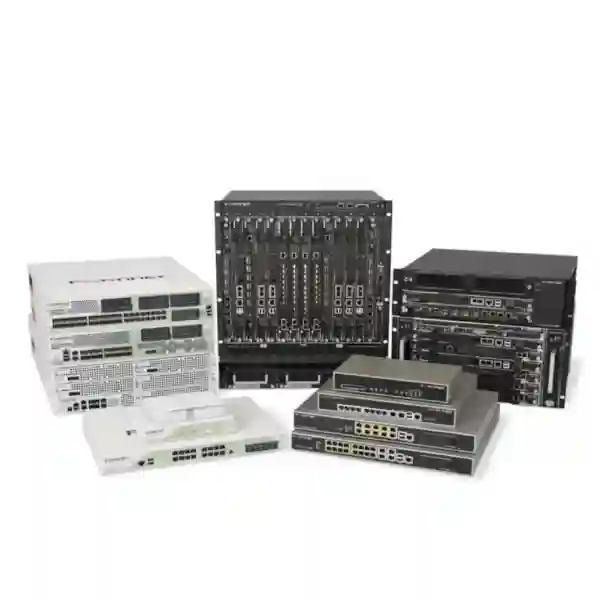
FortiExtender 100G Series
Build a more resilient branch and remote-site WAN with Fortinet cellular connectivity. Fortinet positions FortiExtender as a family of 5G/LTE gateways for primary WAN, backup connectivity, out-of-band management and extension of Fortinet secure networking. This page preserves the requested FortiExtender 100G Series heading; because current official Fortinet material identifies individual G-generation models rather than publishing a generic 100G-series specification table, model-specific radio bands, modem capability, ports and regional variants should be confirmed against the exact Fortinet part number before procurement.
Resilient cellular WAN
FortiExtender can provide cellular broadband as a primary connection or as a failover path when the main internet service is unavailable. This makes the platform relevant to branches, temporary locations, retail sites, kiosks and other environments where continuity matters.
FortiGate integration
Fortinet documents WAN-extension and LAN-extension modes for FortiExtender integration with FortiGate. Design choices should be matched to the FortiGate platform, FortiOS/FortiExtender OS compatibility, topology and the role cellular connectivity will play.
Deployment flexibility
FortiExtender supports standalone and centrally managed deployment approaches across the wider product family. Cellular signal quality, antenna placement, carrier coverage, SIM plan, mounting location, power and environmental conditions remain important design inputs.
What FortiExtender solves
A branch can have an excellent firewall and switching design yet remain dependent on a single last-mile circuit. FortiExtender introduces cellular connectivity into that architecture so organizations can design for alternative WAN access, rapid connectivity at sites where fixed broadband is delayed, or an independent management path for selected equipment. Fortinet also describes use cases spanning point-of-sale environments, factories, healthcare facilities, microbranches and kiosks. The practical value is not simply adding a SIM card; it is integrating cellular access into routing, security, monitoring and operational procedures.
Before selecting a unit, buyers should document the required mobile network generation, carrier and coverage at the exact installation point, expected traffic, whether the link is primary or standby, whether Wi-Fi is required on the selected model, antenna requirements, indoor or rugged deployment needs, available Ethernet connectivity, power method and management architecture. Where FortiGate integration is planned, the firewall model and software compatibility should be checked. This avoids choosing a cellular gateway solely by model name when regional radio support and deployment mode are decisive.
Buying and deployment guidance
| Decision area | What to confirm | Why it matters |
|---|---|---|
| Cellular service | Carrier, bands, SIM/eSIM requirements and site signal | Regional compatibility and real signal conditions determine usable connectivity. |
| WAN role | Primary, backup, temporary or OOB | The role affects policy, monitoring, data-plan sizing and failover design. |
| Fortinet integration | FortiGate model, FortiOS version and management method | Compatibility should be validated before deployment. |
| Physical site | Indoor/outdoor conditions, power, mounting and antenna position | Radio performance depends heavily on placement and environment. |
Related FourTeck resources
For a wider infrastructure discussion, review FourTeck Tanzania IT, networking and security solutions, which explains how firewall, switching, Wi-Fi, servers and supporting infrastructure can be planned together. Buyers with East African requirements can also review FourTeck Uganda and FourTeck Kenya. For broader Fortinet-focused regional requirements, FourTeck Fortinet UAE is a specialist network reference, while FourTeck UAE provides wider IT infrastructure context.
FortiExtender 100G Series Tanzania
Tanzanian organizations evaluating cellular WAN should begin with the operating requirement rather than the model label. A head office may need an independent backup path for critical cloud and VPN traffic, while a branch may need cellular service as its fastest route to initial connectivity. Retail, finance, healthcare, logistics, education and distributed enterprises can all have different tolerance for internet interruption. FortiExtender is relevant because Fortinet positions the family for primary and failover wireless WAN and integration with its secure networking ecosystem.
For Tanzania, confirm the mobile operator intended for each site and test signal quality where the device and antennas will actually be installed. A strong outdoor phone signal does not automatically mean the chosen indoor equipment location will deliver the same result. Building materials, rack position, antenna orientation and surrounding structures can change radio performance. Procurement should therefore include the exact FortiExtender part number, regional modem variant, SIM arrangement, antennas and accessories, power requirements and any management or support subscriptions required for the chosen operating model.
When FortiGate is part of the design, include its model and FortiOS release in the project information. Fortinet documents both WAN-extension and LAN-extension use cases, but supported scale and behavior vary with platform and software. A quotation request should also state whether cellular traffic is expected only during outages or will carry routine business traffic, because that affects the mobile data plan, monitoring thresholds and policy design. For multi-site Tanzania projects, list every location separately so coverage, carrier choice and mounting conditions can be reviewed rather than assuming one design fits every branch.
FortiExtender 100G Series Dar es Salaam
In Dar es Salaam, FortiExtender can be considered for offices, retail outlets, hospitality sites, warehouses, service counters and distributed branches that need an alternative to relying on one fixed internet circuit. The design question is whether cellular service is intended as an emergency backup, a temporary commissioning link, an independent management path or a regular WAN connection. Defining that role first makes firewall policies, data plans and monitoring easier to design.
Dense urban buildings can create very different signal conditions between floors, equipment rooms and external walls. Site planning should include a practical signal assessment at the proposed installation point, along with antenna placement and cable-routing considerations. If the device is being integrated with FortiGate, the network team should decide how failover is detected, which applications are allowed to use cellular bandwidth during an outage and whether bandwidth-heavy services should be restricted. This can help preserve the backup link for business-critical traffic.
A Dar es Salaam quotation request is more useful when it identifies the site count, expected users, existing ISP circuit, firewall model, mobile carrier preference, rack or mounting location, and whether remote management is required. Buyers should also identify any compliance or internal security policies affecting SIM ownership, remote access and logging. These details allow the exact current FortiExtender model and accessories to be matched to the requirement without assuming specifications from the broad 100G heading.
FortiExtender 100G Series Mwanza
For Mwanza deployments, cellular WAN can be useful where a business wants connectivity diversity between a primary fixed service and a mobile network. Branches supporting ERP access, cloud applications, IP telephony, payment systems or remote administration should define which services must remain available during a fixed-line interruption. FortiExtender can then be evaluated as part of a controlled continuity design rather than as an isolated modem.
The physical survey is important. Equipment rooms may be selected for security and power availability but may not provide the best radio conditions. The FortiExtender family’s compact deployment approach can help separate cellular placement considerations from the firewall location, but the final model, antennas, Ethernet path and mounting method should be validated for the site. Organizations with several Mwanza facilities should record signal and carrier information for each address independently.
For procurement, include current network diagrams where possible. State whether the cellular connection will terminate into FortiGate, operate standalone, support out-of-band access or extend a remote LAN design. Also include the expected quantity and deployment timeline. The resulting bill of materials should be based on the exact Fortinet model and regional variant, not an assumed specification for a generic 100G Series name.
FortiExtender 100G Series Arusha
Arusha organizations can evaluate FortiExtender for business continuity across offices, tourism and hospitality operations, service locations, retail environments and other sites that depend on cloud-based applications. A cellular backup link is most effective when the failover policy is designed in advance. Critical SaaS, VPN, DNS, authentication and transaction traffic may deserve priority, while software updates, guest traffic and large transfers can be constrained during a backup event.
Carrier selection should be treated as a site-specific engineering decision. The preferred provider for one property may not deliver the same indoor signal at another. Confirm the exact modem variant and supported regional bands before purchase, then assess antenna position and environmental requirements. Where FortiGate management is planned, validate software compatibility and the desired extension mode using current Fortinet documentation.
Arusha buyers should provide the existing firewall, primary ISP type, expected bandwidth, number of sites and purpose of the cellular link when requesting a quotation. If the project involves remote locations outside the city, identify them separately rather than assuming identical coverage. This gives the solution team enough context to distinguish between simple failover, rapid branch deployment and more specialized remote-management requirements.
FortiExtender 100G Series Dodoma
Dodoma offices and distributed organizations can use cellular WAN planning to reduce dependence on a single access circuit. The most useful starting point is a continuity requirement: which systems must remain reachable, for how long, and with what minimum service level when the primary connection is unavailable? FortiExtender can form the cellular component of that design, with FortiGate integration available where the wider Fortinet architecture is used.
A robust deployment includes more than hardware. Mobile data plans, SIM administration, alerting, failover tests, antenna placement, power resilience and documentation should be considered. If a cellular link is rarely used, periodic testing still matters so a problem is not discovered during the first real outage. For out-of-band management scenarios, access controls and operational procedures should be documented carefully.
When requesting a Dodoma quote, identify whether the device is for a new site, an upgrade or a resilience project. Include carrier preference, firewall details, number of users, critical applications, rack location and any need for centralized management. FourTeck can then discuss the current FortiExtender model options appropriate to the requirement while avoiding unsupported assumptions about radio or port specifications.
FortiExtender 100G Series UAE
UAE deployments often combine high-speed fixed connectivity with a requirement for a separate wireless path for resilience, temporary branches, kiosks or operational access. FortiExtender can be evaluated as the cellular edge component, but the exact regional model and carrier compatibility must be checked. Organizations should specify whether the service is for routine SD-WAN use, standby connectivity, rapid deployment or out-of-band management.
The design should account for data-plan policy, application priority, security inspection and monitoring. If the cellular path becomes active during an outage, business-critical traffic should have a clear policy. FortiGate integration can centralize the relationship between security and WAN control, subject to supported platform and software combinations. For larger deployments, standardizing installation, naming, SIM records and monitoring practices can reduce operational complexity.
A UAE procurement request should list site types, quantities, FortiGate models, preferred carriers and any indoor, outdoor or rugged requirements. Exact Fortinet ordering codes should be confirmed before purchase. This is especially important where the requested 100G Series wording is being used as a procurement category rather than an exact published model identifier.
FortiExtender 100G Series Uganda
Ugandan businesses with branches, service locations and remote operations can evaluate FortiExtender when fixed connectivity needs a cellular alternative. The platform is relevant to continuity, rapid site activation and remote networking, but coverage must be verified at each deployment location. A multi-site project should therefore map carrier choice, expected traffic and installation conditions branch by branch.
If FortiGate is already used, document the firewall platform and desired integration method. WAN extension and LAN extension solve different architectural problems, so the requirement should be clear before ordering. Where the cellular link is backup-only, define how failover is tested and how data consumption is controlled. Where it is primary, expected throughput, usage patterns and data-plan economics become more important.
For quotation, provide exact locations, quantities, preferred mobile operators, existing network equipment and whether antennas or special mounting are required. This information supports selection of a current FortiExtender model and regional variant without inventing specifications for the broad 100G heading.
FortiExtender 100G Series Kampala
Kampala branches can use cellular WAN as a practical resilience layer for cloud services, business communications and secure remote access. The cellular gateway should be treated as part of the WAN architecture, with clear routing, security and monitoring rules. FortiExtender is designed for this kind of integration across Fortinet environments and can also be considered for standalone scenarios depending on the selected model.
Urban signal quality can vary substantially inside commercial buildings. Installation planning should consider rack location, external walls, antenna placement and power availability. If the main circuit fails, the network should know which traffic is allowed onto the cellular link. Prioritizing core business applications can prevent a limited data plan from being consumed by nonessential traffic.
Kampala buyers should submit the FortiGate model, site count, user count, primary WAN type, preferred carrier and continuity objective. If the project includes multiple branches, include each location and expected role. Exact radio support and accessories can then be checked against the current Fortinet ordering information.
FortiExtender 100G Series Arua
Arua deployments may place greater emphasis on practical connectivity resilience and remote manageability. Cellular WAN can support a branch when a fixed connection is unavailable, delayed or operationally inconvenient. FortiExtender can be considered for this role, but the design should start with measured carrier availability and the applications that must remain online.
For remote sites, power continuity can be as important as WAN continuity. The cellular gateway, firewall and essential switching should be included in the power plan so a short utility interruption does not defeat the backup design. Antenna placement and physical security should also be reviewed, particularly where equipment is installed away from a conventional server room.
Procurement information should include the exact site, preferred carrier, existing firewall, power arrangement, expected users and whether the link is primary, failover or out-of-band. With these inputs, the exact current FortiExtender model can be selected and compatibility validated before shipment or installation planning.
FortiExtender 100G Series Mbarara
Mbarara businesses can evaluate FortiExtender for branches where continuity of cloud access, VPN connectivity, payment services or centralized systems is important. A cellular backup path adds value when it is independent enough from the primary access method to provide meaningful diversity. The network design should specify how failover occurs and how users are returned to the primary service after recovery.
The selected carrier and installation position should be tested at the actual site. Organizations should avoid choosing equipment solely from headline cellular generation; regional band support, antennas, SIM arrangement, Ethernet interfaces and management method all affect suitability. FortiGate customers should additionally confirm current software compatibility and intended extension mode.
For a Mbarara quote, provide site quantity, primary ISP details, FortiGate model if present, preferred carrier and approximate backup traffic. These details support a more accurate bill of materials and help determine whether the requirement is simple WAN resilience or part of a broader branch-network architecture.
FortiExtender 100G Series Gulu
Gulu organizations planning resilient branches can use cellular connectivity to create an alternate path for essential services. FortiExtender is relevant where a Fortinet-oriented design needs wireless WAN, remote deployment flexibility or out-of-band connectivity. The cellular component should be documented and tested like any other production WAN link.
Site planning should review mobile coverage, antenna placement, environmental conditions and power. During a primary WAN outage, bandwidth management becomes important because cellular capacity and data allowances may differ from the fixed service. Policies can be designed so priority applications continue while lower-priority traffic is limited.
A Gulu procurement request should identify the exact location, carrier preference, required quantity, firewall environment and business applications that need continuity. If the project is part of a national rollout, standard configuration can be combined with site-specific carrier and signal validation. Current Fortinet documentation should be used to confirm the exact model and supported deployment options.
FortiExtender 100G Series Kenya
Kenyan enterprises can consider FortiExtender for distributed branches, retail, logistics, hospitality, financial services and temporary sites where cellular connectivity complements fixed WAN. The key decision is the operational role: primary access, secondary failover, rapid deployment or management connectivity. Each role produces different requirements for data plans, routing, security and monitoring.
Multi-carrier and multi-site planning should be based on actual coverage rather than national assumptions. The exact FortiExtender regional variant, antennas and accessories should be checked against the chosen carrier. Where FortiGate is used, the firewall model and software version should be included in compatibility validation before rollout.
For procurement, provide branch count, locations, preferred operators, primary circuit types, expected users and whether centralized management is required. A standardized deployment template can simplify operations, while still allowing carrier and antenna decisions to vary by site. Exact specifications should come from the selected Fortinet part number rather than from the general 100G Series phrase.
FortiExtender 100G Series Kuwait
Kuwait organizations can use cellular WAN to add diversity to branch connectivity, support temporary locations or provide a separate management route. FortiExtender fits into Fortinet secure networking architectures, but regional cellular compatibility should be confirmed before ordering. Buyers should state whether the link is expected to carry full production traffic or only selected services during an outage.
Indoor placement can influence cellular performance, particularly in equipment rooms surrounded by dense building materials. Antenna positioning, cabling, power and thermal conditions should be reviewed as part of installation. For FortiGate-managed deployments, validate the intended WAN or LAN extension design and software compatibility.
A Kuwait quotation request should include site type, carrier, quantity, firewall model and operational purpose. Organizations with multiple branches should also define a common monitoring and failover-test process. These inputs make it possible to choose the exact FortiExtender model and accessories based on current vendor data.
FortiExtender 100G Series Ghana
Ghanaian organizations with distributed operations can evaluate FortiExtender when business continuity depends on maintaining internet access beyond a single fixed circuit. Cellular connectivity can be used for backup, initial branch activation or remote access scenarios, with the final design shaped by carrier availability and application priorities.
The cellular link should be incorporated into security policy and monitoring from the start. If a fixed connection fails, administrators should know which traffic is moved to cellular service, how usage is measured and how recovery is verified. FortiGate integration can support a coordinated Fortinet architecture where compatible platforms and software are used.
For Ghana procurement, provide locations, quantities, preferred mobile providers, firewall details and whether special antenna or mounting arrangements are anticipated. Exact radio specifications and regional ordering codes should be confirmed against the current selected model. This prevents assumptions based on the 100G Series heading alone.
FortiExtender 100G Series Nigeria
Nigeria’s large and varied operating environments make site-specific WAN planning particularly important. FortiExtender can be considered where branches need cellular resilience, temporary connectivity or an alternate path for remote administration. Enterprises should define business-critical applications and acceptable behavior during primary-link failure before selecting hardware.
Carrier performance can differ by city, district and building, so coverage should be validated at each installation point. Antenna location, power resilience and physical security are practical considerations alongside network policy. For large rollouts, a consistent FortiGate and FortiExtender design can simplify management, while carrier choice and radio planning remain local decisions.
A Nigeria quotation should list branch locations, quantities, mobile operators, existing FortiGate models, required deployment mode and expected traffic. The exact current FortiExtender part number can then be checked for regional suitability and accessories. Avoid treating a family heading as a substitute for a validated bill of materials.
FortiExtender 100G Series Seychelles
Seychelles organizations can evaluate cellular WAN for branch resilience, hospitality operations, offices and other sites where maintaining access to cloud services and centralized systems is important. FortiExtender can provide the cellular gateway component, while the overall design should account for local carrier service, site signal and the business applications that require continuity.
Island and property-specific conditions make location assessment important. The chosen equipment position should be checked for signal quality, safe mounting, power and network cabling. If FortiGate integration is required, the firewall platform and software should be documented so compatibility can be verified using current Fortinet guidance.
For a Seychelles quotation, include the property or site, preferred carrier, quantity, existing WAN and firewall details, and whether cellular service is primary or backup. Exact regional model support, antennas and accessories should be confirmed before procurement. This approach keeps the design grounded in the actual deployment rather than assumptions from a broad product-family label.
Quotation checklist
For the most useful quotation, provide: deployment country and exact site locations; number of FortiExtender units; whether cellular service is primary, backup, temporary or out-of-band; preferred mobile operator; SIM or eSIM requirement if known; current FortiGate model and software version; existing WAN type; critical applications; approximate user count; indoor, outdoor or rugged environment; mounting constraints; antenna requirements; power method; centralized management preference; target deployment date; and any required support coverage. If you already have a Fortinet part number, include it exactly.
Frequently asked questions
What is FortiExtender used for?
Fortinet positions FortiExtender as a 5G/LTE gateway family for primary or failover WAN connectivity, network-edge extension and out-of-band management scenarios.
Can FortiExtender work with FortiGate?
Yes. Fortinet documents FortiExtender integration with FortiGate using WAN-extension and LAN-extension modes. Supported scale and behavior depend on the FortiGate platform and software combination, so compatibility should be checked for the exact deployment.
Can it be used as backup internet?
Yes. Failover wireless WAN is one of Fortinet’s documented FortiExtender use cases. The final design should include routing, monitoring, traffic priority, mobile data limits and failover testing.
How do I choose the correct regional model?
Provide the deployment country, carrier, required cellular service, site conditions and exact use case. The selected Fortinet part number should then be checked for regional modem compatibility, interfaces and accessories.
Why are exact 100G specifications not listed here?
The requested heading has been preserved, but current official Fortinet material reviewed for this page identifies individual FortiExtender G-generation models. To avoid inventing a generic 100G specification, technical values should be attached to the exact current Fortinet model and ordering code selected for the project.
Decision recap
FortiExtender is best evaluated as part of a WAN resilience and secure networking design. Confirm the exact model, regional cellular compatibility, carrier, antenna placement, FortiGate integration, management method, power and data-plan requirements before ordering. For Tanzania and multi-region projects, send FourTeck the site list and current network details so the quotation can be based on the actual deployment rather than assumptions.



Reviews
There are no reviews yet.