
FortiAuthenticator F Series Tanzania
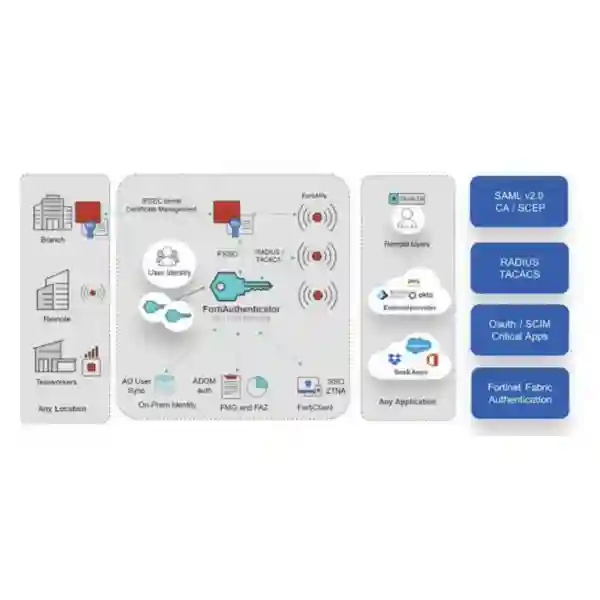
FortiAuthenticator F Series gives organizations a dedicated identity and access management platform for centralizing authentication, strengthening user verification and connecting identity to network security policy. The current hardware family includes FAC-300F, FAC-800F and FAC-3000F. These appliances are designed for different user populations while sharing a common purpose: helping security teams establish who a user is, apply appropriate authentication controls and provide identity information to Fortinet and compatible third-party systems.
Fortinet lists 1,500 base local plus remote users and an upper limit of 3,500, with four copper Gigabit interfaces, RAID 1 local storage and TPM.
Fortinet lists 8,000 base local plus remote users and an upper limit of 18,000, with four copper Gigabit interfaces, two SFP interfaces, RAID 1 storage and TPM.
Fortinet lists 40,000 base local plus remote users and an upper limit of 240,000, with four copper Gigabit interfaces, two SFP interfaces, RAID 1 SAS storage and TPM.
What FortiAuthenticator F Series Solves
Modern access is distributed across office networks, VPN connections, wireless systems, cloud applications, administrative interfaces and partner-facing services. Maintaining separate identity rules for each system can create inconsistent authentication and unnecessary operational work. FortiAuthenticator consolidates important identity functions so organizations can design authentication around users and roles rather than treating every application as an isolated project. Fortinet documents support for RADIUS, TACACS+, LDAP and SAML authentication functions, alongside single sign-on, multifactor authentication, certificate services and guest access capabilities.
For organizations already using FortiGate, FortiAuthenticator can add centralized identity context to security policy. It can also work with third-party systems, making it relevant where an enterprise has mixed infrastructure rather than a Fortinet-only environment. Directory integration is an important planning topic: businesses should document Active Directory or LDAP sources, user groups, administrative accounts, remote-access users and application authentication requirements before selecting an appliance and licensing plan.
Core Identity Capabilities
MFA and Passwordless Options
FortiAuthenticator supports multifactor authentication approaches including FortiToken options and FIDO passwordless authentication. Authentication design should consider which user groups need stronger verification, whether users require mobile or hardware tokens, and how recovery and onboarding processes will be handled.
Single Sign-On
SSO can reduce repeated logins while giving security policy useful identity context. Fortinet documents SAML identity-provider functions, IdP proxy capabilities and integration patterns for cloud and on-premises services. Requirements should be mapped application by application before deployment.
Certificate Management
Centralized certificate services can support enterprise VPN, wireless and other certificate-based access designs. Teams should document certificate lifecycles, enrollment requirements, renewal procedures and dependencies before migrating production authentication.
Choosing FAC-300F, FAC-800F or FAC-3000F
Model selection should begin with identity scale rather than appliance price alone. Count local and remote users, expected growth, concurrent authentication activity, directory integrations, token requirements and resilience objectives. FAC-300F addresses smaller user populations, FAC-800F provides a substantial step in scale, and FAC-3000F is designed for large enterprise populations. The published upper user limits are not a substitute for solution sizing: authentication patterns, high availability, geographic distribution and operational requirements also matter.
| Model | Local + Remote Users | Copper RJ-45 | SFP | Storage |
|---|---|---|---|---|
| FAC-300F | 1,500 base / 3,500 upper limit | 4 | 0 | 2 × 1 TB HDD, RAID 1 |
| FAC-800F | 8,000 / 18,000 | 4 | 2 | 2 × 2 TB HDD, RAID 1 |
| FAC-3000F | 40,000 / 240,000 | 4 | 2 | 2 × 2 TB SAS, RAID 1 |
Deployment, High Availability and Integration Planning
Fortinet documents active-passive high availability for appliance and VM deployments. Because an authentication platform can become a critical dependency for VPN, administrative access, wireless authentication and application sign-on, resilience should be designed before rollout. Teams should identify failure domains, network paths, DNS and time dependencies, directory availability, certificate services and backup procedures. Fortinet also recommends treating FortiAuthenticator as a critical system and isolating it appropriately from general hosts.
A structured deployment normally starts with discovery. Record identity sources, existing RADIUS or TACACS+ servers, applications using SAML, VPN authentication flows, wireless 802.1X requirements, guest access, certificate use cases and administrator authentication. Next, define pilot groups and fallback methods. Finally, document production cutover, monitoring and recovery. Buyers can also review related FourTeck Tanzania technology solutions, regional FourTeck Africa security solutions, FourTeck Uganda solutions, FourTeck Kenya solutions and FourTeck UAE solutions when planning multi-country standards.
FortiAuthenticator F Series Tanzania
Organizations evaluating FortiAuthenticator F Series in Tanzania commonly need to bring remote access, administrator authentication, employee identity and certificate-based services under a more consistent control model. A productive procurement process starts by documenting the number of identities rather than simply counting employees. Include staff, contractors, administrators, remote users, guest populations and service-specific accounts where relevant. Then identify which systems need RADIUS, TACACS+, LDAP, SAML, MFA, SSO or certificate functions. This makes the FAC-300F, FAC-800F and FAC-3000F comparison more meaningful and reduces the risk of choosing solely on current headcount.
For Tanzanian enterprises with headquarters plus branches, identity architecture should also consider WAN dependencies. If branch users authenticate against centralized services, the design needs a clear answer for link interruption, directory reachability and critical administrative access. Organizations using FortiGate can plan identity-aware security policies around verified users and groups, while mixed-vendor environments can assess standards-based integration individually. The appliance should be placed in a protected server environment with controlled management access, reliable power and appropriate backup procedures.
Quotation preparation should include the preferred F-series model, expected user count over the planning period, token or MFA requirements, high-availability expectations, support term, existing Fortinet products, directory platforms and target applications. Buyers should avoid assuming that every authentication method or token entitlement is automatically included in the base appliance. Licensing and subscriptions need to be checked against the intended design. For multi-site organizations, specify where the appliance will be hosted and which locations depend on it.
FourTeck can use this information to frame a more precise product request rather than a generic appliance inquiry. Tanzania buyers comparing physical FortiAuthenticator with virtual or cloud alternatives should also state whether on-premises control, infrastructure ownership, cloud-first deployment or hybrid identity is the priority. This creates a defensible selection process that accounts for operations as well as capacity.
FortiAuthenticator F Series Dar es Salaam
Dar es Salaam organizations often operate dense combinations of headquarters users, remote workers, data-center services, branch connectivity and cloud applications. FortiAuthenticator F Series can be evaluated as a central identity layer for these environments, particularly where a business wants consistent MFA, SSO and network authentication rather than separate credentials and policies for every service. Before requesting a quote, identify the systems that currently perform authentication and the applications that would move to centralized identity.
A Dar es Salaam deployment may serve offices elsewhere in Tanzania, so network architecture matters as much as user count. Document WAN paths, secondary connectivity, DNS and NTP dependencies, Active Directory or LDAP topology, VPN gateways and wireless authentication requirements. If identity services are centralized, determine how administrators retain controlled access during a WAN or directory outage. High availability may be appropriate when authentication is operationally critical, but its value should be assessed against the actual dependency map rather than added mechanically.
Procurement teams should compare FAC-300F, FAC-800F and FAC-3000F against current identities and realistic growth. The published base and upper limits provide a starting point, while authentication workload, resilience and integration scope influence the final design. Enterprises with multiple subsidiaries or business units should also document whether identity administration needs separation, delegated workflows or different policy groups.
For quotation accuracy, provide user totals, expected growth, authentication protocols, FortiToken plans, SSO applications, certificate requirements, existing FortiGate estate and desired support period. A pilot with representative users can validate directory synchronization, MFA enrollment, SSO behavior and operational procedures before a broad migration. This approach is particularly useful for financial, professional-services, logistics, hospitality, education and other organizations where authentication disruption can affect many users at once.
FortiAuthenticator F Series Mwanza
Businesses and institutions evaluating FortiAuthenticator F Series in Mwanza may be connecting a main office with branches, operational sites, remote users or cloud services. The identity challenge is not simply password security; it is establishing a consistent method to verify users and provide trusted identity information to systems that make access decisions. FortiAuthenticator supports centralized authentication functions that can be designed around employee, administrator, contractor and guest access.
For a Mwanza deployment, first map which services must continue working if connectivity to another city is unavailable. If the appliance will be hosted locally, plan protected rack space, power, backup and restricted management networks. If it will be hosted centrally elsewhere, assess WAN resilience and authentication behavior during link interruption. Remote access users should be included in the capacity calculation, and MFA enrollment procedures should account for onboarding, device replacement and recovery.
FAC-300F can suit a comparatively smaller identity population, while FAC-800F and FAC-3000F address progressively larger scales according to Fortinet’s published limits. Selection should leave sensible room for growth without treating the maximum user number as the only sizing factor. Organizations planning 802.1X, certificate services, guest access or several SAML applications should include those requirements in the design discussion.
A useful Mwanza quotation request therefore includes the number of local and remote identities, existing directory services, FortiGate models if present, applications requiring SSO, VPN authentication method, wireless environment, token preferences and availability requirements. This information allows procurement and technical teams to evaluate the appliance as part of an identity architecture instead of as an isolated hardware purchase.
FortiAuthenticator F Series Arusha
Arusha organizations with hospitality, tourism, professional, education, government-facing or multi-site operations may need to distinguish employee access from contractor, administrator and guest access without multiplying authentication systems. FortiAuthenticator F Series provides a platform for centralized identity services, including MFA, SSO, certificate management and guest-related functions. The business objective should be defined before model selection: stronger remote access, centralized administrator authentication, application SSO, network access control support or a combination of these.
Guest and workforce identity deserve separate planning. A hotel, campus or shared facility may have guest connectivity requirements while employees and administrators need stronger controls. Avoid treating all populations as one directory group. Define identity sources, authentication methods, access lifecycles and ownership. For administrators, TACACS+ requirements and MFA may be relevant; for applications, SAML or OIDC-related architecture may be considered according to the supported environment; for network access, RADIUS and certificate workflows can be assessed.
Arusha buyers should also account for business continuity. If the authentication service protects VPN, Wi-Fi and administrative access, a failure can have a broad operational effect. Review high availability, protected network placement, reliable time synchronization, backup and recovery. When remote sites depend on the platform, validate connectivity and fallback behavior during the pilot.
For commercial planning, provide expected user scale, growth horizon, selected F-series model if known, high-availability requirement, token quantities, support term and integration list. This reduces ambiguity in quotations and helps identify whether a physical F-series appliance is preferable to FortiAuthenticator VM or a cloud-delivered identity approach for the organization.
FortiAuthenticator F Series Dodoma
Organizations in Dodoma considering FortiAuthenticator F Series can use centralized identity services to strengthen access to administrative systems, VPNs, network devices and business applications. Public-sector, education and enterprise environments often have formal user lifecycle and audit requirements, making it important to know not only whether a login succeeded but which identity and policy were involved. FortiAuthenticator can integrate identity sources and provide authentication services to Fortinet and compatible third-party systems.
The planning phase should document account ownership, joiner-mover-leaver procedures, privileged administrators, remote users and temporary users. MFA should be targeted according to risk and operational requirements, while SSO should be introduced with careful application testing. Certificate-based authentication can reduce dependence on passwords for selected use cases, but certificate issuance, renewal and revocation processes need clear ownership.
Dodoma deployments that support distributed sites should evaluate WAN dependencies and resilience. Authentication should not be designed as an invisible dependency with no failure plan. Determine which services require continuous identity availability, whether active-passive HA is appropriate and how administrators regain access during infrastructure incidents. Fortinet’s guidance treats FortiAuthenticator as a critical system, supporting the case for protected placement and controlled management.
A complete request for quotation should specify the intended appliance model or user range, support duration, MFA approach, directory type, SSO applications, network authentication use cases and redundancy requirements. Procurement teams should ask for licensing to be aligned with the proposed architecture rather than assuming that appliance hardware alone covers every feature or token requirement.
FortiAuthenticator F Series UAE
Organizations sourcing FortiAuthenticator F Series for UAE operations frequently need identity controls that span headquarters, branches, cloud applications, VPN users and administrative infrastructure. The F-series hardware appliances can be considered when a business prefers dedicated on-premises identity infrastructure and wants centralized authentication integrated with the broader security environment. Buyers should compare this approach with FortiAuthenticator VM and cloud-delivered options according to operational ownership and architecture.
Multi-country organizations should avoid sizing only for the UAE office if the appliance will authenticate users elsewhere. Count every identity population that will depend on the platform and document peak authentication patterns, directory topology and geographic dependencies. SSO applications, MFA methods and certificate services should be inventoried before migration. Where FortiGate protects remote access, identity and MFA requirements can be coordinated with firewall policy rather than planned separately.
Resilience is particularly important for centralized regional services. Active-passive HA is documented for appliance deployments, but the complete design also needs resilient switching, DNS, time, directories and network paths. A pair of appliances cannot compensate for every upstream dependency. Security teams should test authentication and recovery scenarios during implementation.
For a UAE quotation, include FAC-300F, FAC-800F or FAC-3000F preference, local and remote user counts, expected growth, token requirements, support term, HA requirement and applications or devices requiring authentication. Regional buyers can review FourTeck UAE for broader regional technology sourcing context while coordinating a standardized identity design across offices.
FortiAuthenticator F Series Uganda
Uganda enterprises considering FortiAuthenticator F Series can centralize identity services across office users, administrators, VPN users and applications. This is useful when authentication has grown organically and separate systems now rely on different credentials, directories or MFA processes. A consolidated identity platform can reduce policy fragmentation, but consolidation also increases the importance of resilience and disciplined change management.
Start with a dependency map. List FortiGate VPNs, wireless networks, switches, administrative interfaces, SAML applications, Active Directory domains, LDAP sources and certificate-based services. Identify which users need MFA and whether FortiToken Mobile, hardware token, FIDO or other supported methods align with policy. Then calculate identity scale and growth to compare the three F-series appliances.
Ugandan organizations with sites in multiple cities should determine whether authentication will be centralized or whether architecture requires additional local resilience. WAN quality, branch criticality and recovery requirements affect that choice. Where the platform becomes responsible for several access paths, active-passive HA and protected network placement deserve consideration.
A quotation should clearly state appliance model, user range, support period, token quantities, directory integration, SSO scope and high-availability needs. This prevents an apparently simple hardware quote from omitting identity licenses or implementation dependencies. For related regional sourcing and solution context, organizations can consult FourTeck Uganda.
FortiAuthenticator F Series Kampala
Kampala businesses often operate a mix of corporate offices, remote users, cloud services and branch connectivity. FortiAuthenticator F Series can provide a centralized authentication point for environments that need stronger MFA, consistent SSO and identity-aware network controls. The strongest business case usually comes from reducing fragmented authentication while improving visibility and policy consistency, not from replacing passwords in isolation.
Before selecting FAC-300F, FAC-800F or FAC-3000F, security teams should inventory current users and forecast growth. Include administrators and contractors, not only payroll headcount. Determine which applications use SAML or other federation methods, which infrastructure uses RADIUS or TACACS+, and which remote access flows require MFA. If certificates are planned for VPN or network access, include lifecycle management in the scope.
Kampala deployments serving branch sites should be tested against real connectivity conditions. Authentication latency, directory reachability and failover behavior matter. Define emergency administrative access and avoid creating a circular dependency where recovery requires an authentication service that is itself unavailable. Protected placement, backups and HA can be evaluated as parts of a broader continuity plan.
When requesting pricing, provide enough technical context for a configuration-specific response: model, users, growth, support term, HA, token types and quantities, directories, FortiGate estate and target applications. This makes commercial comparison more accurate and gives implementers a clearer basis for planning.
FortiAuthenticator F Series Arua
For organizations in Arua, centralized identity can be especially valuable when a site depends on applications and security services hosted elsewhere. FortiAuthenticator F Series can authenticate users and provide identity services, but the architecture should account carefully for connectivity. If the appliance is remote from Arua, determine how critical services behave during WAN interruption and whether local operational access needs a defined fallback.
Identity discovery should include staff, administrators, temporary users and remote workers. Map applications, VPNs, wireless access and network-device administration to their current authentication source. This reveals where RADIUS, TACACS+, LDAP, SAML, MFA or certificate services may fit. Avoid moving every service simultaneously; a staged pilot helps expose directory, network and user-experience issues.
Model sizing should consider total identities supported by the appliance, not just users physically located in Arua. FAC-300F, FAC-800F and FAC-3000F cover materially different scales. If the same platform serves several Ugandan sites, aggregate those populations and include future expansion. High availability should be evaluated according to the business impact of authentication downtime.
Arua buyers requesting a quote should state delivery destination, required appliance, user count, token plan, support period and integration scope without assuming stock or lead time. Availability and commercial terms should be confirmed at the time of inquiry. A detailed requirements list is more useful than a generic request for the lowest price because identity licensing and resilience choices can change the overall solution.
FortiAuthenticator F Series Mbarara
Mbarara organizations evaluating FortiAuthenticator can approach the project as identity consolidation. The goal is to establish repeatable authentication for users and administrators across network and application services. FortiAuthenticator F Series supports functions such as MFA, SSO, RADIUS, TACACS+, certificate management and guest-related workflows, allowing a design to address several identity requirements from one platform.
Begin by separating user populations. Employees may authenticate against Active Directory, administrators may require stronger MFA and command authorization, guests may require a separate onboarding workflow, and remote users may depend on VPN. Each population has different lifecycle and recovery needs. This classification also helps determine token quantities and avoids overgeneralizing policy.
If Mbarara is one site in a wider enterprise, confirm where the authentication appliances will reside and how network failures affect access. Reliable DNS and time services are fundamental to many identity and certificate workflows. Backup, configuration protection and controlled management access should be included in operations planning. HA may reduce appliance-level risk but should be paired with resilient dependencies.
For procurement, specify current and projected users, F-series model, desired support term, MFA method, directory platform, SSO applications, network authentication and redundancy. The resulting quote can then be compared on equivalent scope. Organizations should also plan implementation effort for discovery, configuration, pilot, user enrollment, migration and documentation rather than treating deployment as merely racking an appliance.
FortiAuthenticator F Series Gulu
Gulu enterprises and institutions can use FortiAuthenticator F Series to create a more controlled identity layer for access to networks, VPNs and applications. Centralized authentication becomes particularly useful when users move between sites or when IT teams administer multiple security systems. Rather than maintaining separate user databases wherever possible, organizations can integrate established directory services and apply stronger verification to sensitive access.
Connectivity planning is essential if identity services are hosted outside Gulu. Identify which functions must remain available during a WAN event and document fallback access for administrators. If FortiAuthenticator is hosted locally, provide protected infrastructure, reliable power and controlled management. In either design, monitor dependencies such as directory, DNS and time services.
Sizing should combine current identities, growth and use cases. A small initial user population does not automatically mean the smallest appliance if a regional consolidation is planned. Conversely, selecting a larger platform without a documented growth case may add unnecessary cost. Use Fortinet’s published capacity ranges as a factual boundary, then validate the architecture against real authentication requirements.
A Gulu quotation request should include the proposed model, total users, remote users, token requirements, directory details, applications, support term and HA expectation. If implementation assistance is required, describe migration scope and current authentication systems. Clear inputs help separate hardware, licensing, support and services so procurement teams can understand what is included.
FortiAuthenticator F Series Kenya
Kenyan enterprises evaluating FortiAuthenticator F Series may have requirements spanning VPN, application federation, network access and privileged administration. Public procurement evidence also shows active demand for FortiAuthenticator virtual appliances in Kenya, reinforcing the importance of comparing physical F-series appliances with VM deployment according to project requirements rather than assuming one form factor fits every environment.
For physical F-series selection, count the complete identity population and forecast expansion. FAC-300F, FAC-800F and FAC-3000F provide different published capacity ranges. Organizations with regional offices should include identities outside Kenya if the same platform will serve them. Directory topology, authentication volume and HA objectives should be documented alongside raw user numbers.
Integration planning should identify FortiGate remote access, wireless 802.1X, administrative TACACS+, RADIUS clients, SAML applications and certificate use cases. Where MFA is required, document token type, enrollment workflow and recovery. For applications using federation, validate service-provider configuration and pilot with representative users before production migration.
Kenya buyers can review FourTeck Kenya for related regional solution context. A useful quote request includes model, users, support term, token quantities, HA, directories and application scope. Avoid assuming availability, price or delivery time until the requested configuration and destination have been confirmed.
FortiAuthenticator F Series Kuwait
Kuwait organizations considering FortiAuthenticator F Series can centralize authentication for employees, administrators, VPN users and applications while integrating identity with security policy. Dedicated appliances can be attractive where organizations prefer on-premises control, predictable infrastructure ownership and clear separation of identity services from general workloads.
Selection should begin with architecture. Document directory services, RADIUS clients, TACACS+ administration, SAML applications, MFA populations, certificate requirements and guest access. Then map these functions to current and future user counts. FAC-300F, FAC-800F and FAC-3000F should be compared using the published user limits together with expected workload and resilience.
For critical deployments, active-passive HA can address appliance failure, while the wider design should also consider switching, network paths, directories, DNS and time. Administrators need a tested recovery procedure that does not depend entirely on the failed authentication path. Security teams should also protect management access and keep configuration backup processes documented.
Kuwait procurement requests should state the exact model or user range, support term, MFA requirements, HA requirement and integration scope. If the organization is standardizing identity across Gulf and African operations, use a common requirements template but size each deployment according to its dependency model. Regional sourcing information can be coordinated through FourTeck Kuwait where relevant.
FortiAuthenticator F Series Ghana
Ghanaian organizations deploying FortiAuthenticator F Series can use centralized identity to support consistent authentication across network security, remote access and business applications. The project is most effective when it begins with identity governance questions: who should access what, how strongly should each population authenticate, where is the authoritative user directory, and what happens when a user changes role or leaves?
Once those questions are documented, technical integration can be mapped. RADIUS may serve network access, TACACS+ may support administrator authentication, SAML can support application federation, and certificate services can support selected secure-access workflows. MFA methods should be matched to user populations and operational realities. Enrollment and recovery deserve the same attention as login.
FAC-300F, FAC-800F and FAC-3000F offer distinct user scales, so Ghana buyers should aggregate all users that will rely on the platform and include a growth horizon. Where the appliance becomes central to many services, evaluate HA and upstream dependencies. A resilient identity appliance still needs reliable directory, DNS, time and network connectivity.
A procurement brief should include users, model, support period, token quantities, applications, directory environment and redundancy. Regional organizations can consult FourTeck Ghana for related sourcing context. Final availability and commercial terms should always be confirmed for the selected configuration.
FortiAuthenticator F Series Nigeria
Nigeria enterprises may need an identity platform capable of supporting large user populations, multiple offices and diverse application estates. FortiAuthenticator F Series spans from FAC-300F through FAC-800F to the higher-capacity FAC-3000F, enabling procurement teams to evaluate a dedicated appliance against the number of users and the criticality of authentication services.
Large or distributed deployments should be designed around dependencies. Determine whether one pair of appliances will serve several locations, whether directories are centralized, and how users authenticate when inter-site connectivity is impaired. Application SSO, VPN MFA, network authentication and privileged administration can create different traffic and availability patterns, so they should be documented separately.
Security operations should define enrollment, credential recovery, token replacement, certificate renewal and administrator break-glass procedures. These operational workflows often determine whether a technically correct identity deployment remains manageable over time. Where active-passive HA is selected, test failover together with dependent network and directory services.
Nigeria buyers should submit a structured quotation request covering model, users, growth, HA, token requirements, support duration and integration scope. For related regional sourcing context, see FourTeck Nigeria. Avoid basing selection on advertised price alone because user upgrades, tokens, support and implementation requirements can materially affect the complete project scope.
FortiAuthenticator F Series Seychelles
Seychelles organizations may operate smaller local teams while still requiring enterprise-grade identity controls for remote access, cloud applications, hospitality systems, administration and multi-site connectivity. FortiAuthenticator F Series can be evaluated where dedicated on-premises identity infrastructure is preferred. The appropriate model depends on total identity scope rather than the size of one physical office.
Island connectivity and service continuity should be explicit design topics. If authentication depends on remote directories or cloud applications, document how outages affect access. If FortiAuthenticator is hosted locally, protect power, management networks and backups. If a centralized regional appliance is used, assess WAN resilience and emergency administration. These questions help determine whether physical, virtual or cloud identity deployment is the better operational fit.
For MFA, consider user onboarding and token recovery for employees who travel or work remotely. For SSO, inventory applications and test federation individually. For certificates, define issuance, renewal and revocation ownership. Small IT teams benefit from clear procedures because identity systems can affect many services simultaneously.
A Seychelles quotation should state the user population, preferred F-series model, support term, MFA quantities, HA expectation and target integrations. Where the project serves multiple islands or regional offices, include all dependent users and network paths. Final pricing, availability and delivery should be confirmed against the exact configuration rather than assumed from another market.
Related Fortinet Security Planning
FortiAuthenticator is most valuable when identity requirements are planned alongside the controls that consume identity. FortiGate remote access and identity-based firewall policy, secure wireless authentication, network-device administration and application federation are common adjacent topics. For Tanzania projects, review the broader FourTeck Tanzania portfolio when building a combined network and security bill of materials. Multi-country organizations can align architecture through the regional FourTeck sites linked above while keeping licensing and procurement specific to each destination.
Quotation Checklist
For a more accurate FortiAuthenticator F Series quotation, provide: preferred model; current local and remote users; three-year growth estimate; Active Directory or LDAP environment; RADIUS and TACACS+ clients; SAML/SSO applications; VPN authentication requirements; FortiToken or FIDO plans; certificate use cases; guest-access requirements; high-availability requirement; support term; existing Fortinet products; target deployment location; and any implementation or migration assistance required.
Frequently Asked Questions
Which FortiAuthenticator F Series models are current?
Fortinet’s published FortiAuthenticator datasheet lists FAC-300F, FAC-800F and FAC-3000F hardware appliances. Model availability should still be confirmed when requesting a quotation.
Does FortiAuthenticator support MFA?
Yes. Fortinet documents MFA support including FortiToken options and FIDO passwordless authentication. The correct licensing and authentication method should be confirmed for the planned user population.
Can FortiAuthenticator integrate with Active Directory?
Yes. Fortinet documents directory integration and multiple user-identification methods. The exact topology, synchronization and authentication workflow should be tested against the organization’s environment.
Can FortiAuthenticator provide SSO?
Yes. Fortinet documents single sign-on and SAML identity-provider capabilities, among other federation functions. Application compatibility and configuration should be validated individually.
Should I choose hardware, VM or FortiAuthenticator Cloud?
The choice depends on infrastructure ownership, user scale, cloud strategy, resilience and feature requirements. F-series appliances provide dedicated hardware; Fortinet also offers virtual-machine and cloud deployment choices. Compare them against the intended architecture rather than form factor alone.
Decision Recap
Choose FortiAuthenticator F Series when the organization needs dedicated identity infrastructure and wants to centralize authentication, MFA, SSO, certificate or related identity services. Compare FAC-300F, FAC-800F and FAC-3000F by verified user scale, then validate the choice against authentication workload, growth, HA and integration. Document licensing and token requirements before purchase. For a multi-site design, map network and directory dependencies so authentication remains an intentionally engineered service rather than an unseen single point of failure.
Plan Your FortiAuthenticator Deployment
Share your user count, preferred model, MFA requirements, directory environment, applications, high-availability needs and destination. FourTeck can use these details to prepare a configuration-focused request for quotation and help clarify the components that belong in the proposed identity solution.


Reviews
There are no reviews yet.