
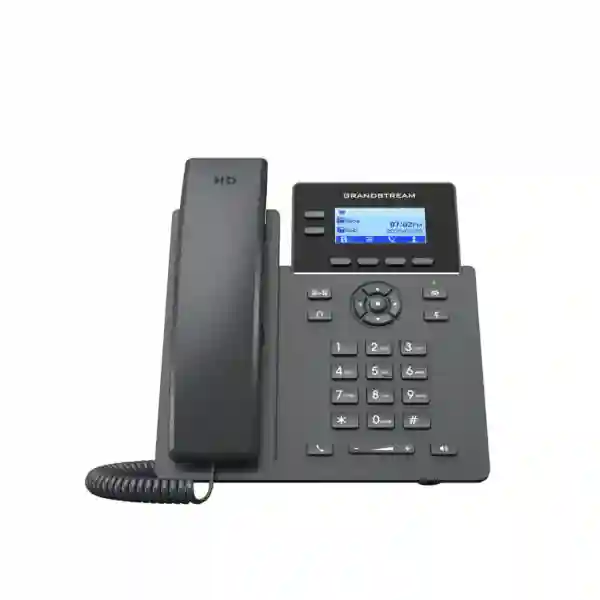
Grandstream GRP2602P Tanzania
The Grandstream GRP2602P is a wired, Power over Ethernet business SIP phone designed for straightforward desktop calling and centrally managed deployments. It supports two lines and four SIP accounts, uses dual switched 10/100 Mbps Ethernet ports, includes integrated IEEE 802.3af Class 1 PoE, offers full HD audio on the handset and speakerphone, supports five-way audio conferencing, and can be provisioned and managed through Grandstream Device Management System. For organisations in Tanzania planning a new IP PBX, refreshing older desk phones or standardising extensions across several offices, the GRP2602P provides a practical endpoint for users who need dependable daily calling without paying for executive-phone features they may not use.
Choose GRP2602P when you need wired Ethernet, PoE, four SIP accounts, HD voice, simple line handling and centralized provisioning. If you require Wi-Fi, Gigabit Ethernet, a larger display or more line keys, compare another GRP variant before ordering.
What the Grandstream GRP2602P is designed to solve
Business telephony projects often need many reliable endpoints rather than a handful of premium desk phones. The GRP2602P addresses that requirement by concentrating on the functions used by standard office users: SIP registration, clear handset and speakerphone audio, transfer and conferencing controls, headset support, PoE power, network pass-through and centralized provisioning. It is part of Grandstream’s GRP Essential family, which is intended for easy deployment by enterprises, service providers and other organisations that may need to configure phones consistently at scale.
The model is especially relevant when the switch already provides PoE. One Ethernet cable can carry network connectivity and power to the phone, reducing the need for a separate adapter at each desk. That design can simplify cabling and can also help maintain voice service when PoE switches are protected by an appropriately sized UPS. The phone is not a Wi-Fi model and its Ethernet interfaces are 10/100 Mbps, so buyers should consider the attached workstation and network design before using the PC pass-through port in environments where Gigabit access is essential.
Supports two line keys while allowing up to four SIP account registrations for flexible business calling profiles.
IEEE 802.3af Class 1 PoE lets a compatible PoE switch provide both power and network connectivity over Ethernet.
Full-duplex speakerphone and HD audio support help users communicate clearly for everyday office calls.
Grandstream Device Management System supports centralized configuration, provisioning, monitoring and deployment management.
Verified GRP2602P technical highlights
| Lines / SIP accounts | 2 lines, 4 SIP accounts |
| Network | Dual switched auto-negotiation 10/100 Mbps Ethernet ports |
| Power | Integrated IEEE 802.3af Class 1 PoE, specified at 3.84 W |
| Display | 132 × 48 backlit graphical LCD |
| Conference | 5-way audio conferencing |
| Headset | RJ9 headset jack with EHS support for supported Plantronics, Jabra and Sennheiser headsets |
| Management | GDMS, TR-069 and AES-encrypted XML provisioning options |
| Security | Secure boot, dual firmware images, encrypted data storage, TLS, SRTP and 802.1X support |
| Operating conditions | 0°C to 40°C operating temperature; 10% to 90% non-condensing humidity |
Compatibility, PBX integration and deployment planning
The GRP2602P is a standards-based SIP endpoint. Its protocol support includes SIP RFC3261 together with common IP, provisioning and security protocols. In practical procurement terms, that means the phone can be considered for Grandstream UCM systems, hosted SIP services and other standards-based PBX platforms, subject to the exact features, provisioning method and service-provider requirements of the chosen system. Compatibility should be confirmed before a bulk order, particularly where the PBX vendor requires a certified device list, a specific firmware release or proprietary feature implementation.
Network readiness matters just as much as PBX compatibility. A PoE switch should have enough available PoE budget for every connected phone, while the data network should provide the VLAN, DHCP, DNS, NTP and Quality of Service settings required by the deployment design. If a workstation will connect through the phone’s PC port, remember that GRP2602P uses 10/100 Mbps Ethernet rather than Gigabit Ethernet. Sites with Gigabit desktop requirements may prefer a Gigabit phone variant or a separate switch connection for the workstation.
Administrators managing several phones can use GDMS or supported provisioning methods to standardize SIP credentials, server addresses, firmware policies and phone preferences. Before production rollout, test a small group of phones with the real PBX, SIP trunk, VLAN, headset model and call flows. Include emergency-calling arrangements in the voice-system design because an IP phone depends on properly configured SIP service and network availability.
Useful FourTeck Tanzania resources for a GRP2602P project
Grandstream GRP2602P Tanzania
For organisations buying the Grandstream GRP2602P in Tanzania, the most useful starting point is to define the user profile and the existing voice environment. This model suits employees who need a conventional desktop SIP phone for daily inbound and outbound calls, transfer, hold, voicemail access, headset use and occasional conference calls. It is not intended to be an executive colour-screen phone or a wireless handset. Its strength is a focused business feature set that can be deployed repeatedly across standard desks. The built-in PoE capability is particularly useful in offices where managed PoE switching is already part of the network design, because a single Ethernet run can deliver both power and data to the handset.
Tanzania deployments should account for the complete voice path rather than considering the phone in isolation. Confirm the IP PBX or hosted PBX platform, SIP trunk or extension service, DHCP and DNS availability, voice VLAN design, switch PoE budget, uplink stability and internet resilience where calls depend on external SIP services. If power continuity is important, the phone can benefit from a UPS-backed PoE switch, but the router, firewall, PBX and internet termination equipment must also remain powered. Voice quality depends on the full network, so congestion, packet loss and badly designed Wi-Fi or WAN links cannot be solved by changing the handset alone.
For multi-site Tanzanian organisations, GDMS and repeatable provisioning profiles can reduce deployment effort. IT teams can standardize account settings, firmware policy and device configuration instead of manually programming each phone. Before ordering a large quantity, run a pilot with representative users and the exact PBX service. Test call transfer, hold, voicemail, conferencing, inbound caller ID, emergency calling arrangements and any headset models that will be used. Also verify whether desktop computers need Gigabit pass-through, because the GRP2602P network ports are 10/100 Mbps. Where Gigabit at the desk is required, the network topology or phone model should be adjusted.
A useful quotation request for Tanzania therefore includes quantity, city, current PBX or cloud voice provider, number of SIP accounts per user, PoE switch details, headset requirements, desired configuration service and whether the phones are part of a new office or a replacement project. FourTeck Tanzania’s contact page can be used to submit those details, while the FourTeck IP phone specialist site provides broader context for business VoIP phone selection across different brands and deployment roles.
Grandstream GRP2602P Dar es Salaam
Businesses evaluating the Grandstream GRP2602P in Dar es Salaam may range from compact professional offices to large organisations with multiple departments, reception points, service teams and branch connectivity. The phone is a sensible candidate for standard desk users when the communication platform is SIP-based and the network is already designed around managed switching. In a new office fit-out, the most efficient approach is to coordinate voice requirements with structured cabling and switching. Each phone position needs a suitable Ethernet outlet, and the access switch needs enough PoE ports and total power budget for the planned handset count. Where computers share the phone’s second Ethernet interface, review the 10/100 Mbps limitation against the expected desktop traffic.
Dar es Salaam sites with heavy internet use should separate the voice design from general assumptions about broadband speed. A fast internet package does not guarantee stable calls if uplinks are congested, Quality of Service is absent or the firewall is overloaded. For cloud PBX or external SIP trunking, assess latency, jitter, packet loss and the behaviour of the internet link under peak business load. Consider WAN resilience when voice is operationally important. Where the PBX is on premises, local extension-to-extension calls may remain internal, but external calling still depends on the SIP trunk or gateway arrangement.
The GRP2602P’s centralized management options can be valuable for organisations with several floors or multiple Dar es Salaam sites. Rather than creating each extension manually at the desk, administrators can use supported provisioning workflows and GDMS to apply consistent settings. Standardization is also useful for user support: the same key layout, firmware policy and basic calling instructions can be repeated across departments. Headset users should test the intended Plantronics, Jabra or Sennheiser EHS arrangement before ordering accessories in volume, because exact headset compatibility can depend on model and cable requirements.
For a Dar es Salaam quotation, provide the exact handset quantity, whether PoE switching already exists, the PBX brand or hosted provider, number of locations, desk-network requirements, headset quantities and any requested provisioning. If the project also needs PoE switches, routers, firewalls, cabling or UPS protection, bundling those dependencies into the same planning exercise can reduce installation surprises. FourTeck’s Tanzania services overview is relevant when the phone rollout is part of a larger IT and telecom project rather than a simple box purchase.
Grandstream GRP2602P Mwanza
For organisations sourcing the Grandstream GRP2602P in Mwanza, a practical deployment plan should begin with how employees actually handle calls. Standard office users, administrative staff, branch personnel and service counters generally need reliable extension access, transfer functions, voicemail, speakerphone and possibly a headset. The GRP2602P covers that everyday profile without introducing Wi-Fi or a large colour interface that may not be necessary. It can register multiple SIP accounts and provides two line keys, allowing administrators to map accounts and calling behaviour according to the PBX design.
The integrated PoE feature can simplify Mwanza office rollouts where network cabling and switching are properly planned. A managed switch can power each phone through Ethernet, helping keep desk areas cleaner and making it easier to centralize backup power at the network rack. However, the switch must have adequate total PoE capacity, and the upstream router, firewall and PBX must also be considered if telephone service is expected to remain available through short power interruptions. For sites without PoE switching, procurement should confirm the appropriate power approach before installation rather than assuming an adapter is included with every market package.
Branch connectivity deserves extra attention when the PBX is located elsewhere. A Mwanza branch connected to a PBX in another city or to a hosted platform depends on the WAN path. Network teams should test call performance under normal and busy conditions and apply appropriate Quality of Service where possible. Voice VLANs can separate phone traffic from general client traffic and make addressing, policy and troubleshooting more orderly. The GRP2602P supports standard enterprise networking and security functions such as 802.1X, TLS and SRTP, but these features must be configured consistently with the network and PBX environment.
Procurement teams should include future expansion in the quantity plan. A branch may start with a small number of phones but later add service desks, reception points or operational areas. Standardizing on a manageable handset class can make spares, configuration and user training simpler. Before volume purchase, confirm the required Ethernet speed at every desk, because computers connected through the phone are limited by its Fast Ethernet interfaces. For broader regional procurement or related IP telephony needs, the FourTeck Kenya site illustrates neighbouring-market VoIP and networking coverage for organisations managing technology across East Africa.
Grandstream GRP2602P Arusha
The Grandstream GRP2602P can fit Arusha offices, hospitality administration areas, tour operators, professional services and other organisations that need straightforward SIP calling at fixed desks. The best purchasing decision is based on the calling role rather than the model name alone. Employees who mainly receive and place standard business calls usually benefit more from predictable operation and easy management than from a very large display or a long row of programmable keys. The GRP2602P’s two-line design, four SIP accounts, HD speakerphone and five-way conferencing meet that general office requirement while PoE reduces power cabling at the desk.
Hospitality and multi-department environments should map the phone to user roles carefully. A standard back-office extension may suit the GRP2602P well, while a busy receptionist with many monitored extensions may need a different phone with additional programmable keys or expansion options. Similarly, a property that needs cordless mobility or Wi-Fi-only placement should consider a wireless handset or a Wi-Fi model rather than forcing a wired desk phone into the wrong location. Correct role mapping avoids buying a single model for every user when requirements differ significantly.
Arusha deployments that rely on a hosted PBX should include internet-path testing in acceptance criteria. Calls should be checked during busy periods, not only when the network is quiet. Network administrators can reserve voice VLANs, apply appropriate QoS and ensure firewall policies do not interfere with SIP and RTP flows. If several properties or branches are managed by the same IT team, centralized provisioning can help keep configuration consistent. Grandstream’s GDMS support is useful for administrators who want a common interface for device configuration, monitoring and provisioning across distributed endpoints.
When requesting a quotation, include user count, number of sites, PBX platform, preferred SIP service, whether PoE is already available, cabling readiness and any need for headsets or wall mounting. If the telephony refresh is connected to a wider network project, review switches, firewall policy and UPS capacity at the same time. FourTeck Tanzania’s technology shop provides the broader procurement context for those supporting components instead of treating the phone as an isolated purchase.
Grandstream GRP2602P Dodoma
Organisations sourcing the Grandstream GRP2602P in Dodoma should plan the handset around extension density, user responsibilities and network infrastructure. The phone is aimed at essential business calling, making it appropriate for many standard office desks, administrative teams and branch staff. It provides the core features required for SIP telephony without the complexity of a high-end executive phone. Four SIP accounts offer flexibility for account registration, while two line keys keep the day-to-day interface simple. Five-way audio conferencing can support small ad-hoc discussions without requiring every user to move to a separate conference device.
For government, education, professional and corporate environments, manageability can be more important than a long feature list. A large handset estate needs repeatable configuration and controlled firmware maintenance. The GRP2602P supports GDMS and other provisioning mechanisms, so administrators can build standard configuration profiles and reduce desk-by-desk setup. Security features such as secure boot, dual firmware images, encrypted data storage, TLS and SRTP support contribute to a more structured endpoint-security approach, although the surrounding PBX and network must be configured to use compatible security settings.
PoE should be planned at the switch level. Count the number of handsets per switch and compare that with the switch’s available PoE budget, leaving reasonable capacity for expansion and any other powered devices. If access points or cameras share the same PoE switch, their combined consumption must be included. Where phone service is critical, the UPS should be sized for the switch, firewall, router, PBX and other components required for voice. A phone connected to PoE will still lose service if the rest of the voice path is unpowered or if the external SIP service cannot be reached.
Dodoma buyers should also ask whether the desk computer needs a Gigabit path. The GRP2602P has dual 10/100 Ethernet interfaces, so high-throughput workstation users may need a separate data outlet or a phone with Gigabit pass-through. This is an important distinction during new cabling projects because it is easier to address at design stage than after handsets are deployed. A complete request should specify quantity, user type, PBX environment, network requirements, headsets and desired installation services so the quotation reflects both hardware and deployment dependencies.
Grandstream GRP2602P UAE
For UAE organisations considering the Grandstream GRP2602P as part of a regional standard, the model’s value is in consistency. Companies with headquarters or procurement functions in the UAE and operating teams in East Africa often benefit from using the same basic handset class for standard users, provided local PBX, SIP and regulatory requirements are checked in each country. The GRP2602P’s SIP orientation, GDMS support and PoE design can make it easier to define a repeatable endpoint profile for office users, while higher-specification phones can be reserved for reception, management or specialist call-handling roles.
A UAE deployment should still be tested against the actual call platform. Hosted voice providers may have specific provisioning templates, firmware requirements or certified endpoint lists. For on-premises IP PBX deployments, confirm SIP interoperability, dial-plan behaviour, voicemail indicators, transfer methods and emergency-calling configuration. The phone’s support for TLS and SRTP can contribute to encrypted signalling and media when the PBX and service support those mechanisms. If endpoint authentication uses 802.1X, test the certificate and network-access workflow before large-scale rollout.
PoE simplifies installation in managed office networks, but UAE buyers should check the switch design carefully if the phone’s second Ethernet port will feed a workstation. The GRP2602P uses Fast Ethernet, so it may not be the preferred model for desks that require Gigabit throughput through the handset. Organisations can avoid that limitation with separate data cabling or a Gigabit phone model where appropriate. This kind of endpoint segmentation is often better than forcing one model across every employee regardless of network needs.
For procurement teams coordinating Tanzania and UAE requirements, the FourTeck IP phone site provides broader multi-brand desk-phone guidance, while Tanzania requirements can be submitted through the local FourTeck Tanzania contact page. A useful regional bill of materials separates handsets, PoE switches, PBX or cloud licences, SIP services, headsets, cabling, UPS and configuration labour. That makes quotations easier to compare and helps prevent an apparently low handset price from hiding missing infrastructure or deployment tasks.
Grandstream GRP2602P Uganda
Ugandan organisations evaluating the Grandstream GRP2602P can use the same role-based approach recommended for Tanzania. The handset is well suited to standard fixed-desk users who need SIP calling, multiple account registration, transfer, hold, conferencing, speakerphone and headset connectivity. It is not a wireless phone, so every desk requires Ethernet connectivity. Integrated PoE is useful where the switching layer is already designed to power phones; a single network cable can reduce desk clutter and simplify centralized power protection.
For companies with branches in Uganda and Tanzania, consistent handset configuration can reduce support overhead. Administrators can define common extension naming, firmware policies, security settings and button behaviour, then adapt only the SIP credentials and site-specific network parameters. GDMS supports centralized management of Grandstream endpoints, which is relevant for distributed estates. Even so, a pilot should be completed in each network environment because firewall behaviour, VLAN settings, SIP provider requirements and WAN quality can differ between sites.
Branch telephony often depends on external connectivity. If the PBX is hosted or located in another country, test latency, jitter and failover behaviour before treating the internet link as production-ready for voice. A secondary WAN path can improve resilience, but failover should be validated for established and new SIP sessions. Where local calls are especially important, procurement teams may also want to discuss the architecture of local SIP trunks, gateway options and emergency calling with the chosen telephony provider.
FourTeck’s Uganda technology site covers IP PBX, VoIP and networking themes that relate directly to GRP2602P projects. When preparing a cross-border quotation, keep handset quantities and infrastructure requirements separate by site. One branch may already have managed PoE switches while another needs a complete access-layer refresh. The phone’s 10/100 Mbps interfaces should also be checked against computer-network requirements at each location so the voice standard does not inadvertently restrict data connectivity.
Grandstream GRP2602P Kampala
Kampala offices considering the Grandstream GRP2602P commonly need to balance purchase cost, user simplicity and manageable deployment. The phone’s essential feature set makes sense for staff who require dependable voice service but do not need premium displays, integrated Wi-Fi or a large number of programmable line keys. In a typical office rollout, the handset can be assigned to administrative users, sales desks, finance teams, branch staff and other employees whose calling is primarily one-to-one with occasional transfers and conferences.
The deployment should start at the access switch. Confirm the number of PoE ports, total PoE power capacity, VLAN configuration and uplink design. Voice endpoints benefit from a predictable network path, and administrators should avoid placing phones on an unmanaged LAN where troubleshooting becomes difficult. If a PC is connected through the phone, remember the Fast Ethernet limitation. High-bandwidth desktop users may be better served by a separate Gigabit connection or a different handset model that supports Gigabit pass-through.
For a hosted PBX, Kampala IT teams should test real call scenarios with the intended ISP connection. Run inbound and outbound calls while file transfers, cloud backups and normal office traffic are active. Check whether Quality of Service is configured and whether the firewall handles SIP consistently. The GRP2602P supports common codecs and secure signalling options, but call quality still depends on network conditions and the selected codec. If bandwidth is constrained on branch links, the telephony design should consider codec choice and concurrent-call estimates rather than only handset count.
Headset-intensive users should verify the exact headset and EHS combination before procurement. The phone has an RJ9 headset connection and supports EHS with supported Plantronics, Jabra and Sennheiser devices, but compatibility can vary by model and accessory. For deployments spanning Kampala and other Ugandan cities, use centralized device management and standard documentation so moves, adds and changes are easier. FourTeck Uganda’s regional site can be referenced for local VoIP and network project discussions, while multinational buyers can maintain a common model specification across Tanzania and Uganda where it suits both environments.
Grandstream GRP2602P Arua
For an Arua office or branch, the Grandstream GRP2602P should be evaluated as part of a complete connectivity plan. The phone itself is straightforward: two lines, four SIP accounts, PoE, HD audio, conferencing and centralized management support. The larger question is whether the site network and WAN can provide consistent service. Branch locations that connect back to a central PBX depend on the reliability of routers, firewalls, internet circuits or private links, so those dependencies should be documented before phones are installed.
PoE can be especially helpful in a branch design because it centralizes handset power at the switch. With appropriate UPS protection, the access switch and phones can continue to operate through short power interruptions. However, continuity only works if the router, firewall, PBX path and any modem or optical termination equipment are protected as well. Rather than placing individual adapters at desks, IT teams can concentrate backup power in the communications rack where it is easier to maintain and monitor.
Arua deployments should also consider remote support. If the site is administered from Kampala or another location, consistent device naming, static reservations where needed, voice VLANs and centralized provisioning can reduce the need for hands-on changes. GDMS is relevant because it offers centralized configuration and monitoring for Grandstream devices. Before remote rollout, record switch port assignments, PBX extension mapping and serial or MAC information according to the organisation’s asset-management practice.
If the branch has only a few users, avoid overspecifying the telephone while underspecifying the network. A simple phone on a well-designed link usually produces a better user experience than an expensive handset on a congested or unstable WAN. Conversely, if users need Gigabit desktop connectivity through the phone, the GRP2602P may not be the right endpoint because of its 10/100 ports. The procurement checklist should therefore cover phones, switch capability, WAN stability, PBX registration, headset needs and backup power in one plan rather than treating them as unrelated purchases.
Grandstream GRP2602P Mbarara
The Grandstream GRP2602P can serve Mbarara businesses that are moving from basic telephony to a managed SIP environment or expanding an existing IP PBX. Its role is best understood as a standard-user desk phone. The interface provides essential call controls without the cost and complexity associated with executive devices. Organisations can assign the phone to general staff while using higher-capacity models for reception or supervisors who need more keys, larger displays or advanced connectivity.
When a business is migrating from analog extensions, the change is not simply a handset replacement. IP phones become network devices, so the LAN must provide addressing, switching, power and appropriate security. Managed PoE switches are preferable for structured deployments because they can provide VLAN configuration, port visibility and centralized power. The GRP2602P’s IEEE 802.3af PoE support works with compatible switching, helping avoid a separate power outlet at every desk. If older cabling is being reused, test it before installation so voice problems are not traced incorrectly to the phone.
Mbarara users connecting to a centralized PBX should have call quality verified under real traffic loads. QoS can prioritize voice packets, but it cannot create bandwidth where a WAN link is saturated. Estimate concurrent calls and choose codecs in line with the PBX design. If remote extensions traverse the public internet, secure signalling and media options should be configured where supported, and firewall rules should be deliberately designed instead of broadly exposing SIP services.
For procurement, request separate pricing for phones, headsets, PoE switching, PBX licensing or services, cabling and installation where applicable. This provides a clearer comparison between suppliers and avoids a situation in which the handset quote looks complete but key deployment items are missing. Include a small quantity of spare phones in operational planning if the organisation wants faster replacement capability. Centralized provisioning and a consistent configuration backup can then make a spare handset easier to introduce without rebuilding settings from the beginning.
Grandstream GRP2602P Gulu
For Gulu organisations, the Grandstream GRP2602P is most useful when it is part of a well-planned business voice system rather than purchased as an isolated desk device. The handset provides the day-to-day functions expected from an essential SIP phone and is designed for managed deployments. It supports several SIP registrations, HD audio, five-way conferencing and headset use, while PoE simplifies desk installation. These characteristics make it practical for administrative offices, project teams, educational organisations, service counters and branch operations that do not require premium executive-phone features.
A branch voice design should define where the PBX is located and how calls reach external telephone networks. If the PBX is hosted, internet reliability becomes part of the telephone service. If the PBX is at a headquarters site, WAN connectivity between locations is critical. In both cases, test failover assumptions. A secondary internet connection may keep new calls working after an outage, but SIP registrations and existing sessions can behave differently depending on routing, NAT and provider design. Document expected behaviour so users know what continuity the system can actually provide.
The GRP2602P’s remote management options help when technical staff are not permanently located at the branch. Standardized firmware, configuration templates and asset records can reduce support visits. Network administrators should also label switch ports and maintain voice VLAN documentation. If phones share a desk connection with computers, make sure the 100 Mbps pass-through speed is acceptable. A branch with cloud applications, large file transfers or other bandwidth-intensive desktop work may need separate Gigabit wiring or a different phone model.
Before final order, test at least one phone with the chosen PBX, SIP account, headset and switch. Check outbound and inbound calls, transfer, voicemail notification, conference calling and codec behaviour. This pilot can reveal provisioning or network issues while the project is still easy to adjust. For organisations managing sites across Uganda and Tanzania, the same pilot checklist can be reused so each branch is validated against a common technical standard rather than relying on assumptions from another location.
Grandstream GRP2602P Kenya
Kenyan organisations can consider the Grandstream GRP2602P for standard office users in SIP-based voice deployments. The combination of four SIP accounts, two line keys, PoE, HD audio and centralized management is useful when an IT team wants a repeatable handset profile across many desks. Companies operating both Kenya and Tanzania can gain additional value from standardising provisioning, user training and spare-device strategy across countries, as long as each site’s PBX, network and service-provider requirements are verified independently.
For new office deployments, desk connectivity should be designed before phones are ordered. The GRP2602P can connect a PC through its second Ethernet port, but both Ethernet interfaces are 10/100 Mbps. If an organisation expects Gigabit performance at the workstation, the phone should not become an unintended bottleneck. Designers can provide separate data outlets, use a switch port arrangement that bypasses the handset for the computer, or select a Gigabit model. This is a simple specification detail that can significantly affect user experience after deployment.
PoE planning should include all powered endpoints sharing the switch. Phones may be only one part of the load alongside access points and cameras. Check both port availability and total PoE wattage, then consider UPS runtime for the entire voice path. Centralized management through GDMS can help administrators maintain configuration across many devices, but a structured change process is still important. Firmware upgrades should be tested on a small group before broad deployment, particularly where the PBX platform or provider has certified versions.
FourTeck’s Kenya site covers VoIP business phones, IP PBX and enterprise networking, making it relevant for organisations planning a Kenyan deployment alongside Tanzania. A complete quotation should identify city or branch, handset count, PBX platform, SIP provider, PoE availability, headset quantities and installation scope. Cross-border procurement teams should compare total deployment scope rather than handset unit price alone, because switching, licensing, cabling, configuration and logistics can differ by site.
Grandstream GRP2602P Kuwait
For Kuwait-based organisations or procurement teams using a common voice standard across multiple markets, the Grandstream GRP2602P offers a simple baseline endpoint for fixed office users. Its primary strengths are SIP flexibility, PoE, HD audio, standard call controls and centralized management. The model can help create consistent user experience across branches where the same PBX platform or hosted service is used, but local numbering, SIP trunking and emergency-calling arrangements should always be validated in the country where the phone is deployed.
The phone’s network specification should be matched to modern office requirements. Two 10/100 Ethernet ports are sufficient for voice and many general desktop scenarios, but they are not equivalent to Gigabit pass-through. Procurement teams should not select the model purely because it has two Ethernet ports; they should confirm the data speed expected by computers that will connect through it. Sites with high-speed wired desktop requirements may use separate cabling or a Gigabit phone variant instead.
For managed deployments, administrators can use GDMS or other supported provisioning methods to apply common settings. This is useful for cross-border teams because configuration can be standardized while site-specific SIP credentials and network parameters vary. Security settings should follow the PBX and enterprise architecture. TLS and SRTP can protect signalling and media when both endpoints and servers are configured compatibly, while 802.1X can support network-access control in environments that use certificate or credential-based authentication.
Kuwait buyers planning a regional rollout should structure the bill of materials by location and dependency: handsets, PoE switching, PBX or hosted subscriptions, SIP services, headsets, cabling, UPS and configuration. A single unit price cannot show whether two quotations include the same scope. For Tanzania branches, use the Tanzania contact channel to confirm local project needs; for other markets, FourTeck’s regional network can support broader technology conversations without assuming that stock, delivery or service coverage is identical in every country.
Grandstream GRP2602P Ghana
The Grandstream GRP2602P can be evaluated by Ghanaian organisations that need a managed SIP desk phone for standard business users. The model is well suited to environments where the communication system already uses IP PBX or hosted SIP services and where managed PoE switching is available. Its four SIP accounts provide account flexibility, while the two-line interface keeps user operation simple. HD audio and a full-duplex speakerphone are useful for everyday calls, and five-way conferencing gives users a built-in option for small audio discussions.
Ghana deployments should include compatibility validation with the exact PBX and service provider. Standards-based SIP creates broad integration possibilities, but PBX vendors and hosted providers can implement provisioning, feature keys and firmware policies differently. Test transfer, hold, voicemail, caller ID, DTMF and any service-provider-specific functions before bulk purchase. If the system uses encrypted signalling or network authentication, validate TLS, SRTP and 802.1X settings in a pilot rather than assuming they will work automatically with the existing infrastructure.
From a network perspective, PoE is one of the main reasons to choose the P variant. A compatible managed switch can power the handset and remove the need for an adapter at the desk. UPS-backed switching can help maintain phone power during short outages, but continuity requires the PBX, router, firewall and connectivity path to remain available as well. IT teams should calculate total switch PoE demand and leave reasonable headroom for additional phones or other powered devices.
FourTeck’s Ghana technology site provides a regional reference point for broader IT requirements. Organisations coordinating Ghana and Tanzania operations can standardize user profiles, device naming and configuration procedures while still accounting for local connectivity. If a workstation will connect through the phone, evaluate the GRP2602P’s 100 Mbps Ethernet ceiling against business applications. Procurement should be based on the complete desk requirement, not only telephony features, so the selected endpoint does not constrain another part of the user’s workflow.
Grandstream GRP2602P Nigeria
Nigerian businesses considering the Grandstream GRP2602P can position it as an essential office endpoint within a larger VoIP architecture. It is suitable for users who need dependable daily calling, multiple SIP registrations, headset use, speakerphone and occasional audio conferencing. The phone is particularly attractive in managed network environments because PoE simplifies desk power and GDMS can help administrators configure and monitor a distributed set of Grandstream devices.
In multi-branch Nigerian deployments, the architecture behind the phone will determine call reliability. Hosted PBX users depend on internet connectivity, while organisations with a central PBX require stable inter-site connectivity. Concurrent-call planning, WAN capacity, Quality of Service and failover should be tested at each branch. If the WAN design includes two internet providers, confirm how SIP registrations and NAT behave after failover. A secondary circuit is valuable only when the voice platform can re-establish service in a predictable way.
Power design also deserves attention. PoE centralizes phone power, which can make UPS protection more efficient than placing individual adapters around the office. Still, the backup solution should cover all components needed for calling. Estimate the switch load, PBX demand, router/firewall power and expected runtime. For larger estates, standardizing access switches and handset profiles can make troubleshooting easier and reduce the number of unique spare parts.
The FourTeck Nigeria site is relevant for broader regional IT discussions, while Tanzania requirements should remain tied to the Tanzanian site and project context. Cross-country organisations can use the same GRP2602P standard where user roles match, but the Fast Ethernet ports must be considered independently at each desk. Users transferring large files or relying on high-speed wired applications may need a separate Gigabit data path. A disciplined pilot and written acceptance checklist are more reliable than assuming that a successful installation in one country automatically proves fit in another.
Grandstream GRP2602P Seychelles
For businesses in Seychelles, including hospitality, administration and professional-service environments, the Grandstream GRP2602P can be a practical fixed-desk SIP handset when wired Ethernet and PoE are available. The model supports the fundamental voice functions required by standard users and offers centralized management for organisations that operate several properties or offices. Because it is not a Wi-Fi phone, locations should have planned Ethernet points at every desk or counter where the handset will be installed.
Hospitality environments should separate back-office telephone requirements from guest-room or reception requirements. The GRP2602P may fit staff offices well, but a front desk with high call volume could require more keys or a different form factor, and guest-room telephony can involve distinct user-interface and property-system considerations. Role-based selection is therefore more effective than using one handset model everywhere. The same applies to headsets: staff who spend long periods on calls should test the exact EHS headset combination before purchasing accessories for an entire property.
Connectivity resilience can be important for island operations that depend on hosted communication platforms. If calls traverse the internet, the network design should consider the available circuits, failover behaviour and the amount of other traffic sharing the link. Local QoS can protect voice inside the LAN, but it cannot control every segment of the public internet. Test representative call scenarios and define an alternate communication method for periods when the primary voice path is unavailable.
PoE and centralized provisioning can simplify support across multiple sites. A centrally managed switch and documented phone configuration make it easier to replace an endpoint or move a user. For sites with limited local technical staff, remote management and consistent labeling are especially valuable. Before ordering, verify the phone quantity, PBX platform, SIP service, PoE ports, UPS requirements, desk data speeds and any installation accessories. This complete checklist helps ensure the GRP2602P is chosen because it fits the operational environment rather than simply because it is an affordable SIP phone.
Buying guidance: GRP2602P versus nearby GRP2602 variants
Choose when Fast Ethernet plus integrated PoE is appropriate and wired deployment is preferred.
Consider when Gigabit Ethernet and PoE are needed for a faster desk data path.
Consider when Wi-Fi connectivity is a requirement rather than a wired-only deployment.
These variants share the core GRP2602 family position but differ in network and power features. The safest selection method is to define the desk’s Ethernet speed, power method and wireless requirement before choosing a suffix. Avoid substituting one variant for another without checking the network design.
Quotation checklist for Grandstream GRP2602P
Frequently asked questions
Does the Grandstream GRP2602P support PoE?
Yes. The P variant includes integrated IEEE 802.3af Class 1 PoE. A compatible PoE switch can provide network connectivity and power over the Ethernet cable.
How many SIP accounts does the GRP2602P support?
The model supports four SIP accounts and has two line keys. The way accounts are presented to users depends on the configured profile and PBX design.
Does GRP2602P have Gigabit Ethernet?
No. GRP2602P uses dual 10/100 Mbps Ethernet ports. If a computer must obtain Gigabit connectivity through the phone, review a Gigabit-capable model such as the appropriate GRP2602G configuration or use a separate data connection.
Can the GRP2602P be centrally managed?
Yes. Grandstream supports the GRP2602 family with GDMS for centralized device configuration, provisioning, management and monitoring. The phone also supports other provisioning methods such as TR-069 and encrypted XML configuration.
Does the GRP2602P support headsets?
The phone includes an RJ9 headset port and supports EHS with supported Plantronics, Jabra and Sennheiser headsets. Confirm the exact headset and accessory combination before bulk purchase.
Can I use the GRP2602P with a hosted PBX?
It is a standards-based SIP phone and can be considered for hosted SIP platforms, but exact provider compatibility, firmware and provisioning requirements should be verified with the service provider before deployment.
Is a separate power adapter required?
Not when the phone is connected to a compatible PoE switch. Because package contents can vary by variant and market, confirm the exact quoted package rather than assuming a power adapter is included.
What should I confirm before buying GRP2602P in Tanzania?
Confirm quantity, PBX or hosted platform, SIP provider, PoE availability, desk data-speed requirement, headsets, VLAN and QoS design, cabling, UPS coverage and desired configuration support. A pilot unit is recommended before a large deployment.
Decision recap
The Grandstream GRP2602P is a strong fit for standard business desks that need a wired SIP phone with PoE, four SIP accounts, HD audio, headset support, five-way conferencing and centralized management. Its main design constraint is Fast Ethernet rather than Gigabit, so workstation network requirements should be checked before purchase. The phone works best as part of a properly designed voice network with adequate PoE, VLANs, QoS, PBX compatibility and resilient connectivity.
For a meaningful quotation, provide the complete deployment context rather than only the model number. That allows the handset, switching, PBX, SIP, cabling, headset and support requirements to be evaluated together.
Talk to FourTeck about GRP2602P
Send the quantity, target city, PBX platform, SIP provider, PoE switch details, headset needs and required configuration scope. FourTeck can then discuss the product in the context of the surrounding IP telephony and network environment rather than treating the handset as an isolated component.



Reviews
There are no reviews yet.