
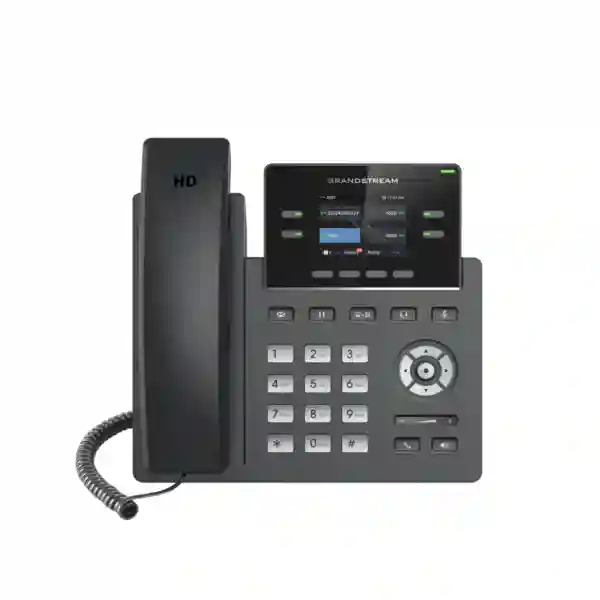
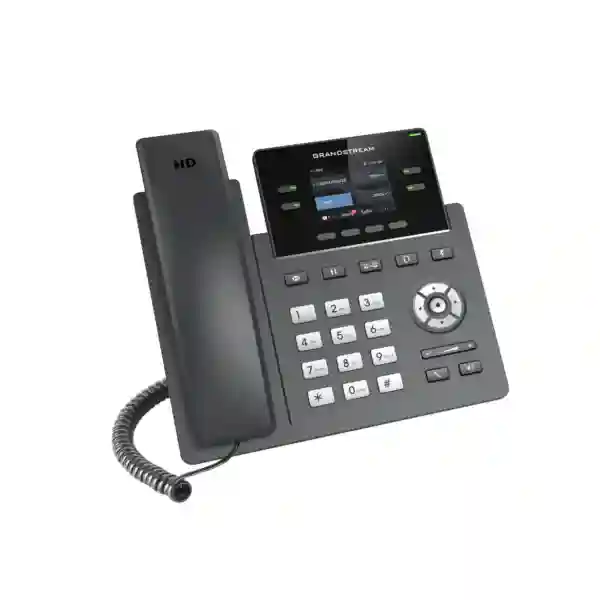
Grandstream GRP2612W Tanzania
The Grandstream GRP2612W is a professional SIP desk phone built for organisations that want a clean balance of business calling features, flexible network connectivity and centralized administration. Grandstream positions the GRP2612 family for mass deployment and easy management, and the GRP2612W adds integrated dual-band Wi‑Fi while also supporting Power over Ethernet. For Tanzanian businesses planning new IP telephony, refreshing ageing handsets or standardising endpoints across branches, this model provides a practical platform for everyday office calling without forcing every desk to depend on a dedicated data cable solely for the phone.
What is the Grandstream GRP2612W?
The GRP2612W is part of Grandstream’s GRP Series of professional carrier-grade IP phones. It is intended for businesses, service providers and other deployments where administrators may need to configure and support many endpoints in a consistent way. The phone combines SIP-based voice functionality with a color display, programmable keys, wideband codec support, Wi‑Fi connectivity and central management through Grandstream Device Management System, commonly called GDMS. The model is especially useful where a wired Ethernet drop is inconvenient, provided the wireless network is designed to support reliable voice traffic.
Grandstream’s current product information lists support for four SIP accounts and four multi-purpose line keys, up to sixteen digital BLF keys, a 2.4-inch 320 × 240 color LCD, five-way audio conferencing, HD audio including G.722 and Opus, secure boot, dual firmware images and encrypted data storage. The GRP2612W also provides dual switched 10/100 Mbps Ethernet ports with integrated PoE. Hardware versions 5.0 and above are listed by Grandstream with integrated dual-band Wi‑Fi 6 support covering 2.4 GHz and 5 GHz; earlier hardware revisions may use earlier Wi‑Fi capabilities, so buyers should confirm the hardware revision when a particular wireless standard is important to the project.
The product should be selected as part of a complete voice environment rather than as an isolated handset. A successful deployment depends on SIP platform compatibility, extension design, call routing, network quality, DHCP and DNS operation, firewall configuration, switching, Power over Ethernet availability where used, Wi‑Fi coverage where wireless is used, and the organisation’s provisioning method. FourTeck Tanzania can help buyers evaluate these dependencies as part of an IP telephony requirement rather than treating the desk phone as a standalone purchase.
Flexible connectivity
Use wired Ethernet with PoE where structured cabling is available, or use the integrated dual-band wireless capability when a properly designed business Wi‑Fi network offers a better installation path.
Central management
GDMS gives administrators a centralized interface for provisioning, configuring, monitoring and maintaining supported Grandstream endpoints, helping multi-device deployments remain consistent.
Business voice
HD audio codec support, programmable keys, BLF capability, call-handling features and five-way conferencing make the phone suitable for everyday office roles and shared communication workflows.
Deployment security
Grandstream lists secure boot, dual firmware images and encrypted data storage as enterprise-level security features, supporting more controlled endpoint deployment and maintenance.
Verified Grandstream GRP2612W features
| Feature | GRP2612W capability | Business relevance |
|---|---|---|
| Lines and SIP | 4 lines and 4 SIP accounts on current product information | Supports users handling several identities, call appearances or service roles. |
| Display | 2.4-inch 320 × 240 color LCD | Provides readable call state, menu and directory information. |
| Wi‑Fi | Integrated dual-band Wi‑Fi; Wi‑Fi 6 listed for hardware version 5.0 and above | Useful for desks where dedicated Ethernet installation is inconvenient. |
| Ethernet / power | Dual switched auto-sensing 10/100 Mbps Ethernet ports with integrated PoE | Supports conventional voice-VLAN desk deployments and reduced adapter use. |
| Audio | HD audio with wideband G.722 and Opus among supported codecs | Helps deliver natural voice quality when the PBX, trunk and network support wideband media. |
| Programmable functions | Up to 16 digital BLF keys | Useful for monitored extensions, speed dial and frequently used telephony functions. |
| Conference | 5-way audio conferencing | Allows simple multi-party conversations without a separate conference device. |
| Management | GDMS-supported centralized provisioning and monitoring | Reduces repetitive configuration for multi-phone or multi-site deployments. |
Who should consider the GRP2612W?
The phone fits general office users who need a professional SIP endpoint with a color screen, convenient line handling and flexible connectivity. It can work well for administrative teams, sales desks, service staff, managers, branch offices, reception overflow positions, hot-desk environments and organisations standardising large numbers of extensions. A key attraction is that the wireless option can simplify placement at desks where structured cabling is not readily available, while Ethernet and PoE remain available for conventional wired deployment.
The model is not automatically the right choice for every role. A busy primary receptionist may need a phone with more physical keys, a larger display or expansion-module support. An executive user may prioritise Bluetooth, a larger screen or more sophisticated collaboration functions. A common-area phone may need fewer features. The GRP2612W is strongest when the requirement is a manageable professional desk phone with Wi‑Fi, PoE, four-line capability and central provisioning. Before ordering a large quantity, organisations should map employee roles to handset requirements and test the intended PBX features, headset options, VLAN settings and network behavior.
IP PBX, SIP and network integration
A SIP phone is only one component of the business telephony chain. The GRP2612W registers to a compatible SIP platform and relies on that platform for extension identity, incoming and outgoing call routing, voicemail, queues, hunt groups, IVR behavior and many other business calling features. The exact user experience therefore depends on both the handset and the PBX configuration. Buyers replacing analogue phones or migrating from another IP phone brand should document existing extension numbers, direct numbers, line keys, shared lines, call pickup groups, forwarding rules, after-hours routing, voicemail behavior and reception workflows before rollout.
Network planning is equally important. Wired deployments may place the phone on a voice VLAN and use QoS policies to protect voice traffic during busy periods. PoE can simplify desk installation and, when the PoE switches are connected to appropriate UPS protection, can help phones remain powered through short utility interruptions. Wireless deployments require dependable signal coverage, sufficient capacity and careful SSID/VLAN design. Voice over Wi‑Fi can be sensitive to poor roaming, interference, overloaded access points or unstable backhaul. A strong signal icon alone does not guarantee good call quality.
For a broader telecommunications project, visit the FourTeck Tanzania services overview, which explains how IP telephony, switching, Wi‑Fi, security and infrastructure can be planned as connected systems. Buyers comparing phones, PBX hardware and related technology can also review the FourTeck Tanzania technology shop for business purchasing guidance.
Grandstream GRP2612W Tanzania
For organisations in Tanzania, the Grandstream GRP2612W can serve as a standardized SIP endpoint for offices, branch locations, customer-service teams and professional users who need dependable desk calling with the option of either wired or wireless network access. Tanzania deployments often involve mixed infrastructure: some desks already have structured Cat6 cabling and PoE switching, while new offices, temporary work areas or difficult cable routes may make Wi‑Fi a useful alternative. Because the GRP2612W supports both approaches, IT teams can standardize on one endpoint while choosing the most appropriate connection method per desk.
A Tanzania procurement plan should begin with quantities and user roles. Define how many extensions are standard users, how many need monitored BLF keys, whether reception requires a higher-capacity model, whether meeting rooms need dedicated conference devices, and whether any remote or branch users will connect across VPN or public internet paths. Then review the PBX. Confirm that the target SIP platform supports the functions the users rely on, including hold, transfer, conference, voicemail indicators, directory access, call pickup, shared lines or other required features. A short pilot with representative users can be more valuable than choosing solely from a feature list.
Network readiness is critical in Tanzania because voice quality reflects the complete path from handset to PBX or SIP service. For wired phones, check switch port availability, PoE budget, VLAN configuration and uplink capacity. For wireless phones, check actual coverage at desk height, interference, access-point load, roaming behavior and how the voice SSID maps to network policy. Internet-based SIP services also depend on stable WAN connectivity, DNS, firewall rules and upstream provider behavior. Where voice is business-critical, it is worth discussing WAN resilience and power protection together with the handset rollout.
Procurement teams should request a quotation that identifies the exact GRP2612W hardware revision, quantity, included accessories, power method, PBX integration scope, provisioning method and any installation or configuration services. If Wi‑Fi 6 support is specifically required, verify the hardware revision because Grandstream’s current product page qualifies Wi‑Fi 6 for version 5.0 and above. Buyers should also confirm warranty terms, firmware policy and support scope in the specific quotation rather than assume these items from another country or reseller listing. For help preparing a practical bill of materials, the FourTeck Tanzania contact page provides a route to submit quantities, site details and integration requirements.
Grandstream GRP2612W Dar es Salaam
Dar es Salaam businesses commonly operate from multi-floor offices, commercial buildings, retail environments, logistics facilities, professional practices and service centers where voice communication must coexist with data, Wi‑Fi, CCTV and cloud applications. In this environment, the GRP2612W can be deployed as a general business handset for staff who need reliable SIP calling without demanding the larger key count of an attendant-class phone. Its combination of Ethernet, PoE and Wi‑Fi lets a project team use wired connections at fixed desks and wireless connectivity in areas where adding a new data outlet would complicate fit-out work.
For an office move in Dar es Salaam, telephony planning should be coordinated with switching and Wi‑Fi design before furniture positions are finalized. If the phones are wired, each desk may need suitable cabling, patch-panel capacity and switch ports. If PoE is used, the switch’s total power budget needs to cover phones together with any access points or cameras sharing the same switch. If wireless calling is planned, access points should be positioned for capacity and voice reliability rather than simply broad coverage. Dense offices may need more careful channel design because many laptops, phones and mobile devices can share the same radios.
Call-flow requirements should also be documented early. A Dar es Salaam headquarters may have reception, finance, sales, operations and support teams, each with different incoming call rules. The GRP2612W can present line and programmable functions, but the PBX must be configured to match the intended workflow. Identify which users need BLF monitoring, which calls should ring groups or queues, how unanswered calls are handled, and what happens outside office hours. This exercise prevents the handset rollout from becoming a simple extension-number assignment that ignores the customer experience.
When requesting pricing, include the number of phones, PBX model or service, desired power method, network switch information, wireless environment, headset needs and any installation expectations. If some desks require a more advanced phone than the GRP2612W, identify those exceptions during design instead of after deployment. A mixed endpoint policy can be efficient when it is deliberate: standard users receive a common model, reception or supervisors receive higher-capacity endpoints, and meeting rooms receive purpose-built conference devices.
Grandstream GRP2612W Mwanza
For businesses in Mwanza, the GRP2612W can support office communications where teams want SIP extensions at desks but need flexibility in how those endpoints connect to the network. Companies operating across administrative offices, service counters, distribution activities, education, healthcare or commercial facilities may find the wireless option useful in renovated spaces where cabling changes are disruptive. The same handset can still use PoE Ethernet where structured cabling is already available, giving IT teams a consistent user interface across different physical areas.
A practical Mwanza deployment starts with the voice platform. Determine whether the organisation uses an on-premises IP PBX, a hosted SIP service or a centralized system serving multiple branches. Confirm extension registration behavior, codecs, dial plan, voicemail, transfer, conferencing and directory needs. If branch traffic travels over VPN or internet links, test latency, packet loss and failover behavior because the quality of the handset cannot compensate for an unstable network path. Where business continuity matters, the project can also consider how phones, switches, routers and wireless access points are powered during short outages.
Wi‑Fi should be treated as an engineered transport for voice, not merely as a convenience. Test the intended desks at busy times, not only after-hours. Review signal strength, interference and access-point utilization. If users may carry calls while moving between areas, roaming performance becomes more important. If phones will remain stationary, the design can focus on strong stable coverage at those desk locations. Separate staff, guest and voice traffic where appropriate so guest usage or large downloads do not unexpectedly affect business calls.
For procurement, ask for model confirmation rather than accepting a generic GRP2612-family description. The GRP2612, GRP2612P, GRP2612W and GRP2612G are variants with different connectivity characteristics. The “W” designation is the relevant model for integrated Wi‑Fi. Also confirm hardware revision where a specific Wi‑Fi standard is required. Include the PBX type and intended quantity in the request so provisioning and compatibility questions can be addressed before the order is finalized.
Grandstream GRP2612W Arusha
Arusha organisations in tourism, hospitality, professional services, administration, education and other sectors often need communication systems that connect front-office staff, operations teams and management. The GRP2612W can be used for standard desk positions where employees need a business SIP phone with a clear color screen, programmable functions and central management. Wireless connectivity may be particularly useful in properties where office layouts change, heritage construction complicates new cabling or selected desks are positioned away from practical Ethernet outlets.
Hospitality and service environments should pay close attention to user roles. Front-desk or reservation staff may handle more simultaneous calls and monitored extensions than ordinary administrative users. The GRP2612W can fit many general positions, while a receptionist may justify a larger Grandstream model with more keys or expansion options. Building an endpoint matrix by role helps avoid both over-specification and under-specification. Staff training should cover transfer, hold, voicemail, conferencing and any PBX-specific functions so the investment improves call handling rather than simply replacing handset hardware.
Wireless network design can be especially important in facilities with multiple rooms, corridors, thick walls or separate buildings. The presence of Wi‑Fi in a general area does not prove that a stationary IP phone will have the stable low-latency connection needed for professional voice. A site assessment should identify access-point locations, channel utilization and network segmentation. For wired positions, confirm PoE switch budget and UPS protection. Where internet-based trunks are used, consider whether the primary WAN link has adequate reliability and whether an alternative route is needed for critical calling.
A quotation request for Arusha should state the number of phones, exact model, user types, PBX platform, existing network equipment, power method and whether configuration is required. If the project includes new switching or Wi‑Fi, include those components in one design conversation. The phone may be simple to place on a desk, but the quality of the finished voice service depends on coordinated network and PBX decisions.
Grandstream GRP2612W Dodoma
In Dodoma, offices planning IP telephony can use the GRP2612W as a standardized user handset across administrative departments, professional teams and branch environments. The model’s four-line capability, programmable functions, HD audio, Wi‑Fi and PoE make it suitable for users who need more flexibility than a basic single-purpose phone but do not require a large attendant console. Central management through GDMS can be helpful when an organisation deploys many endpoints and wants consistent configuration rather than setting each phone manually at the desk.
For new offices, the best time to plan phones is while the LAN and cabling are still being designed. Decide which desks will use Ethernet, whether the phone will share a network connection with a workstation, how voice VLANs are assigned and how PoE capacity is calculated. If Wi‑Fi is preferred for selected positions, confirm the wireless design before relying on it. Government, institutional and corporate networks may have stricter segmentation or authentication requirements, so administrators should validate compatibility with their network access policies and security standards.
PBX provisioning should be documented. Create a standard profile for normal users, define line-key behavior, directory sources, time settings, firmware policy and security parameters, then apply exceptions only where a business role requires them. This approach makes moves and replacement easier because a failed handset can be reprovisioned according to a known template. It also supports future branch expansion because the configuration standard travels with the organisation rather than remaining as undocumented settings on individual phones.
Before purchasing, confirm the actual handset quantity plus spare strategy, the need for headsets, network patch leads, power arrangements and any supporting switch or wireless upgrades. Organisations that require Wi‑Fi 6 should explicitly request confirmation of GRP2612W hardware revision 5.0 or above according to Grandstream’s current product information. The quotation should separately identify installation, PBX configuration, network changes and support so procurement teams can understand the complete scope.
Grandstream GRP2612W UAE
For organisations with operations spanning Tanzania and the UAE, standardising on a common IP phone family can simplify user training, provisioning and support. The GRP2612W can serve general users in branch offices where Wi‑Fi flexibility is useful but wired PoE remains available. Multi-country deployments should focus on configuration consistency rather than assuming that trunks, dial plans and network conditions are identical in every market. Local telecom rules, service-provider interfaces and calling plans can differ, while the endpoint can still follow a shared corporate standard.
A regional IT team can define common settings for naming, firmware policy, security, screen behavior, directories and programmable keys, then apply country-specific SIP accounts and dial plans. GDMS can support centralized endpoint management for Grandstream devices, which is valuable when phones are distributed across multiple sites. Administrators should still test each location’s local network and voice-service path. A successful template is one that standardizes what should be common while allowing controlled exceptions where local requirements differ.
The UAE office may also use different switching or Wi‑Fi infrastructure from the Tanzania branch. Confirm VLAN tagging, DHCP options, firewall rules, QoS and PoE at each site. If phones register to a central PBX across site-to-site VPN, check latency and failover. If they register to a local or hosted platform, document credential handling and disaster-recovery procedures. For related regional procurement and integration discussions, organisations can use FourTeck UAE as a complementary FourTeck resource while keeping the Tanzania deployment aligned with the same broader architecture.
When comparing regional quotations, normalize the scope. Check whether each quote includes the same phone hardware revision, accessories, provisioning, installation, support and taxes. A lower unit price is not necessarily equivalent if one proposal excludes configuration or uses a different variant. Procurement teams should compare the complete delivered requirement and verify the exact model designation GRP2612W.
Grandstream GRP2612W Uganda
Ugandan organisations with Tanzanian branches may benefit from using a common phone standard across the two countries. The GRP2612W supports both wired and wireless connectivity, which can help businesses maintain one preferred endpoint even when office cabling differs between sites. A Kampala headquarters, for example, may use PoE at most desks while a smaller branch relies on Wi‑Fi for a limited set of positions. Standardization can reduce training time and allow IT teams to reuse provisioning templates while still respecting local network conditions.
Cross-border voice architecture should be planned carefully. Some organisations centralize extensions on one PBX, while others operate local systems and connect them with SIP trunks or private links. The correct model depends on internet reliability, security policy, regulatory requirements and business continuity expectations. The GRP2612W can register as a SIP endpoint, but the architecture around it determines whether internal dialing, caller ID, emergency handling, voicemail and failover behave as expected.
A Uganda deployment should verify LAN readiness, Wi‑Fi coverage and power. PoE simplifies desk installation when suitable switches are available, while wireless can reduce cabling requirements for selected desks. In either case, switches, routers, PBX appliances and access points should be considered in the UPS strategy if voice continuity during brief power interruptions is important. Organizations should also create a firmware and configuration policy instead of allowing different branches to drift into unrelated versions and settings.
For buyers coordinating projects in both markets, FourTeck Uganda provides a regional FourTeck reference alongside the Tanzania site. The procurement request should identify quantities by location, PBX architecture, expected user roles and whether centralized provisioning is part of the scope.
Grandstream GRP2612W Kampala
In Kampala, the GRP2612W can suit offices that want a professional SIP phone with wireless flexibility and centralized management. Corporate branches, professional services, education, hospitality and customer-facing organizations can deploy the handset for standard users while reserving larger models for reception or supervisory positions. The decision should be based on the number of lines and keys a user actually needs, not solely on the desire to standardize every desk at the same feature level.
Dense commercial buildings can create complicated wireless conditions because many neighboring networks may share radio spectrum. If the GRP2612W is expected to operate on Wi‑Fi, an IT team should assess channel utilization and coverage rather than rely on a consumer-style coverage assumption. Wired PoE may be preferable for fixed desks where structured cabling already exists. Wireless can then be used selectively for desks that are difficult to cable or likely to move. This hybrid approach often provides more predictable voice performance while preserving deployment flexibility.
PBX integration should be piloted before a large rollout. Confirm account registration, transfer, hold, voicemail notification, conference, BLF behavior and any directory integration required by the business. Validate the exact firmware branch that applies to the handset hardware revision. Grandstream publishes different notes for legacy and newer GRP261x hardware, which is another reason to record hardware revisions in asset documentation instead of treating all units as indistinguishable.
When procuring in Kampala for use within a regional group, define whether devices will be managed locally or by a central IT team. Centralization can reduce duplicated effort, but local administrators still need clear escalation procedures and access boundaries. A documented standard covering device names, extension numbers, VLANs, provisioning and replacement procedures can make the deployment more supportable over its lifecycle.
Grandstream GRP2612W Arua
For branch offices in Arua, practical deployment considerations may be more important than having the most feature-rich handset. The GRP2612W gives organisations a manageable SIP endpoint with the option to connect over Ethernet or Wi‑Fi. This flexibility can help when branch facilities have limited structured cabling or when desks are relocated. The correct connection method should still be selected based on reliability: a stable wired PoE path is often preferable for fixed critical positions, while Wi‑Fi can be valuable when cabling is difficult.
Branch connectivity deserves careful testing if the phone registers to a PBX hosted in another city or country. Measure real network performance during working hours and consider how internet congestion affects voice. Prioritize voice where possible, avoid unnecessary routing complexity and define what happens if the WAN connection fails. Some organizations may need local calling continuity or alternative communication methods for critical roles. These are architecture decisions beyond the handset itself, but they determine whether the overall phone system remains useful when conditions change.
Power design is also part of branch telephony. If phones use PoE, the switch becomes a shared power dependency. UPS protection for the switch, router and PBX or gateway can be more effective than fitting individual adapters at each desk. If Wi‑Fi is used, the access points need the same continuity consideration. The phone’s wireless capability does not help if the access point loses power before the desk equipment does.
For procurement, document each Arua user role, extension, required calling features and desk connection method. A clear branch bill of materials may include phones, PoE switching, wireless coverage improvements, patching, UPS equipment and PBX configuration. Buying only the handset quantity without checking these dependencies can create delays during installation.
Grandstream GRP2612W Mbarara
Mbarara businesses planning a modern voice network can use the GRP2612W for everyday office extensions where staff need a color-screen SIP phone with programmable functions and flexible connectivity. The handset is suitable for general office deployment, but endpoint selection should be tied to role. Staff handling high call volumes may need additional keys or headset-focused features, while occasional-use areas may be served by simpler devices. A small number of phone profiles often produces a better overall result than forcing one model into every role.
If Wi‑Fi is the reason for selecting the GRP2612W, validate the wireless environment first. Consider the number of concurrent clients on each access point, wall construction, interference and whether other high-bandwidth applications share the same radio. Voice packets are small but time-sensitive; delay, jitter and loss can make calls unpleasant even when speed tests look acceptable. Business access points with sensible channel planning and VLAN support are preferable to extending coverage with unplanned consumer repeaters.
On the PBX side, define a configuration baseline. Standardize codec preferences, time settings, directory behavior, line keys, firmware policy and security. Use GDMS where appropriate to reduce repetitive administration and improve visibility across endpoints. Maintain an asset list that includes serial numbers or hardware revisions, especially because wireless capabilities can vary by GRP2612W hardware generation. This makes future firmware and support decisions easier.
A useful quotation request for Mbarara includes quantity, current PBX, required SIP accounts, headset needs, desired power method, network switch details and wireless architecture. If the site is part of a regional organization, include the broader standard so the endpoint configuration aligns with other branches instead of being deployed as a one-off island.
Grandstream GRP2612W Gulu
The Grandstream GRP2612W can support Gulu offices that need manageable SIP phones for administrative staff, service teams or branch users. It is particularly relevant when the project values deployment flexibility: some desks can use Ethernet with PoE while others can use the integrated wireless capability. The choice should be made intentionally according to the site rather than using Wi‑Fi solely because it is available. For fixed desks with reliable cabling, wired service can provide a predictable path; wireless remains valuable for locations where cabling cost or building constraints are significant.
A Gulu branch linked to a centralized PBX should test WAN reliability and security. Voice may traverse VPN, private WAN or public internet paths depending on the architecture. Firewall rules, NAT behavior, SIP settings and quality-of-service policies can affect registration and call stability. A pilot phone at the actual branch gives administrators the opportunity to confirm real behavior before shipping or installing the full quantity.
Support planning matters for distributed sites. Centralized provisioning can reduce travel and manual configuration, but administrators still need a documented method to reset, replace or reassign a phone. Maintain clear extension mapping and configuration backups. Users should know basic procedures for transfer, voicemail, headset use and reporting faults. Simple documentation can prevent routine questions from becoming support incidents.
When evaluating cost, include the infrastructure needed to make the phones work well. A handset price does not include the possible need for PoE switching, Wi‑Fi upgrades, UPS capacity, PBX licenses or trunk changes. A complete quote should expose these dependencies so decision-makers can compare the total project rather than only unit handset pricing.
Grandstream GRP2612W Kenya
Kenyan and Tanzanian operations can use the GRP2612W as part of a common East African endpoint standard where user needs are similar. A shared phone family makes training, spare management and configuration templates easier, while each office can still apply local extensions, trunks and dial plans. For cross-border groups, the strategic value is not that every branch is technically identical but that administrators can recognize and support the same endpoint platform across locations.
A Kenya deployment should validate its own network. Nairobi offices in dense commercial areas may have different wireless interference patterns from a smaller branch or warehouse, so Wi‑Fi use should be assessed site by site. PoE can remain the primary method for fixed desks, with Wi‑Fi reserved for flexible positions. If the organisation uses centralized cloud or data-center PBX services, monitor latency and packet loss from each branch and define backup connectivity where call availability is important.
Procurement teams should use a consistent specification sheet that identifies GRP2612W, required hardware revision where relevant, expected accessories, power method and deployment service. This prevents a regional tender from mixing different GRP2612 variants under one generic description. The project should also confirm that any headset, PBX and directory requirements are validated against the exact intended configuration.
For buyers coordinating technology projects in Kenya as well as Tanzania, FourTeck Kenya provides a regional FourTeck reference. A coordinated design can standardize phone profiles, voice VLAN principles, provisioning and support processes while allowing each site to use the connectivity and trunk arrangements that fit its local environment.
Grandstream GRP2612W Kuwait
For organisations operating in both East Africa and Kuwait, the GRP2612W can be evaluated as part of a standardized Grandstream endpoint strategy. Its combination of SIP accounts, programmable keys, HD audio, Wi‑Fi and PoE is useful for general office roles, while central management supports geographically distributed deployments. Regional standardization should be based on user experience and support efficiency, not on the assumption that telecom services are interchangeable between countries.
Each Kuwait deployment should confirm local PBX and SIP requirements, numbering, emergency calling procedures, telecom service arrangements and network security policy. The endpoint can use the same general provisioning framework as a Tanzania office, but country-specific settings should remain distinct. A change-control process is useful when central IT manages multiple markets, ensuring that a configuration update is tested before being applied across every branch.
Wireless conditions in modern offices can be excellent when access points are correctly designed, but voice still requires stable low-latency service. If desks are fixed and PoE is already available, wired Ethernet may remain the simplest choice. If office layouts are flexible, the GRP2612W’s wireless option can reduce dependence on desk cabling. Confirm hardware revision when a project explicitly requires Wi‑Fi 6, because Grandstream qualifies that capability for version 5.0 and above.
Regional procurement should compare complete delivered scope: handset, included accessories, configuration, PBX changes, installation, support, warranty terms and taxes. Standardized documentation can help a multinational procurement team see where two proposals are truly equivalent and where local service elements differ.
Grandstream GRP2612W Ghana
Ghanaian branches can use the GRP2612W where a professional SIP handset with both PoE and Wi‑Fi is appropriate for standard users. The phone’s centralized-management positioning makes it relevant to organisations with many endpoints or more than one site. A company that already uses Grandstream in Tanzania can potentially reduce operational variation by applying similar endpoint profiles in Ghana while keeping local trunks and dialing rules separate.
The strongest deployment process begins with a pilot. Register the phone to the intended PBX, test transfer and voicemail, validate codecs, confirm caller ID and assess headset requirements. Then evaluate the network under normal working load. If the phone will use Wi‑Fi, check coverage and channel utilization at the intended desk locations. If it will use PoE, check the switch budget and VLAN settings. This practical validation can expose problems that are invisible in a product datasheet.
For branches connected over WAN links, consider whether voice should terminate locally or centrally. Centralization can simplify administration, but it increases dependence on the inter-site connection. The right design depends on business continuity targets and local telecom architecture. The GRP2612W can participate in either approach as a SIP endpoint, provided the surrounding platform supports the required functions.
Procurement documentation should specify exact quantities, user roles, model designation, power method, PBX platform and configuration service. Avoid generic wording such as “Grandstream Wi‑Fi phone” because different models and revisions can have materially different capabilities. A disciplined specification makes quotation comparison and future support easier.
Grandstream GRP2612W Nigeria
Nigeria deployments may range from compact branch offices to large organizations with multiple cities and distributed teams. The GRP2612W can fit the standard-user layer of such an environment when four-line SIP capability, Wi‑Fi flexibility, PoE and centralized management align with the requirement. For larger sites, endpoint standardization should be tied to role profiles so reception and high-call-volume teams are not constrained by a model chosen primarily for general staff.
Network resilience deserves particular attention in voice projects. If the PBX is hosted remotely, an office can lose calling even while the handsets remain powered if the WAN connection fails. Dual-WAN, VPN resilience or local survivability options may be relevant depending on the system design. These capabilities typically sit outside the phone itself, but they should be discussed at the same time because the business experiences the phone system as one service.
Wireless deployment should follow professional Wi‑Fi design principles. Separate guest and corporate services, avoid overloaded access points and test voice quality throughout the areas where phones will be located. If the phones remain stationary, consistent signal and low interference at each desk matter more than roaming features. For wired positions, PoE and UPS-backed switching can simplify installation and improve continuity during brief power events.
A regional organisation buying for Nigeria and Tanzania should maintain a standard configuration document and asset register. Record hardware revision, firmware, extension and site. This is especially useful when manufacturer firmware guidance differs between legacy and newer GRP261x hardware. Good records reduce uncertainty during upgrades and replacement.
Grandstream GRP2612W Seychelles
In Seychelles, businesses in hospitality, professional services, administration and distributed island operations may value the GRP2612W’s ability to operate on a business Wi‑Fi network where fixed cabling is inconvenient. Wireless capability can be useful in renovated properties, reception back offices and flexible work areas, while PoE Ethernet remains available for permanent desks. The handset should be considered as part of the site’s broader communication and network plan, especially where internet-based voice services are important.
Hospitality environments often have strong guest Wi‑Fi coverage, but business voice should not automatically share the same open or heavily utilized guest network. Voice endpoints benefit from controlled authentication, segmentation, predictable addressing and traffic policy. If the property uses multiple access points across buildings or floors, verify that the network design supports the intended phones without unnecessary roaming or congestion. Wired connections remain sensible for critical front-desk positions when available.
The PBX design should reflect the organisation’s call flow. Define which extensions receive external calls, how calls are forwarded, whether remote departments share a queue, and how voicemail or after-hours routing works. The phone provides the user interface, but operational efficiency comes from the PBX logic behind it. Staff training is particularly helpful for hospitality teams that frequently transfer calls between departments or need quick access to commonly used extensions.
For procurement, confirm the exact model, quantity, hardware revision where relevant, power approach and whether provisioning is included. If the organisation operates several properties, central management and consistent device naming can simplify support. A pilot at one representative site can establish the standard before broader rollout.
Deployment, provisioning and lifecycle guidance
Large phone deployments should be treated as managed assets. Start with a naming convention and extension plan, then define one or more provisioning templates by user role. A standard template can cover NTP, language, time zone, firmware policy, display behavior, security options, directories and default key assignments. Separate templates can be created for reception, supervisors or special-service positions. Centralized provisioning through GDMS or another supported method reduces manual error and gives administrators a clearer view of the fleet.
Firmware management deserves care because Grandstream currently distinguishes some GRP261x legacy hardware revisions from newer revisions in its firmware guidance. Administrators should record the phone’s hardware revision before planning fleet-wide upgrades. Test firmware on a small set of representative devices before applying it broadly, especially when the deployment uses custom PBX features, headsets, VLAN settings or wireless configurations. Maintain a rollback and support plan where feasible rather than updating every phone immediately after a release appears.
Security should include strong administrative credentials, controlled access to the web interface, TLS/SRTP where supported by the complete platform, appropriate network segmentation and regular configuration review. Grandstream lists secure boot, dual firmware images and encrypted data storage for the GRP2612 family, but endpoint security still depends on the wider environment. Avoid exposing phone management directly to the public internet. Limit administrative access to trusted networks or secure management paths and protect provisioning credentials.
GRP2612W buying checklist
Before requesting a quotation, gather the details below. They help distinguish a simple handset purchase from a complete IP telephony deployment and reduce the risk of missing infrastructure.
- Required phone quantity and number of spare units.
- User roles: standard office, reception, supervisor, shared desk or special use.
- PBX or hosted SIP platform and current firmware/version where known.
- Number of SIP accounts and required line/BLF behavior.
- Wired PoE, Wi‑Fi or mixed connectivity by location.
- Wi‑Fi standard requirement and hardware-revision confirmation where Wi‑Fi 6 is mandatory.
- Voice VLAN, DHCP, DNS and firewall requirements.
- Headset type and electronic-hook-switch requirements if applicable.
- Provisioning method, including GDMS or local PBX provisioning.
- Installation, configuration, user training and support scope.
- Warranty terms, delivery scope and any included accessories as stated in the final quotation.
Frequently asked questions about Grandstream GRP2612W
Does the GRP2612W support Wi‑Fi?
Yes. The “W” variant includes integrated dual-band Wi‑Fi. Grandstream’s current product information states Wi‑Fi 6 support on hardware version 5.0 and above. Earlier hardware revisions may have different wireless capabilities, so verify the revision when a particular wireless standard is required.
Does the GRP2612W support Power over Ethernet?
Yes. Grandstream lists dual switched auto-sensing 10/100 Mbps Ethernet ports with integrated PoE for the GRP2612W. This allows compatible PoE switching to power the phone and can reduce the need for separate power adapters at desks.
How many SIP accounts does the GRP2612W support?
Grandstream’s current product page lists four SIP accounts and four multi-purpose line keys for the GRP2612 family. Some older documentation for earlier hardware may show different values, so the exact hardware and firmware combination should be confirmed when replacing legacy units.
Can the GRP2612W be centrally managed?
Yes. Grandstream supports the model with GDMS, its cloud-based Device Management System for centralized provisioning, configuration, management and monitoring of compatible Grandstream endpoints.
Is the GRP2612W suitable for reception?
It can suit lighter reception roles, especially where four-line capability and digital BLF functions are sufficient. A high-volume main receptionist may benefit from a model with more physical keys, a larger display or expansion-module support. The decision should be based on real call volume and monitoring needs.
Can the phone work with a non-Grandstream PBX?
The GRP2612W is a standards-based SIP endpoint, but specific feature compatibility depends on the target PBX or hosted service. Registration, calling, transfer and common SIP functions may work broadly, while advanced functions should be tested against the exact platform before a large rollout.
Should I use Wi‑Fi or Ethernet for the phone?
Use the connection method that provides the most reliable service at the desk. Ethernet with PoE is often ideal for fixed locations that already have structured cabling. Wi‑Fi is valuable where cabling is difficult, but the wireless network should be designed and tested for low-latency voice rather than assumed adequate based only on general internet access.
What should I send for a GRP2612W quotation in Tanzania?
Send the required quantity, site location, PBX or SIP platform, expected user roles, desired wired or wireless connection, headset needs and whether you require provisioning, installation or related network upgrades. This information makes the quotation more meaningful than a unit-price request alone.
Decision recap
Choose the Grandstream GRP2612W when your organisation needs a professional SIP desk phone with four-line capability, integrated dual-band Wi‑Fi, PoE, HD audio, digital BLF functions, centralized GDMS management and enterprise-oriented security. It is especially attractive for offices that want one endpoint that can be deployed over either structured Ethernet or a properly engineered wireless network. Confirm the hardware revision if Wi‑Fi 6 is a specific requirement, and validate PBX compatibility, network readiness, power design and user-role fit before a large purchase.
For Tanzania projects, the most useful quotation is one that covers the complete operating requirement: phones, provisioning, PBX integration, switching or Wi‑Fi dependencies, accessories and deployment support. This approach gives procurement and IT teams a clearer view of the final system and helps avoid unexpected infrastructure changes after the handsets arrive.
Talk to FourTeck about your GRP2612W requirement
When you contact FourTeck Tanzania, include the number of phones, your PBX or hosted SIP platform, whether desks will use PoE or Wi‑Fi, and any special requirements such as BLF keys, headsets, reception functions or branch connectivity. If the project includes switching, Wi‑Fi or PBX changes, describe those as part of the same requirement so the supporting infrastructure can be checked with the phones.



Reviews
There are no reviews yet.