
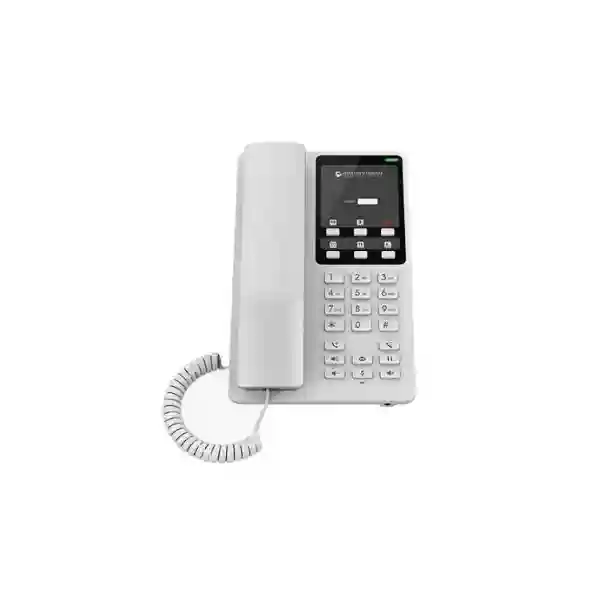
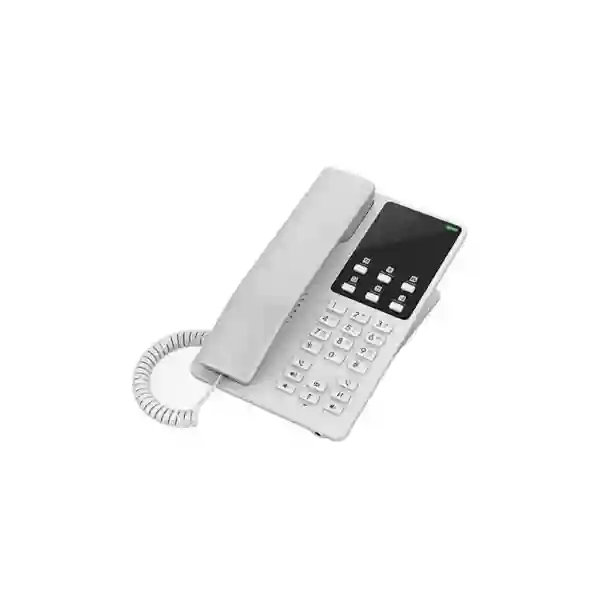
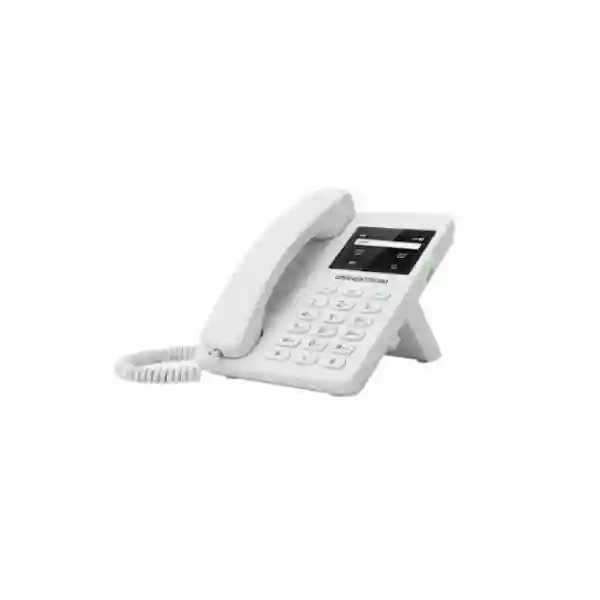
Grandstream GHP620 Tanzania
Grandstream GHP620 is a compact hotel IP phone built for guest rooms and other spaces where a simple, dependable SIP endpoint is more useful than a feature-heavy office handset. It supports two SIP accounts and two lines, Grandstream Device Management System provisioning, three-way audio conferencing, an Ethernet connection with PoE, programmable service access, speed-dial functions, Hearing Aid Compatibility and security protections including secure boot. For hotels, resorts, serviced apartments, hospitals, dormitories and similar environments, the value is not only the handset itself but the way it can be standardized, provisioned and integrated with the property voice network.
FourTeck helps buyers plan the wider requirement around the GHP620: room count, PBX platform, extension plan, PoE switching, VLAN design, structured cabling, faceplate labeling, provisioning workflow, spares and phased rollout. Product availability, warranty route, lead time and project scope should be confirmed at quotation stage rather than assumed.
Quick Product Fit
Best suited for: guest rooms, serviced apartments, patient rooms, dormitories, reception-adjacent service points and similar fixed-use environments.
Core connectivity: SIP over Ethernet with a 10/100 Mbps network port and PoE on the GHP620.
Management: Grandstream GDMS enables centralized provisioning and device administration for larger deployments.
What the Grandstream GHP620 is designed to solve
A hotel-room telephone has a different job from a manager’s desk phone. Guests should not need to understand multiple line appearances, complex menus or corporate collaboration features simply to contact reception, housekeeping, room service, security or another internal extension. The GHP620 focuses on a compact physical format, straightforward calling and programmable keys that can be configured around the service model of the property. That makes it appropriate where predictable guest interaction is more important than a large display or a large set of enterprise-user functions.
The phone supports two SIP accounts and two lines, which allows it to register to a compatible SIP-based communications platform while maintaining a simple guest-facing interface. Its three-way audio conferencing can be useful in non-hotel environments as well, while its HD audio support and full-band Opus codec support are relevant where network conditions and the PBX configuration allow those capabilities to be used. Grandstream also documents an advanced jitter-resilience algorithm for the GHP series, intended to preserve voice quality during packet-loss conditions. Network design still matters: stable switching, correct VLANs, suitable QoS and a well-configured PBX remain essential parts of a reliable voice deployment.
For a property rolling out dozens or hundreds of endpoints, centralized provisioning becomes particularly important. Grandstream Device Management System can be used to provision, manage, monitor and troubleshoot supported Grandstream devices. This reduces the need to configure every handset independently and gives administrators a more consistent way to apply settings, firmware and account information. The operational benefit grows as the number of rooms or sites increases.
2 SIP Accounts / 2 Lines
Supports two SIP accounts and two lines for compatible IP PBX and SIP deployments.
PoE Ethernet
The GHP620 includes a 10/100 Mbps Ethernet port with Power over Ethernet, helping reduce the need for a separate local power adapter where PoE switching is available.
GDMS Management
Centralized provisioning and device management can simplify standardized hospitality rollouts and multi-room administration.
Guest-Service Keys
Programmable and speed-dial functions can be aligned to reception, housekeeping, concierge, security or other internal services.
Verified GHP620 capabilities and deployment meaning
| Area | GHP620 capability | Why it matters |
|---|---|---|
| SIP | 2 SIP accounts / 2 lines | Fits SIP-based hotel and institutional voice systems where two account/line resources are sufficient. |
| Network | One 10/100 Mbps Ethernet port | Provides wired network connectivity for the room endpoint. |
| Power | PoE support | Allows supported PoE switches to carry power and data over the Ethernet run. |
| Voice | HD audio, Opus support, 3-way conferencing | Supports clear speech and basic conferencing when the network and PBX are configured appropriately. |
| Management | Grandstream Device Management System | Useful for centralized configuration, provisioning, firmware and monitoring across multiple endpoints. |
| Security & accessibility | Secure boot and Hearing Aid Compatibility | Adds endpoint security controls and supports broader user accessibility requirements. |
GHP620 versus GHP620W: do not mix the models
The GHP620 is the wired Ethernet model. Grandstream also sells the GHP620W, a wireless variant with integrated dual-band Wi-Fi. Wi-Fi capabilities published for the GHP620W should not be attributed to the GHP620. For a hotel buying the GHP620, the practical planning focus is Ethernet cabling, PoE availability, switch capacity, VLAN configuration and the PBX registration method. If a project requires wireless room phones because Ethernet is unavailable at the handset position, the GHP620W should be evaluated separately and its hardware-version-dependent Wi-Fi specifications should be confirmed before ordering.
This distinction is important during procurement. Similar model names often lead to incorrect assumptions about ports, power and wireless connectivity. A quotation should identify the exact model, color, quantity, accessories and any required customization so the delivered hardware matches the room design.
Hotel and hospitality deployment planning
A successful GHP620 rollout begins with the service workflow, not with the handset count. Decide which calls a guest should be able to make, which service numbers deserve one-touch access, whether room-to-room calling is permitted, how emergency calls are routed, what happens after hours and how reception identifies the calling room. These decisions should then be translated into PBX extension templates, programmable keys, labels and user-facing instructions.
The wired network should be reviewed room by room. Each GHP620 needs a suitable Ethernet path to the access switch. Where PoE is used, the switch must have both enough physical ports and enough aggregate PoE budget for the connected endpoints. Voice VLAN configuration can separate phone traffic from other room or staff traffic, while DHCP options or provisioning methods may be used to streamline deployment depending on the PBX and network design. QoS can help protect voice during periods of high network utilization, but it should be implemented end to end rather than enabled on one device only.
Room turnover and cleaning also affect the physical standard. Cable routing should keep cords tidy and accessible without creating a snag point. If the phone is wall mounted, verify the mounting surface and cable exit before installation. If customized faceplates are required, approve artwork, language, service labels and room information before the full production quantity is committed. Large projects benefit from a pilot room that validates appearance, dialing behavior, PBX integration, sound level, labeling and housekeeping practicality.
For broader hotel-phone selection guidance, FourTeck’s Hotel Phones in Africa guide explains compatibility, room-service workflows and procurement considerations across hospitality telephone projects.
PBX, network and infrastructure compatibility
The GHP620 is a SIP endpoint, so it should be matched to an IP PBX or hosted SIP platform that can provide the required registration, extensions and call routing. Before purchase, the technical team should confirm SIP compatibility, account credentials, codecs, dial plan, DTMF behavior, voicemail or message-waiting requirements, emergency dialing policy and any hospitality-specific integration expected from the PBX. Features such as room status or property-management-system integration are normally PBX or hospitality-platform functions rather than capabilities that should be assumed from the handset alone.
FourTeck Tanzania’s integrated IT and telecom overview describes how IP phones, PoE switches, Wi-Fi, firewalls and structured cabling should be considered as one system. This is especially relevant in hotels, where phones may share access switches and uplinks with staff data, wireless access points, CCTV or building systems. Segmentation and documentation reduce the chance that a change in one subsystem disrupts guest communication.
PoE planning should include the switch power budget, UPS runtime and failure domains. A PoE phone continues to depend on the access switch, upstream network and PBX, so simply powering the handset from a switch does not guarantee service during a wider outage. Properties that treat room telephony as part of safety or emergency operations should define the required backup time and test behavior during power, internet and PBX failures.
Where the site needs broader system planning, the FourTeck Tanzania services page provides context for installation, configuration and integrated infrastructure support. Buyers can also review the FourTeck Tanzania shop for related business technology categories.
Grandstream GHP620 Tanzania
For Tanzania hospitality projects, the GHP620 is most relevant to properties that already use, or are planning to use, a SIP-based phone system and want a standardized guest-room endpoint. Tanzania deployments can range from a single city hotel to resorts, serviced apartments, healthcare facilities, student accommodation and multi-site groups. The correct quantity should therefore be based not only on sellable rooms but also on reception areas, back-of-house positions, accessible rooms, staff accommodation, spares and any renovation phases. A room matrix is a practical way to identify where the GHP620 is appropriate and where another endpoint type may be better.
Network readiness is a major procurement issue. The wired GHP620 expects Ethernet connectivity, so new-build properties can include room data points and PoE switching in the structured-cabling design. Existing hotels should verify whether a usable Ethernet run reaches the required bedside or desk location. Where legacy two-wire telephone cabling is present, replacing an analogue phone with an IP model may require new cabling or a different architecture. That physical survey should happen before a bulk order is approved.
Tanzania buyers should also prepare their PBX information when requesting a quotation: platform and version, current SIP endpoint types, extension range, number of rooms, required guest-service keys, external dialing policy, VLAN details, switch model, PoE capacity and preferred rollout date. If the hotel wants branded faceplates or custom service labels, artwork and language requirements should be included early because they may affect production planning. For multi-property groups, standardizing key positions, extension templates and naming conventions can reduce training and support effort.
FourTeck can use these details to build a more accurate product and infrastructure discussion without implying stock or immediate delivery. The aim is to match the exact GHP620 requirement to the PBX, LAN and operational workflow before commercial terms are finalized.
Grandstream GHP620 Dar es Salaam
Dar es Salaam buyers often evaluate hotel telephony in the context of busy urban hospitality, business travel, serviced apartments, healthcare and mixed commercial developments. For a property with many guest rooms, the GHP620 can provide a consistent fixed endpoint for reception, housekeeping and internal calling while remaining simpler than a typical office desk phone. The project should begin with the room count and service workflow, then map each endpoint to an Ethernet port, PoE budget and PBX extension.
In an existing Dar es Salaam hotel, the most important question may be whether the guest-room cabling is ready for IP telephony. Older properties can have analogue cabling that is not directly suitable for Ethernet handsets. A room survey should confirm cable type, patching, rack location, switch capacity and the intended phone position. In a refurbishment, telephony cabling can be coordinated with Wi-Fi access points, IPTV, CCTV and room-network requirements so the design avoids repeated construction work.
Larger properties should also think about provisioning and change control. When every room follows a common template, support becomes easier: the room number can map cleanly to the SIP extension, service keys can remain in fixed positions, and standardized labels help guests and staff. GDMS can support centralized Grandstream endpoint management, while the PBX remains responsible for call routing and service logic. Before deployment, a pilot room can validate sound, handset placement, key labels, wall or desk mounting and how the phone behaves when the room network or PBX is restarted.
For quotation planning in Dar es Salaam, provide the room count, PBX details, switch and VLAN information, required service keys, desired color, faceplate customization needs, spare-unit policy and installation expectations. That information is more useful than simply requesting a price per handset because it exposes any network or compatibility work that could affect the real project cost.
Grandstream GHP620 Mwanza
In Mwanza, hospitality and institutional buyers can use the GHP620 as part of a controlled SIP voice environment where guest or resident users need a simple fixed telephone. Hotels, lodges, serviced accommodation, hospitals and training residences can all have similar requirements: quick access to a small group of services, predictable dialing and a device that IT can configure consistently. The GHP620’s programmable service access and centralized management approach are well suited to that operating model.
Infrastructure planning should account for the entire voice path. The handset connects to the access switch, the switch carries traffic through the LAN, and the PBX or SIP platform controls the calls. A failure at any stage can affect room service, so documentation and monitoring should cover more than the phone. VLANs, IP addressing, DHCP behavior, PoE budget and UPS protection are useful points to review during design. Where the property has multiple buildings, uplink capacity and fiber or copper distribution between blocks can also influence how the phones are connected.
Procurement teams should avoid ordering solely from a feature list. Confirm the exact GHP620 model rather than the GHP620W wireless version, and identify whether any accessories, wall-mount preparation or customized faceplates are required. If the hotel is replacing existing handsets, list the current PBX and room extension behavior so the new phones can be tested against established workflows. A phased replacement can reduce operational disruption and provide time to validate configuration templates before the rest of the rooms are migrated.
A Mwanza quotation request is strongest when it includes room count, site layout, PBX platform, network switch models, available PoE ports, required key labels, external dialing rules and preferred implementation sequence. These details support a more realistic bill of materials and help distinguish handset supply from the network or configuration work that may be needed around it.
Grandstream GHP620 Arusha
Arusha’s hospitality market includes city hotels, safari-linked accommodation, lodges, serviced residences and properties that need reliable internal communication between guests and staff. In these environments, a guest-room phone can remain valuable even when visitors carry mobile devices because the handset provides a known route to reception and property services without relying on the guest’s mobile coverage, roaming plan or battery. The GHP620 offers a compact SIP endpoint for this purpose.
A hospitality deployment in Arusha should define how service keys are used. Reception, emergency assistance, housekeeping and other commonly requested services can be assigned according to the hotel’s workflow, but the destinations and call permissions are controlled by the PBX configuration. This means procurement, operations and IT should agree on the key plan before a full rollout. Printed faceplates or labels should use concise terms that are understandable to the property’s guest profile and staff.
For properties with separate guest blocks or extended grounds, network architecture matters. Each GHP620 requires wired Ethernet and should be connected through suitable PoE switching. Inter-building links, surge protection, rack placement and backup power may need additional attention where equipment is distributed across a campus-style property. Network segmentation can keep guest-room voice separate from general guest Wi-Fi and other systems, while QoS can protect call traffic during periods of heavier usage.
Arusha buyers should request the GHP620 as part of a clear room-communications scope: exact quantity, PBX platform, room types, service keys, switch and PoE capacity, cabling status, required mounting, customization and spare policy. This allows the quotation to reflect the real deployment rather than presenting a handset in isolation. Where a hotel group expects future expansion, a standard configuration template can make additional rooms or properties easier to commission later.
Grandstream GHP620 Dodoma
Dodoma projects may include hotels, serviced apartments, public-sector accommodation, healthcare facilities, education residences and other sites that need simple fixed SIP phones in many rooms. The GHP620 is useful where the endpoint should remain straightforward for occasional users while still giving administrators centralized provisioning and management options. Two SIP accounts and two lines provide flexibility for compatible phone-system designs without turning the guest interface into a complex office device.
When planning a new site, the most efficient approach is to coordinate telephony with structured cabling and PoE switching from the beginning. Each room can receive a documented data point connected to the correct switch and VLAN. Port labeling should match room numbers or a clear device naming standard so technicians can trace faults quickly. UPS capacity for communication racks should be sized around the switch load, PBX and other critical equipment rather than the phone alone.
In an operational property, migration strategy matters. A floor-by-floor or block-by-block deployment can limit disruption, but the PBX should be ready to support both old and new endpoints during the transition if systems are mixed. Test a representative room before broad deployment and verify dialing, caller identification, service keys, call transfer behavior where relevant, emergency routing, sound levels and the response after power or network recovery. Document the final template after acceptance.
For Dodoma procurement, share the number of rooms, room categories, current telephone platform, cabling type, PoE availability, faceplate expectations, spare-unit quantity and any installation or configuration scope. Exact stock, lead time and warranty route should be confirmed in the commercial offer. That separates verified product capability from project variables that depend on quantity, destination and supply route.
Grandstream GHP620 UAE
UAE hospitality projects can use the GHP620 where a compact wired SIP guest-room phone fits the property standard. Hotels and serviced residences often have well-developed IP networks, but the phone should still be evaluated against the exact PBX, room cabling and service workflow. Centralized management is especially useful in larger properties because configuration consistency becomes more important as endpoint counts increase.
The procurement process should distinguish the GHP620 from the GHP620W wireless model and confirm whether a wired PoE design is preferred. Wired Ethernet is often attractive in fixed guest-room positions because it offers predictable connectivity and central power through the PoE switch. The network team should confirm switch capacity, VLAN assignment, DHCP behavior, QoS and the PBX registration method. Hospitality IT teams may also define separate voice policies from staff and guest data networks.
Properties with branding standards should review faceplate customization and service labels before quantity production. A room prototype allows operations, IT and the design team to approve physical placement, key legends and appearance together. This step can prevent late changes after devices have already been labeled or deployed. For multi-property hotel groups, a common key layout and provisioning template can simplify staff familiarity and support documentation across locations.
FourTeck’s regional network can support cross-market planning where the same hospitality standard is being considered in Tanzania and the UAE. Commercial terms, availability and service scope remain project dependent. Buyers should provide exact quantities, required delivery destination, PBX platform, customization needs and implementation expectations so the quotation can identify both the endpoint and any related network or configuration components.
Grandstream GHP620 Uganda
Uganda hotels, lodges, serviced apartments, hospitals and residences can consider the GHP620 for guest or resident rooms that need a straightforward wired SIP telephone. The phone’s two SIP accounts, PoE Ethernet and centralized Grandstream management support a standardized deployment model, but the practical result depends on the PBX, switching and cabling around it. Buyers should therefore treat the handset as one component of the room communication system.
For a new installation, determine the number of active rooms, spares and non-room endpoints before calculating switch capacity. If phones are powered by PoE, verify both port count and wattage budget. Voice VLANs can help separate traffic, and a documented extension plan can link room numbers to SIP accounts in a predictable way. Where sites experience power interruptions, the PBX, core network and PoE switches should be included in the backup-power design if continuity is important.
For upgrades from analogue hospitality phones, cabling may be the deciding factor. Existing two-wire runs are not automatically suitable for Ethernet IP phones, so survey the pathways and outlets before approving a replacement plan. Some properties may prefer a staged migration that combines existing analogue extensions with new SIP endpoints while network upgrades proceed. Compatibility, dialing behavior and service-key programming should be proven on a sample before bulk deployment.
Uganda buyers should send their room count, PBX brand and model, available Ethernet, switch inventory, PoE capacity, desired service keys, color and faceplate requirements with the quotation request. If the organization operates in several East African markets, a consistent phone and provisioning standard can help reduce configuration variation while still allowing each property to adapt service destinations and local dialing rules.
Grandstream GHP620 Kampala
Kampala hospitality properties can use the GHP620 as a room endpoint where a wired SIP network is available and guests need direct access to a limited set of property services. Business hotels and serviced residences may prioritize fast access to reception and front desk assistance, while hospitals or accommodation facilities may configure different service destinations. The programmable layout should be built around the actual operating process rather than copied from a generic template.
Urban properties often place multiple systems on the same network infrastructure: phones, staff devices, cameras, access points, IPTV and building equipment. That makes switching and VLAN design important. The GHP620’s 10/100 Mbps port is sufficient for its own voice role, but uplinks and shared switching must be sized for the wider site. Where voice quality is critical, network monitoring should check latency, packet loss and congestion instead of treating every call problem as a handset fault.
GDMS can support centralized management of Grandstream endpoints, which is valuable when a Kampala property has many rooms or when an operator manages several sites. Standard configuration profiles reduce inconsistent settings and make replacement devices easier to commission. Firmware policies should still be controlled: updates can improve security and reliability, but large properties should test important changes before deploying them broadly.
When requesting a Kampala quotation, specify whether the requirement is supply only, configuration assistance or part of a larger PBX and network project. Include exact GHP620 quantity, room and floor structure, PBX platform, PoE switch information, required labels and implementation timing. This lets the commercial and technical scope stay clear, especially where cabling or switch expansion is needed before the phones can be installed.
Grandstream GHP620 Arua
For Arua hospitality, healthcare and residential projects, the GHP620 can provide a simple SIP calling point in rooms where a fixed phone remains operationally useful. The phone can be configured for standard extension calling and fast access to selected services, while administrators manage endpoint settings centrally. This is useful where staff want a repeatable room standard that does not depend on guests bringing compatible mobile devices.
The most important technical preparation is often the local network. Each wired GHP620 needs Ethernet and an appropriate power path through PoE. If the property is expanding from a smaller network, review access-switch port count, PoE budget, uplink capacity, rack space and backup power. A voice deployment can expose weaknesses in unmanaged or poorly documented networks because call quality is sensitive to intermittent loss and congestion.
Remote support and standardized provisioning can be especially useful for sites that want to reduce repeated manual setup. A configuration template should define SIP accounts, dialing rules, service-key behavior, language and network settings. The PBX should also be documented so replacement phones can be registered quickly. For facilities with strict calling policies, confirm which external destinations rooms can access and how emergency or front-desk calls are prioritized.
Arua buyers should include the site layout and infrastructure condition in the quotation request rather than providing only the phone quantity. State whether cabling already exists, whether PoE switches are installed, which PBX is in use and what customization is required. This helps identify whether the project is a straightforward endpoint supply or a broader telephony upgrade. Availability and logistics should be confirmed for the specific quantity and destination at the time of quotation.
Grandstream GHP620 Mbarara
Mbarara hotels, lodges, residences and healthcare facilities may select the GHP620 where the goal is a compact, centrally managed SIP phone for rooms and common service points. The device is particularly relevant when the site already has an IP PBX or is moving toward IP-based telephony. Because the handset is simpler than a typical office phone, staff can build a guest-facing layout around a few predictable service keys and dialing actions.
A deployment checklist should include Ethernet availability at the final phone position. Bedside tables, desks and wall locations can have different cabling constraints, so the physical room standard should be confirmed before the network bill of materials is finalized. PoE allows the GHP620 to receive power through the Ethernet connection, but the access switch and upstream infrastructure still require reliable electrical supply. UPS coverage can be planned based on the property’s desired continuity period.
If the property is replacing a legacy system, identify which guest functions are truly used today. Some hotel PBX features are delivered by the PBX rather than the phone, and not every old analog behavior translates directly to SIP. Testing should cover room-to-reception calls, outside dialing policy, service codes, caller identity, voicemail behavior if used, redial, transfer behavior for staff locations and recovery after network interruption. Document accepted results before expanding to the remaining rooms.
For Mbarara procurement, provide room quantity, PBX details, current phone type, cabling status, switch models, PoE headroom, service-key labels and rollout preference. If multiple facilities are involved, state whether the same template should be used at every site. This supports more accurate planning and reduces the risk of assuming that an endpoint purchase alone will deliver a complete hospitality telephony solution.
Grandstream GHP620 Gulu
Gulu buyers evaluating the Grandstream GHP620 should focus on how a fixed SIP phone supports daily guest or resident communication. In hotels, the most common requirement is fast, uncomplicated access to reception and service teams. In hospitals, residences or dormitories, the same compact form factor can serve as a room extension with controlled dialing. The phone’s value increases when configuration and labeling are standardized across the property.
The wired GHP620 should be planned alongside the LAN. Check that every room has a suitable Ethernet link back to a PoE-capable switch or another approved power arrangement. For larger buildings, make sure access switches have sufficient uplink capacity and that voice traffic is segmented appropriately. A documented network map is useful because hotel rooms create a large number of repetitive endpoints; without consistent room-to-port labeling, troubleshooting can consume unnecessary time.
Central management with GDMS can help operations teams apply standardized device settings, but PBX administration remains a separate part of the solution. SIP credentials, extensions, call routing, restrictions and guest-service destinations should be managed according to the organization’s voice platform. Security should include unique administrative credentials, controlled provisioning, current firmware policy and network rules that limit unnecessary access to phone-management interfaces.
A Gulu quotation request should therefore include technical context: PBX type, number of rooms, number of phones including spares, switching architecture, cabling condition, required programmable keys and whether custom faceplates are needed. For a new build, provide floor plans or room schedules where possible. For an upgrade, provide information about the existing telephone system. These details allow the endpoint quantity and infrastructure needs to be reviewed together.
Grandstream GHP620 Kenya
Kenya hotels and hospitality groups can evaluate the GHP620 for properties that need a compact wired SIP endpoint with centralized management. The same purchasing principles apply whether the site is a city hotel, resort, serviced apartment or healthcare residence: first define the room communication workflow, then verify the PBX, network and power design that will support it. A simple guest experience depends on careful configuration behind the scenes.
For multi-site groups, standardization can be particularly valuable. A single approved GHP620 configuration can define service-key positions, extension conventions, device names, firmware policy and basic network settings. Each property can then substitute its own local service destinations while preserving the same user layout. This can reduce retraining and make spare-device management more predictable across a hotel portfolio.
Kenya projects should confirm Ethernet coverage and PoE before assuming the GHP620 can replace any existing hotel telephone. Analogue room cabling may require a network upgrade. New construction should coordinate phone outlets with bedside furniture, wall locations and housekeeping access so finished rooms do not require visible retrofit cabling. The access-switch design should include enough spare ports and PoE margin for maintenance and future room changes.
For broader regional business technology context, the FourTeck Kenya site covers IP PBX, VoIP phones and enterprise networking requirements. When requesting a GHP620 quotation for Kenya, include the destination, exact quantity, PBX platform, cabling and PoE status, customization requirements and desired project scope so supply and integration needs can be reviewed accurately.
Grandstream GHP620 Kuwait
Kuwait hospitality and serviced-residence projects can use the GHP620 where a compact wired SIP guest phone aligns with the property’s communication standard. The handset is designed to keep the guest interface simple while supporting two SIP accounts, PoE Ethernet and centralized Grandstream management. Before ordering, the buyer should verify PBX interoperability and define how room extensions interact with reception, housekeeping, emergency services and external calling.
For high-room-count properties, operational consistency matters as much as endpoint features. Use a standard device name, extension mapping and key template. Keep a controlled record of SIP settings and PBX assignments so replacement handsets can be commissioned without reverse engineering the original installation. Centralized provisioning can reduce repetitive configuration, but it should be protected with appropriate administrative access and change control.
Network planning should cover the physical Ethernet run, access-switch ports, PoE budget, VLANs and backup power. If the property combines voice with IPTV, guest Wi-Fi, surveillance and other IP systems, switch uplinks and rack architecture should be sized for the whole building. Voice traffic itself may be modest, but congestion, loops, poor cabling or unstable switching can still cause symptoms that guests experience as dropped or distorted calls.
A Kuwait quotation request should state the exact GHP620 quantity, room categories, PBX brand and model, network readiness, required labels, faceplate customization and any installation or remote-configuration scope. Product pricing, availability and delivery terms can then be confirmed against the actual project rather than assumed from a generic regional listing.
Grandstream GHP620 Ghana
Ghana hospitality properties, serviced apartments and institutional residences can consider the GHP620 when they need a straightforward guest-room SIP phone connected to a managed IP network. Two SIP accounts and centralized management make the phone suitable for repeatable room configurations, while programmable service access supports a guest experience centered on reception and property services rather than office-style complexity.
A practical deployment should start with a room and service schedule. List every location that requires a phone, including accessible rooms, suites, back-of-house positions and spares. Then map those locations to switch ports and PBX extensions. Where PoE is used, confirm aggregate switch power and UPS design. This planning helps prevent a situation where the handset quantity is correct but the network cannot power or connect every device at the same time.
For hotel groups with properties in more than one country, the GHP620 can be evaluated as part of a common endpoint standard. Standardization does not mean every PBX or carrier arrangement must be identical. It means administrators can preserve key positions, device naming, provisioning logic, security practices and spare procedures while adapting call routing to each location. This balance can simplify support without ignoring local telecom differences.
Ghana buyers should request a commercial offer with exact quantity, site location, PBX platform, Ethernet and PoE status, faceplate needs and deployment scope. If the property is migrating from analogue telephony, mention the current cabling and gateway arrangement. A pilot device should be considered for larger projects so appearance, dialing and network behavior can be accepted before the remaining room quantity is released.
Grandstream GHP620 Nigeria
Nigeria hotels, resorts, serviced residences, hospitals and student accommodation can use the GHP620 where a wired SIP room phone fits the project’s communications architecture. The compact format is intended for simple user interaction, while the management features are aimed at administrators who may need to configure many endpoints consistently. That combination is useful for properties where the guest should see only essential controls but IT still needs centralized visibility.
Power planning is important in any IP-phone deployment because the phone depends on network infrastructure. PoE can simplify the room by moving power to the access switch, but continuity then depends on how the switch and PBX are backed up. A property that expects room telephones to remain available during short mains interruptions should size UPS systems around the actual switch and communications load. Test restart behavior so administrators understand how long endpoints take to recover after an outage.
Large Nigerian hospitality projects should also define procurement and spares standards. Keep a small controlled spare pool for rapid room replacement, document the provisioning process and label the switch ports clearly. If branded faceplates are required, approve artwork before bulk production. If several room types use different keys or call permissions, create separate templates rather than manually modifying phones one by one.
For quotation, provide the site or city, room count, exact number of GHP620 units, PBX platform, switch and PoE information, structured-cabling status, customization requirements and implementation scope. Availability, delivery and warranty arrangements should be confirmed against the project and supply route. This approach gives procurement teams a clearer basis for comparing the total deployment rather than only the unit price.
Grandstream GHP620 Seychelles
Seychelles resorts, hotels and serviced accommodation can consider the GHP620 for guest rooms where a compact fixed SIP phone is desirable. Resort environments often place a premium on simple guest interaction and consistent service access, making programmable keys and standardized room layouts important. The wired GHP620 can fit this model when Ethernet and PoE are available at the room location.
Island and resort projects benefit from disciplined spare and configuration planning. A standardized template can make replacement units easier to commission, while maintaining spare phones on site may reduce dependence on urgent logistics. The quantity should therefore include an agreed operational spare percentage rather than only the installed room count. The correct spare level depends on property size, support model and procurement lead time and should be decided by the buyer.
Network resilience should be considered across the property. If guest-room phones connect through distributed access switches, document each room-to-port relationship and ensure the switching design has suitable power and uplinks. Where buildings are separated, inter-building network links and equipment protection become part of the voice path. The GHP620 itself is only one endpoint; reliable calling depends on the PBX, LAN and power environment around it.
A Seychelles quotation request should include property location, room count, PBX platform, Ethernet and PoE readiness, service-key plan, required custom branding and the intended deployment schedule. If a renovation is being phased by block, explain the sequence so configuration and delivery planning can follow the project. Commercial details, stock and lead time should be confirmed for the specific requirement rather than presumed.
Selection and buying guidance
Choose the GHP620 when the site needs a wired, PoE-powered hotel-style SIP phone and the room network can provide Ethernet. Consider the wireless GHP620W separately if a project specifically requires Wi-Fi. Do not choose between the two models based only on appearance; cabling, power and network policy should determine which deployment method is appropriate.
For a bulk purchase, ask for an exact model confirmation, quantity, unit color, accessories, faceplate requirements, warranty terms, delivery terms and any configuration services. If the project includes PBX or network work, request those items as a separate and clearly described scope. This makes commercial comparison easier and avoids mixing the handset price with infrastructure costs that may vary significantly from one site to another.
The best pre-order test is a representative pilot room. Register one phone, apply the intended configuration, connect it to the production-style VLAN and PoE switch, test the service keys and external restrictions, validate audio quality, confirm labeling and review the physical placement with operations. A small pilot can identify design issues before they are repeated across every room.
Quotation checklist for Grandstream GHP620
Installed rooms, common areas, back-of-house endpoints and spare units.
PBX brand, model, version, extension plan and SIP registration method.
Ethernet outlets, VLANs, DHCP, switch models, spare ports and PoE budget.
Reception, housekeeping, security, emergency and other one-touch destinations.
Faceplate artwork, language, room labels, desk or wall position and cable routing.
Supply only, provisioning, PBX configuration, installation, testing, documentation and support expectations.
Frequently asked questions
Does the Grandstream GHP620 support Wi-Fi?
The GHP620 is the wired Ethernet model. The GHP620W is the related model with integrated Wi-Fi. Buyers should confirm the exact model number and not attribute GHP620W wireless specifications to the GHP620.
Can the GHP620 be powered by PoE?
Yes. Grandstream lists a 10/100 Mbps network port with PoE for the GHP620. The connected switch must support the required PoE standard and have sufficient aggregate power budget for the planned number of phones.
How many SIP accounts does the GHP620 support?
The GHP620 supports two SIP accounts and two lines. The PBX must provide compatible SIP registration and call-routing configuration.
Can Grandstream GHP620 phones be centrally managed?
Yes. Grandstream supports the GHP series through Grandstream Device Management System, which provides centralized provisioning and management functions for supported devices.
Is the GHP620 only for hotels?
No. Grandstream positions the series for hotels and also for similar environments such as apartments, dormitories, hospitals and retail or other locations that benefit from a simple fixed IP phone.
Can we customize the phone faceplate?
Grandstream documents a swappable faceplate for easy customization. For a project, artwork, service labels, language and production requirements should be confirmed before the full quantity is finalized.
Will the GHP620 work with our existing PBX?
It is a SIP phone, but actual interoperability depends on the PBX platform, SIP configuration, codecs, dialing plan and required hotel workflows. Confirm compatibility and run a pilot for larger deployments before bulk purchase.
What information should we send for a quotation?
Send the project location, phone quantity, PBX details, room count, Ethernet and PoE status, required service keys, customization needs and whether you need supply only or installation/configuration support. This gives the sales and technical teams enough context to prepare a more relevant response.
Related FourTeck resources
A GHP620 deployment rarely exists in isolation. Hospitality phones depend on the IP PBX, PoE switching, structured cabling, VLANs and operational support. FourTeck Tanzania covers these adjacent infrastructure areas through its technology services, while the Tanzania product shop provides access to broader IT, networking and communication categories. For regional hospitality-phone planning, the FourTeck Africa hotel-phone category explains room-phone selection and compatibility considerations. Organizations with Kenya operations can use FourTeck Kenya for related IP PBX, VoIP and networking context.
Decision recap
The Grandstream GHP620 is a strong fit when a property wants a simple wired SIP hotel phone with PoE, two SIP accounts, centralized Grandstream management, programmable service access, speed-dial functions and guest-friendly operation. It should be selected as part of a network and PBX design, not as a standalone commodity.
Before ordering, confirm exact model, quantity, PBX compatibility, Ethernet and PoE readiness, room layout, service-key plan, customization, spares and project scope. For large deployments, validate one representative room first. That process reduces avoidable surprises and gives procurement a clearer basis for comparing the total cost of a hospitality telephony rollout.
Plan your Grandstream GHP620 deployment with FourTeck
Share the number of rooms, existing PBX, current handset type, Ethernet and PoE status, desired service buttons, faceplate requirements and project location. FourTeck can use that information to review the product fit, identify related network requirements and prepare a commercial discussion based on the actual deployment rather than assumptions.
For projects spanning Tanzania and other markets, also provide the site list and whether a common configuration standard is required. Multi-site standardization can simplify device templates and documentation while still allowing each property to use its own local extensions and service destinations.



Reviews
There are no reviews yet.