
Grandstream hospitality telephony • Tanzania procurement guidance
Grandstream GHP621 Tanzania
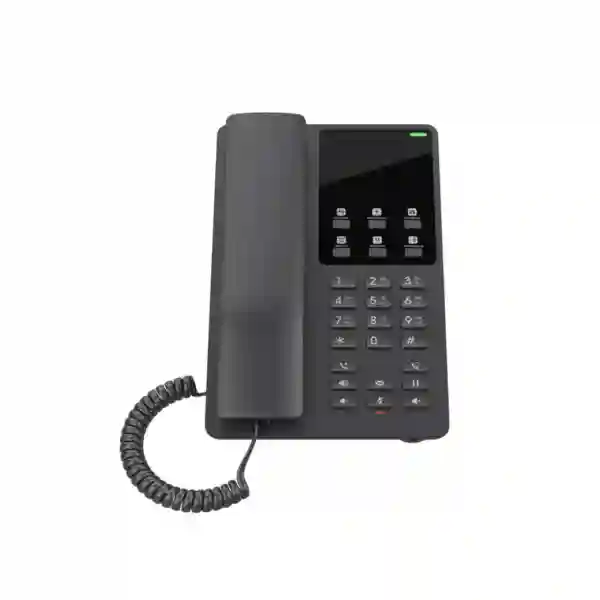
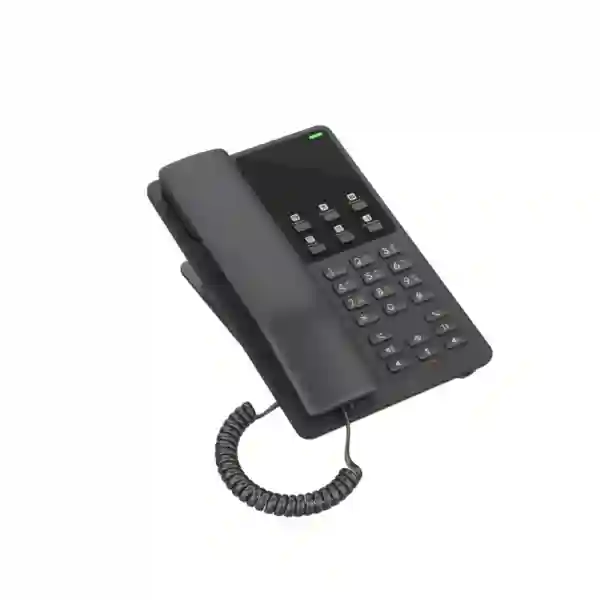
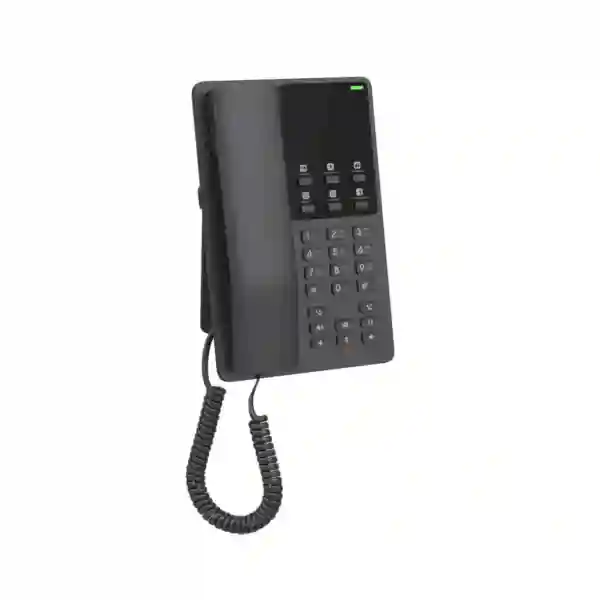
The Grandstream GHP621 is a compact black SIP hotel phone built for guest-room communication and other environments that need a simple, centrally manageable wired IP endpoint. It combines two SIP accounts and lines, six programmable keys, ten speed-dial keys, three-way conferencing, HD audio, secure provisioning and a 10/100 Mbps Ethernet connection with Power over Ethernet. For hotels, lodges, serviced apartments, hospitals, dormitories and similar projects, the design supports straightforward calling without adding a large display or unnecessary user complexity.
What is the Grandstream GHP621?
The GHP621 is part of Grandstream’s GHP62x family of compact hotel IP phones. It is the black wired model and should not be confused with the GHP621W, which is the Wi-Fi-adjacent variant. The GHP621 connects through a 10/100 Mbps Ethernet interface and can use Power over Ethernet, allowing network and power to be delivered over the same compatible network cable. This is particularly useful in structured hospitality deployments because a room phone can be connected to a PoE switch without requiring a separate power adapter at each bedside or desk position.
Grandstream positions the GHP62x family for hotels and guest rooms, but the same form factor can also fit hospitals, apartments, dormitories and other locations that need a compact SIP phone. The device supports two SIP accounts and lines, three-way audio conferencing, full-band Opus alongside common voice codecs, centralized configuration through Grandstream Device Management System, speed-dial functions and programmable keys that can be mapped to services such as reception, housekeeping, room service, concierge, emergency desk or another property-defined destination. A swappable faceplate supports visual customization, and Hearing Aid Compatibility helps broaden accessibility.
For a buyer, the important distinction is not simply whether the handset can make a SIP call. A hotel phone becomes part of a larger communications workflow involving the IP PBX, extension numbering, call permissions, emergency routing, VLAN design, PoE capacity, firmware management and service-key programming. FourTeck Tanzania therefore recommends evaluating the GHP621 as an endpoint within the total telephony and network design rather than as an isolated device. Buyers can review the broader FourTeck Tanzania technology shop for complementary IP telephony and network requirements.
Hospitality-first controls
Six programmable keys and ten speed-dial positions let a property create quick access to commonly used services. The purpose is to reduce the number of steps a guest needs to reach hotel departments or predefined call destinations.
Centralized management
GDMS support gives administrators a centralized method to configure, provision, monitor and maintain compatible Grandstream endpoints across a deployment. This becomes increasingly valuable when dozens or hundreds of room phones must follow the same baseline.
PoE installation
The wired GHP621 supports a 10/100 Mbps network connection with PoE. A suitable PoE switch can simplify room installation, centralize power backup through the network cabinet and reduce the need for a local power adapter.
Security features
Grandstream documents enterprise-oriented protections including secure boot, encrypted configuration/data handling and secure signaling options. Exact deployment security still depends on the PBX, network policy, credentials and firmware practices used by the customer.
Verified GHP621 feature overview
| Category | GHP621 capability |
|---|---|
| SIP accounts / lines | 2 SIP accounts, 2 lines |
| Programmable keys | 6 programmable keys |
| Speed dial | 10 speed-dial keys / positions |
| Network | 10/100 Mbps Ethernet with PoE for the wired GHP621 |
| Conferencing | Up to 3-way audio conferencing |
| Audio | HD audio with wideband/full-band codec support including Opus |
| Management | GDMS online device management and provisioning; additional provisioning methods depend on deployment |
| Installation | Desktop or wall-mount placement |
| Accessibility | Hearing Aid Compatibility (HAC) |
| Colour | Black |
A procurement team should verify hardware revision, current firmware, included accessories and compatibility against the exact project before ordering. In particular, wireless functionality belongs to GHP621W variants rather than the standard wired GHP621 described on this page.
Deployment and buying guidance
A successful hotel-phone project starts with room count and PBX architecture. Confirm how many guestrooms, suites, service desks, public areas and back-of-house locations require endpoints. Identify whether the existing phone system is SIP based, whether extension registration is local or cloud hosted, and whether any legacy analog interface is still involved. The GHP621 is a SIP endpoint, so an analog-only hotel PBX may require migration or an appropriate gateway rather than direct connection.
Next, check the Ethernet and PoE design. Each room needs a suitable wired network path if the standard GHP621 is used. The switch must have enough PoE-capable ports and enough total power budget for the phones and any other PoE devices sharing the same switch. Hotels commonly run IP phones, access points, cameras and access-control devices over the same physical switching infrastructure, so port quantity alone is not enough. VLAN design, uplink capacity and UPS support should also be reviewed.
Then define the guest-service key plan. A property may want dedicated buttons for reception, housekeeping, room service, concierge or emergency assistance. These destinations should be documented before large-scale provisioning so every handset follows the same service map. The swappable faceplate can help with labeling and branding, but the final printed layout should match the actual programming. If the property operates more than one language or service structure, decide whether rooms will share one standard layout or use zone-specific profiles.
For larger projects, centralized provisioning reduces manual configuration. GDMS can help administrators maintain a consistent baseline, but deployment policy should still cover admin passwords, firmware approval, SIP credentials, certificate handling and network access. Before mass installation, FourTeck recommends a pilot room or small test group. Validate voice registration, incoming and outgoing call behavior, service keys, VLAN/QoS, failover expectations, voicemail access, wall mounting if used and the guest experience. After the pilot is accepted, the same configuration can be replicated with fewer surprises.
Grandstream GHP621 Tanzania
For hospitality buyers in Tanzania, the Grandstream GHP621 is best evaluated as part of the complete guest-room communications environment. Hotels and lodges may be building a new SIP system, replacing aging analog room phones or standardizing endpoints across a mixed estate. The GHP621 suits projects that want a compact black phone, wired Ethernet and PoE, two SIP lines, predefined service access and centralized management. A Tanzania requirement should begin with the property profile: number of rooms, PBX platform, existing switching, cabling condition, PoE availability, service departments, emergency dialing requirements and whether phones will be desk-mounted or wall-mounted. These details determine whether the endpoint fits the architecture and how many supporting network components are required.
Tanzania deployments can range from business hotels in dense urban locations to resorts, lodges, apartments, healthcare facilities and institutional accommodation. Network conditions therefore vary significantly. A property with structured Cat5e/Cat6 cabling and PoE switching can use the wired GHP621 efficiently, while a location without room Ethernet may need cabling work or consideration of a different model architecture. Buyers should avoid assuming that the GHP621W is interchangeable with the GHP621: the model suffix matters because wireless capability is associated with the W variant, while the standard GHP621 is intended for wired Ethernet with PoE.
Procurement planning should also account for configuration and lifecycle management. A large hotel may have dozens or hundreds of handsets, making per-room manual setup inefficient. GDMS support can help administrators apply consistent settings, but the project should still define SIP credentials, firmware policy, VLAN and QoS settings, user-facing service keys and failover behavior. A room-by-room installation checklist can record extension number, switch port, handset location and service-key test results. This documentation becomes valuable when rooms are renovated, switches are replaced or the PBX configuration changes.
FourTeck Tanzania can help turn these inputs into a practical quotation discussion. Share the number of phones, hotel or facility type, exact city, current PBX or intended IP PBX, PoE switch information, preferred mounting style and any custom service-key requirements. For broader infrastructure planning, the FourTeck Tanzania business technology overview explains how IP telephony, networking, power and security systems can be considered together.
Grandstream GHP621 Dar es Salaam
Dar es Salaam hospitality projects often combine high guest turnover, business travel requirements, restaurant and conference operations, and a relatively dense IT environment. A Grandstream GHP621 deployment can be planned for guest rooms while front-desk, back-office and management users run different business phone models on the same SIP platform. The first design question is how the hotel’s call flow should work. Guest-room extensions may need restricted external dialing, one-touch access to reception and housekeeping, voicemail behavior, wake-up call integration through the PBX, and controlled transfer paths. These are PBX and provisioning decisions rather than properties of the handset alone, so they should be documented alongside the room-phone rollout.
In a multi-floor property, switching architecture is equally important. The GHP621 uses wired Ethernet and PoE, so the network design may involve access switches in floor cabinets or telecommunications rooms. Engineers should confirm cable lengths, patch-panel condition, PoE port availability, total power budget and uplink resilience. Where guest Wi-Fi access points, CCTV cameras and IP phones share PoE switches, capacity planning must account for all device classes. A hotel can also isolate voice traffic with VLANs and apply QoS so voice remains predictable when guest internet usage is heavy. These choices should be aligned with the firewall, core switch and PBX design rather than configured independently.
Dar es Salaam procurement teams may also care about rollout efficiency. A pilot floor is often more informative than deploying every room at once. Install several GHP621 phones, register them to the intended PBX, test incoming and outgoing calls, verify all programmable service keys, confirm emergency behavior and check the physical placement near bedsides or desks. If wall mounting is planned, test handset access and cable routing in an actual room type. Once the template is approved, GDMS-supported provisioning can help reduce repetitive manual configuration across the remaining rooms.
When requesting a quote, include room count, number of public-area phones, expected spare units, PBX brand/model, switch details and desired button labels. If a renovation is underway, include the planned opening date and cabling status so hardware supply is not treated separately from readiness. FourTeck can then discuss the GHP621 as part of a coordinated hospitality telephony requirement rather than a simple unit-price request.
Grandstream GHP621 Mwanza
In Mwanza, a GHP621 requirement may come from hotels, lakeside hospitality properties, serviced accommodation, hospitals, education campuses or residential facilities that want a compact wired SIP endpoint. The practical buying process should begin by separating endpoint needs from infrastructure needs. The phone provides two SIP accounts/lines, programmable service buttons, speed dial, conferencing, HD audio and centralized management support, but these capabilities depend on a working IP network and SIP call-control platform. If the site is migrating from analog room phones, the migration plan should identify which cabling can be reused, where Ethernet needs to be added and whether the existing PBX can register SIP endpoints.
Power resilience can be especially important for a hotel telephone system because guest communication should remain available during ordinary power interruptions where the wider system is designed for continuity. PoE helps centralize handset power, but continuity depends on whether the PoE switches, PBX, router and upstream network components are connected to suitable UPS capacity or another protected power source. A phone receiving PoE from an unprotected switch will stop operating when that switch loses power. Procurement should therefore consider the complete communication chain rather than assuming PoE automatically means backup power.
Mwanza properties can also benefit from a clear room-number and service-key convention. Each handset should be associated with a documented extension, room identity and switch port. Programmable buttons should have consistent functions across similar room categories. If the hotel has separate buildings, cottages or wings, the PBX dial plan should make internal calling intuitive while maintaining appropriate restrictions. A printed or customized faceplate can support the guest experience, but the labels need to match the programmed destinations precisely.
For quotation preparation, buyers should specify whether the requirement is a new build, renovation, replacement or expansion. State the number of rooms, buildings, floors, expected phone quantity, spare-unit policy and whether installation/configuration is required. Also note whether the network already provides PoE and voice VLANs. These details allow a more meaningful comparison between simply supplying GHP621 hardware and delivering a complete room-phone deployment with provisioning, network adjustments, testing and documentation.
Grandstream GHP621 Arusha
Arusha has a strong hospitality profile, including hotels, safari-oriented accommodation, lodges, conference properties and serviced facilities where guest communication can be part of daily operations. The Grandstream GHP621 can suit properties that prefer a simple black room phone connected to a SIP-based platform over wired Ethernet. Its programmable keys can be mapped to property services, while ten speed-dial positions and two SIP lines support straightforward call access without requiring guests to navigate a large screen or menu system. The exact user experience depends on how the PBX and keys are configured, so the project should begin with a guest-call workflow rather than a device list alone.
For a lodge or multi-building property, the network topology deserves special attention. Separate accommodation blocks may be linked by fiber, copper or wireless backhaul, but the GHP621 itself still expects a wired Ethernet connection at the handset location. The access switch serving each building should provide suitable PoE, VLAN support where required and enough uplink capacity. If the property also runs Wi-Fi access points and CCTV over PoE, engineers should calculate the total power demand and maintain spare switch capacity for replacements or future rooms. Cabling protection, equipment enclosures and UPS planning can be more important than handset specifications in determining long-term reliability.
Arusha properties may also need consistent service programming across room categories. A guest in any room should be able to use the same labeled key for reception or housekeeping where the operating model supports that function. When rooms are spread across wings or buildings, the PBX can still route those buttons to centralized teams. For larger deployments, GDMS-supported management can reduce the administrative burden of keeping phones aligned, but the hotel should retain its own configuration documentation and change-control process.
A useful quote request should include room count, number of buildings, existing PBX, network-switch models, whether PoE is already available and any branding or faceplate requirements. If the project is part of a wider hospitality IT upgrade, note dependencies such as Wi-Fi replacement, CCTV, firewall changes or structured cabling. This gives FourTeck a clearer basis for discussing how the GHP621 fits into the total site rather than treating telephony as an isolated purchase.
Grandstream GHP621 Dodoma
A Grandstream GHP621 project in Dodoma may serve hotels, government-related accommodation, institutional residences, hospitals, training centers or serviced apartments that require a compact SIP endpoint. The model is most useful when the project already has or is planning structured Ethernet and SIP call control. Its wired PoE connection can simplify room power arrangements, while programmable keys can provide direct access to service desks. Before purchase, however, the customer should confirm whether every room has a suitable network outlet and whether existing access switches can supply PoE to the full device quantity.
For facilities with centralized IT teams, management and documentation can be a major advantage. Large deployments should use a repeatable naming convention linking the room number, SIP extension, device identifier and switch port. This helps support staff identify whether a reported problem is caused by the handset, patching, switch configuration, PBX registration or upstream connectivity. GDMS can support remote configuration and monitoring of compatible Grandstream endpoints, but administrators should still define who controls firmware updates, credentials and configuration changes. A managed process is safer than allowing room phones to drift into inconsistent configurations over time.
Dodoma buyers may also be comparing a hotel-specific endpoint with a general office desk phone. The GHP621 is intentionally compact and service-oriented. It is not designed around a large graphical display or advanced desktop workflow. That can be an advantage in guestrooms because it keeps interaction simple and allows the property to present only the calling functions guests actually need. Office staff, receptionists or supervisors may still benefit from different phone models with larger screens, more line keys or richer directory access while sharing the same SIP platform.
When seeking pricing, provide the exact phone quantity, expected spare units, mounting preference, PBX platform and network readiness. Include whether custom labels or faceplates are required and whether the deployment should include configuration templates, installation, testing or staff handover. FourTeck Tanzania’s technology enquiry page is the appropriate place to submit these details for quotation preparation.
Grandstream GHP621 UAE
UAE hospitality deployments often emphasize standardization, fast room turnover, branded guest experience and integration with established IP telephony environments. The GHP621 can fit hotels, hotel apartments, staff accommodation, healthcare facilities and residential projects that want a compact black SIP phone with PoE. A project team should confirm whether the property uses an on-premises IP PBX, hosted SIP platform or centralized multi-property call-control system. The handset can register as a SIP endpoint, but features such as room-status workflows, wake-up calls, billing integration or PMS-related functions depend on the PBX and broader hospitality platform, not simply the phone itself.
Because UAE properties can include high room counts, provisioning efficiency matters. Instead of configuring each handset manually, administrators can build approved templates for SIP accounts, programmable service keys, codec priorities, time settings, network policies and security. GDMS provides centralized management capabilities for Grandstream endpoints, while a property’s own IT governance should determine who can make changes. Pilot testing should include different room categories and any wall-mount installation to confirm cable access, placement and guest usability before bulk deployment.
Network design should account for PoE power, voice VLANs and redundancy expectations. In a large hotel, access switches can serve phones, access points and cameras simultaneously. The design should therefore calculate switch power budget, port availability and uplink capacity with realistic expansion margins. UPS-backed network cabinets can help maintain service through short power disturbances, but continuity also requires the PBX, firewall, routers and any SIP trunk gateway to remain powered and connected. These dependencies should be written into the design so procurement teams understand which components are essential to the communications service.
For UAE projects, share property size, city, number of rooms, PBX details, cabling status, switch models and the desired programming plan when requesting a quote. Buyers comparing multiple properties can also standardize on one service-key layout and configuration baseline while adjusting room extensions per site. This creates a more maintainable estate and makes spare phones easier to stage and replace.
Grandstream GHP621 Uganda
For Uganda, the Grandstream GHP621 can support hospitality and institutional communications where a wired SIP room phone is preferred. Hotels, lodges, serviced apartments, hospitals and residential facilities should first confirm the existing call-control environment. If a property already uses SIP extensions, the phone can be incorporated into that platform subject to compatibility, credentials and network policy. If the property is still based on analog room phones, a migration assessment should identify whether the PBX will be replaced, expanded with SIP capability or connected through suitable gateways.
Uganda deployments can differ substantially between urban hotels and remote properties, so infrastructure preparation should be part of the purchasing discussion. The standard GHP621 depends on Ethernet at the endpoint, and PoE works only when the switch and cabling path support it. A lodge that lacks structured room cabling may need a network upgrade before the phones can be deployed. For sites with power variability, placing PoE switches and call-control infrastructure on correctly sized UPS systems can improve continuity. The UPS design should include switches, PBX, routers and other required components rather than only the phones.
Guest-service configuration should also be standardized. The programmable keys can represent reception, housekeeping, restaurant, security or other destinations, but each label must correspond to a tested PBX route. A consistent configuration reduces guest confusion and simplifies staff support. For a chain with multiple Ugandan properties, a shared template can be adapted by site while preserving the same service-key logic. GDMS-supported management can help administrators monitor and maintain larger Grandstream estates.
When planning procurement, include phone quantity, room count, PBX details, network-switch capability, mounting method and expected service-key layout. It is also useful to identify who will perform installation and who will manage the PBX after handover. Regional buyers can review FourTeck’s broader hotel phone solutions for Africa to frame the GHP621 alongside other hospitality telephone requirements.
Grandstream GHP621 Kampala
Kampala hotels and serviced properties may need room phones that are simple for guests yet manageable for IT staff. The GHP621 is suited to that balance because it offers SIP telephony, quick service access and centralized provisioning without relying on a large display. The black chassis can fit rooms where a dark, discreet finish is preferred. Two SIP accounts/lines provide flexibility for registration and call-handling design, while six programmable keys and ten speed-dial positions allow the property to define commonly used destinations. Three-way conferencing is available where the call scenario requires it.
A Kampala deployment should still begin with the network. If the hotel is renovating, confirm that every room outlet terminates correctly, that switch ports are available and that the PoE budget is sufficient. Voice VLANs can help separate phones from guest or corporate data networks, and QoS can prioritize real-time media where congestion is possible. The PBX and firewall should also be configured to support the intended SIP transport and security policies. Endpoint security is only one layer; weak shared passwords, outdated firmware or permissive network access can undermine the overall design.
Operations teams should create a standard room-phone commissioning sheet. Each installed GHP621 can be checked for extension registration, inbound calls, permitted outbound calls, voicemail behavior, programmable service keys, volume control and physical placement. The same sheet can record the device identifier, room number and switch port. This is useful after future maintenance because technicians can trace the endpoint without rediscovering the installation details. For hotels with frequent room refurbishment, a documented method also makes temporary removal and reinstallation easier.
Procurement teams should ask for more than a unit price. Clarify included accessories, hardware revision, current firmware, warranty terms, delivery scope and whether configuration assistance is part of the offer. If the deployment includes new switches, IP PBX or cabling, combine those requirements in one scope so dependencies are visible. That approach produces a more realistic project budget than buying phones first and discovering infrastructure gaps later.
Grandstream GHP621 Arua
Arua hospitality and institutional buyers may be looking for a practical SIP room phone that can be deployed without a complex user interface. The GHP621 can meet that requirement when wired Ethernet and PoE are available. Its main value in this setting is operational simplicity: guests or room users can access predefined services quickly, while administrators can manage the endpoint through standard SIP and Grandstream provisioning tools. The model should be selected only after confirming that the site has a compatible IP PBX or hosted SIP environment and sufficient network infrastructure.
For properties outside major metropolitan infrastructure, network and power resilience can become a bigger design consideration than the handset itself. The phone depends on the access switch, which depends on the site’s power and network backbone. A resilient design can place switch and PBX infrastructure behind UPS protection, maintain documented spare ports and use labeled structured cabling. Where internet connectivity is used for hosted calling, the design should also consider what happens if the WAN link is unavailable. Local extension-to-extension behavior may differ depending on whether the PBX is on-site or in the cloud, so failover expectations should be discussed before procurement.
A smaller property may not need sophisticated automation, but it still benefits from a standard configuration template. Decide which programmable keys are exposed to the guest, what numbers they dial and whether outside calls are permitted. Confirm emergency-call procedures and whether the property wants guests to reach security, reception or another desk with a dedicated button. Labeling should be readable and should match the configured function. If multiple properties are managed by one organization, shared templates can simplify staff training and inventory.
For an Arua quotation, provide the number of rooms, expected phone quantity, current PBX details, whether Ethernet is already present in each room and whether PoE switching is available. Mention any phased rollout, because a property may prefer to pilot one building before expanding. The goal is to ensure the hardware purchase aligns with the actual site readiness and support model.
Grandstream GHP621 Mbarara
Mbarara buyers considering the Grandstream GHP621 should evaluate both the guest experience and the support experience. For guests, the phone is intentionally straightforward: pick up the handset, dial or use predefined keys. For administrators, the device is part of a SIP and Ethernet environment that can be standardized, provisioned and monitored. This division is useful in hotels and institutional accommodation because the user should not need to understand the network while the IT team still needs control over configuration, security and lifecycle management.
A practical first step is to count endpoint locations. This may include guest rooms, reception support points, security desks, service areas, staff accommodation or common spaces. Not every location necessarily needs the same model. The GHP621 is optimized for compact room use, while reception or administrative desks may need more advanced Grandstream business phones. Separating user profiles helps avoid overspending on guestrooms or underspecifying front-desk users. All devices can still be designed around one compatible SIP platform where appropriate.
The wired GHP621 requires Ethernet and PoE. If the existing network was designed only for Wi-Fi or analog telephony, cabling could become the major project cost. Inspect room outlets, patch panels and switch cabinets before finalizing quantities. Where phones share the switching environment with access points and cameras, check the aggregate PoE load and keep room for expansion. A voice VLAN can simplify policy and troubleshooting, while clear switch-port labeling helps maintenance teams locate each room connection.
Before bulk order, configure several phones and run a complete acceptance test. Verify registration, audio quality, transfers where required, voicemail access, service buttons, restricted dialing, emergency behavior and power recovery. Reboot the switch or simulate a maintenance event to confirm phones return to service as expected. Document the approved template and room commissioning process. Buyers can then request a quote with a clear scope covering hardware, configuration, installation and any network remediation required.
Grandstream GHP621 Gulu
In Gulu, the GHP621 can be considered for hotels, guesthouses, healthcare settings, training facilities and accommodation projects that are moving toward IP-based communications. The phone itself is compact, but the surrounding design needs clear decisions. A SIP endpoint requires call control, addressing, network connectivity and power. If a facility is migrating from analog extensions, the project team should map existing room numbers and call flows into a new extension plan rather than simply replacing handsets one-for-one.
The six programmable keys can be useful for service access when the PBX routes them to appropriate destinations. A hotel might use buttons for reception, housekeeping and restaurant; a healthcare or residence environment may use nurse station, reception, security or administration. The labels and routes must be tested so the key function is predictable. Speed-dial keys can support additional predefined destinations. Because the GHP621 is a simple no-large-screen endpoint, careful labeling is important for usability.
Network readiness should be checked before equipment arrives. The standard GHP621 uses wired 10/100 Ethernet and PoE, so each endpoint needs a compatible path back to the switch. Older cabling or poorly terminated room outlets can cause intermittent registration and audio problems that may be mistaken for phone faults. A pilot test across several distant rooms or buildings can reveal cabling and switching issues before the full rollout. Where the site has multiple buildings, verify uplink reliability and VLAN continuity between switches.
For procurement, include intended quantity, expected expansion, spare-unit count, mounting requirements and the platform the phones will register to. Ask the supplier to identify the exact model as GHP621 rather than GHP621W to avoid receiving the wrong connectivity variant. If broader communication upgrades are planned, combine IP PBX, switching, UPS and cabling questions in the same project scope so installation dependencies are resolved before room handsets are commissioned.
Grandstream GHP621 Kenya
Kenya has a broad hospitality market spanning city hotels, coastal resorts, lodges, serviced apartments and institutional accommodation, and the GHP621 can fit properties that want a wired SIP guest-room phone with centralized management. Project planning should distinguish guest-room endpoints from front-office and administration phones. A GHP621 may be appropriate for rooms because it is compact and service-focused, while reception staff often need phones with larger displays, more programmable keys and higher call-handling visibility. A single SIP PBX can support different endpoint profiles when the platform and licensing permit it.
For room deployment, Ethernet and PoE are the fundamental infrastructure requirements. Property teams should check the number of switch ports, total PoE budget, cabling to guestrooms and whether voice traffic will use dedicated VLANs. Where cameras and access points share the same switches, room count can quickly turn into a capacity issue. Engineers should calculate real device demand and preserve spare capacity rather than specifying exactly one port per current endpoint. UPS-backed switching can also help maintain calling through brief power interruptions when the rest of the telephony chain is similarly protected.
Hotel chains operating multiple Kenyan properties can standardize the GHP621 configuration with consistent service keys and naming conventions. A shared template may define reception, housekeeping and other commonly used buttons, while each site receives its own extension ranges and PBX details. GDMS management can support administration of Grandstream endpoints, but local change procedures should still control firmware and credential updates. Spare handsets can be preconfigured or staged so failed units are replaced without lengthy setup.
Kenyan procurement teams should request the exact model, quantity, current hardware revision information and included accessories. They should also define whether the quote includes only supply or also provisioning, installation and acceptance testing. The FourTeck Kenya technology site provides regional context for IP PBX, VoIP phones and related business network solutions that can accompany a GHP621 project.
Grandstream GHP621 Kuwait
Kuwait hospitality and serviced-residence projects may choose the Grandstream GHP621 where a black, wired SIP room phone aligns with property standards. The endpoint’s compact design suits bedside tables, desks and wall-mount positions, while programmable keys can be configured for service access. Before selection, the integrator should verify the PBX environment, room-network design and dialing requirements. The phone does not by itself provide property-management integration; any PMS-related workflow depends on the call-control and hospitality software architecture used by the property.
Larger buildings should treat the room-phone rollout as a network access project. Each GHP621 consumes a switch port and PoE budget. Telecommunications rooms should therefore be assessed for port density, UPS capacity, uplink redundancy and available rack space. Voice VLANs and QoS can support predictable call behavior, but they must be consistently configured from access switch to core and PBX path. If SIP signaling crosses a firewall or connects to an external provider, security rules and NAT behavior should be tested during the pilot stage rather than after hundreds of phones are installed.
The guest-facing design should remain simple. Decide which services deserve direct keys, how labels will appear and whether room phones can dial external numbers directly. The PBX can enforce restrictions and route calls, while the handset provides the physical interface. In multilingual properties, button labels and printed inserts can be planned carefully so the guest is not presented with ambiguous abbreviations. The swappable faceplate can support a consistent room presentation when branding or service labeling is required.
For Kuwait quotations, share room quantity, building count, PBX model, switch infrastructure and whether phones are required for new construction or replacement. Also state whether the project is one property or part of a wider chain standardization. A clear scope should separate handset supply, configuration, custom labeling, installation, testing and support so procurement can compare offers on the same basis.
Grandstream GHP621 Ghana
Ghanaian hotels, resorts, serviced apartments, healthcare facilities and residences can evaluate the GHP621 when they need a compact wired SIP phone with PoE. The product is particularly relevant to projects replacing analog room phones with an IP-based platform, because it gives guests simple calling controls while allowing the IT team to centralize configuration. Migration planning should not assume existing telephone wiring can carry Ethernet. A survey should confirm whether structured network cabling already reaches each room or whether new data cabling is required.
The IP PBX design should define extension numbering, call permissions and service routes before handsets are deployed. Programmable keys can provide one-touch access to reception, housekeeping, restaurant or security, but those keys need PBX destinations and clear labels. If the property offers chargeable external calling, any billing or PMS integration must be supported by the telephony platform; the GHP621 is the endpoint rather than the billing engine. This distinction is important when comparing a handset replacement with a complete hospitality communications upgrade.
At the network layer, count all PoE devices, not only phones. Access points, CCTV cameras and door devices may share switches with the GHP621. The total PoE power budget and port density should be calculated with room for growth. In larger properties, a structured voice VLAN and documented switch-port map can simplify troubleshooting. Power protection should cover the switches and PBX if the hotel expects phones to remain available during short outages. Cloud-hosted PBX designs should also consider WAN availability and the local behavior expected during internet interruptions.
A Ghana quote request should include the exact number of guestrooms, non-room phones, spare units, PBX platform, location and network readiness. If the buyer has multiple properties, provide quantities by site and preferred rollout sequence. This allows the supplier to distinguish immediate hardware needs from future expansion and identify whether standardized configuration templates can be reused.
Grandstream GHP621 Nigeria
Nigeria offers many potential GHP621 use cases, from business hotels and large hospitality groups to hospitals, serviced apartments, dormitories and residential compounds. The phone’s value is strongest where the organization wants SIP telephony with a controlled, simplified endpoint. Two SIP accounts/lines, programmable keys, speed dial and centralized management support can serve a wide range of room-based communication workflows. Buyers should focus on architecture and scale rather than comparing only per-unit pricing.
In a large property, the deployment may involve hundreds of PoE endpoints. Network planners should calculate switch quantities by floor or building, reserve ports for expansion and verify the total PoE wattage. The GHP621 itself uses a 100 Mbps interface, which is more than sufficient for voice traffic, but the shared network may also carry other services with much greater bandwidth. Uplinks and core switching should therefore be sized for the combined environment. VLANs can separate voice from other traffic, and QoS can prioritize calls during congestion.
Nigeria projects should also include a power strategy. PoE centralizes handset power but transfers dependence to the network cabinet. If uninterrupted service is important, the PoE switch, PBX, router and any SIP gateway or internet equipment need coordinated backup. Generator or inverter availability does not replace careful UPS design for sensitive network equipment. The handover documentation should identify which systems must remain powered for internal and external calling to work.
For procurement, specify whether phones will be installed in one property or distributed across multiple sites. A multi-site operator can benefit from standardized configuration templates, common service-key layouts and centralized inventory. Pilot the chosen setup before mass deployment and test service numbers, emergency procedures, external dialing rules and recovery after power or network events. A complete quote should clarify exact model, quantity, logistics, configuration scope and support responsibilities so there is no ambiguity between GHP621 and GHP621W variants.
Grandstream GHP621 Seychelles
Seychelles hospitality properties may prioritize compact room design, reliable guest services and manageable infrastructure across island resorts or multi-building sites. The GHP621 can support these goals when a wired SIP endpoint is appropriate. Its black finish, compact footprint, programmable service keys and PoE connectivity can suit guest rooms where the phone should be functional without becoming visually dominant. The deployment should still begin with a technical survey because room cabling, switch location and power resilience can vary considerably between resort layouts.
In a spread-out resort, building interconnects are especially important. The GHP621 needs wired Ethernet to the local access switch, while that switch requires a reliable uplink back to the PBX or network core. Fiber may be used between buildings even though the handset itself connects over copper Ethernet within the room area. Any intermediate switch or media path should preserve voice VLANs and QoS where those features are part of the design. If a cloud PBX is used, internet resilience becomes part of the voice-service plan and should be tested under realistic failover conditions.
Maintenance planning can also reduce operational disruption. Resorts can hold configured spare phones and maintain a record mapping each room to its extension, device identity and switch port. If a handset is replaced, the technician can restore service quickly without reconstructing the entire configuration. GDMS-supported management can assist with centralized endpoint administration, but local documentation remains valuable when staff changes or connectivity to management services is temporarily unavailable.
Seychelles buyers should provide the number of rooms, number of buildings or islands involved, existing PBX, network topology and preferred deployment schedule. Shipping and project phasing can be significant, so quantities should include realistic spare units and any staged openings. The quote should distinguish hardware supply from installation, programming and custom labeling. This allows the property to plan both procurement and commissioning rather than treating the handset purchase as the whole communications project.
Compatibility, integration and network checklist
The GHP621 follows SIP standards and is designed for use with compatible SIP call-control systems, but interoperability should be validated with the specific PBX, firmware and features required by the customer. Basic registration and calling are only the first step. A hotel may also need voicemail, call transfer, service keys, emergency routing, restricted dialing, wake-up workflows, call accounting or integration through the PBX to a property-management environment. These functions should be confirmed at the system level rather than assumed from handset specifications.
PBX
Confirm SIP registration method, extension plan, line behavior, service destinations, codecs, dial plan and any hotel-specific application integration.
Switching
Check 10/100 Ethernet compatibility, PoE port availability, total PoE budget, VLAN support, uplinks, switch redundancy and spare capacity.
Security
Use strong unique credentials, approved firmware, controlled management access, secure provisioning and appropriate SIP/TLS/SRTP policies where supported by the full system.
Operations
Document room mappings, labels, spare devices, support contacts, change procedures and commissioning results so the deployment remains maintainable.
Who should consider the GHP621?
The GHP621 is a strong fit for organizations that want a simple room-focused SIP phone rather than a feature-heavy executive desk phone. Hotels and resorts can use it for guest access to reception and services. Serviced apartments can use it as an in-room extension. Hospitals and care environments can place it in rooms where a basic SIP endpoint is sufficient. Dormitories and institutional residences can use it for internal calling. The device is also appropriate where centralized provisioning and PoE simplify a larger rollout.
It may be less suitable when the room has no Ethernet cabling, when the user requires a large display or advanced directory interface, or when the organization expects Wi-Fi connectivity from the standard GHP621. In those cases, alternative Grandstream models or the appropriate Wi-Fi variant should be evaluated. Selection should be based on the room environment, network, PBX and user interaction rather than the model name alone.
Quotation checklist for Grandstream GHP621
To receive a more relevant quotation, provide the exact project information rather than only requesting “GHP621 price.” This helps identify infrastructure or configuration requirements that can affect the total scope.
- Required quantity and preferred spare-unit quantity
- Country, city and property/site name or type
- Number of rooms, buildings and floors
- Existing PBX brand/model or planned SIP platform
- Current network switch models and available PoE ports
- Whether each room already has Ethernet cabling
- Desktop or wall-mount preference
- Required programmable service keys and labels
- Any custom faceplate or branding requirement
- Installation, provisioning, testing and documentation scope
- Target project date or phased rollout schedule
Frequently asked questions
Does the Grandstream GHP621 have Wi-Fi?
The standard GHP621 is the wired Ethernet model. Wi-Fi functionality belongs to the GHP621W variant. Buyers should verify the exact model suffix before ordering.
Can the GHP621 use Power over Ethernet?
Yes. Grandstream documents a 10/100 Mbps Ethernet interface with PoE for the wired GHP621. The connected switch must provide compatible PoE and sufficient power budget.
How many SIP lines does GHP621 support?
The GHP621 supports two SIP accounts and two lines.
How many programmable keys are available?
Current official Grandstream material for the GHP62x family specifies six programmable keys and ten speed-dial keys. Buyers should use current official documentation rather than older reseller descriptions that may contain outdated key counts.
Can the GHP621 be centrally managed?
Yes. It is supported by Grandstream Device Management System for centralized configuration, provisioning, management and monitoring of compatible Grandstream endpoints.
Is the GHP621 only for hotels?
No. Grandstream positions the series primarily for hospitality-style use but also identifies apartments, dormitories, hospitals and similar environments as suitable deployment scenarios.
Can it be wall mounted?
Yes. Grandstream documentation describes desktop and wall-mount installation for the GHP62x series.
Does buying the phone include a hotel PBX?
No. The GHP621 is a SIP endpoint. A compatible IP PBX or SIP service, network connectivity and configuration are separate parts of the solution unless specifically included in a supplier quotation.
Decision recap
Choose the GHP621 when the requirement is a compact black wired hotel-style SIP phone with PoE, two SIP lines, service-oriented programmable keys, speed dial, HD audio and centralized Grandstream management. Confirm Ethernet availability, PoE switching, PBX compatibility and the service-key plan before ordering. Do not assume Wi-Fi support in the standard model, and do not treat handset purchase as a substitute for PBX, network and power planning.
For Tanzania projects, FourTeck can help buyers prepare a clearer scope covering room quantity, network readiness, PBX requirements, configuration and deployment. This reduces the risk of ordering endpoints before the surrounding infrastructure is ready.
Consult FourTeck about a GHP621 deployment
A useful consultation should answer four questions: Is the GHP621 the right room endpoint? Will the existing PBX support the required call flows? Is the network ready to provide Ethernet and PoE to every location? What configuration, installation and support scope should be included? Bring the room count, PBX details, switch information and desired service keys, and the discussion can focus on a workable deployment rather than a generic product list.


Reviews
There are no reviews yet.