
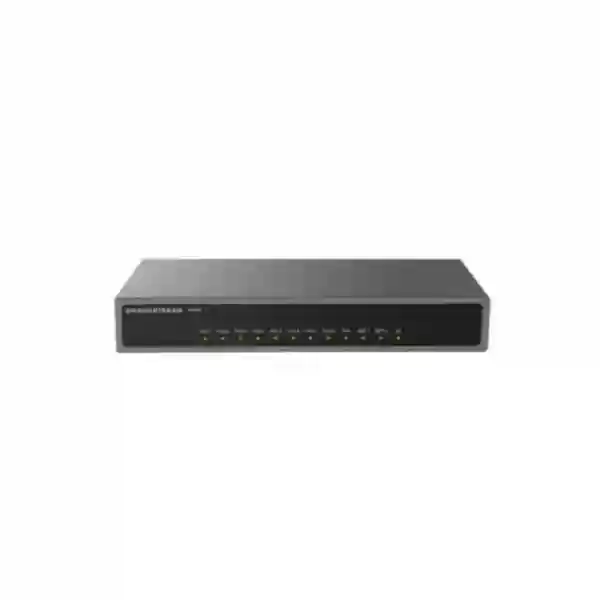
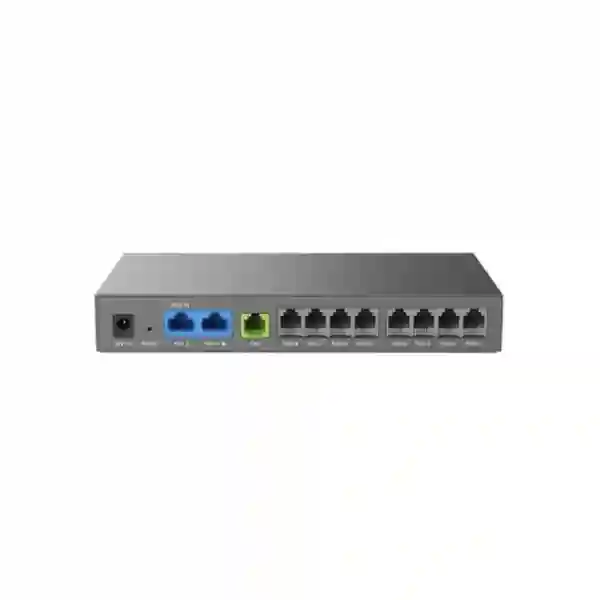
Grandstream HT881 Analog FXO Gateway
The Grandstream HT881 is an analog FXO gateway built for businesses that need to connect conventional PSTN telephone lines to a modern SIP or IP PBX environment without discarding useful analog services. The model provides eight RJ11 FXO ports for PSTN connections and one RJ11 FXS port, making it suitable for offices, branch networks, hospitality sites, institutions and multi-site businesses that need controlled migration from legacy telephony to IP communications. It can translate calls between SIP/RTP networks and traditional analog telephone circuits, while supporting secure signaling and media options, automated provisioning and practical continuity features.
SIP / RTP Integration
T.38 Fax
PoE Input
PSTN-to-SIP migration
Use existing analog telephone lines with a SIP-based communications platform, giving organizations a staged path toward VoIP while preserving services that still depend on PSTN circuits.
Eight FXO interfaces
The HT881 provides eight RJ11 FXO ports for connecting incoming analog lines from a traditional telephone provider or legacy PBX environment.
Secure communications
Support for SRTP, TLS/SIPS/HTTPS and secure automated provisioning helps organizations build a more controlled voice deployment when the wider network is configured correctly.
Business continuity features
SIP server failover and lifeline behavior can help preserve calling paths in selected fault conditions, provided the surrounding PBX, network and power design are also planned appropriately.
What is the Grandstream HT881?
The HT881 belongs to Grandstream’s HT8x1 analog FXO gateway family. Its core purpose is to bridge traditional PSTN telephone lines and an IP communications environment. In practical terms, an organization can connect up to eight analog outside lines to the gateway and then route those lines through a SIP-compatible IP PBX, softswitch or hosted voice platform. The gateway can also provide an analog endpoint through its single FXS port. This makes the unit useful in migration projects where the business wants IP PBX features such as centralized call routing, extensions, branch integration and SIP connectivity but cannot immediately replace every analog carrier line.
The HT881 is different from an FXS-heavy analog telephone adapter. FXO ports are intended to connect to analog telephone lines coming from the public network or another analog PBX. The FXS port, by contrast, supplies the analog station interface used by an analog telephone or fax device. Correctly understanding that distinction is essential before ordering. A project that needs eight analog extensions requires a different type of gateway from a project that needs eight PSTN trunks. The HT881 is primarily the latter: an eight-FXO gateway with one FXS interface.
Verified Grandstream HT881 technical highlights
| Area | HT881 capability |
|---|---|
| Telephony interfaces | 8 RJ11 FXO ports and 1 RJ11 FXS port |
| SIP profiles | Supports multiple SIP profiles; Grandstream’s current product literature lists three SIP profiles across the family |
| Network interfaces | Two RJ45 network ports; the current Grandstream datasheet lists 10/100/1000 Mbps, with Gigabit operation in bridge mode and a lower NAT-mode throughput note |
| Power | 802.3af PoE-PD input on one network port and DC input support |
| Fax | T.38 Group 3 fax relay up to 14.4 kbps and G.711 fax pass-through fallback |
| Voice codecs | G.711, G.723.1, G.729, G.726-32, iLBC and Opus, with jitter buffering and echo cancellation functions |
| Security | SRTP media protection, TLS/SIPS/HTTPS control options and AES-based secure provisioning |
| Provisioning | HTTP/HTTPS, TFTP, SSH, TR-069 and automated provisioning capabilities, with web-based management and syslog support |
Configuration details can vary with firmware and deployment mode. Before production deployment, confirm the current Grandstream firmware, PBX compatibility, carrier line characteristics and any local telecom requirements.
Typical use cases
Common projects include connecting analog PSTN lines to an on-premises IP PBX, giving a branch office controlled access to legacy telephone circuits, consolidating analog lines into centralized call routing, supporting a staged migration from an older PBX, and retaining selected analog services while users move to SIP extensions. The HT881 can also be valuable where eight incoming or outgoing analog trunks need to be presented to a modern PBX without replacing the carrier connection immediately.
Integration planning
A successful deployment starts with line mapping. Identify which PSTN number terminates on each FXO port, define the inbound destination for each line, determine outbound routing rules, decide whether hunting groups are needed, and confirm caller ID presentation and disconnect signaling with the carrier. The gateway should be given stable network addressing, voice VLAN and QoS treatment where appropriate, and a documented path to the PBX and management network.
Security planning
Voice gateways should not be exposed casually to the public internet. Restrict management access, use strong administrative credentials, prefer encrypted signaling and media where supported end to end, limit SIP reachability through firewall policy, keep firmware current and maintain configuration backups. If remote management is required, place it behind an appropriate secure access method rather than opening broad management ports to the internet.
Grandstream HT881 Tanzania
For organizations in Tanzania, the Grandstream HT881 is relevant when analog PSTN circuits remain part of the business communication architecture but the organization wants to use an IP PBX, SIP extensions or centralized call routing. This is common in modernization projects where replacing every telecommunications component at once is either unnecessary or operationally disruptive. The HT881 allows a business to preserve up to eight analog outside lines while moving the call-control layer onto an IP platform. That can simplify extension management, department routing and branch integration without forcing an immediate carrier migration.
A Tanzania deployment should begin by documenting the existing telephone service. Count the active PSTN lines, identify the numbers associated with each circuit, record which lines carry priority inbound calls, and note any fax, alarm, modem or special-purpose service that may behave differently from normal voice. The HT881 supports T.38 fax, but fax behavior always depends on the full path, including the attached device, PBX configuration, codec selection, SIP provider and far-end network. Testing with real documents is therefore more useful than assuming that a standards-compliant feature alone guarantees performance.
For buyers comparing a gateway with a complete IP PBX replacement, the decision should be based on how much analog infrastructure must remain. If the business is keeping eight PSTN trunks for resilience, regulatory reasons, customer contact continuity or carrier availability, the HT881 can be an efficient bridge. If the objective is to eliminate PSTN entirely and move to SIP trunks, the project may instead focus on PBX, firewall and carrier readiness. FourTeck Tanzania can be used as a starting point for broader voice, networking and infrastructure planning through the FourTeck Tanzania technology solutions overview.
Grandstream HT881 Dar es Salaam
Businesses in Dar es Salaam often operate headquarters, branch offices, hotels, professional services offices, warehouses, retail environments and customer-facing teams where reliable inbound telephone access remains important. In such environments, a Grandstream HT881 can serve as a controlled handoff between traditional analog lines and an IP PBX. The value is not merely that the unit has eight FXO ports. The more important benefit is that those lines can become part of an organized call-routing plan with reception groups, department destinations, time conditions and extensions managed by the connected PBX.
For a Dar es Salaam office that is migrating from a legacy PBX, the practical first step is to map the old trunks before touching the cabling. Each analog line should be identified, labeled and associated with its public number and operational purpose. The design can then decide whether specific numbers route directly to departments, enter an IVR, ring reception or remain reserved for outbound use. Because disconnect signaling and caller ID presentation can vary between analog services, acceptance testing should include inbound answer, hang-up detection, outbound dialing, caller ID, busy conditions and failover behavior.
Network quality also matters. The gateway and IP PBX may sit only a few meters apart, but poor VLAN configuration, duplex problems, unstable switching or firewall misconfiguration can still produce difficult-to-diagnose voice issues. Where possible, place voice infrastructure on a clearly documented LAN segment, maintain configuration backups and ensure that UPS strategy covers the gateway, PBX, switch and router together. A lifeline function on the gateway is useful, but business continuity should be designed across the full voice chain rather than relying on one feature. Procurement teams in Dar es Salaam should therefore request a bill of materials that includes the gateway, any required PBX, switching, PoE source, rack accessories, patching and installation tasks, instead of treating the HT881 as an isolated box.
Grandstream HT881 Mwanza
For organizations in Mwanza, the HT881 can be a practical choice when branch or regional offices still depend on analog carrier lines but want the flexibility of SIP-based call control. A typical project might involve a main office with an IP PBX, several departments using IP phones, and a set of existing PSTN numbers that customers already know. By terminating those analog lines on the eight FXO interfaces, the business can preserve established contact numbers while modernizing the internal extension environment. This is particularly useful when changing the external carrier service is not part of the current project scope.
Mwanza buyers should pay attention to physical infrastructure as well as telephony settings. Voice gateways are small appliances, but they still need stable power, a clean rack or equipment shelf, suitable ventilation and protected network connectivity. If the site experiences power interruptions, a UPS should be sized for the complete communications path that must remain active: gateway, PBX, PoE switch, router and any required internet equipment. Keeping only the gateway alive while the switch or PBX has shut down does not maintain normal service. The same principle applies to network redundancy and internet failover where remote SIP services are involved.
Before ordering, document how many analog lines are actually active and whether eight FXO ports are justified. If there are only four PSTN lines and no expected growth, a lower-port model may fit better. If there are more than eight lines, the design may require multiple gateways or a different class of voice interface. Also verify whether any analog line carries fax or special equipment, because those circuits deserve separate testing. The best quotation request will include the number of PSTN lines, PBX make and model, expected inbound call flow, outbound dialing rules, internet arrangement and whether remote branches need access to the same telephony system.
Grandstream HT881 Arusha
Arusha businesses in hospitality, tourism, professional services, education and administration may need to keep traditional telephone numbers while upgrading internal communications. The Grandstream HT881 provides a way to connect up to eight analog PSTN circuits into a SIP-oriented architecture, which can help preserve continuity for customers calling established numbers. Rather than connecting each external line to an older key system, the lines can be presented to an IP PBX where routing, extension groups and reception handling can be managed more consistently.
Hospitality and customer-service environments should design the gateway around call flow, not only port count. Determine which numbers are public, which are used for reservations or administration, which need after-hours routing and whether any line should bypass automated menus. If an analog number has historical importance to guests or partners, keeping that line active through a migration can reduce disruption. The HT881 can support this phased approach while new desk phones, softphones or branch extensions operate on the IP side. The gateway therefore becomes a transition point between old and new rather than an end in itself.
Installation teams should verify caller ID format, disconnect supervision and outbound dialing behavior with the actual analog provider. These details can differ and may require tuning in the gateway or PBX. Security should also be treated as part of deployment: change default credentials, restrict administration access, use encrypted management, back up the final configuration and avoid exposing the gateway directly to the internet. For a multi-building or campus environment, document which rack and switch port serve the device, label each FXO line and keep a simple port-to-number map. That documentation often saves more support time than another layer of advanced configuration. A well-run Arusha project should finish with functional testing, a saved configuration, line mapping and clear handover notes for the IT team.
Grandstream HT881 Dodoma
In Dodoma, the Grandstream HT881 can support organizations that need to integrate legacy PSTN services with modern IP communications while keeping procurement and migration controlled. Government-related offices, private enterprises, institutions, NGOs and service organizations may have telephone numbers that are already published and operational processes built around them. Replacing those services abruptly can introduce unnecessary risk. An FXO gateway allows the existing analog lines to remain in use while the internal PBX platform, extensions and call-routing logic move to SIP.
A good Dodoma deployment separates business requirements from technical implementation. Start with questions such as: Which inbound numbers must remain reachable? Which departments should receive each number? Does the organization need after-hours routing? Are there critical outbound lines that should be reserved for specific teams? Does any circuit support fax? Is call recording required at the PBX level? Once those requirements are clear, the gateway can be configured as part of a deliberate call plan rather than as a generic PSTN adapter.
For procurement, request enough information to avoid hidden integration costs. Confirm the PBX platform, network switch availability, IP addressing, rack location, PoE availability, power backup and number of analog lines. The current Grandstream datasheet lists one network interface with PoE-PD support, which can simplify powering the gateway from suitable PoE infrastructure. However, PoE should still be coordinated with the switch power budget and UPS strategy. Administrators should also plan firmware management, secure remote access and configuration backup. The HT881 supports centralized and automated provisioning capabilities, but automation is most useful when device ownership, naming, credentials and change control are already defined. A documented deployment can be maintained more easily by internal IT staff or a service partner over the device lifecycle.
Grandstream HT881 UAE
For businesses operating in the UAE, the HT881 is useful where an existing analog trunk service needs to be integrated with an IP PBX, SIP server or multi-site voice environment. Companies that have long-established public numbers, analog backup circuits or legacy PBX connections can use an eight-port FXO gateway to preserve those services while changing the internal communications platform. The same architecture can also be relevant to regional organizations that want a consistent gateway model across offices in the UAE and East Africa, provided each country’s carrier interface and regulatory requirements are checked independently.
A UAE project should pay particular attention to telecom-service boundaries and PBX compliance requirements. The HT881 provides the gateway functionality, but the overall solution must still match the services supplied by the relevant operator and the organization’s approved communications design. Do not assume that every analog circuit presents caller ID, disconnect supervision or dialing in exactly the same way. Functional testing should be performed on the live service, and any SIP trunk or hosted PBX element should be configured according to the provider’s requirements.
Regional IT teams can benefit from standardizing documentation even when local carrier details differ. Use a common naming system for FXO ports, define consistent PBX trunk labels, record firmware versions, maintain encrypted configuration backups and document the LAN/VLAN location of the device. Where a company also operates in Tanzania, Kenya or Uganda, a shared template can make remote support easier. For wider UAE infrastructure and communications projects, buyers can review the FourTeck UAE technology portfolio and coordinate gateway procurement with IP PBX, switching, firewall and support requirements rather than treating the voice gateway as a standalone purchase.
Grandstream HT881 Uganda
Organizations in Uganda can use the Grandstream HT881 when they need to bring multiple analog PSTN lines into a SIP-based voice system without abandoning those lines immediately. The eight FXO ports are appropriate for sites where several established telephone numbers remain important for customers, suppliers or operational continuity. The connected IP PBX can then apply modern call control such as ring groups, IVR destinations, extensions and time-based routing while the public telephone circuits remain analog at the carrier edge.
The decision to use an FXO gateway should come from the telephony inventory. Count the analog trunks, confirm who owns each number, determine typical call volume and identify whether any line is retained only for failover. If a business is actively migrating to SIP trunks, a temporary HT881 deployment may provide a transition path. If analog service will remain for years, the gateway can become a stable long-term interface, provided firmware maintenance, configuration backup and spare planning are included. The right lifecycle approach depends on how critical those PSTN lines are to daily operations.
Uganda projects should also coordinate power and connectivity. The voice path can include the analog carrier, HT881, LAN switch, IP PBX, firewall and IP phones. A weak link anywhere can disrupt calls. Use stable power, document switch ports and VLANs, verify QoS where voice shares busy links, and restrict gateway administration to trusted networks. When multiple branches are involved, standardize line labels and trunk names so central support teams can troubleshoot without guessing. Buyers handling projects in Uganda can also consult the FourTeck Uganda regional site for connected voice, network and infrastructure requirements that may sit around the HT881 deployment.
Grandstream HT881 Kampala
Kampala businesses often need a practical way to modernize telephone infrastructure while preserving published analog numbers. The Grandstream HT881 can connect up to eight analog trunks to a SIP-capable PBX, giving IT teams a way to introduce modern extension management and routing without waiting for every external line to be converted to an IP-based service. This can be particularly useful for head offices, hotels, clinics, schools, financial-service branches and service companies with reception-heavy call flows.
A reception environment illustrates why configuration matters. Several PSTN numbers may all need to reach the same reception group, while one direct line goes to finance and another is reserved for management or after-hours use. On the HT881 and connected PBX, those lines should be labeled logically and mapped to clear destinations. Outbound rules can likewise choose a preferred trunk, distribute calls across available lines or reserve certain circuits. Testing should include situations where one or more lines are busy, the primary SIP server is unavailable or the network is interrupted, so the support team understands how the system behaves.
Kampala deployments should also evaluate network security. A voice gateway is an IP device and therefore needs the same basic governance as switches, PBXs and other infrastructure. Place management access behind suitable controls, use strong credentials, apply firmware updates after validation, record configuration changes and monitor logs when troubleshooting. If remote support is required, use a secured administrative path rather than opening management interfaces broadly. Procurement should include the gateway plus any required patch leads, rack accommodation, PoE or DC power arrangement, UPS capacity, PBX licensing and professional configuration. That complete view gives decision-makers a more accurate project cost than comparing gateway hardware prices alone.
Grandstream HT881 Arua
For an office or institution in Arua, the HT881 can help bridge existing analog telephone circuits into an IP-based communications setup while keeping deployment relatively straightforward. The gateway’s eight FXO ports make it suitable for sites with multiple outside lines that need to feed a central PBX. Instead of maintaining separate analog handsets or an aging PBX solely to preserve those trunks, organizations can move internal users to SIP extensions and keep the analog carrier interface at the gateway.
In locations where support access may take longer than in a major metropolitan area, documentation and remote manageability become especially important. The installer should record the IP address, switch port, VLAN, firmware version, administrator ownership and the PSTN number connected to every FXO port. A copy of the known-good configuration should be stored securely. These simple practices allow remote technical staff to diagnose whether a problem is related to a carrier line, a specific gateway port, the LAN or the PBX before dispatching someone to site.
Power design deserves similar attention. If voice service is important during short utility interruptions, the gateway, switch, PBX and routing equipment should be on a properly sized UPS. PoE input can simplify cabling where a suitable backed-up PoE switch exists, but it does not replace whole-system power planning. Organizations should also verify environmental conditions, keep the gateway away from excessive heat or dust and avoid unsupported cabling arrangements. Before purchasing, confirm the number of analog lines, whether those lines carry voice or fax, the PBX type and the desired incoming call routing. That information helps determine whether HT881 is the right eight-port model or whether another gateway size would be more economical and easier to support.
Grandstream HT881 Mbarara
Mbarara organizations can use the Grandstream HT881 to integrate analog outside lines with a SIP PBX while keeping a familiar public telephone presence. This is useful for businesses and institutions that have accumulated multiple PSTN numbers over time and now want centralized call handling. Once the lines terminate on the gateway, the connected PBX can route them to extensions, ring groups or departments, which can simplify reception and reduce dependence on legacy key systems.
Before deployment, create a small line plan. List each telephone number, its normal destination, outbound permissions and whether it is part of a hunt group. Also identify any line that must remain dedicated to fax or another analog function. Although the HT881 supports T.38 fax functionality, fax should be tested with the exact PBX and service path in production conditions. In some environments, G.711 pass-through may be part of the fallback behavior, so codec and jitter conditions matter. Testing should use real inbound and outbound calls rather than only checking whether the SIP registration is active.
A good Mbarara installation also prepares for future changes. Label all RJ11 leads, reserve rack space, document the gateway’s LAN connection and keep an updated configuration file. If new numbers are added later, the team should know which FXO ports are free and how routing is structured. If the organization eventually converts to SIP trunks, the HT881 can be retired deliberately rather than remaining as an undocumented legacy dependency. Buyers should therefore think of the gateway as part of a telephony architecture with a clear purpose, not just a box that converts analog to IP. That approach makes procurement, support and eventual migration more predictable.
Grandstream HT881 Gulu
In Gulu, the Grandstream HT881 can be used by organizations that need to connect existing analog carrier lines to a modern IP PBX while minimizing disruption to established telephone numbers. The gateway is especially relevant when several external lines still serve important inbound calls but users are moving to SIP phones, softphones or centralized PBX features. Its eight FXO interfaces provide enough capacity for a medium-sized set of PSTN trunks without requiring one gateway per line.
The project should begin with a technical audit of the current line environment. Confirm that the services are truly analog PSTN circuits and determine their signaling characteristics. Record caller ID behavior, disconnect supervision and any dialing prefixes. If the old PBX uses unusual line conditioning or if the carrier presents nonstandard behavior, test one line first before migrating all eight. Phased cutover can reduce risk because the team can validate inbound, outbound and hang-up behavior on a single circuit before moving the rest.
After migration, operational clarity is important. The PBX should have trunk names that correspond to physical FXO ports, and each cable should be labeled with its public number. Network diagrams should show where the gateway connects and which VLAN or subnet it uses. Keep management access restricted and retain a backup after final acceptance. If remote support is expected, define a secure path for administrators and avoid sharing default credentials. For sites with intermittent power, a UPS for the entire communications stack is more valuable than protecting only one appliance. These practices help a Gulu deployment remain maintainable even when the team that supports it is not physically at the site every day.
Grandstream HT881 Kenya
Kenyan businesses that are modernizing from analog trunks to IP telephony can use the HT881 as a bridge between the two environments. An organization may have established PSTN numbers for customer service, reservations, sales or branch operations while also deploying an IP PBX and SIP endpoints. With eight FXO ports, the HT881 can terminate those analog lines and present them to the PBX, allowing the internal call architecture to evolve without forcing an immediate change to every public number or carrier service.
For multi-branch companies, consistency is a major benefit. Standard trunk labels, dial plans, gateway firmware policies and security settings can make remote support easier across Nairobi, Mombasa and other locations, even when line counts differ. However, carrier-side details should still be tested locally. Caller ID, disconnect methods and line quality are analog characteristics that can differ by service. A successful project validates those conditions on the actual installed circuits and adjusts the gateway and PBX accordingly.
Kenya procurement teams should ask for a solution-level quotation if the gateway is part of a larger migration. Include the IP PBX or hosted platform, voice licenses, switches, PoE, UPS, rack accessories and professional configuration where needed. If the branch is connecting to a centralized PBX over a WAN or VPN, include firewall and bandwidth planning as well. Voice traffic is sensitive to packet loss and delay, so the IP side deserves the same attention as the analog side. For organizations coordinating East African deployments, the FourTeck Kenya regional site can help connect gateway requirements with wider IP telephony, networking and branch infrastructure planning.
Grandstream HT881 Kuwait
For organizations in Kuwait, the Grandstream HT881 can provide a practical analog-to-SIP interface where multiple PSTN circuits remain in service. This can suit businesses with existing public numbers, analog backup lines or branch telephony that has not yet moved fully to SIP trunks. The eight FXO ports allow the gateway to aggregate several analog circuits into an IP PBX environment, enabling centralized call routing while preserving the carrier edge.
A Kuwait deployment should verify the exact telecom service and PBX design before purchase. The gateway itself does not determine whether a carrier line can provide every expected feature. Caller ID presentation, disconnect supervision, dialing behavior and regulatory requirements need to be confirmed on the live circuit. If the IP PBX is cloud-hosted, the project should also account for internet resilience, firewall policy, NAT behavior and voice quality. If it is on premises, keep the gateway and PBX on a secure and well-documented LAN with appropriate QoS and power protection.
Administrators should use the HT881’s management and security capabilities within a controlled operations process. Keep credentials unique, restrict access, maintain firmware through approved change windows and save a known-good configuration after commissioning. If automated provisioning is used, protect the provisioning server and configuration files. For organizations with regional branches, consider a standard deployment template that documents FXO port assignments, PBX trunk names, SIP server addresses, security settings and acceptance tests. That standard reduces troubleshooting time and makes it easier to compare behavior across sites. When the business eventually replaces analog trunks with SIP services, the same documentation also helps identify which gateway functions can be retired cleanly.
Grandstream HT881 Ghana
Businesses in Ghana can deploy the Grandstream HT881 when legacy analog lines need to remain available inside a modern IP telephony architecture. The gateway converts calls between the PSTN-facing FXO interfaces and SIP/RTP on the IP side, which can help organizations keep customer-facing numbers while gaining PBX features such as extension routing, ring groups, office-hour schedules and centralized administration. This is a transition strategy rather than a requirement to replace the external telephone service immediately.
The eight-port capacity should be matched carefully to the actual line inventory. If a site has six active trunks and expects growth, the HT881 offers spare capacity. If it has only two or three lines, a smaller gateway may be more economical. Conversely, sites with more than eight trunks may need multiple devices or a different gateway architecture. Procurement should therefore begin with a verified count, not an assumption based on the number of telephone handsets in the office. FXO ports connect outside lines; they are not interchangeable with FXS extension ports.
Ghana deployments should include acceptance testing for caller ID, inbound ring detection, outbound dialing, hang-up detection and call quality. Where fax is required, test T.38 and fallback behavior end to end. Where the PBX is hosted remotely, review internet availability, firewall configuration and secure SIP connectivity. Keep the gateway in a protected network zone and avoid unnecessary public exposure. Power backup should protect the complete call path. Finally, provide the support team with a simple table showing public number, physical FXO port, PBX trunk name and normal destination. That small piece of documentation can dramatically shorten troubleshooting when a single analog line develops a fault.
Grandstream HT881 Nigeria
In Nigeria, the Grandstream HT881 can support businesses that continue to use analog PSTN services while upgrading to SIP-based internal communications. The gateway’s eight FXO ports make it relevant for offices with several carrier lines that need to feed an IP PBX. Instead of managing those lines through a legacy analog PBX, the business can route them into a modern platform for extensions, queues, IVR, departmental distribution and multi-site connectivity, while keeping the analog circuits active at the edge.
Reliability planning should consider both analog and IP dependencies. An analog carrier line may continue to function when the internet is unavailable, but if the gateway, PBX or switch loses power, the normal SIP call path can still fail. The HT881 includes lifeline functionality, but it should be understood as one element of a broader continuity design. For critical environments, document which line participates in lifeline behavior, which analog handset is connected to the FXS port, what happens during a PBX outage and how users should place emergency or priority calls when normal routing is unavailable.
Nigeria deployments should also emphasize security and operational discipline. Restrict web management, use encrypted protocols where possible, change default credentials, keep backups and validate firmware before upgrades. If the gateway registers to a remote SIP platform, apply firewall rules that limit exposure and monitor unusual registration or call behavior. For larger businesses with multiple offices, standardize naming and configuration so that support teams can compare sites quickly. A procurement brief should include analog line count, PBX type, expected simultaneous calls, fax requirements, LAN design, power backup and target go-live process. That information helps suppliers quote the correct gateway model and the supporting infrastructure required for a dependable rollout.
Grandstream HT881 Seychelles
For organizations in Seychelles, the HT881 can be useful when existing analog telephone services must be retained while the internal voice system moves to SIP. Hospitality, professional services and distributed operations may rely on public numbers that customers already recognize. An eight-port FXO gateway allows those numbers to terminate on an IP PBX without requiring every carrier service to be changed at the same time. This can make migration easier to schedule and reduce disruption during a communications upgrade.
In island environments, resilience and remote support can carry extra importance. A well-documented HT881 installation should include clear cable labels, a port map, IP settings, PBX trunk names, firmware version and a secure copy of the configuration. If the solution is supported from another location, administrators need a safe remote-access method that does not expose the gateway directly to the public internet. Monitoring and logs can help distinguish between a local analog-line fault, a SIP registration problem and a network issue before anyone travels to site.
The physical environment should also be considered. Install the gateway in a clean, ventilated location with stable power and suitable surge or UPS protection as part of the wider communications rack. If PoE is used, confirm switch compatibility and power budget. If the IP PBX is hosted off-island or in a cloud environment, internet resilience becomes part of voice design, and a secondary path may be worth evaluating based on business criticality. Procurement teams should verify the exact number of PSTN lines, expected call patterns and any fax requirements before choosing the model. The goal is to use the HT881 where eight FXO interfaces genuinely solve a defined integration need, not simply because it offers the highest port count in its immediate family.
Compatibility and PBX integration guidance
Grandstream positions the HT881 for interoperability with leading IP PBXs, softswitches and SIP-based environments, and the device is naturally suited to Grandstream UCM deployments. However, interoperability is not the same as a universal plug-and-play guarantee. A production design should confirm SIP registration method, codec preferences, DTMF mode, caller ID handling, NAT traversal, inbound route behavior and outbound trunk selection. If the PBX is hosted outside the local network, firewall policy and SIP security become especially important.
For older analog lines, disconnect signaling deserves attention. The current datasheet lists busy tone, polarity reversal/wink and loop current methods. The correct setting depends on the line. If hang-up supervision is wrong, calls may remain connected after the remote party disconnects or lines may not free quickly enough for the next call. This is one reason why a competent installation includes live line testing rather than simply applying a template copied from another country or carrier.
Buying checklist for the Grandstream HT881
Confirm how many outside analog lines are physically present. Eight FXO ports do not mean eight analog extensions.
Record the PBX vendor, model, firmware and whether it is on premises or hosted.
List every public number and the department or extension group that should receive it.
Mark lines that carry fax and plan end-to-end testing for T.38 or G.711 pass-through behavior.
Confirm PoE availability or DC power and include the gateway in a broader UPS strategy.
Test inbound, outbound, caller ID, disconnect, busy conditions, failover and management access.
Grandstream HT881 FAQs
What is the difference between HT841 and HT881?
The primary model difference is FXO port capacity. HT841 provides four RJ11 FXO ports, while HT881 provides eight. Both models include one FXS port and belong to the same analog FXO gateway family.
Can the HT881 connect eight analog phones?
No. Its eight primary analog interfaces are FXO ports intended for PSTN lines or similar analog trunk sources. The device has one FXS port for an analog telephone or fax endpoint.
Does the HT881 support fax?
Yes. Grandstream lists T.38 Group 3 fax relay support and G.711 fax pass-through fallback. Fax should still be tested end to end because PBX, carrier, codec and network conditions affect results.
Can the HT881 work with a hosted IP PBX?
It is designed for SIP-based environments and can be used with hosted or on-premises IP PBX platforms when the specific PBX, firewall, SIP registration and network requirements are compatible.
Does the HT881 support PoE?
Yes. Grandstream’s current datasheet lists 802.3af PoE-PD support on one network port. Confirm the PoE switch budget and the production power design before deployment.
What security features are available?
Grandstream lists SRTP for media protection, TLS/SIPS/HTTPS control options, secure provisioning using AES encryption and remote management capabilities. Secure deployment also depends on firewall policy, credentials, firmware and access control.
Is the HT881 suitable for branch offices?
Yes, especially where a branch needs to retain several analog lines while integrating into a SIP PBX environment. The exact design should consider WAN reliability, PBX location, failover and local line behavior.
How should I request a quotation?
Provide the required quantity, installation country and city, number of analog PSTN lines, PBX platform, whether configuration or installation is required, and any fax, failover or branch-integration requirements.
Regional deployment and related FourTeck resources
The HT881 often sits at the boundary between telecom service, IP PBX infrastructure, LAN switching, firewall policy and power protection. For organizations operating across multiple markets, it is useful to standardize the architecture while still validating each country’s carrier requirements. FourTeck’s regional sites can help teams coordinate related infrastructure discussions without assuming that every location has the same line service or deployment conditions.
For connected projects outside Tanzania, explore FourTeck Uganda, FourTeck Kenya and FourTeck UAE. These links are useful when a single business is planning similar voice, network and IT standards across more than one country.
Decision recap
Choose the HT881 when the requirement is to connect as many as eight analog PSTN trunks into a SIP-based PBX environment while retaining one FXS interface, secure provisioning, fax support and voice-gateway management features. Choose a different gateway class if the real requirement is many analog extensions rather than many analog outside lines.
Quotation checklist
Send the required quantity, city/country, current telephone-provider line count, PBX brand/model, network topology, desired inbound and outbound routing, fax requirements, rack/power details and whether installation, configuration, testing or remote support should be included.
Consultation focus
A useful presales discussion should answer three questions: how many analog trunks must remain, where the PBX will run, and what the organization needs to happen when the normal SIP or WAN path fails. Those answers determine whether the HT881 fits the architecture and what supporting equipment is required.



Reviews
There are no reviews yet.