
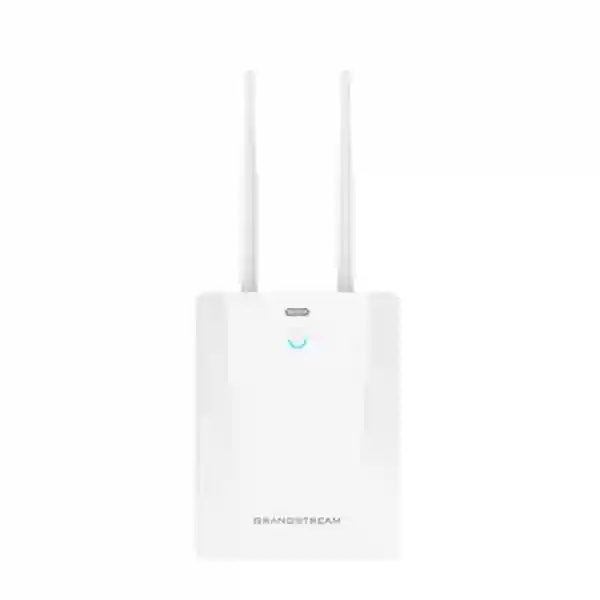
Grandstream GWN7670ELR Tanzania
The Grandstream GWN7670ELR is a long-range outdoor Wi-Fi 7 access point designed for organizations that need high-capacity wireless coverage across demanding outdoor or semi-outdoor environments. Grandstream positions the model as a BE3600 dual-band Wi-Fi 7 access point for medium-to-large businesses, combining 2.4 GHz 2×2:2 and 5 GHz 3×3:2 MU-MIMO, DL/UL OFDMA, Multi-Link Operation, 4K QAM, MRU and preamble puncturing. It delivers up to 3.6 Gbps aggregate wireless throughput and offers a 2.5 GbE PoE+ interface together with an SFP port, creating useful design flexibility where copper and fibre need to meet at the access point edge.
For Tanzania projects, the important question is not simply whether the access point is fast. Outdoor wireless performance depends on mounting height, line of sight, obstacles, client device mix, RF interference, backhaul, PoE budget, VLAN design, security policy and the way users move through the site. FourTeck can help buyers review these dependencies before quotation so the GWN7670ELR is selected as part of a complete network rather than as an isolated device.
Wi-Fi 7 BE3600
Dual-band enterprise wireless with advanced Wi-Fi 7 capabilities including MLO, 4K QAM, MRU and preamble puncturing.
Long-range coverage
Grandstream states up to 350 metres of coverage, subject to real-world site conditions, client capability and RF environment.
High client capacity
Supports up to 512 concurrent Wi-Fi clients and up to 1,000 PPSK accounts for individualized secure access scenarios.
Outdoor-ready design
IP67-rated enclosure, wall or pole mounting, PoE+ input, 2.5 GbE and SFP connectivity support robust outdoor deployments.
What the GWN7670ELR solves
Large outdoor and industrial wireless spaces often expose weaknesses that remain hidden in a normal office. A warehouse yard may need coverage across loading zones and perimeter work areas. A school or campus may need reliable connectivity between buildings. A hospitality property may need outdoor guest Wi-Fi without extending consumer-grade mesh devices beyond their practical limits. Parks, stadiums and healthcare campuses can require many simultaneous devices while maintaining consistent network policy. The GWN7670ELR addresses these scenarios with a purpose-built outdoor enclosure, enterprise wireless features, long-range radio design, higher-density client support and flexible uplink choices.
Its 2.5 GbE copper port supports PoE+ input, helping reduce separate power cabling where a suitable PoE+ switch or injector is available. The SFP interface gives designers another option when fibre is more appropriate for distance, electrical isolation or backbone design. Grandstream states that the SFP link can support optical transmission distances up to 20 km when used with an appropriate optical design and compatible modules. This can be valuable for campuses, industrial sites and distributed outdoor facilities where copper distance limits become a constraint.
Wireless security is equally important. The GWN7670ELR supports WPA2 and WPA3 modes, enterprise authentication options, client isolation, rogue AP detection and containment, MAC filtering, traffic rules and other controls. Its PPSK capability can support individualized access credentials without forcing every user or device to share the same pre-shared key. For managed deployments, Grandstream also supports local Web UI management, GDMS Networking cloud management and GWN Manager options, allowing organizations to choose an operating model that matches their scale and administrative preference.
Verified GWN7670ELR technical highlights
| Area | Verified specification | Planning relevance |
|---|---|---|
| Wireless | Wi-Fi 7, IEEE 802.11 a/b/g/n/ac/ax/be | Supports mixed-generation client environments while enabling Wi-Fi 7 capabilities for compatible devices. |
| Radio architecture | 2.4 GHz 2×2:2 and 5 GHz 3×3:2 MU-MIMO | Useful for capacity planning across legacy, IoT and performance-sensitive clients. |
| Wireless throughput | Up to 3.6 Gbps aggregate | Backhaul and switching should be sized so the AP is not constrained by upstream bottlenecks. |
| Client capacity | Up to 512 concurrent clients | Actual design density should consider application load, airtime, signal quality and roaming behavior. |
| Coverage | Up to 350 metres | A site survey remains important because obstacles, interference and client radios affect usable range. |
| Interfaces | 1× 2.5 GbE RJ45 with PoE input; 1× SFP | Supports copper or fibre-oriented network design depending on site constraints. |
| Power | 802.3at PoE+; maximum power consumption 16 W | Confirm switch PoE class, total PoE budget, surge protection and cable path before deployment. |
| Outdoor protection | IP67 | Suitable for demanding outdoor environments when installed according to manufacturer guidance. |
| Mounting | Wall or pole mount | Placement should balance height, serviceability, coverage direction and cable protection. |
Deployment guidance for Tanzania projects
A successful outdoor Wi-Fi project begins with a coverage and capacity plan. “Up to 350 metres” should not be treated as a guaranteed radius around every installation. Walls, roofs, trees, metal structures, vehicles, machinery, neighboring networks and the transmit capability of client devices all affect the usable cell. A phone at the edge of coverage may hear an access point more strongly than the access point hears the phone. For this reason, organizations should map the user areas, expected device density, roaming paths and critical applications before deciding how many access points are required.
Backhaul matters just as much as radio performance. If the GWN7670ELR is connected over copper, confirm cable category, length, pathway, grounding, surge protection and PoE+ availability. Where fibre is used, confirm the SFP type, fibre mode, connector type, optical budget and termination location. VLANs can separate corporate, guest, IoT, voice or operational traffic. DHCP, DNS, firewall policy and internet capacity should be reviewed with the wireless design rather than after installation.
For customers planning a broader technology refresh, FourTeck Tanzania also covers networking, Wi-Fi, switching, security and integrated IT infrastructure, allowing the access-point design to be considered alongside upstream switches, firewalls, racks, UPS systems and structured cabling. Regional projects can also reference FourTeck Kenya, FourTeck Uganda and FourTeck UAE for related market coverage and solution context.
Grandstream GWN7670ELR Tanzania
In Tanzania, the GWN7670ELR is relevant to organizations that need outdoor wireless coverage to behave like part of the managed enterprise network rather than like a separate hotspot. Business campuses, logistics yards, schools, hospitals, hospitality compounds, warehouses, industrial properties and public-facing facilities can all encounter areas where indoor access points do not provide dependable service. A long-range outdoor Wi-Fi 7 platform can reduce coverage gaps, but the buying decision should be based on a site plan. Customers should identify where users actually work, where handheld devices connect, where vehicles or metal racks may block signals, and where the network can safely deliver copper or fibre backhaul.
The GWN7670ELR provides a useful combination of Wi-Fi 7 capacity, up to 512 concurrent clients and outdoor resilience. For Tanzania environments, this can support mixed estates in which newer Wi-Fi 7 devices coexist with Wi-Fi 6, Wi-Fi 5 and older client hardware. Organizations do not need to replace every endpoint immediately to benefit from a modern infrastructure layer, but expectations should remain practical: performance at each client is controlled by the client radio, signal level, channel conditions, application demand and upstream network. A high-capacity AP cannot compensate for an undersized internet connection, congested switch uplink or poorly planned RF channel layout.
Procurement teams should request a quotation that distinguishes the access point from the surrounding deployment components. Depending on the site, the complete requirement may include a PoE+ switch or injector, surge protection, fibre transceivers, outdoor-rated cabling, patching, mounting work, switching configuration, VLANs, firewall policies and testing. Where several GWN access points are planned, management architecture should also be agreed in advance. Grandstream supports local Web UI control, GDMS Networking and GWN Manager approaches. FourTeck can help document these choices so that the GWN7670ELR is sized for the business objective rather than purchased on range claims alone.
Grandstream GWN7670ELR Dar es Salaam
Dar es Salaam buyers may consider the GWN7670ELR for commercial buildings, logistics and distribution sites, hotels, schools, healthcare facilities, manufacturing locations, yards and multi-building compounds where outdoor connectivity is part of day-to-day operations. In dense urban areas, wireless planning should account for neighboring Wi-Fi networks, cellular equipment, building materials and high device concentration. Simply increasing transmit power is not a substitute for channel planning and appropriate AP placement. A better design defines the required service areas first, then chooses mounting positions and channel settings that create usable coverage without excessive overlap.
The 2.5 GbE PoE+ port can simplify installations where the access point is within an appropriate copper distance from a network switch. For a remote gatehouse, warehouse edge, campus block or external yard, the SFP option can be attractive when fibre is already available or when fibre provides a cleaner path over longer distances. Network planners should verify optical module compatibility, fibre type and termination rather than assuming all SFP components are interchangeable. Outdoor copper routes should be evaluated for surge risk and cable protection. Power resilience should also be considered; if the AP is expected to remain available during brief power interruptions, the upstream PoE switch and network core need suitable UPS support.
Security policy is another buying factor. Guest access, staff access, operational handhelds and IoT devices may need separate SSIDs and VLANs. The GWN7670ELR supports 32 SSIDs in total, with 16 per radio, but practical designs normally avoid creating unnecessary SSIDs because each one contributes management overhead and beacon airtime. PPSK can be useful for device or user-level access separation where shared credentials are undesirable. Dar es Salaam organizations requesting a quote should therefore provide a rough site layout, user count, internet bandwidth, existing switch model, fibre availability and security requirements. That information enables a more realistic bill of materials and deployment plan.
Grandstream GWN7670ELR Mwanza
For Mwanza, the GWN7670ELR can suit organizations operating across compounds, hospitality properties, educational campuses, warehouses, processing facilities, healthcare sites and outdoor work areas where users need consistent access beyond the walls of the main building. Long-range wireless is especially useful when the business objective is operational continuity rather than simply visitor internet. Staff tablets, handheld scanners, maintenance devices, laptops and mobile phones may need to stay connected while users move between indoor and outdoor zones. The network design should therefore consider roaming boundaries, application sensitivity and whether a user is likely to cross between multiple access points during an active session.
The model’s Xtra Range 2.0 technology on 5 GHz is intended to improve signal penetration and coverage. Even so, a pre-installation survey or at least a structured predictive plan is valuable. Water, terrain, vegetation, metal structures and building layout can influence signal behavior. Where the site includes multiple separated buildings, designers can compare whether the GWN7670ELR should serve client access from a central location or whether multiple APs with fibre or Ethernet backhaul will create a stronger result. A point-to-multipoint bridge and an access point solve different problems; procurement should not confuse wireless client coverage with dedicated inter-building backhaul.
Mwanza buyers should also consider serviceability. Outdoor access points should be mounted where they achieve coverage but can still be safely reached for inspection or replacement. Cable entry, drip loops, grounding, pole stability and enclosure orientation matter. For managed estates, alerting and centralized administration can reduce the need to visit every site simply to check status. Grandstream’s supported management options provide choices for remote monitoring, configuration and statistics. FourTeck can help scope the GWN7670ELR alongside switching, fibre, firewall, UPS and structured cabling so that the final deployment has a clear operational model from the start.
Grandstream GWN7670ELR Arusha
Arusha organizations may evaluate the GWN7670ELR for hotels, lodges, schools, offices, institutional campuses, warehouses and outdoor business facilities that need enterprise-managed Wi-Fi beyond normal indoor coverage. Hospitality environments are a good example of why range alone is not enough. Guests may expect connectivity around gardens, pool areas, conference spaces and walkways, while business operations may rely on staff devices and back-office applications. These user groups often require different network policies. Separating guest traffic from internal systems through VLANs and firewall rules is therefore as important as the radio coverage itself.
Wi-Fi 7 introduces capabilities designed to improve efficiency, latency and capacity for compatible devices, but the access network still needs a disciplined RF plan. The GWN7670ELR operates in 2.4 GHz and 5 GHz bands. The 2.4 GHz band can offer broader reach but has fewer non-overlapping channels and is often more crowded; 5 GHz generally provides more spectrum and higher performance but may be more affected by obstacles and distance. Device steering, channel width and power should be tuned to the actual site rather than left at aggressive defaults simply to maximize headline speed.
For Arusha procurement, it is useful to specify whether the requirement is a single coverage extension or a multi-AP managed network. A single AP may cover an outdoor area, but larger properties often benefit from several lower-contention cells instead of one device trying to serve every client from far away. Customers should include expected concurrent users, application types, outdoor area dimensions, mounting possibilities and existing network information in the quotation request. If fibre already runs between buildings, the SFP interface may influence the architecture. If PoE+ switching is already available, the copper uplink may be simpler. FourTeck can help compare these options while keeping the design aligned with maintainability and future expansion.
Grandstream GWN7670ELR Dodoma
In Dodoma, the GWN7670ELR can support government-related facilities, education, healthcare, corporate offices, campuses, hospitality locations, warehouses and other sites where outdoor connectivity forms part of a broader enterprise network. Projects should begin by classifying coverage into critical and non-critical zones. A courtyard used for occasional browsing has different availability requirements from a logistics yard where handheld terminals support daily transactions. This distinction helps determine redundancy, AP count, UPS requirements and the amount of monitoring needed after deployment.
The access point’s stated support for up to 512 concurrent clients is a platform capability, not a promise that one AP should always be loaded with that many active high-throughput users. Voice, video, cloud applications, large downloads and background updates all consume airtime differently. A good design estimates active use, not just the number of registered devices. Where density is high, several APs may provide better capacity and user experience than one long-range device. The GWN7670ELR can still be valuable in that architecture because its outdoor design and strong coverage allow cells to be positioned where indoor models would not be appropriate.
Dodoma buyers should also plan authentication and network segmentation early. Enterprise WPA3 or WPA2-Enterprise may be appropriate when a RADIUS infrastructure is available, while PPSK can help assign unique credentials in environments that need simpler onboarding. Guest access may require captive portal or isolation policies depending on the design. The upstream firewall should control what each wireless segment can reach. Before purchase, FourTeck can review the intended topology, switch capacity, PoE+ budget, fibre availability, mounting constraints, user density and management preference. That creates a clearer quotation and reduces the chance that additional infrastructure is discovered only after installation begins.
Grandstream GWN7670ELR UAE
In the UAE, long-range outdoor Wi-Fi can be relevant to warehouses, logistics parks, hospitality properties, education campuses, industrial facilities, parking areas and large commercial compounds. The GWN7670ELR combines an IP67 enclosure with Wi-Fi 7 capability and flexible copper or fibre connectivity, making it suitable for designs where outdoor coverage must remain integrated with enterprise switching and security. Hot weather, direct sun, dust exposure and long external cable routes make installation practice particularly important. The environmental rating protects the device within its specified design limits, but installers must still follow manufacturer guidance for mounting, cable sealing and operating conditions.
The SFP interface can be useful where fibre is preferred between buildings or across large sites. Fibre can avoid the standard distance limitations of copper Ethernet and provides electrical isolation across separate structures, though the complete link still depends on compatible optics and the correct fibre plant. Where copper is used, PoE+ can simplify power delivery, but surge protection, grounding and cable routing deserve attention. A 2.5 GbE switch port is preferable when the design aims to preserve the AP’s available wired capacity.
UAE buyers often compare centralized cloud management with on-premises control. Grandstream supports multiple approaches, including GDMS Networking and GWN Manager, so the choice can reflect operational policy. Multi-site organizations may prefer centralized visibility and consistent templates, while some environments need local control. For broader regional technology requirements, the FourTeck UAE technology portfolio can provide context around switching, security and infrastructure. A GWN7670ELR quotation should ideally include the intended coverage area, active user estimate, uplink type, PoE availability, management model and security segmentation so the access point is aligned with the network rather than evaluated only as a standalone radio.
Grandstream GWN7670ELR Uganda
For Uganda deployments, the GWN7670ELR can serve organizations that need outdoor wireless at campuses, warehouses, schools, hospitals, hotels, compounds and industrial locations. The combination of Wi-Fi 7, IP67 protection, long-range coverage and high client capacity gives network designers a flexible platform, but the project should still be anchored in a real coverage map. Users do not operate at uniform distances, and applications vary widely. A barcode scanner sending small transactions has different needs from a laptop uploading large files or a camera consuming constant bandwidth.
Infrastructure readiness should be checked before ordering. A PoE+ switch must have enough remaining power budget for the AP and sufficient uplink capacity for all connected devices. Where the AP sits far from the network room, fibre may be a more appropriate backhaul choice. The SFP interface allows designers to consider this without introducing a separate media converter at the edge. The optical path still needs correctly selected modules and fibre. Cable routes, surge protection and UPS support should be reviewed as part of the same design.
Security and management are particularly important in distributed organizations. A common configuration can make it easier to standardize SSIDs, VLAN assignments and authentication policies across sites. The GWN7670ELR supports modern security features and centralized management options that can fit this model. Businesses planning cross-border or Ugandan deployments can also refer to FourTeck Uganda for related networking and technology solution context. When requesting pricing, buyers should provide the expected site count, AP quantity, client numbers, fibre or copper preference, mounting environment and any integration requirements so that the quotation reflects the complete deployment rather than the access point alone.
Grandstream GWN7670ELR Kampala
Kampala organizations may find the GWN7670ELR useful for commercial properties, educational institutions, hospitality, healthcare, warehouses and campuses that require managed outdoor coverage. Dense city environments can create RF competition, making channel planning and careful AP placement important. An access point with a long maximum range should not automatically be installed at maximum power. Excessive cell size can increase contention and make roaming less predictable, especially when several APs overlap. The design goal is balanced coverage with enough signal at the client, enough uplink capacity and enough airtime for the expected applications.
The GWN7670ELR’s dual-band design allows administrators to support 2.4 GHz and 5 GHz clients, but band strategy should be intentional. Older or IoT devices may depend on 2.4 GHz, while modern laptops and phones can benefit from 5 GHz performance. Wi-Fi 7 features improve capability for compatible endpoints, yet mixed-client behavior remains part of enterprise reality. The access point should therefore be tuned for the client population rather than benchmarked only with a single high-end device.
Kampala procurement teams should consider the complete path from AP to application. A strong radio signal cannot correct packet loss on an overloaded WAN, a misconfigured VLAN or a firewall policy that blocks necessary services. Likewise, cloud management requires reliable upstream connectivity. If the site uses fibre between buildings, verify whether the SFP-based topology is preferable. If the AP is connected by copper, verify cable length, PoE+ and surge protection. A quotation request should list the desired coverage area, user density, guest network needs, existing switch and firewall platform, and whether installation and configuration support are required. That information helps translate the GWN7670ELR’s technical capability into a practical network design.
Grandstream GWN7670ELR Arua
Arua deployments can benefit from the GWN7670ELR where business facilities, schools, healthcare sites, hospitality properties, compounds or distribution operations need Wi-Fi beyond normal indoor coverage. In areas where technical teams want to minimize unnecessary outdoor equipment, the combination of a weather-resistant access point, PoE+ and integrated management can simplify the architecture. However, simplification should not mean skipping network planning. Mounting location affects not only coverage but also maintenance access, lightning exposure, cable length and the ability to protect connectors from weather.
For a site with separate buildings, the SFP interface may be a useful design advantage because it allows fibre to reach the access point directly when that suits the topology. This can reduce dependence on long copper runs. Fibre design still requires compatible transceivers, correct connectorization and careful optical-budget planning. If copper is practical, a 2.5 GbE PoE+ switch can carry both data and power. The upstream switch should also support the required VLANs, QoS and monitoring features.
Arua buyers should define the desired user experience before determining AP quantity. If the goal is general internet access across a broad low-density area, long-range coverage may be the priority. If the site expects many active users in concentrated zones, additional APs may be needed for capacity even when a single unit could technically reach the area. Security can be divided between staff, guest and device networks, while PPSK can provide individualized credentials for selected use cases. FourTeck can help build a quotation around these design choices, including networking accessories and configuration requirements, so customers understand what is necessary to turn the GWN7670ELR into an operational wireless service.
Grandstream GWN7670ELR Mbarara
In Mbarara, the GWN7670ELR can be considered for campuses, warehouses, educational environments, healthcare facilities, hospitality sites, offices and outdoor operational spaces. These locations may have a mix of open areas and obstructed zones, so range should be validated against the actual site. A 350-metre manufacturer-stated range is a useful planning reference, but physical obstacles and client transmit power can reduce practical coverage. The best deployment positions often come from balancing height and line of sight with the need to keep cable routes protected and serviceable.
The AP’s ability to support up to 512 concurrent clients is valuable for high-density scenarios, but capacity planning should use realistic traffic assumptions. A classroom block, conference event or busy hospitality area may generate bursts of video, cloud synchronization and software updates. Multiple APs sharing the load can provide better airtime efficiency than forcing too many devices through one radio cell. VLAN design can help separate guest, staff and operational traffic, and firewall rules can control access between those segments.
When planning procurement, Mbarara organizations should decide whether they need only hardware supply or a complete design including switching, fibre, configuration and testing. The GWN7670ELR uses 802.3at PoE+, so the upstream switch or injector should be verified for compatibility and total power budget. If fibre is required, confirm SFP modules and fibre type. If centralized management is desired, determine whether GDMS Networking or a GWN Manager deployment better matches the operating model. Clear requirements around user numbers, coverage zones, authentication and backhaul will make the quotation more accurate and reduce change requests during deployment.
Grandstream GWN7670ELR Gulu
Gulu organizations can use long-range outdoor Wi-Fi to extend managed connectivity across compounds, schools, healthcare environments, logistics areas, hospitality properties and other multi-zone sites. The GWN7670ELR combines outdoor protection and high wireless capacity with enterprise management features, making it more appropriate than consumer extenders for sites where security, VLANs, monitoring and predictable administration matter. Still, project success depends on the supporting network. A strong AP connected to a slow or unreliable uplink will not deliver the expected user experience.
The choice between copper and fibre backhaul should reflect distance, available infrastructure and environmental risk. Copper with PoE+ is efficient when the cable path is within Ethernet distance limits and surge protection is properly designed. Fibre can be preferable for longer runs or links between buildings, and the GWN7670ELR’s SFP interface can simplify that architecture. Upstream switches should provide the right port speed, VLAN support and monitoring. If the business uses a firewall for guest controls, application policy or VPN connectivity, the wireless network should be coordinated with those rules.
For Gulu procurement, a practical scope includes mounting location, cable route, power source, client estimate, traffic profile and the expected management model. Administrators should also decide whether they need separate SSIDs for staff, visitors and operational devices. The GWN7670ELR supports a large number of SSIDs, but fewer well-designed networks are generally easier to operate. Where unique credentials are needed, PPSK can be part of the access strategy. FourTeck can use these inputs to develop a more complete quotation covering the AP and its dependencies, rather than leaving customers to discover missing switch, fibre or installation items after the hardware has been ordered.
Grandstream GWN7670ELR Kenya
Kenya organizations evaluating outdoor Wi-Fi 7 may use the GWN7670ELR in enterprise campuses, logistics facilities, education, healthcare, hospitality, warehouses and outdoor public or staff areas. The model’s stated 350-metre coverage and IP67 protection make it suitable for broad outdoor zones, while its Wi-Fi 7 radio architecture supports higher efficiency and performance for modern devices. In real deployments, organizations should separate coverage requirements from capacity requirements. A single long-range AP might reach a distant area, but a busy site could still need multiple APs to provide enough airtime for simultaneous users.
The 2.5 GbE PoE+ interface and SFP port give designers two backhaul paths. Copper can simplify power and data delivery when an appropriate PoE+ switch is nearby. Fibre can be useful across campus links, large warehouses or separate buildings. Procurement should include the required optics, fibre termination and switching rather than treating the SFP socket as a complete optical link by itself. Surge protection, UPS and outdoor cabling practice should also be part of the installation plan.
For multi-site businesses, centralized management can improve visibility and consistency. Grandstream provides cloud and on-premises management choices, allowing configuration, monitoring and statistics to be managed across access points. Security design can use WPA3, enterprise authentication, segmentation, isolation and PPSK according to the use case. Customers working across East Africa can refer to FourTeck Kenya for regional networking context. A good quotation request should specify site location, outdoor area dimensions, client density, existing switch and firewall, fibre availability, desired SSIDs and whether installation, configuration and post-deployment testing are required.
Grandstream GWN7670ELR Kuwait
Kuwait deployments may use the GWN7670ELR for outdoor enterprise Wi-Fi in warehouses, hospitality, education, industrial compounds, logistics yards and commercial properties. Heat, dust and exposed mounting conditions make hardware suitability and installation quality critical. The AP’s IP67 rating supports outdoor use, but installers should still ensure correct sealing, mounting and cable protection. Environmental design also includes the network equipment feeding the AP; switches and power systems may need to remain inside conditioned or appropriately rated enclosures.
Wi-Fi 7 capability can support newer laptops, phones and enterprise devices while maintaining compatibility with earlier Wi-Fi generations. However, the full benefits of Wi-Fi 7 depend on compatible clients, correct RF conditions and an upstream network that can carry the traffic. The GWN7670ELR’s 2.5 GbE wired interface means a gigabit-only upstream path could become a bottleneck in some high-throughput scenarios. For many real applications, client behavior and internet bandwidth may still be the limiting factors, so capacity planning should be application-led.
Kuwait buyers should also consider whether fibre or copper is more appropriate at the installation point. The SFP interface can be helpful when fibre extends to outdoor zones or distant facilities. For copper, 802.3at PoE+ should be confirmed at the switch or injector. Security planning can include separate guest and corporate segments, WPA3, enterprise authentication or PPSK depending on policy. A complete quotation should state AP quantity, mounting environment, backhaul type, PoE requirements, fibre components, management preference and configuration scope. This helps avoid fragmented purchasing and gives the deployment team a coherent bill of materials.
Grandstream GWN7670ELR Ghana
For Ghana, the GWN7670ELR can address long-range wireless requirements in education, healthcare, hospitality, logistics, enterprise campuses, industrial sites and outdoor business spaces. Organizations that previously extended indoor Wi-Fi through ad-hoc repeaters can benefit from a more structured architecture built around outdoor-rated access points, managed switching and defined VLANs. The access point’s Wi-Fi 7 platform supports advanced radio capabilities, but the practical goal should remain simple: stable connectivity where users and devices actually operate.
Planning starts with a map of coverage and client density. Long open areas may be suitable for the model’s extended range, while dense clusters of users may need multiple APs for capacity. The 5 GHz band can carry high-performance clients, while 2.4 GHz may remain important for legacy or IoT equipment. The correct channel plan depends on local RF conditions. Administrators should avoid creating an excessive number of SSIDs because each network adds management and airtime overhead. Segmentation can instead be designed carefully around actual user groups.
Infrastructure choices are equally important. If the access point is within a suitable copper run, a PoE+ switch can deliver data and power through the 2.5 GbE port. If fibre is required, the SFP interface allows a more direct optical design. Organizations should specify the desired management model, whether local, cloud or on-premises centralized management. Security requirements may include WPA3, enterprise authentication, client isolation, rogue AP controls or PPSK. Ghana buyers requesting a quote should provide the site type, approximate dimensions, user count, existing network equipment, fibre availability and installation requirements so the complete solution can be sized realistically.
Grandstream GWN7670ELR Nigeria
Nigeria presents many use cases for long-range managed Wi-Fi, including enterprise estates, warehouses, hospitality, education, healthcare, manufacturing sites and logistics facilities. The GWN7670ELR is designed for outdoor Wi-Fi 7 coverage with a strong combination of client capacity, high wireless throughput, IP67 protection and flexible uplinks. For large sites, its value is greatest when it is treated as one component of a network architecture that includes switching, fibre, security, UPS and monitoring.
In high-density deployments, the theoretical maximum number of clients should not be used as the only sizing metric. Airtime is shared, and the user experience depends on what those clients are doing. Hundreds of mostly idle sensors behave differently from hundreds of users streaming video or joining calls. The correct AP count should account for simultaneous activity, desired signal level and roaming. A site survey can help reveal interference and obstacles that are not obvious from floor plans.
For outdoor links, power and cabling deserve careful attention. The GWN7670ELR supports 802.3at PoE+ through its 2.5 GbE copper port, while the SFP interface provides a fibre option. Where power quality is a concern, the upstream switch and core network may need UPS protection. Security can be structured with multiple VLANs, WPA3 or enterprise authentication, and PPSK where unique credentials are useful. Nigeria procurement teams should include management preferences, expected client numbers, area dimensions, uplink type and installation scope in RFQs. This enables suppliers to quote not only the AP but also the switching, optics, cabling and configuration required to create a functioning service.
Grandstream GWN7670ELR Seychelles
In Seychelles, outdoor wireless often intersects with hospitality, resorts, offices, education, healthcare and multi-building properties where users expect connectivity in open areas as well as indoors. The GWN7670ELR can be a strong candidate for such environments because it combines long-range Wi-Fi 7 performance with an IP67-rated outdoor enclosure. Coastal and exposed installations still require careful engineering. Environmental rating does not eliminate the need for proper mounting, connector sealing, corrosion-aware hardware selection, cable routing and surge protection.
Hospitality deployments should distinguish guest experience from operational network requirements. Guest Wi-Fi may prioritize simple onboarding and internet isolation, while staff devices may need secure access to internal applications. Separate VLANs and firewall policies can keep those functions apart even when they share the same wireless infrastructure. The GWN7670ELR supports multiple SSIDs and enterprise security options, while PPSK can provide individualized access for selected users or devices.
For properties with buildings spread across a site, fibre may be attractive as the backbone. The SFP interface provides architectural flexibility, but the complete optical path should be verified for transceiver compatibility, fibre type and distance. Copper PoE+ can be simpler where runs are shorter and protected. Client density should also guide AP quantity; a broad outdoor area with light use may have different needs from a busy event space. Seychelles buyers should include site layout, expected users, critical applications, existing switching, fibre routes and management preference when requesting a quotation. A complete design can then account for both wireless coverage and the infrastructure that keeps the access point powered, secured and connected.
Compatibility, management and security planning
The GWN7670ELR is backward compatible with multiple generations of Wi-Fi through IEEE 802.11 a/b/g/n/ac/ax/be support. That makes it suitable for mixed environments, but administrators should still inventory critical clients. Older handhelds, IoT devices and specialized equipment may support only certain bands, channel widths or security methods. A staged migration can preserve compatibility while allowing modern clients to take advantage of Wi-Fi 7 features.
Management is available through the local Web UI and Grandstream management platforms. Organizations should choose the model that best fits operational ownership, internet availability and security policy. A small single-site deployment may favor straightforward local administration, while multi-site environments can benefit from centralized visibility. The decision should also include who will receive alerts, who can change configurations and how backups or documentation are retained.
Security should be layered. WPA3 can strengthen wireless authentication for compatible clients, but VLAN separation, firewall control, client isolation, credential policy and monitoring remain important. Rogue AP detection can help identify unexpected wireless devices. PPSK is useful where unique keys are preferred without deploying full enterprise authentication to every endpoint. The correct approach depends on the organization’s identity infrastructure and device mix.
GWN7670ELR buying checklist
Provide outdoor dimensions, obstacles, building layout and expected mounting points.
Estimate concurrent users, device types and high-bandwidth applications rather than total registered devices only.
State whether 2.5 GbE copper or SFP fibre is preferred and what switching or fibre infrastructure already exists.
Verify 802.3at PoE+ availability, switch power budget, UPS and surge protection requirements.
Define staff, guest, IoT and operational segments, authentication approach and firewall requirements.
Choose local, cloud or on-premises centralized administration according to site count and operations.
Related FourTeck network resources
For Tanzania networking projects, start with FourTeck Tanzania for integrated Wi-Fi, switches, firewalls, structured cabling, racks, UPS and infrastructure planning. Cross-border organizations can use FourTeck Kenya and FourTeck Uganda for corresponding regional technology solution coverage. For UAE-linked procurement or multinational standardization, FourTeck UAE provides a broader integrated IT and telecom portfolio. These resources are relevant where the GWN7670ELR is part of a larger rollout that also includes switching, security, voice, collaboration or infrastructure dependencies.
Frequently asked questions
What is the Grandstream GWN7670ELR?
It is a long-range outdoor dual-band Wi-Fi 7 BE3600 access point designed for medium-to-large business deployments. Grandstream specifies up to 3.6 Gbps aggregate wireless throughput, a 350-metre coverage range, support for up to 512 concurrent clients, an IP67 enclosure, 2.5 GbE PoE+ and an SFP interface.
Does the GWN7670ELR support Wi-Fi 7?
Yes. It supports IEEE 802.11be and Wi-Fi 7 features including Multi-Link Operation, 4K QAM, MRU and preamble puncturing, while remaining compatible with earlier Wi-Fi standards listed by Grandstream.
Can the GWN7670ELR be used outdoors?
Yes. The device has an IP67-rated enclosure and supports wall or pole mounting. Outdoor installation still needs correct mounting, cable protection, grounding and environmental planning.
How far can the GWN7670ELR cover?
Grandstream states up to 350 metres. Real-world coverage varies with obstacles, interference, mounting, client capability and radio configuration, so a site assessment is recommended.
How many clients can connect?
Grandstream specifies support for up to 512 concurrent Wi-Fi client devices. Actual design capacity depends on application load, signal quality and airtime demand.
Does it support fibre?
Yes. The GWN7670ELR includes an SFP port in addition to its 2.5 GbE RJ45 PoE+ interface. The fibre link still requires compatible optics and a correctly designed fibre path.
How is the GWN7670ELR managed?
Grandstream supports local Web UI administration plus GDMS Networking and GWN Manager options for centralized management. The preferred method depends on site count and operating policy.
Decision recap
Choose the GWN7670ELR when the project needs a current-generation outdoor Grandstream access point with long-range coverage, high client capacity, Wi-Fi 7 features, 2.5 GbE PoE+ and optional fibre uplink capability. Do not select it solely from the maximum range figure. Validate the site, user density, application demand, backhaul, security, PoE and management model first. In many business environments, the complete solution will include switching, fibre or copper infrastructure, firewall segmentation, UPS, mounting and configuration services alongside the AP.
Prepare your GWN7670ELR quotation request
For a more accurate quotation, send FourTeck the site type, city or country, approximate coverage dimensions, expected number of active users, key applications, preferred mounting locations, existing switch and firewall models, PoE+ availability, fibre availability, required AP quantity if already known, guest/staff network requirements and whether you need installation, configuration or testing. If drawings or a site map are available, they can help identify likely AP positions and backbone requirements.


Reviews
There are no reviews yet.