
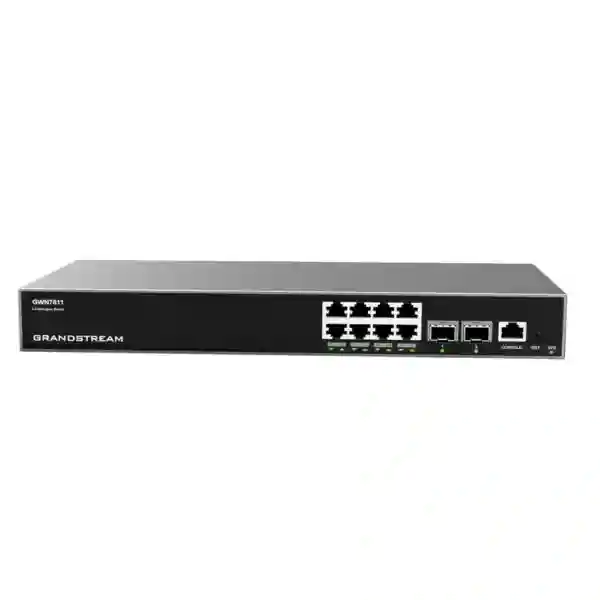
Grandstream GWN7811 Layer 3 Managed Network Switch
The Grandstream GWN7811 is a compact enterprise Layer 3 managed switch designed for organizations that need capable routing, segmentation, security controls and fast uplinks without paying for unused PoE capacity. The model provides eight 10/100/1000Mbps Ethernet ports, two 10Gbps SFP+ uplinks, a console interface and advanced Layer 2/Layer 3 functions for business networks. For buyers comparing managed network switches in Tanzania, the GWN7811 is especially relevant for branch offices, server rooms, distribution points, small aggregation roles and business environments that need predictable VLAN and routing control in a compact format.
GWN7811 at a glance
8 Gigabit Ethernet access ports, 2 x 10Gbps SFP+ uplinks, 56Gbps switching capacity, 28Gbps non-blocking throughput, 41.644Mpps forwarding rate, 12MB packet buffer, IPv4/IPv6 support, advanced VLAN, QoS, security, static and dynamic routing, stacking and centralized management. The GWN7811 itself does not provide PoE output; buyers needing powered endpoint ports should compare the GWN7811P.
Gigabit Ethernet ports for servers, workstations, routers, firewalls and other wired endpoints.
SFP+ uplinks for high-speed fiber or supported direct-attach connectivity between switches and infrastructure.
Published switching capability with 28Gbps total non-blocking throughput.
Static and dynamic routing capabilities for networks that require more than simple access switching.
Why choose the Grandstream GWN7811?
The GWN7811 sits in Grandstream’s GWN7810 family of enterprise Layer 3 managed switches. Its value is not simply that it has eight copper Ethernet ports. The important design point is that it combines a compact access-port count with two high-speed 10Gbps SFP+ uplinks and enterprise switching functions. This makes it useful where an organization wants a smaller managed switch but does not want to give up routing, VLAN segmentation, quality-of-service control or uplink bandwidth. In practical deployments, it can connect servers, firewall interfaces, workstations, storage appliances, PBX systems, network controllers or other devices that already have their own power sources.
The model supports IPv4 and IPv6 networking, IEEE 802.1Q VLAN tagging, voice VLAN, private VLAN, spanning-tree families, link aggregation, multicast controls, DHCP functions, access-control lists and security mechanisms including ARP inspection, IP Source Guard, DHCP snooping, port security and denial-of-service protection. These features help administrators build intentional network boundaries instead of running every endpoint in one flat LAN. The switch also supports routing functions including static routes and dynamic routing protocols such as RIP, RIPng, OSPF, OSPFv3 and BGP, giving experienced network teams more design options for branch, campus and segmented business environments.
Management flexibility is another practical strength. The GWN7810 series supports local web administration and command-line management, while Grandstream also provides centralized options through GDMS Networking and GWN Manager. That can simplify administration when an organization uses multiple Grandstream networking products or wants a more standardized management workflow across sites.
Verified GWN7811 technical specifications
| Specification | Grandstream GWN7811 |
|---|---|
| Gigabit Ethernet ports | 8 x 10/100/1000Mbps RJ45 |
| High-speed uplinks | 2 x 10Gbps SFP+ |
| PoE output | No PoE output on GWN7811; PoE is available on GWN7811P |
| Switching capacity | 56Gbps |
| Non-blocking throughput | 28Gbps |
| Forwarding rate | 41.644Mpps |
| Packet buffer | 12MB |
| MAC addresses | Up to 16K |
| VLAN scale | Up to 4K VLANs with multiple VLAN methods |
| Stacking | Supported, up to 4 devices |
| Jumbo frame | Up to 12288 bytes |
| Operating environment | 0°C to 45°C, 10% to 90% RH non-condensing |
| Dimensions / unit weight | 330 x 176 x 44mm; approximately 1.45kg |
GWN7811 versus GWN7811P: do not confuse the two models
The GWN7811 and GWN7811P share the same compact eight-port class and dual 10Gbps SFP+ uplink concept, but the key purchasing difference is power delivery. The GWN7811 is the non-PoE version. It is appropriate when connected endpoints already receive power separately, such as servers, desktop computers, firewalls, routers and many appliances. The GWN7811P adds eight PoE/PoE+ ports and a published 120W total PoE budget, with up to 30W per PoE port. If your project needs to power IP phones, access points or cameras from the switch, the GWN7811P may be the more appropriate model. If PoE is unnecessary, the GWN7811 avoids buying power-delivery capability that the deployment does not use.
Deployment, VLAN, routing and security planning
A managed Layer 3 switch delivers the most value when the configuration reflects a clear network design. Before deployment, document which endpoints will connect to each port, which services require separate VLANs, where inter-VLAN routing should occur, and whether routing responsibility belongs on the GWN7811, a firewall or another core device. In many office networks, user computers, voice systems, servers, guest services, management interfaces and surveillance equipment benefit from logical separation. VLAN tagging and access policies make that separation predictable, but the design should also account for DHCP scopes, DNS, firewall rules, monitoring and troubleshooting.
The two 10Gbps SFP+ ports deserve special attention because they can remove uplink bottlenecks that would otherwise limit an eight-port switch. One uplink might connect to a core or distribution switch while the second is used for redundancy, link design flexibility or another high-speed infrastructure connection. Supported optical modules, fiber type, distance and patching must be matched correctly. Direct-attach cabling is supported by Grandstream within the vendor’s stated limitations, so the physical uplink should be selected as part of the bill of materials rather than after installation.
Security functions such as DHCP snooping, ARP inspection, IP Source Guard, ACLs and port security can strengthen a LAN, but they need coordinated configuration. Enabling controls without documenting trusted ports, address allocation and legitimate traffic can create avoidable outages. The same applies to spanning-tree and link aggregation. A disciplined implementation includes a port map, VLAN table, addressing plan, routing summary, uplink diagram, configuration backup and change record.
Useful FourTeck resources for a complete network project
Review the wider business technology categories used alongside managed switches, including firewalls, wireless access points, IP phones, IP PBX, servers and infrastructure.
FourTeck Tanzania IT servicesUse the services overview when a switch purchase is part of a wider requirement for design, deployment, configuration, testing, documentation or support.
FourTeck KenyaRegional IT and networking information for organizations coordinating technology requirements between Tanzania and Kenya.
FourTeck UgandaRegional networking, structured cabling, IP PBX and IT solution information for customers managing sites in Uganda.
FourTeck UAEIT infrastructure, network security and telecom information for companies that also maintain offices or procurement operations in the UAE.
Grandstream GWN7811 Tanzania
For organizations searching for the Grandstream GWN7811 in Tanzania, the buying decision should begin with the network role rather than only the port count. This model has eight copper Gigabit Ethernet ports and two 10Gbps SFP+ uplinks, so it can be a strong fit for a compact server room, branch office, controlled access layer or small distribution point where high-speed uplinks matter. A Tanzanian business may use the switch to connect a firewall, local server, storage device, PBX, workstation group or other powered network equipment while keeping traffic separated through VLANs. The GWN7811 is particularly suitable when endpoints already have their own power supply, because it does not provide PoE output. If powered IP phones, Wi-Fi access points or cameras are part of the same access layer, procurement teams should compare the GWN7811P instead of assuming the standard GWN7811 supplies power.
Tanzania deployments should also be planned around the physical environment. Network switches work best in clean, ventilated racks or cabinets with controlled access and dependable electrical protection. Heat, dust, unstable power and poorly organized cabling can create more operational problems than the switch specification itself. A UPS, structured patching and clear port labels improve maintainability. When fiber uplinks are used, the SFP+ module, fiber type, connector, distance and remote switch interface must all be matched. This is important for multi-floor buildings, campuses and sites where the network rack is separated from the main equipment room.
For business networks carrying voice, applications, internet access and operational systems, the Layer 3 capability helps create structured segmentation. Organizations can build VLANs for users, servers, management and other services, apply QoS where time-sensitive traffic matters, and use supported routing or a firewall for controlled inter-network communication. Before requesting a quotation, provide the required port count, uplink type, expected VLANs, existing switch brand, rack availability, fiber distance and whether PoE is needed. That information helps determine whether the GWN7811 is the right model or whether a larger GWN7810-series switch is more appropriate for future growth.
Grandstream GWN7811 Dar es Salaam
Dar es Salaam businesses often operate in dense office, retail, hospitality, logistics and multi-tenant environments where a small switch can still sit inside a complex network. The Grandstream GWN7811 can serve as a compact managed access or edge switch in an office floor, branch rack, communications cabinet or server area. Its eight Gigabit ports are useful for directly connected infrastructure, while the dual 10Gbps SFP+ ports can provide faster links back to a distribution or core layer. This architecture is relevant when the local cabinet serves only a limited number of devices but must move aggregated traffic quickly to another part of the network.
In a Dar es Salaam office, the deployment should start with a port and VLAN schedule. For example, administration users may be separated from finance systems, servers may sit in a protected network, and network management interfaces may be restricted to IT staff. If IP phones, cameras or access points need power, remember that the GWN7811 itself is non-PoE. Those endpoints can be supplied through separate injectors or, more commonly, by choosing a PoE-capable switch such as the GWN7811P when that better matches the design. This distinction matters during budgeting because the lowest equipment price is not necessarily the lowest complete deployment cost.
Dar es Salaam sites should also consider rack conditions and uplink media. Fiber can be valuable between floors, buildings or equipment rooms where copper distance and interference become concerns. The GWN7811’s 10Gbps SFP+ interfaces allow a much faster backbone than its individual 1Gbps access ports, reducing the chance that the uplink becomes the immediate bottleneck. Procurement teams should specify whether they need single-mode or multimode fiber, expected distance, connector type and the remote interface. For organizations replacing an unmanaged switch, migration should include configuration, labeling, VLAN testing and a rollback plan so business traffic is not disrupted unnecessarily.
Grandstream GWN7811 Mwanza
For Mwanza organizations, the Grandstream GWN7811 can support branch networks that require stronger control than a basic unmanaged switch. Warehouses, trading offices, healthcare facilities, education sites, professional offices and operational branches may all need segmentation between business users and critical systems. The GWN7811 provides the functions needed to build that separation, including VLANs, access-control lists, QoS, spanning-tree options, link aggregation and Layer 3 routing. Its eight copper ports make it most appropriate where the local device count is modest or where the switch is used for selected infrastructure rather than as a large desktop access switch.
One useful Mwanza deployment pattern is a small branch connected to a wider company network. The switch can handle local VLANs while a firewall or router controls WAN connectivity and security policy. Alternatively, experienced network administrators can use supported Layer 3 functions on the switch where that fits the architecture. Dynamic routing support gives designers more flexibility in advanced deployments, but smaller offices may prefer simpler static routes and firewall-centered policies. The right approach depends on operational skill, documentation standards and how the organization manages multiple sites.
Physical infrastructure should be part of the request for quotation. Confirm whether the switch will be rack mounted, whether the cabinet has adequate ventilation, whether a UPS is available and whether existing fiber can support the planned SFP+ uplink. If the business expects expansion, count future devices before choosing an eight-port model. A switch that is nearly full on day one can force an early redesign. Mwanza buyers should therefore provide current endpoint counts, expected growth, existing VLANs and uplink requirements. Where more copper ports are required, the broader GWN7810 family offers higher-port-count models. Where the site has only a few locally powered devices but needs high-speed uplinks and advanced management, the GWN7811 remains a focused and efficient option.
Grandstream GWN7811 Arusha
Arusha businesses in hospitality, travel, professional services, education and administration can benefit from managed switching when several network services share the same physical infrastructure. The Grandstream GWN7811 offers a compact way to introduce VLAN segmentation, traffic prioritization and Layer 3 control in locations that do not need a large access switch. It can be used for server-room equipment, management workstations, firewall connections, network appliances or as a controlled distribution point feeding other access switches. The two 10Gbps SFP+ uplinks are particularly useful when a small local switch must connect quickly to a building backbone or central rack.
Hospitality environments provide a good example of why segmentation matters. Guest-facing services should not automatically share the same network as business administration or infrastructure management. Even when the GWN7811 is not the only switch in the design, it can participate in a VLAN architecture that keeps traffic organized and easier to troubleshoot. QoS can also help prioritize services where latency matters, while multicast controls can improve efficiency for specific applications. If wireless access points are part of the project, buyers need to consider where PoE will come from because the GWN7811 does not power connected devices.
Arusha deployments may also involve multiple buildings or longer campus links. In those cases, fiber is often preferable to stretching copper beyond suitable distances. The SFP+ uplinks provide a platform for high-bandwidth fiber connections, but the exact transceiver selection must match the optical design. A quotation request should include distance, fiber mode, connector, remote switch model and desired link speed. Organizations should also define management expectations. If the network team already uses Grandstream’s ecosystem, centralized management options can simplify administration. If the environment is multi-vendor, confirm how monitoring, VLAN naming, routing and configuration backups will be standardized so the GWN7811 fits cleanly into the broader operational process.
Grandstream GWN7811 Dodoma
In Dodoma, offices, institutions, branch operations and service organizations may use the Grandstream GWN7811 where a compact but fully managed switching platform is required. Its eight Gigabit access ports allow selected wired devices to connect directly, while two 10Gbps SFP+ interfaces provide significantly faster uplink capacity for traffic moving toward a core switch, server environment or network backbone. This combination is useful when the local endpoint count is small but the switch must still integrate into a structured enterprise network.
For administrative environments, a common design objective is separating user groups and sensitive systems without making the network unnecessarily complicated. VLANs can divide departments, server networks, management interfaces and other service zones. Access-control lists and security functions can add restrictions at the switching layer, while firewall policy can provide broader security enforcement. The GWN7811 supports IPv4 and IPv6, helping organizations plan for mixed or future addressing requirements. Network teams should decide where DHCP, routing and security enforcement belong before installation so functions are not duplicated unpredictably across multiple devices.
Dodoma buyers should also evaluate resilience from a complete-site perspective. A managed switch cannot compensate for poor power, an overloaded UPS, disorganized patching or a single undocumented uplink. Use labeled cabling, suitable rack ventilation and configuration backups. If the site requires a secondary network path, plan spanning-tree or link-aggregation behavior carefully and test failover under controlled conditions. The GWN7811 supports stacking with up to four devices, but stacking should be selected because it solves a management or resiliency requirement, not simply because the feature exists. For procurement, specify endpoint types, port quantities, uplink medium, VLAN count, rack space, environmental conditions and future growth. This information makes it easier to determine whether the eight-port GWN7811 is appropriately sized for the site.
Grandstream GWN7811 UAE
For organizations coordinating network standards between Tanzania and the UAE, the Grandstream GWN7811 can help create a repeatable branch design. A common hardware and VLAN approach can reduce operational differences between sites, especially when IT teams need consistent port naming, routing behavior, configuration backups and monitoring. The GWN7811’s eight Gigabit ports are well suited to small branches or infrastructure-only racks, while the two 10Gbps SFP+ uplinks can connect the switch to larger core environments without restricting the backbone to 1Gbps.
UAE deployments frequently involve modern offices with IP telephony, wireless networking, cloud applications and secure internet access. The GWN7811 should be selected only for endpoints that do not require switch-delivered power. If the local access layer includes many IP phones, Wi-Fi access points or cameras, a PoE model may reduce the number of separate power adapters and simplify UPS design. In mixed environments, the GWN7811 can still be used for servers, firewall links, controllers, workstations and other powered devices while a separate PoE switch serves powered endpoints.
For cross-region procurement, standardization should include more than the model number. Document approved firmware, management method, VLAN numbering, uplink optics, security settings, naming conventions and backup procedures. The same GWN7811 can behave very differently if each branch is configured independently. Organizations with UAE and Tanzania operations should also confirm locally appropriate power accessories, rack requirements and fiber components during each order rather than assuming every site is identical. When designed carefully, a consistent Grandstream switching platform can simplify remote administration, spare planning and staff training across markets while still allowing each branch to adapt its port count and uplink design to local needs.
Grandstream GWN7811 Uganda
Ugandan businesses considering the Grandstream GWN7811 can use it for compact branch networks, infrastructure cabinets or server-room connections where managed Layer 3 functions are important. The model’s eight Gigabit ports and two 10Gbps SFP+ uplinks create a useful balance between small local port count and high-speed backbone connectivity. This can be valuable for organizations that centralize servers or internet security while keeping only a limited number of local devices on the switch.
In multi-branch environments spanning Uganda and Tanzania, a repeatable VLAN design can reduce troubleshooting complexity. Voice, business data, management and specialized systems can use separate logical networks, with routing and firewall policy documented consistently. The GWN7811 supports advanced VLAN functions, QoS, multicast features and Layer 3 routing, giving network teams options to build that architecture. However, a feature-rich switch should still be configured as simply as the business requirement allows. Unnecessary protocol complexity increases the knowledge needed to support the site.
Uganda procurement should explicitly address PoE. The standard GWN7811 does not power endpoints, so access points, phones and cameras need another power source or a PoE-capable switch. This is particularly important for new offices where the network design may assume one cable provides both data and power. For the physical network, verify rack depth, ventilation, UPS capacity and the type of uplink between cabinets. If fiber is required, define distance and transceiver type before ordering. For organizations operating in both countries, the verified FourTeck Uganda regional site can also support broader structured cabling and networking discussions, while the Tanzania site remains the primary reference for the local Tanzania project.
Grandstream GWN7811 Kampala
Kampala offices often combine corporate users, internet services, wireless access, IP telephony and security systems in the same building. The Grandstream GWN7811 can participate in this environment as a compact managed switch for devices that already have independent power. Its eight copper Gigabit ports can connect selected infrastructure, and the dual SFP+ uplinks can provide fast connections to a core switch or another equipment room. This is useful when local port requirements are limited but traffic from several services needs to move across a higher-capacity backbone.
A Kampala deployment should define the switch’s exact network role. If it is an access switch, decide which ports are untagged or tagged and which VLANs each endpoint uses. If it participates in Layer 3 routing, document gateway addresses, routes and how those routes interact with the firewall or WAN router. If it is primarily an infrastructure switch, restrict management access to authorized administrator networks. Grandstream provides security functions such as DHCP snooping, ARP inspection, IP Source Guard, port security and ACLs, but these controls should be introduced with a test plan because incorrect settings can block legitimate devices.
Uplink planning is equally important. The value of 10Gbps SFP+ ports is highest when the remote switch and fiber path can actually operate at the intended speed. Procurement should therefore include compatible optics or direct-attach cabling where appropriate, not just the switch chassis. Kampala organizations planning growth should also count spare ports. Eight ports can fill quickly if additional servers, routers or appliances are added. Where significant expansion is expected, a higher-port GWN7810 family model may provide a cleaner long-term design. Where the need is genuinely compact and non-PoE, the GWN7811 provides strong management capability without unnecessary access-port scale.
Grandstream GWN7811 Arua
For an Arua branch or operational site, the Grandstream GWN7811 can be useful when a business needs enterprise management features in a relatively small network footprint. The switch is not intended to be chosen simply because eight ports are enough today. Its main advantage is the combination of Gigabit access, dual 10Gbps SFP+ uplinks and Layer 3 management functions. That allows a small site to follow the same network standards as a larger organization, with VLAN segmentation, access controls, routing options, QoS and consistent management.
Remote-site support makes documentation especially important. A clearly labeled switch with a saved configuration, port map and uplink diagram is much easier to troubleshoot than a feature-rich device that nobody can confidently change. For Arua deployments, document which port connects to the firewall, server, uplink, management device or user segment. If the location depends on remote IT support, define secure management access and avoid exposing management services directly to untrusted networks. Centralized Grandstream management can be useful where it aligns with company policy and connectivity.
Power and environmental planning should not be overlooked. The GWN7811 itself requires stable AC power, and network availability can still be affected by interruptions even though attached devices may have separate supplies. A suitable UPS can provide short-duration continuity and protect the switch from abrupt shutdowns. Rack or cabinet ventilation is also important within the published operating environment. If fiber links connect the Arua site to another building or equipment area, make sure optical components are specified correctly. Buyers should also confirm whether any attached endpoint needs PoE. If so, the design may need a GWN7811P or another PoE switch. Making that decision before purchase avoids later additions of injectors and unmanaged power devices.
Grandstream GWN7811 Mbarara
Mbarara organizations upgrading from basic switching can use the Grandstream GWN7811 to introduce better network structure without immediately deploying a large chassis or high-port-count switch. The model supports enterprise Layer 3 functions in a compact format, which can suit professional offices, educational facilities, branch locations, clinics, hospitality administration areas and other business sites with a modest number of wired infrastructure connections.
A practical upgrade path is to begin with segmentation. Rather than placing every endpoint in one network, the organization can separate critical systems, staff devices and management traffic. The GWN7811 supports extensive VLAN capabilities and quality-of-service controls that can help organize traffic. If the site uses IP communications, voice VLAN and QoS design can support more predictable treatment of call traffic, although the phones themselves will need appropriate power because the standard GWN7811 does not provide PoE. In some cases, the switch may be used upstream from a PoE access switch, allowing the GWN7811 to handle routing or aggregation while the access layer powers endpoints.
The two 10Gbps SFP+ uplinks also create options for future backbone improvements. A branch can initially use one uplink and reserve the second for redundancy or expansion, subject to the overall topology. Link aggregation and spanning-tree functions should be configured deliberately so multiple links do not create loops. Mbarara buyers should include fiber modules, patch cords, rack accessories and UPS needs in the bill of materials instead of treating the switch as an isolated purchase. For IT teams supporting several Ugandan branches, consistent configuration templates and naming conventions can reduce the time required to diagnose issues. The best quotation request therefore includes both the switch model and a brief network description, allowing the final solution to account for integration rather than only hardware supply.
Grandstream GWN7811 Gulu
For Gulu businesses and institutions, the Grandstream GWN7811 offers a managed switching option where a small number of wired devices must still connect to a secure, segmented and scalable network. The eight Gigabit ports are suitable for locally powered endpoints and network appliances, while the two 10Gbps SFP+ ports support faster backbone connections. This design can be useful for a branch rack that connects to a larger campus switch, a server area with limited device count, or an office that needs enterprise management features without twenty-four or forty-eight access ports.
The deployment should be based on current and expected traffic. If multiple services share the uplink, such as user data, server access, backups and cloud traffic, the 10Gbps capability can provide meaningful headroom compared with a 1Gbps backbone. However, actual performance depends on the complete path, including the remote switch, transceivers, cabling and connected systems. Do not buy 10Gbps optics without confirming fiber compatibility and distance. For short rack-to-rack connections, compatible direct-attach options may be considered within the vendor’s supported parameters.
Gulu sites should also consider how the switch will be managed after installation. Define administrator access, firmware review procedures, configuration backup and change control. Security features such as port security, DHCP snooping and ARP inspection can improve protection against common LAN problems, but these features require accurate network information. If the site includes cameras, Wi-Fi or IP phones, remember that the GWN7811 will not power them. A PoE-capable model or separate power design is needed. Procurement teams can reduce errors by sharing an endpoint list and network diagram with the supplier before ordering. This helps confirm the correct model, uplink accessories and whether a larger or PoE-enabled switch would provide a better fit.
Grandstream GWN7811 Kenya
Organizations with operations in both Tanzania and Kenya can use the Grandstream GWN7811 as part of a standardized branch-network blueprint. The model provides a manageable eight-port access footprint with enterprise features and high-speed uplinks, making it suitable where branch sites have similar infrastructure needs but different user counts. Standardizing on the same switch family can make firmware, spare planning, training, VLAN templates and troubleshooting procedures more consistent across borders.
A Kenya deployment should still be designed for the specific site. A Nairobi office with several network appliances may use the GWN7811 differently from a smaller branch or hospitality location. The switch’s non-PoE nature means it is best for devices such as firewalls, routers, servers, storage systems and powered workstations, or for use upstream from PoE access switching. If a site expects the switch to power Grandstream phones or wireless access points, the procurement list should change to an appropriate PoE model rather than adding power workarounds later.
The dual 10Gbps SFP+ ports can support a fast backbone between the compact switch and the wider network. For companies moving large files, running local servers or consolidating multiple VLANs over a trunk, the higher uplink speed can reduce congestion. But standardization should include optical modules and fiber practices as well as switch configuration. Document approved transceivers, fiber type, VLAN IDs, management addresses, NTP, DNS, routing expectations and configuration backup. The verified FourTeck Kenya site provides a regional point of reference for networking and wider IT solutions, while the Tanzania deployment can maintain its own local procurement and support requirements. A coordinated technical standard helps ensure the same model produces similar operational outcomes in both markets.
Grandstream GWN7811 Kuwait
For companies coordinating technology between Tanzania and Kuwait, the Grandstream GWN7811 can serve as a repeatable compact switching standard for small offices and infrastructure racks. Its combination of eight Gigabit Ethernet ports, two 10Gbps SFP+ uplinks, Layer 3 routing, VLAN controls and centralized management options supports branch designs that need more than basic connectivity. A standardized switch family can reduce variation across sites, but each location still needs a proper assessment of port count, PoE requirements, uplink media and environmental conditions.
In a Kuwait office environment, the switch may connect locally powered workstations, security appliances, servers or controllers while using one or both SFP+ interfaces for backbone connectivity. If the office includes IP phones, Wi-Fi access points or cameras, their power requirements must be handled separately because the GWN7811 does not provide PoE. In many cases, a mixed design using a PoE access switch and a non-PoE infrastructure switch is cleaner than adding individual power injectors. The choice depends on endpoint count and rack architecture.
Cross-region IT teams should define a configuration baseline that includes management access, VLAN IDs, trunk settings, QoS policy, routing responsibilities, security controls and backup procedures. If BGP, OSPF or other dynamic routing is used, it should be introduced only where the team can operate and troubleshoot it consistently. Smaller branches may be better served by simple routing and clear firewall policy. Kuwait buyers should also confirm electrical accessories and rack practices appropriate to the local site. The switch supports an operating temperature published by the vendor, but equipment-room temperature and airflow remain part of the installation design. A well-planned GWN7811 purchase therefore includes both the hardware and the standards that determine how it will be used.
Grandstream GWN7811 Ghana
Ghanaian organizations planning a compact managed LAN can consider the Grandstream GWN7811 when they need enterprise switching features with only eight local Gigabit ports. The model’s two 10Gbps SFP+ uplinks make it more capable than a simple small-office switch when the local device count is limited but backbone bandwidth matters. It can be used in a branch, equipment room, server area or controlled distribution point, depending on the wider topology.
For a Ghana deployment, network segmentation is often a more important buying consideration than headline port speed. If business users, servers, guest services and infrastructure management all share one broadcast domain, troubleshooting and policy control can become difficult. The GWN7811 supports VLAN and Layer 3 functions that allow a cleaner logical design. QoS can prioritize selected traffic, and security features can help protect the local LAN. These functions should be configured against a documented network plan so they strengthen operations instead of creating hidden dependencies.
Fiber uplink planning is another key point. The 10Gbps SFP+ interfaces can support faster inter-switch links, but optical modules must match the fiber medium and remote equipment. Procurement requests should therefore state whether existing fiber is single-mode or multimode, the approximate distance, connector type and required speed. The same request should state whether any endpoint requires PoE. The GWN7811 is non-PoE, so a project involving IP cameras, phones or access points may require a PoE model or a separate PoE access layer. For organizations with regional offices, standardizing configuration and documentation across Ghana, Tanzania and other markets can simplify remote support while still allowing the physical design to reflect local site conditions.
Grandstream GWN7811 Nigeria
Nigeria has many business environments where compact but capable switching is useful, from branch offices and professional services to retail administration, education, hospitality and distributed enterprise sites. The Grandstream GWN7811 provides eight Gigabit Ethernet ports and two 10Gbps SFP+ uplinks in a managed Layer 3 platform, giving IT teams the ability to use VLAN segmentation, routing, QoS, link aggregation, spanning tree and security controls within a smaller port footprint.
A Nigerian organization with multiple branches may value standardization more than raw port density. The same GWN7811 template can define management VLANs, uplink trunks, allowed networks, port labels and security settings, reducing differences between sites. Centralized management options within the Grandstream ecosystem can also assist with visibility where appropriate. However, remote manageability depends on secure connectivity and good operational procedures. Configuration backups, change records and firmware planning should be part of the rollout.
Power design deserves special attention. The GWN7811 does not deliver PoE, so it should not be selected as the only access switch if the site expects to power phones, cameras or wireless access points over Ethernet. Instead, use an appropriate PoE switch or a mixed design. The switch itself should be connected through suitable power protection, with the UPS sized according to the entire rack rather than only the GWN7811. For high-speed uplinks, confirm SFP+ optics and fiber distance before ordering. Nigeria buyers should also count near-term expansion: eight ports may be ideal for a defined infrastructure role but restrictive for a rapidly growing user-access layer. A good quotation request includes current devices, expected additions, VLAN requirements, uplink destinations and the type of systems that will connect to each port.
Grandstream GWN7811 Seychelles
In Seychelles, compact business sites, hospitality properties, administrative offices and branch facilities may need managed networking without a large number of local copper ports. The Grandstream GWN7811 can be a practical option for that role because it combines eight Gigabit Ethernet ports with two 10Gbps SFP+ uplinks and Layer 3 functionality. The switch can connect locally powered infrastructure while carrying multiple VLANs toward a core network or firewall over high-speed uplinks.
Hospitality and multi-service environments benefit from clear segmentation. Guest connectivity, staff systems, management devices and operational services should not automatically share the same network. The GWN7811 supports VLANs, ACLs, QoS and routing features that can form part of a structured design. If Wi-Fi access points, IP phones or cameras are involved, the project must separately address power because the GWN7811 itself is not PoE-capable. A PoE switch may sit at the access layer while the GWN7811 handles selected infrastructure or aggregation duties.
Island deployments can make spare planning and clear documentation particularly valuable. Keep a copy of the configuration, record the uplink modules, label patching and document which settings are required for recovery or replacement. The two SFP+ ports should be matched to the correct fiber and remote interface, and spare optics may be appropriate where downtime has a high operational impact. Environmental planning also matters: networking equipment should be installed in protected, ventilated locations rather than exposed to uncontrolled heat, moisture or corrosive conditions. Seychelles buyers should therefore treat the switch as one element of a complete rack and cabling solution. By specifying the physical environment, endpoint types, growth expectations and management approach in advance, the final deployment can be both easier to maintain and better aligned with the GWN7811’s strengths.
Buying and sizing guidance
Choose GWN7811 when
You need eight Gigabit copper ports, high-speed 10Gbps SFP+ uplinks, managed VLAN and routing functions, and the connected devices do not need PoE from the switch. It is especially appropriate for infrastructure devices, branch racks and compact managed networks.
Compare another model when
You need more than eight copper ports, want PoE/PoE+ for phones, cameras or access points, or expect rapid near-term expansion. In those cases, compare the GWN7811P or higher-port-count models in the GWN7810 family.
Quotation checklist for Grandstream GWN7811
A useful quotation request should describe the deployment, not only the product code. Provide the number and type of devices that will connect, whether any endpoint needs PoE, the number of VLANs, whether the switch will perform routing, the required SFP+ uplink type, approximate fiber distance, remote switch model, rack availability, UPS requirements, management preference and expected growth. If the GWN7811 is replacing an existing switch, include the current model and any known VLAN or trunk settings. This reduces the risk of ordering incompatible optics or choosing a non-PoE model for a powered-endpoint requirement.
Frequently asked questions
Does the Grandstream GWN7811 support PoE?
No. The GWN7811 is the non-PoE model. If you need eight PoE/PoE+ access ports, compare the GWN7811P, which Grandstream publishes with a 120W total PoE budget and up to 30W per PoE port.
How many 10Gbps uplinks does the GWN7811 have?
It has two 10Gbps SFP+ ports. These can be used for supported optical modules or compatible direct-attach connections within the vendor’s specified limits.
Can the GWN7811 do Layer 3 routing?
Yes. The GWN7810 series supports Layer 3 functions including static routing and dynamic routing protocols. The correct routing design depends on whether your firewall, router or switch should act as the gateway for each VLAN.
Is the GWN7811 suitable for IP phones and Wi-Fi access points?
It can carry their network traffic, but it cannot power them. If the endpoints require PoE, use a separate power method or select a PoE-capable switch such as the GWN7811P where appropriate.
Can multiple GWN7811 switches be stacked?
Grandstream publishes stacking support for the series, with up to four devices. The topology and management objectives should be planned before enabling stacking in production.
What should I provide when requesting a GWN7811 quote in Tanzania?
Provide the required quantity, endpoint types, PoE requirement, uplink media, fiber distance, VLAN or routing requirements, rack and UPS situation, and whether you need configuration or installation assistance. This helps verify that the GWN7811 is the correct model and that necessary accessories are included.
Decision recap
Choose the Grandstream GWN7811 when you need a compact enterprise Layer 3 managed switch with eight Gigabit ports and dual 10Gbps SFP+ uplinks, but you do not need PoE output. Its strongest use cases are controlled branch networks, infrastructure switching, small distribution roles and server-room connectivity where VLANs, routing, QoS, security controls and centralized management matter. If your project needs to power endpoints or requires more access ports, compare the relevant PoE or higher-port-count GWN7810 model before purchasing.
Plan the GWN7811 as part of the complete network
A successful switch deployment includes the uplinks, optics, VLAN plan, routing responsibility, rack, UPS, patching, configuration backup and growth strategy. FourTeck Tanzania can use your endpoint list and topology requirements to help structure a quotation around the complete requirement rather than only the switch chassis.



Reviews
There are no reviews yet.