
Grandstream enterprise networking for Tanzania
Grandstream GWN7830 Layer 3 Aggregation Managed Switch
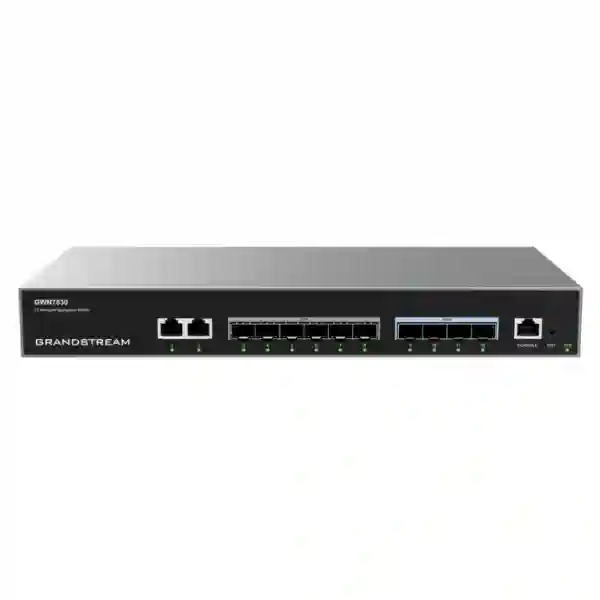
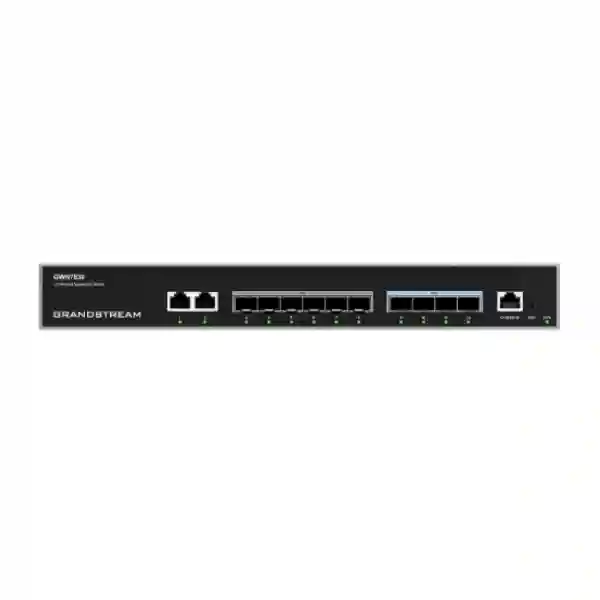
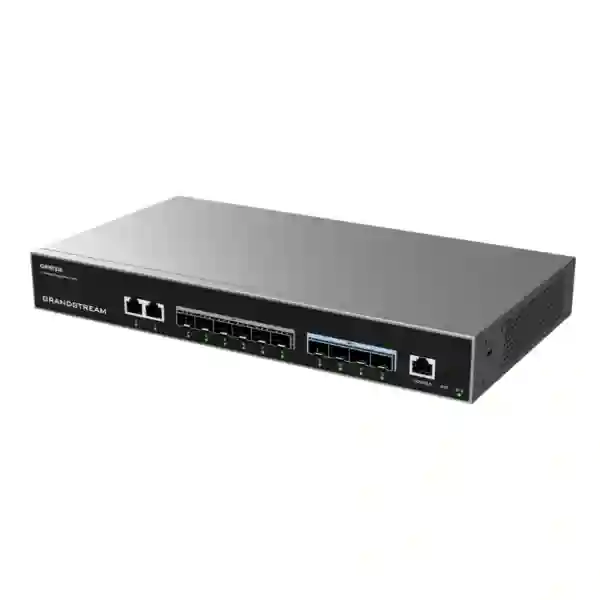
The Grandstream GWN7830 is built for organizations that need a compact aggregation layer with fiber connectivity, 10-Gigabit uplinks, Layer 3 routing, traffic segmentation and security controls. Its mix of 2 Gigabit Ethernet ports, 6 Gigabit SFP ports and 4 10-Gigabit SFP+ ports suits network designs where access switches, servers, wireless infrastructure, surveillance systems or branch links converge before reaching the firewall, core or data-center edge. Grandstream specifies a 96Gbps switching capability, 48Gbps non-blocking throughput and 71.424Mpps forwarding rate for the GWN7830, making it a practical option for medium-to-large business networks that need substantially more than a basic access switch.
2 × Gigabit Ethernet
Copper interfaces for local management, service connectivity or design flexibility within an aggregation deployment.
6 × 1G SFP
Fiber-ready Gigabit aggregation ports for links to remote closets, buildings, access switches and other network nodes.
4 × 10G SFP+
High-speed uplinks for backbone, server, storage or switch-to-switch connectivity where Gigabit links would become a bottleneck.
Layer 3 intelligence
Static and dynamic routing, VLANs, QoS, multicast controls, ACLs and enterprise security functions for structured network design.
What the GWN7830 solves in an enterprise LAN
An aggregation switch sits between edge or access switching and the higher-level core, firewall or routed infrastructure. In a growing office, campus, hotel, school, healthcare site, warehouse, retail operation or multi-floor building, dozens of endpoint-facing switches can create a concentration problem. Each access layer may carry business data, voice, Wi-Fi, cameras, building systems and guest traffic. If all of those links converge onto ordinary low-capacity uplinks, performance and fault isolation become harder to manage. The GWN7830 provides a dedicated place to aggregate those links, route selected VLANs and present faster uplinks toward critical network resources.
The model supports IPv4 and IPv6 networks, advanced VLAN functions, QoS, IGMP and MLD snooping, link aggregation, spanning-tree functions and extensive access-control capabilities. Grandstream documents security mechanisms including 802.1X and MAC authentication, RADIUS and TACACS+, ARP inspection, IP and IPv6 source guard, DHCP and DHCPv6 snooping, port security, storm control and DoS protection. These features matter when the switch is used as part of a disciplined network architecture rather than simply as a port-expansion device.
Management is also flexible. Administrators can use the local web interface, CLI and SNMP, while Grandstream supports centralized operation through GDMS Networking, GWN Manager and compatible GWN management environments. For organizations already standardizing on Grandstream access points, routers or network management, the GWN7830 can therefore fit into a broader operational model. The most suitable deployment still depends on uplink topology, fiber type, transceivers, routing policy, redundancy requirements and the actual traffic profile.
Verified GWN7830 technical highlights
| Specification | Grandstream GWN7830 | Why it matters |
|---|---|---|
| Ethernet ports | 2 × 10/100/1000Mbps | Adds copper connectivity alongside fiber aggregation. |
| Fiber ports | 6 × 1G SFP + 4 × 10G SFP+ | Supports mixed Gigabit and 10-Gigabit backbone designs. |
| Switching capability | 96Gbps | Provides headroom for multiple aggregated links. |
| Non-blocking throughput | 48Gbps | Important when several uplinks are active simultaneously. |
| Forwarding rate | 71.424Mpps | Indicates packet-forwarding capability under load. |
| Packet buffer | 12Mb | Helps absorb temporary bursts and queue traffic. |
| MAC addresses | 16K | Suitable for substantial enterprise Layer 2 domains. |
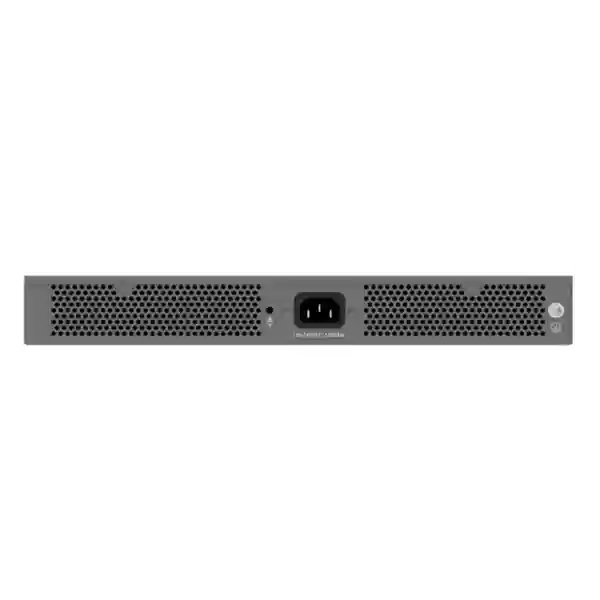
| Mounting | Desktop, wall or rack mount | Allows deployment in network cabinets, racks or controlled technical spaces. |
Routing and segmentation
The GWN7830 supports static routing and dynamic routing protocols including RIP, RIPng, OSPF, OSPFv3 and BGP. Combined with VLAN interfaces, 802.1Q tagging and link aggregation, this gives network designers options for separating departments, voice, cameras, guest services, wireless networks, servers and operational technology while keeping routing close to the aggregation layer where appropriate.
Security and access control
Security functions include port security, 802.1X, MAC authentication, RADIUS, TACACS+, DHCP snooping, ARP inspection, source guard, storm control and protections against common denial-of-service patterns. These capabilities can reduce the risk of unauthorized endpoints or spoofed local traffic when they are configured as part of a clear access policy.
Management and operations
Local Web UI, CLI and SNMP support hands-on administration and monitoring, while GDMS Networking and GWN Manager allow centralized management. Logging, backup and restore, LLDP/LLDP-MED, Ping, Traceroute, port mirroring and other diagnostics support ongoing operations and troubleshooting.
Deployment and buying guidance
Before ordering a GWN7830, map the existing and planned uplinks. Count how many access switches require 1G fiber and how many server, firewall or core links need 10G. Confirm whether each fiber run is single-mode or multimode, the link distance, connector type and compatible SFP or SFP+ module. The switch supports DAC connectivity on 10G ports within Grandstream’s documented limits, but every transceiver or cable choice should be matched to the actual optical or copper design. Buyers should also distinguish aggregation needs from PoE access-switch needs: the GWN7830 is an aggregation switch, not a replacement for PoE access switching where phones, cameras or access points need power from Ethernet.
Routing design should be decided before deployment. Some businesses prefer inter-VLAN routing at the firewall for centralized policy inspection; others place selected routing functions on the Layer 3 switch to keep local traffic efficient. The right answer depends on security policy, traffic volumes, fault domains and operational skills. Spanning tree, link aggregation and stacking should likewise be planned rather than enabled casually. A resilient design needs clear primary and secondary paths, predictable failure behavior and documented switch priorities.
For related procurement guidance, see the Fourteck Tanzania technology shop for business networking categories, the Fourteck Tanzania services page for deployment support, and the Fourteck Tanzania solutions overview for switching, Wi-Fi, firewall, cabling and integrated infrastructure planning. Regional buyers can also review Fourteck Kenya enterprise networking and Fourteck Uganda networking solutions when coordinating multi-country projects.
Grandstream GWN7830 Tanzania
For Tanzanian organizations, the GWN7830 fits projects where the LAN has grown beyond a collection of standalone access switches. A head office may have separate floors with access switches connected over fiber; a hotel can have communications rooms serving guest Wi-Fi, staff systems, CCTV and IP telephony; a school or university can link buildings and labs; a hospital can separate clinical, administrative, guest and surveillance networks. In these designs, the aggregation layer needs enough high-speed interfaces to prevent every service from competing for one narrow uplink. The GWN7830’s six Gigabit SFP ports and four 10-Gigabit SFP+ ports provide a practical mix for moderate-size backbone designs, while its Layer 3 capability can support routed VLANs where that architecture is appropriate.
Procurement in Tanzania should start with topology rather than the switch alone. Identify rack locations, fiber routes, transceiver types, access-switch uplink speeds, firewall interfaces, server connections and expected growth over the next three to five years. If the current environment uses 1G fiber between floors but future Wi-Fi, video or server traffic will require more bandwidth, reserve the 10G interfaces for links that benefit most. If the site is replacing unmanaged switches, plan VLAN structure and IP addressing before installation so the project does not simply recreate an unsegmented network on better hardware.
Environmental and power planning also matters. Grandstream rates the GWN7830 for 0°C to 45°C operating conditions with 10% to 90% non-condensing humidity. Network rooms should therefore have ventilation, controlled dust and reliable power. A suitable UPS can help protect the switch and upstream equipment during short power events, while correct grounding and surge protection are relevant in commercial buildings. Buyers requesting a quotation should include the number of fiber links, cable distances, required optics, rack space, existing switch brands, VLAN count and whether routing will be handled by the switch or firewall. This information allows the bill of materials to include the infrastructure around the GWN7830, not just the chassis.
Grandstream GWN7830 Dar es Salaam
Dar es Salaam businesses often operate dense offices, hotels, campuses, warehouses, healthcare facilities and multi-tenant commercial sites where many network services converge in one building or compound. In that context, a GWN7830 can act as a structured aggregation point between floor switches, fiber-fed distribution closets and the firewall or server layer. The design value is not simply port count. Separating user data, voice, surveillance, wireless guest access and business-critical systems into VLANs can reduce broadcast scope and make policy easier to understand, while QoS can help prioritize latency-sensitive applications when links become busy.
A Dar es Salaam deployment should also consider how internet resilience interacts with the LAN. Many organizations invest in a second ISP or firewall failover path but leave the internal switching design with a single uplink or unmanaged dependency. If the building has multiple access switches, link aggregation and well-planned spanning tree can provide more predictable failover. The GWN7830 supports 32 link aggregation groups and a broad set of spanning-tree features, giving engineers options to create resilient paths without relying on ad hoc loops. These functions must be configured carefully with documented root priorities, VLAN assignments and link roles.
For office towers and compounds, fiber is often chosen between floors or buildings because it supports longer distances and isolates copper-related electrical issues. Before purchasing SFP modules, verify the fiber type already installed. Single-mode and multimode optics are not interchangeable assumptions, and existing patch panels may determine connector format. On the switching side, check which access switches can uplink at 1G and which can benefit from 10G. A practical quotation for a Dar es Salaam project should therefore include switch quantity, optics, patch cords, rack accessories, UPS requirements, configuration scope and testing. This approach helps procurement teams compare complete deployment costs rather than choosing on chassis price alone.
Grandstream GWN7830 Mwanza
In Mwanza, the GWN7830 can support organizations expanding from a single communications room into a more distributed campus or multi-building network. Manufacturing sites, education campuses, hospitality properties, regional offices and logistics operations may have access switches positioned far from the central firewall or server room. When copper distance becomes impractical, fiber uplinks provide a cleaner backbone. The six 1G SFP interfaces on the GWN7830 can aggregate several remote closets, while the four 10G SFP+ ports can connect higher-capacity segments or upstream systems.
The planning question is how much traffic each remote area creates. A small office floor with ordinary desktop usage may operate comfortably on 1G, while a surveillance-heavy zone, large Wi-Fi deployment or server-connected production area may require more. Oversubscription is normal in network design, but it should be intentional. Inventory camera bitrates, Wi-Fi client counts, file-transfer patterns, backup windows and any local applications that cross the backbone. This helps determine whether the GWN7830 should be used as the main aggregation switch or as one layer within a larger hierarchy.
Mwanza deployments should also build maintainability into the design. Label fiber pairs, document SFP types, record VLAN IDs and keep backup configuration files. Grandstream provides backup and restore, syslog, SNMP, LLDP/LLDP-MED and diagnostic functions that support this operational discipline. Where remote administration is required, centralized management through GDMS Networking or GWN Manager can simplify visibility, but credentials, administrator roles and remote-access security should be governed carefully. Buyers preparing a request for quotation should specify the current network diagram, planned building links, switch models at the edge and whether the new aggregation layer must support dynamic routing. With those details, the GWN7830 can be evaluated against actual needs rather than treated as a generic fiber switch.
Grandstream GWN7830 Arusha
Arusha has a broad mix of hospitality, tourism, education, office and service environments where a reliable internal network can carry guest Wi-Fi, property systems, CCTV, VoIP, staff applications and internet access at the same time. A GWN7830 aggregation switch is relevant when those services are spread across several access switches and need a central layer with fiber uplinks, segmentation and Layer 3 controls. Hotels and conference venues in particular should distinguish guest traffic from operational systems and surveillance. VLANs, ACLs and controlled routing can create that separation while retaining a manageable backbone.
For hospitality networks, traffic patterns can change sharply between quiet periods and conferences or high occupancy. The switching layer should therefore be sized for peaks, not averages. Multiple access points can generate significant east-west and internet-bound traffic, while IP cameras send continuous streams toward recorders. If both services share the same aggregation path, the uplink design must account for simultaneous use. The GWN7830’s 10G SFP+ interfaces can provide higher-capacity paths to a firewall, server, recorder or downstream switch where supported by the rest of the equipment.
Physical installation deserves the same attention as logical design. Rack cooling, patching, fiber cleanliness, UPS protection and cable labeling directly affect long-term reliability. The GWN7830 can be rack-mounted, and keeping it in an organized communications cabinet improves serviceability. For an Arusha quotation, describe the number of buildings or floors, existing fiber, access-point quantity, camera count, IP phone usage and whether the business already uses Grandstream management tools. If the organization operates multiple sites, centralized monitoring and consistent VLAN naming can reduce support complexity. A properly planned aggregation layer should make future additions easier, so leave room for new uplinks and document which ports are reserved for expansion.
Grandstream GWN7830 Dodoma
Dodoma organizations planning government, education, professional-services, healthcare or enterprise office networks can use the GWN7830 where several network segments must be brought together through a managed Layer 3 aggregation layer. The model’s combination of 1G SFP and 10G SFP+ interfaces is particularly useful when older access infrastructure still operates at Gigabit speeds but new server, storage, firewall or distribution links need additional capacity. This mixed-speed approach can make phased upgrades more practical than replacing every access switch at once.
A phased migration should begin by identifying which links are genuine bottlenecks. Network monitoring can show uplink utilization, packet loss and error rates. Upgrading a quiet link to 10G produces little benefit, while a congested building uplink or recorder path may show immediate improvement. The GWN7830’s SNMP, traffic statistics, port mirroring and diagnostic tools can help administrators observe the network after deployment. QoS policies can also prioritize selected traffic classes, but QoS is not a substitute for adequate bandwidth; it is a method for deciding which traffic should be protected when contention occurs.
Security planning is important for shared institutional networks. Features such as 802.1X, DHCP snooping, ARP inspection and source guard can strengthen access-layer trust boundaries when the surrounding environment supports them. Implementation should be staged, because strict security controls can block legitimate devices if device inventories and authentication systems are incomplete. For Dodoma procurement, include the number of departments or tenants, desired VLAN structure, authentication platform if any, routing requirements and the existing firewall architecture. The goal is to procure a switch that fits operational policies and can be supported by the local IT team, not simply to enable every available feature on day one.
Grandstream GWN7830 UAE
For UAE projects, the GWN7830 is suitable for medium-to-large office networks, hospitality sites, retail groups, warehouses and regional branches that need a fiber-capable aggregation switch with Layer 3 services. Organizations with mixed 1G and 10G infrastructure can use the six SFP and four SFP+ interfaces to bridge a transition between existing access networks and higher-speed backbone components. This is useful when a business has recently upgraded firewalls, servers or Wi-Fi but still has edge switches that do not require replacement.
UAE deployments frequently place equipment in structured racks with patch panels, UPS systems and dedicated cooling. The GWN7830’s rack-mount support fits that environment, but thermal and power planning remain part of the bill of materials. Fiber specification should also be verified because buildings may contain different generations of cabling. A transceiver that is correct for one site may not suit another. Document fiber mode, connector type, distance and target speed before ordering optics, and verify interoperability at each end of a link.
For companies operating between Tanzania and the UAE, standardized switch configuration can simplify support. Consistent VLAN IDs, interface descriptions, SNMP settings, administrative roles and configuration backups make it easier to compare sites and troubleshoot remotely. Grandstream’s centralized management options can support that operational model. Regional projects can also reference Fourteck UAE integrated IT and networking solutions for related infrastructure requirements. When requesting a quote, include whether the UAE site requires standalone switching, integration with existing Grandstream networks or a broader design involving firewalls, wireless, IP telephony and surveillance.
Grandstream GWN7830 Uganda
Ugandan businesses can deploy the GWN7830 as an aggregation point for branch, campus or multi-floor networks where fiber uplinks are already present or planned. In a growing network, access switches may have been added over time without a consistent hierarchy. Moving those uplinks to a dedicated aggregation switch can simplify topology, centralize routing decisions and create clearer paths toward the firewall and servers. The GWN7830’s 96Gbps switching capability and 10G uplinks provide room for multiple access segments without forcing every service through a single Gigabit bottleneck.
For Uganda-wide operations, centralized management and configuration consistency can be more valuable than any one hardware specification. A business with several offices should define standard VLAN names, IP ranges, management access rules and logging destinations. Grandstream’s GDMS Networking and GWN Manager can support centralized visibility, while local Web UI and CLI remain available for direct administration. Remote management must still be protected with secure credentials and limited administrative access, ideally through a controlled management network or VPN.
When planning procurement, decide whether the GWN7830 will sit at a main site, a regional data room or a larger branch. The number and type of fiber links should match actual topology. If access switches require PoE for phones, access points or cameras, those edge switches remain responsible for endpoint power; the GWN7830 focuses on aggregation. Buyers can review Fourteck Uganda networking and business IT solutions when coordinating deployment requirements. A useful quotation request should include branch count, current switch inventory, desired uplink speeds, firewall model, routing plan and any requirement for 10G server or storage connectivity.
Grandstream GWN7830 Kampala
Kampala enterprises often combine office users, Wi-Fi, IP phones, cameras and cloud applications on the same campus network. As device counts rise, uplink congestion and inconsistent segmentation can become more disruptive than access-port shortages. The GWN7830 addresses that layer of the design by providing dedicated fiber aggregation, Layer 3 routing and security functions. A typical deployment might connect several PoE access switches over 1G SFP links, use a 10G SFP+ uplink toward the firewall or server layer, and reserve additional 10G capacity for future growth or a second high-speed path.
For offices spread across multiple floors, cable routes and equipment-room locations should be documented before hardware selection. If existing fiber supports 10G, upgrading the most heavily used uplinks can improve headroom without replacing every horizontal cable. If only 1G optics are appropriate, the GWN7830 still provides multiple SFP interfaces and can aggregate several access layers. Link aggregation can combine compatible physical links, but both ends must be configured consistently and the traffic distribution characteristics understood.
Kampala IT teams should also define how faults will be diagnosed. SNMP monitoring, syslog, interface descriptions and configuration backups make it easier to identify whether a problem is in the backbone, access switch, firewall or endpoint. LLDP and LLDP-MED can help document connected devices and support voice-network functions. Before requesting a quotation, prepare a simple topology showing each access switch, existing fiber path and target uplink speed. Include whether VLAN routing should remain on the firewall or move to the GWN7830. That design choice affects ACL placement, gateway addresses, troubleshooting procedures and the final implementation scope.
Grandstream GWN7830 Arua
For Arua organizations with regional offices, education sites, healthcare environments, hospitality properties or logistics facilities, the GWN7830 can provide a structured backbone as the network expands beyond a single switch. The most compelling use case is not high port density at the edge; it is the ability to consolidate multiple fiber-connected segments and provide faster 10G paths to key infrastructure. This can make a difference when remote closets serve many users or cameras and all traffic must return to a central server or internet gateway.
Arua projects should pay particular attention to operational simplicity. Complex routing and security features are valuable only when the IT team can document, monitor and maintain them. Start with a clear VLAN plan, standardized port descriptions, management IP addresses and backup procedures. Add dynamic routing only where there is a genuine multi-router requirement. If the network is simple, static routes may be easier to operate. If it grows into several routed segments or sites, OSPF or other supported protocols can be introduced with proper change control.
Power quality and equipment protection should also be included in procurement. The switch, firewall, access switches and optical modules are all part of the same availability chain. A UPS sized for the rack can help keep network services alive through brief interruptions and provide orderly shutdown time. Fiber patching should be clean and labeled, with spare patch cords and known-good optics available for troubleshooting where practical. When asking for the GWN7830 in Arua, describe the number of uplinks, whether they are single-mode or multimode, their distances and the equipment at the far end. This prevents the common problem of receiving a switch without the correct optics or accessories to commission it.
Grandstream GWN7830 Mbarara
Mbarara businesses upgrading campuses, hospitality sites, hospitals, schools or branch offices can use the GWN7830 when the existing LAN needs a clearer separation between access and aggregation. In a flat design, every access switch may connect independently to the firewall or a basic central switch. As the network grows, that approach becomes harder to troubleshoot and often leaves limited capacity between major traffic sources. A dedicated aggregation switch provides a controlled point for fiber uplinks, routing and backbone policy.
The GWN7830’s VLAN and QoS capabilities are especially useful where voice, video and business data coexist. IP phones benefit from predictable latency, while surveillance traffic is continuous and can consume significant bandwidth. Wireless access points may produce short peaks as users download files or join meetings. Separating these services logically and assigning sensible QoS policies can reduce interference, although the backbone must still have sufficient physical capacity. Where a recorder or server generates substantial traffic, a 10G SFP+ link may be appropriate if the connected device also supports 10G.
Mbarara procurement teams should ask for a complete equipment list rather than only the GWN7830. The installation may require SFP or SFP+ modules, fiber patch leads, a rack shelf or mounting kit, UPS capacity, labeled patching and configuration services. Existing fiber should be tested before commissioning so that link issues are not mistakenly attributed to the switch. After deployment, maintain a port map showing what each fiber serves and keep the latest configuration backup. This operational record becomes valuable during future expansions, especially when another building or access switch is added and engineers need to know which interfaces and VLANs are already committed.
Grandstream GWN7830 Gulu
In Gulu, the GWN7830 can serve businesses and institutions that want to move from isolated network islands toward a managed campus backbone. Fiber-fed access switches can be brought into one aggregation point, allowing IT teams to see uplink status, apply VLAN design consistently and route traffic between approved segments. This is valuable for facilities with separate administrative, guest, voice and surveillance networks, or for sites where more than one building shares centralized internet, servers or recording infrastructure.
Capacity planning should consider both current usage and realistic growth. A new Wi-Fi rollout can increase backbone traffic even when the number of wired users remains unchanged. Additional high-resolution cameras can create continuous streams toward an NVR. Cloud backups and software updates can create bursts. The GWN7830 gives network designers four 10G SFP+ interfaces that can be assigned to the heaviest paths, while 1G SFP links remain suitable for lighter access segments. This mix can support staged modernization without forcing every link to 10G immediately.
Operational resilience also depends on topology. Spanning tree, link aggregation and supported stacking functions can improve availability when designed correctly, but redundancy should be tested during commissioning. Simulate a failed uplink and confirm that traffic converges as expected. Verify that management remains reachable after a path changes. Record switch priorities and LAG membership. For Gulu procurement, include expected redundancy, any second aggregation switch, firewall connections and whether the organization requires centralized management. These details allow the solution to be designed around recovery behavior, not just normal operation. A network that works only while every cable and device is healthy is not truly resilient.
Grandstream GWN7830 Kenya
Kenyan organizations can use the GWN7830 in office campuses, hospitality, education, healthcare, retail and logistics networks that require fiber aggregation and 10G uplink capacity. The model is especially useful for multi-floor or multi-building sites where several access switches need to converge on a central distribution layer. With six 1G SFP ports and four 10G SFP+ ports, a design can mix existing Gigabit fiber with faster links to the firewall, server infrastructure or a higher-level core.
For a Kenya deployment, confirm whether the main requirement is bandwidth, segmentation, routing or all three. If the existing central switch is saturated, 10G links may provide immediate headroom. If the bigger issue is an unstructured flat network, VLANs and routing will provide more value than raw speed. If remote closets are connected through unmanaged media converters, moving to native SFP links on managed switches can improve visibility and simplify troubleshooting. Each of these scenarios has a different bill of materials, so the network diagram should come before the quotation.
Companies operating in both Kenya and Tanzania can benefit from standardizing management practices even when exact access-switch models differ. Use common naming conventions, VLAN purposes, SNMP monitoring, syslog and backup schedules. Grandstream’s centralized management tools can help where the wider GWN ecosystem is used. Buyers can review Fourteck Kenya enterprise IT and networking for regional project context. When requesting the GWN7830, include required optics, rack environment, fiber type, desired 10G connections and any migration constraints so installation can be planned with minimal service interruption.
Grandstream GWN7830 Kuwait
Kuwait business networks in offices, retail groups, hospitality, healthcare and industrial support environments can use the GWN7830 where a manageable aggregation layer is needed between access switching and critical upstream infrastructure. The switch’s mixed 1G SFP and 10G SFP+ design is relevant for sites that have a combination of legacy Gigabit fiber and newer high-bandwidth systems. Instead of replacing every uplink simultaneously, network teams can move the busiest links to 10G while retaining compatible 1G connections elsewhere.
Structured rack environments make configuration discipline particularly important. Interface labels on the switch should match rack and patch-panel labels, and fiber pairs should be documented by destination. When several tenants, departments or services share the infrastructure, VLANs and ACLs can control traffic boundaries. Authentication functions such as 802.1X may be added when the wider identity system is ready. The GWN7830 supports these controls, but successful implementation depends on policy design and endpoint readiness rather than hardware capability alone.
Cooling and airflow are also part of network design in hot-climate markets. Even when equipment is installed indoors, communications rooms can become warmer than occupied office areas. Keep the switch within the manufacturer’s operating range, maintain clear ventilation and avoid overloaded racks. A UPS and organized power distribution can improve service continuity. For Kuwait procurement, provide the expected number of access uplinks, whether any servers need direct 10G connectivity, the firewall interface speed and whether the switch will participate in dynamic routing. These details help determine if one GWN7830 is sufficient or whether a larger GWN7830-series model or different topology better matches the site.
Grandstream GWN7830 Ghana
For Ghanaian organizations, the GWN7830 can form the center of a controlled aggregation design for office campuses, schools, hotels, healthcare environments, security networks and growing enterprises. As access switching expands, the aggregation layer becomes the point where traffic from different buildings or floors is combined and sent toward firewalls, servers or internet gateways. The GWN7830’s fiber-focused port mix makes it suitable for this role when the site has several optical uplinks and requires some 10G capacity.
A common planning challenge is mixing business data with high-volume systems such as CCTV. Cameras can produce constant traffic, while ordinary office applications are burstier. Wi-Fi traffic can also rise sharply during meetings, training sessions or guest events. Segmentation and QoS help organize these flows, but topology and bandwidth remain fundamental. Reserve higher-speed links for paths where the traffic analysis justifies them. If the recorder, firewall or server supports only 1G, installing a 10G switch uplink does not remove the downstream limit.
Ghana projects should also include a support plan. Decide who owns firmware updates, configuration backups, monitoring alerts and change approval. Grandstream provides local and centralized management choices, so businesses can select an operating model that matches their team. For multi-country Fourteck customers, Fourteck Ghana business networking and infrastructure can provide regional context alongside the Tanzania project. When requesting a quote, list existing switch models, uplink media, rack location, required VLANs, routing protocols and growth expectations. That makes it easier to determine whether the GWN7830 is the correct size within the GWN7830 family.
Grandstream GWN7830 Nigeria
Nigeria’s large and varied business environments often require switching designs that can grow from one site to several branches, buildings or distribution closets. The Grandstream GWN7830 is relevant where a medium-to-large network needs a dedicated fiber aggregation layer with 10G uplinks, advanced VLANs and Layer 3 routing. It can connect multiple access networks while providing a manageable path toward servers, firewalls or a wider core, helping avoid the bottleneck and operational confusion that can occur when many edge switches are daisy-chained.
For enterprise and institutional sites, resilience should be part of the initial design. Link aggregation and spanning tree can provide alternate paths, and Grandstream also supports stacking functions within the GWN7830 series. However, redundancy should be designed around real failure scenarios. Consider what happens if a fiber link is cut, if the upstream firewall interface fails or if an aggregation switch loses power. Decide which services are critical and whether a second switch, dual uplinks or redundant power architecture is required elsewhere in the solution.
Power and environmental conditions should be reviewed before deployment, especially where technical rooms experience heat, dust or power interruptions. A correctly sized UPS, stable grounding, rack ventilation and scheduled maintenance can protect the investment. Centralized monitoring helps identify rising error rates or failed links before users report major outages. Nigeria-based regional projects can reference Fourteck Nigeria IT and networking solutions. For quotation accuracy, share site count, fiber distances, desired routing approach, security segmentation and whether the GWN7830 will integrate with existing Grandstream or third-party switching.
Grandstream GWN7830 Seychelles
Seychelles organizations in hospitality, government, education, professional services and island-based operations may need aggregation switching where network services are spread across buildings, floors or property zones. The GWN7830 can consolidate fiber-connected access switches and provide 10G uplinks toward the central firewall, servers or recording systems. In resorts and hotels, this can be useful for keeping guest Wi-Fi, staff systems, IP telephony, CCTV and operational systems logically separated while still using a shared backbone.
Because island deployments can make replacement logistics and on-site troubleshooting more demanding, documentation and spares planning deserve extra attention. Record the exact transceiver types, fiber mode, connector format and cable routes. Keep configuration backups and label all uplinks clearly. If the site depends on a small number of critical fiber paths, consider whether spare optics or patch leads should be held locally. These low-cost items can reduce downtime when a link fault occurs. The GWN7830’s diagnostics, SNMP, syslog and port-mirroring functions provide useful tools for remote support when physical access is limited.
Network teams should also avoid overcomplicating the routing design. Use the switch’s Layer 3 capabilities where they improve performance or segmentation, but keep security-sensitive inter-zone policy on the firewall when that provides clearer control. For a Seychelles quotation, include property layout, building-to-building distances, access-switch models, camera and Wi-Fi density, internet gateway speed and expected growth. That information helps determine whether the GWN7830’s six SFP and four SFP+ ports are sufficient or whether another model in the GWN7830 series would provide a better port-count fit. The objective is a maintainable network that can be expanded without redesigning the backbone every time a new building or service is added.
GWN7830 integration checklist
Confirm single-mode or multimode fiber, link distance, connector type, 1G or 10G requirement and compatible SFP/SFP+ modules.
Define user, voice, camera, Wi-Fi, server, management and guest segments before ports are configured.
Decide which gateways live on the switch and which remain on the firewall so policy enforcement is intentional.
Document spanning-tree roles, link aggregation, alternate paths and expected behavior during failure.
Choose local Web UI, CLI, SNMP, GDMS Networking or GWN Manager workflows and protect administrator access.
Check rack position, airflow, UPS sizing, grounding, patching and cable management before installation day.
Grandstream GWN7830 FAQs
Is the GWN7830 a PoE switch?
The GWN7830 is positioned as a Layer 3 aggregation managed switch. It is intended to aggregate network links rather than provide endpoint PoE power. If phones, access points or cameras require PoE, use suitable PoE access switches at the edge and connect those switches to the GWN7830.
How many fiber ports does the GWN7830 have?
It provides six 1-Gigabit SFP ports and four 10-Gigabit SFP+ ports, in addition to two Gigabit Ethernet copper ports.
What is the switching capacity?
Grandstream specifies 96Gbps switching capability, 48Gbps total non-blocking throughput and a forwarding rate of 71.424Mpps for the GWN7830.
Does it support dynamic routing?
Yes. Grandstream documents dynamic routing support including RIP, RIPng, OSPF, OSPFv3 and BGP, alongside static routing and routing-policy features.
How can the GWN7830 be managed?
Management options include the local Web UI, CLI through console/Telnet/SSH, SNMP, GDMS Networking, GWN Manager and supported GWN environments. The preferred method depends on whether the site is standalone or part of a centrally managed network.
Can it be used for CCTV and Wi-Fi networks?
Yes, as an aggregation layer. Access switches can carry camera and access-point traffic into the GWN7830, while VLANs, QoS, multicast controls and higher-speed uplinks help organize those services. PoE power still needs to come from suitable edge switches or other power arrangements.
What information should I provide for a quotation?
Provide the number of uplinks, fiber type and distance, required SFP/SFP+ modules, rack location, current access-switch models, firewall speed, VLAN and routing requirements, redundancy expectations and any 10G server or storage connections. This allows the quote to include the supporting components needed for a complete deployment.
Quotation checklist for the Grandstream GWN7830
For a useful technical and commercial quotation, share the site location, number of access switches, current uplink speeds, required fiber distances, single-mode or multimode cabling, target 10G connections, firewall model and interface speed, VLAN count, whether the switch will perform inter-VLAN routing, any requirement for OSPF or BGP, rack and UPS availability, and whether configuration or migration support is needed. If the installation replaces an existing aggregation switch, include the current configuration or at least a port and VLAN summary. If it is a new build, a simple diagram showing floors, buildings and communications rooms is enough to start planning.
A complete quote should separate the switch itself from optics, DAC cables where applicable, patch leads, rack accessories, UPS or power requirements and professional services. This makes comparison clearer and reduces the risk of discovering missing parts during installation. Availability, lead time, warranty terms and exact accessories should be confirmed at quotation stage rather than assumed from generic product information.
Decision recap: when the GWN7830 is a strong fit
Choose the Grandstream GWN7830 when the network needs a compact Layer 3 aggregation switch with a combination of Gigabit SFP and 10-Gigabit SFP+ connectivity, advanced VLAN and QoS functions, enterprise authentication and source-protection features, dynamic routing and multiple management options. It is particularly relevant for networks with several fiber-fed access switches and a requirement to create a cleaner backbone between edge switching and the firewall, servers or core.
Consider a different design if the main requirement is endpoint PoE, if many more fiber ports are required than the GWN7830 provides, or if the environment needs a larger chassis or specific redundancy architecture. Grandstream’s GWN7830 series includes larger models for higher port counts, so selection should be based on uplink quantity and growth rather than model name alone. A topology review before purchase is the most reliable way to confirm fit.
Talk to Fourteck about GWN7830 design and procurement
Fourteck Tanzania can discuss the GWN7830 as part of a broader LAN requirement that may include access switching, Wi-Fi, firewalling, IP telephony, surveillance, fiber, racks and UPS protection. Share your current topology and intended growth so the recommendation can address compatibility, bandwidth and management from the start. The objective is to supply the correct switch together with the optics, cabling and configuration approach required to make it useful in the real network.

Reviews
There are no reviews yet.