
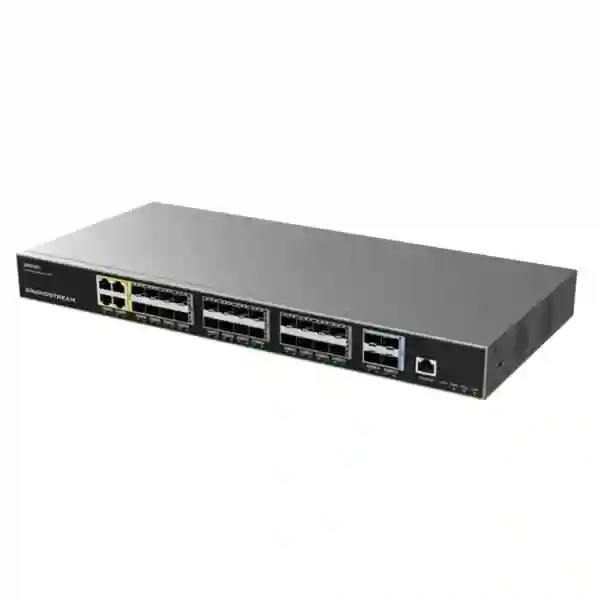
Grandstream GWN7831 Layer 3 Aggregation Managed Switch Tanzania
The Grandstream GWN7831 is a Layer 3 aggregation managed switch built for organizations that need a stronger core or aggregation layer than a conventional access switch can provide. Its combination of 24 Gigabit SFP ports, 4 Gigabit combo ports and 4 10Gigabit SFP+ ports gives network architects a flexible way to aggregate fiber links from access switches, buildings, floors, server zones and other network segments while retaining high-speed uplink capacity. Grandstream specifies a maximum switching capacity of 128Gbps, total non-blocking throughput of 64Gbps and a forwarding rate of 95.232Mpps for this model. For Tanzanian businesses planning a campus network, multi-floor office, hospitality property, education environment, warehouse, enterprise branch hub or data-heavy infrastructure refresh, the GWN7831 offers a practical middle ground between smaller edge switching and higher-capacity core platforms.
24 Gigabit SFP ports provide broad fiber aggregation capacity for larger business networks.
Four SFP+ ports support high-speed uplink, server, aggregation or stacking designs.
Advanced routing, VLAN, ACL, multicast and QoS functions support segmented enterprise networks.
Manage locally through web or CLI, or centrally through Grandstream networking management platforms.

What the GWN7831 is designed to solve
Business networks often grow in layers. A small office may begin with one or two access switches, but a larger site can quickly need multiple wiring closets, fiber runs between floors, dedicated server connections, voice and surveillance VLANs, separate wireless networks, redundant paths and higher-speed links back to a central rack. At that point, relying on ordinary access switches for every function can create bottlenecks and make network management difficult. The GWN7831 is positioned as an aggregation switch for that transition. It allows many lower-speed fiber connections to converge into a managed Layer 3 platform and then move upstream through 10Gbps SFP+ links.
This architecture is relevant where access switches are distributed through a building or campus and need a common aggregation point. It is also useful where departments, servers or operational networks must be separated with VLANs and controlled through routing and access policies. Grandstream supports IPv4 and IPv6, static and dynamic routing, VLAN functions, Spanning Tree variants, link aggregation, multicast controls, DHCP functions, QoS and ACL capabilities. The operational benefit is that the aggregation layer can become a deliberate control point rather than a collection of unmanaged interconnections.
Verified Grandstream GWN7831 specifications
| Specification | GWN7831 |
|---|---|
| Product class | Layer 3 aggregation managed switch |
| Gigabit SFP ports | 24 |
| Gigabit combo ports | 4 combo ports |
| 10Gigabit SFP+ ports | 4 |
| Switching capability | 128Gbps |
| Non-blocking throughput | 64Gbps |
| Forwarding rate | 95.232Mpps |
| Integrated power supply | 60W |
| External redundant power supply | 12V/60W external RPS support |
| Management | Local web UI, CLI and Grandstream centralized network management options |
The GWN7831 is not a PoE access switch. Its role is primarily aggregation, routing and high-density fiber connectivity. Buyers should therefore plan it together with appropriate access switches where endpoints such as IP phones, cameras and wireless access points require PoE. The GWN7831 can then aggregate those access switches through fiber or high-speed uplinks. When optical modules are involved, module type, wavelength, fiber mode, distance and compatibility should be confirmed before purchase. Grandstream documentation also notes that supported DAC cable use on SFP+ connections is subject to cable-length requirements.
Routing, segmentation, QoS and security capabilities
Layer 3 capability is one of the main reasons to consider the GWN7831 instead of a simpler Layer 2 switch. In larger networks, moving traffic between VLANs through a capable aggregation switch can reduce unnecessary dependency on a separate router for every internal path and can make the topology more structured. Grandstream documentation lists support for static routing and dynamic routing including RIP, RIPng, OSPF and OSPFv3, while current product information also describes extensive VLAN control and multicast features. The exact routing design should still be created around the business requirement, firewall boundaries and security policy rather than enabled simply because the feature is available.
Security functions include controls such as ARP inspection, IP Source Guard, DoS protection, port security and DHCP snooping. These features can help reduce common Layer 2 risks when properly configured. Access control lists can be used to permit or block traffic according to network policy, while 802.1X and other authentication-related functions can support controlled access environments. QoS functions can prioritize important traffic classes such as voice, conferencing or critical business applications when congestion occurs. For multicast-heavy environments, IGMP and MLD snooping can help avoid unnecessary flooding and improve traffic efficiency.
Management and operational planning
The GWN7831 can be managed through its local web interface and command-line interface, and it also works with Grandstream centralized management platforms. This gives administrators flexibility: a single site can use direct local administration, while organizations with multiple Grandstream network devices can standardize configuration and monitoring through a centralized platform. Management design matters because a capable switch can become difficult to support if its naming, VLAN structure, addressing and documentation are inconsistent. Before deployment, define management IP addressing, administrator roles, configuration backup, firmware process, monitoring and logging expectations.
Grandstream also supports stacking on the GWN7831 in current firmware, with same-model requirements and designated SFP+ stacking ports. Stacking can simplify administration and provide a more unified operational view, but it should be designed intentionally because stack topology, firmware consistency and link allocation affect resilience. Where redundancy is important, also evaluate external RPS use, diverse power sources, UPS support, redundant uplinks and routing topology. Redundancy works best when power, links and configuration are considered together instead of treating one feature as a complete availability strategy.
Related FourTeck Tanzania resources
For a broader view of available business technology, start with the FourTeck Tanzania technology shop, which explains the purchasing considerations around switches, access points, firewalls, servers and related infrastructure. The technology services overview is useful when the GWN7831 is part of a network design, migration or multi-system rollout. For solution context, the FourTeck Tanzania home page explains how networking, voice, security, Wi-Fi and server systems can be planned together. The About FourTeck Tanzania page provides company context, while the Tanzania contact and quotation page is the correct place to send exact quantities, fiber requirements, switch counts and project details.
Grandstream GWN7831 Tanzania
For customers evaluating the Grandstream GWN7831 in Tanzania, the most useful starting point is to define what the switch will aggregate. A typical project may include several access switches serving users, IP phones, cameras and Wi-Fi access points, with fiber uplinks returning to a central rack. In that design, the GWN7831 can provide the higher-density SFP aggregation layer and 10Gbps SFP+ links required to move traffic toward servers, security appliances or an upstream core. Its 24 Gigabit SFP ports are particularly relevant where a business has many fiber-fed closets, buildings or network segments and wants a cleaner central architecture than a daisy-chain of access switches.
Tanzania deployments can vary greatly in building type, power stability, rack environment and fiber availability. A quotation should therefore include more than the switch itself. Buyers should identify whether each fiber connection is single-mode or multimode, the expected link distance, the connector type, required optical modules, whether redundant links are needed and whether existing equipment supports the intended speed. Power should also be considered. The switch has an integrated power supply and supports an external redundant power option, but resilient operation also depends on the upstream electrical design, UPS capacity and rack cooling.
The GWN7831 is well suited to organizations that need structured VLANs and internal routing. For example, a hotel can separate guest Wi-Fi, administration, CCTV and voice; a university can separate labs, offices, student networks and infrastructure management; a multi-floor corporate office can aggregate access switches from each floor; and an operations facility can isolate surveillance, business data and control networks according to policy. FourTeck can help translate these requirements into port allocation, VLAN design, uplink selection and fiber-module planning. For related networking work, the network switching service section and infrastructure planning section provide useful project context.
Grandstream GWN7831 Dar es Salaam
Organizations in Dar es Salaam often need to consolidate switching for headquarters, branch hubs, warehouses, hospitality properties, education facilities and commercial buildings where many network services share the same core infrastructure. The GWN7831 fits this role when multiple access switches or fiber-fed zones need to converge in a central rack. Instead of treating every floor or department as an isolated network, a planned aggregation layer can provide common VLAN policy, routing, monitoring and high-speed upstream connectivity. The combination of 24 SFP ports and 4 SFP+ ports gives network designers room to collect many Gigabit fiber links while reserving 10Gbps capacity for higher-throughput paths.
Before ordering a GWN7831 for a Dar es Salaam site, map the physical network. Count wiring closets, access switches, fiber links, server connections and uplinks to the firewall or router. Confirm whether existing fiber is single-mode or multimode and measure the longest runs. A building may already have fiber, but that does not automatically mean every transceiver is interchangeable. Wavelength, speed, connector and optical budget need to match. If the project is a migration from older switching, document current VLANs, default gateways, trunk ports and any static routes before moving services.
For dense commercial environments, the aggregation switch can also help keep traffic patterns predictable. Voice, CCTV, business data, guest wireless and infrastructure management can be separated logically, while QoS can protect latency-sensitive traffic. Where the switch is part of an internet-edge redesign, it should be coordinated with firewall throughput and WAN capacity so the internal network is not faster only to be constrained elsewhere. Buyers can use the FourTeck Tanzania contact page to request a Dar es Salaam quotation with model quantity, module type, rack details, required installation scope and any migration needs.
Grandstream GWN7831 Mwanza
For Mwanza businesses, institutions and multi-building sites, the GWN7831 can be valuable where fiber links are already used or planned between sections of a property. A common example is a main communications room that needs to aggregate access switches from offices, classrooms, warehouses, accommodation blocks or security areas. The GWN7831 provides enough SFP density to bring many of those Gigabit fiber paths into one managed device, while the SFP+ uplinks can connect toward servers, a higher-speed core or other strategic network points. This can make troubleshooting easier because link status, VLAN membership and traffic policy are concentrated in a known aggregation layer.
Mwanza deployments should be designed around maintainability. If several buildings are connected over fiber, keep an accurate record of strand assignment, patch-panel ports, transceiver model, cable type and destination. Network diagrams should show which access switch reaches each GWN7831 port and whether the path is primary, redundant or part of a link aggregation group. This documentation matters during expansion, because a fiber-heavy environment can become confusing quickly if links are unlabeled. Spare optical modules may also be appropriate for operational continuity, provided they are the correct type for the installed fiber.
Layer 3 features can be especially useful when the site contains different departments or operational zones. Rather than extending one flat broadcast domain everywhere, VLAN interfaces and routing can create deliberate boundaries. Security controls and ACLs can then limit which networks can communicate. If the site also operates IP cameras, access points or IP phones, remember that those edge devices usually rely on PoE access switches; the GWN7831 acts above them as an aggregation device. FourTeck can help review this hierarchy as part of a wider switch, Wi-Fi, firewall and structured-networking design.
Grandstream GWN7831 Arusha
Arusha organizations in hospitality, tourism, education, professional services and multi-site operations can use the GWN7831 where many network segments must converge into a reliable central platform. Hotels and larger properties are a good example: guest Wi-Fi, administration, IP telephony, CCTV, back-office systems and building services may all use the same physical network but should not necessarily share the same logical segment. The GWN7831 provides the Layer 3 and VLAN framework needed to aggregate those services without forcing them into one unmanaged network.
A hospitality or campus design should pay close attention to peak traffic rather than only average use. Wireless users can create sudden demand, surveillance video may generate continuous traffic, and backups or server synchronization can consume large bursts of bandwidth. The SFP+ ports on the GWN7831 can provide 10Gbps paths for key upstream links when the rest of the infrastructure supports that speed. Link aggregation may also be used where appropriate, but capacity planning should be based on real traffic flows and failover expectations rather than adding links without a topology plan.
Operational resilience matters in Arusha sites where service interruptions can affect guests, staff or business operations. Review UPS capacity, rack ventilation, cable management, redundant uplinks and configuration backups. If an external redundant power supply is part of the design, confirm its inclusion explicitly because it is not something to assume from the base switch package. For projects that combine switching with Wi-Fi, access points and structured cabling, the FourTeck Tanzania services page gives a broader view of integrated planning.
Grandstream GWN7831 Dodoma
The Grandstream GWN7831 can support Dodoma organizations that are moving from small-office switching toward structured enterprise infrastructure. Government-related offices, educational institutions, commercial organizations, professional services and new facilities may need multiple access layers feeding into a central network. The GWN7831 is particularly relevant when fiber is used between floors, buildings or distant network closets, because it offers 24 Gigabit SFP ports and four 10Gigabit SFP+ ports in a single Layer 3 aggregation platform.
For a new Dodoma deployment, design the logical network before installation day. Decide which VLANs are required, where inter-VLAN routing should occur, which subnets are allocated to users, phones, cameras, wireless clients, servers and network management, and how these segments interact with the firewall. The GWN7831 can implement significant routing and policy functions, but security boundaries should be intentional. Sensitive server or management networks may still need firewall inspection depending on the organization’s policy and threat model.
Procurement should also include physical accessories and network dependencies. Count SFP and SFP+ modules, patch leads, rack space, power distribution, grounding, console access and any fiber patch-panel work. If the switch is replacing older equipment, determine whether the existing transceivers can actually be reused; buying the correct switch but incompatible optics can delay commissioning. The FourTeck Tanzania shop guidance emphasizes compatibility, capacity, infrastructure and lifecycle checks before ordering, which is especially relevant for an aggregation product where the surrounding network matters as much as the chassis.
Grandstream GWN7831 UAE
For UAE deployments, the GWN7831 can be positioned as a fiber aggregation layer for offices, hospitality properties, warehouses, schools, retail environments and multi-floor business facilities. The product is suitable where numerous Gigabit fiber connections need to converge and where the network team wants managed Layer 3 routing, segmentation and QoS rather than a simple Layer 2 backbone. UAE projects frequently involve high-density Wi-Fi, IP telephony, surveillance and cloud services, so uplink design should be evaluated against the combined load rather than the requirements of only one application.
A strong UAE design can use the four SFP+ ports for 10Gbps uplinks to a firewall, server environment, distribution layer or another aggregation device, while the 24 SFP ports collect Gigabit links from access switches. When redundancy is required, administrators should review spanning-tree architecture, link aggregation, stacking and power resilience together. The GWN7831 supports an external redundant power option, but UPS design, diverse power feeds and redundant network paths remain separate considerations.
Businesses with operations spanning Tanzania and the UAE may benefit from standardizing naming, VLAN structure, management and documentation while allowing site-specific capacity differences. This makes remote troubleshooting and future expansion easier. FourTeck’s UAE technology solutions site provides regional context for IT infrastructure and networking projects, while the Tanzania team can coordinate the requirements for local deployments. For procurement, always request exact transceiver requirements, rack accessories, support scope and configuration needs rather than comparing only the base switch price.
Grandstream GWN7831 Uganda
Organizations in Uganda that operate several departments, floors or branches can use the GWN7831 as an aggregation point where a larger number of fiber uplinks need to be centralized. The device is especially useful when access switches already serve edge devices such as workstations, Wi-Fi access points, IP phones and cameras, while a separate aggregation switch is needed to collect those access layers and handle internal routing. Its 24 SFP interfaces create flexibility for fiber-rich topologies, and the four 10Gbps SFP+ ports support faster upstream connections.
For Uganda projects, identify whether the network is being built new or migrated from an existing topology. New designs can define consistent VLAN numbers, subnet ranges, switch naming and management policies from the beginning. Migrations need more care: capture current trunks, native VLANs, routing tables, IP helper settings, DHCP dependencies and spanning-tree behavior before replacing equipment. A successful aggregation upgrade should improve performance and manageability without unexpectedly breaking services that depended on undocumented legacy settings.
The FourTeck Uganda site covers networking and related business IT solutions for the market. Cross-border organizations can also standardize on similar network design principles across Uganda and Tanzania so branch support remains predictable. When requesting a GWN7831 quotation, include the number of fiber links, distance of each run, expected link speed, existing module type, desired redundancy and whether configuration or installation support is required.
Grandstream GWN7831 Kampala
Kampala businesses with dense office infrastructure, multiple wiring closets or growing bandwidth requirements can deploy the GWN7831 at the aggregation layer rather than relying on many independent access switches. A structured design might place PoE switches near users and devices on each floor, then connect those switches over fiber to the GWN7831 in a main rack. This keeps copper runs local while giving the core network centralized visibility into VLANs, trunks and uplink capacity.
In a busy Kampala office, traffic can include cloud applications, video meetings, voice, backups, surveillance and Wi-Fi access at the same time. The value of 10Gbps uplinks is not simply raw speed; it is the ability to give aggregate traffic enough headroom as several access switches feed into the same upstream path. Network designers should compare current utilization, expected growth and server or internet capacity before deciding whether one or more SFP+ links are required. Link aggregation can increase capacity and resilience when configured correctly, but every downstream and upstream device must support the chosen design.
Security segmentation should be planned alongside performance. Guest Wi-Fi, CCTV, phones, business users and management interfaces can be separated into appropriate VLANs, with ACL or firewall policies defining communication. Grandstream security controls such as DHCP snooping, ARP inspection and IP Source Guard can add protection at the switching layer when deployed carefully. Buyers should also schedule firmware and configuration backup procedures so the aggregation switch remains maintainable over its lifecycle.
Grandstream GWN7831 Arua
Arua sites may have different scale and connectivity patterns from a large metropolitan campus, but the GWN7831 can still be justified where several fiber-fed zones, buildings or operational areas need to connect back to a central point. Warehouses, education sites, healthcare facilities, administrative compounds and larger commercial properties can benefit from a fiber aggregation design because fiber supports longer distances and electrical isolation between buildings more effectively than long copper runs.
The key purchasing question is whether the site truly needs this level of SFP density. If there are only a few uplinks, a smaller aggregation model may be more economical. If the network is expected to expand, however, the 24 SFP capacity can avoid an early replacement. A network plan should show current fiber links, future reserved links and which SFP+ ports will be used for core or server connectivity. This prevents all ports being consumed without room for expansion.
For Arua deployments, practical supportability is important. Keep spare configuration backups, label fiber routes clearly and document module types. If replacement optics are ever needed, technicians should not have to guess whether the link uses single-mode or multimode fiber. If a site has limited technical staff, centralized management can help administrators monitor switch status without frequent local intervention. A complete quotation should therefore include not only hardware but also any requested configuration, documentation, optical modules, rack accessories and support expectations.
Grandstream GWN7831 Mbarara
For Mbarara organizations, the GWN7831 is best considered when there is a clear aggregation requirement rather than simply a desire for a powerful switch. The product makes sense where multiple access switches, fiber links or network zones must converge and where Layer 3 routing, segmentation and high-speed uplinks are part of the design. This can apply to growing institutions, commercial facilities, hospitality environments and distributed sites that want one organized network core instead of a chain of loosely connected switches.
Start with a topology drawing. Show internet edge, firewall, GWN7831, access switches, servers and key network services. Mark which links need Gigabit SFP and which need 10Gigabit SFP+. If the site uses cameras, IP phones and wireless access points, the access layer should provide the required PoE; the GWN7831 then aggregates those access switches. This distinction prevents procurement mistakes where a non-PoE aggregation switch is expected to power endpoint devices directly.
Mbarara buyers should also review future expansion. The number of users may grow, cameras may be added, wireless coverage may expand and server workloads may increase. A core design with spare fiber ports and adequate uplink headroom can support that growth more cleanly. At the same time, avoid over-engineering: choose transceiver speed, redundancy and routing features according to real requirements. Good documentation and remote management often deliver more operational value than unused features.
Grandstream GWN7831 Gulu
The GWN7831 can serve Gulu organizations that need to connect several buildings, floors or network zones through fiber while keeping routing and management centralized. For example, an education or institutional campus may have separate switches in offices, labs, administration blocks and accommodation areas. Rather than extending one large flat network, each area can connect into the GWN7831, with VLANs and Layer 3 routing separating traffic according to purpose.
Reliability planning should consider both logical and physical failure modes. Spanning Tree and link aggregation can protect against certain network-path failures, while an external RPS can add another power option for the switch itself. However, a complete resilient design also needs UPS capacity, reliable rack cooling, protected fiber routes and upstream redundancy where business continuity requires it. If only one firewall or one uplink exists, redundant switching alone will not eliminate all single points of failure.
For Gulu procurement, confirm the exact optics list before ordering. Every fiber link needs the correct module pair and matching fiber type. Distance, wavelength and connector must all align. If the site uses direct-attach cables for short 10Gbps rack connections, follow Grandstream-supported cable requirements. Including these accessories in the initial bill of materials reduces commissioning delays and makes the quotation more meaningful than a chassis-only price.
Grandstream GWN7831 Kenya
Kenyan enterprises and institutions can use the GWN7831 for network aggregation in larger offices, campuses, hospitality sites, warehouses and multi-building environments. Its strength is the combination of high SFP density and Layer 3 capability. Twenty-four Gigabit SFP ports allow many fiber-connected access switches or segments to terminate in one device, while four SFP+ ports provide higher-speed paths toward servers, security appliances or an upstream core. This topology is useful where edge switches remain close to users but the network needs a centralized control point.
A Kenya deployment should evaluate the entire path from endpoint to application. Upgrading the aggregation layer to 10Gbps does not automatically improve user experience if access ports, servers, firewall or internet connections remain bottlenecks. The best design identifies which links actually carry aggregated traffic and gives higher capacity to those paths. For organizations with large camera systems or heavy file transfers, this can be especially important because constant video streams and backup windows can consume significant bandwidth.
For Kenya-specific project planning, the FourTeck Kenya site covers enterprise networking and related IT solutions. Organizations operating in both Kenya and Tanzania can use common switch-management standards, VLAN naming and documentation while adapting quantities and uplink speeds to each site. A request for quotation should specify model quantity, optical modules, installation location, required rack accessories, desired routing features and whether migration from an existing switch is included.
Grandstream GWN7831 Kuwait
Kuwait business networks can use the GWN7831 where a fiber-based aggregation layer is needed for office towers, education facilities, hospitality environments, warehouses or distributed enterprise sites. In these settings, many access switches may serve endpoints while the aggregation switch handles trunks, routing and high-speed uplinks. The GWN7831’s 24 SFP ports provide room for a significant number of Gigabit fiber links, and its SFP+ interfaces can connect at 10Gbps where higher aggregate capacity is required.
Environmental and rack planning are important for any aggregation device. Ensure appropriate ventilation, stable power, UPS protection and organized fiber management. Dense fiber patching can become difficult to maintain if cables are not labeled and routed carefully. A structured rack layout with fiber trays or organizers helps technicians identify links without accidental disruption. Configuration backups, firmware management and centralized monitoring should be treated as part of normal operations rather than one-time commissioning steps.
The FourTeck Kuwait site provides regional IT and networking context. Multi-country customers can align switch standards across Kuwait and Tanzania while choosing local quantities and optics according to each facility. When comparing suppliers, ask for an itemized quotation that distinguishes the GWN7831 chassis, SFP/SFP+ modules, redundant power option if required, rack accessories, configuration services and any installation scope.
Grandstream GWN7831 Ghana
In Ghana, the GWN7831 can support enterprises that need a scalable aggregation layer for fiber-connected access switches, server zones or multi-building networks. The model is attractive when the business has outgrown small Layer 2 switching and needs routing, VLAN control, QoS and stronger visibility at the network core. With 24 Gigabit SFP ports, it can bring many distributed links into one central device, while four 10Gigabit SFP+ ports provide capacity for strategic high-bandwidth connections.
Ghana projects should begin with a requirement map that identifies users, services and traffic classes. Voice, Wi-Fi, cameras, business data and infrastructure management can each have different security and performance needs. The GWN7831 provides technical tools for segmentation, but policy should be defined by the organization. Decide which VLANs may communicate, which traffic must pass through a firewall and what should be prioritized during congestion. This produces a network that is easier to explain and troubleshoot than one built from ad-hoc trunks.
The FourTeck Ghana technology site covers network switches and broader business infrastructure. For cross-regional procurement, confirm model and accessory lists separately for each country because fiber type, installed cabling and rack conditions can differ from site to site. A complete GWN7831 proposal should include optics, uplink design, management method, configuration requirements and documentation rather than only the switch price.
Grandstream GWN7831 Nigeria
Nigerian enterprises with larger campuses, office complexes, education environments, hospitality operations or data-heavy branch networks can deploy the GWN7831 as a central aggregation switch. Its high SFP count is useful when many remote access switches or building links terminate over fiber, and its Layer 3 functions allow routing and segmentation closer to the core. The four 10Gbps SFP+ ports can support faster links to servers, upstream distribution or security infrastructure where traffic demand justifies the capacity.
Because aggregation equipment can become a critical dependency, resilience planning should be proportional to business impact. If losing the switch would interrupt an entire site, consider redundant topology, external RPS use, UPS sizing, spare optics and configuration backup. Stacking may also be relevant in larger deployments, but only when the design and firmware requirements are understood. Resilience should be tested during commissioning so failover behavior is known rather than assumed.
The FourTeck Nigeria site provides regional context for business networking and infrastructure. Procurement teams operating between Nigeria and Tanzania can standardize documentation templates and network policies even when hardware quantities differ. For pricing, specify exact GWN7831 quantities, SFP and SFP+ module types, cable distances, rack location and whether the requirement includes configuration, installation or migration services.
Grandstream GWN7831 Seychelles
Seychelles projects can use the GWN7831 where a property or organization has multiple fiber-fed areas that must be aggregated centrally. Hospitality is a particularly relevant use case: guest Wi-Fi, administration, IP telephony, CCTV, point-of-sale systems and back-office services may all share the physical infrastructure while requiring logical separation. A Layer 3 aggregation switch can provide a structured point for those VLANs and uplinks rather than allowing the network to grow through unmanaged cascades.
Island and resort environments often place a premium on maintainability and spares planning. If a network depends on particular optical modules, keeping accurate records and appropriate spare units can reduce downtime. Fiber routes should be labeled by building and destination, and configuration backups should be stored securely. Where remote administration is used, management interfaces should be protected and limited to trusted administrators. The GWN7831 supports centralized management options that can assist with multi-device visibility when configured securely.
Before ordering for Seychelles, review total port count, current and future fiber links, 10Gbps uplink requirements, module type, rack environment and power resilience. If the GWN7831 is only one part of a broader network refresh, include access switches, Wi-Fi, firewall and structured cabling in the same design discussion. This avoids solving one bottleneck while leaving another unchanged and helps procurement teams compare complete architectures instead of isolated device prices.
Choosing the right GWN7831 deployment design
A GWN7831 purchase is most successful when the network architecture is clear before equipment arrives. Start by counting current access switches and fiber links. Record which links are copper, single-mode fiber or multimode fiber, then identify the target speed for each path. Determine how many SFP+ ports are needed for 10Gbps uplinks, stacking or server connectivity and leave realistic headroom for growth. Next, define VLANs and routing. Decide where user, voice, CCTV, guest, server and management networks terminate and which traffic needs firewall inspection.
Then review resilience. Ask what happens if an uplink fails, if the switch loses power or if a fiber module fails. If the business requires higher availability, redundant links, external RPS, UPS support, stacking or spare hardware may be appropriate. Finally, define management: administrator access, configuration backups, firmware updates, syslog, monitoring and documentation. These operational practices determine whether the network remains manageable long after installation.
Quotation checklist for the Grandstream GWN7831
State how many GWN7831 units are required and whether they will operate independently or in a redundant/stacked design.
Provide SFP/SFP+ speed, single-mode or multimode requirement, connector type and approximate link distances.
Include access-switch count, VLANs, routing, firewall connection, servers and any existing infrastructure that must be retained.
Specify rack mounting, fiber patching, configuration, migration, testing, documentation and support expectations.
Frequently asked questions
Is the GWN7831 a Layer 3 switch?
Yes. Grandstream positions the GWN7831 as a Layer 3 aggregation managed switch and documents static and dynamic routing features alongside VLAN, multicast, QoS and security functions.
How many SFP ports does the GWN7831 have?
The GWN7831 provides 24 Gigabit SFP ports, along with 4 Gigabit combo ports and 4 10Gigabit SFP+ ports.
What is the GWN7831 switching capacity?
Grandstream specifies 128Gbps switching capability for the GWN7831, with 64Gbps total non-blocking throughput and a forwarding rate of 95.232Mpps.
Does the GWN7831 provide PoE?
The GWN7831 is an aggregation switch rather than a PoE access-switch model. If endpoints such as cameras, IP phones or access points require PoE, plan suitable PoE access switches below the aggregation layer.
Can the GWN7831 be centrally managed?
Yes. Grandstream supports local web and CLI management as well as centralized network-management platforms for GWN devices.
Can the GWN7831 be stacked?
Grandstream documentation supports stacking on current GWN7831 firmware, using designated SFP+ ports and same-model switches. Confirm firmware and topology requirements before deployment.
What information is needed for a GWN7831 quote in Tanzania?
Provide quantity, existing network topology, number of fiber links, fiber type and distance, required SFP/SFP+ modules, rack details, uplink speeds, redundancy goals and whether configuration, installation or migration services are required.
Decision recap
Choose the Grandstream GWN7831 when you need a managed Layer 3 aggregation platform with substantial Gigabit SFP density, several 10Gbps uplinks and enterprise switching features in one device. It is most appropriate for networks that have moved beyond a simple single-switch topology and need organized aggregation between access switches and upstream infrastructure. Its value comes from the way it fits into the architecture: fiber aggregation, VLAN segmentation, routing, QoS, security controls, centralized management and growth capacity.
For Tanzania and multi-region deployments, the next step is to match the switch to the actual fiber plant, access layer and traffic requirement. FourTeck can help review port counts, transceivers, VLAN design, uplinks, redundancy and the installation scope before a quotation is finalized. This prevents the common mistake of buying the correct chassis with the wrong optics, insufficient rack planning or an incomplete network design.
Discuss your GWN7831 network requirement
Share the number of sites, access switches, fiber links, VLANs, 10Gbps uplink needs and any existing switch or firewall details. FourTeck can use that information to prepare a more complete product and deployment recommendation.




Reviews
There are no reviews yet.