
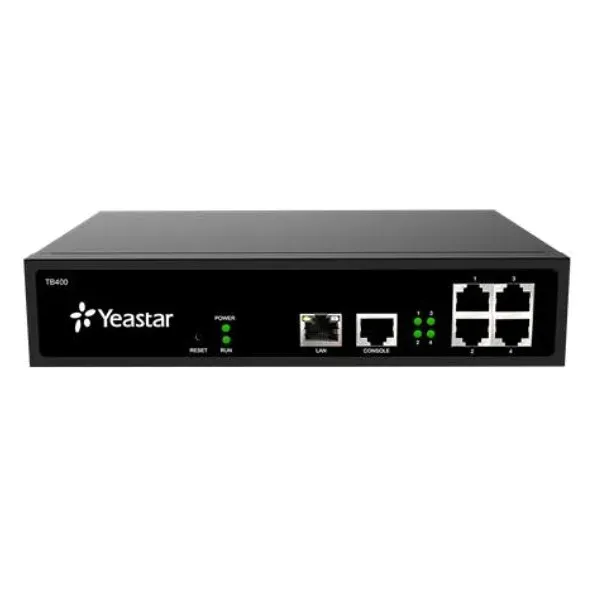
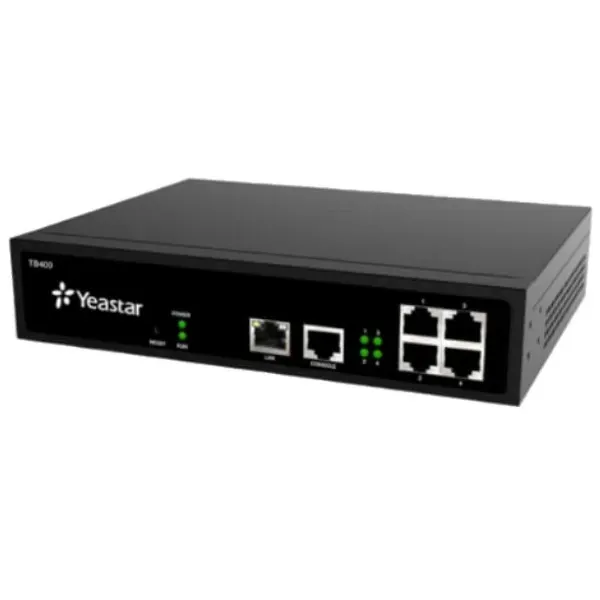
Yeastar ISDN BRI to SIP Gateway
Yeastar TB400 BRI VoIP Gateway
The Yeastar TB400 is a four-port BRI VoIP gateway built for organizations that need a practical bridge between ISDN Basic Rate Interface services and SIP-based communications. It can help an existing ISDN PBX gain access to a VoIP network, or allow an IP PBX to use BRI trunks without forcing a complete telephony replacement. For Tanzania buyers, the central procurement question is usually not only whether a gateway has the right number of ports, but whether its BRI mode, SIP routing, numbering plan, security settings and intended PBX architecture are aligned before installation. The TB400 is designed around that integration role.
4 BRI ports
The TB400 is the four-port model in Yeastar’s TB family, intended for BRI connectivity between legacy ISDN and VoIP environments.
Programmable NT/TE
NT and TE modes can be configured to match whether the gateway is connecting toward a PBX or toward an ISDN service side.
SIP integration
SIP RFC3261 support enables the TB400 to act as a practical conversion point between BRI trunks and SIP-based voice systems.
Web management
A browser-based interface, call logs, system logs and packet-capture tools support configuration and troubleshooting workflows.
What the Yeastar TB400 solves
The TB400 addresses a common migration problem: a business may have a useful ISDN PBX or active BRI service but also need the flexibility of SIP and IP telephony. Replacing the full voice platform in one project is not always the best operational choice. A BRI VoIP gateway can create a controlled transition path by converting calls between the ISDN and IP sides while the organization keeps familiar extensions, call flows or existing trunk arrangements where appropriate. This can be valuable during phased upgrades, branch consolidation, PBX modernization, or when an IP PBX must reach a BRI network.
Yeastar documents the TB400 for both directions of use: connecting an ISDN PBX to VoIP networks and providing BRI lines to an IP PBX. That distinction matters during planning because the gateway must be placed correctly in the call path and configured with the corresponding BRI mode, SIP trunk mode, routes and number manipulation. Buyers should therefore prepare a clear diagram of the current PBX, BRI circuits, numbers, desired SIP system, network addressing and expected inbound/outbound routing before commissioning.
Verified Yeastar TB400 technical specifications
| BRI ports | 4 |
| VoIP protocol | SIP (RFC3261) |
| Transport | UDP, TCP, TLS, SRTP |
| Codecs | G.711 (A-law/U-law), G.722, G.726, G.729A, GSM, ADPCM |
| DTMF modes | RFC2833, SIP Info, In-band |
| BRI operating options | Programmable NT/TE; Point-to-Point or Point-to-Multipoint |
| Network | DHCP, DDNS, Firewall, Static Route |
| LAN | 1 × 10/100 Mbps |
| Power | AC 100–240 V input, 12 V 2 A adapter |
| Dimensions | 213 × 160 × 44 mm |
Additional documented functions include T.38 fax, flexible number manipulation, least-cost routing, SIP registrar functionality for IP phones, call-detail logging, system logs, firewall rules, IP blocklist, certificates for TLS trunks, backup and restore, firmware update, route settings and diagnostic packet capture. Final compatibility should be checked against the PBX, BRI service characteristics and software versions in the intended deployment.
Deployment and integration guidance
A successful TB400 project starts by identifying which side of the gateway is acting as the ISDN network side and which side is the terminal side. This determines NT or TE mode and influences cabling and BRI configuration. The next decision is SIP connection method. Yeastar documentation describes Account Mode, VoIP Mode and Service Provider SIP mode, with the latter documented as a recommended method in the TB200/400 manual. In practical deployments, the chosen approach should match the PBX capabilities, authentication model and routing design rather than being selected only by convenience.
Number handling is equally important. Existing BRI services may present full DIDs, partial numbers, prefixes or caller IDs differently from the SIP system. The TB400 provides number manipulation and routing functions, so a commissioning plan should define exactly which inbound pattern reaches each PBX destination and which outbound prefixes are passed to each BRI trunk. Test calls should cover inbound, outbound, caller ID, DTMF, fax where required, fail cases and after-hours routes. Call logs and packet capture can assist troubleshooting when a route registers correctly but calls fail because of numbering or SIP signaling.
For customers planning a broader voice refresh, FourTeck’s Tanzania IT and telecom solutions overview provides context around IP PBX, network switching, Wi-Fi, security and supporting infrastructure. Organizations with cross-border requirements can also review FourTeck Uganda, FourTeck Kenya, FourTeck Africa and the specialist IP phone and business telephony resource when planning related endpoints and regional voice architecture.
Yeastar TB400 Tanzania
For organizations sourcing a Yeastar TB400 BRI VoIP Gateway in Tanzania, the strongest use case is usually a controlled connection between existing ISDN BRI infrastructure and a SIP-based communication platform. A business may already have a traditional PBX that users understand, established extension numbering, reception call flows and BRI lines that remain operational. The TB400 gives the project team a way to introduce VoIP connectivity without treating every existing voice asset as obsolete. With four BRI ports, the model is positioned for sites that require more BRI capacity than the two-port TB200 while still using a compact standalone gateway. The technical design should begin with an inventory of active BRI circuits, current PBX interfaces, DIDs, call-direction requirements and the target SIP platform.
Tanzania deployments should also be planned around the quality and structure of the local IP network. Voice traffic depends on stable switching, predictable addressing and appropriate security controls. The TB400 includes a single 10/100 Mbps LAN interface, web management, static routing and firewall functions, but the surrounding LAN still needs clear VLAN, QoS and firewall policies if voice shares infrastructure with data, cameras or guest networks. Where the SIP system is hosted or located at another site, latency, packet loss and internet stability become part of the voice design. A gateway does not compensate for a poorly performing WAN, so connectivity testing should be included before final cutover.
Procurement teams in Tanzania should request a quotation that clearly identifies the exact TB400 model, power accessories, any required BRI cabling, installation scope and the level of configuration assistance expected. They should also supply the PBX make and model, current ISDN service details and the intended SIP provider or IP PBX. That information makes it easier to determine whether the project is a straightforward trunk bridge or requires more detailed route, number-manipulation and security work. No assumption should be made that every BRI implementation behaves identically. The safest approach is to confirm electrical role, framing expectations, numbering and call scenarios before service migration.
For Tanzanian businesses modernizing gradually, the TB400 can be valuable because it separates the telephony migration decision from the immediate need to replace an entire PBX. The organization can preserve proven internal calling while adding SIP reach, or it can deploy an IP PBX and continue using available BRI trunks during a transition. This flexibility is particularly useful for offices, hotels, institutions, service organizations and multi-site businesses that need a staged project with documented testing. Buyers should ask for a commissioning checklist covering BRI status, SIP trunk status, inbound and outbound calls, DTMF, caller ID, fax where used, backup of the final configuration and a simple topology diagram for future support.
Yeastar TB400 BRI VoIP Gateway Dar es Salaam
Dar es Salaam businesses often operate mixed generations of communications technology: an established PBX may still support front-desk operations while newer departments use SIP phones, soft clients or cloud applications. The Yeastar TB400 can serve as a bridge where four BRI interfaces are required between that legacy environment and an IP voice platform. For a head office, hotel, trading company, professional services firm or larger branch, the procurement goal should be to understand exactly what must remain operational during migration. A detailed call-flow map—reception numbers, hunt groups, direct inward dial ranges, fax numbers and outbound dialing prefixes—gives the installer a reliable basis for the gateway configuration.
In a dense commercial environment, network design deserves as much attention as the gateway. The TB400 can use SIP over UDP or TCP and supports TLS and SRTP options, but the path between the gateway and PBX must be stable and deliberately secured. If the IP PBX sits in the same LAN, the design can remain simple, provided routing and firewall rules are controlled. If the PBX is hosted remotely, the internet edge, NAT behavior, security policies and failover strategy need review. Voice quality issues are often caused by congestion, poor WAN conditions or inconsistent QoS rather than by the BRI-to-SIP gateway itself, so pre-deployment network checks can prevent unnecessary troubleshooting after cutover.
Dar es Salaam buyers should also distinguish hardware purchase from integration scope. A TB400 quotation can be more useful when it identifies whether services include IP addressing, BRI mode configuration, SIP trunk creation, inbound and outbound route setup, number manipulation, security hardening, testing and documentation. If an existing PBX is staying in production, downtime windows should be agreed and rollback steps should be defined before changes begin. Where multiple BRI lines carry different numbers or departments, each route should be tested independently rather than assuming a successful call on one port validates the entire system.
The TB400 is also relevant where an IP PBX needs continued access to BRI during a phased telecom change. Four ports can support a practical migration stage while users move to SIP endpoints gradually. The gateway’s web interface, trunk status pages, call detail logs and packet tools can help administrators diagnose whether a fault is on the BRI side, SIP registration side, routing layer or number plan. For long-term maintainability, the final Dar es Salaam deployment should be handed over with configuration backup, firmware information, port labeling and a concise call-routing document so future changes are made deliberately rather than by trial and error.
Yeastar TB400 BRI VoIP Gateway Mwanza
For businesses in Mwanza, a Yeastar TB400 project can make sense when a site has usable ISDN BRI infrastructure but needs to connect it to a newer SIP-based PBX or VoIP network. Rather than replacing every telephone component at once, the four-port gateway can provide an integration layer that lets the organization modernize in stages. This approach is useful where a branch depends on familiar reception workflows, legacy extensions or existing BRI numbering and wants to reduce migration risk. Before ordering, the customer should document how many BRI ports are active, which numbers terminate on them, what PBX currently handles calls and whether the future design keeps the existing PBX, introduces an IP PBX or connects to a remote SIP service.
Mwanza deployments may also involve links back to a head office or centralized voice platform. In that case, WAN performance becomes part of the design. The TB400 converts between BRI and SIP, but reliable voice still depends on low packet loss, controlled latency and a network path that does not become saturated by backups, large file transfers or video traffic. Businesses should evaluate how voice will share internet or private WAN capacity and whether VLANs, QoS and firewall rules are configured consistently across locations. If a remote SIP server is involved, security policies should expose only the required communication paths and avoid unnecessary management access from the public internet.
A good quotation request for Mwanza should include the PBX brand and model, expected SIP integration, number ranges, BRI line count and any fax requirement. The TB400 supports T.38 fax, but fax interoperability depends on the complete end-to-end path, so it should be tested rather than assumed. Likewise, DTMF methods can differ between systems; Yeastar lists RFC2833, SIP Info and in-band options. Interactive voice menus and banking or service hotlines should be included in acceptance testing because a call may connect while DTMF signaling still behaves incorrectly.
Operationally, the gateway is most useful when it is treated as a managed network device rather than an invisible adapter. Assign a documented IP address, change default credentials, limit management access, back up the final configuration and record which BRI port maps to which service. Call logs and system logs can then support faster diagnostics. For Mwanza organizations operating with limited on-site telecom expertise, this documentation is especially valuable because future troubleshooting can be performed methodically: first checking BRI status, then SIP trunk state, route rules, numbering and network reachability instead of making changes without a baseline.
Yeastar TB400 BRI VoIP Gateway Arusha
Arusha organizations in hospitality, tourism, professional services, education and administration can encounter voice environments where a traditional PBX remains closely tied to daily operations even as the business adds IP-based collaboration and SIP services. The Yeastar TB400 is relevant to that mixed environment because it provides four BRI interfaces and SIP connectivity in a dedicated gateway. A hotel, for example, may wish to preserve existing room-extension logic while modernizing external trunks, whereas an office may want an IP PBX to retain access to BRI during a staged change. The correct design depends on the direction of integration, and programmable NT/TE modes provide the flexibility required for different BRI roles.
Planning should focus on continuity. Voice systems serve reception desks, reservations, operations, security and management, so changes should not begin until the existing call flow is understood. Identify which incoming numbers reach which departments, how outbound calls are authorized, whether there are hunt groups or auto attendants, and whether fax or modem-like services still use the BRI circuits. Then build a test plan around real operational scenarios. The TB400 supports flexible number manipulation and routing, which is useful when the old and new systems use different number formats, but routing rules should be kept simple and documented to avoid future confusion.
Arusha buyers should also check the surrounding network. A gateway can be correctly configured yet deliver poor user experience if SIP packets traverse an unstable WAN or congested LAN. When voice shares switching with Wi-Fi, business applications or CCTV, traffic segmentation and QoS can help protect call quality. If a remote or hosted PBX is involved, internet reliability and backup connectivity should be considered in the broader telephony continuity plan. Security is also important: TLS/SRTP capabilities may support protected SIP signaling and media in compatible designs, while firewall rules, strong credentials and restricted management access reduce unnecessary exposure.
For procurement, request a solution description rather than only a unit price. The quote should state whether the scope includes gateway configuration, BRI cabling checks, SIP trunk creation, route setup, number normalization, PBX-side changes, security hardening, acceptance testing and documentation. Ask that a backup of the final TB400 configuration be provided and that firmware information be recorded. For an Arusha site where telephony must be dependable but modernization needs to proceed carefully, that structured handover can be more valuable than a rushed migration, because it gives the organization a clear path for support, expansion and eventual transition to a more fully IP-based voice environment.
Yeastar TB400 BRI VoIP Gateway Dodoma
In Dodoma, organizations considering the Yeastar TB400 are typically balancing the stability of established ISDN BRI services with a need for SIP connectivity, centralized call control or a gradual IP telephony upgrade. The TB400 is designed for this interworking role, providing four BRI ports together with SIP support. It can let an existing ISDN PBX reach a VoIP network or let an IP PBX access BRI trunks. For government-related offices, institutions, NGOs, professional organizations and commercial branches, this staged approach can reduce the operational disruption associated with replacing every telephony component during one maintenance window.
The project should begin with a telephony audit. Count active BRI ports, capture the current phone-number presentation, identify any direct-dial ranges, document reception and after-hours behavior and determine whether the legacy PBX expects point-to-point or point-to-multipoint service. The TB400 supports both connection types and programmable NT/TE modes, but selecting the wrong combination can prevent the BRI side from coming up correctly. Once physical BRI status is stable, the SIP side can be configured with the chosen trunk method and tested in both directions. This sequence makes troubleshooting easier because each layer is validated before additional routing complexity is introduced.
Network and security design should be included from the start. The gateway has browser-based administration, firewall functions, static routing and TLS/SRTP options, but those features are most useful when accompanied by clear access-control policies. Management should be limited to trusted administrator networks, passwords should be changed from defaults and configuration backups should be stored securely. Where SIP crosses a WAN, firewall and NAT behavior should be verified carefully. Voice quality testing should include busy periods, not only a quiet-time test call, because congestion can reveal problems that are invisible during initial setup.
A Dodoma procurement request should specify the desired outcome in plain language: preserve an ISDN PBX while adding SIP, connect a new IP PBX to BRI, or temporarily bridge both systems during migration. This helps the supplier propose the correct services and testing scope. The handover should include a topology diagram, IP information, BRI port mapping, SIP trunk details, route descriptions, backup file and acceptance results for inbound and outbound calling. With that discipline, the TB400 becomes more than a converter; it becomes a documented transition component that supports future changes without forcing the organization to rediscover how its voice environment was assembled.
Yeastar TB400 BRI VoIP Gateway UAE
For UAE businesses, the Yeastar TB400 remains relevant wherever BRI interfaces still need to interoperate with SIP telephony. A company may be consolidating older PBX systems, moving branches toward centralized IP PBX services, or keeping BRI connectivity during a transitional period. The four-port TB400 allows these projects to be approached without immediately discarding a functioning ISDN system. Because the device supports SIP RFC3261, programmable NT/TE modes and flexible routing, it can be positioned between the legacy and IP environments as long as the BRI service type and PBX behavior are carefully verified.
UAE deployments often involve more complex enterprise networks, multiple VLANs, centralized firewalls or hosted voice platforms. The gateway should therefore be integrated into the network with a defined IP address, documented routes and restricted management access. If SIP traverses firewalls between sites, the security team should confirm the required signaling and media paths, NAT behavior and whether TLS/SRTP will be used end to end. Security features on the TB400 are useful, but they should complement—not replace—the organization’s broader network controls. A clean design avoids exposing the web interface or unnecessary services to untrusted networks.
Procurement should also separate hardware capability from telecom-provider compatibility. The TB400 supports point-to-point and point-to-multipoint BRI, but the actual service parameters supplied by a carrier must match the configuration. Number formats and caller ID presentation can also vary. Before migration, capture several examples of inbound and outbound calls from the existing system. Those samples help define manipulation rules on the gateway and PBX. Testing should then cover external dialing, inbound DIDs, DTMF, transfer scenarios, fax if required, and failure handling. Keeping a pre-change baseline makes it much easier to identify whether an issue began on the BRI, gateway, IP PBX or provider side.
For multi-site UAE organizations, the TB400 can also support a phased strategy where one location retains BRI while call control moves to a newer SIP platform. This can simplify the timing of a wider voice transformation, but long-term architecture should still be reviewed to avoid unnecessary layers once the transition is complete. Ask for configuration backup, firmware details and route documentation as part of handover. The goal should be a gateway deployment that is easy to understand, secure to manage and straightforward to remove or repurpose when the organization eventually reaches its intended all-IP design.
Yeastar TB400 BRI VoIP Gateway Uganda
Ugandan organizations considering the Yeastar TB400 are often looking for a practical way to bridge established BRI telephony with SIP systems while controlling migration risk. The device provides four BRI ports and can connect in either direction: an ISDN PBX can reach a VoIP network, or an IP PBX can access BRI trunks. That flexibility is useful for businesses that do not want to replace a working PBX simply because they are adding SIP connectivity. It also supports staged branch upgrades, where newer IP endpoints and centralized services are introduced over time while existing numbering and call-handling processes remain operational.
Before deployment in Uganda, confirm the BRI role and connection type for every port. The TB400 supports NT and TE modes and point-to-point or point-to-multipoint configurations, but those settings must match the attached PBX or telecom circuit. The next layer is SIP. Decide whether the gateway will register to a PBX, accept a SIP account, or use a service-provider style trunk arrangement. Keep the route plan simple: define which numbers enter from BRI, where they terminate on the SIP side, and which outbound patterns are sent back through each BRI trunk. Number manipulation should be used deliberately and documented.
For organizations with Kampala headquarters and up-country branches, WAN quality may influence whether the SIP platform should be local or centralized. A gateway at a branch can be technically healthy while calls still suffer if the WAN experiences loss, jitter or congestion. Network assessment should therefore include business-hour tests and consideration of how voice traffic competes with cloud applications, backups and video. VLAN and QoS policies can help, while security controls should limit access to the gateway and SIP services. If TLS or SRTP is required, certificates and compatible configuration need to be planned on both sides.
A strong Uganda quotation request should include the exact PBX model, number of active BRI lines, DID ranges, expected concurrent call patterns, fax requirements and target SIP system. It should also define the desired service level for installation and support. Ask for inbound and outbound test results, configuration backup, call-routing documentation and a port map. These details reduce dependence on individual installer knowledge and make future troubleshooting faster. The TB400 is most effective when it becomes a clearly documented integration point rather than an undocumented box between two phone systems.
Yeastar TB400 BRI VoIP Gateway Kampala
Kampala is a natural fit for TB400 projects where a head office, hotel, financial services firm, school, NGO or enterprise site operates established BRI telephony but wants to introduce SIP-based call routing. The Yeastar gateway can provide four BRI connections and translate between ISDN and SIP without requiring the business to complete a full PBX replacement on day one. This allows a communications team to modernize around business priorities: connect a new SIP trunk, centralize call control, introduce IP phones in selected departments, or preserve a legacy PBX while other network services are refreshed.
Kampala deployments can become complex when multiple departments, direct-dial numbers and branch routes are involved, so the call plan should be written before configuration begins. Separate requirements into inbound BRI-to-SIP, outbound SIP-to-BRI and any direct gateway-to-phone use cases. The TB400 includes route rules, trunk groups, number manipulation and a SIP registrar, but using every feature is not the objective. A smaller set of well-documented rules is usually easier to support. During acceptance, test each DID or representative group, outbound permissions, caller ID, DTMF navigation and any fax flow that is business critical.
The network team should give the gateway a stable management and voice path. If the PBX is on the same LAN, verify VLAN access and firewall policy. If the PBX is remote, test WAN quality and SIP traversal. The gateway supports TLS and SRTP transport options, but encrypted voice requires compatible configuration across the complete connection. Management security also matters: use strong credentials, restrict administrator access and keep a backup before making changes. System logs, call-detail records and packet capture are especially useful when a trunk appears registered but individual call scenarios fail.
For procurement teams in Kampala, it is useful to request a statement of work together with the hardware quote. That document should state who configures the BRI side, who changes the PBX, who coordinates telecom-provider details and what constitutes successful acceptance. It should also identify whether changes are performed during business hours or a maintenance window. Clear ownership avoids a common integration problem where each party assumes another party is responsible for signaling or routing. With a disciplined implementation, the TB400 can provide a predictable bridge through a staged voice modernization and simplify the transition from traditional circuits to a more SIP-centered architecture.
Yeastar TB400 BRI VoIP Gateway Arua
In Arua, the value of a Yeastar TB400 deployment may be less about adding advanced features and more about preserving continuity while connecting existing BRI telephony to a modern SIP environment. A business or institution that has an operational ISDN PBX can continue using familiar extensions and call handling while the gateway provides an IP connection to another PBX or VoIP service. The four BRI ports give room for multiple circuits, but buyers should confirm that the current installation actually requires four ports and document which trunks carry which numbers before selecting the model.
Remote supportability deserves special attention. A gateway installed in a branch should have a fixed and documented network identity, secure administrator credentials and a saved configuration. The TB400 offers web-based management, system logs, call logs and packet capture that can help an off-site technician diagnose issues. However, remote management should be provided through a secure network path rather than by exposing the interface directly to the internet. If the SIP PBX is hosted elsewhere, the firewall and WAN routing should allow only the necessary voice traffic and should be tested for stability under normal business load.
Arua sites may also benefit from a simple commissioning sequence. First verify each BRI port physically and confirm the correct NT/TE mode. Next establish the SIP trunk and verify registration or peer reachability. Then create one straightforward call route and test it before adding number manipulation or multiple trunk groups. This layered approach makes faults easier to isolate. When inbound and outbound calling is stable, validate caller ID, DTMF and fax requirements. If T.38 is needed, test with the real remote fax destinations because end-to-end compatibility can depend on more than the gateway alone.
When requesting a quote for Arua, customers should include the current PBX make, BRI service information, desired SIP endpoint and whether installation support is needed on site or remotely. Avoid leaving the integrator to discover the number plan during the change window. A one-page topology and call-flow summary can significantly reduce deployment risk. After installation, keep the gateway backup, administrator-access procedure and port map with the organization’s IT documentation. That preparation makes the TB400 easier to operate over its useful life and supports future migration decisions without relying on undocumented historical knowledge.
Yeastar TB400 BRI VoIP Gateway Mbarara
Mbarara businesses that rely on legacy voice infrastructure can use the Yeastar TB400 as a controlled interconnection point when introducing SIP. The gateway’s four BRI ports are intended for environments where Basic Rate Interface circuits must coexist with IP telephony. Instead of viewing a modernization project as an all-or-nothing PBX replacement, the organization can keep functioning BRI services and move selected elements to IP. This is particularly useful for branch offices, healthcare facilities, hotels, education sites and commercial organizations where telephony changes must be coordinated around daily operations.
Sizing should still be based on real call requirements. Four physical BRI ports do not mean every deployment needs the TB400 rather than the two-port TB200. Count active circuits and understand expected simultaneous calls, then choose the model that fits the architecture. Where the TB400 is appropriate, identify the mode of each BRI interface and whether the service is point-to-point or point-to-multipoint. Those facts are fundamental to installation. On the SIP side, decide how the gateway authenticates or peers with the PBX, and document the addresses, ports and route patterns used.
Mbarara sites that connect to a centralized PBX should consider WAN resilience. Voice may be one of several services sharing the same internet link, so congestion from cloud backups or large downloads can affect audio quality even though BRI signaling remains healthy. QoS, traffic separation and sensible bandwidth management can improve predictability. Security should be practical as well: limit management access, maintain updated credentials, use firewall rules and consider TLS/SRTP where supported by the complete solution. Do not assume encryption is active merely because the gateway supports those protocols; both ends must be configured accordingly.
A complete handover for Mbarara should include more than confirmation that one phone call worked. Validate inbound and outbound routes across the necessary BRI ports, caller ID, extension destinations, DTMF and any fax requirement. Record the gateway’s firmware version and back up the final configuration. Label BRI connections physically so future technicians can match a port to a telecom service without tracing cables during an outage. These small operational details make the gateway easier to support and preserve the business value of a staged migration, because the environment remains understandable while the organization gradually adopts newer SIP systems.
Yeastar TB400 BRI VoIP Gateway Gulu
For Gulu organizations, the Yeastar TB400 can be a practical choice when an existing BRI-based phone system remains useful but the business needs access to SIP calling, a newer IP PBX or a centralized voice platform. The gateway’s role is to translate and route between those environments, allowing a staged approach to modernization. This is valuable when replacing all desk phones, cabling, PBX functions and trunks at once would introduce unnecessary disruption. With four BRI ports, the TB400 can accommodate a multi-circuit site while preserving the option to evolve the IP side over time.
The first technical task is to understand the existing BRI implementation rather than starting from a generic configuration template. Confirm NT/TE requirements, connection type, number presentation and which BRI ports are actually active. The TB400 supports point-to-point and point-to-multipoint operation, and those settings should mirror the service or equipment connected to the port. Then configure the SIP side and create routes that are easy to explain. If number manipulation is needed, document examples showing the number received, the rule applied and the number sent onward. This reduces future troubleshooting time considerably.
If the IP PBX is hosted outside Gulu, network assessment is important. The voice path needs acceptable latency, packet loss and jitter, and should not be treated as just another best-effort application. Where possible, separate voice traffic logically and apply QoS across managed network devices. The gateway’s firewall and security features can contribute to a secure design, while administrator access should remain limited to trusted networks. Remote troubleshooting can use call logs and packet capture, but diagnostic access should be controlled and disabled or restricted when not needed.
A Gulu quotation should clearly state whether installation is only hardware supply or includes the full integration service. A business that lacks in-house telephony expertise may need help with BRI configuration, SIP trunks, routing, PBX changes, testing and documentation. It is better to define that scope before purchasing than to discover during deployment that different parties own different parts of the system. The final acceptance package should include configuration backup, topology, IP details, BRI port mapping and the test cases used. With those records in place, the TB400 can serve as a stable transition gateway instead of becoming another undocumented dependency in the communications environment.
Yeastar TB400 BRI VoIP Gateway Kenya
Kenyan businesses can use the Yeastar TB400 where four BRI interfaces are required to connect traditional ISDN services with SIP telephony. Typical projects include preserving an existing PBX while adding a VoIP trunk, connecting a modern IP PBX to available BRI circuits, or maintaining both systems during a planned migration. The gateway supports SIP RFC3261, configurable NT/TE modes, point-to-point and point-to-multipoint BRI, routing and number manipulation, so it can adapt to several deployment patterns. The correct pattern should be selected from the actual PBX and carrier configuration rather than from a generic diagram.
For a Nairobi head office or up-country branch, voice architecture may also involve site-to-site networks and cloud services. If the TB400 connects to a PBX across a WAN, the network should be tested for latency, packet loss and jitter under business load. A successful ping test is not enough to prove voice readiness. Organizations should identify whether competing traffic can saturate the link and whether managed switches and routers can prioritize voice appropriately. Firewall and NAT rules should be documented, and TLS/SRTP should be considered only as part of a compatible end-to-end security design.
Procurement teams in Kenya should provide accurate line and PBX information when seeking a quote. Include the number of BRI circuits, service type, DID ranges, existing equipment, target SIP system and whether fax remains in use. The TB400 supports T.38, but fax should be validated with real end destinations. DTMF should also be tested, particularly where users navigate IVRs or payment systems. These operational tests are more useful than simply confirming that a SIP trunk shows registered, because registration does not prove that number handling and media behavior are correct.
Handover quality strongly affects long-term support. Ask for port labels, a network diagram, route summary, configuration backup and firmware information. Administrators should change default credentials and restrict web management to trusted addresses. When troubleshooting, the TB400’s status pages, call logs and packet capture can help separate BRI faults from SIP or network problems. For organizations operating across East Africa, standardizing how gateways are documented can make multi-site support easier, because technicians can follow the same diagnostic sequence regardless of location. The TB400 can then function as a predictable migration component rather than a site-specific configuration that only one person understands.
Yeastar TB400 BRI VoIP Gateway Kuwait
Kuwait organizations with remaining BRI infrastructure can use the Yeastar TB400 to connect those circuits or PBX interfaces to SIP-based communications. The gateway provides four BRI ports, making it suitable for sites that need more than a small two-port bridge. It can be deployed to give an ISDN PBX access to VoIP or to let an IP PBX use BRI trunks. This flexibility is useful during phased modernization, mergers of different office telephony systems or temporary coexistence between legacy and new platforms. The design should be driven by the actual telecom interface and desired call path, not simply by the number of available ports.
Enterprise sites in Kuwait often have segmented networks and strict firewall controls, so the gateway should be treated as a managed voice appliance. Assign a stable IP address, place it in an appropriate voice or infrastructure segment and permit only the required SIP, management and related traffic. The TB400 supports TLS and SRTP transport options, certificates, firewall rules and IP blocking, but the broader security policy still controls how safely it is exposed. Administrator access should be restricted, credentials should be updated and configuration files stored securely. Where a remote PBX is used, NAT behavior and SIP traversal should be validated rather than left to default firewall helpers.
Call routing should be based on a documented numbering plan. Existing BRI trunks may deliver numbers in a format that differs from the IP PBX, making normalization necessary. The TB400 supports number manipulation, but rules should be simple and tested with representative inbound DIDs and outbound destinations. Verify caller ID, transfer scenarios, DTMF and fax where required. If the organization uses several BRI circuits for different departments, route tests should cover each trunk group and expected fail behavior rather than assuming all ports are interchangeable.
A Kuwait purchasing request should clarify whether the supplier is expected to deliver only the gateway or a full integration service. A complete project may include BRI role configuration, SIP trunk setup, route programming, PBX-side changes, security hardening, testing and documentation. Establish a maintenance window and rollback plan for production voice systems. At handover, retain a configuration backup and a simple topology showing BRI, TB400, network and PBX relationships. This documentation supports faster future changes and helps the organization decide when the gateway remains useful and when a completed migration makes direct SIP connectivity the simpler long-term architecture.
Yeastar TB400 BRI VoIP Gateway Ghana
Ghanaian organizations can consider the Yeastar TB400 when they need to connect established BRI telephony with an IP voice environment without replacing all legacy equipment immediately. The gateway’s four BRI ports and SIP connectivity create a practical migration layer between ISDN and VoIP. This can be useful for offices, hotels, institutions and multi-branch companies that have existing numbers, call flows and PBX investment but also want centralized management or SIP trunking. The device should be selected after confirming how many BRI ports are genuinely needed and whether the intended connection is toward a legacy PBX, telecom circuit or both.
The technical plan should identify NT/TE mode, point-to-point or point-to-multipoint operation, numbering and SIP trunk behavior. These are not cosmetic settings; they determine whether the gateway can establish correct BRI signaling and route calls predictably. Start with a clear topology and configure one call path at a time. When that path works, add the required route rules and number manipulation. Use the TB400’s status pages to confirm BRI and SIP state separately. This approach prevents a configuration problem on one side from being mistaken for a fault on the other.
For branches that connect back to a central PBX, Ghana deployments should also review WAN quality. If the IP side crosses the internet, latency and loss can affect audio even though the BRI side is stable. QoS, traffic separation and sufficient bandwidth can improve consistency. Security controls should limit management access and allow only necessary SIP paths. TLS and SRTP are available transport options, but using them requires compatible peer configuration and certificate planning. Administrators should also preserve backups and record firmware details before changes or upgrades.
During procurement, provide the supplier with the existing PBX model, BRI service details, number ranges, expected SIP platform and any fax or IVR dependencies. Ask for an acceptance plan that validates inbound and outbound calls, caller ID, DTMF, fax if needed, and representative failure conditions. The final documentation should show which BRI port maps to which circuit and how numbers are transformed between BRI and SIP. With that information, future support becomes easier and the TB400 can remain a well-understood bridge during the organization’s shift toward a more IP-focused communication environment.
Yeastar TB400 BRI VoIP Gateway Nigeria
Nigeria’s large and varied business environment includes many organizations that operate mixed telephony estates across headquarters, branches and legacy sites. The Yeastar TB400 is relevant where four BRI ports are required to connect that ISDN infrastructure with SIP. A business can keep a functioning traditional PBX while adding a VoIP link, or deploy an IP PBX and preserve access to BRI circuits during migration. This phased approach can reduce disruption and give the organization time to move departments or locations according to operational priorities rather than replacing everything during a single project.
A Nigeria deployment should begin with capacity and service mapping. Document each BRI circuit, associated numbers, average call use, PBX interface and required direction of traffic. Confirm whether each BRI side expects NT or TE behavior and whether the connection is point-to-point or point-to-multipoint. The TB400’s four ports provide flexibility, but configuration should reflect the real circuit design. On the IP side, choose the SIP trunk method that aligns with the PBX and security architecture. Keep routes explicit and use number manipulation only where required to translate between carrier and PBX formats.
Network resilience is especially important for distributed organizations. If the gateway connects to a central or cloud PBX, voice quality depends on WAN performance. Internet redundancy can be valuable, but failover must be tested with SIP sessions rather than assumed from general data connectivity. QoS and bandwidth controls can prevent bulk traffic from degrading calls. The gateway’s firewall, certificates, TLS/SRTP options and IP blocklist can support a secure solution, while organizational policy should restrict web administration and avoid unnecessary public exposure. Logs and packet capture can help diagnose call setup problems across complex multi-vendor environments.
Procurement should include integration expectations. A quote that only lists the hardware may not cover PBX changes, route design, BRI testing, network adjustments or provider coordination. Define who owns each task and what evidence is required at acceptance. Test inbound and outbound calls on representative numbers, caller ID, DTMF, fax where relevant, and behavior during network or trunk failure. Preserve the final configuration backup, firmware record and a route map. For Nigerian businesses with multiple sites, standardizing this documentation across branches can significantly simplify support and future migration from BRI to direct SIP services.
Yeastar TB400 BRI VoIP Gateway Seychelles
In Seychelles, businesses in hospitality, professional services, public administration and other sectors may need to retain established PBX functions while introducing SIP connectivity. The Yeastar TB400 provides four BRI ports for interworking between ISDN and VoIP, making it useful where existing telephone infrastructure still supports daily operations but modernization is underway. A resort or hotel, for example, may have room and reception workflows tied to a legacy PBX, while management wants better integration with IP-based services. A gateway can preserve that continuity while the organization plans a longer-term telephony strategy.
Because island connectivity can make WAN planning an important part of communications design, organizations should assess the full path between the TB400 and any remote SIP system. The gateway can convert BRI to SIP, but audio quality over a remote link still depends on latency, loss, jitter and congestion. If the PBX is local, this concern is reduced, though LAN segmentation and firewall policy still matter. If it is hosted externally, test call quality during normal operating periods and consider how voice shares connectivity with guest internet, cloud systems, video conferencing and other bandwidth-intensive applications.
The BRI side should be configured from verified service information. Confirm NT/TE requirements and whether the connection is point-to-point or point-to-multipoint. Capture current number formats and call flows before making changes. Then configure SIP and build simple route rules. The TB400 offers flexible number manipulation, but excessive transformations can make troubleshooting difficult. Test caller ID, DTMF, fax where needed, inbound and outbound routing and transfer behavior. Use call logs and packet capture when signaling issues require deeper analysis.
For Seychelles procurement, ask whether the supplier’s scope includes remote configuration, on-site work, PBX coordination and post-deployment documentation. If replacement hardware is not immediately available locally, good configuration backups and clear topology records become even more important for operational continuity. Record the power arrangement and consider how the gateway is protected by UPS infrastructure along with switches, PBX equipment and routers. The final handover should identify every BRI port, SIP peer and route. With that disciplined approach, the TB400 can provide a stable and supportable bridge while the business continues to modernize its communications at a manageable pace.
Selection, sizing and buying guidance
Choose the TB400 when the project genuinely requires up to four BRI ports and when BRI-to-SIP or SIP-to-BRI conversion is the correct architectural answer. If only two ports are required, the TB200 may be the more proportionate model in the same family. If the site uses E1/T1/PRI rather than BRI, a different gateway family is required. The physical interface must therefore be confirmed before purchase. Buyers should also confirm whether they are preserving a legacy PBX, connecting an IP PBX to BRI or building temporary coexistence. That answer determines the implementation plan more clearly than a generic request for a ‘VoIP gateway.’
Before requesting a quote, gather: PBX manufacturer and model, number of active BRI circuits, NT/TE role if known, point-to-point or point-to-multipoint service, number ranges, expected concurrent calls, target SIP system, IP addressing, firewall topology, DTMF requirements, fax requirements and desired cutover date. Also state whether configuration, testing, documentation and user handover are part of the required scope. This information reduces unnecessary back-and-forth and helps distinguish a simple gateway supply from a broader telephony migration project.
Frequently asked questions about the Yeastar TB400
How many BRI ports does the Yeastar TB400 have?
The Yeastar TB400 has four BRI ports. The related TB200 has two. Model choice should be based on the number of BRI interfaces required by the real deployment.
Can the TB400 connect an old ISDN PBX to VoIP?
Yes. One of Yeastar’s documented use cases is connecting an ISDN PBX to a VoIP network so an organization can preserve existing PBX infrastructure while introducing SIP connectivity.
Can an IP PBX use BRI lines through the TB400?
Yes. Yeastar also documents the TB series for providing BRI connectivity to an IP PBX. The BRI role, SIP trunk and routing configuration must be matched to the actual system.
Does the TB400 support NT and TE modes?
Yes. The BRI interfaces support programmable NT/TE modes, which is important when matching the electrical and signaling role expected by the connected BRI equipment or service.
Does the TB400 support secure SIP transport?
Yeastar lists UDP, TCP, TLS and SRTP among the supported transport options. Encryption still requires compatible configuration on the peer system and appropriate certificate/security setup.
Does the Yeastar TB400 support fax?
The TB200/400 documentation lists T.38 fax support. Fax should be tested end to end because successful operation depends on the complete path and the systems at both ends.
Quotation checklist for Yeastar TB400
Provide the following when requesting pricing or implementation support so the proposed solution can be checked against the intended environment.
Decision recap
The Yeastar TB400 is a four-port BRI VoIP gateway for organizations that need to connect ISDN BRI and SIP telephony. Its key verified capabilities include programmable NT/TE modes, point-to-point or point-to-multipoint BRI, SIP RFC3261, UDP/TCP/TLS/SRTP transport, common voice codecs, T.38 fax, number manipulation, least-cost routing, web management and diagnostic tools. It is most appropriate when the integration requirement has been confirmed and the organization wants to preserve existing telephony investment or phase an IP migration.
The buying decision should not be made on port count alone. Confirm the BRI service type, PBX compatibility, number plan, SIP architecture, WAN quality and commissioning scope. A well-documented TB400 deployment can provide a clean migration bridge; a poorly planned one can add another troubleshooting layer. The most valuable quotation is therefore one that matches the exact hardware with the real call flow, network and support requirements.
Consult FourTeck about your BRI-to-SIP migration
Share your current PBX model, BRI line count, number ranges and intended SIP platform. FourTeck can use those details to help scope the correct gateway, integration steps, testing plan and related voice-network requirements. Availability, commercial terms, delivery arrangements and final compatibility should be confirmed at quotation stage for the destination market.



Reviews
There are no reviews yet.