
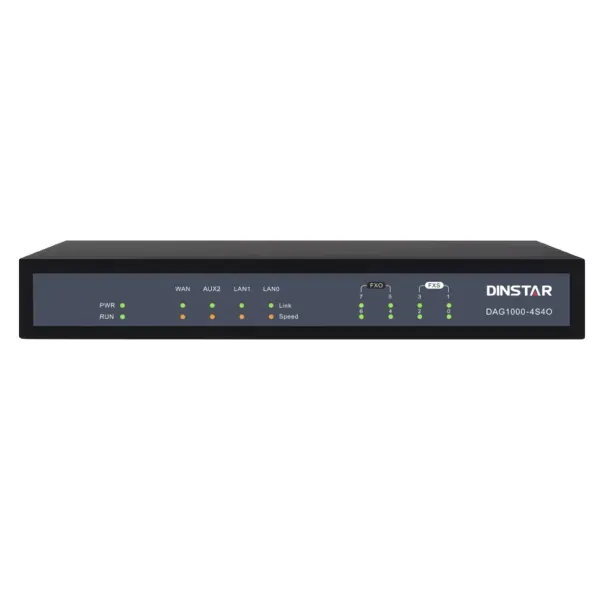
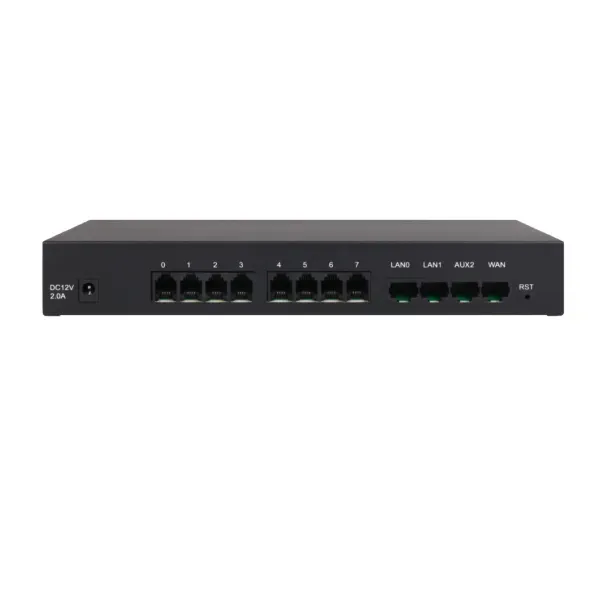
Dinstar DAG1000-4S4O Hybrid VoIP Gateway
The Dinstar DAG1000-4S4O combines four FXS and four FXO interfaces in one compact gateway for organisations that need to preserve analog phones, fax endpoints, PBX trunks or PSTN lines while moving call control and routing to SIP. It is designed for practical migration, branch connectivity and survivability scenarios where a business cannot simply replace every analog component at once.
Analog endpoints
PSTN/PBX lines
IP voice core
Fax support
What the Dinstar DAG1000-4S4O is designed to solve
Many businesses reach a point where their telephone environment is split between old and new technologies. A reception desk may still use analog handsets, an office may rely on a legacy PBX, a fax workflow may not yet have been replaced, while new branches or remote sites use SIP extensions and IP PBX services. Replacing every device immediately can be expensive and disruptive. The DAG1000-4S4O provides a bridge between these environments, allowing analog endpoints and analog trunk lines to participate in a SIP-based communications architecture.
The four FXS interfaces are intended for analog subscriber devices such as standard telephones or compatible fax equipment, while the four FXO interfaces connect to analog PSTN lines or suitable PBX ports. This mixed-port design is useful when both directions are required in the same location. It can support phased migration, local fallback arrangements, branch voice integration and call-routing scenarios that would otherwise require separate FXS and FXO gateways.
Mixed 4 FXS + 4 FXO
Use analog phones or fax endpoints through FXS while also terminating analog PSTN or PBX lines through FXO, reducing the need for separate gateway appliances in smaller deployments.
SIP, IMS and routing
Standard SIP support, SIP trunking and flexible routing help connect legacy analog voice resources to modern IP PBX, softswitch and SIP-server environments.
Fax and voice services
T.38 and fax pass-through support help organisations retain fax-dependent processes while migrating their broader telephone infrastructure to IP.
Continuity features
Power-failure and network/SIP failover concepts are built into the product family to help maintain practical local calling paths when normal IP service is unavailable.
Verified technical capabilities
| Analog interfaces | 4 FXS and 4 FXO, RJ-11 |
| VoIP | SIP v2.0, SIP trunking, TLS/SRTP, RTP/RTCP and SIP failover-related functions |
| Fax | T.38 and pass-through |
| Network | IPv4/IPv6, DHCP, PPPoE, VLAN 802.1P/802.1Q, QoS/DiffServ, HTTP/HTTPS, DNS and related IP services |
| Management | Web management, SNMP, TR-069 family management, auto provisioning, logs, CDR, backup/restore and firmware upgrade functions |
| Voice processing | Common telephony codecs and features, echo control, jitter handling, DTMF methods, call transfer, forwarding, call waiting, hunting and dial-plan controls |
Compatibility, integration and deployment planning
A hybrid gateway should be selected as part of a complete call architecture, not only by port count. Before deployment, confirm the analog line type, caller-ID behaviour, dial plan, DTMF method, fax requirements, SIP server details, IP addressing, VLAN design, QoS policy, security settings and failover behaviour. Where the device connects to an existing analog PBX, the exact port role must be documented so FXS and FXO interfaces are not confused. Where it connects to PSTN lines, line signalling and local carrier behaviour should be tested during commissioning.
The gateway is suitable for use alongside an IP PBX or SIP server where analog devices need to remain available. FourTeck Tanzania’s broader technology integration services can help align voice equipment with LAN, firewall, cabling and power requirements. The Tanzania business technology shop is useful when the gateway is part of a larger procurement covering IP phones, switching, firewalls, servers or supporting infrastructure. For solution discussions and quotations, use the verified FourTeck Tanzania contact page.
Because the gateway carries real-time voice, the network path should be stable and appropriately prioritised. VLAN separation can help keep voice traffic organised, while QoS can protect call quality when data traffic becomes busy. Security should also be addressed: SIP credentials, management access, remote exposure and firmware practices should follow the same discipline applied to other business network devices.
Typical business use cases
Analog phone migration
Retain selected analog phones while moving the central call platform to SIP, useful for phased upgrades where not every endpoint can be replaced at the same time.
PSTN line integration
Use FXO interfaces to bring existing analog carrier lines into an IP PBX call-routing environment for incoming and outgoing call scenarios.
Branch-office survivability
Keep local analog resources available at a branch while centralised SIP calling, remote extensions or cloud-connected telephony handle normal operations.
Fax continuity
Support legacy fax workflows during a broader transition to IP communications, subject to end-to-end carrier and PBX compatibility testing.
Dinstar DAG1000-4S4O Tanzania
For organisations in Tanzania, the Dinstar DAG1000-4S4O is most relevant where a voice network must connect established analog infrastructure with SIP-based telephony without forcing an immediate replacement of every telephone line or endpoint. A Tanzanian office may have a legacy PBX, a few analog phones in operational areas, a fax-dependent workflow and one or more PSTN lines that remain important for inbound or backup calling. In that environment, a mixed FXS/FXO gateway can act as the controlled migration layer. Four FXS ports can serve analog endpoints while four FXO ports connect suitable analog lines or PBX interfaces, allowing the IP PBX to manage routing while preserving selected legacy resources.
Procurement should begin with a port and call-flow audit. Count the analog devices that genuinely need to remain, identify which carrier lines are active, confirm whether any lines are dedicated to fax or alarms, and document how calls currently enter and leave the organisation. That information determines whether the 4S4O configuration is sufficient or whether a higher-density gateway is more appropriate. It is also important to confirm the SIP platform, voice VLAN, firewall policy, DNS/NTP availability, UPS protection and internet dependency. The gateway should not be treated as an isolated box because call quality and reliability depend on the network around it.
In Tanzania, branch standardisation can be especially valuable when a company operates sites with different telecom histories. One location may already use IP phones while another still has analog lines. A repeatable gateway configuration, dial-plan structure and documentation approach can reduce support complexity. Organisations should include configuration backup, firmware management and test procedures in the handover. Where telephone continuity is critical, failover behaviour should be tested deliberately rather than assumed. The broader FourTeck Tanzania portfolio covers integrated IT and telecom solutions, which helps when the voice gateway must be coordinated with switches, firewalls, IP phones, structured cabling and power protection.
For a quotation, provide the number of PSTN lines, number and type of analog endpoints, IP PBX or SIP server model, required fax support, site count, network addressing plan and expected failover behaviour. That creates a more accurate project scope than asking only for a gateway price. Buyers comparing alternatives should also check port density, management options, security support, routing flexibility and the future migration plan. The objective is not merely to keep old equipment alive; it is to create a controlled bridge toward a maintainable IP communications architecture.
Dinstar DAG1000-4S4O Hybrid VoIP Gateway Dar es Salaam
Businesses in Dar es Salaam often operate mixed technology environments where offices have modern Ethernet networks but continue to rely on analog PSTN services, analog reception phones, fax devices or legacy PBX equipment. The DAG1000-4S4O can be useful in this exact transition stage. Rather than replacing the complete voice system in one project, the gateway allows selected analog services to connect to a SIP-based call platform. This approach can support office relocations, PBX upgrades, branch consolidation and staged rollout of IP phones.
A Dar es Salaam deployment should start with the physical and logical voice path. Determine where the telecom provider lines terminate, where the gateway will be installed, whether an equipment rack is available, how power is protected, and which switch or router carries the SIP traffic. If the gateway is installed in a communications room, ensure the analog cabling is labelled by line and purpose. If the office has multiple floors, avoid extending poorly documented analog circuits without testing. On the IP side, use a defined voice VLAN where appropriate, keep management access controlled and confirm that SIP registration and RTP traffic follow the intended firewall policy.
Commercial buyers in Dar es Salaam should also consider operational continuity. If the office depends on PSTN lines for customer calls, test what happens when the SIP server is unreachable or when network connectivity fails. If fax remains important, test the actual end-to-end fax path because successful T.38 operation depends on more than the gateway alone. Where the organisation is replacing a legacy PBX, map existing extension numbers and inbound line assignments before changing the architecture. This preserves business logic such as reception routing, department numbers and after-hours behaviour.
A well-scoped quotation should include gateway quantity, port use, SIP platform details, installation location, network prerequisites, cabling work, configuration, testing and documentation. Buyers can combine the gateway requirement with FourTeck Tanzania’s IP telephony and infrastructure services where integration is required. For companies moving from analog to IP in stages, the DAG1000-4S4O is best viewed as migration infrastructure: it preserves useful analog assets while creating a clear path toward centralised SIP routing, easier administration and eventual endpoint modernisation.
Dinstar DAG1000-4S4O Hybrid VoIP Gateway Mwanza
For Mwanza businesses, branches, warehouses, hospitality properties, clinics and administrative sites, the Dinstar DAG1000-4S4O can serve as a practical bridge where analog telephony remains useful but the organisation wants the control and flexibility of SIP. A branch may receive calls over analog carrier lines yet use an IP PBX hosted at headquarters, or it may need to keep existing analog handsets in areas where replacing cabling and endpoints is not immediately justified. The mixed four-FXS and four-FXO design allows these requirements to be addressed in one appliance.
The strongest design principle for Mwanza deployments is local clarity. Identify which services must keep working if the WAN link to headquarters is unavailable. If local PSTN lines are intended as backup, define exactly how calls should route during a failure and test the scenario before handover. If the site uses centralised extensions over a VPN or other branch link, confirm latency, jitter and packet-loss conditions because voice quality depends on the network path. A gateway can provide the necessary analog/SIP conversion, but it cannot compensate for a poorly designed WAN.
Power protection should also be part of the bill of materials. The gateway, network switch, router and any IP PBX appliance involved in the call path should share an appropriate continuity strategy. For short interruptions, UPS protection can help preserve service; for longer outages, the organisation should decide which voice functions are expected to remain available and whether the analog failover path satisfies that requirement. Documentation should list line numbers, ports, SIP accounts, dial-plan rules and recovery steps so support staff can troubleshoot efficiently.
When requesting a Dinstar DAG1000-4S4O quotation for Mwanza, include the current PBX model, number of PSTN lines, analog telephone or fax count, required extension plan, network details and whether the site will connect to other branches. FourTeck Tanzania can align the gateway with related IP phones, switching and business network equipment. This broader planning approach is particularly useful for organisations that want consistent voice standards across several Tanzanian locations while still accommodating local line availability and legacy equipment.
Dinstar DAG1000-4S4O Hybrid VoIP Gateway Arusha
Arusha organisations in tourism, professional services, education, NGOs, logistics and multi-site operations may have a mixture of internet-based communications and traditional telephone services. The Dinstar DAG1000-4S4O is designed for exactly this type of mixed environment. It provides analog station interfaces for existing phones or fax devices and analog trunk interfaces for PSTN or PBX connectivity, while using SIP to connect the site to an IP PBX, softswitch or broader unified communications architecture.
A common Arusha use case is a property or office that wants modern call routing without immediately replacing every room phone, desk phone or legacy line. By placing the gateway at the boundary between the analog infrastructure and the IP network, administrators can move call control to SIP while retaining functional analog assets. The key is to classify each existing circuit correctly. Not every RJ-11 connection is the same; the engineering team must know whether the port feeds an endpoint, comes from a carrier line or belongs to an analog PBX interface before assigning it to FXS or FXO.
Voice quality and reliability should be assessed together with the LAN. If calls traverse a shared business network, switching, VLANs and QoS settings should prevent large data transfers from affecting RTP traffic. If the gateway connects to a cloud or remote SIP platform, internet stability matters. For sites that require dependable inbound service, retain and test an agreed fallback route. The DAG1000-4S4O includes failover-related functionality, but the final behaviour still depends on how the gateway and PBX are configured and how lines are physically connected.
Arusha buyers should request a quotation based on the complete voice requirement: analog device count, PSTN line count, PBX integration, fax use, branch links, network readiness, installation and support expectations. Avoid selecting the gateway solely because it has eight analog ports; the 4+4 split matters. If a project needs mostly analog extensions or mostly analog trunks, another port mix may be better. FourTeck can help evaluate this alongside the wider Tanzania telephony environment through its solution consultation channel.
Dinstar DAG1000-4S4O Hybrid VoIP Gateway Dodoma
In Dodoma, offices, institutions, project sites and branch facilities may need to modernise voice communications while preserving existing analog circuits or devices. The Dinstar DAG1000-4S4O provides a balanced gateway for such transitions because it combines four FXS interfaces and four FXO interfaces with SIP-based IP connectivity. It can therefore connect analog phones or fax equipment on one side and analog PSTN or PBX resources on the other while presenting those resources to an IP telephony platform.
For procurement teams, the most useful first step is to define the current and future-state call architecture. The current state should document line providers, analog numbers, PBX extensions, fax use, reception routing and business-critical calling. The future state should define which calls will be handled by SIP, which analog services must remain, whether branches will share a central PBX, and what should happen during internet or power interruptions. The gateway then becomes a component in that migration plan rather than an isolated purchase.
Dodoma deployments should also account for maintenance and handover. Configuration backups, port labels, SIP account records, dial-plan documentation and network diagrams are valuable because voice faults can originate in several layers. A caller may report that a line is unavailable, but the cause could be the carrier circuit, FXO configuration, SIP registration, firewall policy or PBX route. Good documentation shortens fault isolation. Management features such as logs, CDR and remote administration can also support troubleshooting when used securely.
If a site expects future growth, consider whether four analog extensions and four analog trunks will remain sufficient over the intended lifecycle. If the analogue footprint is shrinking, the 4S4O can be a sensible transitional size. If the organisation plans to preserve many analog extensions or multiple trunks, a larger gateway may provide a cleaner design. Buyers can review related network, power and communications requirements through FourTeck Tanzania’s integrated technology services before finalising the bill of materials.
Dinstar DAG1000-4S4O Hybrid VoIP Gateway UAE
For UAE organisations managing offices, retail sites, warehouses, hospitality properties or regional branches, the Dinstar DAG1000-4S4O is useful where analog endpoints or PSTN resources must be integrated into a SIP-centric communications design. Many businesses have moved core call control to IP PBX or cloud-connected systems but still maintain legacy analog devices, building interfaces or carrier lines. The gateway enables a measured migration by converting between analog FXS/FXO interfaces and SIP without requiring every connected device to change at once.
A UAE project should be approached as an interoperability exercise. Confirm the exact IP PBX or SIP server platform, registration method, codec preferences, DTMF handling, fax method, inbound and outbound routing rules, and the characteristics of the analog line. If the organisation has several offices, consistent templates can simplify deployment. Standardising port naming, SIP account conventions, routing rules and backup procedures allows IT teams to compare configurations across sites and makes fault analysis faster.
For multi-country businesses, the gateway can also support regional standardisation where one branch retains analog PSTN connectivity while another is fully SIP-based. The hardware role remains the same, but local carrier conditions and numbering plans should be handled per site. FourTeck’s UAE technology resources at FourTeck UAE can complement cross-border planning when a customer is coordinating voice and network infrastructure between Tanzania and the Emirates.
Quotation preparation should include the number of required FXS and FXO channels, line type, expected concurrent calls, IP PBX information, network topology, rack or desktop installation needs and project services. If the organisation expects analog demand to decline, avoid oversizing unnecessarily. If analog line survivability is a key reason for the purchase, specify the failure scenarios that must be tested at commissioning. The gateway provides useful continuity features, but business continuity comes from the complete design, including power, network, SIP platform and carrier connectivity.
Dinstar DAG1000-4S4O Hybrid VoIP Gateway Uganda
Ugandan businesses that are modernising office telephony can use the Dinstar DAG1000-4S4O to connect analog extensions and analog lines to SIP-based voice infrastructure. The four FXS ports support analog endpoint connectivity, while the four FXO ports can connect compatible PSTN or analog PBX lines. This makes the gateway suitable for branch migration, hybrid PBX environments, local-line integration and situations where selected analog devices must remain in service after the main phone system moves to IP.
Uganda deployments should be scoped around the actual call paths. If a company has a central IP PBX in Kampala and branches elsewhere, identify whether each site needs local PSTN breakout, local analog endpoints or both. The 4S4O layout is particularly useful when a small branch needs both. If a site only needs to connect many analog phones, an FXS-focused gateway may be more appropriate. If it only needs several carrier lines, an FXO-focused model may be simpler. The mixed gateway should therefore be selected intentionally.
Network planning is equally important. SIP traffic should have stable reachability to the PBX, and voice packets should not be crowded out by backups, cloud synchronisation or high-volume data transfers. VLAN and QoS policies can help. Where voice depends on an inter-site VPN or internet connection, monitor latency and packet loss. Power continuity for the gateway, switch and router should be considered together, because keeping only the gateway online does not preserve IP calling if the upstream network equipment is off.
Organisations coordinating Tanzania and Uganda operations can also use the regional FourTeck Uganda technology site for country-specific project discussions. A complete gateway quotation should include configuration, line testing, PBX integration, dial-plan setup, security hardening and handover documentation where required. The result should be a clear migration layer that supports today’s analog dependencies while fitting the organisation’s longer-term SIP strategy.
Dinstar DAG1000-4S4O Hybrid VoIP Gateway Kampala
Kampala organisations frequently operate a mixture of legacy and IP communications, especially when office expansions and PBX upgrades have happened over several years. The Dinstar DAG1000-4S4O gives IT teams a way to consolidate mixed analog requirements into a SIP-managed environment. Four FXS ports can serve existing analog phones or compatible fax equipment, while four FXO ports can terminate analog trunk lines or connect to suitable PBX interfaces. This creates a compact bridge for offices that need both functions at once.
For a Kampala head office, one practical use is preserving a small number of PSTN lines as part of a migration to IP PBX. Incoming calls can be routed by the PBX rather than by a separate legacy system, while outbound rules can decide whether calls use SIP or analog trunks. For a branch, the gateway can allow local calling resources to remain available while most extensions register centrally. The correct design depends on licensing, numbering and carrier arrangements, so the call flow should be diagrammed before configuration begins.
IT administrators should also plan management access. Restrict the web interface to approved networks, use strong credentials, back up configurations and maintain firmware appropriately. Collect logs and CDR information when troubleshooting. If the gateway is exposed to a remote SIP service, firewall rules should be deliberate rather than broad. Voice systems are often treated as separate from cybersecurity, but SIP devices are networked systems and should follow the same access-control principles as switches, firewalls and servers.
For Kampala procurement, provide the existing PBX model, SIP provider or server details, port requirements, expected simultaneous calls, analog line information and installation scope. If fax is required, include it explicitly so the project can be tested using the intended fax method. If resiliency is important, describe the failure cases: internet failure, PBX failure, power interruption or WAN loss. This allows the gateway’s failover capabilities to be configured and validated against the organisation’s real business-continuity needs.
Dinstar DAG1000-4S4O Hybrid VoIP Gateway Arua
For an Arua branch, clinic, education site, NGO office, retail location or service operation, the Dinstar DAG1000-4S4O can help combine local analog telephony with an IP-based communications platform. Remote or distributed offices often have a different telecom history from headquarters. One branch may still depend on analog carrier lines or analog phones while the main organisation has already standardised on SIP. The gateway allows those local resources to be integrated without creating a completely separate voice system.
The most important question in Arua is often what the branch should be able to do when connectivity to the central platform is interrupted. If the site needs local inbound and outbound calling over analog lines, configure and test those routes explicitly. If analog phones are attached through the FXS ports, define how they should behave during normal SIP operation and under failover conditions. Do not rely on theoretical diagrams alone; commissioning should include real calls in both directions, caller-ID checks, DTMF tests and any required fax testing.
A small branch also benefits from simple operations. Avoid unnecessary dial-plan complexity. Label every analog port and keep a one-page record showing which line or endpoint is connected. Record the gateway IP address, management process, SIP server and support contacts. If remote IT teams will administer the site, ensure they have a secure path to the management interface without exposing it openly to the internet. A straightforward, well-documented configuration is usually easier to support than a heavily customised design with many exceptions.
When requesting a quotation for Arua, specify whether installation and remote configuration are required, whether local analog cabling already exists, and whether the gateway will be part of a branch VPN or other private network. Include power-protection requirements and any rack or enclosure constraints. This information helps determine the complete deployment cost rather than only the device cost and supports a voice solution that remains understandable as the organisation grows.
Dinstar DAG1000-4S4O Hybrid VoIP Gateway Mbarara
Mbarara organisations can use the Dinstar DAG1000-4S4O where a compact site needs both analog subscriber connections and analog line integration. Four FXS interfaces are available for analog endpoints, and four FXO interfaces provide the complementary trunk-side role. The SIP gateway can then present these resources to an IP PBX or softswitch, making it useful for businesses that are replacing an old PBX in stages or introducing centralised voice control across several branches.
A typical Mbarara project may involve an existing reception phone, one or more analog lines, a fax machine and a desire to connect the branch to a central PBX. Rather than keep a separate legacy phone system at the branch, the gateway can consolidate these analog requirements into the IP call platform. The planning process should document extension numbers, incoming line assignments, emergency or backup routes, after-hours routing and any numbers that must retain a particular caller-ID presentation.
Network and power design are part of the voice solution. If the branch router or switch loses power, SIP connectivity disappears even if the gateway itself is powered. UPS design should therefore consider the complete call path. Likewise, if the branch internet connection is heavily used, voice QoS may be necessary. Where possible, monitor the network before deployment to understand latency and packet loss. A gateway solves analog-to-SIP conversion; it does not eliminate the need for a healthy network.
For procurement, Mbarara buyers should compare the DAG1000-4S4O against both the current analog requirement and the expected three-to-five-year migration path. If most analog phones will be removed soon, four FXS ports may be sufficient. If the site will retain more endpoints, a higher-density alternative could avoid adding another gateway later. The quotation should include gateway hardware, configuration, PBX integration, network work, testing, labels and documentation as appropriate so the delivered system is ready for operational use.
Dinstar DAG1000-4S4O Hybrid VoIP Gateway Gulu
Gulu businesses and institutions that need to retain a limited analog voice footprint while adopting SIP can consider the Dinstar DAG1000-4S4O as a transition gateway. The value of the model is not simply that it has eight analog ports, but that the ports are divided evenly between FXS and FXO functions. This allows one device to serve analog phones or fax devices and analog line connections at the same site. For a branch that needs both, the mixed layout can simplify hardware and management.
The deployment should begin with a clear inventory. Identify each analog phone, fax endpoint, carrier line and PBX connection. Record which services are critical and which are temporary legacy requirements. Then define the SIP destination, extension plan and routing policy. If the Gulu site connects back to a central PBX, decide whether calls should always traverse headquarters or whether local lines should handle selected outbound and backup traffic. This design choice affects both cost and resilience.
For sites where IT support is remote, simplicity and observability matter. Use consistent network addressing, secure remote administration, configuration backups and clear device labels. Enable appropriate logging and CDR so call-routing issues can be traced. If a user reports that an analog phone cannot place a call, the support team should be able to determine whether the issue is at the FXS port, SIP account, route pattern or upstream PBX without requiring guesswork.
Gulu procurement teams should also confirm whether fax is genuinely required, because fax over IP can be more sensitive to network and carrier conditions than voice. Test the actual destination numbers used by the business. When resiliency is a priority, document the expected behaviour during WAN, SIP or power failures and include those tests in acceptance. This turns the gateway from a simple converter into a properly engineered part of the branch continuity plan.
Dinstar DAG1000-4S4O Hybrid VoIP Gateway Kenya
Kenyan organisations with offices, branches or operational sites can use the Dinstar DAG1000-4S4O to bridge analog telephony and SIP where both technologies need to coexist. Four FXS ports can connect analog endpoints, while four FXO ports can connect compatible PSTN or PBX lines. This makes the model useful for staged migration, local breakout, legacy PBX interworking and branch survivability projects where replacing the entire voice estate is not practical in one phase.
In Kenya, the gateway should be selected according to the actual analog port mix rather than the total number of ports. If a Nairobi or regional branch needs four PSTN lines and only one analog phone, the spare FXS capacity may be acceptable but should be understood. If a site needs eight analog extensions and no PSTN lines, an FXS gateway would usually be a cleaner fit. The project should also define the IP PBX or hosted platform, SIP authentication, codec policy, DTMF mode, fax requirements and outbound route preferences.
Multi-site organisations can benefit from using the same gateway configuration principles across Tanzania and Kenya. Standard extension numbering, voice VLAN design, configuration backups and branch naming conventions make regional support easier. The FourTeck Kenya technology site provides a regional point of reference for related infrastructure and procurement discussions, while Tanzania projects can remain coordinated through the Tanzania team.
A Kenya quotation should identify the number of gateways, required ports, analog line provider details, site locations, installation scope, remote management method and testing expectations. Where the gateway is being used for continuity, acceptance testing should include simulated SIP or WAN failure. Where it is being used primarily for migration, the documentation should show which analog dependencies will be retired later. That gives the business a clear path from hybrid voice toward a more fully IP-based system without losing control of current services.
Dinstar DAG1000-4S4O Hybrid VoIP Gateway Kuwait
Kuwait businesses operating legacy analog lines alongside IP PBX or SIP services can use the Dinstar DAG1000-4S4O as a mixed-interface gateway. The device provides four FXS and four FXO ports, allowing analog telephones or fax devices and analog trunk connections to be integrated through a single platform. This is useful for offices where the transition to IP telephony is underway but selected analog services remain operationally necessary.
A Kuwait deployment should document carrier line characteristics and the expected routing logic before installation. If analog lines are used for inbound business numbers, determine how calls will be presented to the IP PBX and which extensions or queues should receive them. If analog lines are used as backup outbound routes, define the conditions under which the PBX should select them. If the gateway serves analog extensions, map each port to the correct extension and user. This preparation avoids confusion during commissioning.
Security and lifecycle management should be part of the design. Restrict management access, use strong SIP credentials, back up the final configuration and maintain firmware according to an agreed process. If the gateway is remotely managed across sites, use secure network paths and avoid exposing administration services unnecessarily. Consider voice VLANs and QoS on the local network, especially where the same uplink carries large file transfers, backups and cloud applications.
For organisations coordinating GCC and East African sites, the FourTeck Kuwait regional site can support related technology discussions. A quotation request should specify the intended role of each FXS and FXO port, PBX platform, line count, fax requirements and desired failover behaviour. This makes it easier to confirm whether the DAG1000-4S4O is the right density and whether additional network, UPS, cabling or PBX configuration work should be included.
Dinstar DAG1000-4S4O Hybrid VoIP Gateway Ghana
In Ghana, organisations with existing analog telephone infrastructure can use the Dinstar DAG1000-4S4O to introduce SIP without abandoning useful legacy devices or lines prematurely. Four FXS ports provide analog station connectivity, and four FXO ports provide analog trunk-side connectivity. This combination is especially useful for offices that need local PSTN access while centralising extension management and call routing on an IP PBX or SIP platform.
A Ghana project should define whether the gateway is primarily for migration, line consolidation, fax integration or business continuity. Those goals influence configuration. For migration, the priority may be preserving analog phones while moving features such as IVR, queues and extension management to IP. For line consolidation, the focus may be routing incoming PSTN calls through the IP PBX. For continuity, the design should emphasise fallback paths and testing. For fax, end-to-end compatibility and network quality become especially important.
Network readiness should be checked before commissioning. Confirm stable IP addressing, DNS/NTP if required, SIP reachability, VLAN and QoS settings, and firewall rules. Place the gateway and related voice equipment on UPS protection where continuity matters. If the IP PBX is cloud-based, consider the quality and resilience of the internet connection. If the PBX is on-premises, ensure the LAN switching path and power design are equally dependable.
Regional buyers can also reference the FourTeck Ghana technology site when coordinating projects in Ghana. For quotation accuracy, provide analog line details, endpoint count, PBX or SIP platform, site locations, installation scope and expected expansion. If the business expects to reduce analog usage over time, document that roadmap. The best gateway investment is one that supports the current requirement while fitting a clear, supportable transition to IP.
Dinstar DAG1000-4S4O Hybrid VoIP Gateway Nigeria
Nigerian businesses, contact environments, branch offices and service organisations can use the Dinstar DAG1000-4S4O to connect analog telephony resources into SIP-based systems. The gateway’s four FXS and four FXO interfaces are useful when a site needs both analog endpoint connectivity and analog line connectivity. That balanced port layout can reduce equipment count in a branch where only a few legacy devices and PSTN circuits remain after an IP PBX migration.
For Nigeria deployments, start with call traffic and continuity requirements. Identify which calls should use SIP trunks, which should use analog lines, and what should happen if one path is unavailable. If a site uses multiple connectivity providers, the gateway can be part of a broader resilience design, but it should not be assumed that analog failover alone guarantees uninterrupted service. Power protection, PBX availability, switching, routing and carrier-line health all contribute to the final outcome.
The gateway’s routing and dial-plan capabilities can support controlled call selection, but keep rules understandable. Complex manipulation should be documented carefully so future administrators can trace why a number is transformed or routed in a particular way. Use logs and CDR to validate call flow during commissioning. If the gateway connects to a contact-centre platform or PBX with queues, test transfers, DTMF navigation and caller-ID presentation as part of acceptance.
Businesses coordinating procurement in Nigeria can use the FourTeck Nigeria regional technology site alongside the Tanzania project team for multi-market requirements. A complete quotation should specify line count, extension count, expected simultaneous calls, SIP platform, fax need, network topology, installation and configuration. This provides enough context to determine whether the 4S4O model is appropriate or whether a different port density would better fit the site.
Dinstar DAG1000-4S4O Hybrid VoIP Gateway Seychelles
Seychelles businesses, hospitality properties, offices and service organisations may need a compact gateway that preserves analog phones or carrier lines while adding SIP-based call control. The Dinstar DAG1000-4S4O fits this hybrid requirement with four FXS and four FXO ports. In hospitality or multi-building environments, retaining selected analog endpoints can be attractive when existing cabling or room devices remain serviceable, while the central PBX is modernised to IP.
A Seychelles deployment should distinguish between endpoint migration and trunk migration. If analog phones remain in rooms, service areas or common spaces, the FXS ports can connect a limited number of these devices to the SIP system. If analog PSTN lines remain active, FXO ports can present them to the PBX for routing. Where both are needed, the mixed gateway reduces the need for separate appliances. However, if the project involves many room extensions, a higher-density FXS solution may be more appropriate.
For island or distributed properties, remote management and documentation can be valuable. Maintain clear port maps, line numbers, gateway IP information, SIP settings and backup files. Protect network equipment with appropriate UPS capacity and ensure environmental conditions around the communications cabinet are suitable. If the voice system depends on remote SIP infrastructure, verify internet performance and establish a practical fallback plan rather than relying on one connectivity path.
Quotation requests should include property or office layout, number of analog devices, number of PSTN lines, PBX platform, desired calling features, fax use and installation requirements. If the gateway is part of a broader technology upgrade, coordinate the voice design with switching, firewall and cabling decisions. A hybrid gateway offers the most value when it simplifies the transition rather than creating another undocumented layer of equipment.
Related FourTeck resources for a complete voice deployment
The gateway is only one part of a working business voice system. FourTeck Tanzania’s integrated business technology overview explains how IP telephony depends on switching, firewall policy, internet, power and structured cabling. The Tanzania technology shop is relevant when the project also requires IP phones, network switches, wireless infrastructure, firewalls, servers or racks. The services page covers planning, integration and lifecycle support, while the About FourTeck Tanzania page provides company context and the contact page is the verified route for quotation discussions.
For regional projects, use FourTeck UAE, FourTeck Kenya, FourTeck Uganda, FourTeck Ghana and FourTeck Nigeria as the most relevant network sites for multi-country technology coordination.
Quotation checklist for the DAG1000-4S4O
Frequently asked questions
What is the difference between the FXS and FXO ports on the DAG1000-4S4O?
FXS ports provide the subscriber-side analog interface used for devices such as standard analog phones or compatible fax equipment. FXO ports connect toward analog trunk sources such as PSTN lines or suitable analog PBX interfaces. The 4S4O model includes four of each type.
Can the DAG1000-4S4O connect to an IP PBX?
Yes. The gateway supports standard SIP and is designed to interoperate with SIP-based IP PBX, softswitch and related platforms. Exact feature compatibility should still be tested with the intended PBX, firmware and carrier environment.
Does it support fax?
The product supports T.38 and fax pass-through. Successful fax operation depends on the complete call path, including the PBX, SIP provider or carrier and network conditions, so real end-to-end testing is recommended.
Is the DAG1000-4S4O suitable for branch offices?
Yes. Its mixed analog ports, SIP support, routing controls and failover-related capabilities make it useful for small branches that need both analog endpoints and local analog line connectivity while using a central or remote SIP platform.
What information should I provide for a quotation?
Provide the number and type of analog devices, number of PSTN lines, PBX or SIP server details, fax requirements, site location, network information, desired failover behaviour and whether installation, configuration, cabling and testing are required.
Decision recap
Choose the Dinstar DAG1000-4S4O when a site genuinely needs a balanced mix of four analog subscriber ports and four analog trunk ports together with SIP integration. It is particularly well suited to phased migration, branch survivability and legacy-device retention. If your project needs a very different ratio of analog extensions to trunk lines, compare the 4S4O against other Dinstar FXS, FXO or higher-density hybrid gateways before ordering.
The best result comes from treating the gateway as part of a complete voice architecture. Confirm line signalling, PBX compatibility, network QoS, security, power continuity, call routing and failover behaviour, then document and test the finished design. This approach reduces deployment surprises and makes future migration easier.
Consult FourTeck Tanzania for a deployment-ready quotation
Share your analog line count, phone/fax requirements, current PBX or SIP platform, branch topology and expected continuity requirements. FourTeck can use those details to scope the gateway together with the related network, power, cabling and configuration tasks needed for a working business voice solution.



Reviews
There are no reviews yet.