
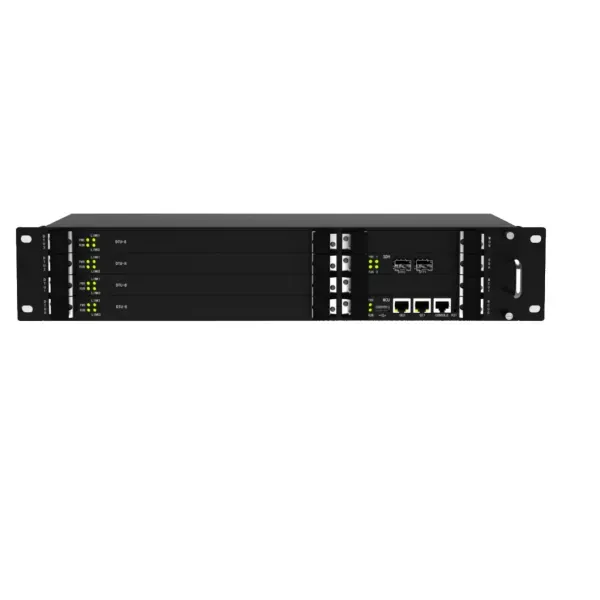
Dinstar MTG3000 Digital VoIP Gateway
The Dinstar MTG3000 Digital VoIP Gateway is engineered for organizations that need to bridge high-capacity TDM voice infrastructure with SIP, IMS and modern IP telephony platforms without treating the migration as a small-office gateway project. Dinstar positions the MTG3000 as a carrier-grade platform for telecom operators, ITSPs and large communications environments. Its architecture scales from 16 to 63 E1/T1 ports, supports an STM-1 interface, can handle up to 1,890 simultaneous calls, and combines redundant main control units with dual power supplies. That makes the MTG3000 particularly relevant for dense interconnection points, service-provider nodes, large call-routing environments, legacy PBX migration, PSTN-to-SIP conversion and projects where availability and operational visibility matter as much as raw port count.
For Tanzanian buyers, the most important question is not simply whether a gateway has E1/T1 ports. The practical buying task is to confirm signaling, trunk capacity, call concurrency, codec expectations, SIP interworking, numbering plans, redundancy requirements, management access and the relationship between the gateway and the existing PBX, softswitch, SBC, carrier handoff or IMS environment. FourTeck can help structure that requirement so the proposed gateway is evaluated as part of the full voice architecture rather than as an isolated appliance.
What the Dinstar MTG3000 is designed to solve
Large voice networks often sit between two generations of telephony. One side may still use E1/T1 digital trunks, ISDN PRI, SS7 or R2 MFC signaling, while the other side is moving toward SIP trunks, softswitches, IP PBX, IMS, hosted platforms or centralized VoIP services. The MTG3000 is designed for this boundary. Rather than forcing an immediate replacement of every legacy system, it provides a controlled interconnection point that translates media and signaling between traditional PSTN-facing infrastructure and IP-based voice systems.
This role is important in carrier networks, service-provider environments, contact centers, large enterprises and organizations that have significant investment in TDM equipment. A gateway can allow an existing PBX to remain operational while SIP services are introduced. It can also aggregate multiple digital trunks into a modern IP core, or expose SIP-based applications to established PSTN circuits. Because the MTG3000 supports flexible routing, multiple SIP trunks, caller and called-number manipulation, time-based routing, route rules and trunk grouping, it can be used to shape how calls move between the two worlds rather than acting only as a simple protocol converter.
For procurement teams, this makes discovery work essential. A correct proposal should identify how many E1/T1 circuits are in use, which signaling protocol each circuit uses, how many simultaneous calls must be sustained at busy hour, whether SS7 link redundancy is required, which SIP platform is on the IP side, what codecs are expected, whether fax or modem traffic must be preserved, and what failover behavior is expected if a controller, power source, trunk or IP path is lost.
High-density trunking
The platform scales from 16 to 63 E1/T1 ports in a 2U chassis and supports an STM-1 interface, making it appropriate where many digital trunks must be consolidated into an IP voice environment.
Carrier-scale call load
Dinstar specifies support for up to 1,890 simultaneous calls, giving planners a defined concurrency ceiling for high-volume voice interconnection projects.
Legacy and SIP interworking
The MTG3000 supports SIP with traditional signaling such as ISDN PRI, SS7 and R2 MFC, helping organizations migrate without discarding functioning legacy voice infrastructure prematurely.
Resilience features
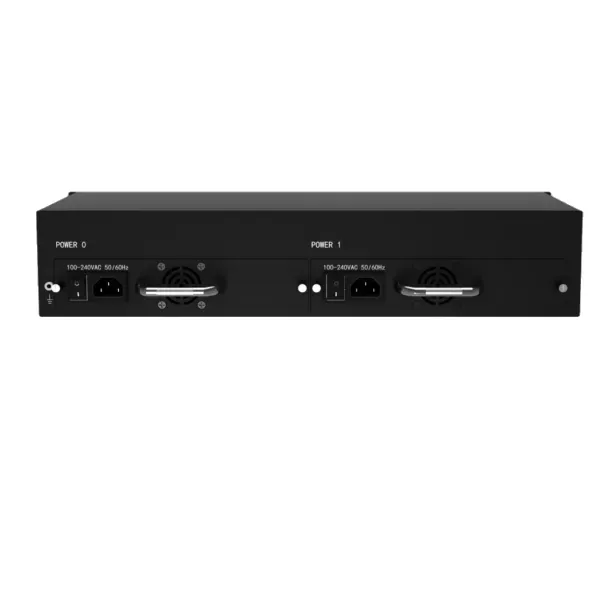
A 1+1 redundant main control unit architecture and dual power supplies are designed to support higher-availability deployments where a single hardware failure should not become an immediate service outage.
Verified Dinstar MTG3000 features and technical capabilities
| Area | Verified capability | Why it matters |
|---|---|---|
| Digital capacity | 16 to 63 E1/T1 ports; STM-1 interface | Supports dense trunk aggregation and migration from large TDM estates. |
| Call scale | Up to 1,890 simultaneous calls | Provides a planning reference for busy-hour concurrency and growth. |
| Control redundancy | 1+1 redundant MCU | Reduces dependence on a single main control unit. |
| Power | Dual power supplies | Supports resilient power design when paired with properly separated feeds and UPS infrastructure. |
| Signaling | SIP v2.0, SIP-T, ISDN PRI, SS7, R2 MFC | Enables interworking across modern SIP systems and traditional digital signaling. |
| Codecs | G.711 A/µ-law, G.723.1, G.729A/B, iLBC, AMR | Helps match codec policies across interconnected networks. |
| Fax and legacy data | T.38 and pass-through fax; modem/POS support | Useful where non-voice services still rely on legacy transport behavior. |
| Voice quality | G.168 echo cancellation up to 128 ms, adaptive dynamic buffer, silence suppression, comfort noise, VAD | Provides tools that support stable voice quality across mixed network conditions. |
| Routing | PSTN-PSTN, PSTN-IP, IP-PSTN; prefix, time and intelligent routing; number manipulation | Allows the gateway to participate in practical dial-plan and interconnect policy. |
| Management | Web GUI, SNMP v1/v2/v3, configuration backup/restore, syslog, network capture, centralized management | Supports operations teams that need monitoring, troubleshooting and repeatable configuration management. |
Deployment planning: what to confirm before ordering
The MTG3000 is a high-capacity platform, so selection should begin with architecture rather than a model number. Confirm the number of active and planned E1/T1 circuits, whether the service is E1 or T1, the signaling used on every trunk, and whether the project needs PRI, SS7, R2 MFC or a mixture. Document busy-hour call concurrency rather than relying only on extension count. A system with thousands of registered users may require far fewer simultaneous external calls, while a carrier interconnect or contact center may consume channels continuously.
On the IP side, identify the SIP peer, softswitch, IMS core, IP PBX or SBC that the gateway will connect to. Record SIP transport expectations, IP addressing, VLANs, routing, QoS, codec order, DTMF method, fax behavior and number normalization rules. If the network uses multiple SIP trunks or interconnect partners, clarify whether calls must be distributed by prefix, time, trunk priority or other policy. These details help determine whether the MTG3000 routing features align with the intended call plan.
Availability planning should also go beyond the presence of redundant hardware. Dual power supplies are most useful when they are connected to separate protected power paths. Redundant control should be matched with resilient Ethernet switching, appropriate IP routing and operational monitoring. For SS7 environments, point codes, link relationships, signaling topology and failover expectations need to be mapped before cutover. For PRI or R2 deployments, framing and signaling parameters should be documented from the existing carrier circuit or PBX.
Dinstar MTG3000 Digital VoIP Gateway Tanzania
Organizations evaluating the Dinstar MTG3000 Digital VoIP Gateway in Tanzania are usually addressing a communications problem larger than a conventional office PBX upgrade. The MTG3000 becomes relevant when an enterprise, carrier, ITSP, contact center, institution or service platform has multiple digital trunks, significant call concurrency, legacy signaling requirements or a need to interconnect an established TDM environment with SIP. In Tanzania, that can include projects where older PBX estates continue to operate reliably but must connect to newer IP telephony, where a centralized softswitch needs access to E1 circuits, or where a service provider wants to aggregate digital trunks into an IP core.
The procurement discussion should start with the exact network boundary. If the carrier side presents E1 with ISDN PRI, the gateway must be configured for the correct PRI parameters and numbering behavior. If SS7 is involved, signaling design is more complex and should include point codes, link planning, routing and redundancy. R2 MFC environments require their own signaling profile. On the SIP side, the project team should identify the target PBX, softswitch, SBC or IMS platform and define codecs, DTMF, fax, registration or peer mode, routing rules and security boundaries.
Tanzania deployments may also need to account for the physical operating environment. A 2U carrier-grade gateway belongs in a properly organized rack with adequate power protection, cooling, cable management, grounding and monitored network connectivity. Redundant power supplies are valuable only when the upstream power design protects against a single feed failure. The same principle applies to Ethernet connectivity and upstream switching. A reliable voice gateway should not be installed behind a single unmanaged switch or an unprotected power strip if the business expects high availability.
FourTeck Tanzania approaches telecom projects as part of a broader infrastructure design. The FourTeck Tanzania technology portfolio includes IP PBX, SIP telephony, networking, security and supporting infrastructure. For an MTG3000 project, that broader scope is useful because trunk gateways depend on routing, switching, power, rack layout, IP addressing and PBX or softswitch design. Buyers can therefore prepare one requirement covering the gateway, voice platform, LAN/WAN dependencies and operational handover instead of treating each component as a disconnected purchase.
Dinstar MTG3000 Digital VoIP Gateway Dar es Salaam
Dar es Salaam is a natural market for high-density voice interconnection because many national businesses, service providers, financial institutions, hospitality groups, contact centers and large enterprises concentrate communications infrastructure in the city. A Dinstar MTG3000 deployment in Dar es Salaam can make sense where a central site terminates several E1 circuits, supports large inbound or outbound call volumes, or provides shared telephony services to branches. It can also be used during a staged migration in which an older PBX remains connected to digital trunks while newer SIP systems are introduced alongside it.
For a central-office design, the engineering team should map the current trunk inventory before equipment selection. Each circuit should be labeled by carrier, port, signaling type, channel count, number range and business function. Incoming DIDs, outbound CLI rules, emergency or priority routing, contact-center numbers and failover paths should be documented. If the MTG3000 is replacing an older gateway, export the existing dial plan and record edge cases such as special prefixes, blocked ranges, fax numbers and legacy modem or POS services. These details often determine whether cutover is smooth.
Bandwidth planning on the SIP side is equally important. Voice packets leaving the gateway may traverse campus switching, a data-center core, MPLS, SD-WAN, internet VPN or a direct service-provider interconnect. The network should have predictable latency, low packet loss, correct QoS and sufficient capacity for busy-hour traffic. The MTG3000 supports multiple codecs, but codec choice should be deliberate. G.711 consumes more bandwidth but avoids compression; G.729 can reduce bandwidth at the cost of codec processing and different quality characteristics. The chosen policy should match the adjacent SIP platform and transport network.
Dar es Salaam buyers should also define support boundaries. Decide who will manage the Dinstar web interface, who receives SNMP alerts, where syslog is stored, who controls firmware changes and how configuration backups are retained. The gateway provides extensive operational tools, including SNMP, call statistics, network capture and debug functions, but those tools create value only when an operations process exists. A well-run deployment includes documentation, IP and port maps, trunk labels, dial-plan records, backup procedures and a tested rollback plan.
Dinstar MTG3000 Digital VoIP Gateway Mwanza
For organizations in Mwanza, the Dinstar MTG3000 can serve as a central interconnection platform when voice traffic from multiple offices, branches or service locations must be consolidated into a high-capacity SIP architecture. The model is not intended for a small site with a handful of analog lines; its value appears when the business has dense E1/T1 requirements, significant concurrent calling, or a need to preserve digital PSTN connectivity while modernizing the core voice system. Regional enterprises with a hub-and-spoke network can place the gateway at a central communications site and route SIP traffic to other locations over a managed WAN.
A Mwanza deployment should assess WAN resilience because branch communications may depend on the gateway even when the gateway itself is healthy. If branch IP PBXs or phones reach the central trunk gateway over MPLS, SD-WAN or VPN, the design should define what happens when a WAN path fails. Local survivability, alternate SIP trunks, secondary routing or manual fallback may be required depending on business criticality. The MTG3000’s flexible route methods can form part of the solution, but end-to-end continuity depends on the wider network.
Power quality is another design consideration. Redundant power supplies should be connected in a way that genuinely removes a single point of failure. For critical deployments, separate UPS circuits, appropriate surge protection and monitored rack power are preferable to connecting both power supplies to the same unprotected source. Rack cooling and dust management also matter because high-density telecom equipment is expected to operate continuously. Routine maintenance should include checking fan behavior, power status, alarm logs, interface errors and configuration backups.
Procurement teams can improve quotation accuracy by supplying a simple voice architecture diagram with the RFQ. Show the existing PBX or softswitch, all E1/T1 trunks, signaling types, SIP peers, approximate simultaneous calls, desired redundancy, management VLAN and any fax or modem requirements. That reduces ambiguity and helps determine whether the MTG3000’s scale is appropriate or whether a smaller Dinstar MTG model would be a better commercial fit.
Dinstar MTG3000 Digital VoIP Gateway Arusha
Arusha businesses often operate across hospitality, tourism, international organizations, education, logistics and multi-site commercial services, and some environments retain established PBX systems because they remain dependable and deeply integrated with operations. The Dinstar MTG3000 can help when such an organization wants to introduce SIP trunks, centralized call control or a new IP communications core without replacing every legacy component at once. Its ability to interwork SIP with PRI, SS7 and R2 MFC allows migration to be staged around operational priorities.
For a hotel group or campus-style environment, for example, the migration plan should identify where guest-room or departmental telephony terminates, whether the existing PBX exposes digital trunks, and how calls are presented to the public network. The gateway may sit between the legacy PBX and a new SIP platform, allowing existing extensions to remain while external trunking or centralized services change. In an institutional deployment, the same architecture can support a phased transition where old systems and new systems coexist during testing.
Voice quality should be validated before production cutover. Echo, one-way audio, DTMF failures and fax issues can result from mismatched settings rather than defective hardware. The MTG3000 supports G.168 echo cancellation, adaptive buffering, multiple DTMF methods, T.38 and pass-through fax, but the adjacent systems must be configured compatibly. A test plan should include inbound and outbound calls, long-duration calls, transfers, IVR navigation, caller ID, fax if required, busy-hour load and failover scenarios.
For Arusha procurement, avoid comparing gateways only by headline port count. Evaluate the signaling protocols required, redundancy architecture, management features, support for the chosen codecs, routing flexibility and the operational team’s ability to maintain the platform. A lower-cost gateway that cannot match the signaling environment or resilience target can create more migration cost than it saves. The MTG3000 is best evaluated as a long-lived infrastructure component within a documented voice design.
Dinstar MTG3000 Digital VoIP Gateway Dodoma
In Dodoma, organizations planning centralized communications for government-related environments, institutions, enterprises and growing multi-building sites may encounter a mix of older digital telephony and newer IP systems. The Dinstar MTG3000 is suited to cases where that mix includes substantial E1/T1 capacity and a requirement for controlled migration to SIP. Because the gateway supports traditional signaling and modern SIP interworking in one high-density platform, it can reduce the need to replace functioning PBX infrastructure simply to adopt a new carrier or IP core.
Project teams should start with governance. Define which system owns the dial plan, where number translations occur, who is responsible for carrier coordination, and which team approves changes. In large organizations, inconsistent ownership is often a bigger risk than the technology itself. The MTG3000 can provide caller and called-number manipulation, route rules, trunk groups and time-based routing, but those functions should be implemented from an approved numbering plan rather than accumulated as undocumented fixes.
Security planning should also be included. A voice gateway sits at an important network boundary. Management access should be limited to trusted administrative networks, credentials should follow organizational policy, logging should be centralized where possible, and firmware changes should be controlled. SIP interfaces should be placed within an architecture that considers firewalls, SBC functions, routing and access lists. The product supports IP access rule lists and black/white lists, but wider network controls are still necessary.
For procurement in Dodoma, include rack space, power feeds, UPS capacity, network switch ports, fiber or copper uplinks, console access, labeling and documentation in the scope. The gateway occupies 2U, but a dependable implementation requires more than 2U of thinking. Planning the supporting infrastructure early avoids last-minute compromises during installation and makes future troubleshooting much easier for the operations team.
Dinstar MTG3000 Digital VoIP Gateway UAE
In the UAE, high-density voice gateways are commonly evaluated for carrier interconnection, enterprise migration, contact-center consolidation and large hospitality or campus environments that still rely on digital trunks. The Dinstar MTG3000 fits projects where 16 to 63 E1/T1 ports, STM-1 connectivity and up to 1,890 simultaneous calls are relevant. Its mix of SIP, ISDN PRI, SS7 and R2 MFC support makes it suitable for complex interworking rather than simple branch-office connectivity.
A UAE deployment can involve multiple service providers, separate inbound and outbound routes, disaster-recovery sites and strict change-control processes. The project should document which E1 circuits terminate at each site, how SIP traffic is routed between data centers, and whether trunks must fail over automatically if an interconnect is unavailable. Dinstar’s routing features and redundant control design provide useful building blocks, but redundancy should be modeled across the complete architecture, including switching, IP routing, SBCs, softswitches, power and WAN transport.
Interoperability testing is especially important when the gateway connects systems from different vendors. Dinstar documentation references compatibility with mainstream VoIP platforms, but a production project should still validate the exact software versions, signaling parameters and codec policy in use. Test calls should cover caller ID, number manipulation, DTMF, IVR access, transfers, fax where needed, supplementary services and call release behavior. For SS7, signaling tests should include link status and expected failover behavior.
Organizations coordinating projects between East Africa and the Gulf can also use the FourTeck UAE technology practice as a regional reference point for integrated telecom, networking and infrastructure planning. The objective is to keep the gateway specification aligned with the wider communications platform rather than sourcing a high-capacity chassis without a tested interconnection plan.
Dinstar MTG3000 Digital VoIP Gateway Uganda
Ugandan organizations considering the Dinstar MTG3000 are likely to be service providers, large enterprises, institutions or multi-site operations with more voice capacity than a conventional SME gateway can handle. The MTG3000 can bridge dense E1/T1 services into SIP, support traditional signaling such as PRI, SS7 and R2 MFC, and provide a platform for phased migration from legacy telephony to IP communications. Its up-to-1,890-call capacity means the design should be driven by real traffic engineering rather than assumptions based on employee count.
A countrywide deployment may centralize trunks in Kampala or another main site while remote branches connect to the IP voice core over WAN services. If so, the voice design should distinguish gateway redundancy from network redundancy. A healthy MTG3000 cannot carry calls from a branch that has lost its only WAN path. Critical branches may need secondary connectivity, local survivability or alternate trunk arrangements. The call-routing plan should state what happens during each failure condition instead of assuming that redundancy in one component protects the entire service.
Operations teams should make use of management features such as SNMP, syslog, call statistics, network capture and configuration backup. These tools support proactive monitoring and troubleshooting, particularly when voice problems occur intermittently. A standard operating procedure can define alarm thresholds, backup frequency, firmware review, log retention and escalation paths. That operational discipline is important for carrier-grade hardware because the expected service life is usually longer than that of an ordinary office appliance.
For regional coordination, the FourTeck Uganda solutions site provides a broader context for PBX, networking and infrastructure requirements. Cross-border organizations can use a common architecture standard while still adapting carrier signaling, number plans and WAN design to the conditions of each country.
Dinstar MTG3000 Digital VoIP Gateway Kampala
Kampala is a likely location for centralized carrier, enterprise and contact-center infrastructure, making it a practical city in which to evaluate the Dinstar MTG3000 for dense digital trunk aggregation. If a business already operates multiple E1s into a legacy PBX or switching environment, the MTG3000 can provide the conversion layer needed to adopt SIP trunks, move call-control applications to IP or connect a modern softswitch while preserving existing circuits during migration.
The sizing exercise should separate physical ports from traffic capacity. A site may require many E1 interfaces but use fewer simultaneous channels, or it may operate close to full busy-hour capacity. The MTG3000 supports up to 63 E1/T1 ports and up to 1,890 simultaneous calls, so planners should document both port utilization and peak channel usage. Growth assumptions should be realistic and tied to business plans rather than simply selecting the maximum configuration by default.
Contact-center environments should pay particular attention to codec selection, DTMF and release signaling. IVRs and dialers depend on accurate digit transport and clean call state transitions. Recordings and quality-monitoring platforms may also be sensitive to media changes. Testing should involve the actual application stack, not just a technician making a few manual calls. Load testing under realistic concurrency can expose issues in routing, network bandwidth or upstream platforms before the production cutover.
Kampala deployments can also benefit from formal rollback planning. Before replacing an existing trunk gateway, capture configuration backups, port mappings and carrier settings. Define how to restore the original path if acceptance tests fail. Migration windows should include enough time for signaling verification and user testing, especially when many number ranges are involved. Good change management reduces business risk even when the hardware itself is designed for carrier-grade reliability.
Dinstar MTG3000 Digital VoIP Gateway Arua
Arua deployments may be less about local high-density carrier infrastructure and more about supporting a regional hub that connects back to a centralized voice core. The Dinstar MTG3000 is appropriate only when the trunk density and signaling requirements justify a carrier-grade platform. For smaller sites, another Dinstar MTG model may be more economical. For a regional operator or organization aggregating multiple circuits, however, the MTG3000’s scale and routing capabilities can provide room for consolidation and future growth.
If the gateway is installed in a regional hub, environmental resilience deserves careful attention. Rack cooling, clean power, UPS runtime, grounding, surge protection and physical access should be treated as part of the voice solution. High availability should not stop at redundant power supplies. The upstream switch, router and WAN link should be selected so that a single supporting-device failure does not defeat the resilience built into the gateway.
Remote operations are also important. The MTG3000 supports web management, SNMP, syslog, centralized management and configuration backup. A support team located elsewhere can monitor the gateway if secure management connectivity is designed correctly. Management access should be isolated from general user traffic, and remote troubleshooting should use controlled administrative paths. Capturing logs and alarms centrally can reduce the need for site visits when diagnosing transient trunk or signaling issues.
For procurement, clearly state whether the site needs E1 or T1, the required port count, signaling protocol, expected call concurrency and SIP peer. Those five facts eliminate many common quotation errors. Add the physical power arrangement, rack requirements, IP addressing, WAN topology and target implementation window, and suppliers can respond with a much more useful technical proposal.
Dinstar MTG3000 Digital VoIP Gateway Mbarara
In Mbarara, a high-capacity gateway can be relevant for institutions, distributed enterprises or communications providers that maintain digital trunks while centralizing voice applications over IP. The MTG3000 provides a bridge between traditional E1/T1 interfaces and SIP-based systems, allowing a project to modernize call control without forcing every legacy circuit or PBX to disappear on day one. This staged approach can reduce migration risk when telephone services are operationally important.
The first design decision is where the gateway belongs. It may sit next to the carrier demarcation, next to a legacy PBX, or in a data-center rack adjacent to the SIP core. The location affects cabling, power, resilience and troubleshooting. Digital trunks should be clearly labeled, and cross-connects should be documented. Ethernet paths should connect into managed switching with suitable VLAN and QoS policy. Management interfaces should be reachable through a secure administrative network.
If the organization uses fax, payment terminals or legacy modem-based applications, those services should be identified early. Dinstar specifies T.38 and pass-through fax as well as modem/POS support, but actual behavior depends on end-to-end configuration. Do not assume that a service will work simply because a feature appears on a datasheet. Test the real device and workflow. Fax pages, modem handshakes and transaction terminals may expose timing or codec issues that ordinary voice calls do not reveal.
A successful Mbarara deployment should finish with operational handover. The support team needs the final configuration, trunk map, IP addresses, credentials process, backup location, alarm contacts and escalation procedures. Training should cover basic health checks, log collection and how to distinguish a carrier-side problem from a SIP-side or gateway-side issue. This makes the MTG3000 easier to operate throughout its lifecycle.
Dinstar MTG3000 Digital VoIP Gateway Gulu
Gulu organizations evaluating a Dinstar MTG3000 should begin by confirming whether a high-density digital gateway is actually required. The MTG3000 is designed for large trunk counts and carrier-grade workloads. If the environment has only one or two E1 circuits, a smaller gateway may meet the need more efficiently. If the site acts as a regional communications hub, service-provider node or aggregation point, the MTG3000’s scalable 16-to-63-port design can provide the density and resilience needed for centralized voice services.
For a hub design, document the traffic flows between local trunks and remote SIP systems. Calls may enter via E1 and terminate on a centralized PBX, route to another region, or leave through a different carrier connection. The MTG3000 supports PSTN-PSTN, PSTN-IP and IP-PSTN routing, giving architects flexibility to model these paths. Prefix rules, trunk priorities and number manipulation should be documented so troubleshooting does not depend on institutional memory.
Monitoring is especially useful at remote sites. SNMP can feed network-management platforms, while syslog and call statistics can help identify whether failures are associated with a particular trunk, route or time period. Network capture capabilities support deeper analysis when SIP signaling or RTP media behaves unexpectedly. Centralizing this telemetry gives engineering teams more evidence before escalating problems to a carrier or traveling to the site.
Power and connectivity design should reflect the service’s importance. If both gateway power supplies feed from the same UPS and both Ethernet interfaces terminate on the same access switch, the practical redundancy may be limited. A resilience review should map every single point of failure from the incoming carrier circuit through the gateway and IP network to the call-control platform. That review is often more valuable than simply buying redundant hardware features.
Dinstar MTG3000 Digital VoIP Gateway Kenya
Kenyan carriers, ITSPs, BPOs, large enterprises and multi-site organizations may consider the Dinstar MTG3000 when a voice project requires substantial E1/T1 density, carrier signaling and high concurrent call capacity. The gateway’s support for PRI, SS7, R2 MFC and SIP makes it useful in migration scenarios where legacy digital services remain active while the core voice platform moves toward IP. The 2U form factor can consolidate a large number of circuits into a relatively compact rack footprint.
For BPO and contact-center applications, busy-hour concurrency should drive sizing. Agent count alone can be misleading because predictive dialing, callbacks, inbound queues and campaign behavior influence channel utilization. The design should model maximum concurrent calls, codec policy and bandwidth. DTMF must work consistently with IVR systems, and caller ID handling must follow carrier and business requirements. If call recording is involved, confirm where media is anchored and how the gateway interacts with the recording architecture.
Large enterprises may use the MTG3000 during PBX consolidation. Multiple legacy sites can be migrated into a centralized SIP platform while selected TDM trunks remain connected. This requires a detailed numbering plan so extensions, DIDs and outbound prefixes remain predictable. Number manipulation on the gateway can help normalize formats, but rules should be kept understandable. Complex translations built without documentation are difficult to maintain and can create subtle routing problems later.
For related regional solution planning, visit FourTeck Kenya, which covers business IT, VoIP PBX and network-security projects. Organizations operating in both Tanzania and Kenya can standardize gateway, PBX, networking and documentation practices while adapting each country’s carrier interfaces and numbering requirements.
Dinstar MTG3000 Digital VoIP Gateway Kuwait
In Kuwait, the Dinstar MTG3000 is relevant to telecom providers, large enterprises, contact centers and organizations with established digital telephony that need a controlled path to SIP. Its carrier-grade design, support for up to 63 E1/T1 ports and high simultaneous-call capacity make it suited to centralized voice infrastructure rather than small branch deployments. The platform can help preserve legacy investments while the surrounding network adopts IP-based call control and service delivery.
A typical migration may place the MTG3000 between digital carrier trunks and a new softswitch or IP PBX. During transition, calls can be routed between PSTN and IP domains while old and new systems coexist. The project should identify which system controls each number range, how outbound calling is selected, and which platform provides services such as IVR, voicemail or call queues. Clear ownership avoids circular routing and duplicated dial-plan logic.
For high-availability sites, test redundancy rather than assuming it works. Simulate the loss of a power feed, a control unit, an Ethernet path and a SIP peer where safe to do so. Observe how active calls and new calls behave, and document recovery time. If the business expects automatic failover to a disaster-recovery SIP platform, that behavior should be validated before acceptance. The gateway is one component in a chain, and resilience is only as strong as the weakest dependency.
Technical buyers should request a proposal that separates hardware configuration from professional services. Hardware may include the chassis and required interface capacity, while services can include design review, configuration, integration testing, migration support and documentation. This separation helps procurement compare like-for-like offers and understand what is required to move from delivered equipment to a working production service.
Dinstar MTG3000 Digital VoIP Gateway Ghana
Ghanaian service providers and enterprises with dense E1 connectivity can use a platform such as the Dinstar MTG3000 to bridge traditional digital trunks into SIP-based voice networks. The gateway’s scale is appropriate where call volumes are high, where carrier signaling such as SS7 is present, or where a legacy PBX estate must continue operating during a longer modernization program. Because the MTG3000 supports multiple SIP trunks and flexible routing, it can also participate in multi-carrier or multi-platform interconnection designs.
Before procurement, determine whether the requirement is primarily media conversion, signaling conversion, routing, aggregation or all four. If SS7 is involved, signaling architecture may become the most important design element. If the project uses PRI, configuration is more straightforward but still requires matching framing, line coding, channel and numbering parameters. If the gateway connects to a hosted or virtualized SIP platform, WAN stability and SBC architecture may dominate the risk profile.
Capacity planning should include growth. A gateway that initially terminates 16 E1s may later be expected to support more. The MTG3000’s modular scale up to 63 E1/T1 ports can provide expansion headroom, but the upstream softswitch, SIP licensing, network bandwidth and carrier contracts must also be sized for that growth. Capacity in one appliance does not automatically create capacity across the entire service chain.
For organizations coordinating infrastructure across multiple African markets, the FourTeck Africa technology site provides a broader regional solution context. Standardized design templates, test plans and documentation can reduce operational complexity when the same voice architecture is deployed in several countries.
Dinstar MTG3000 Digital VoIP Gateway Nigeria
Nigeria’s large telecom, financial-services, BPO and enterprise markets can generate the kind of traffic volumes that justify a carrier-grade gateway such as the Dinstar MTG3000. The product supports up to 1,890 simultaneous calls and up to 63 E1/T1 ports, making it relevant for dense interconnection nodes, large contact centers, wholesale voice environments and major PBX migration projects. Its support for SS7, PRI, R2 MFC and SIP helps bridge mixed-generation networks.
In high-volume environments, observability should be designed from the outset. The MTG3000 provides PSTN and SIP trunk statistics, SNMP, syslog and network capture. Operations teams can use these tools to track trunk utilization, investigate call failures and distinguish media problems from signaling problems. Integrating alarms into an NMS or monitoring process reduces reliance on users reporting issues after service has already degraded.
Security teams should review both signaling and management exposure. The gateway should not be administered from unrestricted networks. Access rules, firewall policies, administrator roles and credential procedures should reflect the organization’s security standards. If SIP traverses untrusted networks, the wider architecture may require SBC and VPN or other transport protections. The gateway should be considered part of the enterprise or carrier security boundary, not an appliance that can be placed anywhere because it handles voice.
Commercial evaluation should include total migration cost. A quote for the chassis alone does not capture engineering, testing, carrier coordination, cabling, rack changes, monitoring integration or maintenance. Conversely, replacing a large legacy PBX estate all at once may be far more expensive than using a gateway to phase the transition. The right business case compares both pathways and measures risk, operating complexity and future scalability.
Dinstar MTG3000 Digital VoIP Gateway Seychelles
In Seychelles, the scale of an MTG3000 deployment should be justified carefully because the platform is built for high-density digital voice. Large hospitality groups, telecom environments, government-scale infrastructure or organizations aggregating multiple E1 services may benefit from the gateway, while smaller businesses may be better served by a lower-capacity model. The important point is to align the gateway with actual trunk density and concurrent-call requirements rather than choosing a carrier-grade chassis only for future-proofing.
Island and multi-site environments often place extra emphasis on remote support and resilience. If specialist engineers are not always on site, management tools such as SNMP, syslog, configuration backup and network capture become particularly useful. Secure remote access can allow a central team to review alarms and troubleshoot signaling without immediate travel. Documentation should be comprehensive enough that local technical staff can perform safe first-line checks.
Where hospitality systems are involved, the voice migration should consider integrations beyond ordinary extensions. Front-desk consoles, emergency calling, wake-up systems, billing interfaces or older PBX-dependent workflows may exist. The MTG3000 handles trunk interconnection rather than hotel application logic, so the migration plan must identify which functions remain on the PBX and which move to a new SIP platform. A phased gateway-based migration can be useful because it allows those workflows to be tested before the legacy system is retired.
Physical deployment should include protected power, adequate cooling and clear cabling. Because international replacement logistics can take time, organizations may also choose to hold suitable spares or establish support procedures based on business criticality. Spare strategy should be decided by the customer and supplier from risk assessment rather than assumed. The objective is a maintainable voice platform whose failure and recovery procedures are understood before an incident occurs.
Compatibility, codecs, fax and signaling design
The MTG3000 supports a useful set of codecs including G.711 A-law and µ-law, G.723.1, G.729A/B, iLBC and AMR. Codec support is important because two networks may prefer different media formats, but the project should not select codecs only because they appear on the feature list. G.711 is common where bandwidth is plentiful and low processing overhead is preferred. Compressed codecs can reduce bandwidth across constrained links. The SIP peer, licensing, transcoding architecture and voice-quality requirements should determine the final policy.
For fax, Dinstar lists T.38 and pass-through support. Fax over IP can be sensitive to packet loss, jitter and configuration mismatches, so test with the actual fax endpoints if the service is business critical. Modem and POS support is also listed, but legacy data devices can be more timing-sensitive than voice. Validate the exact application rather than assuming success from generic feature compatibility.
On the signaling side, PRI, SS7 and R2 MFC serve different environments. PRI projects should record switch type, framing and number presentation. SS7 projects require deeper planning around point codes, linksets, routes and network topology. R2 MFC projects need parameter alignment with the connected exchange or PBX. SIP interworking then adds a second layer involving peers, registration mode where applicable, SIP-T, DTMF, codec negotiation, NAT behavior and routing. A gateway deployment is successful when both sides are treated as one coherent signaling design.
When the MTG3000 is the right size — and when it is not
The strongest reason to choose the MTG3000 is density. If the project requires 16 or more E1/T1 interfaces, significant concurrency, STM-1 or carrier-grade redundancy, the model enters its natural territory. It is also a strong candidate when the gateway is part of a telecom operator, ITSP or large-enterprise core and must support multiple SIP trunks, traditional signaling and detailed routing. In these situations, consolidating many circuits into a 2U platform can simplify rack design and operations.
For smaller deployments, another model may be more appropriate. Dinstar’s MTG range includes lower-capacity gateways. Buying an oversized platform can increase capital cost and operational complexity without creating business value. During requirements gathering, compare current port count, three-to-five-year growth, redundancy targets and expected call load. If the numbers do not approach the MTG3000’s capacity range, request alternatives instead of forcing the highest-density model into the design.
The same logic applies at the high end. If the design is close to the platform’s maximum call or port capacity from day one, growth headroom may be limited. Capacity planning should consider normal busy hour, exceptional peaks, failover scenarios and future service expansion. In redundant architectures, one surviving node may temporarily need to carry more traffic during maintenance or failure, so N+1 thinking can be more useful than sizing each box to average load.
Related FourTeck telecom and infrastructure resources
Tanzania integrated IT & telecom
Use FourTeck Tanzania to review the wider IP PBX, networking, security and infrastructure scope that can sit around a digital voice gateway project.
Uganda regional planning
The FourTeck Uganda site is useful for organizations coordinating PBX, CCTV and networking requirements across East African operations.
Kenya regional planning
Visit FourTeck Kenya for business VoIP PBX, network and security solution context in Kenya.
Africa multi-country context
The FourTeck Africa site provides a regional reference for organizations standardizing communications and IT infrastructure across multiple African markets.
UAE technology projects
For Gulf-region coordination, FourTeck UAE covers integrated IT and telecom requirements relevant to multi-region deployments.
Quotation checklist for Dinstar MTG3000
A complete quotation request should include enough information to distinguish capacity, signaling and integration needs. Supplying the checklist below helps reduce back-and-forth and allows the technical proposal to focus on the actual topology.
Frequently asked questions
How many E1/T1 ports does the Dinstar MTG3000 support?
Dinstar specifies the MTG3000 as scalable from 16 to 63 E1/T1 ports. The platform also supports an STM-1 interface. The exact hardware configuration should be matched to the required port density and future growth plan.
How many simultaneous calls can the MTG3000 handle?
Dinstar states support for up to 1,890 simultaneous calls. Real-world design should still consider codec choice, connected platforms, signaling, routing and overall network capacity.
Does the MTG3000 support SS7 and ISDN PRI?
Yes. Dinstar lists ISDN PRI, SS7 and R2 MFC among the supported traditional signaling options, together with SIP and SIP-T on the IP side.
Can the MTG3000 connect a legacy PBX to SIP?
Yes, when the PBX exposes a compatible digital trunk interface and signaling profile. The gateway is designed to interconnect traditional digital telephony with SIP networks. A migration project should still validate number plans, signaling, codecs, DTMF and fax behavior before cutover.
Does it support redundant hardware?
The MTG3000 includes a 1+1 redundant main control unit design and dual power supplies. End-to-end high availability also depends on resilient power feeds, Ethernet switching, routing and SIP-side systems.
Does the MTG3000 support fax?
Dinstar lists T.38 and pass-through fax support. Fax should be tested end to end with the actual carrier, SIP platform and endpoint because fax-over-IP behavior is sensitive to network and configuration conditions.
What management options are available?
The product supports web GUI configuration, SNMP v1/v2/v3, centralized management, configuration backup and restore, syslog, call statistics and network capture. These tools can be incorporated into a formal operations and monitoring process.
Is the MTG3000 suitable for a small office?
Usually not. The MTG3000 is a high-density carrier-grade gateway. Small offices with one or a few digital trunks should compare lower-capacity models so the hardware scale and cost match the actual requirement.
Decision recap
Choose the Dinstar MTG3000 when the project genuinely requires high E1/T1 density, carrier-grade call capacity, SIP interworking with PRI/SS7/R2 MFC, operational management tools and a resilient chassis design. Its strongest use cases are carrier and ITSP interconnects, large enterprise migrations, contact centers, centralized trunk aggregation and environments where legacy digital voice must coexist with modern SIP platforms.
Do not choose it only because it is the larger model. Compare present and future trunk counts, simultaneous calls, signaling, redundancy and deployment topology. For a smaller site, a lower-density gateway can be more economical and easier to operate. For a very large or geographically distributed environment, the design may require multiple gateways with site or service redundancy rather than one maximally loaded chassis.
Talk to FourTeck about your MTG3000 topology
A useful pre-sales discussion should cover the existing carrier circuits, PBX or softswitch, signaling, busy-hour traffic and migration objective. Share a network diagram if available. FourTeck can use those details to structure a quotation around the gateway and the supporting telecom infrastructure rather than responding with a chassis-only offer that leaves key integration assumptions unresolved.
For Tanzania projects, include the city, required E1/T1 capacity, signaling type, target SIP platform and expected implementation window. For multi-country projects, identify which locations have different carrier interfaces so each site can be engineered correctly instead of copying one configuration everywhere.



Reviews
There are no reviews yet.