
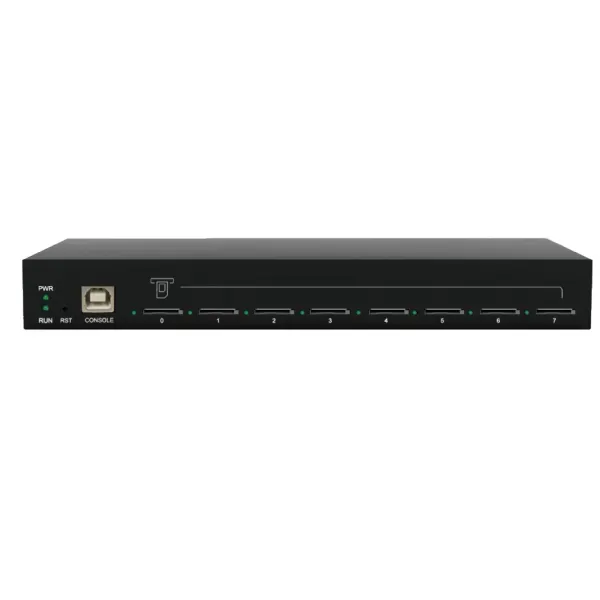
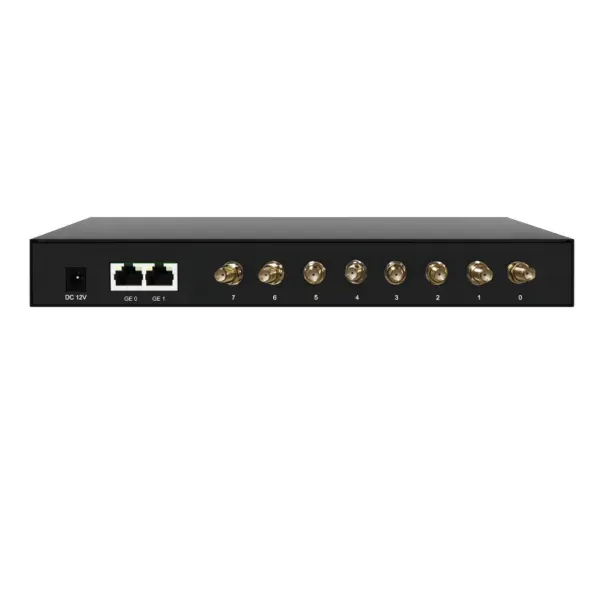
Dinstar UC2000-VE GSM LTE VoIP Gateway
The Dinstar UC2000-VE is a compact mobile-to-VoIP gateway for organizations that need controlled integration between GSM, WCDMA or LTE mobile services and SIP-based telephony. Dinstar positions the UC2000-VE as a 4- or 8-channel platform supporting voice and SMS, VoLTE, hot-swappable SIM cards, SIP interoperability, web management and optional remote SIM management through Dinstar SIMBank and SIMCloud. For Tanzanian organizations, the practical value is the ability to connect mobile trunks with an IP PBX, branch communications platform or call-handling system while keeping routing, number manipulation, usage control and diagnostics within one managed appliance.
Choose the UC2000-VE when you need four or eight mobile channels integrated with SIP voice, SMS workflows or a business IP PBX, and when the selected radio variant and mobile-network compatibility have been confirmed for the target country.
Official Dinstar product information identifies 4- and 8-channel UC2000-VE configurations with matching SIM slots and antennas.
The platform uses SIP v2.0 and supports Voice over LTE, helping connect mobile services to mainstream VoIP platforms.
The gateway supports voice, SMS/USSD functions, SMPP and HTTP API options for message-oriented application integration.
HTTPS/HTTP configuration, backup and restore, logs, statistics and diagnostic capture features support day-to-day operation.
What the Dinstar UC2000-VE does
A GSM/LTE VoIP gateway sits between a mobile network and an IP-based voice environment. On the mobile side, the UC2000-VE uses SIM-based GSM, WCDMA or LTE connectivity according to the installed hardware variant and supported frequency plan. On the VoIP side, it connects through SIP so that an IP PBX, call-routing platform or compatible SIP system can send calls toward mobile networks or receive mobile-originated traffic. This can give an organization an additional trunking path where mobile connectivity is useful, a way to route selected traffic through mobile channels, or a method to extend a voice system into sites where fixed telephony options are constrained.
Dinstar also provides functions that go beyond simple voice conversion. The vendor lists SMS sending and receiving, SMS-to-email and email-to-SMS, HTTP API support, SMPP, USSD, credit or balance-related controls, caller and called number manipulation, white and black lists, port and trunk grouping, call statistics, local CDR storage and multiple diagnostic tools. These functions make the gateway relevant not only for basic PBX connectivity but also for carefully designed business workflows in which mobile calling or messaging is integrated with an application or central communications platform.
Deployment planning should start with network compatibility rather than assuming that every UC2000-VE variant works identically in every country. Dinstar publishes multiple GSM, WCDMA and LTE frequency choices, and mobile operators can apply different service, SIM, VoLTE and policy requirements. FourTeck therefore recommends confirming the intended operator, radio technology, SIM type, number of concurrent channels, PBX details, expected call direction, SMS requirements and site connectivity before quotation. This avoids choosing a gateway merely by channel count while overlooking the radio or integration requirements that determine whether the finished system will work as expected.
Verified feature overview
| Mobile connectivity | GSM/WCDMA/LTE support with country-specific LTE frequency choices; VoLTE is listed by Dinstar. |
| Channels / SIMs | 4 or 8 mobile channels with 4 or 8 SIM slots and antennas, depending on model configuration. |
| VoIP protocol | SIP v2.0 / RFC3261 with SIP trunks, trunk groups, port groups and number manipulation. |
| Voice codecs | G.711 A-law/u-law, G.723.1 and G.729AB are listed in Dinstar specifications. |
| Messaging | SMS/USSD, HTTP API, SMPP, SMS-to-email and email-to-SMS functions are supported. |
| Security | Dinstar lists signaling and RTP encryption support. Exact end-to-end security depends on the surrounding SIP platform and configuration. |
| Management | HTTPS/HTTP web configuration, backup/restore, firmware upgrade, logs, statistics and SIP/RTP/PCM capture. |
| Remote SIM management | Optional integration with Dinstar SIMBank and SIMCloud. |
Where the UC2000-VE can fit
Dinstar lists use cases including mobile connectivity for SME IP phone systems, mobile trunking for multi-site offices, voice backup trunks, land-line replacement in areas with limited fixed-line infrastructure, call-center or contact-center scenarios and SMS services. These are broad platform capabilities rather than guarantees that every carrier will permit every application. A responsible design checks local operator terms, numbering, SIM policies, call volumes, caller-ID behavior and any regulatory requirements before the gateway is placed into production.
For an IP PBX project, the most important questions are usually practical: how many concurrent mobile calls are required, which mobile operators are intended, whether both inbound and outbound routes are needed, whether VoLTE is required, how SIP authentication will be configured, which number transformations are needed, whether SMS must be integrated with software, and how the gateway will be monitored. FourTeck Tanzania’s broader business IT and telecom solutions can place those questions in the context of the LAN, firewall, IP PBX, IP phones, power protection and remote-site design rather than treating the gateway as an isolated box.
Buying and deployment checklist
Choose between a 4- or 8-channel requirement based on realistic concurrent call demand, not simply total users.
Match the gateway radio variant to the intended operator bands and confirm VoLTE requirements where relevant.
Provide PBX vendor/model, SIP addressing, authentication method, codecs, dial plan and expected routing behavior.
State whether SMS is manual, application-driven, email-linked or API/SMPP integrated so the design can be validated.
Dinstar UC2000-VE GSM LTE VoIP Gateway Tanzania
For organizations evaluating the Dinstar UC2000-VE in Tanzania, the key decision is whether a four- or eight-channel mobile gateway solves a defined telephony requirement more effectively than adding another conventional SIP trunk or separate mobile devices. The UC2000-VE can be considered where an IP PBX needs controlled access to GSM, WCDMA or LTE mobile services, where a branch requires mobile voice as an additional path, or where an application needs supported SMS functions alongside SIP calling. The gateway is not a substitute for planning the voice network; it is a bridge that must be matched to the PBX, operator, SIM policy and expected traffic.
A Tanzania quotation should therefore identify the intended mobile network or networks, the location of installation, available LTE coverage, whether VoLTE is needed, expected simultaneous calls, whether SIM cards will be dedicated per channel, and whether inbound mobile calls need to terminate on extensions, queues or an IVR. PBX information is equally important. The technician needs to know whether the system will register the gateway, use an IP-authenticated SIP trunk, apply prefix-based routing, manipulate numbers or use specific codecs. If SMS is part of the project, define whether staff will use the web interface or whether a software platform will integrate through HTTP API, SMPP, email or another supported workflow.
For business sites in Tanzania, network quality inside the premises is also part of successful deployment. The gateway should sit on a stable LAN with appropriate IP addressing, firewall rules, secure management access and reliable power. Voice traffic benefits from a clean network path to the PBX, while remote administration should not be exposed carelessly to the public internet. In locations with variable power, a suitable UPS can help the gateway, router, switch and PBX remain available together during short interruptions. Antenna positioning and actual mobile signal conditions should be checked at the installation point rather than assumed from outdoor coverage maps.
Buyers searching for a Dinstar UC2000-VE supplier in Tanzania should ask for the exact radio variant, channel configuration and integration scope in the quotation. FourTeck can help frame the gateway within a wider IP telephony project, including PBX routing, network readiness and endpoint planning. The objective is to procure a configuration that matches the mobile operator and the intended workflow, with clear information about what must be supplied, configured and tested before production use.
Dinstar UC2000-VE GSM LTE VoIP Gateway Dar es Salaam
Dar es Salaam businesses often operate communications environments that combine headquarters telephony, customer-facing call handling, branch connectivity and mobile staff. In that setting, the Dinstar UC2000-VE can be evaluated as a mobile trunk gateway for a SIP-based PBX when the organization has a clear requirement to route selected calls over mobile channels. Four channels may suit a smaller deployment with limited concurrency, while eight channels provide a higher mobile-call capacity. The correct choice depends on actual simultaneous usage, not the number of employees in the organization.
A Dar es Salaam deployment should begin with operator and radio compatibility. LTE service may be widely available in many business areas, but the selected UC2000-VE hardware must support the required frequency configuration and the SIM service must support the intended voice behavior. VoLTE requirements should be checked rather than assumed. For offices in high-rise buildings, industrial areas or sites with shielded equipment rooms, indoor signal strength can differ materially from street-level coverage. Antenna placement and cable routing should therefore be considered during installation planning.
In a contact center or busy reception environment, dial-plan design becomes important. The PBX may need to choose mobile routes by prefix, least-cost policy, user group or failover condition. Incoming mobile calls may need to land on a receptionist, queue, ring group or IVR. The UC2000-VE provides caller/called-number manipulation and trunk/port grouping, but those controls still need to be coordinated with the PBX so that the finished routing remains predictable. CDRs, call statistics and diagnostics can assist troubleshooting when a call fails or audio quality is inconsistent.
For procurement in Dar es Salaam, provide the PBX model, SIP addressing, number of mobile channels, operator details, desired call direction, SMS requirements and installation environment when requesting a quote. This allows the proposal to focus on compatibility and deployment rather than just a product price. Businesses planning broader telephony modernization can also review FourTeck Tanzania’s technology product catalogue for related infrastructure needed around the gateway.
Dinstar UC2000-VE GSM LTE VoIP Gateway Mwanza
Organizations in Mwanza considering the Dinstar UC2000-VE may be looking for a practical way to connect a central IP PBX to mobile networks without relying on individual desk-mounted mobile phones or manual call forwarding. A managed gateway can bring mobile trunks into the same dial plan used by SIP phones and other extensions, which is useful when a branch has a defined requirement for mobile-originated or mobile-terminated business calls. The design should still be based on operator compatibility, signal conditions and permitted SIM usage.
For a multi-site organization, Mwanza may function as a regional office connected to another location over an IP network. In such a design, the UC2000-VE can sit locally while the PBX is local or remote, provided the network path, SIP security and routing have been designed correctly. This can allow the organization to retain mobile connectivity close to the branch while maintaining centralized call policies. Latency, packet loss and firewall behavior between sites matter because the mobile leg may be healthy while the IP leg causes one-way audio or call setup problems.
Mwanza deployment planning should also consider physical installation. The gateway needs stable power, appropriate ventilation, a reliable Ethernet connection and antennas positioned for usable mobile signal. Where a rack or communications cabinet is used, radio reception should be tested before final mounting; a metal enclosure can affect practical signal conditions. UPS-backed power for the gateway and associated router/switch can improve continuity during short power disturbances, but any resilience plan should also consider the PBX and internet or WAN path.
When requesting a Dinstar UC2000-VE quotation for Mwanza, document whether the requirement is four or eight channels, expected peak calls, operator/SIM information, VoLTE needs, SMS/API integration and PBX type. If the project includes multiple branches, include the inter-site network design and the desired failover behavior. Clear requirements help determine whether the UC2000-VE is the right size or whether another Dinstar UC2000-series channel count would be more appropriate.
Dinstar UC2000-VE GSM LTE VoIP Gateway Arusha
Arusha businesses in hospitality, tourism, professional services, education and multi-site operations may use an IP PBX for structured internal and external communications. Where mobile trunks are part of that design, the Dinstar UC2000-VE offers a compact 4/8-channel option that can connect mobile services to the SIP environment. Its suitability depends on how many simultaneous mobile calls are required and whether the selected GSM, WCDMA or LTE variant matches the intended operator services.
For hotels, lodges, travel businesses or organizations with distributed operations, a useful requirement may be to route particular outbound calls through mobile channels while keeping internal extensions and reception workflows on the PBX. Incoming mobile numbers can also be directed toward defined PBX destinations when the deployment and operator service support the intended call flow. Before configuring routes, map which calls should use the gateway, which should use other trunks, what happens if all mobile channels are busy, and how after-hours calls should be handled. This prevents unexpected routing loops or busy conditions.
The UC2000-VE’s SMS functions may also be relevant where an organization needs controlled messaging from an application or business workflow. Dinstar lists SMS sending/receiving, HTTP API, SMPP and email-related functions. Those capabilities should be tested with the actual application and mobile operator before a business-critical messaging process is launched. Message throughput, sender behavior, operator policies and application error handling can affect the user experience even when the gateway itself is correctly configured.
For an Arusha quotation, include the intended use case rather than requesting only “one UC2000-VE.” State whether the project is for PBX mobile trunking, backup voice, branch connectivity, SMS integration or a combination. Add channel count, operator, SIM quantity, PBX make/model, site network information and whether configuration assistance is required. This information helps shape a procurement scope that is technically useful and avoids buying a radio variant or channel count that does not fit the actual environment.
Dinstar UC2000-VE GSM LTE VoIP Gateway Dodoma
In Dodoma, the Dinstar UC2000-VE can be assessed for offices, institutions and organizations that want mobile-network connectivity integrated with a managed SIP telephony platform. Instead of treating mobile lines as separate handsets, a gateway can present mobile channels to the IP PBX and allow administrators to define routing rules around them. This is most useful when the organization can describe exactly which departments, destinations or failover cases should use the mobile trunks.
A procurement team should distinguish channel capacity from user capacity. A four-channel gateway can carry up to four mobile calls at the same time; an eight-channel configuration is intended for a greater level of concurrent traffic. Many more users can potentially share those channels through the PBX, but peak-call analysis is needed to avoid congestion. Review existing call records or estimate the busiest hour, then decide how many calls may need mobile routing simultaneously. Leave room for growth where the mobile trunk is likely to become more important over time.
Security and administration are another part of the Dodoma design. Dinstar provides web management and lists signaling/RTP encryption capabilities, yet those features must be configured as part of an end-to-end security plan. Management access should be restricted, credentials protected, firmware maintained and configuration backups stored safely. If the gateway connects to a PBX across sites, firewall rules should permit only the required traffic, and troubleshooting tools such as SIP/RTP capture should be used carefully because they can contain sensitive call metadata.
A useful quotation request for Dodoma includes four or eight channels, required radio technology, operator/SIM information, PBX model, SIP topology, SMS needs, expected call patterns and desired installation support. Where the gateway forms part of a larger office rollout, FourTeck can coordinate the dependency on switching, firewall policy, IP addressing, UPS protection and IP phones. That integrated view helps prevent a technically capable gateway from being limited by an unsuitable network around it.
Dinstar UC2000-VE GSM LTE VoIP Gateway UAE
Organizations evaluating the Dinstar UC2000-VE in the UAE should approach the gateway as part of a controlled enterprise communications design. The hardware can bridge mobile services and SIP telephony, but the chosen mobile service, permitted use of SIMs, radio compatibility and local telecommunications requirements must all be confirmed before deployment. A product specification alone does not establish that a particular traffic pattern is permitted by an operator or regulator.
For multi-office businesses, the UC2000-VE may be considered where a defined mobile trunk is needed beside an IP PBX, for approved business calling, branch continuity or application-linked SMS. The gateway offers routing, number manipulation, trunk grouping, call statistics and optional remote SIM management. These features can simplify administration when they are paired with documented dial plans and monitoring. If several sites share a PBX, decide whether the gateway should remain local to the branch or be centralized, then evaluate WAN quality and firewall implications.
A UAE deployment should also account for rack layout, antenna reception, environmental conditions and secure remote management. The gateway should not be placed in a location where mobile signal is unreliable simply because the network rack is convenient. Verify signal strength at the proposed antenna position and test voice behavior with the intended SIM service. Where encrypted SIP or RTP is required, confirm interoperability with the PBX and security policy rather than assuming all platforms use identical settings.
For customers working across Tanzania and the UAE, a consistent design standard can help. Document gateway firmware, SIP trunk naming, route patterns, number formats, logging, backup configuration and escalation procedures in each site. For broader UAE IT and telecom requirements, the FourTeck UAE technology platform provides regional context, while the Tanzania project can be coordinated around the same procurement and integration principles.
Dinstar UC2000-VE GSM LTE VoIP Gateway Uganda
Ugandan organizations considering the Dinstar UC2000-VE may need a mobile-to-SIP bridge for a PBX, branch network or communications application. The gateway’s four- or eight-channel architecture makes it appropriate for modest mobile-trunk requirements where calls must be managed centrally rather than through individual mobile handsets. As with any cellular gateway, the radio variant, operator service, SIM policy and intended use should be validated before procurement.
For a business with sites in both Uganda and Tanzania, the gateway can support a standardized approach to mobile trunking while still being configured for local operator conditions. The PBX may use similar SIP routing logic at each site, but number formats, carrier behavior, LTE bands and VoLTE provisioning can differ. A design document should therefore separate the common system architecture from country-specific mobile settings. This makes troubleshooting easier because administrators know which parameters are expected to vary and which should remain consistent.
The UC2000-VE’s diagnostic and management capabilities are valuable in distributed environments. Web configuration, call statistics, CDR records, logs and packet/media capture can help technical teams investigate registration issues, failed calls or one-way audio. Remote management should be protected through appropriate network controls and not simply exposed on a public address. Optional SIMBank/SIMCloud functions may be relevant to organizations with centralized SIM administration, but the operational and policy requirements should be checked before those features are included in a solution.
A quotation request for Uganda should state channel count, operator, radio/VoLTE requirements, PBX or SIP platform, call direction, peak traffic and any SMS/API needs. Customers can also review FourTeck Uganda IT and communications solutions for regional integration context. The aim is to select the UC2000-VE configuration because it fits the call plan and network, not merely because the product supports mobile connectivity in general.
Dinstar UC2000-VE GSM LTE VoIP Gateway Kampala
Kampala offices, contact centers and multi-branch businesses may evaluate the Dinstar UC2000-VE where a SIP PBX needs access to a controlled pool of mobile channels. In a busy city environment, the value of a gateway is administrative as much as technical: mobile routes can be placed inside the business dial plan, user permissions can be defined at the PBX, and call statistics can be reviewed without depending on separate handsets at each desk.
Before specifying four or eight channels, estimate concurrent traffic during the busiest periods. An organization with many extensions may still need only a few mobile channels if mobile routing is selective, while a smaller call-handling team can need more channels if most external calls use the gateway. Define overflow behavior when every channel is occupied. The PBX can be designed to return busy, use another trunk or apply another policy, but the decision should be intentional and tested.
Kampala deployments should also verify indoor LTE or GSM signal at the actual equipment location. Offices in reinforced buildings, basements or dense commercial complexes can have strong service outdoors but weak reception inside equipment rooms. Antenna placement, distance from interference sources and the selected operator all influence practical performance. When VoLTE is required, both gateway variant and SIM service should be confirmed. Voice quality troubleshooting should consider the mobile radio leg and the SIP/IP leg separately.
For Kampala procurement, provide a clear call-flow description: which extensions may use the mobile trunk, which prefixes should be routed through it, whether incoming SIM calls must reach PBX destinations, whether caller ID behavior matters and whether SMS is part of the project. Add PBX details, LAN addressing and firewall information when configuration assistance is required. A structured scope makes it easier to validate the Dinstar gateway before it becomes part of production communications.
Dinstar UC2000-VE GSM LTE VoIP Gateway Arua
For an organization in Arua, a mobile VoIP gateway may be especially relevant when a branch needs a practical link between mobile voice services and an IP-based communications platform. The Dinstar UC2000-VE can provide four or eight mobile channels and use SIP on the enterprise side, allowing calls to be routed between SIM-based services and an IP PBX. The deployment should be engineered around the local signal conditions and operator service at the specific site.
Branch architecture matters. A local PBX can connect directly to the gateway on the same LAN, or a centrally hosted PBX may communicate with the gateway across a WAN. The second design can simplify central administration but places more dependency on the inter-site network. Packet loss, firewall NAT, SIP ALG behavior, latency and asymmetric routing can cause call setup or audio problems even when mobile reception is good. A pilot test with the actual WAN path is useful before large-scale rollout.
Power continuity can also be significant for branch communications. If the gateway is expected to provide a backup voice path, it should not share a single unprotected power point with the equipment whose failure it is meant to mitigate. The gateway, router, relevant switch and PBX or edge device should be included in the same continuity plan. Dinstar’s configuration backup and logging functions can support recovery, but operational documentation is equally important when local technical resources are limited.
An Arua quotation should specify channel quantity, network operator, required radio technology, VoLTE requirement, antenna environment, PBX details and the desired routing logic. If SMS or API integration is needed, describe the application and expected usage rather than assuming all message workflows are identical. This enables the solution to be validated from radio layer through SIP routing and user workflow, which is more reliable than purchasing solely from a headline list of features.
Dinstar UC2000-VE GSM LTE VoIP Gateway Mbarara
Mbarara organizations using IP telephony can consider the Dinstar UC2000-VE when they require mobile trunks inside the business voice system. Typical drivers can include selected outbound mobile calling, inbound calls to dedicated SIM numbers, a supplementary route for branch communications, or controlled SMS integration. The gateway supplies the bridge, while the PBX determines how users experience the service through extensions, queues, IVR menus and routing policies.
Sizing should reflect concurrent mobile calls. Four channels can support four simultaneous mobile voice sessions, while the eight-channel configuration increases that capacity. If the gateway is expected to handle inbound and outbound calls at the same time, both directions consume available channels. Estimate the busiest hour, consider seasonal peaks and decide what should happen when all channels are occupied. That planning is more useful than choosing the largest model without understanding expected traffic.
Integration with the LAN and firewall is also important in Mbarara branch deployments. Give the gateway a controlled IP addressing plan, restrict administrative access, configure the SIP peer deliberately and keep a backup of the working configuration. If the PBX is cloud-hosted or located at another site, ensure the WAN and firewall support the required SIP/RTP traffic securely. Dinstar’s diagnostic tools can help isolate issues, but a documented network makes those tools much more effective.
When requesting a quote, include the intended operator, radio band or VoLTE requirements, number of SIMs, PBX platform, expected call volume, SMS/API requirements and whether installation/configuration assistance is needed. If the branch is part of a national rollout, use a consistent template for every site but verify mobile coverage and operator behavior locally. That balance between standardization and site-level validation helps make the UC2000-VE easier to operate across multiple locations.
Dinstar UC2000-VE GSM LTE VoIP Gateway Gulu
For a Gulu office or branch, the Dinstar UC2000-VE provides a way to bring SIM-based mobile voice into a SIP telephony environment using four or eight channels. The use case is strongest when the business already has an IP PBX or has a clear plan to deploy one, because the PBX can then control which extensions use mobile routes, how inbound calls are distributed, and how other trunks are used if the mobile channels are unavailable.
A practical Gulu design starts by checking mobile signal at the site and confirming the hardware variant for the operator network. If LTE voice is intended, VoLTE provisioning must be verified. If 2G/3G fallback is expected, confirm that the selected operator service and gateway radio configuration support the planned behavior. These checks are especially important for equipment installed in a back room or communications cabinet where actual reception may differ from users’ phones elsewhere in the building.
The gateway’s management tools can support remote technical teams. Web access, logs, call statistics, CDRs and packet captures can help diagnose failures without immediately dispatching an engineer. Secure remote administration should be implemented through appropriate VPN or controlled network access rather than open management ports. Configuration backups should be taken after commissioning and after major changes, and the PBX routing should be documented alongside the gateway settings.
For procurement in Gulu, a detailed request should include four/eight channels, SIM count, operator, required voice technology, PBX details, LAN/WAN topology, inbound and outbound routing needs, SMS usage and desired support scope. If the gateway is intended as a backup path, explain what event should trigger the alternate route and how users should behave during an outage. A clear operational requirement makes it easier to test the UC2000-VE against the business objective rather than only verifying that the device powers on and registers.
Dinstar UC2000-VE GSM LTE VoIP Gateway Kenya
Kenyan businesses can evaluate the Dinstar UC2000-VE as a 4/8-channel mobile gateway for a SIP PBX, branch communications platform or approved messaging workflow. The gateway supports GSM, WCDMA and LTE variants, VoLTE, SMS, SIP and web-based administration. The exact configuration must be matched to the intended operator frequencies and service, especially where LTE and VoLTE are important to the project.
For companies operating between Kenya and Tanzania, a common PBX standard can reduce administrative complexity. The Dinstar gateway can be configured with similar trunk naming, route logic, monitoring and backup procedures across countries, while local operator and numbering settings remain site-specific. This is useful for groups that want central technical governance without ignoring differences in mobile networks. Keep an inventory of SIM assignments, gateway channels, IP addresses and PBX routes so each branch can be supported consistently.
If the UC2000-VE is used with a cloud or remote PBX, the internet connection becomes part of the voice path. Quality of Service, firewall configuration, public addressing or VPN design and latency should be considered. A mobile gateway can provide an alternative carrier path on the radio side, but it cannot compensate for a poorly designed IP connection to a remote PBX. Organizations that require resilience should identify every dependency from the SIM and radio signal to the LAN, WAN, PBX and endpoint.
A Kenyan procurement brief should identify channel count, operator/SIMs, intended LTE/VoLTE technology, PBX or SIP platform, expected simultaneous calls and SMS requirements. Customers planning related PBX, networking or security work can review FourTeck Kenya IT and VoIP solutions. The gateway should be selected as one component of a complete communication design, with compatibility and regulatory/operator requirements checked before commissioning.
Dinstar UC2000-VE GSM LTE VoIP Gateway Kuwait
In Kuwait, the Dinstar UC2000-VE should be considered only within a communications design that has been checked for local operator, radio and regulatory requirements. Technically, the gateway can provide four or eight mobile channels with SIP connectivity, VoLTE capability, SMS functions, web administration and flexible routing. Operational permission for a particular SIM or traffic model, however, is a separate consideration and should be confirmed before deployment.
For an enterprise PBX, the UC2000-VE can be configured as one of several external routes. Users may continue to dial through the same extensions while the PBX decides when a mobile trunk should be used. The business can define route permissions by department or destination and keep other SIP trunks for general traffic. If mobile channels are used as an alternate route, test the failover and recovery process carefully so calls return to the preferred trunk when normal service is restored.
Environmental and radio conditions should be considered during installation. Equipment rooms can be shielded from mobile signals, and antenna placement can have a larger impact on call reliability than the physical proximity of the gateway to the PBX. Stable power and network connectivity are also essential. Where the PBX is remote, secure WAN transport and correct firewall/NAT behavior must be tested along with mobile voice quality.
A Kuwait quotation request should specify the operator, required bands/VoLTE behavior, channel count, PBX model, SIP topology, desired inbound/outbound flows and any SMS/API integration. Organizations comparing options should ask for exact model/variant identification rather than a generic “4G GSM gateway” description. This helps ensure that the supplied unit corresponds to the intended network environment and that any integration work can be scoped before shipment or installation.
Dinstar UC2000-VE GSM LTE VoIP Gateway Ghana
Ghanaian enterprises and branch networks can consider the Dinstar UC2000-VE where mobile voice must be integrated into a SIP-based communications system. The platform supports four or eight mobile channels, enabling a PBX to send or receive calls through SIM-based services under defined routing rules. The gateway also supports SMS functions that can be relevant to customer notifications, operational messaging or application integration where permitted and properly designed.
A Ghana deployment should start by identifying the actual business objective. If the goal is to reduce manual use of mobile phones, the PBX should provide a simple dialing experience while the gateway handles the mobile leg. If the goal is continuity, the PBX should define when calls move to mobile channels and how users are notified. If the goal is messaging, the application interface, throughput, error handling and operator conditions should be evaluated. Clear objectives reduce the chance of overcomplicating the gateway configuration.
Remote branches can benefit from centralized documentation even when each gateway is managed locally. Record the SIM assigned to each channel, mobile number, operator, signal readings, SIP peer, route prefix, firmware version and PBX destination. Dinstar provides logs, statistics and capture tools, but those diagnostics are most useful when technicians know the intended configuration. For secure management, use controlled network access and maintain configuration backups after successful testing.
For Ghana procurement, request the exact UC2000-VE channel and radio variant, not just the product family name. Provide operator details, PBX information and planned call/SMS workflows. Regional organizations can also use FourTeck’s broader MEA technology capabilities when coordinating multi-country standards, while the local deployment should still be validated against Ghanaian operator and regulatory conditions.
Dinstar UC2000-VE GSM LTE VoIP Gateway Nigeria
Nigeria has many organizations with high call volumes, distributed offices and mixed communications infrastructure. The Dinstar UC2000-VE can be relevant to a defined portion of that environment when four or eight mobile channels need to be integrated with SIP. The gateway should be viewed as a controllable interface between mobile service and the PBX, not as a universal replacement for carrier trunks. Capacity, operator compatibility, policies and local requirements must be considered at the design stage.
Call-heavy environments should pay particular attention to channel occupancy. An eight-channel gateway still supports only eight simultaneous mobile calls, so a contact center with substantial traffic may need a different architecture, more capacity or a combination of trunks. Review the average and peak concurrent calls that genuinely need mobile routing. Dinstar offers larger UC2000-series channel counts, so the VE model is best selected where its compact capacity aligns with the actual requirement rather than where growth would immediately exceed it.
For SMS projects, the same sizing discipline applies. The gateway supports HTTP API and SMPP functions, but application design, message volume, operator policies and delivery behavior should be tested. Businesses should avoid assuming that a technical API automatically guarantees unlimited messaging or specific sender presentation. Build retries, logging and error handling into the software workflow, and retain appropriate operational records for troubleshooting.
A Nigerian quotation request should include mobile operator information, channel count, desired radio/VoLTE technology, PBX platform, call direction, expected concurrency, SMS needs and installation topology. If the business has sites in several countries, create a common integration template while keeping local mobile settings separate. That approach gives administrators a predictable support model and reduces configuration drift as gateways are added or replaced.
Dinstar UC2000-VE GSM LTE VoIP Gateway Seychelles
For Seychelles businesses, hospitality organizations and multi-site operations, the Dinstar UC2000-VE may be useful when a SIP telephone system needs a small number of mobile channels. Its four- or eight-channel format can suit offices where mobile routing is important but the traffic volume does not justify a much larger cellular gateway. The device can support both voice and messaging functions, provided the selected radio version and operator services match the deployment.
Island and multi-property operations should consider where the gateway physically sits relative to the PBX and users. If each property has a local gateway, mobile service remains close to the site, while centralized PBX control can still be possible over a reliable network. If the gateway is centralized, branches depend more heavily on the inter-site connection. The best topology depends on WAN quality, continuity goals, staffing and how quickly local communications need to continue during a link failure.
Mobile signal testing is essential at the actual installation point. Equipment rooms can have different reception from guest areas, offices or outdoor spaces. Antennas should be installed in a way that supports stable service and does not create unnecessary cabling or interference issues. The gateway, router, switch and PBX path should also have suitable power protection where voice continuity matters. Monitoring and configuration backup help remote support teams maintain the system across geographically separated sites.
For a Seychelles procurement request, state whether the requirement is for a single property, multiple branches or a centralized communications environment. Include operator details, four/eight-channel preference, expected concurrent calls, PBX make/model, SIP network path, VoLTE requirement and any SMS/API workflow. A properly scoped project can then assess the UC2000-VE against the intended call plan and local network conditions rather than relying on generic assumptions about LTE availability or mobile trunk behavior.
Compatibility and integration guidance
Dinstar states that the UC2000-VE is compatible with mainstream VoIP platforms through SIP. In practice, successful interoperability still depends on specific settings: IP addressing, SIP transport, authentication, codec negotiation, DTMF method, number format, NAT, firewall rules and how the PBX expects caller identification to be presented. The gateway supports RFC2833 and SIP INFO for DTMF and provides caller/called-number manipulation, which can help normalize numbers between a mobile network and a PBX dial plan.
When integrating with an IP PBX, start with a simple route before adding complex transformations. Confirm that one inbound and one outbound call can establish correctly, that audio works in both directions, that DTMF passes correctly, and that caller ID is presented as expected. Then add route groups, prefixes, failover, call permissions and SMS integration. This staged approach makes troubleshooting easier because each new function is introduced after the base SIP connection has been verified.
If the gateway and PBX are on different networks, document every firewall and NAT rule. SIP helpers or ALGs can sometimes interfere with registration and media, so their effect should be tested rather than assumed. Where remote administration is necessary, place management access behind appropriate controls. The goal is a configuration that is supportable months later, not merely one that works during the first test call.
Related FourTeck resources
Use the Tanzania solution overview to plan the UC2000-VE alongside IP PBX, switching, firewalls, Wi-Fi, UPS and related business infrastructure.
Browse related technology products when the gateway is part of a broader communications or office infrastructure project.
Useful for organizations standardizing PBX and networking requirements across Tanzanian and Ugandan branches.
Regional IT, VoIP and network context for companies coordinating East African communications deployments.
Regional technology resource for organizations with UAE and East African operations that want consistent communications design standards.
Frequently asked questions
Is the Dinstar UC2000-VE a 4-port or 8-port gateway?
Dinstar offers the UC2000-VE in 4- and 8-channel configurations. The correct option depends on how many simultaneous mobile calls the system needs to support.
Does the UC2000-VE support LTE and VoLTE?
Yes. Dinstar lists LTE and Voice over LTE support. Because LTE frequency choices vary by country and operator, the exact radio variant and SIM service should be confirmed before ordering.
Can it connect to an IP PBX?
Yes. The gateway uses SIP v2.0 and is designed to interoperate with mainstream VoIP platforms. PBX-specific SIP settings, codecs, DTMF, number formatting and firewall behavior still need to be configured and tested.
Can the Dinstar UC2000-VE send and receive SMS?
Yes. Dinstar lists SMS sending and receiving, SMS/USSD, HTTP API, SMPP, SMS-to-email and email-to-SMS functions. Operator policies and application requirements should be checked for the intended use.
Does it support remote SIM management?
Dinstar lists optional remote SIM management with Dinstar SIMBank and SIMCloud. Confirm the required optional components and architecture when requesting a quote.
What information should I send for a quotation?
Provide country/city, mobile operator, required 4- or 8-channel configuration, LTE/VoLTE needs, PBX make/model, inbound and outbound call requirements, expected peak concurrent calls, SMS/API requirements and whether configuration or installation assistance is needed.
Quotation checklist
A complete request helps avoid delays caused by missing compatibility details. Include the following information when asking FourTeck about the Dinstar UC2000-VE:
Decision recap
The Dinstar UC2000-VE is a strong fit when the requirement is specifically for four or eight mobile channels to be integrated with a SIP environment, with useful support for VoLTE, SMS, API-based messaging and detailed routing/management. It is less appropriate when the expected mobile concurrency immediately exceeds eight calls, when the intended operator or band has not been confirmed, or when the business has not defined how mobile routing should interact with the PBX.
A successful purchase therefore starts with compatibility and call-flow design. Confirm the mobile network, exact radio variant, PBX, SIP topology, channel count and messaging requirements, then test the completed path from SIM through gateway and PBX to the user. This turns the UC2000-VE from a generic cellular appliance into a manageable part of the organization’s communications architecture.
Consult FourTeck about the Dinstar UC2000-VE
If you are planning a Dinstar UC2000-VE deployment in Tanzania or across regional branches, send the proposed operator, channel count, PBX information and required call/SMS workflow. FourTeck can use those details to help shape the product selection and integration scope around the real environment. No stock, pricing, operator approval, delivery time or local authorization should be assumed until confirmed in the quotation process.



Reviews
There are no reviews yet.