
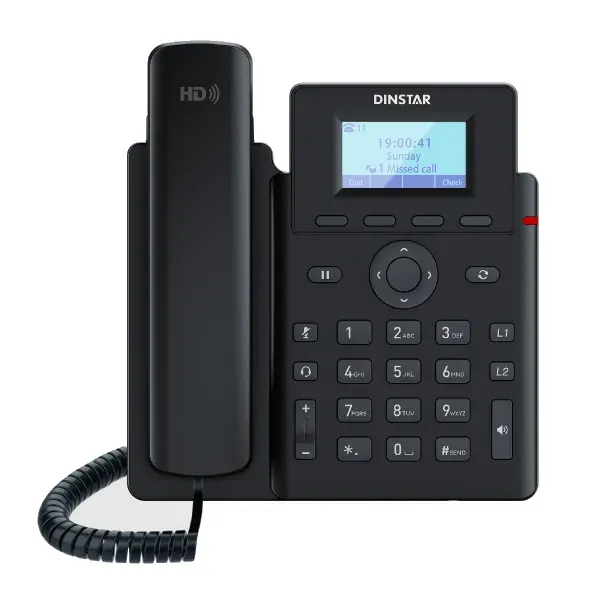
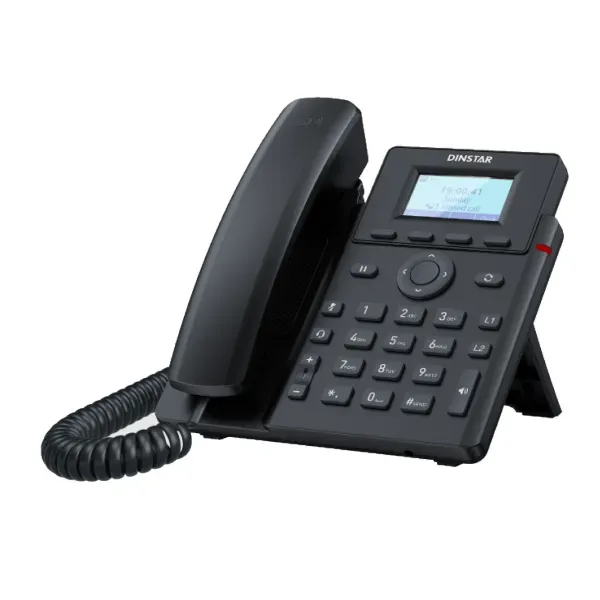
Dinstar G100 Business IP Phone
The Dinstar G100 is an entry-level business IP phone built for organizations that want clear SIP calling, straightforward day-to-day operation and practical integration with modern IP PBX platforms. It supports two SIP accounts, two line keys, a 132×64-pixel backlit graphical LCD, dual 10/100/1000 Mbps Ethernet ports, HD voice, 5-way audio conferencing and EHS wireless headset support. For businesses planning a new VoIP deployment or replacing older desk phones, the G100 provides a focused feature set without adding unnecessary complexity.
What is the Dinstar G100?
The Dinstar G100 is a business-focused SIP desk phone in Dinstar’s G100 Series. Dinstar positions the G100/G100P family as an entry-level enterprise IP phone range for use with IP voice systems. The phone combines a compact monochrome backlit display with two SIP accounts, two line keys and a set of common call-control functions such as hold, mute, do-not-disturb, call waiting, forwarding, redial, blind transfer and attended transfer. Its full-duplex speakerphone, digital signal processing and wideband codec support are intended to provide clearer day-to-day voice communication than basic narrowband desk-phone deployments.
A key procurement detail is the difference between the G100 and G100P. The standard G100 is powered by an external 5 V DC adapter and does not include PoE support. The G100P supports IEEE 802.3af Power over Ethernet, with an external adapter optional. Buyers should therefore confirm whether their switching environment is PoE-enabled and whether they specifically require the G100P rather than the base G100. This distinction matters in multi-desk projects because a PoE design can simplify desktop power cabling and can allow the phone system to benefit from centralized UPS-backed switching, while adapter-powered phones need accessible mains power at each desk.
HD audio
The G100 Series supports HD voice, full-duplex speaker operation and wideband codecs including G.722 and OPUS-WB. Echo cancellation, dynamic jitter handling, voice activity detection and comfort noise generation help support consistent voice quality when the network is properly configured.
Two SIP accounts
Two SIP accounts suit everyday office roles where a user needs a primary extension plus a second account, service identity or alternate registration. The two physical line keys keep routine call handling simple for users who do not need a large multi-line console.
Gigabit pass-through
Dual 10/100/1000 Mbps Ethernet ports allow the phone to sit between the wall network point and a nearby computer. This is useful where a desk has one structured-cabling outlet, provided the LAN design and VLAN policy are planned correctly.
Centralized provisioning
Dinstar lists FTP, TFTP, HTTP, HTTPS and PnP provisioning options, web-based configuration, firmware upgrades and NMS management support. These tools are valuable when multiple handsets need consistent extension, network and feature settings.
Verified Dinstar G100 technical highlights
| SIP accounts | 2 | Line keys | 2 |
| Display | 132×64 pixel backlit graphical LCD | Ethernet | 2 × RJ45 10/100/1000 Mbps |
| Conference | Up to 5-way audio conference | Audio | HD voice, full-duplex speaker, G.722 and OPUS-WB |
| Headset | EHS wireless headset support for listed third-party brands | Security | SIP over TLS, SRTP, 802.1X and OpenVPN support |
| G100 power | 5 V DC power adapter | G100P power | IEEE 802.3af PoE or optional adapter |
Compatibility and deployment planning
Dinstar’s current G100 documentation lists compatibility with platforms including 3CX, Asterisk, Yeastar, Xorcom, VoIP.ms, BroadSoft and FreeSWITCH, in addition to Dinstar UC and IP PBX systems. Compatibility statements are useful, but production deployment should still be validated against the exact PBX version, SIP trunk design, desired feature set and provisioning method. Functions such as BLF behavior, directory integration, codec preferences, transfer workflows, voicemail signaling and security policies can vary between PBX platforms and service-provider profiles.
Before a business purchases dozens of endpoints, a pilot handset should be registered to the intended PBX and tested for inbound and outbound calling, transfer, hold, conference, voicemail indication, caller ID, emergency dialing policy and any local extension plan. Network checks should include DHCP behavior, voice VLAN assignment, DNS and NTP, firewall traversal, QoS and the availability of stable upstream connectivity. Where remote provisioning is used, HTTPS and controlled administrative access should be preferred over insecure exposure of the device-management interface.
For broader telephony planning, FourTeck’s Tanzania business technology solutions cover IP phones, IP PBX, switching, Wi-Fi, structured cabling and related infrastructure. Multi-country teams can also reference FourTeck Uganda, FourTeck Kenya, FourTeck UAE and the specialist IP phone solutions site when standardizing voice endpoints across offices.
Who should consider the Dinstar G100?
The G100 is best suited to business users who need reliable everyday calling rather than a large color display or a high number of programmable keys. General office staff, finance teams, branch users, support desks with moderate call volume, administrative teams, classrooms, clinic desks, retail back offices and shared work areas may all fit the profile. Its two SIP accounts provide more flexibility than a single-account handset without turning the endpoint into a complex executive console.
Organizations with heavy receptionist traffic, many monitored extensions or frequent one-touch line selection should compare the G100 with higher models in the Dinstar range that offer more accounts, larger displays and more programmable keys. Likewise, deployments that specifically require integrated Wi-Fi, 4G connectivity or other specialized network options should evaluate the corresponding G100 Series variants rather than assuming those capabilities exist in the standard G100. The purchasing objective should be to match each user role to the simplest endpoint that fully supports the required workflow.
Dinstar G100 Business IP Phone Tanzania
For Tanzanian businesses, the Dinstar G100 can serve as a practical endpoint in new IP telephony deployments, branch upgrades and phased migration away from older analog desk phones. The most important procurement question is not simply whether the handset can make SIP calls, but whether it fits the complete communications environment. A Tanzania deployment may involve an on-premises IP PBX, a hosted PBX, SIP trunks, remote extensions, a voice VLAN and a mixed fleet of phones for different user roles. The G100’s two SIP accounts make it a sensible option for standard users who need a primary business extension plus an additional registration or alternate service profile.
Network readiness should be assessed before bulk installation. Voice performance depends on latency, jitter, packet loss and prioritization, so a fast internet connection alone does not guarantee good calls. Businesses should verify switching capacity, VLAN design, uplink congestion, firewall handling and internet resilience. The dual Gigabit Ethernet ports can reduce the need for a second data outlet at a desk because a computer can connect through the phone, but the switch configuration must support the required data and voice segmentation. Where centralized power is preferred, specify the G100P rather than the base G100 so IEEE 802.3af PoE can be used.
For procurement teams requesting a Tanzania quotation, useful information includes the quantity of phones, PBX brand and version, whether PoE is required, whether EHS wireless headsets will be used, the number of offices or branches, preferred provisioning method and any requirement for secure remote extensions. This information helps avoid mismatched accessories or unnecessary features. Businesses replacing an existing phone fleet should also document extension numbers, user names, VLAN settings and any special speed-dial or transfer functions before migration. A controlled pilot with a small number of endpoints can confirm compatibility and user acceptance before a larger rollout.
The G100 is therefore most attractive where simplicity, HD audio, Gigabit desk connectivity and core SIP features matter more than a color display or numerous programmable keys. Tanzania organizations can use it as part of a standardized voice endpoint strategy, with higher-feature models reserved for reception, management or high-volume calling roles. This role-based approach keeps the deployment easier to support while giving each user the functionality they actually need.
Dinstar G100 Business IP Phone Dar es Salaam
Dar es Salaam offices often combine headquarters functions, customer service, logistics, finance and sales teams in environments where telephone availability remains important alongside email, messaging and video collaboration. The Dinstar G100 suits organizations that want a consistent SIP desk phone for ordinary users without equipping every desk with a high-end executive model. Its two SIP accounts, HD voice capability and familiar physical call-control keys can support routine extension use while keeping training requirements modest for employees moving from traditional office telephones.
In larger Dar es Salaam sites, network design has a direct effect on call quality. Voice handsets may share switching infrastructure with computers, printers, wireless access points, cameras and cloud applications. The correct approach is to identify expected simultaneous call volume, establish a voice VLAN where appropriate, enable suitable QoS policies and ensure firewall rules do not introduce avoidable SIP or RTP problems. If a desk has only one network outlet, the phone’s dual Gigabit Ethernet interfaces can allow the PC to connect through the handset, preserving wired desktop access without an unmanaged mini-switch under the desk.
Power design should be decided before ordering. The standard G100 relies on an external adapter, which can be perfectly suitable for small offices or sites where PoE switching is not available. For a centralized enterprise design, the G100P may be preferable because IEEE 802.3af PoE allows power to be delivered from the network switch. When the switch and PBX are connected to a correctly sized UPS, PoE can also support more orderly resilience during short power interruptions. The purchase request should therefore state whether the requirement is G100 or G100P rather than treating the model names as interchangeable.
Dar es Salaam procurement teams should also consider headset users. Dinstar lists EHS compatibility with selected Plantronics, Jabra and Sennheiser wireless headsets, which can be valuable for employees who need to move while speaking. Exact headset and EHS-cable compatibility should be checked before quantity purchase. For reception or contact-center roles that need many monitored extensions, a more advanced phone may be more appropriate. The G100 is strongest as a standard business endpoint in a larger, well-designed IP telephony environment.
Dinstar G100 Business IP Phone Mwanza
Businesses in Mwanza considering VoIP can use the Dinstar G100 as a straightforward office phone for branch administration, customer communication, sales support and internal extensions. The phone’s value is its focused design: two SIP accounts, two line keys, a backlit graphical display, HD audio and dual Gigabit Ethernet. That combination is suitable for users who need a dependable desk endpoint but do not require the complexity or higher cost associated with large color displays, dozens of programmable keys or multi-page executive phone interfaces.
For a Mwanza branch linked to a central PBX in another city or country, the WAN path becomes part of the voice system. IT teams should test round-trip latency, jitter and packet loss during busy periods, not only during an idle network test. Bandwidth should be reserved or prioritized when voice competes with cloud backups, large file transfers, video meetings or CCTV traffic. A well-configured G100 cannot compensate for a congested or unstable network path, so network troubleshooting and voice endpoint deployment should be treated as one project rather than separate purchases.
The phone supports common enterprise protocols and management methods, including HTTP/HTTPS configuration, provisioning over several standard transfer methods and network features such as LLDP and 802.1X. These capabilities make it easier to standardize a branch when central IT wants predictable settings across multiple phones. A naming convention for extensions, device records, switch ports and user assignments can reduce support time later. Configuration backups and controlled firmware management are also useful practices when the business expects the phone fleet to remain in service for several years.
A Mwanza quotation should specify whether the site needs the adapter-powered G100 or PoE-enabled G100P, the target PBX, extension quantity and any headset requirement. Businesses with seasonal staffing, multiple counters or changing desk assignments may also want to define a provisioning process that allows phones to be reassigned cleanly. The G100 works best when it is treated as part of a documented voice platform with tested calling, clear network ownership and a repeatable support procedure.
Dinstar G100 Business IP Phone Arusha
Arusha businesses in tourism, professional services, education, hospitality administration and multi-site operations often need dependable voice communication between front offices, reservations, back-office teams and external callers. The Dinstar G100 can be a good fit for standard desks where employees need a reliable SIP extension and clear audio rather than an advanced touchscreen endpoint. Two SIP accounts allow a user to maintain more than one registration, while 5-way audio conferencing can support small ad-hoc discussions without requiring every internal conversation to move immediately to a separate meeting platform.
For hospitality-related deployments, the G100 should be assessed specifically for office and administrative roles rather than assumed to be a guest-room hotel phone. Dinstar offers other products for hotel use, and the right device depends on the workflow. In a reservation office or management department, the G100’s EHS headset support, Gigabit Ethernet and standard SIP capabilities may be useful. In a guest room, requirements such as simplified labeling, service keys and hospitality-specific design can point to a different endpoint class.
Arusha sites with distributed buildings or departments should review switching and cabling before deployment. Structured cabling should provide stable Ethernet to each phone location, and network switches should have sufficient port capacity. If G100P handsets are selected, the total PoE budget of the switch must be checked rather than assuming every port can deliver full power simultaneously. A voice VLAN, LLDP policy and DHCP design can simplify deployment where the network infrastructure supports them. Time synchronization, DNS and secure PBX reachability should also be tested before user acceptance.
For purchasing, businesses should provide the planned phone count, user roles, PBX platform, power preference and whether phones will be centrally provisioned. If some departments need many line appearances or BLF keys, it can be more cost-effective to mix G100 units for general users with more capable models for reception and supervisors. The objective is a balanced phone fleet that remains easy to manage, rather than forcing one device specification onto every desk regardless of actual use.
Dinstar G100 Business IP Phone Dodoma
Organizations in Dodoma that are modernizing office communications can consider the Dinstar G100 for everyday SIP calling across administrative departments, project offices, education environments, professional firms and branch operations. The phone’s two-account design supports typical extension requirements while avoiding an unnecessarily complicated interface. The backlit monochrome display provides call and menu information, and physical line, mute, speaker, headset and navigation controls make the handset approachable for users who prefer conventional desk-phone operation.
A Dodoma deployment should begin with a call-flow design. The PBX should define how external numbers reach departments, how unanswered calls are handled, which users require voicemail, whether calls can be forwarded externally and what happens outside business hours. Once those policies are clear, the G100 can be configured consistently for users. Features such as call waiting, call forward, attended and blind transfer, hold and do-not-disturb are most effective when employees understand the organization’s preferred workflow and the PBX is configured to support it.
Security also matters. Dinstar lists SIP over TLS, SRTP, 802.1X and OpenVPN support among the G100 Series capabilities. Their usefulness depends on the PBX and network design, but they provide options for organizations that want encrypted signaling, encrypted media or controlled network access. Administrators should change default credentials, limit management access, use secure provisioning where possible and avoid exposing phone web interfaces directly to the public internet. Firmware management and configuration backup should be included in the operational plan rather than left until a problem occurs.
When requesting pricing in Dodoma, the buyer should distinguish between device price and complete deployment cost. A successful project may also involve PoE switching, cabling, PBX licensing, SIP trunk configuration, headset accessories, UPS capacity and installation services. The standard G100 does not use PoE, while the G100P does, so power architecture must be part of the bill of materials. Clear planning at quotation stage helps prevent later changes and ensures that the selected phone is matched to the site instead of purchased as an isolated device.
Dinstar G100 Business IP Phone UAE
For UAE businesses, the Dinstar G100 can fit branch offices, general staff desks, back-office operations and cost-sensitive extension deployments where the requirement centers on reliable SIP calling rather than premium executive-phone features. Enterprises with offices in both the UAE and East Africa may also value the ability to standardize a basic endpoint profile across multiple locations. A common phone model can simplify user training and support, provided each local PBX, SIP trunk and network environment has been tested for compatibility.
The UAE market includes many hosted PBX and SIP service options, so businesses should confirm service-provider requirements before purchasing. Registration parameters, outbound proxy settings, NAT handling, codec policies and emergency calling requirements can vary. The G100 supports standard SIP protocols and a broad set of codecs, but the deployed configuration must match the service actually used. A small pilot should verify call setup, DTMF behavior, transfers, voicemail indication and audio quality before a large quantity is rolled out.
PoE is common in structured enterprise networks, making the G100P particularly relevant where phones are expected to receive both data and power from managed switches. The base G100 remains suitable where adapters are preferred or existing switching does not provide PoE. In either case, dual Gigabit Ethernet can help preserve wired connectivity for a co-located computer. Network administrators should configure voice VLANs and QoS according to the site design and avoid relying on the phone alone to solve congestion problems.
For multi-country organizations, a standardized procurement sheet can capture model, firmware policy, extension format, language, time zone, VLAN, provisioning URL and PBX server settings. That approach makes it easier to deploy the same endpoint in Dubai, Abu Dhabi, Tanzania, Uganda or Kenya without rebuilding the process from scratch. The G100 is best considered the standard-user device in such a framework, while receptionists, executives and contact-center staff may require models with more keys, screens or accessory options.
Dinstar G100 Business IP Phone Uganda
Ugandan businesses can use the Dinstar G100 as a standardized SIP endpoint for offices, branches and support teams that need clear everyday voice communication. The phone’s two SIP registrations are sufficient for many general users, while the full-duplex speakerphone and HD voice support provide a more flexible calling experience than a basic analog handset. Because the phone is standards-based, it can be evaluated with a range of IP PBX platforms rather than tying the business to a single proprietary telephone ecosystem.
When deploying phones across multiple Ugandan sites, central provisioning becomes important. Instead of manually programming every device, IT teams can prepare consistent templates for account settings, time, network behavior and user features. Dinstar supports several provisioning protocols and web-based management, helping administrators reduce configuration drift. Device records should still be maintained so a phone’s user, extension, MAC address, site and switch port are known. This becomes especially valuable during moves, replacements and troubleshooting.
WAN quality between branches and the PBX should be measured. If a central system is hosted in Kampala while users are in regional offices, voice packets depend on the stability of the inter-site path. QoS, internet failover and bandwidth management may matter more than the brand of handset. Sites carrying video surveillance or large cloud synchronization traffic on the same links should be assessed during peak usage. The G100 can perform well on a properly engineered network, but no endpoint can remove packet loss caused by an overloaded connection.
Uganda buyers should also decide between adapter and PoE power. The base G100 uses an external adapter, while G100P adds IEEE 802.3af PoE. A PoE strategy can simplify desks and support centralized UPS protection, but only if the switches have sufficient PoE budget. Quotations should therefore include switch model, available PoE capacity and expected endpoint count where relevant. This prevents a common deployment problem in which the phones support PoE but the infrastructure cannot power the full fleet reliably.
Dinstar G100 Business IP Phone Kampala
Kampala organizations often operate busy headquarters environments where voice endpoints need to coexist with Wi-Fi, business applications, cameras and cloud services on shared network infrastructure. The Dinstar G100 is suitable for standard employees who need two SIP accounts, a simple display, HD audio and conventional call controls. It can be deployed as part of a larger IP PBX solution that uses more advanced phones only for roles requiring many programmable keys or a richer screen.
A Kampala office rolling out a large quantity of G100 phones should treat switching as part of the telephony project. Each desk requires an Ethernet path, and the dual Gigabit interfaces allow the phone and computer to share one wall outlet when the network design supports that topology. Managed switches can assign voice and data to different VLANs, prioritize RTP traffic and provide visibility when troubleshooting. If the G100P version is selected, switch PoE capacity must be calculated across all endpoints rather than assessed one port at a time.
For call-intensive teams, headset planning is worth including in the pilot. Dinstar states that the G100 Series supports EHS wireless headsets from named major brands, but the exact headset model and cable should be verified before purchase. Users should test answer/end-call behavior, comfort and audio level under real working conditions. General office staff may prefer a conventional wired headset, while mobile support or sales users may benefit from wireless freedom.
Procurement teams in Kampala should request a quote that separates handset quantity, power method, accessories, PBX configuration and network work. This makes comparisons more meaningful than a device-only price. If the organization is migrating from analog extensions, numbering, inbound routes, fax dependencies, door phones and other legacy services should be inventoried before cutover. The G100 can be an effective standard endpoint, but successful migration depends on understanding everything that the old telephone system currently supports.
Dinstar G100 Business IP Phone Arua
For organizations in Arua, the Dinstar G100 offers a practical path to standardized SIP desk calling where users need familiar phone operation and a modest feature set. Branch offices, clinics, education facilities, NGOs, service organizations and commercial operations can use the handset for normal extension calling, transfers, hold, voicemail indication and conference functions when these features are supported by the chosen PBX. The two-account design is especially useful where a user needs a secondary identity without requiring a larger multi-line phone.
Connectivity planning may be particularly important for sites that depend on an internet-hosted PBX or a central system located in another city. The business should assess link stability across the working day and consider how voice will behave during periods of high utilization. QoS can prioritize voice inside the local network, while internet resilience and secondary links may reduce disruption when external connectivity fails. If reliable voice is operationally critical, failover design should be discussed before deployment rather than after the first outage.
Local power and infrastructure choices also affect the handset strategy. The adapter-powered G100 can operate without a PoE switch, which may suit smaller branch environments. The G100P is better aligned with managed PoE networks where centralized power and cleaner desktop cabling are priorities. In either case, UPS protection for network switching, routers and PBX equipment is more important than protecting the phone alone because an IP handset cannot make calls if the network path is unavailable.
Arua buyers should prepare extension lists, user roles, PBX details and device quantities before requesting a quotation. If the branch is part of a national organization, a standard configuration template can make support easier across locations. The same template can define codec order, time settings, contacts, voicemail access, security options and provisioning. This turns the G100 from a standalone desk device into a manageable component of a repeatable enterprise voice architecture.
Dinstar G100 Business IP Phone Mbarara
Mbarara businesses evaluating IP telephony can use the Dinstar G100 for staff who need core business calling functions without premium endpoint features. The handset supports two SIP accounts and common operations such as hold, forward, transfer, redial, do-not-disturb and call waiting. The 132×64-pixel backlit screen keeps menus and call information visible without the added cost and power requirements associated with larger color displays. This makes the G100 a sensible candidate for fleet deployments where many users share a similar calling profile.
The phone’s dual Gigabit Ethernet ports are particularly useful in offices where structured cabling has one outlet per desk. A workstation can be connected through the phone, preserving Gigabit capability to the endpoint. IT teams should still review VLAN behavior, switchport configuration and security policy so data and voice are separated appropriately. Where 802.1X is used for network access control, the handset’s support should be tested against the actual authentication design rather than assumed to be plug-and-play in every environment.
For businesses with several branches, the G100 can fit a consistent endpoint strategy. A centrally managed PBX can use common extension conventions and provisioning profiles, while local networks provide the required transport. Administrators should document firmware versions and avoid unmanaged variation between sites. Planned updates can then be tested on a small set of phones before wider rollout. This reduces the chance that a firmware change affects calling features across the entire organization at once.
A complete Mbarara quotation should identify phone quantity, whether PoE is required, any headset accessories and the intended PBX or SIP provider. It should also note whether configuration, installation and user handover are needed. Device price alone does not capture the work required to produce a dependable phone system. When the endpoint, network and PBX are designed together, the G100 can provide a clean, repeatable desk-phone experience that is easier for both users and IT staff to manage.
Dinstar G100 Business IP Phone Gulu
In Gulu, the Dinstar G100 can support businesses and institutions that want to move to SIP calling while keeping the desktop experience simple. Two SIP accounts provide flexibility for general office users, and the physical keypad and dedicated controls reduce dependence on touchscreen navigation. HD voice support and full-duplex speaker operation can improve clarity when the PBX and network use compatible codecs and the connection has sufficiently low packet loss and jitter.
Organizations with remote or distributed users should decide where the PBX will be hosted. A local appliance can keep internal extension traffic on the LAN, while a hosted service can simplify some infrastructure requirements but depends more heavily on internet availability. Either approach can work with standards-based SIP phones, but the network design, security model and failover plan differ. The G100 should therefore be selected after the voice architecture is understood, not before.
The phone’s management capabilities can help IT teams support multiple handsets without visiting every desk for every change. Web configuration, auto provisioning and configuration backup make it possible to standardize settings. Administrative access should be protected with unique credentials and secure protocols. Where the organization uses a central NMS or provisioning server, devices should be enrolled according to a documented process so replacement phones can be prepared quickly when needed.
For Gulu procurement, buyers should consider the lifecycle of the deployment. Spare units, approved firmware, documented configuration and an extension inventory can be more valuable than buying only the exact number of phones needed on day one. Expansion plans should be included in switch and PBX sizing. If PoE will be used, select G100P and verify IEEE 802.3af capacity across the switching layer. If adapters are preferred, ensure suitable desk power is available. These decisions make deployment smoother and reduce avoidable support calls later.
Dinstar G100 Business IP Phone Kenya
Kenyan businesses can consider the Dinstar G100 for ordinary extension users in offices, branches, retail administration, clinics, schools and service environments. The handset’s feature set is intentionally focused: two SIP accounts, two line keys, HD audio, dual Gigabit Ethernet, 5-way conferencing and common call controls. This makes it easier to deploy a consistent phone to many users while reserving more advanced models for roles that genuinely need additional keys, accounts, expansion modules or larger screens.
In Nairobi and other connected business centers, hosted PBX services are common options alongside on-premises systems. The G100’s standards-based SIP support can fit either architecture, but service compatibility should be confirmed through testing. Network address translation, SIP ALG behavior, TLS requirements and codec policies can affect registration and media. A phone that works correctly on one provider profile may need different settings on another, so pilot testing is the safest approach before a bulk purchase.
Multi-branch Kenyan deployments benefit from standardized provisioning. IT teams can prepare templates for user accounts, VLAN settings, NTP, directory access and security policies. Dinstar’s supported provisioning methods make it possible to apply repeatable configurations instead of setting every handset manually. The process should include a rollback or replacement plan, because operational simplicity is one of the main reasons to standardize endpoint models in the first place.
When comparing quotation options, buyers should check whether the offered model is the G100 or G100P, because power capabilities differ. If the site already has managed PoE switches, G100P can simplify power at the desk. If not, the G100 with adapter may avoid a switching upgrade where other requirements are modest. Headset requirements, PBX integration, configuration and support should be specified separately. A transparent bill of materials allows procurement teams to compare complete solutions rather than handset prices that omit necessary infrastructure.
Dinstar G100 Business IP Phone Kuwait
Kuwait organizations looking for a straightforward SIP desk phone can use the Dinstar G100 as a standard-user endpoint within a larger business communications platform. Its two SIP accounts are suitable for routine extension use, while Gigabit Ethernet prevents the phone from becoming a bottleneck for a connected workstation. HD voice, full-duplex speakerphone operation and broad codec support provide a solid technical base for clear calls when the PBX and network are configured correctly.
Enterprise buyers should consider the G100 as one layer of the solution. The PBX controls extensions and call routing, SIP trunks connect external calling, switches transport voice on the LAN and firewalls govern traffic at network boundaries. The handset can support TLS and SRTP, but encryption must also be enabled and supported on the PBX side. Good security therefore requires coordinated settings across the endpoint, server and network rather than ticking a feature box on the product specification.
The choice between G100 and G100P should reflect the office infrastructure. PoE can simplify large deployments and make it easier to keep phones powered from centrally protected switches. Adapter-powered units may be suitable in smaller offices or specific desk layouts. If PoE is selected, total switch budget, UPS runtime and redundancy should be calculated for the full phone count. This is especially important in projects where access points, cameras and phones all draw power from the same switch stack.
For Kuwait procurement teams managing regional offices, the G100 can also support endpoint standardization across markets. A common configuration standard can define extension numbering, directories, firmware, security and user training. Regional variations can then be handled at the PBX and carrier level while the desktop user experience remains consistent. This approach is valuable for IT departments that support multiple countries and want fewer device types to troubleshoot, stock and document.
Dinstar G100 Business IP Phone Ghana
Ghanaian organizations can deploy the Dinstar G100 where employees require dependable desk-based SIP communication with a simple interface. The device supports two accounts and 5-way conferencing, making it suitable for typical business users who make and receive calls, transfer customers, join short internal conferences and access voicemail. The backlit monochrome LCD keeps the endpoint practical and cost-conscious, which can be important when outfitting many desks at once.
For Accra headquarters and regional branches, endpoint standardization can simplify both deployment and support. A common model allows IT teams to maintain one set of user instructions, approved firmware and configuration templates. The G100 supports auto provisioning through several common methods, so account and network settings can be delivered consistently. A provisioning project should still include security controls, because leaving default credentials unchanged or using unsecured management access can create avoidable risk.
Voice quality should be engineered across the full path. On the LAN, QoS and VLAN design can protect real-time traffic from local congestion. Across the internet or WAN, sufficient bandwidth and a stable service provider are important. Businesses using cloud storage, video conferencing and CCTV across the same connection should test during peak demand. A high-quality handset cannot correct packet loss introduced elsewhere in the path, so troubleshooting should consider switches, routers, firewall, ISP and PBX together.
Ghana buyers should specify power preferences in the quotation. The G100 requires an adapter, whereas G100P supports IEEE 802.3af PoE. For a new structured office, PoE may provide the cleanest design. For an existing small site without PoE switches, the adapter-powered G100 may be more economical. The correct choice depends on total infrastructure cost, not the phone alone. Accessories, headset use, PBX compatibility and any installation requirement should be listed so the final solution can be evaluated accurately.
Dinstar G100 Business IP Phone Nigeria
Nigerian businesses can use the Dinstar G100 as a standard SIP endpoint for office personnel who need a focused set of calling features and reliable wired networking. Two SIP accounts and two line keys support everyday extension use, while dual Gigabit Ethernet makes the phone suitable for modern LANs. Organizations can mix the G100 with higher-end endpoints for reception, executives and supervisors, creating a role-based phone fleet that controls cost without limiting users who genuinely need additional functionality.
Large Lagos, Abuja or multi-state deployments should prioritize provisioning and inventory control. Manually configuring a handful of phones may be manageable, but it becomes inefficient and error-prone at scale. Central templates can standardize PBX addresses, codec order, VLAN parameters, time settings and user functions. Device inventories should map each handset to a site and extension, enabling IT staff to replace or move units without reconstructing undocumented settings.
Power resilience can be a major design consideration in any IP telephony system. If G100P handsets are powered from PoE switches connected to a UPS, the desktop phone may continue operating during short mains interruptions as long as the router, firewall, PBX and WAN path also remain available. Adapter-powered G100 units need their own protected power strategy if continuity is required. The best approach depends on the site, but power should be designed as an end-to-end service rather than handled only at the handset.
A Nigerian quotation should include expected call volume, extension quantity, PBX platform, SIP provider, network topology and user types. High-volume call-center agents may need specialized headsets and additional telephony features, while ordinary staff can often work effectively with the G100. Testing should cover transfer workflows, voicemail, DTMF to IVR systems and any recording or compliance functions delivered by the PBX. Careful pilot validation reduces risk when a large rollout depends on consistent behavior across many users.
Dinstar G100 Business IP Phone Seychelles
Businesses in Seychelles can consider the Dinstar G100 for offices, administration teams, service desks and back-office roles that need dependable SIP calling. Island and hospitality environments often combine local staff with regional support teams, making standards-based IP telephony useful for connecting extensions through centralized or hosted PBX platforms. The G100 provides a compact feature set for ordinary users while allowing more specialized phones to be deployed in reception or high-call-volume roles.
Where a site depends on cloud or remote PBX infrastructure, internet reliability is part of the voice service. Organizations should understand what happens when the primary WAN link fails and whether a secondary path is available. Voice traffic consumes relatively modest bandwidth per call, but it is sensitive to delay and loss. QoS, link monitoring and sensible separation from heavy backup or media traffic can improve consistency. A clear failover strategy is especially important for hotels, service operations and customer-facing businesses that depend on telephone availability.
The G100’s dual Gigabit Ethernet ports can help where desk cabling is limited, allowing a computer and phone to share a single structured network drop. That topology should still be documented so IT teams know which workstation is behind each phone. If the site uses PoE, select the G100P and verify switch capacity. If the base G100 is used, plan for external adapters and adequate protected power. Environmental placement should also be sensible: phones should be kept within their stated operating conditions and away from excessive moisture or heat.
For Seychelles procurement, buyers should describe the complete requirement rather than asking only for a unit price. Useful details include the number of phones, PBX type, user roles, headset needs, PoE preference, provisioning method and whether regional standardization is required. This allows a quotation to account for integration and accessories instead of producing a low device price that omits necessary components. The G100 is strongest when selected as part of a planned voice system with clear network, power and support responsibilities.
Dinstar G100 buying and quotation checklist
List the number of standard users, supervisors, receptionists and shared phones. This helps determine where G100 is appropriate and where a higher-feature model may be better.
Confirm whether external adapters are acceptable or whether IEEE 802.3af PoE is required. Do not assume the base G100 includes PoE.
Provide the PBX platform and version, hosting location and SIP trunk or service-provider details so compatibility and provisioning can be assessed.
Identify voice VLAN, switch type, PoE budget, headset requirements and any need for centralized provisioning, installation or user handover.
Frequently asked questions
Does the Dinstar G100 support PoE?
The base G100 does not support PoE and uses a 5 V DC power adapter. The related G100P model supports IEEE 802.3af PoE. Buyers should specify the exact model required.
How many SIP accounts does the G100 support?
The G100 Series supports two SIP accounts and two line keys, making it suitable for general business users who do not need a large number of simultaneous registrations.
Can the Dinstar G100 work with 3CX or Asterisk?
Dinstar lists compatibility with 3CX, Asterisk, Yeastar, Xorcom, VoIP.ms, BroadSoft and FreeSWITCH among other platforms. Production compatibility should still be tested with the exact PBX version and feature requirements.
Does it have Gigabit Ethernet?
Yes. The G100 Series provides dual 10/100/1000 Mbps Ethernet ports, allowing the phone and a co-located computer to share a single network drop where the LAN design permits it.
Is the G100 suitable for reception?
It can handle normal calls, but receptionists who monitor many extensions or require numerous programmable keys may be better served by a higher model. The G100 is primarily suited to standard business users.
Does the G100 support wireless headsets?
Dinstar lists EHS wireless headset compatibility with Plantronics, Jabra and Sennheiser. The exact headset and EHS cable combination should be verified before procurement.
What should be tested before a bulk deployment?
Test SIP registration, inbound and outbound calling, DTMF, hold, transfer, voicemail indication, conference behavior, codecs, headset operation, VLAN assignment, QoS and the intended provisioning method.
Decision recap
Choose the Dinstar G100 when the requirement is a simple, wired, two-account business SIP phone with HD voice, Gigabit Ethernet, 5-way conferencing and standard enterprise call controls. Choose the G100P when the same functional profile is required with IEEE 802.3af PoE. Consider a higher Dinstar model if the user needs a color display, more SIP accounts or significantly more programmable keys. Before ordering in quantity, confirm PBX compatibility, power method, network readiness, provisioning process and headset requirements.
Consult FourTeck for a Dinstar G100 quotation
For a useful quotation, share the required quantity, deployment city or country, PBX platform, whether PoE is required, any headset needs and whether installation or provisioning is part of the project. FourTeck can then align the handset selection with the wider voice, switching and network requirements rather than treating the phone as an isolated purchase.




Reviews
There are no reviews yet.