
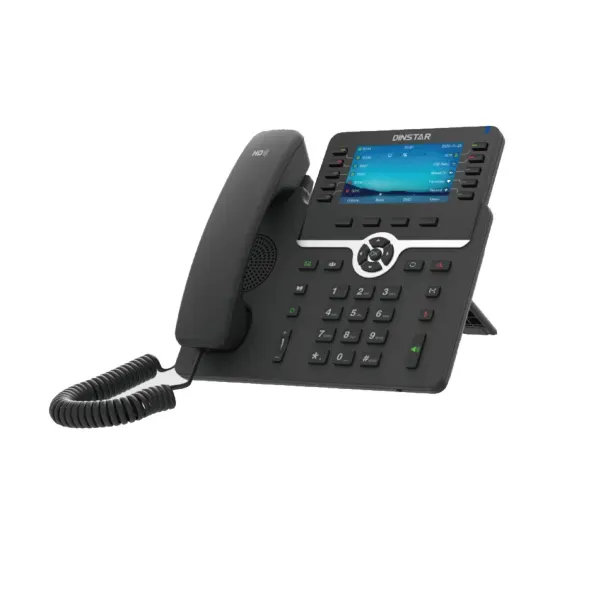
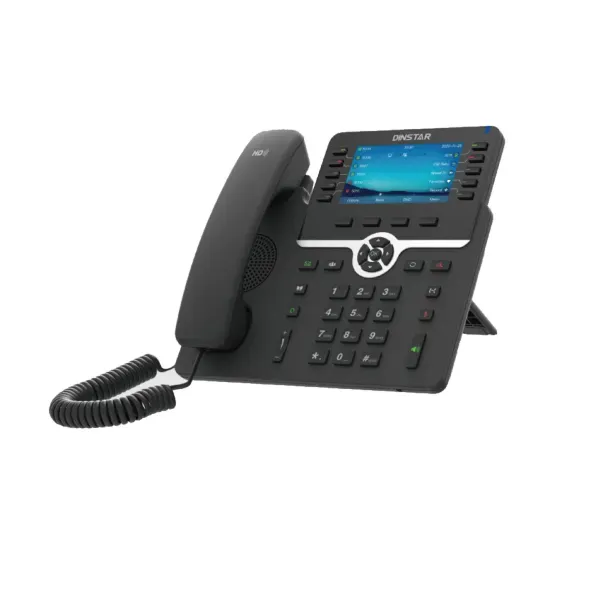
Dinstar C66GP PoE Business IP Phone
The Dinstar C66GP is built for business users who want a feature-rich SIP desk phone without turning everyday calling into a complicated workflow. It combines a 4.3-inch 480 × 272 color display, HD voice, up to 20 SIP accounts, 50 programmable line keys, 6-way conferencing, dual-port Gigabit Ethernet and IEEE 802.3af Power over Ethernet. For organizations in Tanzania planning IP PBX deployments, reception upgrades, branch-office telephony or standardized enterprise endpoints, the C66GP offers a practical blend of visibility, programmability and network-ready deployment.
This page focuses specifically on the C66GP PoE model. Dinstar also lists a C66G variant, but the C66GP is the version with PoE support. Power adapter requirements, PBX interoperability, headset choice, provisioning method and switch PoE budget should still be checked against the exact project before purchase.
Choose the C66GP when your desk users need many SIP identities, programmable keys, a larger color interface, Gigabit pass-through networking, PoE, business headset support and multi-party conferencing in a SIP-based phone system.
What the Dinstar C66GP solves for business users
A business desk phone becomes valuable when it supports the way a user actually handles calls. A receptionist may monitor several extensions and transfer calls continuously. A manager may use multiple SIP accounts, speakerphone conferencing and a headset. A customer-service user may need fast access to hold, transfer, redial, voicemail and presence-related functions. The C66GP is positioned for these more demanding desk roles. Its programmable key capacity gives administrators room to map frequently used functions, while the color display makes multiple accounts and call states easier to distinguish than on a basic monochrome endpoint.
The phone also fits network designs where the desk connection must serve both the phone and a connected computer. Dual Gigabit Ethernet ports allow the handset to sit inline on a Gigabit LAN without forcing the workstation onto a 100 Mbps link. PoE simplifies the physical installation by allowing a compatible IEEE 802.3af switch to deliver power over the Ethernet cable. That does not eliminate the need for infrastructure planning: the switch must have enough available PoE budget, voice VLANs and Quality of Service should be configured deliberately, and UPS protection is worth considering when organizations want phones to remain available during short power interruptions.
Useful for users who handle several identities, departments, branches or service lines from one desk endpoint.
Provides extensive programmable access for line appearances and one-touch business functions such as speed dial or BLF where supported.
The C66GP supports IEEE 802.3af PoE and dual 10/100/1000 Mbps Ethernet ports for voice-ready business LAN deployments.
Supports multi-party audio conversations directly from the phone, subject to the call environment and PBX configuration.
Verified Dinstar C66GP specifications
The following points are based on Dinstar’s current C66 product page, official C66G/C66GP datasheet and quick guide. They are presented as model facts rather than estimates. Where deployment depends on PBX licensing, network design or optional accessories, those project dependencies are identified separately.
| Display | 4.3-inch color graphical LCD, 480 × 272 pixels, backlight |
|---|---|
| SIP accounts | Up to 20 |
| Programmable capacity | 50 line keys, plus soft and function keys |
| Conference | 6-way audio conferencing |
| Ethernet | 2 × RJ45 10/100/1000 Mbps Gigabit Ethernet ports |
| Power | IEEE 802.3af Power over Ethernet; 5V DC input is also listed, with adapter optional for C66GP |
| Audio | HD voice, full-duplex speakerphone, wideband codecs including G.722 and OPUS-WB |
| USB | USB 2.0 port |
| Headsets | RJ9 headset connection and third-party EHS wireless-headset support listed for Plantronics, Jabra and Sennheiser |
| Provisioning | FTP/TFTP/HTTP/HTTPS/PnP auto provisioning, web configuration and Dinstar management options |
| Security | SIP over TLS, SRTP, HTTPS management and related IP security protocols listed by Dinstar |
IP PBX compatibility and integration planning
Dinstar lists compatibility with a range of SIP platforms, including Dinstar UC/IP PBX products and third-party systems such as 3CX, Asterisk, Yeastar, Xorcom, VoIP.ms, BroadSoft and FreeSWITCH in its C66 documentation. That is a useful starting point, but a purchase decision should still consider the exact PBX version, required features and provisioning method. Basic SIP registration is only one layer of compatibility. Busy Lamp Field behavior, directory integration, voicemail indications, multicast paging, call pickup, remote phonebooks, LDAP, firmware management and EHS headset functions can depend on how the PBX and phone profiles are configured.
For organizations replacing an existing fleet, begin by documenting the current extension numbering, SIP credentials, VLAN configuration, DHCP options, QoS policies, directory source, call-flow logic and any reception monitoring requirements. Then map those needs to the C66GP rather than assuming that every setting transfers automatically. Where phones are deployed in volume, auto provisioning should be prepared before rollout. A repeatable template reduces manual mistakes, speeds replacement of failed units and gives administrators a consistent baseline for security and user features.
FourTeck Tanzania’s broader IT, telecom and infrastructure services can be relevant when the phone project includes PBX configuration, switching, VLAN design, structured cabling or other integration work. Customers comparing multiple endpoint families can also use the FourTeck Tanzania business technology shop as a procurement starting point rather than treating the handset as an isolated device.
PoE, switching and deployment considerations
The C66GP’s PoE capability can simplify desks by removing a separate power adapter, but the network must be designed to support that convenience. Count every PoE endpoint on the switch and check total available wattage, not only the number of PoE-capable ports. A switch may have enough physical ports yet an insufficient power budget when phones, wireless access points, cameras and other powered devices share the same hardware. Uplink capacity, VLAN support and switch management are equally important when a site carries data, voice and other IP services across the same infrastructure.
Voice traffic should normally be treated as a planned service. Organizations can use dedicated voice VLANs, DHCP options and QoS policies where their switching and PBX architecture supports them. Stable DNS, NTP and DHCP services improve operational consistency. Firewalls and SIP trunks must be configured carefully to avoid one-way audio, registration failures and unnecessary exposure. Remote management should use secure protocols and controlled administrator access. The phone supports SIP over TLS and SRTP, but encryption has to be supported and configured across the wider call path if the organization wants encrypted signaling and media.
For network preparation, FourTeck Tanzania’s integrated technology planning overview explains how IP phones relate to PoE switches, VLANs, structured cabling, internet links and power resilience. For broader regional IP-telephony research, the specialist FourTeck IP phone resource can provide additional context about business desk-phone selection and VoIP deployment.
Who should consider the C66GP?
High key capacity can support monitored extensions, speed dials and frequently used transfer destinations, making the phone relevant where one user handles many incoming calls.
The larger color interface, multiple SIP accounts, speakerphone conferencing and headset options suit users who manage calls across teams, business units or locations.
Teams that repeatedly use hold, transfer, voicemail, pickup, directories and programmable functions can benefit from a more capable endpoint than a basic two-line handset.
The C66GP is not automatically the best endpoint for every desk. A simple extension that only places and receives occasional calls may be better served by a lower-cost model with fewer keys. Conversely, a very high-volume attendant position may need an expansion module or a dedicated software console. Good procurement separates users into profiles and chooses endpoints according to real call behavior. The FourTeck Tanzania company and solution approach emphasizes this integrated, requirements-first method rather than selecting equipment in isolation.
Regional procurement and deployment guidance
The C66GP is a standards-based SIP endpoint, so the core model does not change by city. What does change is the surrounding project: available switching, internet links, PBX architecture, branch connectivity, power resilience, procurement process, support expectations and the number of users being standardized. The following location sections therefore focus on materially different buying and deployment questions rather than repeating the same sales paragraph with a different place name.
Dinstar C66GP PoE Business IP Phone Tanzania
Businesses evaluating the Dinstar C66GP in Tanzania should start by defining the voice environment around the handset. The model’s 20 SIP accounts, 50 line keys, Gigabit Ethernet and PoE make it particularly relevant to organizations that are standardizing IP telephony across departments or moving beyond basic analog handsets. A Tanzania deployment may involve a local IP PBX, a hosted SIP platform, branch-to-branch calling or a combination of on-premises and cloud services. Before ordering, confirm extension count, user profiles, reception requirements, SIP trunk arrangements and whether the existing switches provide enough IEEE 802.3af PoE capacity. This creates a realistic bill of materials and avoids discovering after delivery that extra switches, adapters or cabling work are required.
For multi-site organizations, standardization can be more valuable than simply choosing a feature-rich phone. A common provisioning template, naming convention, voice VLAN, firmware baseline and directory structure makes support easier across offices. The C66GP supports auto provisioning over FTP, TFTP, HTTP, HTTPS and PnP, so administrators can prepare repeatable settings instead of programming every phone manually. Security should be treated in the same way. SIP over TLS and SRTP are supported by the handset, but organizations should verify end-to-end compatibility with the PBX and provider before presenting encrypted calling as a completed requirement.
Tanzania buyers should also include practical operating conditions in the quotation request. Ask whether phones will sit on UPS-backed PoE switches, whether desktops will pass through the phone’s Gigabit port, whether a headset is needed, and whether remote offices rely on WAN links with variable latency. A technically correct phone can still deliver a poor user experience when the LAN is congested or the internet route is unstable. Procurement should therefore cover the endpoint, PBX, network readiness, cabling, power and support workflow as one project. FourTeck’s Tanzania contact process is designed to collect these details so the model can be evaluated against the actual site rather than sold as a generic desk accessory.
Dinstar C66GP PoE Business IP Phone Dar es Salaam
In Dar es Salaam, the C66GP is well suited to offices where reception, sales, logistics, finance or customer-service users need a richer desk-phone interface than basic SIP endpoints provide. The city’s larger commercial sites often combine voice with managed switching, Wi-Fi, CCTV and business applications on shared network infrastructure, so the phone purchase should be connected to LAN design. Dual Gigabit Ethernet allows a workstation to share the desk connection without forcing traffic through a slower Fast Ethernet port. PoE reduces local power clutter, but the switch must have sufficient wattage for the entire endpoint population and should be protected by appropriate UPS capacity if call availability during short power interruptions matters to the business.
For a new office fit-out, it is useful to classify desk roles before ordering. Reception may need more monitored extensions and quick transfers; management may need multiple SIP identities and conferencing; general staff may need fewer keys. This prevents over-specifying every extension while still using the C66GP where its programmable capacity creates operational value. If a site already uses 3CX, Asterisk, Yeastar, Dinstar or another SIP platform, confirm the exact firmware and feature profile before rollout. Registration can be straightforward while advanced features such as BLF, remote phonebooks, pickup groups or EHS headset control still require model-specific provisioning.
Dar es Salaam projects may also involve several floors, warehouses or adjacent buildings. In these cases, voice VLANs, fiber uplinks between communications rooms, switch redundancy and cabling documentation can matter as much as the handset. Businesses should request a quotation that distinguishes device supply from configuration, installation, training and ongoing support. That separation makes commercial comparison clearer and ensures each dependency has an owner. Where the C66GP is being added to an existing voice system, sharing the PBX model, number of extensions, switch models, current VLAN design and preferred headset can significantly improve the accuracy of the recommendation.
Dinstar C66GP PoE Business IP Phone Mwanza
Mwanza organizations considering the C66GP may include regional offices, trading businesses, healthcare facilities, education sites, hospitality operations and distribution teams that need dependable desk communications. In these environments, the most useful question is whether the phone is being deployed as a standalone replacement or as part of a broader voice modernization. If the organization is moving from analog extensions to SIP, the project may require PoE switching, IP PBX configuration, extension planning and staff orientation in addition to phones. The C66GP’s programmable keys and multiple SIP accounts become especially useful when users handle departmental numbers or need direct access to frequently called colleagues.
Connectivity should be assessed carefully where branches depend on centralized PBX services hosted elsewhere. WAN quality, latency, jitter, packet loss and firewall behavior can directly affect audio even when the handset itself is functioning correctly. The C66GP supports HD voice and modern codecs, but codec selection and call quality still depend on the PBX and network path. Organizations can reduce support problems by documenting network addressing, voice VLANs, switch ports and provisioning URLs before deployment. Central configuration also allows a replacement handset to inherit a known profile rather than being manually rebuilt from memory.
For procurement in Mwanza, ask for the exact C66GP PoE model and confirm what is included in the package. Dinstar’s quick guide notes that the C66GP is designed for PoE use and the power adapter is optional, so buyers who do not have PoE switching should address power at quotation stage rather than assuming a PSU is supplied. Headset users should identify the headset brand and connection method early. Finally, consider spare capacity and future desks. A slightly larger managed PoE switch or a standardized phone profile may cost more initially but can simplify later expansion compared with repeated one-off additions.
Dinstar C66GP PoE Business IP Phone Arusha
Arusha businesses in hospitality, tourism, professional services, NGOs, education and regional administration often need voice systems that connect front desks, departments and external callers without making daily operation difficult. The C66GP can be a strong fit for reception and supervisory desks because its color display, high programmable-key count and multiple SIP accounts allow users to see and reach more functions from one device. For hospitality or visitor-facing environments, however, it may be sensible to use different endpoint classes: a feature-rich C66GP for the front desk and simpler phones for rooms or low-use areas. Role-based selection can reduce project cost while preserving capability where it matters.
When Arusha sites use centralized PBX services in another city or country, resilience should be discussed explicitly. A phone cannot maintain external service if the site loses its WAN path to a hosted platform, so businesses should understand whether local survivability, backup connectivity or secondary SIP routes are important. Switches and routers should also be protected according to the desired availability target. PoE is convenient because it centralizes power, but that means the switch and its UPS become part of the phone system’s power dependency. Documenting these relationships helps operational teams know where to troubleshoot when calls fail.
For quotations, include the number of C66GP phones, expected simultaneous calls, PBX brand, SIP-trunk arrangement, desk cabling, switch model, PoE availability and headset requirements. If users need remote phonebooks or LDAP, provide the directory source and authentication expectations. If the phones will be managed from another location, confirm secure provisioning and administration access. These details turn a simple device request into a deployable plan and reduce the risk that advanced features remain unused because the supporting configuration was never prepared.
Dinstar C66GP PoE Business IP Phone Dodoma
In Dodoma, the C66GP can support administrative, institutional and commercial offices that need structured SIP communications across departments. The phone is most useful where users benefit from a larger screen, multiple lines and programmable shortcuts rather than only basic dial-and-answer behavior. When planning deployments for offices with many extensions, create a user-role matrix before purchasing. List reception, executive, department coordinator, standard office and shared-area users, then decide which roles need the C66GP. This approach produces a more defensible procurement plan and makes the resulting system easier to support.
Government, education and other structured organizations may also care about configuration consistency and change control. The C66GP’s auto-provisioning capabilities can support centrally managed templates, but the surrounding process matters: administrators need controlled configuration files, secure credentials, documented firmware versions and a repeatable onboarding method. Where SIP over TLS and SRTP are required, verify the PBX certificate, media settings and service-provider compatibility. Security functions should not be enabled only at the endpoint without checking the rest of the call path.
The PoE model also deserves infrastructure review. Count the phones per switch, calculate available PoE power, check whether computers will connect through the phone, and ensure the switch uplinks can handle normal business data plus voice. In new or refurbished offices, structured cabling should be tested and labeled before rollout. For a Dodoma quotation, provide the number of users, floor count, existing rack and switch environment, PBX platform, expected growth and support expectations. That information helps determine whether the request is only for C66GP units or whether it should include switches, cabling, PBX configuration and deployment assistance.
Dinstar C66GP PoE Business IP Phone UAE
UAE organizations often manage multi-branch voice environments, international teams and mixed on-premises or hosted communications platforms. In that context, the C66GP can be evaluated as a standardized SIP endpoint for reception, management and high-call-volume desks. Its dual Gigabit ports suit modern LANs, while PoE can simplify office fit-outs by centralizing phone power at the switching layer. The 20 SIP accounts and programmable key capacity can also be useful for users who monitor multiple business identities, departments or branch extensions from one device.
For UAE projects, interoperability should be checked against the exact PBX and telecom arrangement. Many businesses have existing SIP trunks, cloud PBX subscriptions or enterprise call platforms with defined device profiles. Dinstar lists broad SIP-platform compatibility, but administrators should test the functions that matter to the workflow, including BLF, attended transfer, voicemail indication, conferencing, directories and headset control. A pilot group is often a sensible step before replacing a large installed base because it verifies real behavior on the customer’s network rather than relying only on protocol support.
Regional procurement may also involve shipping products between business units or maintaining a common model across countries. In that case, keep a standard configuration document that identifies firmware, provisioning server, VLAN method, SIP security, date/time settings, directory integration and user-button layouts. This makes the same endpoint easier to deploy in different offices while allowing local SIP and network settings to vary. Buyers should request the exact C66GP PoE variant and confirm adapter needs, quantities, support scope and lead-time separately rather than assuming those commercial details from technical documentation.
Dinstar C66GP PoE Business IP Phone Uganda
Uganda deployments can range from a single Kampala office to branch networks across several towns. The C66GP is particularly relevant where a business wants a common, higher-capability endpoint for receptionists, managers and coordinators while keeping simpler phones for general users. The large set of programmable keys can reduce the number of menu steps needed for busy call handling, and multiple SIP accounts allow one device to represent several identities when the PBX design calls for that. This should be planned deliberately so users are not presented with more lines than they can realistically manage.
A branch-based Uganda organization should define whether phones register to a local PBX, a central PBX in Kampala, or a hosted service. Each option creates different dependencies. Centralized registration makes administration easier but places more reliance on WAN quality. Local PBX systems can preserve internal extension calling when an internet link fails, but they add equipment to maintain. Hosted services reduce on-site infrastructure but still depend on reliable internet and correct firewall behavior. The C66GP can operate in these SIP scenarios, yet the wider architecture determines resilience and call quality.
PoE planning is equally important. A rollout of dozens of phones can consume a meaningful share of the switch power budget, especially when the same switches also power cameras or access points. Buyers should provide switch models and device counts when requesting an integrated quotation. Headset needs, expansion-module requirements and directory integration should be listed by user role. A well-prepared request makes it easier to distinguish the cost of the phones from PBX licensing, switches, installation, cabling and support, which is particularly useful when comparing proposals from different suppliers.
Dinstar C66GP PoE Business IP Phone Kampala
Kampala offices with customer-facing teams, shared-service functions and regional management roles may find the C66GP attractive because it combines a business-grade display with extensive programmable controls. In a reception setting, keys can be allocated to monitored extensions and frequently called destinations when the PBX supports the required presence functions. In management roles, multiple SIP accounts and 6-way conferencing can simplify calls across business units. The device should be viewed as part of a SIP system, however, not as a standalone communications platform. PBX configuration, SIP trunks, numbering plans and network quality still define the final user experience.
Dense office environments should pay attention to switch design and desk connectivity. Dual Gigabit Ethernet lets the phone share a cable route with a workstation while maintaining Gigabit capability. Voice VLANs can separate phone traffic logically from ordinary data, and QoS can help prioritize real-time media when the network is busy. These controls are useful only when configured consistently across access switches, uplinks, routers and WAN equipment. If users report poor audio, administrators should investigate packet loss, latency, jitter and codec behavior rather than assuming the handset is defective.
For Kampala procurement, identify the exact number of high-feature users before specifying C66GP quantities. A receptionist may need a C66GP plus expansion capacity, while a low-call desk might not need this class of endpoint. Include the current PBX model, switch type, PoE budget, internet topology, required accessories and support scope in the request. If the organization plans future branches, ask whether the same provisioning profile can be reused with location-specific parameters. This creates a scalable endpoint standard instead of repeating configuration work for every new office.
Dinstar C66GP PoE Business IP Phone Arua
Arua buyers may be more focused on branch connectivity, straightforward maintenance and infrastructure resilience than on building a large call center. The C66GP can still be useful for branch managers, reception staff and coordinators who need a clear display and quick access to many extension functions. The key planning question is where the PBX resides. If calls depend on a centralized platform in another city, the WAN link becomes part of the phone system. Organizations should understand what happens during internet interruption and whether a secondary route, mobile failover or local calling capability is required for critical operations.
Power is another practical consideration. Because the C66GP supports IEEE 802.3af PoE, a UPS-backed PoE switch can keep multiple desk phones powered from one protected network point. This is more manageable than individual adapters, but only when the switch and upstream router are also protected and the UPS is sized for the intended runtime. Cabling should be tested, labeled and documented, particularly where an older office network is being reused for SIP. Gigabit capability does not guarantee performance if physical cabling or uplinks are unreliable.
Arua quotations should therefore state whether the requirement is phone-only supply or a complete operational deployment. For phone-only supply, confirm the exact C66GP model and the customer’s PoE readiness. For integrated deployment, include PBX registration, VLAN settings, switch configuration, user templates and testing. Where remote support is expected, secure web administration and provisioning should be planned from the start rather than added later. These details help a branch obtain a system that is supportable even when specialist staff are not permanently on site.
Dinstar C66GP PoE Business IP Phone Mbarara
Mbarara businesses can use the C66GP as a higher-tier endpoint for administrative teams, branch leadership, sales desks or reception areas where users interact with more than one line or frequently transfer calls. Its 4.3-inch color screen provides more visual space than entry-level phones, and the programmable keys can surface common actions without requiring users to navigate deep menus. Before selecting it across an entire office, buyers should review which roles actually need that capability. Mixing endpoint classes can deliver better value while keeping advanced phones at the desks that benefit most.
For branches connected to a central PBX, voice quality should be treated as a network performance target. The organization can measure latency and packet loss on the WAN path and confirm that firewall or NAT behavior is compatible with SIP. The C66GP supports common SIP security and provisioning mechanisms, but configuration consistency becomes especially important when the IT team manages phones remotely. Standard extension labels, button layouts and firmware versions help support staff diagnose user reports without first discovering how each phone was configured.
The PoE decision should include future growth. If the current switch can power exactly the number of phones being installed today, there may be no capacity for additional users, access points or cameras later. A quotation can therefore include a PoE-budget review and spare-port assessment. Buyers should also identify whether staff will use wired or EHS headsets and whether directory integration is required. These choices affect accessories and provisioning even though they do not change the core handset model. A complete request should make quantities, site conditions, PBX details, network readiness and support responsibilities explicit.
Dinstar C66GP PoE Business IP Phone Gulu
Gulu offices planning SIP telephony may prioritize manageable deployment and reliable branch communication. The C66GP is a strong candidate for users who need more programmable functions than an entry-level phone, especially reception desks, department coordinators and supervisors. Its support for up to 20 SIP accounts means one physical endpoint can represent multiple identities where that matches the call plan, but administrators should avoid creating unnecessary complexity. A smaller number of well-labeled accounts and keys is often easier for users than exposing every possible function.
Where the PBX is hosted outside the site, organizations should document the network dependency and the troubleshooting path. If internal users can browse the web but calls are poor, the cause may be jitter or packet loss rather than a total outage. QoS, stable routing and sensible bandwidth use can improve voice performance. Where a VPN carries voice between branches, its capacity and encryption overhead should be included in planning. The handset’s HD audio features are most useful when the network consistently transports real-time media.
Procurement should also clarify power and accessories. The C66GP is the PoE version, and Dinstar describes the power adapter as optional, so sites without PoE should request the appropriate power solution explicitly. If offices use centralized PoE, calculate total consumption and protect the switch with a UPS according to business needs. A Gulu deployment may be easier to support when the phones are preconfigured or enrolled into an auto-provisioning system before they reach desks. That approach reduces on-site configuration time and helps ensure every user starts from the same approved baseline.
Dinstar C66GP PoE Business IP Phone Kenya
Kenya organizations evaluating the Dinstar C66GP may be replacing older SIP endpoints, expanding branch networks or standardizing desk phones across East African operations. The C66GP’s combination of Gigabit Ethernet, PoE, 20 SIP accounts, programmable keys and HD voice makes it appropriate for business users with more complex call handling. A procurement team should first define how many desks genuinely need this feature level and which can use simpler endpoints. The outcome can be a tiered phone standard that aligns cost with user role while preserving a consistent SIP architecture.
Interoperability testing matters where an existing platform is already in production. Dinstar references compatibility with major SIP systems, but each organization may use a particular firmware, provisioning server, directory service or headset that introduces its own requirements. A pilot phone can be registered to the live environment and tested for transfers, BLF, voicemail, pickup, remote phonebook, security and audio before a bulk purchase. This is especially valuable when the replacement project covers many desks because a small configuration issue can otherwise be multiplied across the entire fleet.
For branch networks linking Kenya with Tanzania or Uganda, standardization can reduce support friction. Keep a common button map and firmware baseline, then apply site-specific SIP servers, VLANs and time settings through provisioning. Review WAN resilience and PoE capacity per location rather than assuming every office has the same infrastructure. Commercial requests should separate equipment quantities, optional accessories, installation, configuration and support. That makes quotations easier to compare and avoids treating unverified stock, warranty or delivery assumptions as part of the technical specification.
Dinstar C66GP PoE Business IP Phone Kuwait
Kuwait businesses may use the C66GP in corporate offices, trading companies, hospitality operations or multi-site organizations that need a capable SIP desk endpoint. The model’s color interface and programmable functions fit users who handle a larger number of calls, while dual Gigabit ports suit modern desktop networks. Because PoE is built into the C66GP, new office deployments can centralize phone power at the access switch and reduce local adapters. Network designers should verify available PoE wattage, UPS protection and voice VLAN requirements before scaling the deployment.
Organizations with cloud or hosted PBX services should confirm how the provider supports third-party SIP phones. Some services allow open SIP registration, while others depend on certified device profiles or provider-managed firmware. Dinstar’s standards support does not override provider policy. Before purchase, test registration, caller ID, transfer, voicemail indication, conferencing, directory access and emergency-calling requirements relevant to the site. Security policies may also require TLS signaling or SRTP media, which should be verified end to end rather than enabled only on the phone.
For Kuwait procurement, exact model naming matters because C66G and C66GP differ in power behavior. Quote requests should specify C66GP PoE, quantities, power approach, headset needs and any expansion modules. If desks will connect computers through the handset, confirm that cabling and switching support Gigabit throughout the path. If the organization operates branches elsewhere in the Gulf or Africa, a shared provisioning framework can simplify support across countries. The device remains the same, while SIP server addresses, VLANs, language and time settings can be applied per site.
Dinstar C66GP PoE Business IP Phone Ghana
Ghana businesses looking for a feature-rich SIP phone can assess the C66GP for reception, management, service and branch coordination roles. The phone’s 50 line keys and 20 SIP-account capacity give administrators substantial flexibility, but the best deployment uses that flexibility to simplify work rather than expose unnecessary complexity. User interviews can identify which keys should be assigned to colleagues, queues, pickup groups, speed dials or call functions. This role-based setup can make training easier and reduce mistakes for staff who handle calls continuously.
Infrastructure checks should come before bulk ordering. Confirm whether the access switch supports IEEE 802.3af and has enough remaining power budget for all planned phones. If the same switches power wireless access points or cameras, include those loads in the calculation. Check whether voice traffic will have its own VLAN, how DHCP delivers addressing, where the PBX is located and whether the WAN link is stable enough for real-time media. The C66GP includes Gigabit Ethernet, so it can share a desk connection with a PC without reducing the endpoint link to 100 Mbps, assuming the rest of the cabling path is also Gigabit capable.
A Ghana quotation should state whether the customer requires only equipment or also provisioning, PBX integration and user rollout. Include the target PBX platform, required SIP accounts, headset type, directory source and any security requirements. For multi-office deployments, ask for a standard configuration profile that can be reused with site-specific parameters. This creates a more maintainable system and makes it easier to replace a handset later. Commercial details such as stock, warranty and lead time should be confirmed in the quotation rather than inferred from online product specifications.
Dinstar C66GP PoE Business IP Phone Nigeria
Nigeria’s large and distributed business environments can make endpoint standardization important. The C66GP can serve as a higher-tier desk phone for receptionists, supervisors, account managers and operations users who need more call-control capacity. Its 20 SIP accounts and numerous programmable keys can support complex extension and line arrangements, while the 4.3-inch color display provides a clearer user interface than basic phones. For enterprise rollouts, the key is not to configure every available function; it is to create a consistent user template that fits the organization’s call flow.
Sites that experience variable connectivity should examine the PBX architecture carefully. A centrally hosted system may be easy to manage but places each branch’s voice service on the quality of its WAN path. Local survivability, backup internet or alternate routing may be important for critical sites. Power planning is also significant. Using PoE allows the phone fleet to be protected through central UPS systems at the network rack, but the switches and routers must be included in runtime calculations. If a site has a generator or inverter strategy, network equipment should be integrated into that continuity plan.
For procurement, test the C66GP against the target SIP platform and any required headset or directory service before ordering large quantities. Verify transfer behavior, BLF, voicemail, conferencing and security settings. Document firmware and provisioning so replacement devices can be deployed consistently. Nigerian organizations with many branches can benefit from common templates and centrally maintained configuration files while still applying site-specific VLAN and server settings. A quotation request should list quantities by location, user roles, PBX model, PoE readiness, optional accessories and the desired installation/support scope.
Dinstar C66GP PoE Business IP Phone Seychelles
Seychelles organizations in hospitality, professional services, government and tourism can use SIP telephony to connect reception, administration and operational teams. The C66GP is most relevant for desks that need many programmable functions, multiple SIP identities or richer visual call handling. In hospitality environments, this may mean using the C66GP at the front desk or back office while choosing purpose-built or simpler phones for guest rooms and common areas. Matching endpoint type to user role prevents unnecessary complexity and supports easier training.
Island or multi-property operations should pay particular attention to WAN architecture and centralized management. When phones at several sites register to one PBX, the organization should understand how each site behaves if the inter-site link or internet circuit is unavailable. A backup connectivity strategy may be appropriate for locations where voice is operationally important. The C66GP’s auto-provisioning features can reduce on-site configuration by allowing phones to retrieve approved settings when connected, but the provisioning infrastructure should be secured and documented.
PoE can be especially useful in clean, professionally managed deployments because it reduces desk adapters and centralizes power protection. Switch selection should account for the combined demand of phones, access points and cameras where those services share a rack. For a Seychelles quotation, provide the site count, phone quantity, PBX platform, extension plan, switch models, headset needs and any special reception workflows. If equipment must be deployed across several properties, standardized templates and pre-deployment testing can reduce installation effort. Lead time, shipping, warranty and commercial support should be confirmed explicitly at quotation stage rather than assumed from product documentation.
Quotation checklist for Dinstar C66GP projects
A useful quotation request gives enough information to identify the correct model, supporting infrastructure and service scope. This reduces back-and-forth and makes competing proposals easier to compare on a like-for-like basis.
Buying guidance: C66GP versus a simpler IP phone
Choose the C66GP for desks where the larger display, high SIP-account capacity and programmable keys will be used. These are usually front-desk, supervisory, sales, service, operations or management positions. A simpler phone may be more economical for users who mainly place and receive calls on one or two extensions. Endpoint standardization does not have to mean one model everywhere; it can mean a small approved family of models with consistent provisioning and network policies.
Also separate technical capability from project scope. The handset supports PoE, Gigabit Ethernet, HD voice, SIP security and centralized provisioning, but a complete business voice solution still needs suitable switching, IP addressing, PBX configuration, SIP service and operational support. Buyers comparing prices should check whether quotations include only hardware or also configuration, deployment and post-installation assistance.
Dinstar C66GP FAQ
Does the Dinstar C66GP support PoE?
Yes. Dinstar identifies the C66GP as the PoE version and lists IEEE 802.3af support. The related C66G variant does not have the same PoE designation. Confirm that the access switch has sufficient PoE capacity before deployment.
How many SIP accounts does the C66GP support?
Dinstar’s current C66 product information lists support for up to 20 SIP accounts. The practical number used by an organization depends on its PBX design and user workflow.
Can the C66GP work with 3CX, Asterisk or Yeastar?
Dinstar lists compatibility with 3CX, Asterisk, Yeastar and several other SIP platforms. For production deployment, confirm the exact PBX version and test advanced functions such as BLF, remote directories, voicemail indication and headset control rather than relying only on basic SIP registration.
Does the C66GP have Gigabit Ethernet?
Yes. It has two 10/100/1000 Mbps RJ45 Ethernet ports, allowing the phone to connect to the LAN and provide a Gigabit pass-through connection for another desk device such as a computer.
Does the C66GP support wireless headsets?
Dinstar lists EHS support for wireless headsets from Plantronics, Jabra and Sennheiser. Compatibility should still be checked against the exact headset model and required EHS cable or interface before ordering.
Is a power adapter included?
Dinstar describes the C66GP as PoE powered and lists the power adapter as optional. If the installation does not provide PoE, specify the required adapter in the quotation rather than assuming it is part of the standard package.
Can the C66GP be centrally provisioned?
Yes. Dinstar lists FTP, TFTP, HTTP, HTTPS and PnP auto-provisioning methods, along with web configuration and management functions. A centralized template is recommended for larger deployments.
What information should I provide for a Tanzania quotation?
Provide the number of phones, site location, PBX or hosted platform, existing switch model, PoE availability, SIP provider, headset requirements, user roles and whether you need supply only or installation and configuration as well. This information helps identify infrastructure gaps before the order is finalized.
Decision recap
The Dinstar C66GP is a high-capability SIP desk phone for users who need more than basic calling. Its verified strengths include a 4.3-inch color display, 20 SIP accounts, 50 line keys, 6-way conferencing, dual Gigabit Ethernet, HD voice, USB 2.0, EHS headset support, auto provisioning and IEEE 802.3af PoE. It is particularly well matched to reception, management and call-intensive office roles.
Before buying, verify the PBX profile, required advanced features, PoE budget, VLAN/QoS design, headset model and provisioning plan. The phone can be an excellent endpoint, but call quality and manageability depend on the wider network and voice architecture. FourTeck Tanzania can use these project details to help prepare a more relevant product and deployment quotation.
Consultation panel
For a useful recommendation, send the C66GP quantity, city or country of use, PBX platform, switch/PoE information and the roles of the intended users. If you are replacing existing phones, include the current model and any functions users rely on today. If this is a new system, provide extension count, SIP-trunk information and whether you need installation, configuration or network readiness work.
This approach helps separate hardware selection from unverified assumptions about stock, warranty, delivery time or provider compatibility. Commercial terms can then be confirmed in a current quotation, while the technical design remains based on the exact project.


Reviews
There are no reviews yet.