
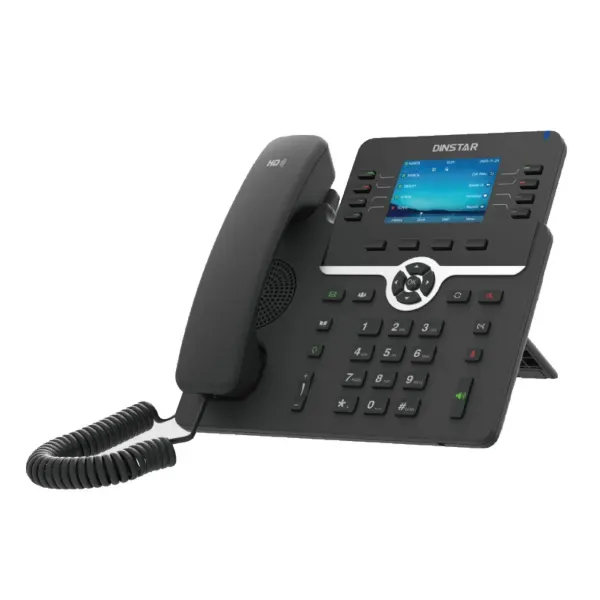
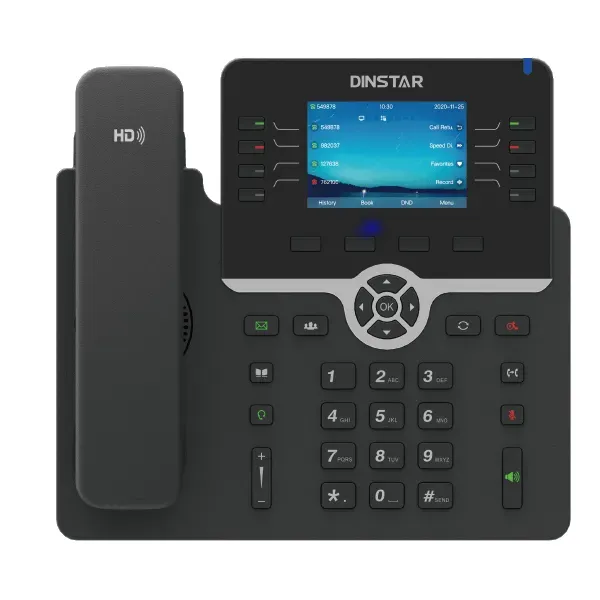
Dinstar C64G Business IP Phone
The Dinstar C64G Business IP Phone is designed for organizations that want a feature-rich SIP desk phone for professional calling without moving to an oversized executive terminal. It combines a 3.5-inch 480 × 320 color display, HD voice processing, dual-port Gigabit Ethernet, support for up to 16 SIP accounts, 40 line keys, six-way audio conferencing, USB 2.0 connectivity and EHS wireless-headset support. For businesses comparing IP phones in Tanzania, the C64G sits in a practical position between basic entry-level endpoints and higher-cost touchscreen devices: it provides extensive line handling, programmable functions and enterprise VoIP compatibility in a familiar desk-phone format.
The C64G should be specified as part of a complete voice environment rather than as an isolated handset. Successful deployment depends on SIP-PBX compatibility, extension planning, voice VLAN design, Quality of Service, switch capacity, headset requirements, cabling, power availability and user profiles. FourTeck Tanzania can help customers evaluate the endpoint alongside the wider Tanzania business technology portfolio, while regional projects can also be coordinated through the wider FourTeck Africa technology network.
16 SIP Accounts
Support for up to sixteen SIP accounts makes the C64G suitable for users who handle multiple extensions, service identities or department lines from one endpoint.
HD Voice
Wideband G.722 support, full-duplex hands-free operation and echo-control functions help create clearer day-to-day business conversations when the network is correctly engineered.
Dual Gigabit Ethernet
Two 10/100/1000 Mbps Ethernet ports allow the phone to fit into modern desk networks where a computer can share the same physical network drop.
40 Line Keys
Programmable multi-color function keys can be used for line appearances, speed dials, busy-lamp monitoring and other one-touch call functions.
What businesses should know before choosing the C64G
The Dinstar C64G is a SIP endpoint, so the most important buying question is not simply whether the handset has enough features. The real question is whether those features map cleanly to the user role and the organization’s call platform. A receptionist may need visible line states, transfer shortcuts, BLF keys and fast access to colleagues. A manager may value multiple accounts, conferencing and headset integration. A service desk may prioritize call handling speed, easy mute/hold controls, a stable wired connection and predictable provisioning. The C64G can serve all of these roles when its programmable keys and SIP accounts are configured deliberately.
Dinstar’s published material lists compatibility with platforms including 3CX, Asterisk, Yeastar, Xorcom, VoIP.ms, BroadSoft and FreeSWITCH, alongside Dinstar UC/IP-PBX products. Compatibility should still be confirmed against the specific PBX version, required features and provisioning method in the customer environment. SIP registration alone does not guarantee that every advanced function—such as BLF behavior, directory integration, call recording controls or special feature codes—will operate identically across platforms.
Power planning is also important. The C64G variant is listed with an external power adapter, while PoE applies to the C64GP variant. Buyers who want to power phones centrally from a PoE switch should therefore verify that the selected unit is the C64GP rather than assuming every C64-series phone supports PoE. This distinction matters in larger installations because centralized PoE can simplify desk cabling and makes it easier to keep phones online through a UPS-protected network switch. For the C64G, power adapter placement and socket availability should be part of workstation planning.
Verified Dinstar C64G technical highlights
| Area | Published capability | Business relevance |
|---|---|---|
| Display | 3.5-inch color LCD, 480 × 320 pixels, backlight | Clearer navigation, caller information and programmable-key context. |
| SIP | Up to 16 SIP accounts | Useful for multi-line users, departments, executives and shared-service teams. |
| Conference | Six-way conferencing | Allows quick audio collaboration without always creating a separate bridge. |
| Network | Dual-port Gigabit Ethernet | Fits Gigabit office networks and supports PC pass-through at the desk. |
| Headset | EHS wireless headset support | Useful for users who need mobility while handling calls. |
| USB | USB 2.0 | Provides additional peripheral flexibility in supported use cases. |
| Security | SIP TLS and SRTP support | Supports encrypted signaling and media when the overall voice platform is configured accordingly. |
| Provisioning | FTP/TFTP/HTTP/HTTPS/PnP; web and keypad configuration; TR-069 | Can support repeatable deployment and centralized administration strategies. |
C64G or C64GP?
The C64G and C64GP share the same core business-phone positioning, display, SIP-account capacity, conferencing features and Gigabit networking. The practical purchasing distinction is power. Dinstar’s datasheet shows the C64G using a power adapter and the C64GP supporting PoE, with the power adapter optional for the C64GP. If a site already has PoE switches and wants centrally backed-up power for desk phones, the C64GP is normally the model to evaluate. If local power at each desk is acceptable, the C64G can be considered. Always confirm the exact model code on the quotation and purchase order.
Dinstar C64G Business IP Phone Tanzania
For Tanzanian businesses moving from analog extensions to SIP telephony, the Dinstar C64G offers a practical endpoint for roles that need more than a basic two-line phone. Organizations in finance, logistics, professional services, education, healthcare administration, retail operations, hospitality back offices and multi-branch businesses can use the phone as part of a structured IP-PBX deployment. Its sixteen SIP accounts and forty programmable line keys are especially relevant where one user needs visibility across several extensions, departmental identities or shared lines. Rather than assigning the same configuration to every employee, a Tanzania deployment can be mapped by role: simple calling for general users, richer key layouts for supervisors, multiple accounts for managers and heavy call-handling profiles for reception or support desks.
A reliable Tanzania deployment starts with the LAN. Voice traffic should be separated logically where appropriate, switches should have sufficient capacity, and Quality of Service policies should protect real-time traffic during busy periods. If the office connects phones and computers through the same desk cabling, the C64G’s dual Gigabit ports can help maintain a clean physical layout. For sites using the non-PoE C64G, power sockets and adapters must be planned at every desk. For projects where UPS-backed PoE is preferred, buyers should compare the C64GP. These details are more important than marketing labels because they influence resilience, cable management and how easily the environment can be supported later.
Tanzania buyers should also prepare PBX details before requesting a quotation: platform and version, number of extensions, SIP trunk arrangement, headset requirements, directory needs, call-flow expectations, language preferences, VLAN design and whether zero-touch or centralized provisioning is expected. FourTeck’s Tanzania IT and telecom solution overview explains how IP phones depend on switching, structured cabling, firewalls and PBX design. For larger regional programs spanning multiple countries, FourTeck Africa can be a useful reference point for coordinated technology planning.
Dinstar C64G Business IP Phone Dar es Salaam
Dar es Salaam organizations often operate fast-moving offices where reception, sales, dispatch, finance and customer-service teams depend on dependable voice communication. In these environments, the Dinstar C64G can be used as a higher-capability wired SIP endpoint for people who handle more calls than a typical office user. The 3.5-inch color display and programmable keys can reduce the time users spend navigating menus, while multiple SIP accounts make it possible to assign different extension identities or service lines to the same desk phone. A front-desk deployment can use busy-lamp fields and speed dials for frequently contacted staff, whereas managers may use separate accounts for business units or branch identities.
The network design matters greatly in dense commercial buildings. Shared uplinks, internet congestion, unmanaged switches and inconsistent cabling can create call-quality problems even when the phone itself is capable. A Dar es Salaam project should therefore assess switch ports, voice VLANs, QoS policies, router capacity, firewall traversal and SIP trunk behavior before endpoint rollout. The C64G’s Gigabit pass-through can be useful where one desk outlet serves both the phone and a workstation, but IT teams should still check VLAN tagging behavior and the expected link topology. Users handling long calls may benefit from EHS-compatible wireless headsets if their preferred headset model is supported.
Procurement teams should distinguish between C64G and C64GP when specifying power. The C64G is associated with an external power adapter, while the C64GP is the PoE-capable variant. This affects switch selection, UPS strategy and desk power planning. A useful quotation request should state the number of phones, required model variant, PBX platform, provisioning expectations, desired headset setup and any call-center or reception functions. Businesses evaluating broader voice modernization can also review specialist IP telephony resources at FourTeck IP Phone solutions and FourTeck IP PBX solution guidance for architecture concepts that apply across professional deployments.
Dinstar C64G Business IP Phone Mwanza
Businesses in Mwanza may need IP telephony for head offices, regional branches, clinics, educational institutions, wholesale operations, hotels, transport coordination and distributed sales teams. The Dinstar C64G is relevant when a user needs a full desktop SIP phone with multiple line appearances and programmable functions rather than a basic extension device. Six-way conferencing can be useful for quick internal coordination, and the sixteen-account capacity gives system administrators room to design more complex extension behavior where required. For branch operations, the phone can register to a central IP PBX if connectivity and security policies are designed appropriately.
Connectivity resilience should form part of the Mwanza design. If a branch relies on a WAN or internet link to reach a central PBX, administrators should consider what happens during link interruption, whether local survivability exists, how DNS and SIP registration are handled, and whether backup connectivity is available. Voice traffic is sensitive to latency, packet loss and jitter, so bandwidth figures alone do not guarantee call quality. Network monitoring, consistent cabling and proper switch configuration are important. The C64G’s Gigabit Ethernet capability prevents the phone itself from becoming a bottleneck at a modern desk, especially where a PC shares the second port.
Mwanza buyers should avoid assuming that every advertised PBX feature is automatically exposed on every endpoint. The C64G is SIP-based and supports widely used call functions, but advanced behavior should be tested against the intended platform. Before ordering, identify required BLF keys, transfer workflows, shared lines, directory sources, voicemail behavior and provisioning method. For deployments that include data networking as well as phones, the wider FourTeck Tanzania infrastructure portfolio is relevant because switching, routing and structured cabling directly influence voice reliability. A planned deployment should document extensions, MAC addresses, switch ports, VLANs and user assignments so future support does not depend on informal knowledge.
Dinstar C64G Business IP Phone Arusha
Arusha has a diverse business environment that includes tourism operators, hospitality groups, NGOs, professional services, logistics companies, education providers and regional offices. The Dinstar C64G can fit users who need a polished wired SIP phone for daily business communication, particularly where incoming calls must be transferred quickly or where staff need visual access to multiple lines and colleagues. Programmable multi-color keys can be configured for commonly used functions, while the color screen offers a clearer user experience than simple monochrome endpoints. The phone can therefore be considered for front desks, reservations teams, administrators, supervisors and other call-intensive roles.
For hotels and service businesses, endpoint design should follow the call flow. The device used at a reception desk may require different keys and permissions from one used in accounting or a back office. For NGOs and multi-site organizations, administrators may need standardized templates so phones behave consistently across offices. Dinstar supports common auto-provisioning methods, web configuration and TR-069, which can support repeatable administration when the chosen platform and deployment process are compatible. Security options such as SIP TLS and SRTP can also be incorporated when supported end to end by the PBX and voice infrastructure.
Arusha procurement planning should also consider power and resilience. If phones are expected to remain available during local power events, an organization can evaluate UPS-backed network equipment and the PoE-capable C64GP variant. The C64G itself is specified with an external power adapter, so every planned desk position should have appropriate power. Buyers should request the exact model, not simply “C64 series,” on commercial documents. A complete quotation should include quantity, PBX details, headset needs, whether expansion or directory integration is required, and any installation or configuration scope. That approach produces a more useful comparison than evaluating handset price alone.
Dinstar C64G Business IP Phone Dodoma
Organizations in Dodoma can use the Dinstar C64G where reliable desk telephony is needed across administrative offices, public-facing service desks, associations, educational facilities and growing private-sector operations. Its support for multiple SIP registrations makes it suitable for users who participate in more than one call group or organizational function. The forty line keys can simplify recurring actions such as speed dialing, extension monitoring and line selection, while six-way conferencing gives users a quick method for bringing several participants into one call. For administrators, the model is most valuable when deployed from a standardized template rather than configured phone by phone without documentation.
A Dodoma rollout should begin with a site readiness review. Check whether switches are managed, whether voice VLANs are required, whether desk cabling supports Gigabit operation and how the PBX is reached. If the PBX is cloud-hosted or in another city, WAN stability and firewall configuration become part of the voice design. If it is on premises, local backup power and switch resilience may be more important. In either case, call quality should be tested during busy network periods, not only when the office is quiet. Voice QoS, correct duplex negotiation and well-terminated cabling are basic controls that can prevent many recurring complaints.
For buyers comparing endpoint fleets, it can be sensible to use the C64G only for roles that benefit from its higher key and account capacity, while simpler users receive a lower-cost phone. This role-based model keeps the deployment practical and makes support easier because each class of user has a defined endpoint profile. Customers should also evaluate whether the desired wireless headset is compatible with the C64G’s EHS implementation. For larger IT refreshes, voice should be reviewed alongside switching, firewalls and structured cabling instead of treated as an isolated purchase.
Dinstar C64G Business IP Phone UAE
The Dinstar C64G is also relevant to UAE organizations that operate multi-extension office environments and need a wired SIP phone with strong programmable-key density. In reception, facilities, shared-service and administrative roles, the combination of sixteen SIP accounts and forty line keys provides room for flexible call handling. Companies standardizing between UAE and African branches may also value using the same endpoint family across sites, provided the selected PBX, firmware, provisioning and telecom requirements are compatible. Standardization can simplify user training and template management, but it should never replace local validation of SIP trunks and regulatory requirements.
UAE deployments often place significant emphasis on structured network design, rack-based PoE switching and centralized administration. Because the C64G variant is not the PoE model, customers using a centralized PoE architecture should compare the C64GP and confirm exact part numbers before ordering. Where the C64G is retained, desk power and adapter management should be included in the installation plan. Gigabit Ethernet support is useful in offices where phones share wired connectivity with PCs, but VLAN design should still separate traffic logically and QoS should prioritize real-time voice where needed.
Companies with cross-border operations can coordinate broader requirements through FourTeck UAE. A procurement specification should list extension quantity, PBX platform, SIP trunk environment, required programmable functions, preferred headsets, provisioning approach and any desired encryption settings. This makes it easier to compare the C64G against other business phones on operational fit rather than screen size or headline features alone. For organizations that support mixed endpoint fleets, it is also useful to define firmware governance, configuration backups and replacement-device procedures before large-scale rollout.
Dinstar C64G Business IP Phone Uganda
Ugandan businesses planning SIP telephony can evaluate the Dinstar C64G for managers, reception teams, customer-service desks and other users who need more line visibility than basic desk phones provide. The color display, multiple SIP accounts and programmable keys support a broad range of call-handling layouts. Six-way conferencing may be useful for internal coordination, while Gigabit Ethernet helps the phone integrate into newer business LANs. For distributed organizations, the endpoint can be part of a centrally managed IP-PBX design when branch connectivity, security and provisioning are correctly planned.
The key design issue is the relationship between the phone and the network. A branch with unstable WAN connectivity may require backup links or a different survivability strategy. A site with unmanaged switches may need network upgrades before voice quality can be considered predictable. VLAN separation, DHCP options, DNS resolution, NTP, firewall behavior and SIP ALG settings can all influence deployment success. The C64G supports familiar provisioning and management methods, but administrators should choose one controlled process and document it rather than mixing manual configuration with ad hoc templates.
Uganda customers can also reference FourTeck Uganda for regional technology requirements. When requesting a Dinstar quotation, state whether C64G or C64GP is required, because the power method differs. Include expected quantity, PBX brand and version, user roles, headset needs and any integration with directories or call-center applications. For multi-site organizations, a pilot of several phones can validate key mappings, codecs, transfer behavior, BLF, voicemail indicators and remote provisioning before the full fleet is deployed.
Dinstar C64G Business IP Phone Kampala
Kampala offices with high call volumes can use the C64G as a feature-rich SIP endpoint for users who regularly monitor colleagues, transfer customers or work across multiple service identities. This can include receptionists, administrators, sales coordinators and support supervisors. The forty line keys create useful visual capacity for BLF and shortcuts, while the 3.5-inch color screen helps users navigate contacts and call functions. The value of these features increases when the PBX template is designed around actual workflow instead of assigning a large number of unused keys.
In busy Kampala office networks, voice quality can suffer when internet traffic, cloud applications and large file transfers compete with telephony on poorly configured links. QoS policies, managed switching and correct uplink sizing help reduce this risk. Where the phone and computer share one cable run, the dual Gigabit ports can simplify the workstation layout, but the network should still be designed to pass the correct voice and data VLANs. If users depend on wireless headsets, the exact headset/EHS combination should be verified during the pilot stage.
Procurement teams should look beyond unit price and assess deployment effort, power method, spares, provisioning, user training and support documentation. The C64G’s external power requirement may be acceptable in smaller offices, while sites built around PoE should consider the C64GP. A written endpoint standard can define which roles receive the C64-series phone, which keys are programmed, which codecs are preferred and what firmware version is approved. This turns the phone from an individual device into a manageable part of the communications environment.
Dinstar C64G Business IP Phone Arua
For organizations in Arua, a business IP phone deployment may need to balance centralized communication with the realities of branch connectivity. The Dinstar C64G can provide a capable desk endpoint for staff who need multiple SIP identities and programmable functions, but its effectiveness depends on how the branch reaches the PBX. If the PBX is hosted remotely, stable connectivity and appropriate security controls are essential. If the site uses a local PBX, administrators should consider backup power, configuration management and how inter-branch calls are routed during WAN interruptions.
The C64G can be particularly useful for branch managers and front desks because it offers more visible keys than basic phones. Staff can be given one-touch access to head office, other branches, security, logistics or departmental contacts. Six-way conferencing can support quick coordination without waiting for a separate meeting platform. Yet users should be trained on transfer, hold, conference and voicemail functions; a technically capable phone does not automatically improve communication if its features are not mapped to simple workflows.
Arua procurement planning should identify the complete bill of requirements: endpoint quantity, C64G versus C64GP, power adapters where applicable, switching capacity, patch cords, VLAN configuration, PBX licenses if required by the chosen platform and deployment support. Do not assume phone purchase alone covers those dependencies. Administrators should also document credentials securely, avoid shared default passwords and use encrypted SIP signaling/media where supported by the end-to-end platform. A well-documented rollout makes future replacement and troubleshooting far easier for distributed organizations.
Dinstar C64G Business IP Phone Mbarara
Mbarara businesses and institutions can evaluate the Dinstar C64G when they need professional desk telephony for roles that handle multiple extensions or frequent transfers. The model’s sixteen SIP accounts provide headroom for complex user profiles, and its programmable keys can make common destinations visible at a glance. In environments such as healthcare administration, education, hospitality, wholesale and professional services, this can reduce dependence on memorized feature codes and improve consistency in daily call handling.
A successful Mbarara deployment should match endpoint capability to network readiness. Where older switches or cabling are in place, check negotiated link speeds and packet loss before assuming a new phone will solve call-quality issues. If the office uses a shared internet connection for cloud applications and SIP trunks, test voice performance during peak traffic. Managed QoS can prioritize voice packets, while a dedicated voice VLAN can simplify policy control and troubleshooting. The phone’s Gigabit ports are useful, but the whole path—from desk cable to switch to router and PBX—must be stable.
The power distinction between C64G and C64GP should be documented in the purchase specification. The C64G uses an external adapter, whereas the C64GP is designed for PoE. For organizations with UPS-backed PoE switches, selecting the correct variant can improve continuity and reduce individual power supplies at desks. Before a larger order, a test unit should be validated with the actual PBX, required codecs, transfer workflows, BLF, directories and any wireless headset planned for users.
Dinstar C64G Business IP Phone Gulu
In Gulu, organizations that need structured communication between departments or branches can use the C64G as part of an IP-PBX environment designed around user roles. A front desk can use programmable keys for commonly contacted departments, while managers can maintain more than one SIP account if the PBX design calls for it. The phone’s color display and clear key layout can improve usability for staff transitioning from legacy analog phones to feature-based SIP endpoints.
For multi-site deployments, administrators should decide whether configuration is controlled from head office or managed locally. Dinstar’s support for web configuration, auto provisioning and TR-069 gives several options, but consistency is more important than the number of methods available. Standard templates can define extension credentials, codecs, time settings, directory locations and programmable keys. Change control should record firmware updates and configuration revisions so troubleshooting is repeatable rather than dependent on individual technicians.
Gulu customers should also plan for connectivity and power. A centrally hosted PBX needs a stable WAN path, and any outage strategy should be understood before deployment. The C64G requires local power through its adapter, so desk sockets and backup arrangements must be considered. If the project standard calls for PoE, the C64GP is the more relevant model variant. A good quotation request will therefore describe the site, PBX, user count, network design and expected support scope rather than asking only for a phone price.
Dinstar C64G Business IP Phone Kenya
Kenyan organizations with SIP-based communications can evaluate the C64G for user profiles that need numerous programmable keys and multiple account registrations. It can be positioned for reception, supervisory, administrative and executive roles while simpler endpoints serve general staff. This role-based approach controls cost and keeps user training focused. The six-way conference function can support impromptu internal discussions, and the Gigabit Ethernet design aligns with modern wired office networks.
For Kenya deployments, PBX interoperability and SIP trunk configuration should be validated before fleet rollout. Even when a phone registers successfully, behavior for BLF, call parking, directory services and feature synchronization may vary by platform. A short pilot should replicate real workflows such as blind transfer, attended transfer, hold, conference, voicemail access and after-hours call routing. Network engineers should also verify VLAN tagging, DHCP, DNS and QoS policies. If remote branches connect to a centralized PBX, WAN quality and failover planning become part of the voice architecture.
Regional customers can refer to FourTeck Kenya for broader business technology requirements. Buyers should clearly specify C64G or C64GP depending on power strategy. The non-PoE C64G needs an adapter at the desk; the C64GP supports PoE. For larger offices, this choice can affect switch budgets, UPS capacity, desk cable management and recovery after power events. A complete procurement checklist should therefore include phones, power, switching, PBX licensing, headsets, configuration, testing and documentation.
Dinstar C64G Business IP Phone Kuwait
Kuwait businesses looking for a multi-line SIP desk phone can consider the Dinstar C64G where users need extensive programmable keys and several registered identities. The model is especially relevant for reception areas, back-office coordination, customer service and managers who regularly transfer or monitor calls. Its 3.5-inch color screen gives users a practical visual interface without moving to a large touchscreen platform, and the phone’s HD voice capabilities support clear speech when codec and network conditions are suitable.
Office network standards in Kuwait may include managed Gigabit switching, voice VLANs and centralized racks. The C64G’s dual Gigabit interfaces fit such designs, but its local power requirement must be accounted for. Organizations that want PoE should select the C64GP. This distinction should appear explicitly in tender documents and purchase orders to avoid receiving a technically similar but operationally different variant. IT teams should also decide how phones will be provisioned, how firmware will be maintained and whether TLS/SRTP will be enabled across the supported PBX environment.
For cross-border or regional projects, FourTeck Kuwait can support broader planning discussions. Before ordering, buyers should document quantity, PBX platform, SIP trunk setup, user roles, headset choices, desired programmable-key layout and installation expectations. This ensures the selected endpoint is compared on operational fit rather than only on headline feature count.
Dinstar C64G Business IP Phone Ghana
Ghanaian organizations can use the C64G as part of a structured SIP telephony rollout for employees who need richer call handling than an entry-level IP phone provides. The device supports up to sixteen SIP accounts and has forty line keys, giving administrators flexibility to configure department lines, busy-lamp monitoring, speed dials and commonly used functions. This can benefit reception, sales, administration and support roles where call-routing efficiency matters to customer experience.
For sites that depend on cloud PBX or remote SIP infrastructure, connectivity quality should be tested with real calls during peak periods. Packet loss and jitter can affect conversation quality even when nominal bandwidth is high. Managed switches, voice QoS, clear VLAN policies and well-configured edge firewalls can make the environment more predictable. The C64G provides Gigabit Ethernet for wired integration, but reliable voice is always the result of the full network path rather than one endpoint feature.
Ghana buyers should also distinguish the C64G from the C64GP for power. If the design uses centralized PoE from a UPS-protected switch, the C64GP is the appropriate variant to evaluate. If local adapters are acceptable, the C64G can fit. Procurement teams should include PBX compatibility, headset needs, provisioning and user training in the project scope. A small pilot can help validate behavior before standardizing the phone across multiple departments or branches.
Dinstar C64G Business IP Phone Nigeria
Nigeria’s large and diverse business environments can create demanding call-handling requirements, from corporate headquarters and service desks to logistics operations and multi-branch organizations. The Dinstar C64G offers an endpoint profile suited to users who need multiple SIP registrations and significant key capacity. A receptionist can dedicate keys to departments and frequently contacted staff, while supervisors can monitor service extensions. Managers can use separate SIP identities where the PBX architecture requires them. The objective should be to simplify the user’s daily workflow, not merely fill every programmable key.
Network resilience deserves close attention in Nigerian deployments. Organizations may use multiple internet connections, SD-WAN, VPNs or local PBX infrastructure depending on site requirements. Voice design should account for which path SIP traffic uses, how failover affects registrations and whether NAT/firewall settings remain consistent after a link change. For internal LANs, managed switching and QoS help protect voice from congestion. The C64G’s Gigabit ports can support combined phone-and-PC desk connections where cabling is limited.
For procurement, document the exact endpoint variant, quantity, user types, PBX platform, required codecs, BLF behavior, provisioning method and headset model. The C64G uses an external power adapter; the C64GP supports PoE. This difference can materially affect power continuity and switch design in larger offices. Organizations rolling out hundreds of endpoints should also define firmware standards, spare-device procedures and secure credential handling so replacements can be deployed consistently.
Dinstar C64G Business IP Phone Seychelles
Businesses in Seychelles, including hospitality, professional services, tourism operators and administrative offices, may require dependable desk telephony that integrates with modern SIP PBX systems. The Dinstar C64G can suit roles where users need multiple line appearances, programmable shortcuts and clear visual call information. Reception and reservations teams, for example, can use programmable keys to reach departments quickly, while managers may benefit from multiple SIP account support for different properties or business functions.
Island and multi-property deployments often depend on WAN connectivity between locations or on a hosted PBX. That makes link quality, failover behavior and firewall configuration part of the endpoint decision. Voice traffic should be tested for latency, jitter and packet loss across the actual network path. Within each office, managed switching, correct VLAN configuration and good cabling help keep phone behavior predictable. The C64G’s dual Gigabit Ethernet ports can simplify desks where a computer shares the wired connection.
Power planning is equally important. The C64G requires an external adapter, so each desk must have reliable local power. Where the network is already built around PoE and UPS-backed switches, the C64GP may be operationally preferable. Buyers should include the exact model code in quotations and validate PBX compatibility, headset requirements and provisioning before a broad deployment. For multi-site businesses, documented extension plans and standardized templates help staff receive the same calling experience across offices.
Compatibility, integration and deployment guidance
The C64G supports SIP v1 and SIP v2, with Dinstar publishing compatibility references for systems such as 3CX, Asterisk, Yeastar, Xorcom, VoIP.ms, BroadSoft and FreeSWITCH. In production, the integration checklist should go further than registration. Test inbound and outbound calls, attended and blind transfer, hold, DND, call waiting, voicemail message waiting, DTMF, conference, directory access and any BLF or speed-dial mappings. If encrypted communications are required, confirm SIP TLS and SRTP settings across both the phone and PBX. Where firewalls perform SIP inspection, verify that the feature does not interfere with the selected deployment architecture.
For provisioning, organizations can use supported protocols such as FTP, TFTP, HTTP and HTTPS, with PnP and TR-069 options available in the product family. A good operational model uses version-controlled templates, unique extension credentials and a defined firmware baseline. Configuration backups should be protected, and administrative interfaces should not be left exposed unnecessarily. For large fleets, consistent naming conventions for extensions, phones and switch ports reduce troubleshooting time.
Who should choose the Dinstar C64G?
Reception & front desk
Good fit where users need visible extensions, transfer shortcuts, multiple line appearances and fast access to frequently contacted staff.
Managers & supervisors
Useful for users who need several SIP identities, conferencing, headsets and a richer programmable-key layout.
Customer-service teams
Appropriate for desks that spend significant time handling, transferring and monitoring business calls through a SIP PBX.
Quotation checklist
To receive a technically useful quotation, specify the exact Dinstar model required, quantity, PBX brand and version, number of SIP accounts per user, required programmable-key functions, headset model, whether local power or PoE is preferred, switch/VLAN details, provisioning method, desired encryption, installation scope and any requirement for configuration templates. Also state whether the phones will be deployed at one site or multiple branches. This information helps prevent mismatched accessories, incorrect power assumptions and avoidable configuration work.
Frequently asked questions
Does the Dinstar C64G support PoE?
Dinstar’s datasheet identifies the C64G as using a power adapter, while PoE support is provided on the C64GP variant. Buyers who require PoE should specify C64GP explicitly.
How many SIP accounts does the C64G support?
The C64G supports up to 16 SIP accounts, making it suitable for users who need multiple extensions or service identities.
Can the C64G work with 3CX or Asterisk?
Dinstar lists compatibility with 3CX, Asterisk and several other IP-PBX platforms. Specific feature behavior should still be validated against the exact PBX version and configuration.
Does it support wireless headsets?
The product supports EHS wireless-headset integration. The exact headset and EHS combination should be confirmed for compatibility before purchase.
Is the C64G suitable for reception?
Yes, its programmable line keys, multiple SIP accounts and color display can make it a strong fit for reception or front-desk roles when configured to match the organization’s PBX and call flow.
Decision recap
Choose the Dinstar C64G when you need a wired business SIP phone with a color display, up to 16 SIP accounts, extensive programmable keys, HD voice, six-way conferencing and Gigabit networking, and when external adapter power fits the site. Choose the C64GP instead when PoE is a requirement. In either case, validate the phone with your PBX, network and headset environment before fleet deployment. A well-designed voice solution aligns endpoint roles, switch capacity, VLANs, QoS, provisioning and power so the user experience stays consistent after installation.
Consult FourTeck for Dinstar C64G planning
FourTeck can help business customers prepare a practical IP-phone requirement covering model selection, PBX compatibility, user profiles, network readiness, provisioning and deployment scope. The goal is to avoid treating the handset as a standalone purchase when its performance depends on the wider voice and LAN environment. For Tanzania projects, start with the verified FourTeck Tanzania contact channel and include your user count, locations, PBX details and preferred power model.




Reviews
There are no reviews yet.