
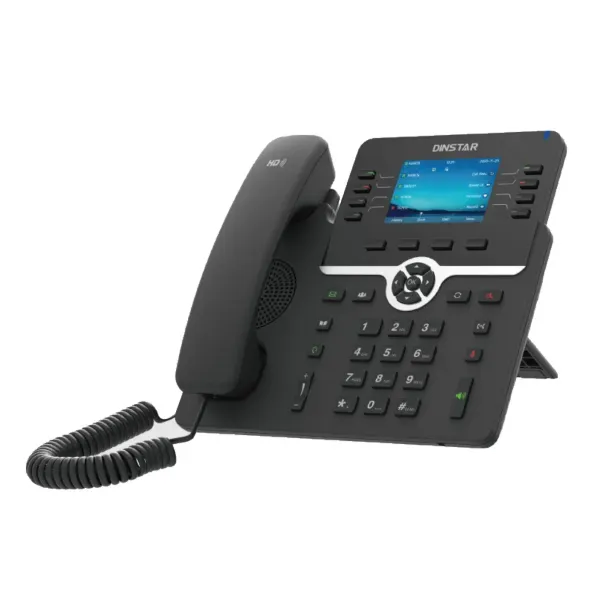
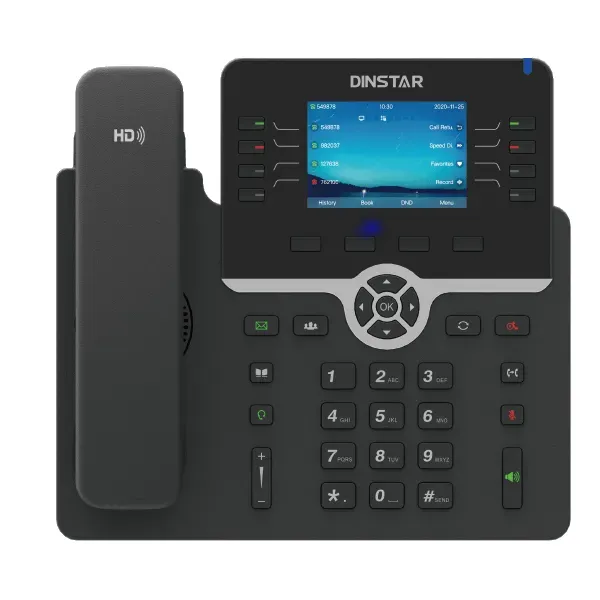
Dinstar C64GP PoE Business IP Phone
The Dinstar C64GP PoE Business IP Phone is designed for organisations that want a capable SIP desk phone for busy business users without moving into an oversized executive endpoint. It combines a 3.5-inch colour graphical display, 16 SIP accounts, dual-port Gigabit Ethernet, Power over Ethernet, programmable keys, HD voice and 6-way conferencing in a practical desktop format. For businesses in Tanzania, the value of the C64GP is not only the number of features on the handset. It is how well those features fit into a structured IP telephony deployment that includes the PBX, SIP service, VLAN design, PoE switching, call-routing policy and user provisioning.
FourTeck can help customers evaluate the C64GP for reception areas, management desks, sales teams, customer-service users, branch offices and other roles that need multiple line appearances or programmable functions. The objective is to choose a phone that matches the user role, then deploy it on a network that is prepared for voice quality, power, security and central administration.
Supports multi-line business use, shared identities and role-based extension planning.
C64GP adds Power over Ethernet and provides dual Gigabit Ethernet ports for voice-ready desk deployment.
Full-duplex audio, DSP and wideband codec support are designed for clearer everyday calling.
Useful for team discussions, supplier calls and multi-party business conversations from the desk phone.
What the Dinstar C64GP is designed to solve
Business telephony often becomes difficult when the endpoint cannot keep pace with the way a user handles calls. A general office user may need only one or two lines, but reception, sales, support and management roles frequently need several call identities, quick transfer actions, busy-lamp fields, conference functions, voicemail access and headset operation. The C64GP is positioned for this more demanding desk environment. Its programmable function access allows frequently used actions to be brought closer to the user instead of buried in menus.
The phone also supports a deployment model in which data and voice share structured Ethernet infrastructure. Dual Gigabit Ethernet allows the handset to sit between the network and a desk computer where that topology is appropriate. The PoE capability of the C64GP can simplify power at the desk when a compatible PoE switch is used. In larger deployments this can reduce reliance on individual power adapters and can make UPS-backed voice continuity easier to plan because the switch and network core can be protected centrally.
The endpoint should still be treated as one part of a complete voice system. SIP registration, firewall policy, codec selection, call routing, PBX configuration, QoS, DHCP options, VLANs and provisioning all affect the result. A phone with strong specifications cannot compensate for a poorly designed network or unstable SIP service. FourTeck therefore recommends evaluating the C64GP together with the PBX platform and LAN design rather than as an isolated desktop purchase.
Verified C64GP business features
3.5-inch colour display
The C64 series uses a 3.5-inch colour graphical LCD with backlight. The display supports a clearer visual workflow for line status, menus, directory access and phone functions than a basic monochrome endpoint.
Programmable line and function access
Dinstar specifies 40 line keys together with programmable soft and function keys. These can support one-touch business actions such as speed dial, transfer or monitored line functions when configured by the telephony platform.
HD voice and full-duplex speakerphone
The audio system combines a full-duplex speaker and microphone with DSP processing. Dinstar lists wideband voice support including G.722 and OPUS-WB on the current product page, alongside standard narrowband codec options.
6-way audio conferencing
A user can build a six-party audio conference from the phone, subject to the deployed calling environment. This can be useful for quick operational meetings without requiring a separate conference-room device.
Headset support
The C64 series supports EHS wireless-headset integration with supported headset ecosystems. This makes it relevant to users who spend substantial time on calls and need hands-free movement around the desk.
Centralised provisioning and management
Dinstar lists auto-provisioning methods including FTP, TFTP, HTTP, HTTPS and PnP, plus a web GUI and its NMS platform. These capabilities matter when many handsets must follow repeatable configuration standards.
Technical planning for a C64GP deployment
| Area | C64GP capability | Deployment implication |
|---|---|---|
| SIP | Up to 16 SIP accounts | Confirm PBX registration limits, dial plan, extension policy and line-key mapping. |
| Network | Dual 10/100/1000 Ethernet | Useful where phone and PC share a desk network drop; VLAN and QoS design should still be validated. |
| Power | PoE on C64GP | Check switch PoE standard, port availability, total PoE budget and UPS strategy. |
| Display | 3.5-inch colour graphical LCD | Better suited to roles that need visible line state, menus and frequent telephony interaction. |
| Conference | 6-way audio conference | Useful for ad-hoc collaboration; test call routing and carrier/PBX behaviour for the intended scenario. |
| Provisioning | FTP/TFTP/HTTP/HTTPS/PnP, web management, NMS | Create standard templates, naming conventions, firmware policy and credential controls before mass rollout. |
Compatibility, IP PBX and network integration
Dinstar positions the C64G/C64GP as a standards-based SIP endpoint and lists compatibility with widely used IP telephony environments including Dinstar UC/IP PBX products and third-party platforms such as 3CX, Asterisk, Yeastar, Xorcom, VoIP.ms, BroadSoft and FreeSWITCH. Compatibility statements should still be interpreted correctly: a SIP phone may register successfully while particular functions such as BLF, remote directory, call recording controls, provisioning templates or specialised feature codes require platform-specific configuration. For procurement projects, the PBX model and software version should therefore be part of the quotation request.
On the LAN, voice quality benefits from predictable addressing, appropriate VLAN separation and traffic prioritisation. A managed switch can place phones in a voice VLAN while keeping user PCs in a separate data VLAN where the network design calls for it. QoS can help protect signalling and real-time media from competing transfers, backups or other burst traffic. The firewall should permit the required SIP and RTP flows without unnecessarily exposing the PBX or phones to the public internet.
Customers considering a wider telephony project can review FourTeck Tanzania’s integrated IT and telecom solutions, while multi-country teams can also reference specialist FourTeck resources for business IP phones and IP PBX planning. These related environments matter because endpoint selection is most effective when the PBX, network and user requirements are reviewed together.
Who should consider the C64GP?
The C64GP is particularly relevant to users who actively manage several lines, extensions or call states during the workday. Reception desks can use programmable functions for monitored extensions and transfers. Sales teams can benefit from headset use, rapid redial, hold, transfer and conference functions. Managers may value multiple SIP identities and the colour interface when working across departments or business units. Customer-service users can use the phone as a dedicated voice endpoint while their computer handles CRM or ticketing applications.
It may be more capability than is necessary for a low-call-volume common area or a user who needs only a single extension and basic dialling. Matching different phone models to different roles can reduce cost and simplify training. A sensible project can therefore place C64GP units at communication-intensive desks while using simpler endpoints elsewhere.
Dinstar C64GP PoE Business IP Phone Tanzania
For Tanzanian organisations evaluating the Dinstar C64GP, the most useful purchasing discussion begins with the voice architecture rather than the handset quantity alone. A buyer may be replacing legacy analogue extensions, expanding an existing SIP platform, opening a new office or standardising phones across several branches. Each scenario changes the bill of materials. A new office may need PoE switches, structured cabling, a firewall, an IP PBX or cloud calling service and user provisioning. An expansion project may only require additional phones, licenses or extension capacity. A replacement project may need migration planning so established numbers, hunt groups and receptionist workflows continue to operate correctly.
The C64GP is attractive in Tanzania where a business wants to keep desk power simple through PoE and where Gigabit pass-through is useful at workstations. Before ordering, confirm whether the access switch provides enough PoE-enabled ports and total power budget. If phones are expected to remain available during short utility interruptions, the PoE switches, PBX, firewall and internet equipment should be included in the UPS plan. Protecting only the handset does not preserve service if the upstream network loses power.
Network readiness is equally important. Voice traffic should be considered alongside CCTV, wireless access points, servers and ordinary user data. Congestion can cause delay or poor audio even when the phone itself is functioning correctly. Managed switching, VLANs and QoS can help create a more predictable environment. Where internet-based SIP services are used, the stability of the internet path also matters. Organisations with critical calling requirements may assess backup connectivity or alternative call routing as part of business-continuity planning.
For procurement teams, a useful Tanzania quotation request should state the number of users, current PBX platform, SIP provider if known, number of sites, PoE availability, headset requirements and any need for call recording, queues or receptionist monitoring. FourTeck can then help distinguish between endpoint requirements and wider voice-system requirements. Customers can also review the broader FourTeck Tanzania shop and technology services when the phone is part of a larger network or office deployment.
Dinstar C64GP PoE Business IP Phone Dar es Salaam
Businesses in Dar es Salaam often have a wide mix of communication requirements, from compact professional offices to larger headquarters, logistics operations, hotels, retail groups and customer-service environments. The Dinstar C64GP can fit well where desk users need more than a basic extension. A reception user, for example, may need visibility of several monitored colleagues, rapid transfers and multiple line appearances. A commercial manager may want separate SIP identities for different business functions. A support user may need a comfortable headset workflow and the ability to build a multi-party call without moving to a meeting room.
In a new Dar es Salaam office, it is worth coordinating the phone rollout with the network design before furniture and cabling are finalised. One structured outlet can often serve a phone and a connected workstation through the phone’s dual Gigabit Ethernet interfaces, but network engineers should still check bandwidth, VLAN policy and failure implications. If the desk computer depends on the phone’s pass-through link, a handset fault or disconnection can also affect the computer connection. Some organisations therefore prefer separate drops in higher-availability areas.
PoE is particularly useful for clean office deployment, but switch capacity should not be assumed. The total PoE budget has to cover every powered phone as well as other devices such as wireless access points or cameras on the same switch. For a larger office floor, it can be sensible to separate voice, CCTV and wireless power budgets across access switches. UPS planning should then protect the switching layer and any local PBX or gateway equipment so telephony remains coordinated during short power events.
Dar es Salaam buyers preparing a C64GP request should include their PBX brand, extension count, expected growth, SIP trunk details and preferred headset type. They should also identify whether phones need remote provisioning across several branches. This information helps determine whether the project is simply a handset purchase or a wider migration. Rather than relying on a price-only comparison, procurement teams can ask for a bill of materials that clearly distinguishes phones, switching, licensing, implementation and support. That makes competing quotations easier to compare and reduces the risk of discovering missing infrastructure after delivery.
Dinstar C64GP PoE Business IP Phone Mwanza
For organisations in Mwanza, a business IP phone project can support local offices that need reliable internal calling, centralised call handling and structured communication with other branches. The Dinstar C64GP offers a useful feature set for managers, receptionists and teams that interact frequently with customers or suppliers. Its 16 SIP accounts provide flexibility where a user needs more than one extension identity or service registration, while the programmable keys can shorten common actions such as transfer, speed dial and monitored extension access when the PBX supports those functions.
A Mwanza deployment should consider how the site connects to the PBX. If the PBX is local, the internal LAN and power design are central. If the PBX is hosted or located in another city, the WAN and internet path become more important. Latency, packet loss and unstable connectivity can affect voice more noticeably than ordinary web browsing. Businesses using centralised cloud or head-office telephony may therefore want to test call quality on the actual site connection before a large rollout and define what should happen if the primary connection is unavailable.
PoE also creates an opportunity to centralise power resilience. Instead of placing a separate adapter at every phone, a PoE switch can feed multiple handsets from one protected network location. If the switch, firewall and PBX are backed by a suitable UPS, the voice environment is easier to manage during brief interruptions. The exact runtime depends on the complete load, so UPS selection should be based on measured or designed consumption rather than the number of phones alone.
For branch-standardisation projects, Mwanza teams can use the C64GP as part of a repeatable profile that defines device naming, extension numbering, firmware, VLAN, PBX settings and user features. Standardisation makes troubleshooting easier because the configuration is not recreated differently at each site. A good quotation should therefore identify whether the Mwanza office will be a standalone telephony site or part of a multi-branch system. It should also note how many users genuinely require the C64GP’s advanced controls, because mixing endpoint tiers by user role can improve value without compromising the overall system design.
Dinstar C64GP PoE Business IP Phone Arusha
Arusha organisations in hospitality, tourism, professional services, education, administration and commercial operations may need telephony that can be managed centrally while still giving desk users direct access to the features they use most. The Dinstar C64GP can serve front-office and supervisory roles that handle frequent incoming and internal calls. Its colour screen, programmable keys, headset support and 6-way conferencing can make it easier for active users to manage transfers, discussions and multiple line states without relying on a softphone for every task.
Hospitality and service environments should map the phone to the operational workflow before selecting quantities. A back-office reservation or finance desk may benefit from the C64GP, while guest rooms or simple common areas may be better served by a different endpoint type. The same principle applies to schools and campuses: administrative offices may need multi-line business phones, whereas classrooms or security posts may have simpler calling requirements. Separating endpoint classes by function avoids paying for features that are not used.
For an Arusha site using IP telephony alongside Wi-Fi, cameras and other PoE devices, switch design should be reviewed as one combined power and traffic plan. Every new phone consumes a PoE port and adds real-time traffic. Managed switches can separate voice into dedicated VLANs and enforce predictable policies, but configuration should be documented so future expansions do not create inconsistent port settings. Where phones pass a desktop connection through the second Gigabit interface, the VLAN behaviour of both voice and data traffic should be tested with the selected switch platform.
When requesting a quotation in Arusha, customers should include extension count, desired call flow, whether there is an existing SIP trunk, the PBX platform, the number of PoE ports available and any remote-site requirements. If a receptionist needs many monitored extensions, specify that use case rather than asking only for “office phones.” If the organisation needs automated configuration, include the provisioning method and network-security requirements. These details allow the C64GP to be evaluated as part of a functional communications design rather than as a standalone model selected by specification alone.
Dinstar C64GP PoE Business IP Phone Dodoma
In Dodoma, organisations planning a new office, expanding administrative facilities or standardising an existing voice network can use the Dinstar C64GP for staff who need a feature-rich desk phone. The 16 SIP-account capability is useful where extension identities or services must be separated, while the programmable controls can be aligned with departmental call handling. Managers, reception desks, help desks and coordination teams are typical examples of roles that can make practical use of a larger number of line and function keys.
Government, institutional and corporate environments may place a high value on repeatability and documentation. For that reason, a rollout should define a baseline configuration before many phones are installed. This can include firmware version, administrator credentials, time settings, directory source, SIP server addresses, codec preference, VLAN details, provisioning URL and allowed web-management access. A documented template reduces configuration drift and makes replacement easier when a device must be swapped later.
The C64GP’s PoE support can reduce desk-side power complexity, but the network room becomes more important because it now powers the voice endpoints. Switch power budget, UPS capacity, ventilation and rack organisation should be part of the project. Where several floors or buildings are involved, fibre uplinks and access-switch placement may influence the telephony architecture. Voice VLANs should have a clear path to the PBX, DHCP and DNS services, and firewall rules should be limited to what the service actually requires.
Dodoma buyers should also consider user training. A technically capable phone delivers little benefit if users are not comfortable with transfer, conference, hold, voicemail and headset functions. Short role-based training can significantly improve adoption, especially at reception and support desks. A quotation can therefore separate equipment, configuration, deployment and training so procurement teams understand what is included. This approach is more dependable than assuming every reseller quote covers the same level of implementation simply because the handset model is identical.
Dinstar C64GP PoE Business IP Phone UAE
For businesses operating between Tanzania and the UAE, the Dinstar C64GP can be considered as part of a common SIP endpoint standard across branch locations. A consistent phone profile can simplify extension numbering, user training and support when employees move between offices. The handset’s 16 SIP accounts, Gigabit connectivity, programmable controls and 6-way conferencing provide enough flexibility for users who handle multiple business lines or departmental functions from one desk.
The key design question for a multi-country deployment is where the call control resides. A central PBX, hosted platform or independent PBX at each site creates different networking and resilience requirements. If UAE and Tanzania offices share central call control, latency, VPN design, SIP-security policy and failure routing need attention. If each office has its own PBX, numbering plans and inter-site routing can still be coordinated. Either approach can work, but the architecture should be decided before provisioning hundreds of user-specific settings.
Procurement teams should also avoid assuming that accessory, power-adapter or headset bundles are identical in every market. The C64GP supports PoE, so many business projects prefer switch-powered deployment, but any required adapter or headset should be itemised in the quote. Firmware and provisioning templates should likewise be controlled centrally where possible. This makes it easier to maintain security settings and feature behaviour across offices.
Customers coordinating projects in both regions can use FourTeck UAE for UAE technology requirements while using the Tanzania business technology site for the local project. The important point is not to force every branch into an identical physical design. Standardisation should cover configuration principles, numbering, security and support procedures, while local network layouts, internet connections and user counts are allowed to differ according to operational need.
Dinstar C64GP PoE Business IP Phone Uganda
Ugandan businesses evaluating the C64GP may be looking for a desk phone that can support office expansion, branch telephony or a move from analogue extensions to SIP. The model’s multiple SIP accounts and programmable controls make it best suited to users with active call-handling responsibilities rather than occasional calling. A well-planned deployment can place advanced handsets at reception, service desks and management positions while using simpler SIP endpoints for low-usage desks.
For branch communication, organisations should first decide whether Uganda offices connect to a central PBX or operate independently. Centralised call control can simplify extension management but creates dependence on the inter-site connection. Local call control can improve site autonomy but may add administration. The C64GP can work in either style because it is a standards-based SIP endpoint, but the configuration and failure strategy should be designed around the chosen architecture.
PoE switching is another planning area. If phones, cameras and access points share a switch, calculate the combined PoE demand and leave reasonable headroom for growth. Voice traffic can be placed in a dedicated VLAN and prioritised according to the network policy. Where users share the phone’s second Ethernet port with a workstation, confirm that data and voice VLAN behaviour is correct and that security rules prevent unnecessary access between segments.
For organisations with operations in Uganda and Tanzania, a shared endpoint standard can reduce support complexity. Documentation can define extension conventions, provisioning URLs, firmware and phone-button templates so the user experience is broadly consistent. Regional customers can also review FourTeck Uganda for Uganda-focused requirements. Before purchase, provide the expected user count, PBX platform, SIP trunk details and branch topology so the phone quantity, networking and implementation scope are aligned.
Dinstar C64GP PoE Business IP Phone Kampala
Kampala businesses with busy front desks, sales teams, contact functions and management users can consider the Dinstar C64GP when a basic two-line phone is not enough. The interface and programmable keys are intended to reduce the number of steps required for common telephony tasks. In practice, the benefit depends on thoughtful configuration. A BLF key is useful only if it is mapped to the right colleague, and a speed-dial key is valuable only if it reflects the user’s daily workflow. Provisioning should therefore be based on job role rather than cloning the same button layout to every phone.
In multi-floor Kampala offices, endpoint planning should be coordinated with the switching layout. Access switches need sufficient Gigabit ports and PoE budget. Uplinks should have capacity for combined voice, user data, wireless and other services. Voice traffic itself is not normally bandwidth-heavy compared with video, but it is sensitive to delay and packet loss. QoS is therefore about predictability rather than raw throughput. A network that looks fast in a file-transfer test can still produce poor calls if it is congested unpredictably.
If the PBX is hosted, security and remote provisioning deserve attention. Phones should not be left with default credentials, web management should be controlled, firmware should be maintained and SIP registration should follow the provider’s secure configuration where supported. If VPNs are used between sites, voice routes and firewall rules should be tested under failover conditions rather than only during normal operation.
A quotation request for Kampala should explain the current environment: number of existing extensions, PBX make and version, trunk provider, call queues, receptionist needs, remote branches and headset preferences. It is also useful to ask whether provisioning templates and user training are included. These details make it easier to compare suppliers on total deployment scope instead of comparing only the handset price, which can hide important differences in configuration, support and network preparation.
Dinstar C64GP PoE Business IP Phone Arua
For organisations in Arua, the C64GP can be useful where a branch needs to participate in a wider corporate voice system without giving up the convenience of a dedicated desk phone. Multiple SIP accounts allow flexible registration plans, and the phone’s conference and programmable-key functions can support branch managers or administrative teams that coordinate frequently with colleagues, suppliers and customers in other locations.
Connectivity should be assessed carefully when a remote branch depends on central call control. The quality of a voice call is affected by both local LAN conditions and the WAN path. If a site connection experiences variable latency or packet loss, users may hear drop-outs even though general internet access appears usable. Before large-scale deployment, it can be worthwhile to test SIP calling during busy periods and confirm whether the network provider offers the consistency required for business voice.
Power architecture is also important. PoE reduces the number of adapters at user desks, but it concentrates dependency at the access switch. A properly sized UPS can protect phones indirectly by supporting the PoE switch, router and any local voice gateway. If a branch has a secondary internet link, failover behaviour should be tested together with SIP re-registration and DNS handling so staff understand what happens during an outage.
Arua customers should prepare a procurement checklist covering handset count, user roles, central or local PBX location, required call features and network readiness. It is often helpful to identify a small number of pilot users before rolling the same configuration across the office. Pilot testing can reveal button-layout preferences, headset compatibility and call-routing issues. Once the template is proven, automated provisioning can reduce manual effort and keep configurations more consistent over time.
Dinstar C64GP PoE Business IP Phone Mbarara
Mbarara businesses expanding from simple telephone systems to SIP-based communications may use the Dinstar C64GP at desks where call handling is a significant part of the job. The phone’s 3.5-inch colour display and programmable controls help users interact with lines and functions more directly, while its 16 SIP accounts provide room for complex extension or identity requirements. The model can therefore serve as a higher-tier endpoint within a mixed fleet of office phones.
A migration project should start by documenting the existing call flow. Which numbers ring reception? Which groups answer sales or support? What happens after hours? Are there analogue lines, fax devices, door phones or paging systems that still require gateways? Replacing desk phones without mapping these dependencies can cause surprises at cutover. The C64GP itself is a SIP endpoint, so analogue interfaces require separate gateway planning where legacy devices must remain.
The switch environment should also be checked before relying on PoE. Port count is only one consideration; the power budget, VLAN features and uplink design matter as well. Where switches already power wireless access points or security cameras, adding many phones can create a power-capacity issue even when free Ethernet ports remain. A bill of materials should identify whether existing switches are retained, upgraded or supplemented.
For Mbarara procurement, separate the endpoint price from the overall telephony project. The wider scope may include PBX licenses, SIP trunk setup, gateways, headsets, switches, cabling, UPS systems, installation and support. This level of detail makes budgeting clearer and helps avoid comparing incomplete quotations. If the business is part of a wider Uganda network, use standard provisioning and naming conventions so the Mbarara site can be supported consistently with other branches.
Dinstar C64GP PoE Business IP Phone Gulu
In Gulu, the Dinstar C64GP can support administrative, commercial and service-oriented teams that need a more capable SIP endpoint for daily business communication. Its value is strongest for users who actively use several phone functions throughout the day. Programmable line keys can reduce repetitive menu navigation, the 6-way conference function supports quick team discussions and PoE can make deployment cleaner when compatible switching infrastructure is already in place.
A branch-office rollout should define resilience expectations before installation. If a phone must reach a PBX in another city, the branch depends on the WAN path. If the business requires basic calling during connectivity problems, alternatives such as secondary links, local gateways or provider-level failover may be considered according to the broader voice design. The handset cannot by itself solve a lost network path, so continuity planning belongs at the system level.
Central provisioning becomes more valuable when support staff are not permanently based at the branch. Instead of configuring each device manually, administrators can apply standard settings remotely using supported provisioning methods. Secure credential handling and change control are important because convenient remote management can also increase risk if management interfaces are exposed carelessly. Access should be limited to authorised administrators and configurations should be backed up or reproducible from templates.
When requesting a Gulu quotation, provide the number of users, their roles, the PBX location, internet topology and existing network equipment. Ask whether PoE capacity has been checked and whether the quoted solution includes switch upgrades if required. Also state whether users need EHS wireless headsets or ordinary wired headsets. Clear accessory requirements prevent delays at deployment and help ensure that the phones are ready for real working conditions rather than merely delivered in boxes.
Dinstar C64GP PoE Business IP Phone Kenya
Kenyan organisations with regional operations can consider the Dinstar C64GP as part of a standardised SIP endpoint strategy across East African offices. A common phone model can simplify user training and support, particularly for roles that move between branches or where central IT teams manage multiple countries. The C64GP’s combination of multiple SIP accounts, Gigabit Ethernet, PoE and programmable controls makes it suitable for active business users rather than basic low-volume extensions.
Cross-border standardisation should focus on configuration and support principles rather than assuming that every office has the same connectivity or switching environment. A Nairobi office may have a different ISP topology from a Tanzanian branch, while a smaller branch may have fewer PoE ports or different resilience requirements. The endpoint template can remain similar while network implementation is adapted to local conditions. Extension numbering, firmware versions, security settings and button mappings can still follow a shared standard.
Where a central PBX serves users across countries, test WAN performance and failover behaviour. SIP and RTP traffic may traverse VPNs, SD-WAN paths or public internet connections depending on design. Firewall policies should be narrowly defined, and voice quality should be monitored during peak network use. Where each country uses its own PBX, inter-site dialling and number presentation can still be designed consistently.
Regional procurement teams can reference FourTeck Kenya for Kenya-focused requirements while maintaining a shared technical standard with Tanzania. For accurate quotation planning, specify the number of C64GP users, other endpoint types, PBX platform, PoE switching, headsets and desired support model. This provides a more meaningful comparison than asking for one unit price in isolation from the rest of the voice environment.
Dinstar C64GP PoE Business IP Phone Kuwait
For organisations connecting Tanzania operations with Kuwait, the C64GP can be evaluated as a shared business desk-phone platform for users who need consistent SIP features across offices. The handset offers enough account capacity and programmable controls for reception, management and client-facing roles, while Gigabit Ethernet and PoE suit structured office networks. A common endpoint can reduce training differences when users transfer between branches.
The telephony architecture should account for country-specific carrier arrangements and local PBX placement. If each office has its own SIP trunk and PBX, user experience can still be standardised through templates. If call control is centralised in one country or a cloud region, network latency and resilience must be measured from every participating site. Call quality depends on the full route, not simply the phone model.
Security should also be coordinated across branches. Administrator passwords, provisioning transport, firmware policy and management access should follow a documented standard. SIP credentials should be protected and the public internet should not expose phone web interfaces unnecessarily. Where remote support is required, use controlled access methods that can be audited and revoked rather than permanent open management ports.
Kuwait procurement teams can consult FourTeck Kuwait for Kuwait-related technology projects. When comparing the C64GP across markets, confirm what is included with each quote, including power accessories, headsets, licenses, provisioning and installation. The model designation may be the same while the complete delivered solution differs significantly. A clear bill of materials and implementation scope prevents those differences from being hidden behind a single handset price.
Dinstar C64GP PoE Business IP Phone Ghana
Ghanaian businesses looking at the C64GP may be planning a SIP migration, a new office or a multi-site standardisation project. The phone is most appropriate where users need extensive call-control functions and multiple SIP identities. Its programmable keys can be aligned with reception, sales or support workflows, while its conferencing and headset capabilities support users who spend significant time communicating with customers and colleagues.
A Ghana deployment should begin with PBX compatibility and network readiness. Standards-based SIP provides broad flexibility, but feature behaviour varies by platform. BLF subscriptions, directories, provisioning templates and transfer behaviour should be tested with the chosen PBX. A short pilot can confirm these interactions before many phones are provisioned. This is especially useful when an organisation is migrating from another brand of endpoint and expects existing user workflows to remain unchanged.
PoE simplifies desk deployment when access switches are designed for the load. Businesses should calculate phone quantity, expected PoE consumption, switch redundancy and UPS capacity together. If a large number of handsets are installed on a single access switch, that device becomes an important availability component. Network documentation should therefore identify where phones are connected and which uplinks carry the voice VLAN.
For regional projects, procurement teams can use FourTeck Ghana for Ghana-focused requirements and coordinate standards with Tanzanian sites. A complete request should state user count, PBX details, SIP trunk information, desired button functions, headset needs and support expectations. This allows suppliers to quote not only the C64GP hardware but also the implementation work needed to turn the phones into a usable business communication system.
Dinstar C64GP PoE Business IP Phone Nigeria
Nigeria-based organisations can consider the Dinstar C64GP for offices where users need multiple SIP accounts, high-speed Ethernet and a generous set of programmable keys. Typical use cases include executive desks, reception, departmental coordinators, sales and support functions. The C64GP can also act as a standard higher-tier phone within a larger fleet where not every employee requires the same feature depth.
Larger deployments should use automated provisioning rather than configuring devices individually. A configuration template can define SIP servers, extension credentials, VLAN settings, time zone, key layout, firmware and directory sources. Changes can then be managed consistently. It is important to secure the provisioning process because configuration files may contain sensitive account information. Access to provisioning servers should be restricted and transport methods should follow the organisation’s security policy.
Power resilience is another system-level consideration. PoE can centralise power delivery, but the switch and uplink must remain operational. A UPS strategy can cover access switches, firewalls, PBX equipment and internet devices according to required runtime. For offices with backup generators or alternative power systems, the transition behaviour of network equipment should be included in testing. Voice systems are most useful during disruptions when staff need to coordinate, so resilience should be planned rather than assumed.
Nigeria-focused buyers can also review FourTeck Nigeria for related regional technology requirements. When requesting the C64GP, specify whether phones are being added to an existing PBX or form part of a new system. Include site count, estimated call volume, SIP provider, PoE availability, required headsets and implementation expectations. This level of detail helps separate endpoint procurement from the network and voice-services work that may also be required.
Dinstar C64GP PoE Business IP Phone Seychelles
In Seychelles, the C64GP can suit hotels, corporate offices, service businesses and administrative teams that need an advanced SIP phone for communication-intensive desks. It is especially relevant for reception, reservations, management and back-office roles where multiple lines, rapid call transfers and headset use may be more valuable than a basic single-extension endpoint. The phone’s 6-way conferencing can also support quick coordination between departments or external parties.
Hospitality environments should distinguish between guest-room telephony and business-user telephony. The C64GP is a feature-rich business phone, so it will often be more appropriate at reception, reservations or management desks than in standard guest rooms. Guest-room requirements may prioritise simplicity, customised keys or specific hospitality functions. Using different endpoint categories within one PBX is normal when user needs are different.
For island or multi-property deployments, remote management can reduce the need for manual configuration at each site. Standard provisioning templates allow IT teams to apply consistent settings and recover faster when a unit is replaced. WAN reliability should still be reviewed if properties connect to centralised call control. A secondary link may be valuable for critical operations, but failover must be tested with SIP registration rather than assumed from ordinary internet browsing.
Seychelles buyers should provide a clear use case with their request: number of properties or offices, total extensions, PBX platform, receptionist requirements, headset preferences, PoE-switch capacity and support expectations. Where the phone is part of a wider hospitality technology project, coordinate voice with VLANs, Wi-Fi, security and structured cabling. This produces a more maintainable environment than deploying the handset as an isolated device without reference to the network that powers and connects it.
Buying and sizing guidance
Do not choose the number of C64GP units simply by counting desks. Start by grouping users according to how they communicate. Reception, support supervisors and managers may use the C64GP’s programmable keys and multiple SIP accounts extensively. General office users who make occasional calls may need fewer features. Conference rooms may need a different class of endpoint altogether. This role-based approach can create a better user experience while controlling project cost.
Next, confirm the PBX and SIP environment. Record platform make, software version, extension licensing, trunk configuration, codec policy and provisioning method. If the system is new, document required call flows such as auto-attendant, ring groups, queues, business hours, voicemail and escalation. The handset’s controls should then be programmed to support those workflows.
Finally, validate the LAN. Count PoE ports, review total power budget, check access-switch uplinks, identify voice VLANs and verify firewall policies. If computers will connect through the phone, test PC throughput and VLAN behaviour. For multi-site deployments, measure WAN performance and decide whether call control is centralised or local. This sequence turns a product purchase into a deployment plan.
Related infrastructure for a reliable C64GP rollout
IP PBX and SIP trunks
The PBX controls extensions, call routing, voicemail, queues and many endpoint features. Confirm platform compatibility and licensing before ordering large quantities.
Managed PoE switches
PoE switching can centralise power and enable VLAN control. Size both port count and total PoE capacity with expansion headroom.
Structured cabling
Reliable Ethernet cabling and labelled patching make the voice network easier to commission, troubleshoot and expand.
UPS and network resilience
Protect the switch, firewall, PBX and internet equipment, not only individual phones, when continuity during short outages is required.
Dinstar C64GP quotation checklist
Frequently asked questions
Does the Dinstar C64GP support PoE?
Yes. The C64GP is the PoE variant in the C64G/C64GP family. A compatible PoE switch can power the phone through Ethernet. Always check switch power budget and port availability for the full deployment.
How many SIP accounts does the C64GP support?
Dinstar specifies support for up to 16 SIP accounts, making the phone suitable for users who need multiple identities, lines or service registrations.
Can the C64GP connect a PC through the phone?
The phone has dual Gigabit Ethernet ports, which can support a phone-and-PC desk topology. The exact VLAN and security configuration should be tested with the selected switch and network design.
Does it work with 3CX, Asterisk or Yeastar?
Dinstar lists compatibility with platforms including 3CX, Asterisk, Yeastar, Xorcom, VoIP.ms, BroadSoft and FreeSWITCH. Platform-specific functions should still be validated against the exact PBX version and configuration.
Can the phone be provisioned centrally?
Yes. Dinstar lists FTP, TFTP, HTTP, HTTPS and PnP auto provisioning, a web management interface and Dinstar NMS support. Central provisioning is recommended for larger or multi-site deployments.
Is the C64GP suitable for reception?
It can be a strong option for reception users who need multiple line appearances, monitored extensions and fast transfer controls. Confirm the required number of BLF or programmable keys and test them with the chosen PBX.
Does the C64GP support business headsets?
The C64 series supports EHS wireless-headset integration with supported headset ecosystems. For procurement, confirm the exact headset and EHS accessory combination before ordering.
What should be checked before buying the C64GP in Tanzania?
Check PBX compatibility, extension licensing, SIP trunk requirements, PoE switch capacity, VLAN and QoS design, headset needs, provisioning method, firmware policy and whether installation or training is required. These factors determine the real project scope.
Decision recap
Choose the Dinstar C64GP when the user genuinely needs a business-class SIP phone with a colour display, 16 SIP accounts, extensive programmable access, dual Gigabit Ethernet, PoE, HD voice and 6-way conferencing. It is especially appropriate for reception, management, sales and support roles that handle calls actively throughout the day.
Do not evaluate the handset separately from the network and PBX. Confirm the SIP platform, PoE capacity, VLAN design, QoS, provisioning, security and resilience before a larger rollout. A role-based mix of endpoint models can often deliver better value than installing the same high-feature phone on every desk.
Plan your Dinstar C64GP deployment with FourTeck
For a useful quotation, share the number of users, current PBX, locations, PoE-switch environment and required call-handling functions. FourTeck can help review whether the C64GP is appropriate for each user group and identify the supporting network, provisioning and telephony components that should be included in the project scope.
You can learn more about FourTeck’s broader regional technology capabilities through FourTeck’s main technology platform or continue with the Tanzania team for a project-specific discussion.

Reviews
There are no reviews yet.