
2-Wire Network Modernization for Existing Buildings
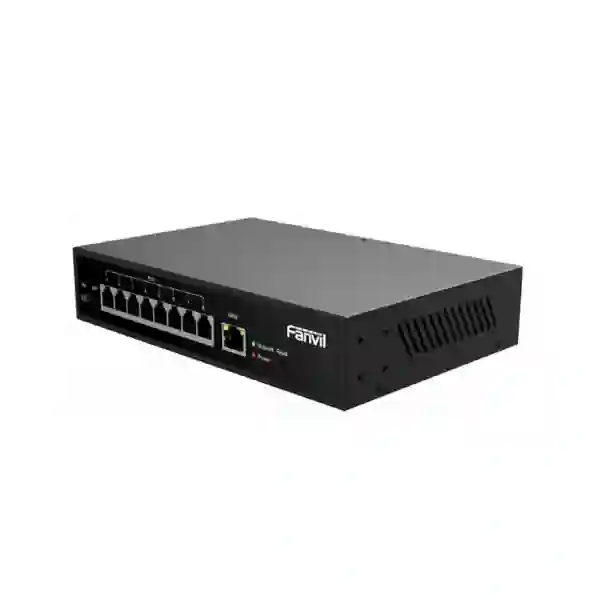
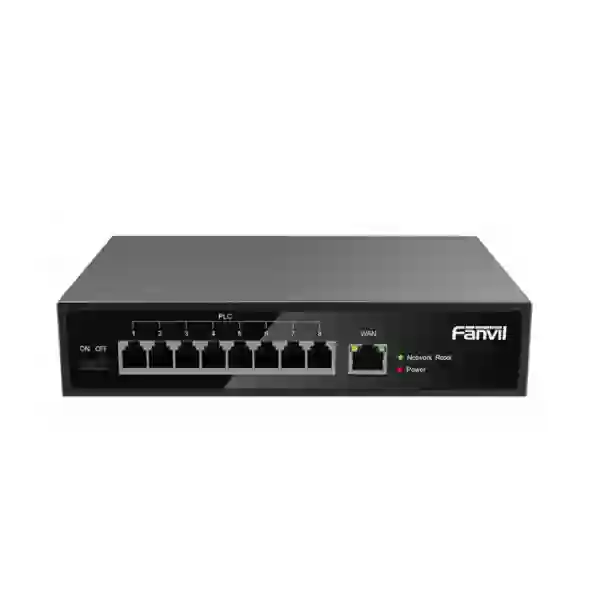
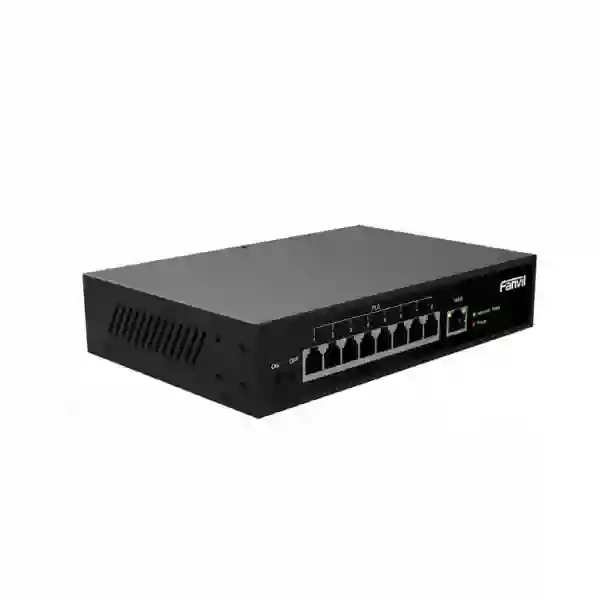
Fanvil PN8 2-Wire PoE Switch
The Fanvil PN8 is designed for projects that need to move compatible communication devices onto an IP network while making practical use of existing two-wire cabling. Instead of assuming that every room or endpoint needs a completely new Ethernet cable run, the PN8 provides eight RJ11 two-wire interfaces and one 10/100 Mbps RJ45 network connection, delivering both data and power to compatible Fanvil two-wire devices across distances of up to 300 metres. For hotels, offices, refurbishment projects and multi-room properties, that approach can reduce the physical disruption associated with recabling while keeping the deployment centered on modern IP communications.
Verified PN8 highlights
✓ 8 × RJ11 2-wire interfaces
✓ 1 × 10/100 Mbps RJ45 network interface
✓ Up to 300 m 2-wire transmission
✓ Reuse of suitable PSTN / RVV cabling
✓ Built-in 100–240 V AC power input
What the Fanvil PN8 is designed to solve
The biggest value of a 2-wire PoE platform appears in buildings where the communication requirement has changed but the existing physical cabling is still usable. Many hotels, apartments, offices, hospitals, schools and older commercial properties were built with telephone-grade or other two-wire cabling reaching rooms and work areas. A conventional IP migration may require new Cat5e, Cat6 or fiber infrastructure before every endpoint can be replaced. The PN8 provides an alternative for compatible Fanvil 2-wire deployments by allowing the network and endpoint power to travel over an appropriate two-wire run.
This does not mean that every old cable should automatically be reused. Cable condition, conductor quality, topology, termination, electrical environment and the intended endpoint all need to be checked. However, when an existing run is suitable, reuse can materially reduce wall opening, conduit work, ceiling access and the coordination burden that comes with a full structured-cabling replacement. For a working hotel or office, less invasive cabling work can be particularly valuable because guest rooms, offices and public areas may need to remain operational during the modernization project.
The PN8 is therefore best understood as a migration and deployment tool rather than a generic Ethernet access switch. It sits between an IP network and compatible two-wire endpoints, giving project planners a way to combine existing building wiring with IP-based services. Organizations evaluating the PN8 should define the number of rooms or endpoints, the cabling type and length, the central network location, the compatible endpoint model, power conditions and future expansion needs before finalizing quantities.
Reuse existing wiring
Fanvil states that the PN8 can reuse existing PSTN and RVV cabling in appropriate deployments. This can make it attractive for renovation projects where replacing all horizontal cabling would be disruptive or expensive.
Network plus power
The switch supports network and power transmission over two-wire links to compatible devices, simplifying the endpoint side when the solution is designed correctly.
Up to 300 metres
Official Fanvil material specifies a transmission distance of up to 300 metres, giving designers flexibility for properties with longer existing runs than typical Ethernet channel limits.
Eight 2-wire ports
Eight RJ11 interfaces make the PN8 suitable for grouping multiple compatible room or desk endpoints back to one central switch location.
Fanvil PN8 technical specifications
| Item | Verified specification |
|---|---|
| Network interface | 1 × RJ45 |
| Network speed | 10/100 Mbps |
| 2-wire interfaces | 8 × RJ11 |
| Transmission distance | Up to 300 metres |
| Power input | Built-in power supply, 100–240 V AC wide-voltage input |
| Operating temperature | -20 °C to 50 °C |
| Enclosure | Galvanized steel |
| Dimensions | 195 × 130 × 40 mm |
| Installation | Desktop, wall-mounted or rack-mounted |
Specifications above are based on Fanvil’s published PN8 documentation. Final project design should still confirm endpoint compatibility, wiring condition, distance, topology and power requirements before deployment.
Compatibility and project planning
Fanvil documentation shows the PN8 being used with the company’s 2-wire endpoint ecosystem, including the X303-2 Wire IP Phone and H1-2 Wire hotel phone. Fanvil also documents a PN1 converter that can be used when a two-wire link needs to terminate into an RJ45-connected device. These relationships matter because the PN8 is not intended to be treated as a universal power source for arbitrary legacy phones or unrelated two-wire equipment.
Before procurement, identify every endpoint and mark whether it will connect directly as a Fanvil two-wire device or require a converter. Measure or estimate cable-run lengths, inspect cable condition where possible and note any splices, distribution frames or cross-connects. The most dependable quotation is based on this physical inventory rather than simply multiplying a room count by one phone and assuming that every cable is reusable.
Fanvil PN8 Tanzania
For organizations in Tanzania, the Fanvil PN8 is especially relevant where an older building already has copper telephone pairs reaching offices, guest rooms, service counters or accommodation units, but the communications platform needs to move toward IP. The practical question is not simply whether the PN8 can be purchased; it is whether the property can use its existing cabling in a controlled migration. A Tanzania deployment should therefore begin with a site-level inventory covering cable routes, endpoint locations, central communications rooms, available rack or wall space, upstream Ethernet connectivity and power protection.
Hotels are a natural example. Replacing every room cable in an occupied hotel can require access to corridors, ceilings and guest spaces. When existing two-wire runs are in suitable condition, a PN8-based design may allow compatible Fanvil room phones to be introduced with less physical disturbance. The same thinking can apply to older offices, schools, clinics, residential compounds and institutional buildings where legacy telephone wiring already reaches many rooms. Because the PN8 supports up to eight two-wire endpoints, planners can map room groups to switch locations and calculate how many units are required per floor, wing or communications cabinet.
Tanzania buyers should also consider power quality and network resilience. The PN8 has a built-in 100–240 V AC input, but the wider installation may benefit from appropriate UPS protection, grounding practices and network-side surge planning based on the site environment. The upstream IP network must also provide the VLAN, DHCP, routing and voice-service connectivity needed by the endpoints. The PN8 itself is one part of that architecture, not a replacement for PBX, SIP configuration or overall LAN design.
FourTeck Tanzania can be approached for solution scoping across IP telephony, network switching and structured infrastructure. For broader infrastructure context, review the FourTeck Tanzania technology portfolio, which covers voice, networking and related business systems. A useful quotation request should include the number of two-wire endpoints, building type, approximate cable lengths, intended Fanvil device model, PBX or SIP platform, and whether installation or configuration assistance is required.
Fanvil PN8 2-Wire PoE Switch Dar es Salaam
Dar es Salaam has a broad mix of hotels, office buildings, commercial complexes, educational sites and renovated properties, which makes cabling strategy an important part of any IP telephony upgrade. The Fanvil PN8 can be considered where a site already has two-wire telephone cabling and wants to introduce compatible Fanvil IP endpoints while minimizing unnecessary civil work. In a busy building, that can matter because new cable installation may involve ceiling access, drilling, trunking, temporary room closures and coordination with facilities teams.
For a Dar es Salaam hotel project, a sensible starting point is a floor-by-floor room schedule. Record each room number, current telephone outlet, cable termination point and approximate distance to the proposed PN8 location. Grouping up to eight compatible endpoints per PN8 can simplify quantity planning, but designers should leave room for practical distribution and future changes. If some rooms have damaged or nonstandard cabling, those exceptions should be treated separately rather than forcing the entire project into one assumption.
Commercial offices may use the PN8 differently. An older office tower or renovated business facility might have legacy analog-extension cabling that reaches desks or service areas. Where those pairs are suitable, the PN8 can create a migration path to compatible Fanvil two-wire phones while the core remains Ethernet and IP based. The upstream network should still be prepared for voice traffic with appropriate addressing, segmentation and quality-of-service policies. PBX registration, SIP credentials and dial-plan behavior are handled at the communications platform and endpoint level, so those requirements should be documented alongside the cabling plan.
When requesting a PN8 quotation for Dar es Salaam, provide the number of endpoints, whether the deployment is hotel, office or institutional, the intended compatible phone model, current PBX information and whether the project is a new installation or a retrofit. This helps distinguish a simple product request from a complete migration project and allows the bill of materials to account for switches, endpoints, possible PN1 converters, network equipment and supporting power protection.
Fanvil PN8 2-Wire PoE Switch Mwanza
In Mwanza, businesses considering a voice-network upgrade may be working with buildings where traditional telephone pairs are already installed but structured Ethernet does not reach every required endpoint. The Fanvil PN8 gives system designers a way to evaluate those existing pairs as part of a modern Fanvil two-wire IP solution. That can be useful for hotels, healthcare environments, offices, educational facilities and multi-room properties where opening walls or installing new cable routes would create avoidable disruption.
A project assessment should separate the condition of the cable from the condition of the old telephone system. Even if the previous PBX or analog phones are obsolete, the copper pair itself may still be usable after inspection and testing. Conversely, some old cables may have undocumented joins, corrosion, damaged insulation or routing problems that make replacement the better option. The PN8 should therefore be part of a measured migration rather than a reason to skip basic cabling checks.
For sites with longer building runs, Fanvil’s stated support for up to 300 metres of two-wire transmission can be valuable, but the exact installation should still follow the manufacturer’s guidance and practical cable conditions. Centralizing PN8 units in a suitable communications space can make maintenance easier because endpoint groups, cable labels and network uplinks can be documented together. The switch’s galvanized-steel enclosure and desktop, wall or rack mounting options give installers flexibility when planning that central point.
Mwanza buyers should request a proposal that distinguishes hardware from implementation services. Hardware quantities may include PN8 switches, compatible Fanvil phones and any converters required by the design. Implementation may include cable testing, labeling, switch mounting, network connection, PBX registration, extension mapping and handover documentation. Clear separation helps procurement teams compare offers on the same scope rather than focusing on the PN8 unit price alone.
Fanvil PN8 2-Wire PoE Switch Arusha
Arusha’s hospitality, tourism, institutional and business environments often include properties that have evolved over many years. A lodge, hotel or office may have dependable two-wire telephone cabling already routed to rooms even though the communications requirement has moved toward SIP and IP telephony. The Fanvil PN8 can support a staged modernization strategy by carrying network connectivity and power over compatible two-wire runs to supported Fanvil devices.
Hospitality deployments deserve particular planning because a guest-room telephone is not an isolated device. It may need to register with an IP PBX, support programmed service keys, follow room-status or property workflows and remain simple for housekeeping and front-desk operations. The PN8 solves the transport and power portion of the connection; the wider voice solution must still account for the PBX, extension plan, SIP configuration, reception requirements and any hotel-system integration expected by the customer.
For Arusha refurbishment work, consider installation sequencing. Instead of recabling an entire property at once, a project can be organized by floor, building or room block after the existing pairs are checked. This makes it easier to test each group of endpoints, verify registration and confirm call behavior before moving to the next area. Where suitable, one PN8 can serve up to eight two-wire endpoint runs, so room grouping can be reflected in the rack or wall layout and in the labeling scheme.
Procurement teams should include cable information in the request for quotation rather than asking only for a product price. State whether the property uses legacy telephone pairs, approximately how many rooms or extensions are involved, whether existing cabinets or patch points are available, and which compatible Fanvil handset is preferred. If the endpoint model is not yet selected, request a solution recommendation based on the room use, required keys, user interface and PBX environment.
Fanvil PN8 2-Wire PoE Switch Dodoma
Organizations in Dodoma evaluating communication upgrades may have government, institutional, educational, hospitality or corporate buildings with pre-existing telephone wiring. The Fanvil PN8 is relevant where those two-wire runs can be retained as part of a compatible Fanvil IP deployment. Its role is straightforward: connect the central Ethernet network to up to eight two-wire links and transport both network connectivity and power to supported devices.
For procurement planning, the strongest approach is to define the operational outcome before specifying quantities. A building may need guest-room phones, internal extensions, service-desk communications or phones in locations where new Ethernet is difficult to install. Once those endpoints are listed, the existing cable routes can be checked and grouped. This avoids underestimating the number of PN8 units or purchasing hardware before discovering that some runs require new cabling.
Dodoma projects should also consider resilience at the central equipment point. The PN8 accepts 100–240 V AC through its built-in power supply, but the communications service may depend on several other systems: the upstream LAN, IP PBX, SIP trunk or gateway, internet connectivity where relevant and backup power. If the voice service is expected to remain available during short power interruptions, the design should assess UPS capacity for the complete chain instead of protecting only the PN8.
A complete request for quotation can include hardware supply, cable assessment, installation, configuration and testing as separate items. For customers already running an IP PBX, provide the PBX brand and model, current extension numbering and any VLAN information available. For a new voice platform, define the number of users, external lines or SIP services, reception workflow and call-routing needs. This gives the PN8 a clear place inside a broader solution rather than treating it as a standalone telephone system.
Fanvil PN8 2-Wire PoE Switch UAE
In the UAE, the Fanvil PN8 can be relevant to hotel renovations, serviced apartments, offices and mixed-use buildings that already contain large amounts of telephone-grade two-wire cabling. The commercial value is strongest when retaining suitable existing cable can reduce the need for intrusive recabling across occupied spaces. A project team can keep the IP core and PBX architecture modern while using the PN8 to bridge compatible Fanvil two-wire endpoints into that environment.
High-density hospitality projects should map endpoint groups carefully. Eight RJ11 interfaces per PN8 means the unit can be associated with a small block of rooms or endpoints, but actual cabinet planning should account for cable terminations, labeling, Ethernet uplinks, power distribution and service access. A neat installation is easier to troubleshoot than a retrofit where old pairs are moved without documentation. For larger properties, the PN8 can be deployed in multiple distribution locations rather than forcing every cable back to one distant rack.
The UAE market also places emphasis on project coordination and handover. Buyers should request cable schedules, port labeling, endpoint maps and configuration records where installation services are part of the scope. The upstream voice network should be reviewed for VLAN design, addressing and PBX connectivity. Fanvil’s two-wire architecture is a transport option; it does not remove the need to plan the IP layer or voice-service configuration.
For UAE-wide technology sourcing and related networking requirements, the FourTeck regional technology site provides a broader reference point for integrated IT and telecom projects. A PN8 inquiry should identify building type, endpoint count, compatible phone model, cable condition and whether the request covers product-only supply or a designed migration with testing and configuration.
Fanvil PN8 2-Wire PoE Switch Uganda
Uganda organizations with legacy telephone cabling can evaluate the Fanvil PN8 as part of an IP telephony modernization plan. Hotels, schools, offices, healthcare facilities and accommodation properties often have two-wire pairs already running to rooms, while the core communications requirement is increasingly based on SIP and IP networks. Where the installed cabling is suitable, the PN8 can connect those room or desk runs to an Ethernet-based voice environment without requiring every endpoint path to be rebuilt from scratch.
The design should start with a cable and endpoint inventory. Note how many pairs terminate at each distribution point, the approximate length of the runs, the rooms served and whether the pairs are dedicated or shared through old telephone distribution hardware. Any legacy splitters, bridged taps or undocumented cross-connections should be reviewed because an IP-over-two-wire deployment benefits from clean, traceable paths. The goal is to reuse good infrastructure, not preserve problematic wiring simply because it already exists.
Fanvil specifies up to 300 metres transmission for the PN8 two-wire link, which can make the platform useful across larger properties. Still, actual deployment quality depends on cable condition and correct installation. Endpoint compatibility should be confirmed at the same time, particularly when using Fanvil X303-2 Wire or H1-2 Wire devices or when considering PN1 converters for RJ45-connected equipment.
For Uganda-specific infrastructure and solution context, visit FourTeck Uganda. A useful quotation request should specify the project location, quantity of endpoints, cabling type if known, intended phones, PBX information and required services such as testing, mounting, configuration or handover documentation.
Fanvil PN8 2-Wire PoE Switch Kampala
Kampala has many commercial and hospitality properties where communications systems have been upgraded more frequently than the physical building cabling. The Fanvil PN8 is well suited to evaluation in that kind of retrofit. Its eight two-wire interfaces allow compatible endpoints to use existing suitable copper pairs, while the switch links back to the IP network through its RJ45 connection. For a renovation team, this can create a practical path from legacy cabling to modern SIP-based endpoints.
The main planning advantage is reduced dependency on new horizontal cabling, but that advantage is only real when the existing pairs are tested and documented. A Kampala hotel could begin with one floor or room block, validate cable continuity, install the PN8 in a secure distribution location and connect compatible room phones. Once call registration, audio quality and PBX behavior are confirmed, the same process can be repeated across other areas. A pilot-first approach can reduce deployment risk in occupied properties.
For office environments, the PN8 may support extensions in areas where new Ethernet is difficult to route. However, buyers should compare the life-cycle value of reusing old pairs against installing new structured cabling where access is easy. New Ethernet may be preferable in sections undergoing major refurbishment, while PN8-based reuse may be more attractive in finished rooms or protected interiors. A hybrid design can be more sensible than insisting on one cabling method throughout the site.
When requesting a Kampala quote, include both the immediate endpoint count and likely future expansion. This helps determine whether PN8 units should be installed close to current capacity or with spare grouping flexibility. Also provide information about PBX platform, network switching and power backup so the proposal can account for the whole communications path rather than only the two-wire device.
Fanvil PN8 2-Wire PoE Switch Arua
For projects in Arua, the Fanvil PN8 can support a measured upgrade path where a property already has conventional two-wire telephone cabling but wants compatible IP-based endpoints. In smaller hotels, offices, clinics or institutional buildings, this may help reduce the installation burden of pulling new Ethernet to every room. The key is to treat cable reuse as an engineering choice supported by inspection rather than an automatic assumption.
A practical survey can be simple but should be systematic. Identify where the existing telephone cables originate, count the usable pairs, mark the rooms or desks they serve and note any areas where the route appears damaged or undocumented. Because the PN8 supports eight RJ11 two-wire connections, endpoint groups can be matched to switch quantities. The upstream RJ45 connection can then join the local Ethernet network, where IP addressing, PBX access and voice policy are handled.
Power and environment should also be included in the design. The PN8 supports a 100–240 V AC input and an operating temperature range published by Fanvil from -20 °C to 50 °C. Even so, install the unit in a protected, ventilated and serviceable location, not in an exposed area simply because that is where old telephone joints happen to be. Good equipment placement improves maintenance and reduces accidental disconnection.
Arua customers comparing quotations should ask suppliers to state exactly what is included: PN8 hardware, compatible handsets, converters where needed, patching materials, cable testing, installation, PBX configuration and user handover. This makes pricing more transparent and reduces the risk of discovering after purchase that key implementation work was outside the quoted scope.
Fanvil PN8 2-Wire PoE Switch Mbarara
Mbarara businesses and institutions upgrading communications may find the Fanvil PN8 useful when the existing building wiring includes reliable two-wire telephone pairs. Rather than viewing an IP phone project only through the lens of new Cat6 cabling, the PN8 allows planners to consider a dedicated Fanvil two-wire architecture for compatible endpoints. This can be attractive in properties where rooms are already finished or where extensive new cable routing would be disruptive.
The decision should take into account expected service life and future changes. If a building is about to undergo major renovation, installing structured Ethernet may offer wider long-term flexibility. If the building is operational and its two-wire cabling is in good condition, using the PN8 may allow a faster and cleaner telephony upgrade. The correct answer can differ by floor or department, so mixed cabling strategies are valid when clearly documented.
A PN8 deployment should also be sized around distribution points rather than only total endpoint count. A property with sixteen phones does not automatically need two PN8 units if those phones are split across distant cable termination areas. Conversely, a compact eight-room block may fit neatly onto one PN8. Reviewing where the existing pairs terminate prevents awkward extensions and keeps service access manageable.
Mbarara procurement teams can improve proposal accuracy by sharing a basic building or floor plan, room count and information on the current phone system. State whether the desired outcome is simply replacing handsets, introducing a new IP PBX, integrating reception functions or modernizing a hotel room-phone environment. This allows the PN8 to be specified as part of a complete voice solution rather than as an isolated switch purchase.
Fanvil PN8 2-Wire PoE Switch Gulu
In Gulu, a Fanvil PN8 project can be relevant where an organization needs modern IP communication endpoints but has useful two-wire cabling already embedded in the building. Hotels, education facilities, offices and healthcare environments can all have large numbers of legacy telephone pairs. Replacing those cables may be unnecessary in some areas if the existing runs are suitable for Fanvil’s two-wire solution.
The PN8 can carry network data and power to compatible devices across up to 300 metres according to Fanvil’s published specifications. That distance capability can be helpful for dispersed properties, but designers should not use the maximum figure as a substitute for site assessment. Long runs should be identified, cable quality should be checked and the switch location should be selected with access, power and network connectivity in mind.
A well-organized Gulu deployment should label every two-wire port to its destination. This is particularly important in retrofit projects because old distribution frames may contain unused or mislabeled pairs. Clear labels and a port schedule shorten troubleshooting time later. The RJ45 uplink should also be documented with the corresponding network switch port, VLAN and IP voice design where applicable.
When evaluating cost, compare the whole project rather than only device prices. A PN8-based migration may reduce new cabling labor and building disturbance, but the scope may still include endpoint hardware, network preparation, PBX configuration, testing and support. Ask for a bill of materials and service scope that makes those components visible. This gives decision-makers a better basis for comparing a two-wire retrofit with a full structured-cabling replacement.
Fanvil PN8 2-Wire PoE Switch Kenya
Kenya has a large base of hotels, offices and institutional properties where IP telephony upgrades may need to work around existing building infrastructure. The Fanvil PN8 offers a targeted solution for sites that can reuse suitable two-wire cabling with compatible Fanvil endpoints. It is particularly relevant when the operational cost and disruption of replacing every telephone pair with Ethernet would be disproportionate to the communication requirement.
For hotel environments, planners can map PN8 units to room clusters and use the existing risers or floor distribution points when technically appropriate. That can reduce new cable routes through guest areas while still enabling an IP-based PBX architecture. The room phone must be a compatible Fanvil two-wire model, and any need to connect an RJ45 device over the two-wire span should be reviewed against Fanvil’s PN1 converter approach.
For corporate sites, the same platform may help preserve cabling to service counters, reception spaces or remote offices within a building. However, new Ethernet should still be considered where future bandwidth requirements extend beyond telephony. The PN8 is a purpose-built two-wire PoE solution, not a replacement for general-purpose LAN switching to computers, access points or other high-bandwidth devices.
For Kenya-specific sourcing and systems context, consult FourTeck Kenya. When requesting a PN8 quotation, provide project city, property type, endpoint quantity, cable details and PBX environment. If the project spans multiple branches, include each site separately so the cabling and switch quantities can be evaluated on their own physical conditions rather than averaged across the entire rollout.
Fanvil PN8 2-Wire PoE Switch Kuwait
Kuwait retrofit projects can involve hotels, offices, residential properties and institutional buildings where legacy telephone cabling remains physically installed even after the communications platform has become outdated. The Fanvil PN8 creates an option to use suitable two-wire runs with compatible Fanvil IP endpoints, reducing the need for immediate recabling in areas where access is difficult or finishes should be preserved.
A robust design starts with the existing telecommunications room. Determine where the old telephone pairs terminate, how they are distributed and whether there is sufficient space, power and Ethernet connectivity for PN8 units. Because the device supports desktop, wall and rack installation, the physical mounting can be adapted to the available environment. The objective should be a tidy, labeled arrangement that technicians can understand without reverse engineering old wiring each time a fault occurs.
The PN8 should also be considered in relation to building renovation cycles. If a hotel floor will remain in service for years without major construction, reusing suitable two-wire infrastructure may offer a practical migration path. If walls and ceilings are already being opened for refurbishment, installing new structured cabling at the same time may provide broader future flexibility. A technology proposal should explain why the selected approach fits the physical project rather than treating cable reuse as automatically superior.
Kuwait buyers should request confirmation of endpoint compatibility and the intended operating topology before purchase. Include the number of room or desk phones, cable-run estimates and the target PBX or SIP platform. Ask for optional installation and testing as separate line items if procurement needs to compare product-only pricing with a full turnkey deployment.
Fanvil PN8 2-Wire PoE Switch Ghana
For Ghanaian organizations, the Fanvil PN8 can be a practical component in projects where two-wire telephone cabling already reaches many user locations. A modern IP communications project normally focuses on SIP, PBX features and endpoint usability, but the physical cable path can become the most expensive part of a retrofit. The PN8 provides a way to evaluate existing suitable pairs rather than assuming that every endpoint needs a new Ethernet run.
Hotels are a strong use case because guest-room cabling is often hidden behind finished interiors and may be expensive to replace. By grouping compatible Fanvil two-wire phones onto PN8 switches, a property can retain portions of the existing cabling while moving the core voice platform to IP. That said, each cable path should be verified and documented, especially in older properties where years of maintenance may have introduced splices or changes that are not shown on drawings.
For institutional and office settings, the purchasing decision should compare the PN8 approach with structured-cabling upgrades. Two-wire reuse is particularly attractive when the endpoint requirement is specifically telephony and the building finish should remain untouched. New Ethernet may be more suitable when the same location will later require PCs, Wi-Fi access points, cameras or other data devices. Planning around the long-term use of each outlet prevents short-term savings from creating a future limitation.
A Ghana quotation should include endpoint counts by building or floor, cable information, preferred Fanvil phone models and PBX details. Buyers can also consult FourTeck Africa for broader regional IT and communications solution context when coordinating projects that extend beyond a single country.
Fanvil PN8 2-Wire PoE Switch Nigeria
Nigeria’s large hospitality, corporate and institutional market includes many properties with substantial existing analog telephone infrastructure. The Fanvil PN8 can be considered when those two-wire cable runs are still serviceable but the organization wants to migrate compatible endpoints to an IP communications platform. By carrying network and power over two-wire links, the PN8 can reduce the need for invasive recabling in selected parts of a property.
Large sites should avoid sizing solely by total phone count. Instead, map the physical distribution of the pairs and locate the points where groups of cables converge. Eight endpoints can connect to each PN8, but if eight cables terminate in different buildings, a single centrally located switch may not be practical. Network planners should create a floor or building schedule that links each room, cable pair, PN8 port and upstream Ethernet connection.
Power resilience is another important design topic. The PN8 has a built-in wide-voltage input, but telephony availability depends on the upstream switching, PBX and any network services used for call routing. Organizations that require continuity during power disturbances should evaluate UPS coverage for the complete communication chain. This is particularly relevant for reception, security, healthcare or operational areas where internal calling is business critical.
For procurement, request a solution bill of materials rather than only a PN8 price. The complete requirement may include compatible Fanvil two-wire phones, PN1 converters for specific RJ45 device scenarios, Ethernet switches, UPS capacity and implementation services. A clear scope should state whether configuration, cable testing and PBX integration are included. This prevents product pricing from being mistaken for the total project cost.
Fanvil PN8 2-Wire PoE Switch Seychelles
In Seychelles, hospitality properties and island facilities may face a particular incentive to reuse sound building infrastructure where replacement work is disruptive. The Fanvil PN8 can support compatible Fanvil two-wire telephony deployments by using existing suitable copper pairs for both network connectivity and endpoint power. For hotels and resorts, this may help modernize room communications while reducing the amount of new cable routing through finished guest areas.
A resort deployment should consider how equipment will be distributed across separate buildings, floors or villas. Although Fanvil specifies up to 300 metres transmission over two-wire links, the correct architecture should reflect actual cable routes and network distribution. It may be preferable to place PN8 units closer to endpoint groups, with Ethernet uplinks connecting those locations back into the property network, rather than relying on very long or poorly documented legacy cable paths.
Environmental conditions also make equipment placement important. The PN8 should be installed in a protected location with appropriate power and service access. Existing cable pathways should be checked for corrosion, moisture exposure and previous repairs before reuse. The goal is not simply to keep old wire in service; it is to preserve usable infrastructure while replacing weak or unreliable segments as part of a controlled upgrade.
Seychelles procurement teams can improve quotation quality by supplying a room schedule, building map, current phone-system details and photos or descriptions of cable termination points where available. If the project includes PBX modernization, ask for the telephony platform, endpoint configuration, reception design and extension mapping to be included in the proposal. This ensures that the PN8 is integrated into the complete communication solution rather than purchased without a deployment plan.
Deployment and installation guidance
A good PN8 installation begins with documentation. Label every two-wire run at both ends, record its destination, note the approximate length and mark the PN8 port used. Where the original telephone distribution frame is retained, remove or isolate obsolete bridging components that are not part of the new design. Keep the switch in a serviceable location and use the installation method that best fits the environment: desktop, wall or rack mounting according to Fanvil’s published options.
Fanvil’s installation documentation notes that two-wire cords should use the center positions of the RJ11 connector when cables are made on site. Power should be disconnected during wiring work. This is an important reminder that although the system is designed for straightforward deployment, cabling should still be handled as an engineered connection rather than improvised at the endpoint.
After physical installation, test each endpoint for power-up, network reachability, PBX registration, inbound calling, outbound calling and expected feature behavior. Record results against the room or extension schedule. If the project involves hotel phones, include front-desk call flows and any programmed keys in acceptance testing. If the project involves offices, test internal extensions, external dialing and voicemail or hunt groups where applicable.
Related FourTeck solution areas
IP telephony planning
The PN8 transports connectivity to compatible endpoints; the overall project still needs SIP and PBX design. Review FourTeck Tanzania services when the requirement includes design, implementation or support rather than hardware only.
Product sourcing
For broader product procurement and complementary network requirements, the FourTeck Tanzania shop provides a useful route into available technology categories and related infrastructure.
PN8 quotation checklist
To receive a more useful quotation, provide the following project information where available:
• Number of two-wire endpoints required.
• Building type: hotel, office, school, healthcare, residential or other.
• Existing cable type and approximate run lengths.
• Intended Fanvil two-wire endpoint model.
• Existing or planned IP PBX / SIP platform.
• Number and location of telecom distribution points.
• Need for PN1 converters or RJ45-device connections.
• Installation, cable testing and configuration scope.
• UPS, rack, network-switch or structured-cabling requirements.
Frequently asked questions
What is the Fanvil PN8?
The PN8 is a Fanvil 2-wire PoE switch with one RJ45 network interface and eight RJ11 two-wire interfaces. It is designed to deliver network connectivity and power over suitable two-wire cabling to compatible Fanvil devices.
How far can the PN8 transmit over two-wire cabling?
Fanvil publishes a maximum transmission distance of up to 300 metres. Actual installation planning should still consider cable condition, topology and manufacturer guidance.
Can the PN8 reuse old telephone wiring?
Fanvil specifically positions the PN8 for reuse of suitable existing PSTN and RVV cabling. Before reuse, the cable should be inspected or tested so damaged, shared or undocumented runs do not undermine reliability.
Which phones work with the PN8?
Fanvil documents the PN8 in its 2-wire ecosystem and shows compatibility with products such as the X303-2 Wire IP Phone and H1-2 Wire hotel phone. Project-specific compatibility should be confirmed before ordering.
Does the PN8 replace an IP PBX?
No. The PN8 provides the two-wire network and power transport for compatible endpoints. Call control, extensions, SIP registration, routing and voice features remain functions of the IP PBX or communications platform.
Can the PN8 connect an ordinary RJ45 device across two wires?
Fanvil documents the PN1 2-wire converter for scenarios where the two-wire link needs to terminate into an RJ45-connected device. The exact topology should be checked against Fanvil guidance before deployment.
How many endpoints can one PN8 serve?
The PN8 provides eight RJ11 two-wire interfaces. Quantity planning should still consider where cable runs terminate, because endpoint geography can require multiple switch locations even when total device count is low.
What should I send when requesting a PN8 quote?
Send the endpoint quantity, building type, project location, cable details, preferred Fanvil phone model, PBX information and the required installation or configuration scope. A floor plan or room schedule can further improve project sizing.
Decision recap
Choose the Fanvil PN8 when the project specifically benefits from reusing suitable two-wire cabling for compatible Fanvil endpoints, especially in retrofits where new Ethernet cabling would create significant disruption. Its eight 2-wire ports, 10/100 Mbps Ethernet uplink, up-to-300-metre transmission capability and wide-voltage built-in power input make it a focused tool for voice and communication modernization.
Do not choose it merely because old telephone cable exists. First confirm cable condition, endpoint compatibility, switch location and the wider IP/PBX design. In buildings undergoing full renovation, new structured Ethernet may offer more future flexibility. In occupied or finished spaces with sound existing pairs, a PN8-based architecture can be a highly practical alternative.
Talk to FourTeck about your Fanvil PN8 deployment
A useful PN8 discussion begins with the building and cabling, not only the switch model. Share your room or extension count, current wiring, compatible endpoint requirement and PBX environment. FourTeck can then help frame the product quantities and the surrounding network, telephony and implementation scope. For cross-border projects, the regional sites linked above can also support a consistent procurement and solution-planning conversation.
If you are unsure whether the PN8 or a conventional Ethernet-based deployment is the better option, request a comparison based on your physical site conditions. That approach makes the decision easier to defend technically and commercially.




Reviews
There are no reviews yet.