
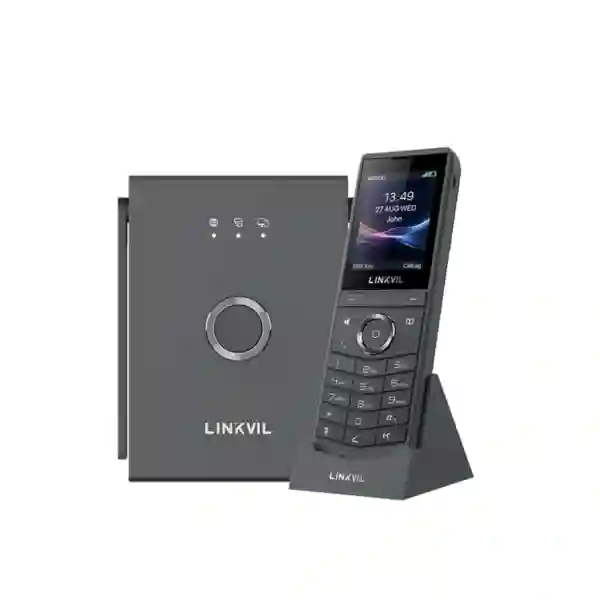
LINKVIL W620P DECT Phone System
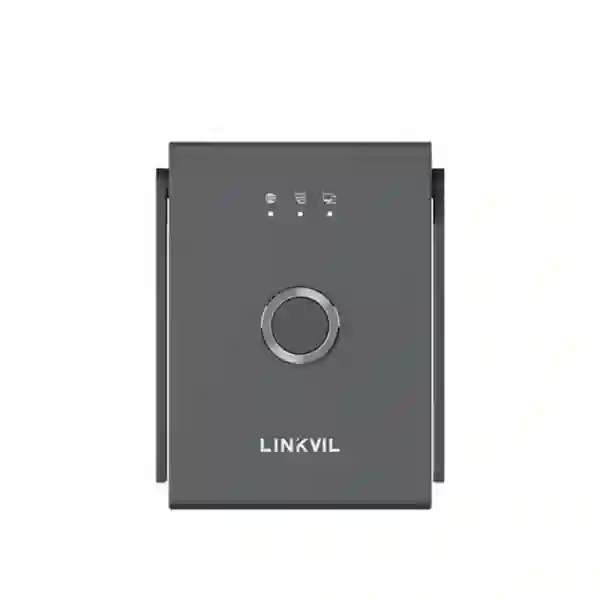
The LINKVIL W620P DECT Phone System is a single-cell cordless SIP communication solution designed for small and medium business environments that need staff mobility without giving up business telephony features. The system pairs the W710D base station with W620D cordless handsets and supports up to 10 handsets, 10 simultaneous calls, 20 SIP accounts and 10 internal extensions. For workplaces such as offices, reception areas, retail stores, clinics, service counters, light warehouses and operational teams, it provides a practical way to extend IP telephony beyond fixed desk phones.
What the LINKVIL W620P is designed to solve
A fixed desk phone works well when a user remains at one workstation, but many business roles involve constant movement. Store supervisors walk between shelves, clinic personnel move between rooms, warehouse coordinators move across work areas, and office support teams may need to answer calls away from a desk. The W620P addresses that mobility requirement by moving SIP calling onto cordless DECT handsets while keeping the system connected to the organisation’s IP telephony environment.
The system is especially useful when a business needs more than a consumer cordless phone but does not yet require a larger multi-cell DECT architecture. Its single-cell design is easier to scope for compact sites, while the ability to register multiple handsets and support multiple calls lets teams share one base platform. Buyers should still plan around actual building layout, walls, radio conditions, user count, call concurrency and PBX compatibility rather than relying only on theoretical range figures.

Official product image shown for identification. Final configuration should be matched to the required handset quantity and telephony environment.
Verified LINKVIL W620P capabilities
Capacity
The W620P platform supports up to 10 cordless handsets, up to 10 simultaneous calls, 20 SIP accounts and 10 internal extensions. These figures make it suitable for small teams that need shared cordless availability without moving immediately to a multi-cell deployment.
Coverage
The published wireless range is up to 50 metres indoors and 300 metres outdoors in suitable conditions. Real buildings can reduce coverage through concrete, metal, shelving, equipment, room density and radio interference, so placement remains important.
Handset experience
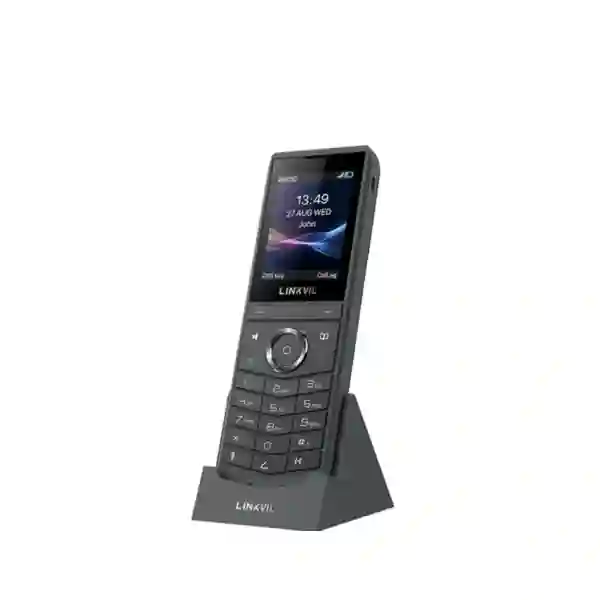
The W620D handset uses a 2.4-inch 240 × 320 colour screen, supports a large local contact directory, programmable DSS functions and business audio features including HD voice, intelligent noise reduction and acoustic shielding.
Battery
Published figures list up to 13 hours of talk time and up to 240 hours of standby time under ideal conditions. Actual endurance varies with usage, signal strength, configuration, battery condition and operating environment.
Technical and deployment overview
| System type | Single-cell DECT IP phone system |
|---|---|
| Base / handset | W710D base station with W620D cordless handset |
| Handset capacity | Up to 10 handsets |
| Concurrent calls | Up to 10 simultaneous calls |
| SIP accounts | Up to 20 |
| Indoor / outdoor range | Up to 50 m indoors / 300 m outdoors under suitable conditions |
| Handset display | 2.4-inch, 240 × 320 colour screen |
| Base network ports | 2 × 10/100 Mbps Ethernet ports; PoE support is documented |
| Battery figures | Up to 13 hours talk time and up to 240 hours standby in ideal conditions |
Compatibility, PBX planning and buying guidance
The W620P is built around SIP-based IP telephony, which makes it relevant to organisations using an IP PBX or hosted voice platform. However, SIP support alone should not be treated as a guarantee that every feature will behave identically on every PBX. Provisioning methods, directory synchronisation, call features, codec selection, extension policies, NAT handling, firmware versions and vendor-specific integrations can affect the user experience. Before purchasing, confirm the intended PBX or hosted voice service, number of extensions, expected simultaneous calls and any required features such as transfer, hold, conference, shared directories or programmable keys.
Infrastructure matters as much as the handsets. The W710D base needs reliable Ethernet connectivity, appropriate IP addressing and reachability to the SIP platform. Where Power over Ethernet is used, confirm the network switch can provide suitable PoE. Voice VLANs, QoS policies, firewall rules, DHCP options, time services and secure remote management may also form part of a professional deployment. FourTeck Tanzania can be contacted through the technology enquiry page with the existing PBX, user count, floor plan and mobility requirements so that the discussion starts with the actual environment rather than only a model number.
Who should consider the W620P?
The W620P is a good candidate for a compact business site where users move within a defined coverage area and where no more than 10 cordless handsets are required on a single base. Typical examples include reception and administration teams, retail stores, clinics, workshops, small warehouses, hospitality back-office functions, schools, service desks and branch offices. It may be less suitable for a campus, multi-floor complex or large warehouse where users need seamless roaming across multiple radio cells. In those environments, a multi-cell DECT design or another wireless voice architecture should be assessed instead of stretching a single-cell product beyond its intended role.
LINKVIL W620P DECT Phone System Tanzania
For Tanzanian businesses, the LINKVIL W620P fits a common requirement: giving staff a professional extension they can carry while remaining connected to an IP-based business phone system. In an office, the handset can support reception overflow, supervisors, facilities teams or staff who regularly move between rooms. In a retail environment, it can help a manager remain reachable while assisting customers or checking stock. In a clinic, workshop or light warehouse, it can reduce the need to return to a fixed desk simply to answer or place internal calls. The value comes from combining mobility with a central SIP telephony architecture rather than creating a separate consumer cordless setup.
A Tanzania deployment should begin with site conditions. Published range figures of up to 50 metres indoors and 300 metres outdoors are useful for initial planning, but they should never replace an assessment of walls, shelving, machinery, reinforced concrete, floor changes and radio interference. The W620P is a single-cell system, so base placement has a direct effect on usable coverage. A centrally positioned base with proper Ethernet access can work well for compact premises, while long corridors, thick walls and divided floors can create weak areas. Businesses should therefore provide a rough floor plan, identify where users spend time and note any areas where voice coverage is especially critical.
Capacity planning is equally important. The platform supports up to 10 handsets and 10 simultaneous calls, but a buyer should distinguish between the number of users, the number of physical handsets and expected peak call concurrency. A ten-person team does not necessarily need ten simultaneous external calls, while a reception-heavy operation might need more concurrent call handling than its headcount suggests. Buyers should also identify the PBX or hosted SIP platform already in use, whether extensions are individual or shared, and whether directory, transfer, conferencing or programmable-key functions are operational priorities.
For procurement, request a quotation that clearly states handset quantity, base quantity, required accessories, power method, PBX platform and deployment location. The FourTeck Tanzania technology portfolio also covers IP PBX, IP phones, switching, Wi-Fi and other network infrastructure, which is relevant because cordless voice still depends on a stable network and properly configured telephony environment. This broader project view helps prevent a phone purchase from being separated from the Ethernet, PoE, VLAN and PBX requirements that determine whether the system performs reliably in everyday use.
LINKVIL W620P DECT Phone System Dar es Salaam
Dar es Salaam organisations often need communication systems that support mobile staff within busy commercial premises. The W620P can suit offices, showrooms, clinics, service centres, retail stores and operational facilities where a user may need to leave a desk but remain reachable on a business extension. Rather than depending on personal mobile phones for internal communication, a DECT handset can keep staff connected to the organisation’s SIP environment, helping maintain consistent extension-based calling and business call handling.
The best way to evaluate the W620P in Dar es Salaam is to map the real user movement pattern. A small office may need coverage across reception, meeting rooms and management areas. A retail site may need calling across front-of-house, stock room and administration. A clinic may need handsets shared between reception and service rooms. Each of these layouts introduces different radio challenges, so base positioning should be chosen for coverage rather than convenience. Metal shelving, structural concrete and equipment can affect DECT performance even when the linear distance from the base appears modest.
Network readiness should be checked at the same time. The W710D base is an IP-connected device and therefore depends on Ethernet, addressing, DNS or SIP server reachability, and the policies of the existing network. If the base is powered by PoE, verify switch capability and available power budget. If the organisation separates voice traffic using VLANs, ensure the base receives the correct network configuration. If the PBX is hosted outside the site, firewall and NAT behaviour may need to be considered. These details are not unique to Dar es Salaam, but they become especially important where businesses combine local branch infrastructure with cloud-hosted voice platforms.
When requesting pricing for a Dar es Salaam site, specify the number of W620D handsets, desired extension assignments, existing PBX brand or hosted service, number of floors, approximate coverage area and any high-priority calling features. FourTeck’s Tanzania services page is relevant for buyers considering the W620P as one component of a wider telecom or network project. A complete requirement may include the DECT system, PBX configuration, PoE switching, cabling, firewall changes and user setup, so scoping these dependencies together can produce a clearer and more useful quotation than treating the cordless phones as isolated hardware.
LINKVIL W620P DECT Phone System Mwanza
In Mwanza, the W620P can support businesses that need staff mobility within compact offices, clinics, retail premises, workshops and service operations. The key buying question is not simply whether a cordless phone works, but whether one single-cell DECT base can serve the actual layout while supporting the required handset count and peak call traffic. The system’s published capacity of up to 10 handsets and 10 simultaneous calls gives small teams useful headroom, yet the site should still be assessed for how many users will actively call at the same time and where they move during the day.
A practical Mwanza deployment plan should identify the network cabinet or switch location, the potential base-station position and the furthest working areas where voice coverage is required. If the base is mounted close to network infrastructure but far from users, radio performance may be compromised. Conversely, placing it centrally may require extra cabling. This is why DECT design and structured cabling decisions should be considered together. Buyers should also confirm whether the site uses PoE, since the W710D supports PoE and this can simplify installation where a compatible switch is already present.
The handset experience may be particularly useful for managers and service staff who need a familiar physical keypad and dedicated business calling device. The W620D includes a colour display, programmable DSS functions, a local contacts capacity and noise-processing features intended to make day-to-day calling more practical. Battery figures are published as up to 13 hours of talk time and 240 hours of standby in ideal conditions, but charging routines and battery condition should be considered for shift-based teams. Where handsets are shared, define who is responsible for charging, naming and extension assignment so the system remains organised.
For a Mwanza quotation, include the type of premises, floor count, approximate dimensions, quantity of staff, expected handsets, PBX platform and whether installation or configuration support is required. If the site already uses fixed SIP phones, explain whether the new cordless extensions should share numbers or receive separate identities. Providing this context helps distinguish a straightforward product supply request from a telephony integration project and makes it easier to identify whether the W620P is appropriately sized or whether a more expansive wireless voice design should be considered.
LINKVIL W620P DECT Phone System Arusha
Arusha businesses in hospitality support, professional services, healthcare, retail, education and operations may need cordless voice communication that is more structured than using personal mobile phones. The LINKVIL W620P is relevant where a compact site already uses SIP telephony or plans to move toward an IP PBX. By registering multiple cordless handsets to one W710D base, a team can keep business extensions available while employees move within the supported radio area. This can be particularly useful for reception, supervisors, facilities personnel and customer-facing employees.
Hospitality and guest-facing environments should pay close attention to physical layout. Guest facilities can have thick walls, separated service areas, kitchens, back offices and outdoor transition spaces. The published coverage values provide a reference, but deployment should be based on real building construction and expected handset movement. A single-cell system is not designed to provide seamless roaming between multiple bases, so large properties should not assume that adding independent bases will produce a multi-cell experience. Where one base cannot adequately cover the operational area, a different architecture should be evaluated.
For offices and service companies in Arusha, PBX compatibility and call workflow may be the larger issue. Buyers should list the features users rely on: extension-to-extension calling, transfer, hold, conference, caller identification, shared directories or programmable shortcuts. The W620P supports SIP-based operation, but the available feature set in a real installation depends on the PBX and how the extensions are provisioned. Testing a representative handset against the selected voice platform can therefore be valuable when a deployment depends on particular call-control behaviour.
Procurement should include the quantity of handsets, spare or replacement requirements, charging arrangements, network connection method and configuration responsibility. The FourTeck Tanzania contact page lists Arusha among its office contacts and provides a central route for technology enquiries. Buyers can use that channel to submit the intended site, coverage requirement and PBX details so that product selection is tied to real conditions rather than based solely on a catalogue specification.
LINKVIL W620P DECT Phone System Dodoma
For organisations in Dodoma, the W620P can provide a straightforward cordless extension layer for a SIP-based phone system. Administrative offices, service counters, clinics, training facilities and other compact workplaces may benefit when staff need to move between rooms while remaining reachable. The ability to support up to 10 registered handsets gives a small team room to allocate devices by person, department or function, while support for up to 10 simultaneous calls provides call capacity that can exceed what many small cordless systems are designed to handle.
Site planning should start with a distinction between radio range and network connectivity. The handset communicates wirelessly to the W710D base using DECT, while the base connects into the IP network. This means a successful installation needs both a good base location for wireless coverage and a stable Ethernet path to the telephony platform. The best physical position may therefore require cabling to a central point rather than leaving the base beside the network rack. If PoE is available, the installation can be cleaner because power can be delivered over the network connection, but switch compatibility and power budget should be checked.
Dodoma buyers should also decide how cordless extensions fit into the broader call plan. Some organisations may assign one handset per manager or duty role, while others may share devices among teams. Extension naming, ring groups, transfer targets and access permissions should be defined before deployment. If the organisation has a receptionist or central number, consider how incoming calls will route to mobile staff when a desk phone is unattended. These call-flow decisions often have a bigger impact on user satisfaction than raw handset specifications.
When requesting a quote, provide handset quantity, number of users, expected concurrent calls, building size, PBX platform and network details. The goal should be a complete bill of requirements rather than only the W620P model name. This helps identify whether the site also needs a PoE switch, cabling changes, PBX licences, configuration work or other voice components. FourTeck Tanzania’s contact channel can be used to begin that assessment for Dodoma requirements.
LINKVIL W620P DECT Phone System UAE
In the UAE, the LINKVIL W620P is relevant to businesses looking for cordless SIP extensions in offices, clinics, retail stores, workshops, warehouses and other compact premises. A single-cell DECT design can be easier to deploy than a multi-cell system when users remain within one clearly defined coverage zone. The published system limits of up to 10 handsets, 10 simultaneous calls and 20 SIP accounts make it suitable for small teams that need more call capacity and management structure than a basic consumer cordless system.
UAE buyers often integrate telephony with managed networks, hosted PBX services or on-premises IP PBX systems. For that reason, the purchase decision should include SIP interoperability, VLAN design, firewall policies, PoE switching and remote management. A system can be technically compatible with SIP and still require careful provisioning to deliver the desired call features. Confirm extension counts, line registration requirements, codecs, directory needs and call transfer workflows with the target platform before a larger rollout. Where a hosted PBX is used, verify internet resilience and firewall behaviour as part of the voice design.
Coverage planning is also important in UAE offices and commercial spaces where reinforced walls, lift cores, metal partitions, storage racks and equipment rooms can change radio conditions. The W620P’s published indoor and outdoor ranges are best treated as planning maxima rather than guarantees. A central base location and practical coverage testing are recommended for premises where handsets must work reliably in specific operational areas. Large warehouses or multi-floor sites may require a multi-cell alternative rather than relying on one base beyond its intended scope.
For UAE procurement, buyers can also review the broader FourTeck UAE technology portfolio when the DECT system is part of a wider voice, networking or security project. A quotation request should include the exact handset quantity, PBX platform, deployment site type, network power method and whether configuration services are needed. That information helps ensure the requested solution is sized around users and call workflows rather than simply matching a product model to a location.
LINKVIL W620P DECT Phone System Uganda
Ugandan businesses considering the LINKVIL W620P are typically solving a mobility problem within an existing or planned SIP phone environment. The system can give managers, reception teams, clinic staff, retail supervisors and operational users a cordless extension that stays connected to business calling while they move through a compact site. Up to 10 handsets can be registered to the base, making the platform suitable for small teams that need individual or role-based cordless devices.
A proper Uganda deployment should examine coverage, power and network stability together. The base can support PoE, which can simplify installation and centralise power when the network switch and backup power are appropriately designed. If continuity during utility interruptions is important, the switching and PBX infrastructure also need appropriate backup; keeping only the handset charged does not keep the phone system operational if the network or SIP platform is unavailable. This is an important procurement point for organisations that depend on voice communications during operational disruptions.
The system’s support for up to 20 SIP accounts can be useful where multiple line identities or extensions are required, but account planning should be tied to the PBX licence and call routing architecture. Buyers should identify whether each handset needs a unique extension, whether some users share lines, and how inbound calls should be distributed. Call queues, hunt groups and reception routing are normally controlled by the PBX rather than by the DECT hardware alone, so requirements should be described in terms of workflow.
For broader regional support and solution context, buyers can visit FourTeck Uganda. When requesting a quotation, include site location, approximate dimensions, handset count, PBX type, current network switch and whether installation or configuration is required. This makes it easier to determine whether the W620P is the right scale or whether a larger wireless telephony architecture is more appropriate.
LINKVIL W620P DECT Phone System Kampala
Kampala offices and commercial businesses can use the W620P where staff need to move around a single site without losing access to extension-based calling. This is particularly relevant for front-desk teams, customer service supervisors, clinic staff, retail managers and technical personnel who cannot remain beside a fixed phone. A cordless SIP handset provides a dedicated business device and can reduce dependence on personal mobile numbers for internal or customer-facing communication.
The first design question should be whether a single base can serve the required area. Open-plan offices can be relatively easy to cover, while multi-room premises, thick concrete walls and stair cores can reduce radio reach. A published indoor range of up to 50 metres should not be interpreted as a guaranteed radius through every building. Placing the W710D near the centre of the intended operating area and testing the weakest locations is a more reliable approach than mounting it beside the network rack without considering handset movement.
Kampala buyers should also consider call concurrency. Although up to 10 handsets can be registered, the number of users actively speaking at the same time may be lower or higher depending on the business. Reception-heavy environments should map peak call periods and PBX queue behaviour, while back-office teams may prioritise internal calling and transfer. The W620P supports up to 10 simultaneous calls, but the upstream PBX, SIP trunk or hosted service must also be licensed and provisioned for the required capacity.
For purchasing, include all required charging accessories, handset quantities and network considerations in the request. If the system is replacing an older cordless platform, provide the current PBX details and desired migration plan. If it is part of a new office fit-out, coordinate the base position with cabling and PoE switch design. This avoids last-minute changes and ensures the cordless telephony requirement is integrated into the network project from the beginning.
LINKVIL W620P DECT Phone System Arua
For businesses and organisations in Arua, the LINKVIL W620P offers a compact way to deploy multiple cordless SIP extensions from one DECT base. It can be particularly useful for branch offices, service centres, clinics, retail facilities and other sites where staff need to answer calls while moving between nearby work areas. The single-cell design keeps the architecture straightforward, but it also means the physical coverage requirement should be understood before choosing the product.
Arua deployments should consider not just the straight-line distance from the base to a handset but also the construction materials in between. Concrete walls, metal doors, storage shelves and equipment can attenuate radio signals. If a site is spread across detached buildings or multiple large floors, it may exceed what a single W710D should be expected to cover reliably. In such cases, selecting a multi-cell product at the design stage is better than trying to compensate later with an architecture that was not built for seamless roaming.
Power and network continuity can be important where communication is operationally critical. The base’s PoE capability can simplify cabling, but it should be connected to network infrastructure that is stable and, when needed, protected by appropriate backup power. A DECT phone system is only one part of the chain: the Ethernet switch, router or firewall, PBX and internet connection may all affect calling depending on how SIP service is delivered. A resilience plan therefore needs to consider the full path rather than the handsets alone.
When preparing an Arua purchase request, specify the number of users, expected handset count, PBX platform, type of building and whether the phones will be used mainly for internal communication, inbound customer calls or both. This practical information helps establish whether the W620P’s scale and single-cell coverage model match the site. It also helps determine whether additional network equipment, PBX configuration or structured cabling should be included in the same project scope.
LINKVIL W620P DECT Phone System Mbarara
In Mbarara, a cordless SIP platform can be useful for organisations whose teams work across a compact facility rather than at fixed desks all day. The W620P is aimed at this type of environment, combining a W710D base with W620D handsets and allowing up to 10 registered cordless users. A retail manager can remain reachable while moving between sales and stock areas, a clinic administrator can answer calls away from reception, and a supervisor can communicate across workshop or office zones without relying on a personal phone.
The handset’s dedicated controls, display and programmable functions provide a business-oriented user experience, while intelligent noise-reduction features can help in moderately noisy working environments. Buyers should remember that audio quality depends on the complete voice path: handset radio quality, LAN performance, PBX configuration, codec choice, SIP trunk quality and internet conditions where applicable. Troubleshooting voice therefore should not begin and end with the handset itself.
Mbarara organisations should decide in advance whether users require named individual extensions or shared role-based devices. A shared duty handset may need a clearly assigned extension and charging location, while individually assigned handsets benefit from user-specific contact lists and call permissions. The W620P supports a large local contacts capacity, but directory strategy should be defined if the company wants consistent entries across multiple users. PBX-side central directories may behave differently depending on platform support, so compatibility should be confirmed.
For a useful quotation, provide the number of handsets, expected calls at peak times, site layout and the telephony platform. Also indicate whether a PoE switch is already available, whether voice VLANs are in use and whether the project includes installation. These details make it easier to assess total project cost and prevent missing infrastructure items. If the site is likely to expand beyond one base’s practical coverage, mention the growth plan early so that the wireless telephony architecture can be selected with future requirements in mind.
LINKVIL W620P DECT Phone System Gulu
The LINKVIL W620P can serve Gulu businesses that need professional cordless calling across a relatively compact workplace. It is not simply a standalone cordless telephone; it is part of an IP telephony system in which the W710D base connects to the network and SIP platform while W620D handsets provide user mobility. This distinction matters because the system’s success depends on both wireless coverage and correct IP voice configuration.
A site survey for a Gulu office, clinic, school administration block or retail location should identify the base position, wall construction and areas where users must take calls. If the furthest work area is behind several dense walls or on another floor, actual radio performance may be lower than a simple distance calculation suggests. Test coverage before finalising a larger deployment whenever communication reliability is operationally important. The single-cell design is best suited to sites where one well-positioned base can cover the intended movement area.
From a management perspective, businesses should document handset allocation, extension names, PIN and security practices, firmware management and replacement procedures. The base acts as the system manager for the single-cell installation, so administrators should retain configuration records and ensure passwords are changed from default values. This is especially important when the phone system is connected to an IP network that may also carry business data and other services.
Procurement teams in Gulu should request an itemised scope covering base station, handsets, chargers, any optional power components, required network equipment and setup services. If the organisation is comparing the W620P with Wi-Fi handsets or multi-cell DECT, the decision should be based on building coverage, roaming expectations, user count, available Wi-Fi quality and administration needs. A well-scoped wireless voice project should choose the architecture first and the device second, which reduces the risk of buying a product that cannot match future expansion.
LINKVIL W620P DECT Phone System Kenya
Kenyan organisations looking for a cordless business phone system can consider the W620P when their deployment fits a single-cell model. The product supports up to 10 handsets and can handle up to 10 simultaneous calls, which makes it suitable for many small offices, clinics, shops, branch locations and service environments. Its SIP design allows it to become part of an IP PBX environment rather than operating as an isolated analogue cordless phone.
A Nairobi office, regional branch or upcountry facility can have very different physical characteristics, so radio coverage should be planned locally. Open offices may require relatively simple placement, whereas warehouses or multi-room clinics can introduce signal barriers. The W620P’s published range values are most useful as upper limits for planning; the safe approach is to assess where users actually walk and identify the weakest expected points. If one base cannot cover those areas, a multi-cell design may be the more appropriate solution.
Network integration should include the IP PBX, SIP trunk, VLAN and PoE environment. If the business uses cloud telephony, check firewall and NAT requirements and make sure internet resilience matches the importance of voice service. If the PBX is on premises, ensure the base can register to it on the appropriate network and that extension permissions are configured correctly. The system’s ability to register multiple SIP accounts gives deployment flexibility, but the exact call-routing design remains a PBX responsibility.
Kenyan buyers can review FourTeck Kenya for regional IT and telephony context. A quotation request should include the number of cordless users, site size, existing phone system, current network switch and any required services. If the W620P is intended for a new office, coordinate voice requirements with switching, Wi-Fi, firewall and cabling decisions so the complete infrastructure is ready when handsets are deployed.
LINKVIL W620P DECT Phone System Kuwait
Kuwait businesses may consider the LINKVIL W620P for branch offices, retail, clinics, service desks and operational teams that need reliable cordless SIP extensions within a defined coverage area. The system’s combination of multiple handset registration, concurrent call capacity and business-focused handsets makes it more structured than basic cordless telephony. It is particularly useful where users need a dedicated company handset but do not require a large multi-cell mobility platform.
In office towers and commercial buildings, structural materials can affect DECT radio propagation. Reinforced concrete, metal partitions, utility rooms and lift cores may create coverage shadows. Rather than assuming that a published indoor range will apply equally in every direction, place the W710D base with the intended movement path in mind. If the requirement crosses several floors or a large warehouse footprint, consider whether a multi-cell alternative would deliver a more predictable result.
The W620P should also be assessed as part of the LAN. PoE support can make installation cleaner, especially where the network switch and UPS infrastructure already support voice endpoints. VLAN separation and QoS can help maintain predictable voice performance on busy networks, while secure configuration and restricted management access reduce unnecessary exposure. Businesses using hosted PBX platforms should confirm any provider-specific provisioning requirements before deploying multiple handsets.
For Kuwait procurement, prepare a clear requirement that includes handset quantity, extension plan, PBX or hosted service, desired coverage area and expected simultaneous call volume. If the business operates several branches, specify whether each branch will have its own base and how extensions are centrally managed. This helps distinguish a simple hardware purchase from a larger unified communications project and ensures that network and PBX requirements are included in the commercial scope.
LINKVIL W620P DECT Phone System Ghana
Ghanaian businesses that need cordless extensions inside an IP telephony environment can use the W620P as a single-cell option for compact premises. It can support up to 10 handsets and up to 10 simultaneous calls, which gives smaller organisations flexibility to assign handsets to individuals, departments or duty roles. The system can work well for customer-facing teams, reception staff, clinics, retail, light warehouse operations and administrative offices where people regularly leave fixed workstations.
The main design question is whether the building can be covered effectively by one base. In an Accra office with open layouts, coverage may be straightforward; in a concrete multi-room facility, the same distance can behave very differently. Buyers should therefore document the locations where calls must work and position the W710D with radio coverage in mind. If reliable calling is required outdoors, the published outdoor range can inform planning, but actual site obstructions and local conditions still determine usable performance.
System administration should be included in the rollout plan. The base manages the registered handsets, SIP accounts and related settings, while the PBX handles broader call routing and extension logic. Companies should decide who maintains configuration, firmware, extension credentials and user changes. Where many handsets are deployed, keeping a simple inventory of device names, users and charger locations can reduce support confusion.
For procurement in Ghana, provide the PBX brand, number of handsets, expected call concurrency, building type and network details. Ask for the complete required set rather than assuming every accessory or power component is included in a standard package. If the phone system is part of a wider office refresh, coordinate it with PoE switching, internet security, cabling and power continuity. This approach helps ensure that the DECT system is deployed as part of a dependable communications environment rather than as a standalone device purchase.
LINKVIL W620P DECT Phone System Nigeria
Nigeria’s wide range of business environments makes careful scoping important when selecting a cordless phone system. The LINKVIL W620P is best suited to compact single-cell deployments where up to 10 cordless handsets are sufficient. Offices, clinics, retail sites, professional service firms and operational branches can use it to give staff mobility while retaining extension-based SIP calling. For larger campuses or warehouses, the single-cell architecture should be recognised as a design limit rather than stretched beyond its intended use.
Power resilience can be a significant planning consideration. The W620D handsets have rechargeable batteries, but the complete calling service also depends on the W710D base, Ethernet switch, router or firewall, PBX and possibly an internet connection. If voice service needs to remain available during power interruptions, backup design should cover the relevant network and telephony infrastructure. PoE can simplify centralised backup because the base may be powered from a protected switch, provided the switch itself is correctly sized and supported by suitable backup power.
For organisations using hosted SIP services, internet quality and failover arrangements should be considered alongside handset selection. Voice can be sensitive to latency, packet loss and unstable links, so a high-quality cordless endpoint cannot compensate for poor connectivity. Businesses with multiple internet links should ensure firewall and SIP handling policies are designed to prevent unexpected registration or audio issues during failover. Where the PBX is on premises, the local LAN remains equally important.
A Nigeria quotation request should specify location, handset quantity, intended call volume, existing PBX, current network and resilience requirements. If the business expects rapid growth, mention the likely future number of cordless users and whether more coverage zones may be needed. That allows the solution to be compared with multi-cell DECT or Wi-Fi voice alternatives before money is committed. Properly matched, the W620P can provide a clean and manageable cordless voice layer without unnecessary complexity.
LINKVIL W620P DECT Phone System Seychelles
In Seychelles, the W620P can be useful for offices, guest-service operations, clinics, retail and other organisations that need cordless business extensions within a compact site. The combination of a central W710D base and portable W620D handsets gives users mobility while preserving SIP-based telephony. For hospitality-related operations, this can help service staff remain reachable while moving between nearby guest, administrative and support areas, provided the physical coverage requirement fits a single-cell design.
Building layout should be evaluated carefully. Resorts and hospitality properties can include separated rooms, reinforced service areas, kitchens, outdoor transitions and multiple buildings, any of which may exceed practical single-cell coverage. The published outdoor range does not mean one base should be expected to support an entire property. If users must roam across several buildings or large outdoor spaces, a multi-cell or alternative wireless voice architecture is likely to be more appropriate.
For smaller offices or reception environments, the W620P can be simpler to administer. The system supports multiple SIP accounts and handsets from one base, while the W620D provides a colour display, programmable DSS functions and long published battery endurance. Businesses should establish charging locations and handset ownership so devices are available at the start of each shift. Where customer calls are time-sensitive, a spare handset or battery continuity plan may be worth considering as part of operations.
Seychelles buyers should provide the exact site type, expected handset count, PBX platform, network switch details and coverage requirement when asking for a quotation. If the installation is in a hospitality environment, describe whether phones will be used by reception, housekeeping supervisors, maintenance or back-office staff, because each role may have different movement and call-flow needs. A clear operational brief makes it easier to assess whether the W620P is a good fit or whether a system designed for broader roaming would better serve the property.
Related infrastructure and FourTeck resources
A cordless phone system should be planned as part of the communications stack. The FourTeck Tanzania shop provides a starting point for product discovery, while the main Tanzania site explains the broader portfolio covering IP phones, IP PBX, switching, Wi-Fi, firewalls and related infrastructure. Buyers deploying W620P handsets should pay particular attention to PoE switching, LAN quality, PBX compatibility and internet resilience where hosted voice is used.
For projects extending beyond one country, FourTeck’s regional sites can help provide context for related technology requirements, including FourTeck Africa, FourTeck Uganda and FourTeck Kenya. These links are most useful when a business is planning multi-site technology standards and wants to keep voice, networking and security requirements aligned across locations.
Quotation checklist for LINKVIL W620P
State how many people need cordless phones and whether devices are individually assigned or shared.
Provide floor count, approximate dimensions and important coverage zones.
Identify the IP PBX or hosted SIP service and any required call features.
Confirm Ethernet, PoE, VLAN and firewall environment so the base can be integrated correctly.
Frequently asked questions
How many handsets can the LINKVIL W620P support?
The W620P platform supports up to 10 registered cordless handsets. The suitable number for a particular site also depends on user workflow, coverage and expected simultaneous calls.
How many simultaneous calls can it handle?
The published system capacity is up to 10 simultaneous calls. The PBX, SIP trunk or hosted service must also have sufficient capacity and licensing for the required call volume.
What is the W620P indoor coverage?
The published figure is up to 50 metres indoors, while outdoor range is listed as up to 300 metres. Actual range varies with building materials, obstructions, radio conditions and base placement.
Is W620P a multi-cell DECT system?
No. The W620P is documented as a single-cell system. Large sites requiring seamless roaming across several radio cells should evaluate a purpose-built multi-cell solution.
Does the W710D base support PoE?
Yes, PoE support is documented for the W710D base. Confirm that the intended network switch has compatible PoE capability and adequate power budget.
Can I use the W620P with any SIP PBX?
The system uses SIP, but feature interoperability and provisioning can vary by PBX or hosted platform. Confirm the required call features and test compatibility when the deployment depends on platform-specific behaviour.
Decision recap
Choose the LINKVIL W620P when you need a compact single-cell DECT system for up to 10 cordless users, SIP-based calling and mobility within a defined business area. Its strongest fit is a small or medium site where one base can provide practical coverage and where the PBX, network and call workflow are already known or can be planned.
Choose a different architecture if the requirement includes seamless roaming across a large campus, several floors, detached buildings or more users than one base can support. The right decision is based on coverage, concurrency, user movement and PBX integration—not only handset features.
Consult FourTeck Tanzania about your DECT requirement
To prepare a useful proposal, share the number of cordless users, site layout, existing IP PBX or hosted SIP service, required call features, available PoE switching and whether the project needs supply only or installation and configuration support. FourTeck Tanzania can use those details to discuss compatibility, capacity and deployment scope.
Avoid choosing only by maximum range or handset count. A concise floor plan and call-flow description can quickly show whether a single-cell W620P design is appropriate or whether another wireless voice architecture would be a better long-term fit.



Reviews
There are no reviews yet.