
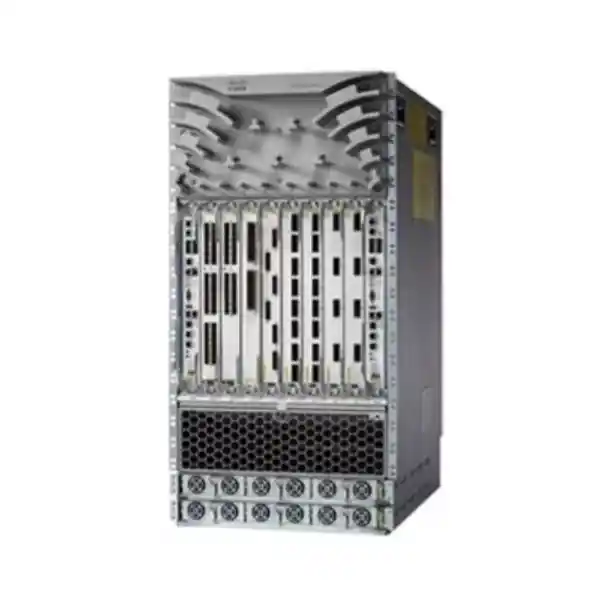
Cisco ASR 9000 Series • Service-provider routing platform
Cisco ASR 9910 Aggregation Services Router
Build a high-capacity aggregation, edge, peering, core, mobile-transport, or data-center-interconnect layer with a modular 21-RU router that can scale with changing traffic and interface requirements. The Cisco ASR 9910 combines eight line-card slots, redundant control and fabric resources, modular power, front-to-back cooling, and Cisco IOS XR software in a platform intended for large, resilient IP networks.
8 line-card slots
21 RU chassis
400G-capable options
Cisco IOS XR
Best starting point for a quote: share your required port speeds and quantities, current and forecast traffic, resiliency target, power type, rack constraints, optical reach, routing scale, and the services you plan to run. FourTeck can then help map those requirements to a compatible ASR 9910 bill of materials rather than treating the chassis as a one-size-fits-all purchase.
What the ASR 9910 is designed to solve
Large networks rarely fail because a chassis is simply “not fast enough.” The harder problem is sustaining growth while preserving operational consistency, fault isolation, deterministic forwarding, service quality, and maintenance flexibility. The Cisco ASR 9910 is intended for operators that need a modular platform between compact fixed systems and the largest multi-chassis-scale designs. It provides room for multiple high-capacity line cards, redundant route switch processors, dedicated switch-fabric cards, modular power, and two fan trays in a single 21-RU chassis.
For an internet service provider, carrier, large enterprise, cloud interconnect environment, content network, or mobile-transport architecture, this can make the ASR 9910 useful as an aggregation node, multiservice edge, internet edge, peering router, core node, routed optical endpoint, or data-center-interconnect platform. The exact role depends on line-card selection, software features, route scale, service scale, optics, and the surrounding network architecture. A project should therefore start with the traffic and service requirement, not with a chassis-only specification.
Cisco currently describes the ASR 9910 as a 21-RU system with up to 64 Tbps capacity, eight line-card slots, two route switch processor positions, and five dedicated fabric-card positions. Modern 400 Gigabit Ethernet line cards are supported, but a high-density 400G deployment may require the appropriate generation of fabric cards, RSPs, cooling components, optics, and software. That dependency is important during upgrades: compatibility should be confirmed for the whole system rather than assumed from the physical line-card slot alone.
Key ASR 9910 specifications at a glance
| Platform family | Cisco ASR 9000 Series Aggregation Services Routers |
|---|---|
| Form factor | 21 RU; approximately 36.69 in / 931.9 mm high and 17.60 in / 447.04 mm wide |
| Depth | Approximately 39.63 in / 1006.6 mm with air reflector; 30.41 in / 772.4 mm without air reflector |
| Line-card slots | 8 modular line-card slots |
| Control / route switch processors | 2 RSP slots for dual redundant route switch processors with integrated fabric resources |
| Fabric | Five dedicated switch-fabric card slots plus fabric resources on the RSPs; designed for redundant active/active fabric operation |
| Published platform capacity | Up to 64 Tbps with supported current configurations |
| 400 Gigabit Ethernet | Supported through compatible ASR 9000 / ASR 9900 400G line-card options; exact capacity depends on the selected hardware generation and configuration |
| Operating system | Cisco IOS XR |
| Airflow | Front-to-back |
| Cooling | Two fan trays, with twelve variable-speed high-efficiency fans per tray in Cisco’s published chassis specification |
| Power architecture | Modular AC or DC power; 6 kW AC and 4.4 kW DC module options are documented for the chassis generation; AC and DC modules are not mixed in one system |
| Power redundancy | Architecture supports feed, power-module, and PEM redundancy; Cisco documents N+N for AC and N+1 for DC configurations |
| Nominal operating temperature | 5°C to 40°C |
| Nominal operating humidity | 5% to 90% relative humidity |
| Base chassis product number | ASR-9910. This is Cisco’s product number for the chassis, not a FourTeck Tanzania inventory SKU. |
Why modularity matters in a high-capacity routing project
A modular router should be evaluated as a system of interdependent resources. Line cards define port density and interface rates, but they are only one part of the forwarding path. Switch-fabric generation affects available bandwidth between slots. Route switch processors influence control-plane capability, supported system scale, timing features, software compatibility, and in some configurations fabric resources. Power modules and PEMs determine how much electrical capacity is available and how redundancy is built. Fan trays and airflow components must match the thermal profile. Optics must match the intended reach, fiber type, standards, and line-card port mode.
This is especially important when moving toward 100G and 400G. Cisco documents multiple generations of ASR 9000 and ASR 9900 line cards, including high-density multi-rate and 10-port 400 Gigabit Ethernet options. A card may be mechanically compatible with the ASR 9910 but still require newer fabric, RSP, cooling, or software components to deliver the intended throughput. An upgrade plan should therefore identify the existing chassis inventory, installed fabric generation, RSP type, fan and power configuration, software train, licenses, and optic requirements before any high-speed card is ordered.
The advantage is flexibility. A correctly planned ASR 9910 can combine different interface needs and evolve over time without replacing the entire chassis each time traffic grows. Operators can align capital expenditure with staged expansion, reserve slots for future growth, and standardize operational processes around IOS XR. The value comes from engineering the configuration around the network roadmap, not simply maximizing every slot on day one.
Suitable deployment scenarios
Service-provider aggregation
Aggregate large numbers of access, metro, or regional links into a resilient IP/MPLS layer. Eight line-card slots provide room to balance current access density with future uplink growth. The platform’s redundant architecture is relevant where a single aggregation-node failure would affect many downstream customers.
Internet edge and peering
Use high-speed Ethernet interfaces, large-scale routing, policy controls, QoS, and resilient forwarding for upstream, internet exchange, cache, and content interconnections. The exact route scale and features should be checked against the selected RSP, line-card type, and IOS XR release.
Core and regional transport
Deploy the ASR 9910 where multiple high-capacity paths converge and deterministic forwarding, fast recovery, traffic engineering, and scalable IPv4/IPv6 transport are needed. Segment Routing and MPLS technologies can support engineered paths and resilient transport designs when licensed and configured appropriately.
Mobile transport and timing-sensitive networks
The ASR 9000 family supports timing functions such as SyncE and Precision Time Protocol capabilities in supported hardware and software combinations. This can make the platform relevant to packet transport for mobile networks, provided the end-to-end synchronization design is validated.
Data-center interconnect
High-capacity Ethernet, EVPN, VXLAN-related capabilities, MPLS, Segment Routing, and routed optical designs can support DCI use cases. Optics, coherent reach, encryption needs, route scale, failure domains, and operational ownership should be defined before selecting the final hardware.
Business and wholesale VPN services
L2VPN, L3VPN, EVPN, QoS, multicast, access control, and service resiliency features make the platform applicable to multiservice networks. Capacity planning should include not only interface bandwidth but also VRF, route, label, policy, queue, multicast, and subscriber or service scale.
IOS XR and the network features that matter
Cisco IOS XR is central to the ASR 9000 architecture. For a buyer, the practical value is not the operating-system name itself but the operational model it enables across a large routed network. Cisco positions IOS XR as a modular operating system for high-availability routing platforms, with process isolation, distributed forwarding, software maintenance capabilities, telemetry and automation integration, and a broad set of service-provider routing features. The correct release should be selected against the installed hardware, required protocols, lifecycle policy, security baseline, and change-management process.
The ASR 9000 family supports IPv4 and IPv6 routing, BGP and IGP functions, MPLS, Segment Routing, SRv6, EVPN, L2VPN and L3VPN services, Layer 2 and Layer 3 multicast, hierarchical QoS, ACLs, operations and maintenance functions, and resiliency technologies such as Nonstop Forwarding and Nonstop Routing. Cisco also documents capabilities such as MC-LAG, Integrated Routing and Bridging, MPLS traffic-engineering fast reroute, Ethernet OAM, MPLS OAM, SyncE, and PTP across supported ASR 9000 hardware and releases.
Feature availability can vary by line card, RSP, scale profile, license, and software release. A project that needs only packet transport may favor a different processor and scale profile from one that requires a large multiservice edge with extensive VPN, policy, subscriber, or service state. This is why a technically accurate quote needs more than a port count. It should capture route scale, VRF count, expected BGP peers, label scale, multicast requirements, QoS hierarchy, telemetry, timing, automation, security controls, and any requirement for in-service software maintenance.
For existing ASR 9000 environments, common software and operating procedures may reduce the amount of retraining and tooling change required when adding an ASR 9910. For a new deployment, IOS XR introduces its own design and operational practices that should be accounted for in training, configuration management, monitoring, backup, software lifecycle, and incident-response procedures.
400G growth: what to verify before ordering
Cisco’s current ASR 9000 material lists the ASR 9910 with up to 64 Tbps of system capacity and support for up to thirty-two 400G QSFP-DD ports in an appropriate platform configuration. Cisco also documents 5th-generation high-density multi-rate line cards and ASR 9900 10-port 400 Gigabit Ethernet line cards as compatible with the ASR 9910. Those statements are platform capabilities, not a guarantee that every installed ASR 9910 can accept any 400G card without changes.
A 400G upgrade review should identify the installed switch-fabric generation, RSP generation, fan and cooling components, available power, software release, slot placement rules, optic type, fiber plant, and the desired port breakout or multi-rate mode. Cisco specifically notes that some high-density 400G cards may require hardware updates to fabric, RP/RSP, and cooling systems. That makes the pre-order audit a critical part of avoiding a card that fits physically but cannot deliver the intended bandwidth or cannot be supported in the current chassis configuration.
Optics are equally important. A port described as 400G does not by itself define reach or fiber requirements. A deployment may need short-reach data-center optics, longer-reach client optics, coherent ZR/ZR+ options, breakout modes, or lower-speed compatibility. The optical budget, connector type, patching, fiber quality, dispersion considerations, intermediate optical equipment, and peer-side transceiver must all be checked as part of the solution.
If the immediate requirement is 100G with a planned move to 400G, it can be useful to design the fabric, RSP, cooling, power, and rack environment around the intended later state. That may reduce disruptive upgrades, but it must be balanced against current budget, lifecycle planning, and the actual timing of capacity demand.
High availability and fault-domain planning
The ASR 9910 chassis is designed with redundancy across major common components. Cisco documents dual RSP positions, redundant fabric resources, two fan trays, two power-entry modules, power-module and feed redundancy, and software resiliency features. In a production architecture, those hardware capabilities need to be paired with correct cabling and topology. Two power supplies connected to the same upstream breaker are not equivalent to two independent power feeds. Two uplinks that share the same duct, optical shelf, or upstream router can still form one failure domain.
A resilient deployment should identify the failure conditions the network must survive: an RSP failure, fabric-card failure, line-card failure, fan-tray failure, individual power-module loss, whole-feed loss, optic failure, fiber cut, upstream router failure, software process failure, maintenance event, or an entire site outage. The appropriate response may include component redundancy inside the chassis, dual-homing to independent upstream devices, diverse fiber routing, ECMP, fast convergence, MPLS or Segment Routing protection, BFD, NSF/NSR, maintenance procedures, and spare strategy.
Redundancy also affects capacity. A network that must carry full traffic after losing a line card, fabric resource, or uplink should be engineered to the post-failure state, not only the normal state. The same principle applies to power: the remaining feed and power modules must support the desired hardware after a failure. When planning dense 400G or high-power configurations, this margin can materially affect how many modules are required.
For maintenance, the operational objective should be defined as well. Some environments require upgrades without traffic interruption, while others can accept a scheduled maintenance window. Hardware redundancy and IOS XR software features can support highly available designs, but the exact procedure and expected impact depend on software release, feature set, redundancy state, and the change being performed.
Power, cooling, rack space, and site preparation
The ASR 9910 is a large modular platform, so facilities planning is part of the network design. Cisco specifies the chassis at 21 RU, approximately 931.9 mm high and 447.04 mm wide. The depth is approximately 772.4 mm without the air reflector and about 1006.6 mm with the air reflector. The published chassis weight is about 77.27 kg with two PEMs and approximately 137.38 kg in a configuration with two fan trays, two RSPs, five fabric cards, and two PEMs, before adding the selected line cards and power modules. Rack loading and handling procedures should account for the final installed configuration rather than only the empty chassis.
Cisco documents front-to-back airflow for the ASR 9910 and two fan trays with twelve variable-speed fans per tray. The rack or cabinet should therefore provide a clear intake and exhaust path and sufficient room for required airflow components. Hot-air recirculation, blocked perforations, insufficient aisle airflow, or an undersized cooling system can reduce thermal margin even when the room’s average temperature appears acceptable.
For power, Cisco documents modular 6 kW AC and 4.4 kW DC module types for the ASR 9906/9910 architecture, with AC and DC modules not mixed in the same system. Published input ranges include 200–240 V AC at 50–60 Hz and -40 to -72 V DC for the associated modules. The exact number of modules required is configuration-dependent. Line-card type, RSP generation, fabric cards, fan load, optics, redundancy target, and growth margin all affect the power design.
Site preparation should therefore confirm rack type and depth, floor loading where relevant, lifting and installation procedure, AC or DC feed design, breaker sizing, A/B-feed diversity, earthing, cable pathways, fiber management, front and rear service clearance, cooling capacity, and environmental monitoring. In facilities with generator or UPS backup, the transition and autonomy design should be evaluated at the system level rather than assuming the router alone provides continuity.
Cisco lists a nominal operating-temperature range of 5°C to 40°C and nominal operating humidity of 5% to 90% relative humidity for the ASR 9906 and ASR 9910. A short-term operating range is also documented, but normal facility design should aim to keep the equipment within the nominal envelope with adequate margin. Local site conditions, dust, salt, humidity, heat load, power quality, and maintenance access should all be considered for a Tanzania deployment.
Tanzania deployment planning: questions to answer before quotation
The network requirement should drive the bill of materials. FourTeck Tanzania should not assume stock, lead time, warranty terms, local certification, installation coverage, or a final price without verifying the exact requested configuration. To prepare an accurate technical and commercial response, collect the following information from the project team.
Define whether the node is aggregation, internet edge, peering, core, DCI, mobile transport, business-services edge, wholesale edge, routed optical, or a combination. The role influences the required service scale and hardware profile.
List each required speed, port count, optic type, reach, connector, fiber type, breakout requirement, and expected growth. Include both client-facing and network-facing interfaces.
Provide current peak traffic, forecast growth, east-west and north-south patterns, oversubscription policy, and the minimum traffic that must continue to flow after a component or uplink failure.
Estimate IPv4/IPv6 routes, BGP peers, VRFs, labels, EVPN instances, L2VPN/L3VPN services, multicast state, ACLs, QoS policies, and any subscriber or service-edge requirements.
State whether the design must survive single RSP, line-card, fabric, power-feed, uplink, upstream-router, fiber-path, or site failures and how much traffic impact is acceptable during convergence or maintenance.
Confirm available rack units, rack depth, power feeds, breaker capacity, AC or DC preference, cooling, front-to-back airflow, cable entry, grounding, UPS/generator strategy, and physical access.
Specify required IOS XR features, automation interfaces, telemetry, management tooling, AAA, logging, software release policy, maintenance windows, security standards, and integration with existing operational processes.
Describe the existing platform, migration window, temporary coexistence, addressing and routing changes, rollback requirements, traffic-drain method, optical changes, testing, and acceptance criteria.
Choosing between packet-transport and service-edge requirements
The ASR 9000 family has historically offered hardware profiles optimized for packet transport and for service-edge scale. The difference matters because two networks with the same total throughput can have very different control-plane and service requirements. A transport node might carry a small number of very high-capacity links and rely mainly on IP/MPLS, Segment Routing, traffic engineering, fast convergence, and large forwarding tables. A multiservice edge may carry more VRFs, policies, QoS hierarchies, BGP state, VPN services, multicast state, subscriber functions, or service-specific features.
Current Cisco documentation also includes later-generation RSP5 and RSP5-X options for compatible ASR 9000 chassis including the ASR 9910. These processors bring their own feature, scale, timing, and power characteristics. An installed base may still contain older generations. The correct selection must be based on supported combinations and the current Cisco hardware/software compatibility data for the target release.
For procurement, avoid specifying only “ASR 9910 with redundant processors.” The quote should identify the exact RSP part numbers, fabric-card generation, line cards, optics, power modules, PEMs, fan components, software subscription or license requirements, accessories, rack kits, and any spares. This reduces ambiguity between a chassis that can theoretically support a feature and the specific ordered system that actually provides it.
Routing, MPLS, Segment Routing, EVPN, and service design
The ASR 9910 is most valuable when it is selected as part of a clear end-to-end architecture. In an IP/MPLS network, that means defining IGP boundaries, BGP policy, label distribution or Segment Routing behavior, traffic engineering, fast-reroute strategy, VPN control plane, multicast design, QoS model, telemetry, and failure handling. If SR-MPLS or SRv6 is planned, the project should verify software support and feature behavior for the intended release and hardware combination, then test interoperability with the rest of the network.
EVPN can provide a modern control plane for Ethernet and integrated Layer 2/Layer 3 services, while L2VPN and L3VPN remain important for many carrier and enterprise-service designs. The best choice depends on service requirements, operational maturity, multivendor interoperability, convergence expectations, and migration constraints. A product page cannot decide that architecture by itself; it can only establish that the ASR 9000 family provides the relevant feature families when properly licensed and configured.
QoS design also deserves early attention. Interface speed alone does not guarantee service quality when many customer, peering, mobile, or backbone flows compete for the same links. Cisco documents hierarchical QoS capabilities in the ASR 9000 family. Engineers should define classification, marking, policing, shaping, queue hierarchy, congestion policy, buffer expectations, and SLA treatment before finalizing line cards and service scale.
For observability, plan what the operations team needs to see during normal operation and incidents: interface utilization, queue drops, route changes, BFD state, protocol adjacency, optical levels, temperature, power, fan status, fabric health, CPU and memory, telemetry streams, syslog, flow data, and configuration changes. An accurate monitoring design is part of making a high-capacity router operationally useful.
Routed optical and coherent connectivity considerations
Cisco includes the ASR 9910 in its routed optical networking solution material. In practical terms, a routed optical design can reduce the number of separate transponder layers in some architectures by using supported coherent optics directly in router ports. The potential benefit is a simpler packet-optical architecture, but the engineering responsibility moves closer to the router and optical design teams. Route, wavelength, optical budget, reach, fiber quality, amplifier chain, ROADM compatibility, management, and failure behavior must all be validated together.
Not every 400G port or QSFP-DD optic should be assumed to support the same coherent mode, reach, or optical system. Cisco line-card and transceiver compatibility matrices should be used for the exact card, software release, and optic. The far-end device must also support the desired standard and operating mode. When a third-party optical system is involved, interoperability testing or vendor confirmation may be required.
For Tanzania networks that span long terrestrial routes, metropolitan fiber, data centers, subsea landing connectivity, or regional interconnection, the transport design should start with measured fiber characteristics and the required service availability. The ASR 9910 can be part of that architecture, but it does not remove the need for optical engineering, diverse routing, protection strategy, spares, and clear operational ownership across the packet and optical domains.
Migration from an existing router
A chassis migration should be planned as a service transition rather than a hardware replacement. Start by documenting all physical interfaces, optics, VLANs, link aggregation groups, routing adjacencies, VRFs, MPLS and Segment Routing state, VPN services, multicast, QoS, ACLs, timing, management services, monitoring, AAA, logging, automation hooks, and external dependencies on the existing platform. Classify each item by business criticality and rollback complexity.
Next, decide whether the ASR 9910 will be introduced in parallel, whether links can be moved gradually, or whether a concentrated cutover is required. A parallel migration often makes validation easier because traffic can be shifted in stages, but it may require temporary optics, patching, rack space, power, and IP resources. A single-window cutover may use fewer temporary resources but increases the importance of pre-staging, configuration review, lab validation, and rollback planning.
Before carrying production traffic, verify hardware inventory, software image, licenses, RSP redundancy, fabric health, power redundancy, fan status, management access, time synchronization, routing protocols, policy behavior, forwarding, QoS, optical levels, telemetry, logging, and alarm integration. Then validate traffic under normal and failure conditions. Testing should include at least one realistic convergence event so that the team understands the behavior rather than discovering it during an incident.
After migration, retain a defined observation period and compare the new node against the baseline: traffic levels, packet loss, latency, route stability, queue drops, CPU, memory, temperature, power, alarms, and customer-service metrics. Decommissioning of the old node should wait until rollback conditions have expired and configuration, backups, monitoring, diagrams, inventory, and support records are updated.
Procurement checklist for an ASR 9910 solution
Chassis and common hardware: ASR 9910 chassis, appropriate route switch processors, compatible switch-fabric cards, fan trays, fan filter, PEMs, power modules, rack-mount accessories, air-management components, and any required fillers or cable-management parts.
Interfaces: exact line-card part numbers, port modes, breakout requirements, optics or cables, spare optics, patch leads, fiber type, connector type, and any coherent or routed-optical components.
Software: supported IOS XR release, feature licenses or subscriptions, automation and telemetry requirements, software support entitlement, and a lifecycle plan compatible with the organization’s maintenance policy.
Resiliency: sufficient power modules for the desired failure state, A/B feeds, dual RSPs where required, fabric redundancy, redundant upstream links, diverse fiber, and the necessary spare strategy for optics, fan, power, and line-card components.
Facilities: 21 RU of rack space plus service clearance, rack depth and load capacity, power distribution, cooling, grounding, fiber management, physical security, and installation handling.
Professional services: design validation, configuration, migration planning, staging, implementation, acceptance testing, documentation, training, and post-cutover support where required. Service scope should be defined separately rather than assumed from the chassis purchase.
ASR 9910 versus smaller or larger ASR 9000 platforms
The ASR 9910 sits between smaller modular systems such as the ASR 9904 and ASR 9906 and larger chassis such as the ASR 9912 and ASR 9922. Cisco’s current platform comparison lists the ASR 9904 at up to 16 Tbps with two line-card slots, the ASR 9906 at up to 32 Tbps with four line-card slots, the ASR 9910 at up to 64 Tbps with eight line-card slots, the ASR 9912 at up to 80 Tbps with ten line-card slots, and the ASR 9922 at up to 160 Tbps with twenty line-card slots.
Capacity alone should not decide the model. Rack space, failure-domain size, growth pattern, interface diversity, site power, line-card sparing, operational standardization, and geographic distribution may favor two smaller routers over one larger chassis, or one larger chassis over several smaller nodes. A network that needs eight high-density slots at one location may find the ASR 9910 a natural fit, while a site with modest capacity and strict rack limits may be better served by a smaller ASR model.
Conversely, a core site with a clear path beyond eight line cards or 64 Tbps may justify evaluating the ASR 9912, ASR 9922, or another current Cisco routing architecture before committing. FourTeck can scope alternatives against the same requirement so the decision is based on lifecycle fit and total architecture rather than a single headline number.
Operational and security considerations
A high-capacity router becomes part of critical infrastructure, so management and security controls should be designed before commissioning. Use dedicated management paths where appropriate, centralized AAA, role-based access, secure protocols, configuration version control, approved cryptographic settings, time synchronization, logging, and monitoring. Restrict management-plane exposure and document break-glass access procedures. The exact security configuration should follow the organization’s policy and the supported capabilities of the selected IOS XR release.
Software lifecycle is equally important. Cisco continues to publish IOS XR documentation for the ASR 9000 family, including current configuration guides and release notes. Maintenance planning should track supported releases, security advisories, field notices, hardware compatibility, software maintenance updates, and any required ROMMON or field-programmable-device upgrades. A stable network does not mean a static network; it needs controlled maintenance based on evidence and risk.
Backup and recovery procedures should cover more than the running configuration. Record hardware inventory, serial information, software packages, licenses, boot variables, golden images, automation templates, telemetry configuration, routing policies, certificates, and external system dependencies. Test the recovery process so that a failure does not become the first time the team discovers what was missing.
For change management, use pre-checks and post-checks that include protocol adjacency, route count, label state, interface errors, optic levels, queue drops, CPU, memory, fabric status, power, fans, temperatures, and alarms. The scale of the ASR 9910 makes disciplined operational procedure more valuable, not less.
Frequently asked questions
What is the Cisco ASR 9910?
It is a modular member of the Cisco ASR 9000 Series designed for high-capacity aggregation, edge, core, peering, transport, and multiservice routing. Cisco lists the platform as a 21-RU chassis with eight line-card slots, two RSP positions, five dedicated fabric-card positions, and up to 64 Tbps capacity in supported current configurations.
Does the ASR 9910 support 400 Gigabit Ethernet?
Yes. Cisco documents compatible 400G line-card options for the ASR 9910 and lists the platform with support for up to thirty-two 400G QSFP-DD ports in an appropriate configuration. A specific chassis may require compatible fabric cards, RSPs, cooling components, power capacity, software, and optics, so the complete hardware state must be checked before an upgrade.
How many line cards can it take?
The ASR 9910 has eight line-card slots. The usable port density and aggregate throughput depend on the selected line cards, fabric generation, RSP generation, software, and system configuration.
What operating system does it use?
The platform runs Cisco IOS XR. The required release should be selected against the exact hardware, line cards, features, licenses, lifecycle policy, and interoperability needs of the project.
Can it be used for MPLS and Segment Routing?
The ASR 9000 family supports MPLS, Segment Routing, SRv6, L2VPN, L3VPN, EVPN, traffic engineering, and related resiliency features in supported software and hardware combinations. Exact feature support should be verified for the target IOS XR release and component set.
Is the chassis AC or DC powered?
Cisco documents modular AC and DC power architectures for the ASR 9910. The published architecture includes 6 kW AC and 4.4 kW DC power-module types for this chassis generation, with AC and DC not mixed in the same system. Module quantity depends on the configured load and redundancy target.
Is the ASR 9910 suitable for a data center?
It can be suitable for data-center interconnect, internet edge, peering, and high-capacity routed services when the rack, depth, power, cooling, optics, and operational requirements are compatible. Its 21-RU size makes facility planning important compared with compact fixed systems.
Can an older ASR 9910 be upgraded to newer 400G hardware?
Potentially, but the existing configuration must be audited. Cisco notes that high-density 400G line cards may require updates to fabric cards, RP/RSP hardware, and cooling systems. Software and power requirements must also be checked.
What information is needed for a Tanzania quote?
Provide required port counts and speeds, optic reach, current and forecast traffic, routing and service scale, resiliency requirements, rack and power details, preferred AC or DC architecture, IOS XR features, migration constraints, and any existing ASR 9000 hardware that may be reused. This enables a quote to be based on a compatible system rather than an incomplete chassis-only assumption.
Does this page confirm Tanzania stock, pricing, warranty, or delivery time?
No. Those commercial details depend on the exact configuration and must be verified at the time of quotation. This product page describes the technical platform and the information needed to scope a solution; it does not claim local stock, a fixed price, a specific warranty term, or a delivery commitment.
Request an ASR 9910 configuration review
Send FourTeck Tanzania your port matrix, traffic forecast, topology, routing scale, resilience target, optic distances, rack details, and AC/DC power requirements. A configuration review can identify the chassis components, RSPs, fabric cards, line cards, optics, power modules, cooling, software, and migration considerations needed for a technically coherent bill of materials.
Commercial note: price, stock, lead time, warranty, installation scope, and support terms should be confirmed for the exact quoted configuration. No secure or verified Tanzania-site quote URL was available through public search during preparation of this page, so this call to action is intentionally not linked.



Reviews
There are no reviews yet.