
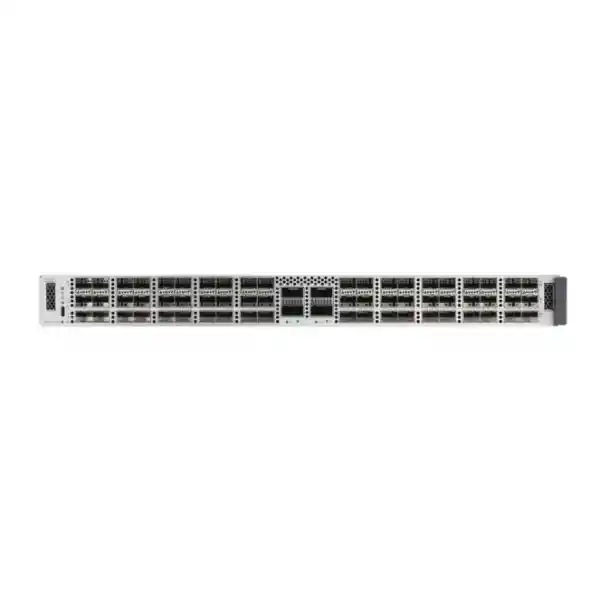
4 × 40/100/200/400G QSFP-DD
1RU Fixed Core / Distribution
Cisco Silicon One Q200
Cisco Catalyst C9500X-60L4D Network Switch for High-Density Enterprise Fiber
The Cisco Catalyst C9500X-60L4D is designed for networks that have outgrown traditional 10G or 25G aggregation and need a compact fixed platform with dense 50G interfaces plus 400G uplinks. It is particularly relevant when a campus, data-intensive enterprise, large office environment, research facility, colocation environment, or service network must aggregate many high-speed fiber links without moving immediately to a modular chassis. The switch provides sixty SFP56 ports for 10/25/50 Gigabit Ethernet and four QSFP-DD ports for 40/100/200/400 Gigabit Ethernet, creating a strong fit for high-capacity distribution and core designs.
For buyers in Tanzania, the important question is not only whether the switch is fast enough. A correct purchase also depends on transceiver selection, fiber type, port-speed grouping, redundancy, power and airflow direction, Cisco IOS XE release, licensing, and the intended routing or segmentation features. FourTeck Tanzania can use those requirements to build a quote around the actual deployment rather than treating the chassis as a standalone item. Price, stock, lead time, and final license entitlement should be confirmed for the requested configuration.
Quick Technical Summary
| Model | Cisco Catalyst C9500X-60L4D |
|---|---|
| Primary fixed ports | 60 × 10/25/50G SFP56 |
| High-speed ports | 4 × 40/100/200/400G QSFP-DD |
| Switching capacity | Up to 9.2 Tbps for the C9500X-60L4D |
| Forwarding rate | 8 Bpps |
| ASIC | Cisco Silicon One Q200 |
| System memory | 32 GB DRAM and 32 GB flash |
| Form factor | 1RU fixed switch |
| Dimensions | 4.39 × 44.45 × 55.37 cm including fan/tray handles |
| Weight | About 12.75 kg with two power supplies and fan assemblies |
| Power options | 1500W AC or DC power supplies; two power-supply slots |
| Software baseline | Minimum Cisco IOS XE 17.10.1 for this model |
| High availability | StackWise Virtual, redundant power capability, field-replaceable fan trays, and software resiliency features subject to release requirements |
| Security | Hardware support for 256-bit MACsec and WAN MACsec; secure boot and trustworthy-system capabilities in the Catalyst 9500X platform |
The figures above describe the platform, not a complete bill of materials. Optics, breakout cables, power supplies, fan direction, software subscriptions, support services, and other accessories must be matched to the intended design. Feature availability can also depend on the selected Cisco license and IOS XE software release.
Who Should Consider the C9500X-60L4D?
This model makes the most sense when port density and link speed are both important. A network team aggregating dozens of 10G or 25G access switches may want room to move those links to 50G without replacing the core platform. A data-intensive campus may need high-bandwidth inter-building uplinks, while a private-cloud or research environment may need dense fiber connectivity to servers, storage fabrics, security appliances, or leaf switches. The C9500X-60L4D gives those designs a large pool of SFP56 interfaces while reserving four QSFP-DD ports for very high-capacity uplinks, inter-switch connectivity, or backbone links.
It is also a useful choice where rack space is constrained. Because the platform is fixed and occupies one rack unit, it can deliver substantial aggregate bandwidth without the physical footprint of a modular chassis. That simplicity can reduce the number of components that must be selected, but it also means buyers should plan the required port mix carefully. Unlike a modular platform, the fixed port layout cannot be changed by adding interface line cards later. The sixty SFP56 ports and four QSFP-DD ports therefore need to align with both current needs and a realistic growth plan.
The switch is less suitable when the design primarily needs large numbers of copper access ports, PoE for phones and access points, or low-speed edge connectivity. It is a fiber-centric enterprise core and distribution product. In those cases, an access-layer Catalyst family may be more appropriate, with the C9500X-60L4D positioned above it as the aggregation or core layer. Treating the switch according to its intended role helps avoid spending on high-end capacity where simpler edge switching would meet the requirement.
Performance Architecture: Why the Silicon One Q200 Matters
The C9500X generation moves beyond the UADP architecture used in other Catalyst 9500 models and uses the Cisco Silicon One Q200 ASIC. For the C9500X-60L4D, Cisco specifies up to 9.2 Tbps of switching capacity and an 8 billion packets-per-second forwarding rate. Those numbers matter when the switch is used to aggregate many simultaneously active links, especially where traffic patterns are east-west, bursty, or distributed across many interfaces rather than concentrated on a few uplinks.
The Catalyst 9500X platform also provides dedicated low-latency buffering and high-bandwidth memory for deeper packet buffering. In practical terms, buffering is valuable when traffic enters at one speed and exits through a temporarily congested interface, or when multiple sources send bursts toward the same destination. No buffer can eliminate poor capacity planning, but a deeper buffering architecture can improve the platform’s ability to handle short-lived congestion events compared with designs that rely on very shallow queues.
Cisco lists large forwarding-table scale for the Q200-based 9500X models, including up to 256,000 MAC addresses and up to 2 million IPv4 routes, with actual usable scale influenced by software, address patterns, and selected table allocation. This is relevant for large routed campuses, complex enterprise segmentation, service environments, and networks that expect route growth. Buyers should still size route, host, multicast, ACL, MPLS, and telemetry requirements against the actual design instead of treating maximum table values as simultaneously available in every configuration.
For a Tanzanian organization considering a long network lifecycle, the key benefit is headroom. If today’s distribution layer runs mostly 10G and 25G, a platform that supports native 50G access-facing links and 400G backbone connectivity can make future bandwidth upgrades less disruptive. That headroom is most valuable when matched with suitable fiber plant, optics, upstream capacity, resilient power, and a software plan that keeps the platform on a supported Cisco IOS XE release.
Port Design, Optics and Breakout Planning
The C9500X-60L4D provides sixty SFP56 interfaces that can operate at 10, 25, or 50 Gigabit Ethernet with supported transceivers. The four QSFP-DD interfaces support 40, 100, 200, or 400 Gigabit Ethernet with supported optics and cabling. This combination is useful for mixed-speed migration because a network can retain certain 10G or 25G connections while introducing 50G links and using 100G, 200G, or 400G for aggregation. The exact optical module, connector, reach, fiber type, and wavelength must be selected from Cisco’s compatibility guidance for the desired software and hardware combination.
The QSFP-DD ports support breakout use, which can increase logical interface density for certain designs. Breakout planning should be done before ordering because the intended parent-port speed, breakout cable type, remote interface type, and supported configuration must all match. On this model, breakout support is associated with the QSFP-DD ports rather than the SFP56 port bank. A bill of materials should clearly distinguish ordinary optics, direct-attach cables, active optical cables, adapters, and breakout assemblies so installation teams do not receive a collection of physically compatible-looking parts that cannot form the intended link.
There is also an important 1G limitation. Cisco documents that the C9500X-60L4D supports a maximum of eight 1G SFP-1G-SX and/or SFP-1G-LH modules in the SFP56 ports per system. Buyers planning to reuse many legacy 1G fiber links should therefore not assume that all sixty SFP56 ports can be populated as 1G ports. Where a large 1G estate remains, it can be better to retain an intermediate access or aggregation layer and use the 9500X for the faster routed or distribution links.
Port-speed grouping is another deployment detail. Cisco documents speed-group behavior for adjacent SFP ports on the C9500X-60L4D, meaning some neighboring ports must use the same configured speed, while specified bottom-row ports are not subject to the same grouping constraint. This matters when mixing 10G, 25G, and 50G optics. A port map should therefore be created before installation, not after all fibers have been patched. If a mismatched optic is inserted into a configured port group, the affected interface can become err-disabled.
For procurement, provide the link inventory: quantity, current speed, target speed, fiber mode, approximate distance, connector type, and remote device. That information enables a more accurate optics and cabling selection and helps identify links that may require patch-panel changes or transceiver replacements as part of the switch upgrade.
High Availability and Resilient Campus Design
Core and distribution switches sit on the path to many users and applications, so resilience should be designed at both device and topology level. The C9500X-60L4D has two power-supply slots and supports 1500W AC or DC power supplies. A dual-supply configuration can be used to reduce exposure to a single power-module failure, and power feeds can be planned from separate protected circuits where the facility design supports that approach. The platform also uses field-replaceable fan trays, with airflow options that must be aligned with the rack’s hot-aisle/cold-aisle strategy.
At the system level, Cisco StackWise Virtual allows two compatible switches to operate as a virtualized system for high-availability designs. Multi-chassis EtherChannel can then be used across the pair, allowing downstream or upstream devices to form redundant links without relying on a single physical chassis. Stateful Switchover and In-Service Software Upgrade support are tied to StackWise Virtual and specific software requirements, so the target IOS XE release should be confirmed before defining maintenance procedures or promising a particular upgrade behavior.
A resilient design should also consider failure domains outside the switch. Dual C9500X units connected to the same UPS, the same fiber path, the same upstream router, or the same room can still share a common point of failure. For critical deployments in Tanzania, review power continuity, generator and UPS design, rack cooling, diverse fiber routes, upstream carrier or WAN diversity, and management access. The switch provides the networking mechanisms for a strong resilient architecture, but business continuity depends on how the entire physical and logical system is built.
Operational procedures are equally important. Keep validated configuration backups, record optic and fiber mappings, document StackWise Virtual links, test failover, and maintain a software lifecycle plan. High availability is not simply a hardware checkbox; it is the combination of redundant components, sound topology, compatible software, monitoring, and practiced recovery procedures.
Security for High-Capacity Links
The Catalyst 9500X platform includes hardware support for 256-bit MACsec and WAN MACsec, giving architects options for protecting traffic on supported Ethernet links. MACsec can be useful when sensitive data crosses shared building infrastructure, inter-building fiber, metropolitan links, or other segments where link-layer encryption is appropriate. The feature still requires compatible endpoints, supported optics and topology, correct keying, and the relevant software and licensing. It should be planned as part of the security architecture rather than enabled without considering operational impact.
The platform also includes secure-boot and trustworthy-system capabilities intended to protect the integrity of the device and software chain. At the network-policy layer, the broader Catalyst 9500 feature set supports access control lists, segmentation functions, routing policy, telemetry, and integration into Cisco enterprise management architectures. Network Advantage or higher-level subscription capabilities may be required for advanced functions, so buyers should map desired security features to the chosen license before finalizing the purchase.
A practical security design starts by defining zones and trust boundaries. Decide which links carry user, server, voice, management, internet-edge, partner, or replication traffic; identify where encryption is needed; and confirm which enforcement point owns each policy. Avoid building an architecture where the core switch becomes a catch-all security appliance for every function. Firewalls, identity systems, endpoint controls, and secure management platforms still have separate roles.
Management-plane security should receive equal attention. Restrict administrative access, use strong authentication and role separation, prefer secure management protocols, monitor configuration changes, and maintain supported software. The C9500X-60L4D’s capacity can make it central to a large environment, which also makes a well-governed management plane important to reducing operational and security risk.
Cisco IOS XE, Automation and Operational Visibility
The C9500X-60L4D runs Cisco IOS XE, with Cisco specifying IOS XE 17.10.1 as the minimum software release for this model. IOS XE provides the familiar routing and switching operating environment while also supporting modern automation and telemetry methods. Cisco documents model-driven APIs including NETCONF, RESTCONF, and gNMI with YANG data models, as well as streaming telemetry and on-box scripting capabilities. These features are useful for organizations that want repeatable provisioning and monitoring rather than manual per-device administration.
For a network team managing multiple sites, automation can reduce configuration drift and speed up standard changes. Templates can standardize interfaces, routing policies, logging, AAA, NTP, telemetry, and security controls. Streaming telemetry can provide more frequent operational data than traditional polling alone, giving monitoring platforms richer visibility into interface state and system behavior. The value comes from building clear operational processes around those capabilities, including version control, change review, and rollback.
Cisco also positions the Catalyst 9500 family for use with Cisco Catalyst Center and offers cloud-management options through the Meraki dashboard for supported workflows. The correct management approach depends on the organization’s installed Cisco tools, license entitlements, security requirements, scale, and operating model. A customer that already uses CLI and standard monitoring can still deploy the switch without immediately redesigning the entire management stack, while another customer may choose centralized policy, assurance, and automation.
Before deployment, standardize the intended software train and verify feature support for that exact release. Newer features can have higher minimum-release requirements than the chassis itself. StackWise Virtual, SSO, ISSU, WAN MACsec, EVPN-related functions, and management capabilities should each be checked against the selected release and license. This avoids designing around a feature that is present in the platform family but unavailable in the chosen software state.
Routing, Segmentation and Core-Network Roles
The Catalyst 9500 Series is built for enterprise core and aggregation, and the platform supports advanced Layer 3 services. Cisco documents support across the family for technologies such as IPv4 and IPv6 routing, multicast, MPLS services, VRF-based segmentation, NAT, and Software-Defined Access functions. Which functions are available in a particular deployment depends on the network license, subscription tier, software release, and configuration. This distinction is important when comparing quotations that may look similar at the hardware level but include different software entitlements.
In a conventional campus design, the C9500X-60L4D can aggregate access or distribution switches and provide routed connectivity toward data-centre, WAN, internet, firewall, or service layers. In a routed-access design, Layer 3 boundaries can be moved closer to the edge to limit spanning-tree domains. In segmented environments, VRFs can separate departments, services, tenants, or security zones while controlled policy connects them. These are design choices rather than fixed requirements, and the right topology depends on operational skill, application behavior, failure domains, and security policy.
The scale of the Q200 platform makes it attractive where route and endpoint counts could grow substantially. However, architects should not simply target headline maximums. Table resources are shared and can vary according to selected software database templates and configured features. Large route tables, MAC tables, ACLs, MPLS labels, multicast entries, and NetFlow resources can compete for hardware allocation. A detailed design review should model the expected steady-state scale plus growth and failure scenarios.
For buyers upgrading from a smaller Catalyst core, this is an opportunity to review architecture rather than perform a port-for-port replacement. Evaluate whether routing boundaries should change, whether 50G can remove link bundles, whether 400G can simplify the backbone, and whether segmentation or telemetry should be introduced at the same time. A migration plan can then sequence optics, software, configuration, validation, and cutover with less disruption.
Licensing: Confirm the Software Tier Before Ordering
Cisco’s current Catalyst 9500 licensing model can be purchased through unified switching subscriptions or Cisco DNA licensing, depending on the commercial path and software strategy. Cisco identifies Essentials and Advantage tiers, with Advantage adding advanced capabilities beyond the foundational functions in Essentials. Legacy-style hardware product numbers may also include a license suffix, so a buyer should not assume that the chassis name alone defines the complete entitlement.
For the C9500X-60L4D, the safest procurement method is to create a feature list before requesting the final quote. Include the routing protocols, segmentation, SD-Access or fabric functions, assurance, telemetry, management platform, encryption, and high-availability behaviors required by the network. The reseller or integrator can then map those requirements to the appropriate Cisco license and subscription term. This is more reliable than buying the lowest-cost software option and discovering during implementation that an advanced function requires a different tier.
Cisco Smart Licensing provides centralized entitlement management. Organizations should identify who owns the Cisco Smart Account, how virtual accounts are structured, and who will be responsible for assigning and renewing licenses. That administrative detail matters during deployment and future support events. If the switch is part of a larger Cisco Enterprise Agreement or networking subscription, the purchasing team should confirm whether the new device will join that agreement or be licensed separately.
Licensing policies evolve, so use current Cisco commercial documentation when the order is placed. The product page should therefore be treated as guidance on the platform, while the formal quotation should specify the exact hardware product number, software tier, subscription term, support level, and any required add-on licenses. That protects the buyer from ambiguity and gives the implementation team a clear entitlement baseline.
Power, Cooling and Rack Preparation
High-density switching requires more preparation than simply finding one free rack unit. The C9500X-60L4D measures approximately 4.39 cm high, 44.45 cm wide, and 55.37 cm deep including fan and tray handles. Cisco lists the chassis at about 12.75 kg when configured with two power supplies and fan assemblies. Before installation, confirm rack depth, rail compatibility, front and rear service clearance, cable-management space, and whether nearby equipment will obstruct airflow or transceiver access.
The model supports 1500W AC and DC power supplies. Cisco specifies a 90 to 264 VAC input range for the platform when using the relevant AC supply. Actual consumption depends on system configuration, optics, traffic, environmental conditions, and installed options; the power-supply rating is not the same as constant device consumption. The electrical design should therefore use Cisco’s current power calculator or engineering guidance where a precise heat and circuit load is required.
Airflow direction must be consistent with the rack and room. Cisco offers front-to-back and back-to-front fan options for the C9500X. Mixing an unsuitable airflow direction with the data-centre layout can cause the switch to ingest hot exhaust air from neighboring equipment. Cisco also documents different maximum operating temperatures depending on the selected fan direction and altitude. In Tanzania, where equipment rooms may face high ambient temperatures or variable cooling, environmental planning should be treated as a core deployment requirement.
For critical sites, plan protected power and graceful shutdown procedures around the broader facility. Dual PSUs improve device-level resilience only when the upstream power architecture is also considered. Document which PDU, UPS, and circuit feeds each power supply, keep compatible spare components where operationally justified, and monitor environmental alarms. These steps help translate the switch’s redundant hardware capabilities into real service resilience.
Tanzania Deployment Planning: Questions to Resolve Before Purchase
A high-capacity core switch is usually part of a larger upgrade, so Tanzanian buyers should begin with traffic and infrastructure requirements rather than a model number. Map current switch uplinks, server and storage connections, WAN handoffs, firewall interfaces, internet circuits, inter-building fiber, management networks, and expected growth. Identify links that can stay at 10G or 25G, links that should move to 50G, and backbone connections that justify 100G, 200G, or 400G. This creates a realistic port plan and prevents overbuying optics or underestimating future capacity.
Next, verify the physical fiber plant. A transceiver that supports the desired Ethernet speed still needs the correct fiber type, connector, and distance. Existing campus fiber may include different generations of multimode and single-mode cable, and the available strands may not be identical between buildings. Record approximate distances and patching points so the optics list can be validated before the equipment arrives. Where fibers pass through shared ducts or external routes, consider path diversity for critical uplinks.
Power and cooling should be checked at each installation site, especially where mains instability, generator transitions, UPS autonomy, dust, or elevated room temperature could affect availability. The network design should also consider out-of-band management and remote recovery if the site is difficult to reach. A high-performance core is most useful when operations teams can monitor and recover it quickly during incidents.
Finally, build the cutover plan around business impact. Define the maintenance window, configuration staging, optics testing, routing convergence expectations, fallback procedure, and the team responsible for application validation. If replacing an existing core, consider running the old and new networks in parallel long enough to migrate services in controlled stages. The C9500X-60L4D provides substantial capacity, but successful deployment depends on disciplined preparation across network, facilities, security, and application teams.
- Number of 10G, 25G, 50G, 100G, 200G and 400G links required now and over the next few years.
- Fiber type, connector type and approximate distance for each important link.
- Single-switch or dual-switch high-availability design.
- AC or DC power, redundancy requirements and preferred airflow direction.
- Routing, segmentation, encryption, automation and management features needed.
- Required Cisco software tier, subscription term and support expectations.
C9500X-60L4D vs. C9500X-28C8D: Choosing the Right 9500X Port Mix
The two main Catalyst 9500X fixed platforms target different interface-density priorities. The C9500X-60L4D emphasizes a large number of 10/25/50G SFP56 ports and provides four QSFP-DD ports for 40/100/200/400G. The C9500X-28C8D instead emphasizes 100G-class QSFP28 connectivity and provides eight QSFP-DD ports. Both use the Silicon One Q200 architecture, but they are not interchangeable from a cabling and port-planning perspective.
Choose the C9500X-60L4D when many downstream devices naturally connect at 10G, 25G, or 50G and only a smaller number of very-high-speed uplinks are needed. Examples include dense campus distribution, aggregation of many access blocks, or environments migrating from 25G toward 50G. Its sixty SFP56 interfaces can reduce the need for multiple lower-density switches when the physical and logical design fits a fixed 1RU form factor.
Choose the C9500X-28C8D when the design is centered more heavily on 40G or 100G interfaces and needs a larger count of 400G-capable QSFP-DD ports. That may be preferable for a core where fewer but faster connections dominate. The correct choice should be based on actual endpoint and uplink counts, not simply the higher headline capacity or port count.
A useful exercise is to draw the expected port map for year one and a growth-state map for year three or year five. Include redundancy, maintenance spare capacity, breakout requirements, and planned speed migrations. The resulting map usually makes the better chassis obvious and helps avoid a design that consumes every high-speed interface on day one.
Migration Guidance for Existing Cisco Networks
Organizations moving from older Catalyst cores or aggregation switches should treat the migration as a controlled network change rather than a hardware swap. Start by exporting current Layer 2, Layer 3, routing, spanning-tree, VLAN, VRF, ACL, QoS, multicast, monitoring, AAA, NTP, logging, and management configurations. Identify commands that are platform-specific or obsolete in the target IOS XE release. Where possible, rebuild the configuration from current design intent instead of copying years of historical configuration line by line.
The new platform’s interface naming, optics, port-speed grouping, and breakout behavior should be incorporated into a fresh cable schedule. If LAGs or EtherChannels are being replaced by single higher-speed links, calculate the effect on resiliency and hashing. A 100G or 400G interface may provide more bandwidth than several older links, but a bundle can also provide path diversity if its member links use different physical routes. Faster does not automatically mean more resilient.
Routing migration requires special care. Confirm protocol timers, route filtering, summarization, first-hop redundancy behavior, and any redistribution points. If the old core and new core will coexist temporarily, define how routes are preferred during each migration phase. Validate MTU end to end, especially if the environment uses jumbo frames, overlays, storage traffic, or encrypted links. The C9500X supports jumbo frames, but every device on the path must use a compatible configuration.
After cutover, compare interface counters, routing tables, MAC learning, telemetry, application reachability, latency, and error rates against the pre-change baseline. Keep the rollback path available until key services have been validated. A structured migration makes it easier to realize the performance of the C9500X-60L4D without introducing unnecessary operational risk.
Buying Checklist for the Cisco Catalyst C9500X-60L4D
1. Chassis and software
Confirm the exact C9500X-60L4D hardware product number, license tier, subscription term, Cisco Smart Account plan, IOS XE target release, and required support coverage.
2. Optics and cables
List every link by speed, reach, fiber type, connector and remote device. Confirm Cisco-supported transceivers, DAC/AOC choices, adapters and breakout assemblies.
3. Port map
Plan 10G, 25G and 50G placement around port-speed grouping constraints and reserve capacity for growth, maintenance and failover.
4. Resilience
Decide whether the design uses one or two switches, StackWise Virtual, multi-chassis EtherChannel, dual power, diverse fiber and separate upstream paths.
5. Rack and facility
Check rack depth, rails, cable space, airflow direction, cooling, protected electrical circuits, UPS capacity and out-of-band management.
6. Migration
Prepare configurations, test optics, define routing coexistence, document rollback, schedule the maintenance window and assign post-change validation owners.
Frequently Asked Questions
Is the C9500X-60L4D a 50G switch or a 400G switch?
It is both in different parts of the port layout. The switch has sixty SFP56 ports that support 10/25/50G and four QSFP-DD ports that support 40/100/200/400G with supported optics. The design is therefore well suited to aggregating many lower-speed high-bandwidth links into a smaller number of very-high-speed backbone links.
What is the switching capacity of the C9500X-60L4D?
Cisco specifies up to 9.2 Tbps switching capacity for this exact model, with an 8 Bpps forwarding rate. These are platform performance figures. Real network performance also depends on traffic patterns, configuration, optics, attached systems, routing design, and upstream capacity.
Can all sixty SFP56 ports be used at 1G?
No. Cisco documents a specific 1G limitation for this model: a maximum of eight supported SFP-1G-SX and/or SFP-1G-LH modules can be used per system. Buyers with a large quantity of legacy 1G fiber links should plan an intermediate access or aggregation layer rather than assuming the C9500X can replace a 1G-dense switch directly.
Does the switch support redundant power?
The chassis has two power-supply slots and supports 1500W AC or DC power supplies. A redundant design requires the appropriate second supply and should also consider independent upstream power feeds, UPS and facility design where available.
Does it support StackWise Virtual?
Yes, the Catalyst 9500X platform supports Cisco StackWise Virtual, subject to the required IOS XE release and configuration. It can be used with multi-chassis EtherChannel for resilient topologies. Confirm the exact software requirements for SSO and ISSU features in the intended release.
What Cisco IOS XE version is required?
Cisco lists IOS XE 17.10.1 as the minimum software release for the C9500X-60L4D. Individual features can require later releases, so the deployment baseline should be selected according to the functions you need rather than using the minimum release automatically.
Does the C9500X-60L4D support MACsec?
The Catalyst 9500X platform has hardware support for 256-bit MACsec and WAN MACsec. Actual deployment depends on the software release, license, interface design, compatible peer, and key-management configuration. Confirm those dependencies before specifying encryption on a production link.
Can I mix 10G, 25G and 50G optics anywhere in the SFP56 ports?
Not without planning. Cisco documents port-speed grouping constraints on sets of adjacent SFP ports, while certain bottom-row ports are treated differently. Build the physical port map first and confirm the intended optic and speed for each interface so neighboring ports do not create a speed conflict.
Is this suitable for access-layer PoE devices?
It is not primarily an access-layer PoE switch. The C9500X-60L4D is a fiber-centric fixed core and distribution platform. If the project needs large quantities of copper ports and PoE for phones, cameras or wireless access points, use an appropriate access switch and aggregate it into the 9500X.
What should be included in a Tanzania quotation?
A complete quote request should specify the exact chassis, license tier and term, power-supply quantity and type, fan airflow direction, optics, cables or breakout assemblies, support requirements, and any implementation services required. Price and availability should be confirmed for that final bill of materials rather than inferred from the base model alone.
Can the C9500X-60L4D be used as a campus core?
Yes. Cisco positions the Catalyst 9500 Series, including 9500X models, for enterprise core and aggregation roles. The C9500X-60L4D is especially attractive where the core or distribution layer needs many 10/25/50G ports and a smaller number of 100/200/400G backbone connections.
How do I decide between Essentials and Advantage licensing?
Start with required features. Foundational switching, automation and visibility may fit an Essentials tier, while advanced routing, segmentation, assurance, security or fabric functions may require Advantage capabilities. Because Cisco licensing changes over time and varies by management model, the final entitlement should be verified against current Cisco documentation at the time of purchase.
Request a C9500X-60L4D Configuration Review and Quote
For an accurate Cisco Catalyst C9500X-60L4D proposal in Tanzania, share your required port speeds, fiber type and link distances, redundancy design, power preference, airflow direction, software features, and expected growth. A configuration review can help align the switch, optics, cables, licenses, and resiliency components before the order is finalized.
Ask FourTeck Tanzania for a solution-based quotation rather than a chassis-only price.




Reviews
There are no reviews yet.