
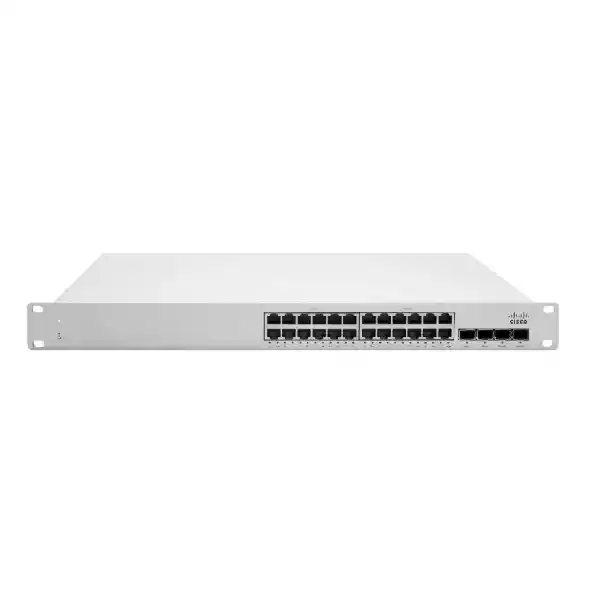
Cisco Meraki MS150-24T-4X Tanzania
The Cisco Meraki MS150-24T-4X is a cloud-managed Layer 2 access switch for organisations that want a predictable, centrally administered wired network across branches, offices, campuses and distributed sites. This specific model combines 24 10/100/1000 Mbps RJ45 access ports with four 10 GbE SFP+ uplinks, two dedicated physical stacking ports providing 80 Gbps stacking bandwidth, a dedicated management interface and a 128 Gbps switching capacity. It is a data-only model, so it does not provide Power over Ethernet. That distinction is important for buyers planning networks with IP phones, cameras or wireless access points: those powered endpoints require separate PoE switching or local power, while the MS150-24T-4X can serve data-only desks, servers, printers, appliances and other Ethernet devices.
For Tanzania deployments, the value of the MS150-24T-4X is not just port count. Meraki Dashboard management provides centralized configuration, network-wide visibility, remote troubleshooting tools and automated firmware workflows. The switch supports business features including 802.1Q VLAN tagging, IPv4/IPv6 ACLs, 802.1X authentication, DHCP snooping, Dynamic ARP Inspection, broadcast storm control, SNMP/syslog integration and static routing. Procurement should include the required Meraki licensing choice, suitable power cord, supported uplink optics or DACs where needed, and stacking cables when a physical stack is planned.
Twenty-four RJ45 access ports for wired user and device connectivity.
High-speed uplinks for aggregation, distribution or server connectivity using supported optics or DACs.
Two dedicated stack ports help build a manageable physical stack for expansion and operational simplicity.
Cisco Meraki Dashboard centralizes monitoring, configuration, firmware and troubleshooting workflows.
Cisco Meraki MS150-24T-4X overview
Cisco positions the MS150 family as stackable access switching for branch and campus environments. Within that family, the MS150-24T-4X is the 24-port, non-PoE model with 10 Gigabit SFP+ uplinks. This makes it especially relevant where the access layer needs straightforward Gigabit copper connectivity while the uplink or aggregation path needs significantly more bandwidth. Examples include office floors with desktop computers, branch locations with local servers or NAS devices, small data rooms, training centres, administration buildings and distributed business sites where cloud management is preferred over device-by-device local administration.
The switch supports static routing, but it should not be mistaken for a full enterprise core-routing platform. Its strongest role is at the access layer, where VLAN segmentation, identity-based access controls, port management and high-speed uplinks matter. Organisations can use VLANs to separate departments, voice, guest, management, CCTV or operational device traffic, although powered endpoint requirements must be handled by another PoE-capable switch where necessary. The model’s four SFP+ ports can be used for resilient or high-capacity uplinks, inter-switch connectivity or fiber runs using supported Meraki transceivers and direct-attach cables.
The hardware uses a fixed internal power supply and fits a standard 1U rack footprint. Cisco lists an operating range of 0°C to 45°C and a 100–240 VAC input. Because region-specific power cords are not universally included, procurement teams should confirm the appropriate cord for Tanzania and the destination site before shipment. The same applies to SFP/SFP+ modules, stacking cables and licensing: these are design dependencies, not details to leave until installation day.
Verified technical specifications
| Specification | MS150-24T-4X |
|---|---|
| Access ports | 24 × 10/100/1000 Mbps RJ45 |
| Uplinks | 4 × 10 GbE SFP+ |
| PoE | No — data-only model |
| Stacking | 2 dedicated stack ports, 80 Gbps stacking bandwidth |
| Switching capacity | 128 Gbps |
| Layer 3 capability | Static routing |
| Management | Cisco Meraki Dashboard, SNMP/syslog integration, remote packet capture tools |
| Security / access features | IPv4/IPv6 ACLs, 802.1X, DHCP snooping, Dynamic ARP Inspection, VLAN tagging, Adaptive Policy with appropriate licensing |
| Form factor | Integrated 1U rack mount |
| Dimensions | 1.72 × 19 × 9.84 in (4.4 × 48.2 × 25 cm) |
| Weight | 7.61 lb (3.45 kg) |
| Operating temperature | 0°C to 45°C |
| Power input | 100–240 VAC |
Licensing, optics and stacking planning
Meraki switching is designed around cloud management, and the MS150 licensing choice should be treated as part of the purchase rather than an afterthought. Cisco documents Enterprise and Advanced licensing tiers for the MS150, with 1, 3, 5, 7 and 10-year terms in the traditional licensing structure, as well as subscription licensing options. In co-termination organisations, licensing-tier consistency rules apply, so procurement teams adding an MS150 to an existing Meraki organisation should confirm the organisation’s licensing model and tier before ordering. The Advanced tier adds Adaptive Policy capability, while Enterprise covers the standard MS150 feature set.
For uplinks, Cisco lists supported 1 GbE and 10 GbE transceivers for SFP+ MS150 models, including short-range and long-range fiber options as well as direct-attach copper choices. The correct optic depends on the media type, fiber standard, distance, peer device and desired link speed. A quotation should therefore specify the switch and the required uplink modules separately. For physical stacking, Cisco identifies dedicated stack cables in 0.5 m, 1 m and 3 m lengths. Cable length should be selected after rack position and stack topology are known.
A useful buying checklist is to confirm the number of MS150 switches, intended access-port use, SFP+ uplink count, fiber or DAC requirements, whether physical stacking is required, rack depth, power-cord type, existing Meraki licensing model, desired license term and whether Advanced features are needed. This avoids incomplete orders and makes deployment scheduling more predictable.
Related FourTeck resources
FourTeck Tanzania servicesUseful for projects that require design, installation, configuration, documentation, troubleshooting or lifecycle support alongside hardware supply.
About FourTeck TanzaniaUnderstand FourTeck’s integrated approach to networking, cybersecurity, telecom and supporting business infrastructure.
Tanzania IT and networking solutionsExplore connected IT, telecom, security and infrastructure solutions for business environments in Tanzania.
Cisco Meraki MS150-24T-4X Tanzania
For organisations sourcing the Cisco Meraki MS150-24T-4X in Tanzania, the strongest buying case is centralized operational control combined with a capable wired access layer. Tanzanian companies increasingly operate more than one office, branch, retail location, service point or project site, and managing network switches individually can become inefficient as the environment grows. Meraki Dashboard gives IT administrators a single cloud-managed view that can simplify configuration standards, switch monitoring, port-level troubleshooting and firmware administration across distributed locations. The MS150-24T-4X is especially suitable when the access layer needs 24 Gigabit copper ports but the upstream network requires 10 Gigabit connectivity for aggregation, server access or inter-switch links.
Tanzania buyers should pay close attention to the model suffix. The “T” version is data-only and does not supply PoE. A site connecting powered access points, IP phones or surveillance cameras therefore needs either a PoE-capable companion switch, injectors where practical, or a different MS150 model such as a P or MP variant. This is an important procurement decision because a switch can have enough Ethernet ports while still being unsuitable for the endpoint power plan. When the access devices are desktops, printers, servers, appliances, controllers or other self-powered Ethernet equipment, the 24T-4X can be a clean and efficient fit.
Network planners in Tanzania should also confirm uplink media before ordering. Four SFP+ slots support high-speed fiber or supported direct-attach links, but the correct transceiver depends on distance and fiber type. Physical stacking requires dedicated stack cables, which should be included in the bill of materials if multiple switches will operate as a stack. Rack depth, cable management, airflow, UPS capacity and a compatible power cord should be documented before installation. For organisations already using Meraki, licensing compatibility with the existing organisation should be checked before procurement, particularly where co-termination rules and Enterprise versus Advanced tiers apply.
FourTeck can help structure a quotation around the actual site requirement: number of access ports, number and speed of uplinks, fiber distance, stacking needs, license tier and term, rack accessories, patching and associated firewall or wireless infrastructure. The result is a more complete procurement package than ordering the switch alone. For broader regional projects, the FourTeck Africa technology network can provide useful context for multi-country standardisation, while Tanzania-specific enquiries can be directed through the contact option below.
Cisco Meraki MS150-24T-4X Dar es Salaam
Dar es Salaam organisations commonly need switching for corporate offices, logistics operations, financial and professional services, hospitality properties, retail locations, warehouses, technology firms and branch-heavy business environments. In these settings, the Cisco Meraki MS150-24T-4X can provide a practical 24-port access layer where the connected equipment is primarily self-powered and administrators want to manage network policy from a central dashboard. The four 10 GbE SFP+ uplinks are particularly useful in buildings where access switches feed an aggregation layer, server room or fiber backbone and 1 GbE uplinks would constrain future capacity.
A Dar es Salaam deployment should be planned from the rack outward. The site survey should identify the number of copper endpoints, which endpoints need PoE, the location of the nearest distribution switch, the fiber type already installed, whether redundant uplinks are required and how many switch ports should remain free for growth. The MS150-24T-4X can carry multiple VLANs and support access-control features, allowing businesses to separate departments, management traffic and operational systems. However, segmentation design should reflect the overall firewall and routing architecture rather than relying on switch configuration alone.
Where a company has several branches across Dar es Salaam, cloud management can reduce the need to maintain separate local switch-management workflows. IT teams can standardize port templates, monitor connectivity and investigate issues remotely through the Meraki platform. This can be valuable for lean internal IT teams or managed environments where administrators are responsible for multiple sites. Zero-touch style deployment workflows are also useful when a switch is staged for a branch and configuration is prepared centrally before or during installation.
Before requesting a quotation, provide the site count, required switch quantity, intended uplink design, fiber distance, existing Meraki organisation details, preferred license duration and any need for stacking. If the same project includes wireless access points or IP phones, specify those devices because the 24T-4X itself cannot power them. FourTeck can then separate data-only switching from PoE requirements and align the bill of materials with the real office design instead of treating every 24-port switch as interchangeable.
Cisco Meraki MS150-24T-4X Mwanza
For businesses and institutions in Mwanza, the Cisco Meraki MS150-24T-4X is relevant where a centrally managed wired network is needed across offices, education environments, healthcare administration areas, hospitality operations, distribution facilities or growing branch networks. The switch’s 24 Gigabit Ethernet access ports can serve conventional wired endpoints while four 10 Gigabit SFP+ uplinks provide headroom for fiber connectivity to an aggregation switch or data-room core. This combination is useful in sites where endpoint traffic is moderate but the uplink must carry combined traffic from many users without becoming the first bottleneck.
Mwanza projects often benefit from clear infrastructure documentation because support teams may need to manage systems across more than one physical location. Meraki Dashboard can help administrators maintain visibility without relying entirely on local device access. Port configuration, VLAN assignment, event visibility and troubleshooting workflows can be handled centrally, which supports consistent network standards across a branch estate. The MS150 family also supports physical stacking, allowing multiple switches to be grouped when a single 24-port unit is not enough for the site.
The data-only design should be considered carefully. If a Mwanza site is expanding Wi-Fi coverage, IP telephony or CCTV at the same time, those devices may require PoE. Rather than forcing a data-only switch into a power-delivery role it cannot perform, planners can combine the MS150-24T-4X with a PoE switch or select a different MS150 power variant for the powered endpoint segment. This split can be sensible where office computers and servers are separated from high-PoE-density access-point or camera networks.
Quotation preparation should include license term, transceiver type, stacking cables if required, power cord, rack space and uplink topology. If the switch will connect over fiber between buildings, confirm actual cable type and distance rather than ordering optics from assumption. A complete design also considers UPS protection, grounding, patch-panel organization and labeling so the cloud-managed switch is supported by reliable physical infrastructure. These details make the difference between a product purchase and a maintainable Mwanza network deployment.
Cisco Meraki MS150-24T-4X Arusha
Arusha has a diverse mix of tourism, hospitality, education, professional services, NGOs, administration and multi-site organisations, all of which can create different access-switching requirements. The Cisco Meraki MS150-24T-4X is a good candidate where the objective is a manageable 24-port Gigabit access switch with fast 10 Gigabit uplinks and cloud-based operational visibility. Hotels, offices and campuses may have several network segments for staff, guests, administration, back-office systems and operational equipment; VLAN-capable managed switching helps keep those services organized when designed with the firewall and routing layer.
For an Arusha site, determine whether the switch will be used for conventional data endpoints or for devices that also need power. The 24T-4X has no PoE budget, so it should not be selected as the sole access switch for a floor filled with Wi-Fi access points, IP phones or PoE cameras. It is stronger for desktops, printers, local appliances, servers and other powered devices, or as part of a mixed switching design where PoE loads are handled elsewhere. This simple distinction prevents installation delays and unexpected additions of power injectors.
The four SFP+ uplinks can be especially useful for properties or campuses with fiber between network rooms. Supported 10 GbE optics allow the access layer to feed aggregation at higher speed, but the transceiver choice must match the fiber and distance. If multiple MS150 units are installed in the same rack, dedicated physical stacking can simplify administration and expand port capacity. Cisco documents 80 Gbps stacking bandwidth across the dedicated stack interface design, which is separate from the front-panel uplinks.
Cloud management is also useful for Arusha organisations whose IT administrators are based elsewhere or support multiple sites. Central visibility can reduce routine travel for configuration checks and initial troubleshooting, though physical faults still require local attention. Before ordering, provide a port map, uplink plan, expected VLANs, number of switches, current Meraki licensing model and desired support term. This allows the hardware, license and accessories to be quoted as one coordinated system rather than disconnected line items.
Cisco Meraki MS150-24T-4X Dodoma
In Dodoma, government-related offices, professional organisations, education environments, service providers and expanding enterprises often need network infrastructure that can be standardized and supported over time. The Cisco Meraki MS150-24T-4X offers a cloud-managed access-switch option for projects that need 24 Gigabit copper ports and fast uplink capacity without PoE. Its centralized management model can be valuable where policies need to remain consistent across departments, buildings or remote branches and where IT teams want network visibility without maintaining a separate local-management workflow for every switch.
A Dodoma deployment should begin with endpoint classification. Workstations, printers and many server-side appliances can connect directly to the data ports. Wireless access points, many IP phones and surveillance cameras commonly require PoE, so those devices need an appropriate powered access layer. If the site already has PoE switches for phones and Wi-Fi, the MS150-24T-4X can serve another data-only segment or provide additional capacity for administrative users. This mixed model can help separate device groups while preserving consistent Meraki management across compatible network infrastructure.
The 10 GbE SFP+ uplinks should be designed according to the building backbone. Short runs in the same rack may use a supported DAC, while longer building or campus links may require the correct optical transceiver and fiber type. Redundant uplinks can be considered where the upstream architecture supports them. Physical stacking is available when multiple MS150 units are co-located, and stacking cables should be included in the procurement list from the beginning.
Licensing is part of the operational model. New installations should choose the appropriate Meraki licensing structure and term, while existing organisations should verify compatibility with their current license tier and model. When requesting pricing for Dodoma, include switch quantity, intended deployment date, fiber distances, optics, stack requirements, rack and UPS context, license term and whether the network is new or being integrated into an existing Meraki organisation. That information produces a more accurate and implementation-ready quotation.
Cisco Meraki MS150-24T-4X UAE
For organisations coordinating infrastructure between Tanzania and the UAE, the Cisco Meraki MS150-24T-4X supports a standardized cloud-managed switching approach across regional offices. The same dashboard-centric operating model can help IT teams apply consistent configuration practices, monitor distributed locations and reduce the differences between locally managed switch estates. The 24-port non-PoE format is suitable for wired office users and self-powered network equipment, while four 10 GbE SFP+ uplinks provide capacity for high-speed distribution or fiber connectivity.
UAE procurement often forms part of a regional standardisation programme where hardware model, license tier, optics and support terms need to be consistent across countries. The MS150-24T-4X can fit such a programme when branches have similar data-only access requirements. However, location-specific power cords, import requirements, project schedules and installation scope must still be confirmed separately. A standard model number does not remove the need to verify local physical infrastructure and delivery conditions.
For the UAE side of a multi-country project, FourTeck’s regional resources at FourTeck UAE can support broader IT, telecom and infrastructure planning. When the same customer operates in Tanzania, the network design can be aligned so VLAN naming, uplink standards, Meraki organisation structure and switch configuration templates remain as consistent as business policy allows. This is particularly useful for organisations with centralized IT governance.
The key buying questions remain technical: do the endpoints need PoE, are 24 copper ports enough, are four 10 GbE uplinks appropriate, will switches be physically stacked, which optics are needed, and which Meraki license model applies? If the project is a refresh, document the existing uplinks, transceivers and license state before selecting accessories. These checks reduce mismatches between a UAE reference architecture and the actual equipment needed at the Tanzania destination site.
Cisco Meraki MS150-24T-4X Uganda
Ugandan organisations with branches, offices, campuses and distributed operations can use the Cisco Meraki MS150-24T-4X as a standardized cloud-managed access switch where data-only Gigabit ports and 10 Gigabit uplinks are needed. Because the switch is administered through the Meraki cloud, IT teams can maintain a common operational view across sites rather than relying on separate local interfaces at every branch. This is valuable for organisations extending the same network policy across Uganda and Tanzania or consolidating management after acquisitions and branch expansion.
A regional project should define device categories carefully. If an office has many wired PCs, printers, servers and appliances but only a separate small PoE requirement, the MS150-24T-4X can serve the main data layer while a PoE switch handles access points, IP phones and cameras. If most endpoints require PoE, a different model may be more economical and operationally simpler. The decision should be based on actual endpoint power demand rather than only the number of available Ethernet ports.
The four 10 GbE SFP+ uplinks give network designers options for resilient uplinks, aggregation or fiber runs. Optics should be matched to the exact fiber and distance, and stack cables should be included if switches are physically stacked in the same rack. Meraki licensing must also be selected correctly, particularly for existing organisations where tier consistency rules may matter. A licensing review before purchase is more reliable than discovering a mismatch during activation.
For Uganda-specific projects, visit FourTeck Uganda for regional solution context. For cross-border deployments, a shared bill-of-material template can identify switch model, license, optic, stacking accessory, power lead and rack requirements by site. This allows procurement teams to compare like with like while still accounting for differences in fiber plant, device density and local installation conditions.
Cisco Meraki MS150-24T-4X Kampala
Kampala businesses often operate headquarters, branch offices, retail points, professional-service locations and mixed-use buildings where centralized IT management can reduce administrative overhead. The Cisco Meraki MS150-24T-4X supports this model with 24 Gigabit Ethernet ports, four 10 GbE SFP+ uplinks and cloud-based Meraki Dashboard management. It can be particularly useful when the network team wants repeatable port configurations and remote troubleshooting across several Kampala locations without installing a separate on-premises controller for the switch management plane.
In office deployments, the access layer should be divided by endpoint type and business importance. User devices, printers, local systems and application appliances can use the switch’s data ports. PoE-dependent access points, phones and cameras require a powered switching strategy elsewhere. This distinction is easy to overlook in purchasing because the “24-port managed switch” description sounds complete, but the absence of PoE is a deliberate characteristic of the T model and should be aligned with the actual endpoint inventory.
Kampala sites with fiber uplinks can make use of the SFP+ interfaces for higher-capacity distribution. Where multiple switches are installed in the same rack, dedicated stacking provides a structured scale-out path. The dashboard can then simplify monitoring of the stack and connected ports. Security-related switching functions such as 802.1X, ACLs, DHCP snooping and Dynamic ARP Inspection can form part of a broader access-control design when configured consistently with identity, DHCP, firewall and VLAN policies.
A useful request-for-quote package includes the number of sites, number of switches, endpoint count, uplink type, fiber distance, need for stacking, rack size, licensing term and whether an existing Meraki organisation is already in use. This information allows procurement to evaluate the whole access-layer requirement. It also gives project teams a clearer basis for comparing alternatives instead of comparing hardware-only prices that omit licensing, optics and implementation dependencies.
Cisco Meraki MS150-24T-4X Arua
Arua deployments can benefit from cloud-managed switching where organisations need centralized visibility over infrastructure located away from the primary IT team. The Cisco Meraki MS150-24T-4X provides a straightforward data-access platform with 24 Gigabit RJ45 ports and four 10 Gigabit SFP+ uplinks. For branch offices, institutional sites and operational facilities, the ability to manage and troubleshoot switch ports through Meraki Dashboard can reduce dependence on local configuration access for routine network administration.
The physical network still needs careful planning. Cloud management does not replace the need for stable power, suitable UPS protection, organized rack installation, documented patching and correct fiber transceivers. In Arua projects where connectivity between buildings or racks uses fiber, the design team should identify connector type, fiber mode and distance before selecting an SFP+ module. If the switch will be used in a small rack, its 1U form factor and depth should be checked against available space and cable bend radius.
Because the MS150-24T-4X is non-PoE, a device survey is essential. A branch that needs many Wi-Fi access points or cameras may be better served by a PoE model. A branch that primarily connects desktops, printers, local servers and non-PoE appliances can use the 24T-4X efficiently. Mixed environments may use both data-only and PoE switches, with the uplink design ensuring sufficient capacity between them and the upstream network.
For organisations standardizing sites in Arua, Kampala and Tanzania, naming conventions, VLAN IDs, port templates and monitoring rules can be developed as a common operational baseline. The final quotation should still be site-specific for optics, power cords, stack cables and licensing. This balance between standardised management and site-specific physical design is one of the practical strengths of a cloud-managed switching approach.
Cisco Meraki MS150-24T-4X Mbarara
For Mbarara offices, campuses, healthcare administration environments, retail operations and regional businesses, the Cisco Meraki MS150-24T-4X can provide an access layer that is easy to incorporate into a centrally managed network. Twenty-four Gigabit ports cover a common branch-size requirement, while four 10 GbE SFP+ uplinks provide significantly more upstream capacity than traditional 1 GbE fiber uplinks. This allows network designers to connect the access switch to aggregation infrastructure without creating an avoidable uplink bottleneck as traffic grows.
Meraki Dashboard management can help multi-site administrators maintain consistency across Mbarara and other branches. Device status, port configuration and troubleshooting information can be viewed remotely, and firmware operations are integrated into the cloud-management model. For businesses with limited on-site IT staff, this does not eliminate the need for local hands during cabling or hardware failures, but it can improve diagnosis and reduce the number of visits needed for routine configuration changes.
The switch’s security and segmentation functions can support departmental separation and access-control policy. VLANs, 802.1X, ACLs, DHCP snooping and Dynamic ARP Inspection are particularly relevant in managed business networks where unauthorized connectivity and accidental network crossover need to be reduced. These features work best when identity, addressing, DHCP and firewall rules are planned as one architecture rather than configured independently on the switch.
A Mbarara buyer should verify whether PoE is required before selecting this exact model. The 24T-4X has no PoE output, so powered devices need another solution. If the data-only profile is correct, the next decisions are uplink optics, stacking, rack placement, licensing and support term. Providing these details with the quotation request makes it easier to produce a complete package and avoids last-minute accessory purchases during installation.
Cisco Meraki MS150-24T-4X Gulu
Gulu organisations looking for centrally managed switching can consider the Cisco Meraki MS150-24T-4X for branch and campus access deployments that do not require PoE from the switch. The 24 Gigabit Ethernet ports are suitable for conventional wired endpoints, while the four SFP+ uplinks allow the switch to connect into a higher-speed distribution layer. This architecture is useful for sites that need simple edge connectivity today but want the uplink capacity to support increasing traffic, new servers or future network growth.
Cloud management is relevant where network responsibility is centralized outside Gulu. Administrators can maintain switch configuration and visibility through Meraki Dashboard, helping a small IT team supervise several locations. Port-level troubleshooting and remote packet-capture capabilities can assist diagnosis before technicians are dispatched. This is particularly useful when the issue is configuration-related or when the central team needs to verify whether a port is active, which VLAN it uses or whether connectivity changed after a local cabling event.
The physical design should still be resilient. A reliable UPS, suitable rack ventilation, organized copper patching and protected fiber pathways contribute as much to availability as the switch itself. If several MS150 units are required in one rack, physical stacking can provide a more structured expansion path. Stack cables are separate accessories and should be planned according to rack layout. Fiber optics also need to be specified based on real distance and media type.
Before procurement, classify every planned endpoint as data-only or PoE-powered. This prevents the common mistake of using port count as the only switch-selection criterion. Then identify license term, Meraki organisation model, uplink requirements and any advanced feature needs. With these details, the MS150-24T-4X can be evaluated on its intended role rather than as a generic 24-port switch, making the final Gulu network design more predictable and easier to support.
Cisco Meraki MS150-24T-4X Kenya
Kenyan businesses operating alongside Tanzania subsidiaries or regional branches can use the Cisco Meraki MS150-24T-4X to standardize access switching across East Africa. A common switch platform simplifies documentation, spare planning, licensing review and administrator training, while Meraki Dashboard provides the centralized operational view needed for distributed networks. The MS150-24T-4X is best suited to sites where 24 Gigabit data ports are appropriate and PoE is not required from those ports.
For Nairobi or other Kenyan sites that act as regional hubs, the four 10 GbE SFP+ uplinks can support connectivity to aggregation switches, server infrastructure or fiber backbones. If the Tanzania branch follows the same reference architecture, configuration standards such as VLAN naming, management IP conventions and port templates can be kept consistent. The physical fiber and transceiver design should still be validated per location because building cabling can differ even when switch models are identical.
For Kenya-specific solution information, FourTeck Kenya provides regional context. A multi-country bill of materials can separate globally standardized items from local site dependencies. The switch model and license policy may be standard, while power cords, optics, stacking cable lengths and rack accessories vary by installation. This approach keeps procurement controlled without forcing every site into an identical physical design.
A cross-border purchasing team should also decide whether Meraki organisations will be structured centrally or separately by business unit. Licensing choices and administrative delegation depend on that operating model. Before ordering, confirm existing Meraki estate, license tier, number of switches, stack design, uplink modules and endpoint power needs. These checks help ensure that the 24T-4X is selected because it matches the branch role, not simply because it shares a family name with PoE-capable MS150 variants.
Cisco Meraki MS150-24T-4X Kuwait
For companies with operations in Kuwait and Tanzania, the Cisco Meraki MS150-24T-4X can form part of a shared branch-access standard. A cloud-managed switch platform is useful when IT governance, configuration and monitoring are centralized, because administrators can apply common practices across offices without relying on a separate local management system at every site. The 24-port configuration suits modest branch density, while four 10 GbE SFP+ interfaces provide high-speed uplink flexibility.
Regional standardization should include more than hardware. The license model, license tier, firmware policy, VLAN design, naming conventions, identity integration and troubleshooting process should also be documented. When those operational standards are shared, the same MS150 model can be easier to support across different countries. Physical installation details such as power cords, racks, UPS systems and fiber modules should then be adapted to each site rather than assumed to be identical.
Kuwait environments may have different building standards and procurement processes from Tanzania, but the product-selection logic remains the same. Verify whether connected endpoints need PoE. If the branch network includes many access points, phones or cameras, a data-only 24T-4X may need to be complemented by PoE switches. If most ports serve desktops, printers and appliances, the non-PoE model can be appropriate and may simplify the bill of materials for that segment.
For a regional request, list each site separately with switch quantity, port demand, uplink type, stack requirement and license term. This makes it possible to preserve a common architecture while sizing each location correctly. It also helps procurement identify which accessories can be standardized and which must be ordered specifically for the local fiber plant or rack configuration.
Cisco Meraki MS150-24T-4X Ghana
Ghanaian branches and regional operations can use the Cisco Meraki MS150-24T-4X when they need a manageable Gigabit access layer with 10 Gigabit uplink capability. The model is especially useful for organisations that want to extend a Meraki-managed network from Tanzania or another country into Ghana while retaining centralized visibility. With 24 RJ45 ports, the switch can support a typical office or departmental access requirement, and the SFP+ interfaces create room for faster connectivity to distribution infrastructure.
Cloud administration can support consistent policy across Accra and other sites, but local network design still determines how well the switch fits. Endpoint inventories should identify all PoE devices because the 24T-4X cannot power them. A Ghana branch using Meraki wireless, IP phones or PoE surveillance may need a companion PoE switch or a different MS150 variant. Separating powered and unpowered endpoint requirements during planning avoids under-specification.
The SFP+ uplinks can use supported fiber transceivers or direct-attach options, depending on the connection. Procurement should avoid treating “10G SFP+” as a complete requirement because optic wavelength, distance and fiber mode matter. Physical stacking uses dedicated cables and should be planned if multiple switches share the rack. The result is a bill of materials that includes switch, license, optics, stack cables, power cord and any site-specific rack or UPS components.
For businesses building an Africa-wide IT standard, a Meraki dashboard structure can provide centralized visibility while allowing local roles and site-specific configuration where necessary. FourTeck’s wider regional presence can support this planning, with Tanzania enquiries managed through the local site and multi-country requirements coordinated as part of a broader infrastructure programme. The goal is not merely to ship the same model to every branch, but to use a shared platform where the technical role actually matches each site.
Cisco Meraki MS150-24T-4X Nigeria
Nigeria’s large multi-branch business environments can benefit from standardized cloud-managed access switching where IT teams need visibility across many offices. The Cisco Meraki MS150-24T-4X offers 24 Gigabit access ports with four 10 GbE uplinks and physical stacking, making it suitable for branch offices, departmental networks and data-only access layers. Central Meraki management can help network teams maintain configuration consistency and perform remote diagnostics across geographically distributed locations.
A Nigerian site with high device density may need more than one 24-port switch, in which case stacking and uplink design become important. Multiple MS150 units can be physically stacked using the dedicated stack interfaces, while front-panel SFP+ ports remain available for upstream connectivity. The rack design should include stack cable length, patch-panel positioning and airflow. Administrators should also determine whether redundant upstream connectivity is part of the architecture and configure spanning-tree or link design accordingly.
The model’s lack of PoE means it should be deliberately assigned to data-only endpoints. In many Nigerian offices, IP phones, access points and cameras are common, so a mixed access layer may be appropriate. This can involve using the MS150-24T-4X for desktops and appliances while PoE-capable switches handle powered edge devices. The Meraki management model can still provide operational consistency when the broader switch estate uses compatible cloud-managed platforms.
Licensing should be planned centrally for multi-site deployments. If an existing Meraki organisation is already in use, confirm its licensing model and tier before adding MS150 hardware. For regional organisations operating in both Nigeria and Tanzania, a shared standard for license duration, uplink modules, rack accessories and documentation can simplify procurement and support. The final site design should remain flexible enough to reflect actual port count, power demand and fiber infrastructure in each location.
Cisco Meraki MS150-24T-4X Seychelles
Seychelles businesses in hospitality, professional services, administration and multi-site operations can use the Cisco Meraki MS150-24T-4X where centralized switch management and reliable wired access are priorities. Island environments can make remote visibility especially valuable because specialist technical resources may not always be on site. Meraki Dashboard gives administrators a cloud-managed view of the switch and its ports, helping them assess configuration and connectivity before deciding whether physical intervention is necessary.
Hospitality and resort networks often contain a mixture of user devices, operational systems, wireless access points, cameras and voice endpoints. The MS150-24T-4X should therefore be assigned carefully because it does not provide PoE. It can serve back-office desktops, printers, servers, controllers and other self-powered devices, while PoE switches handle wireless and surveillance infrastructure. This segmentation can also make power budgeting clearer because the data-only and powered access layers have distinct roles.
The four 10 GbE SFP+ ports can support fiber uplinks between network rooms, which is useful in larger properties or campuses. The optic choice must match actual fiber type and distance. If multiple switches are installed together, physical stacking can simplify scale-out. Because replacement logistics can be more complex in island locations, the project plan should document the switch model, license, optic part numbers, stack cables, spare strategy and configuration standards so support teams have accurate information when troubleshooting.
For organisations headquartered elsewhere, the same Meraki platform can be used to monitor Seychelles alongside Tanzania and other regional sites. A common dashboard approach supports standard policy, while local physical differences remain documented per site. Before ordering, confirm endpoint power demand, fiber backbone, switch quantity, stack requirement, license term, rack dimensions and power protection. This creates a deployment package designed for maintainability rather than a hardware-only purchase.
Buying guidance: when the MS150-24T-4X is the right choice
Choose the MS150-24T-4X when you need approximately 24 Gigabit access ports, want high-speed 10 Gigabit uplinks, prefer cloud-based Meraki management, and do not need PoE on the access ports. It is a strong fit for offices with self-powered endpoints, branch networks that feed a faster aggregation layer, mixed environments where PoE is handled by another switch, and organisations that already use Meraki and want to extend the same management model.
Consider a different MS150 variant when endpoint power is part of the requirement. The 24P-4X adds PoE+ capability, while MP models add multigigabit access ports and higher-power options for demanding wireless or IoT designs. A 48-port variant may be more appropriate when the port count is expected to exceed a single 24-port access layer shortly after deployment. Model selection should therefore be based on endpoint count, PoE demand, uplink speed, physical stack size and growth, not merely on list price.
For wider IT planning, FourTeck’s main technology site provides broader solution context, while FourTeck Africa supports regional infrastructure thinking. These links are useful for organisations comparing a single-switch purchase with a multi-site architecture that also includes firewalls, Wi-Fi, servers, cabling and support services.
Quotation checklist
To receive a more accurate quotation for the Cisco Meraki MS150-24T-4X, provide the quantity of switches, site location, number of active wired endpoints, expected growth, required uplink speed, fiber type and distance, number of SFP+ modules, physical stacking requirement, required stack-cable length, preferred license term, current Meraki licensing model if applicable, rack availability and power-cord requirement.
Also identify every PoE-dependent endpoint. This is essential because the 24T-4X is a non-PoE model. If the project includes access points, phones or cameras, the quotation can include a suitable PoE switching layer or an alternative MS150 model. For multi-site deployments, provide the same information per branch so switch counts and accessories can be sized accurately instead of copied from one site to another.
Cisco Meraki MS150-24T-4X FAQs
Does the MS150-24T-4X provide PoE?
No. Cisco identifies the MS150-24T-4X as a data-only model. Devices such as many wireless access points, IP phones and IP cameras require another PoE-capable switch, injectors where appropriate, or a different MS150 variant.
How many uplink ports does it have?
It has four 10 GbE SFP+ uplink interfaces. The appropriate optic or direct-attach cable depends on the peer device, link distance and installed fiber or copper media.
Can MS150 switches be physically stacked?
Yes. The MS150 family provides two dedicated stack ports and Cisco documents 80 Gbps stacking bandwidth. Supported stack cables are ordered separately and should be selected to suit the rack layout.
Does the switch need a Meraki license?
Meraki cloud management uses a licensing model. Cisco documents Enterprise and Advanced options for the MS150 and also provides subscription licensing models. Existing organisations should verify their current license model and tier before adding new hardware.
What is the switching capacity?
Cisco lists 128 Gbps switching capacity for the MS150-24T-4X.
Can it perform Layer 3 routing?
The MS150 supports static routing. For advanced dynamic routing or larger core requirements, network architects should evaluate the broader routing design and select the appropriate platform for that role.
What should I include in a Tanzania quotation?
Include switch quantity, license term, SFP/SFP+ modules, stack cables if needed, power-cord requirement, rack and UPS context, endpoint count, PoE requirements and the existing Meraki organisation details if the switch is joining an established deployment.
Decision recap
The Cisco Meraki MS150-24T-4X is best understood as a cloud-managed, non-PoE access switch with 24 Gigabit copper ports, four 10 Gigabit SFP+ uplinks, physical stacking and centralized Meraki operations. Its strongest use cases are branch and campus access networks where self-powered endpoints dominate and where IT teams value remote visibility, standardized configuration and high-speed uplinks.
The main buying risks are selecting the wrong MS150 power variant, overlooking license requirements, forgetting uplink optics or stack cables, and assuming a generic 24-port switch specification is enough. A complete design verifies port count, PoE demand, fiber media, stack topology, licensing model, rack environment and power protection before ordering.
Consult FourTeck Tanzania
If you are planning a Cisco Meraki MS150-24T-4X deployment in Tanzania, share the site count, required switch quantity, port use, uplink design, fiber distances, existing Meraki environment and licensing preference. FourTeck can use those details to structure a procurement discussion around the switch, supported accessories, licensing and related network requirements. The same conversation can include firewalls, Wi-Fi, structured cabling, racks, UPS systems and deployment services when the switch is part of a larger project.
For multi-country projects, FourTeck can also align the Tanzania requirement with regional infrastructure standards using the wider FourTeck network. The objective is to keep hardware, licensing and configuration consistent where practical while allowing each site to use the correct optics, power, cabling and installation approach.


Reviews
There are no reviews yet.