
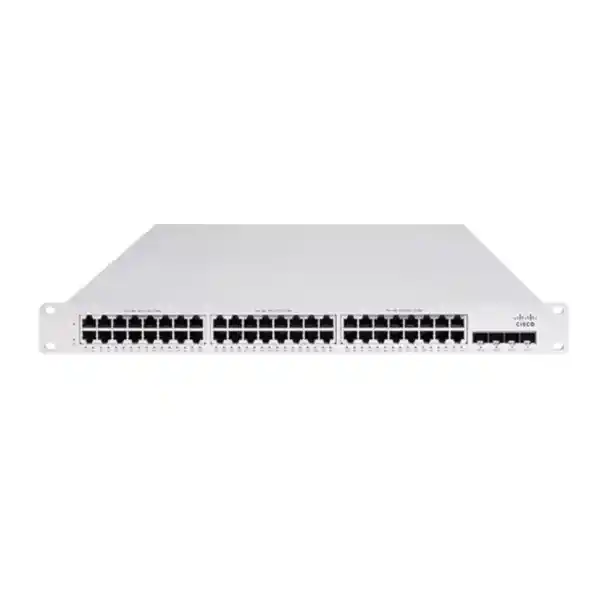
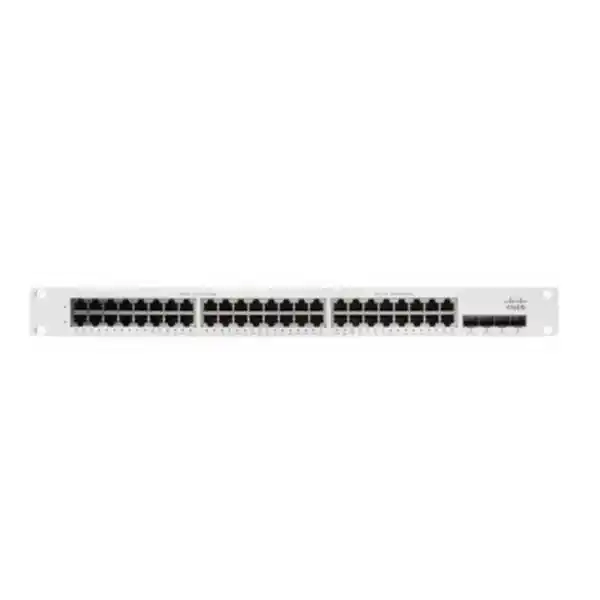
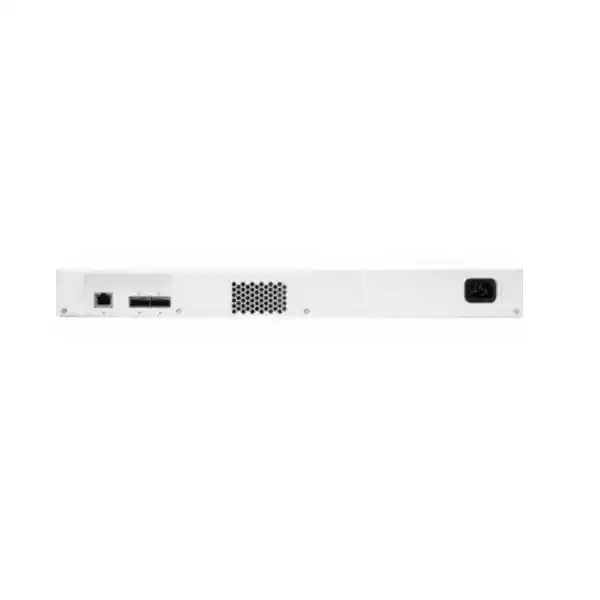
Cisco Meraki MS150-48FP-4G
The Cisco Meraki MS150-48FP-4G is a 48-port cloud-managed access switch designed for organizations that need substantial PoE capacity, centralized administration and a practical migration path for modern wired, wireless, voice, surveillance and IoT networks. Cisco documents 48 x 1 GbE RJ45 access ports, four fixed 1 GbE SFP uplinks, a 740 W PoE budget on the full-power FP model, two dedicated 80G physical stacking interfaces, virtual stacking, DHCP relay and static routing for the MS150 family. The platform is managed through the Meraki Dashboard, giving network teams a consistent way to configure, monitor and troubleshoot switches across one or many sites.
For buyers in Tanzania, the important decision is not simply whether a switch has 48 ports. Port count, endpoint power, fiber uplink requirements, network segmentation, licensing model, stacking design, rack power, UPS capacity and future expansion should be considered together. FourTeck Tanzania can help procurement and IT teams build a quotation around the complete deployment rather than treating the switch as an isolated line item.
Access ports: 48 x 1 GbE RJ45
Uplinks: 4 x 1 GbE SFP
PoE budget: 740 W
Stacking: 2 x 80G dedicated physical stacking plus virtual stacking
Management: Cisco Meraki Dashboard cloud management
What the Cisco Meraki MS150-48FP-4G is designed to solve
A modern access switch has to do more than connect desktop computers. One wiring closet may serve Wi-Fi access points, IP phones, cameras, badge readers, printers, meeting-room devices, building systems and ordinary user endpoints. The MS150-48FP-4G is positioned as a branch and campus access switch where cloud management, high PoE capacity and stackable operation can simplify a growing network. The 740 W PoE budget is especially relevant when many attached devices must be powered from the switch, although final power planning should always be based on the actual per-device requirements and not on port count alone.
Cloud management can also reduce the operational friction of distributed networks. Meraki Dashboard supports centralized configuration and visibility, zero-touch deployment workflows, automatic firmware handling and remote diagnostic capabilities. For an organization with several branches, this changes the operating model: network administrators can apply common standards, review switch health and investigate port-level issues without treating every site as an independent island. The benefit is strongest when the physical network is also documented properly, with clear VLAN design, naming conventions, uplink planning and rack organization.
High-density access
Forty-eight 1 GbE copper ports suit offices, schools, hotels, clinics, branches and other environments with many wired endpoints in one rack.
Full PoE model
The FP variant carries a 740 W PoE budget, allowing deployment planners to support a larger mix of powered endpoints than lower-budget models.
Cloud operations
Meraki Dashboard management is useful for standardized configuration, event visibility, diagnostics and multi-site operational consistency.
Stackable design
Dedicated physical stacking can help simplify management and resilience when multiple access switches are installed together.
Technical planning for the MS150-48FP-4G
| Model | Cisco Meraki MS150-48FP-4G |
| Copper access interfaces | 48 x 1 GbE RJ45 |
| Fixed uplinks | 4 x 1 GbE SFP |
| PoE budget | 740 W |
| Physical stacking | 2 x 80G dedicated stacking interfaces |
| Routing functions documented for MS150 family | DHCP relay and static routing |
| Mounting | Integrated 1U rack mount |
| Operating environment | Cisco installation documentation lists 0°C to 45°C operating temperature and 5% to 95% humidity for the family models shown. |
The 4G suffix is an important procurement detail because this model uses four 1 GbE SFP uplinks, not the 10 GbE SFP+ uplinks found on 4X variants. If a design expects sustained high-throughput aggregation from many access ports, high-resolution surveillance streams, large backups or dense wireless traffic, the uplink requirement should be calculated before purchase. In some networks the 1 GbE SFP uplinks are entirely appropriate; in others, a 10 GbE uplink model may be the better fit. This is why FourTeck recommends confirming topology, traffic patterns and upstream switch capability before finalizing the bill of materials.
Licensing and deployment considerations
Cisco Meraki switches are cloud-managed and require appropriate licensing or subscription coverage according to the chosen Meraki licensing model. Cisco documentation lists MS150 options under both traditional Meraki licensing approaches and subscription licensing. The correct license family, term and feature tier should be selected with the organization’s existing Meraki environment in mind, particularly where an organization already uses Enterprise or Advanced licensing. Procurement teams should therefore request hardware and licensing together rather than assuming the switch can be commissioned independently of the Meraki management entitlement.
Deployment preparation should include Meraki organization and network structure, switch naming, VLAN assignments, management addressing, uplink configuration, spanning-tree strategy, link aggregation where used, port profiles, voice VLANs, access policies and monitoring. Where PoE is critical, create a per-endpoint power estimate and leave sensible headroom. Rack depth, ventilation, earthing, UPS sizing and fiber transceiver compatibility should also be confirmed before installation.
Related FourTeck resources for a complete network project
A managed switch is most effective when the surrounding network is designed as one system. The FourTeck Tanzania technology solutions overview explains how switching, security, Wi-Fi, voice, CCTV and structured infrastructure fit together. Buyers comparing product options can also use the FourTeck Tanzania shop to review available business technology categories, while the FourTeck Tanzania services page gives context for design, installation, configuration and support requirements. Organizations managing East African operations can coordinate related requirements through FourTeck Kenya and FourTeck Uganda for regional project continuity.
Cisco Meraki MS150-48FP-4G Tanzania
For organizations sourcing the Cisco Meraki MS150-48FP-4G in Tanzania, the strongest use case is a professionally managed access layer that needs many powered ports, centralized administration and straightforward branch or campus operations. A 48-port switch may serve a full office floor, an education block, a hospitality area, a clinic, a warehouse or a mixed-use wiring closet where PCs share infrastructure with IP phones, cameras and wireless access points. The model’s 740 W PoE budget is valuable in such environments because endpoint power can become a limiting factor long before port count is exhausted. Procurement should still calculate the real draw of every powered endpoint, including startup requirements and future devices, because a good design leaves room for change rather than allocating every watt on day one.
Tanzania deployments also benefit from careful attention to rack power and environmental conditions. Cloud management does not remove the need for resilient local infrastructure. The switch, firewall, ISP equipment and upstream devices should ideally be connected through appropriately sized UPS protection, while the rack should have ventilation and cable organization that supports safe maintenance. In sites where utility interruptions or generator transfers are part of normal operations, the network designer should define which devices must remain online and for how long. For multi-floor or multi-building locations, fiber uplinks can reduce distance limitations and electrical interference, but the 1 GbE SFP uplink characteristic of the 4G model should be checked against expected aggregate traffic.
From a management perspective, Meraki Dashboard can be particularly useful for Tanzania businesses with branches outside the main IT office. A central team can standardize switch configuration, review event data and use remote troubleshooting tools without dispatching a technician for every basic diagnosis. That advantage becomes stronger when deployment documentation is disciplined: each port should have a defined purpose, VLANs should separate user, voice, camera, guest and infrastructure traffic where appropriate, and uplinks should be labeled both physically and in the dashboard. When requesting a quotation, include the number and type of powered devices, existing firewall and switch models, fiber requirements, rack location, current Meraki licensing state and expected growth. This allows FourTeck Tanzania to evaluate whether the MS150-48FP-4G is the right fit or whether another uplink or port-power profile would be more suitable.
Cisco Meraki MS150-48FP-4G Dar es Salaam
Businesses in Dar es Salaam often combine office users, customer-facing spaces, security systems, wireless coverage and cloud applications within the same premises. The Cisco Meraki MS150-48FP-4G can suit that kind of converged access network when a single rack or floor needs up to 48 wired connections and a substantial PoE budget. Corporate offices can power IP phones and access points, retail or hospitality sites can connect cameras and operational devices, and mixed-use buildings can segment traffic so that guest Wi-Fi, surveillance and business applications do not sit in one unmanaged broadcast domain. The cloud-managed operating model is especially useful when IT staff support several sites around the city or across the country.
A Dar es Salaam quotation should begin with the physical site. The number of data outlets does not always equal the number of switch ports required because access points, cameras, phones, meeting-room systems and future expansion all consume interfaces. If a desk phone provides a pass-through connection to a PC, that can change port planning, but voice VLAN and QoS configuration still need to be correct. For CCTV-heavy buildings, PoE demand and camera traffic should be modeled together. High-resolution recording can place sustained load on uplinks, so the four 1 GbE SFP uplinks on the 4G model should be assessed against how traffic reaches NVRs, servers or aggregation switches. Where 10 GbE uplinks are required, a 4X variant may deserve consideration instead of forcing the wrong model into the design.
Power and heat are equally practical concerns. A full-power PoE switch can be part of a significant rack load, and it should not be treated like a low-power desktop device. UPS runtime calculations should include the switch and the powered endpoints that depend on it; otherwise a UPS may keep the switch alive for only a short period or overload when many PoE devices are active. The rack should also support airflow and service access. For businesses opening or refurbishing offices in Dar es Salaam, the best time to solve these issues is before cabling and rack positions are finalized. FourTeck can review endpoint counts, PoE classes, VLAN needs, fiber uplinks, Meraki licensing and site topology so the final MS150-48FP-4G proposal is aligned with the actual installation instead of being based only on a model number.
Cisco Meraki MS150-48FP-4G Mwanza
For organizations in Mwanza, the Cisco Meraki MS150-48FP-4G is relevant where IT teams want enterprise-style switch visibility without relying on a locally managed interface at every branch. A cloud-managed access layer can help companies operating offices, education environments, hospitality facilities, healthcare sites or distribution locations maintain consistent network standards across geographically separated sites. The switch’s 48 Gigabit Ethernet access ports provide useful density in a rack, while the 740 W PoE budget can support deployments where wireless access points, cameras and IP phones make power delivery a central design requirement rather than an optional feature.
The most important Mwanza planning question is how much of the site depends on the switch. If the device powers most cameras and access points, then switch availability and UPS runtime directly affect security and connectivity. Network designers should separate essential and non-essential loads, understand the expected PoE draw and provide power protection suited to the business’s continuity requirements. It is also sensible to document spare port and power headroom for future expansion. A hotel, school or warehouse may start with a moderate number of powered devices and then add coverage areas, cameras or door systems later. Buying exactly to the first-day requirement can make the next project more expensive than choosing a sensible growth margin.
Connectivity to upstream infrastructure needs similar discipline. The MS150-48FP-4G uses four 1 GbE SFP uplinks, so fiber distance and transceiver selection should be checked, and traffic volumes should be estimated rather than guessed. If large file transfers, centralized video recording and heavy wireless usage all cross the same uplink, link aggregation or a different uplink profile may be necessary. Meraki Dashboard can then provide centralized monitoring and diagnostics, but it works best when naming, VLANs and port profiles follow a clear standard. When requesting a Mwanza quotation, provide the existing network diagram if available, the number of floors or buildings, endpoint categories, fiber distances, internet connection speeds and current Meraki organization details. Those inputs help determine not only hardware quantity but also licensing, optics, stacking accessories, rack and power requirements.
Cisco Meraki MS150-48FP-4G Arusha
In Arusha, the Cisco Meraki MS150-48FP-4G can be a strong access-switch candidate for hospitality, tourism, professional services, schools, healthcare facilities and other organizations that depend on reliable wired and wireless connectivity. Many of these environments combine guest Wi-Fi, staff systems, cameras, IP telephony and operational devices on the same physical switching infrastructure. The correct design is therefore not to connect everything to a flat LAN. Managed VLANs, appropriate security boundaries and predictable uplink paths make the network easier to secure and troubleshoot. Meraki cloud management provides the control plane for configuring and monitoring that access layer across one property or several locations.
Hospitality and campus-style sites in particular should pay attention to PoE architecture. Wireless access points may be mounted across corridors, rooms, public spaces and outdoor-adjacent areas, while cameras add another large powered-device population. The MS150-48FP-4G’s 740 W PoE budget gives planners considerable capacity, but each endpoint’s requirements still need to be checked. A design should also allow for future AP or camera upgrades that could consume more power than older devices. Where high-power endpoints are expected, cable quality, length and termination matter as well; PoE problems can appear as intermittent device behavior when the root cause is physical-layer quality rather than switch configuration.
Arusha buyers should also decide whether the four 1 GbE SFP uplinks match the traffic profile. A property with locally recorded CCTV, large backups or many high-throughput wireless clients may concentrate significant traffic on the aggregation link. If the uplink becomes the bottleneck, adding more access ports does not improve user experience. During procurement, FourTeck can help review uplink speed, fiber type, stacking, switch location, rack size, UPS capacity and licensing. For multi-site hospitality groups or organizations with branches elsewhere in Tanzania, a standardized Meraki template can reduce operational variation: the same VLAN numbering, port profiles, SSID mappings and documentation format can be reused while still allowing each site to have a size-appropriate bill of materials.
Cisco Meraki MS150-48FP-4G Dodoma
Organizations in Dodoma evaluating the Cisco Meraki MS150-48FP-4G are often looking for a managed access layer that can support growth while keeping administration centralized. Government-related offices, professional services, education facilities, NGOs, healthcare environments and expanding businesses may all need structured connectivity for users, voice, security cameras and wireless services. A 48-port switch with a 740 W PoE budget can consolidate many of those endpoints into one rack, but the project should be designed around services rather than just available sockets. Each network segment should have a purpose, and access to sensitive resources should be controlled intentionally.
Cloud management can help reduce the difference between a well-staffed headquarters and a smaller branch. Meraki Dashboard allows authorized administrators to review switch status, ports and events remotely, which can shorten troubleshooting when an endpoint loses connectivity or a port needs to be checked. That does not eliminate the value of local documentation. Patch panels should be labeled, rack layouts should be recorded and uplink paths should be clear so that a remote administrator can work effectively with onsite personnel. For branch-heavy organizations, consistent device naming and port-profile templates can make expansion more predictable.
Dodoma procurement teams should include licensing in the budget from the beginning. The MS150 is part of the Meraki cloud-managed ecosystem and should be quoted with the correct licensing or subscription approach for the organization. Existing Meraki customers also need to consider whether the new switch must align with the license tier already used in the organization. Hardware selection should then be validated against fiber and bandwidth plans. The MS150-48FP-4G has four 1 GbE SFP uplinks; if the site is expected to aggregate high-bandwidth wireless, server or video workloads, confirm that this uplink capacity is appropriate. A useful quotation request includes endpoint count, PoE device list, floor plan or rack location, desired VLANs, current firewall, upstream switch, fiber requirements and expected growth over the next several years.
Cisco Meraki MS150-48FP-4G UAE
For UAE organizations, the Cisco Meraki MS150-48FP-4G fits cloud-managed access deployments where distributed branches, retail outlets, hospitality properties, clinics, offices and education sites need a common operational model. The switch’s 48 x 1 GbE access ports and 740 W PoE budget can support a mixed endpoint environment, while dedicated physical stacking is useful when several access switches share the same closet. The Meraki Dashboard approach is particularly relevant for companies with sites in multiple emirates or a broader regional footprint because network standards can be defined centrally and applied consistently.
The procurement decision in the UAE should distinguish the 4G and 4X variants clearly. This MS150-48FP-4G model provides four 1 GbE SFP uplinks. Sites planning high-density Wi-Fi, large surveillance environments, substantial east-west traffic or high-speed links to aggregation should calculate whether 1 GbE uplinks provide enough headroom. Where 10 GbE is a requirement, selecting the correct 4X model at the outset is generally better than redesigning around an uplink limitation after installation. Optics, fiber type and upstream port compatibility should be included in the same review.
PoE planning can also be substantial in modern UAE buildings, where a single floor may contain many access points, cameras, IP phones and smart-building endpoints. The 740 W budget is a key capability, but design teams should map real device power consumption and future expansion. Rack cooling and UPS design become more important as power density rises. For multinational groups with Tanzania and UAE operations, Meraki’s centralized management can support a repeatable branch template while still allowing local differences in internet service, device density and building layout. A complete quotation should cover the switch, relevant license, compatible optics, stacking accessories if needed, rack power and any installation or configuration scope. This avoids comparing only hardware prices when the operational solution includes several interdependent components.
Cisco Meraki MS150-48FP-4G Uganda
In Uganda, the Cisco Meraki MS150-48FP-4G can serve as a cloud-managed access switch for businesses that want consistent network operations across headquarters, branches and remote sites. With 48 Gigabit Ethernet access ports and a high PoE budget, it can consolidate data, voice, Wi-Fi and camera connectivity in a structured rack. This is particularly useful when a site is replacing several small unmanaged switches with a documented architecture. Moving to a managed platform makes it possible to separate services with VLANs, apply port policies and monitor network health centrally rather than troubleshooting by repeatedly disconnecting cables.
For Ugandan multi-site organizations, the management model may be as important as raw port count. Meraki Dashboard supports remote visibility and standardized configuration, which can reduce the operational differences between a Kampala headquarters and smaller sites elsewhere. IT teams can define naming conventions and port profiles that are recognizable across the estate. When a support call reports that a camera, phone or access point is offline, the network administrator can begin with dashboard information and physical documentation instead of treating the location as unknown infrastructure.
The MS150-48FP-4G still needs careful site engineering. Four 1 GbE SFP uplinks must be matched to the bandwidth expected between access and aggregation. The 740 W PoE budget must be matched to endpoint demand and UPS capacity. Meraki licensing must be included, and compatible optics and stacking components should be selected for the actual topology. For organizations coordinating procurement between Uganda and Tanzania, the same high-level design standard can be reused: separate staff, guest, voice, cameras and infrastructure where appropriate; maintain consistent addressing and labeling; and document deviations clearly. Buyers can coordinate related regional requirements through FourTeck Uganda while using the Tanzania team for Tanzania deployments, helping multinational IT teams maintain a common architecture instead of purchasing disconnected hardware site by site.
Cisco Meraki MS150-48FP-4G Kampala
Kampala organizations often need access switching that can handle dense office networks while being manageable by a small central IT team. The Cisco Meraki MS150-48FP-4G is designed for that type of branch and campus access role, offering 48 x 1 GbE ports, a 740 W PoE budget and Meraki cloud management. A corporate floor can use the switch for computers, phones and access points; a hotel can connect wireless, cameras and operational systems; and a school can use it to organize classrooms, labs, staff networks and surveillance. The common requirement is that the network remains structured as device numbers increase.
In a Kampala deployment, the first technical review should be endpoint classification. Count wired users, access points, cameras, phones, controllers and other PoE devices separately. Determine which devices need continuous operation during a power event and calculate UPS runtime accordingly. Then map traffic paths. Cameras may send continuous streams to an NVR, while access points can generate bursty traffic from many users. If those flows all converge on one uplink, the four 1 GbE SFP ports of the 4G model need to be assessed against the required throughput. Link aggregation can help in some architectures, but it should be designed rather than assumed.
The Meraki licensing model is another line item that should not be left until installation day. Buyers should confirm the correct term and tier for the organization and include the entitlement in the procurement package. Existing Meraki customers should also review the organization’s licensing approach to avoid unnecessary mismatch. After deployment, standardized port descriptions, VLAN labels and rack documentation make remote support far more effective. For organizations with offices in Kampala and Tanzania, the same configuration philosophy can be extended across both countries: use repeatable templates for common services, adapt internet and power design to each site, and maintain one documented baseline for security and operations.
Cisco Meraki MS150-48FP-4G Arua
For an Arua branch, campus or operational site, the Cisco Meraki MS150-48FP-4G can provide a centrally managed access layer where local IT resources may be limited. Cloud-managed switching is valuable in this context because configuration and diagnostics can be handled by an authorized central team while onsite staff focus on physical checks such as cabling and power. The switch offers enough port density for a substantial site and a 740 W PoE budget that can support a large group of powered devices, making it suitable for networks that combine office connectivity with wireless access and surveillance.
Remote-site design should place extra emphasis on resilience and documentation. If a switch powers most access points and cameras, a power issue can remove several business services at once. The UPS therefore needs to be sized around the switch plus actual PoE load, and the rack should have enough airflow and physical security for the installation environment. Spare ports and PoE capacity should be reserved where expansion is likely because adding another switch later may require rack space, power sockets, stacking and uplink changes. A small amount of headroom at the design stage can simplify future growth.
Connectivity from Arua to centralized systems should also influence the VLAN and uplink plan. The switch has four 1 GbE SFP uplinks, and the designer should determine whether those links connect to a local firewall, an aggregation switch or a fiber backbone. If the site sends camera recordings or large data sets to another location, sustained traffic should be considered. Meraki Dashboard can simplify management, but cloud visibility depends on stable upstream connectivity, so the local LAN should remain logically organized even during WAN problems. For procurement, provide FourTeck with device counts, expected PoE load, fiber distances, rack conditions, internet architecture and current Meraki licensing details. That information supports a complete proposal instead of a hardware-only quote that leaves optics, licensing or power requirements unresolved.
Cisco Meraki MS150-48FP-4G Mbarara
Mbarara businesses, education sites, healthcare facilities and regional branches can use the Cisco Meraki MS150-48FP-4G when they need a high-density managed switch with substantial PoE capacity and centralized operational control. Forty-eight 1 GbE access ports can reduce the need for multiple small switches, while the 740 W PoE budget is useful where many endpoints receive both data and power over Ethernet. Consolidation should still be approached carefully because placing many critical services on one switch increases the importance of power protection, uplink resilience and disciplined configuration.
A well-planned Mbarara deployment can separate staff PCs, voice, wireless, CCTV and infrastructure management into appropriate VLANs, then apply the required routing and security policy upstream. Port profiles make it easier to maintain consistent settings for repeated endpoint types. For example, phone ports can use the correct voice parameters, camera ports can sit in a surveillance segment and access-point trunks can carry the VLANs required by wireless SSIDs. This is more maintainable than configuring every port from scratch and gives remote administrators a predictable model when troubleshooting.
The MS150-48FP-4G provides 1 GbE SFP uplinks, so topology should be reviewed if the site is expected to aggregate a lot of video, wireless or server traffic. Fiber modules and cable type need to be compatible with both ends of the link, and unsupported assumptions about optics can delay commissioning. Licensing is equally essential because Meraki cloud management depends on the correct entitlement. For buyers comparing quotations, evaluate the full installed solution: hardware, license, optics, stacking cables if used, rack accessories, UPS design, configuration and documentation. A lower hardware-only price may not represent the lowest project cost if important components are missing. FourTeck can use a bill-of-materials review to identify those dependencies before procurement so the switch arrives as part of a deployable network design.
Cisco Meraki MS150-48FP-4G Gulu
For organizations in Gulu, the Cisco Meraki MS150-48FP-4G is a practical option where a central IT team wants visibility into a remote access network without sacrificing managed switching features. The switch can host 48 wired endpoints and provides a 740 W PoE budget, allowing one rack to support data users alongside access points, IP phones, cameras and other powered devices. This can simplify branch standardization because a common hardware and configuration approach can be repeated across locations while endpoint counts and port assignments vary by site.
Remote management should be paired with physical discipline. A Gulu installation should have labeled patch panels, clear port descriptions, reliable UPS protection and documented uplink paths. Those details allow an engineer working through Meraki Dashboard to communicate effectively with someone onsite. If port 32 is labeled both in the rack and dashboard as a specific camera or AP, troubleshooting becomes much faster than tracing an undocumented cable. The network can also use consistent VLAN numbering and naming so that a support engineer understands the site immediately.
PoE and uplink sizing remain central. A 740 W budget is generous for many deployments, but actual power consumption varies by endpoint, and future wireless or camera upgrades may raise demand. Similarly, four 1 GbE SFP uplinks may be appropriate for a branch but need review where traffic is concentrated. The quotation should therefore include the business applications and endpoint types, not just the required port count. Licensing must also be specified because the Meraki platform is cloud managed. For organizations with sites in Gulu, Kampala and Tanzania, standardized Meraki configurations can create a common operational framework. Local physical conditions may differ, but management conventions, VLAN roles, security expectations and documentation can remain consistent, improving support and reducing the risk of each branch evolving into an incompatible network.
Cisco Meraki MS150-48FP-4G Kenya
In Kenya, the Cisco Meraki MS150-48FP-4G is relevant to enterprises, branches, schools, healthcare sites, hospitality environments and retail operations that want cloud-managed access switching with high PoE capacity. A 48-port access switch can form the edge of a floor or building network, while Meraki Dashboard provides central administration for organizations with many locations. This operating model is particularly useful to companies that already use Meraki wireless, security or switching because network teams can maintain a consistent management experience across the estate.
The 4G model should be selected with uplink requirements in mind. It offers four 1 GbE SFP interfaces. In an office where most traffic goes to the internet through a modest WAN link, that may be entirely adequate. In a high-density wireless environment, data-heavy campus or surveillance deployment with centralized recording, aggregate traffic can be much higher. Network planners should estimate peak and sustained loads and decide whether link aggregation, multiple uplinks or a 10 GbE 4X model is more appropriate. This avoids a situation where the access layer has many available ports but the upstream path becomes the performance constraint.
The 740 W PoE budget is another reason buyers may choose the FP model, particularly when powering many access points and cameras. The corresponding electrical design should account for switch power, endpoint load, UPS capacity and ventilation. Meraki licensing must be quoted as part of the solution, and any physical stacking design should include the necessary accessories. Companies coordinating Kenya and Tanzania infrastructure can benefit from a common branch standard: define approved switch families, VLAN roles, port-profile templates, wireless mappings and documentation requirements. FourTeck Kenya and FourTeck Tanzania can support region-specific project discussions while the customer’s IT team maintains a shared technical baseline. That approach is more scalable than treating every country procurement as a completely separate design exercise.
Cisco Meraki MS150-48FP-4G Kuwait
Kuwait businesses considering the Cisco Meraki MS150-48FP-4G can use it as a cloud-managed access switch for offices, retail, hospitality, education and other structured LAN environments. The model combines 48 Gigabit Ethernet user ports with a high 740 W PoE budget, so it can support dense endpoint populations without requiring separate power adapters for every compatible phone, access point or camera. Meraki Dashboard management adds centralized configuration and monitoring, making the switch attractive to organizations that support multiple branches from one IT team.
Thermal and rack planning should be treated seriously in a high-PoE installation. The switch belongs in a suitable communications rack with correct airflow, clean cable management and dependable power protection. If the device powers dozens of endpoints, UPS sizing must account for the combined load rather than just the switch chassis. The design team should decide which services need to remain online during short outages and whether a single access switch creates an unacceptable concentration of dependency. Physical stacking can simplify management of multiple units in a closet, but resilience still depends on upstream topology and power architecture.
The four 1 GbE SFP uplinks on this specific 4G model also deserve early review. Many office deployments will be well served by Gigabit fiber uplinks, while data-intensive sites may require faster aggregation. The choice should follow measured or expected traffic, not the assumption that all 48 access ports will be active at full speed simultaneously. Cisco Meraki licensing should be ordered with the hardware and aligned to the organization’s existing licensing model. For regional groups operating in Kuwait, the UAE, Tanzania or East Africa, Meraki’s cloud model can support standardized switch templates and remote troubleshooting across countries. The procurement package should include license term, optics, stacking requirements, rack and UPS needs and configuration scope so the total solution is comparable across suppliers and deployable when it reaches site.
Cisco Meraki MS150-48FP-4G Ghana
For Ghanaian organizations, the Cisco Meraki MS150-48FP-4G can provide a managed access layer that combines high port density, strong PoE capacity and centralized cloud operations. This can be useful in offices, education, healthcare, hospitality and distributed enterprises where IT teams need to manage several sites without maintaining separate local switch-management practices. Forty-eight Gigabit Ethernet access ports can support a full wiring closet, while the 740 W PoE budget creates room for networks that rely heavily on wireless access points, IP telephony, cameras and other powered devices.
A Ghana deployment should begin with the endpoint inventory and traffic map. Identify which devices require PoE, how much power they draw and where their traffic goes. Camera traffic may stay local to an NVR or cross to centralized storage; wireless users may access cloud applications or local servers; phones require low-latency service and predictable VLAN handling. When these flows are understood, the network designer can decide whether the MS150-48FP-4G’s four 1 GbE SFP uplinks are sufficient and how the links should connect to the firewall or aggregation layer.
Meraki Dashboard helps operations teams turn that design into a repeatable standard. Ports can have clear descriptions and consistent roles, while remote diagnostics can reduce the need for onsite investigation of every incident. Still, cloud management works best when the physical installation is organized: label cables, protect equipment with suitable UPS capacity, maintain ventilation and document fiber paths. Licensing must also be budgeted alongside the switch. Multinational businesses with Ghana and Tanzania branches can use one standard for VLAN roles, configuration templates and documentation while adapting hardware quantities to each site. This simplifies governance because the IT team manages a familiar architecture even when local buildings, WAN services and endpoint counts differ. A complete quotation should therefore describe the whole network context rather than asking only for a unit price on the switch chassis.
Cisco Meraki MS150-48FP-4G Nigeria
Nigeria’s large and distributed business environments can make centralized network management especially valuable. The Cisco Meraki MS150-48FP-4G is suited to access-layer roles where organizations need 48 Gigabit Ethernet ports, high PoE capacity and remote administration through Meraki Dashboard. Branch networks can use the switch to support staff devices, wireless access points, phones, cameras and operational endpoints with consistent policies. Headquarters teams can then maintain a common standard across offices instead of depending on locally configured standalone switches that evolve differently over time.
The 740 W PoE budget makes the full-power model attractive for camera- and Wi-Fi-heavy sites, but power design should be explicit. IT teams should create a PoE schedule showing each endpoint, expected draw and growth allowance. UPS sizing should then include both switch consumption and powered loads. Where business continuity requirements are strict, consider whether one switch or one UPS represents too large a failure domain. Cabling quality also matters because higher-power PoE and long runs can expose termination problems that may not be obvious during simple data testing.
Traffic engineering is equally important. The MS150-48FP-4G has four 1 GbE SFP uplinks, which may suit many branch networks but should be evaluated carefully for large video, wireless or server workloads. The correct answer may be aggregated Gigabit links or a different model with faster uplinks. Licensing is required for the Meraki cloud-managed environment and should be included in the procurement plan with optics and stacking accessories where applicable. For organizations that operate in Nigeria and East Africa, a standardized Meraki branch design can improve governance: consistent VLAN names, IP conventions, port profiles and monitoring practices allow teams to troubleshoot more quickly. The site-specific elements—ISP capacity, fiber distances, power resilience and endpoint count—can then be adapted without changing the overall operational framework.
Cisco Meraki MS150-48FP-4G Seychelles
In Seychelles, the Cisco Meraki MS150-48FP-4G can be particularly useful for hospitality, commercial, government, education and multi-site organizations that value centralized management and strong PoE capability. Island and distributed-property environments often make remote visibility more valuable because specialist network staff may not be present at every site. Meraki Dashboard allows authorized administrators to monitor and configure the access switch centrally, while 48 Gigabit Ethernet ports and a 740 W PoE budget can support a dense mix of access points, IP phones, cameras and wired business systems.
For hospitality properties, network segmentation is a central design concern. Guest wireless, staff systems, security cameras, point-of-sale devices and building services should not simply share one flat network. A managed access layer can map different endpoint groups to defined VLANs, with policy enforced through the wider network architecture. Wireless access points may carry several SSIDs and require trunk configurations, while cameras may generate continuous traffic toward local recording systems. These requirements should be mapped before port profiles are applied so that the switch configuration reflects operational needs rather than generic defaults.
The MS150-48FP-4G’s four 1 GbE SFP uplinks should be checked against the size of the property and aggregation design. A resort with many APs and high client density may benefit from faster uplinks depending on traffic patterns, making model comparison worthwhile before purchase. Power resilience should also be reviewed because the switch may supply a large group of critical endpoints. UPS capacity, rack ventilation and spare PoE headroom are part of the switching decision. The Meraki license is another required procurement component. For groups managing Seychelles together with Tanzania, Kenya or other regional operations, standardized templates can create consistent operations while local site surveys account for building layout, fiber distances, internet capacity and power conditions. The final quotation should therefore combine hardware, licensing, optics, stacking if required and deployment scope into one complete design discussion.
Buying and sizing guidance
Choose 4G or 4X deliberately
The MS150-48FP-4G uses four 1 GbE SFP uplinks. If 10 GbE uplinks are a design requirement, review the corresponding 4X family variant rather than assuming the uplinks can be upgraded later.
Size PoE from devices
Build a port-by-port PoE schedule for access points, cameras, phones and IoT devices. Include future headroom and UPS implications instead of relying only on the 740 W headline figure.
Include licensing
A Meraki cloud-managed switch should be procured with the appropriate license or subscription entitlement. Match the model and tier to the organization’s existing Meraki licensing strategy where applicable.
Plan the rack as a system
Confirm rack space, ventilation, patching, fiber management, UPS capacity, earthing and physical access. Deployment reliability depends on these infrastructure details as much as on switch features.
Quotation checklist for Cisco Meraki MS150-48FP-4G
To receive a more accurate technical quotation, provide the number of switches required; total wired endpoints; number and model of PoE devices; current switch and firewall models; expected VLANs; fiber distances and type; uplink speed requirement; whether physical stacking is planned; rack size and available power; UPS requirement; current Meraki organization and licensing model; desired license term; installation location; and whether configuration, migration, documentation or post-deployment support is required. If the project replaces an existing network, a basic topology diagram and port list can expose hidden dependencies before equipment is ordered.
Frequently asked questions
How many ports does the Cisco Meraki MS150-48FP-4G have?
Cisco documents 48 x 1 GbE RJ45 access ports and four fixed 1 GbE SFP uplink ports for the MS150-48FP-4G. The uplinks should be planned according to aggregation and fiber requirements.
What is the PoE budget?
The full-power FP model is documented with a 740 W PoE budget. Actual deployment capacity depends on the power draw of attached devices, so a per-port power plan is recommended.
Does the MS150-48FP-4G support 10 GbE uplinks?
No. The 4G variant provides four 1 GbE SFP uplinks. Cisco also offers 4X variants in the MS150 family with 10 GbE SFP+ uplinks, so model selection should reflect the required aggregation speed.
Can the MS150 be physically stacked?
Yes. Cisco lists two dedicated 80G physical stacking interfaces for the MS150 family, in addition to virtual stacking capabilities. The final stack design should include the appropriate physical accessories and topology.
Does Cisco Meraki MS150 require licensing?
Meraki switches are cloud managed and require the appropriate licensing or subscription entitlement. Cisco documentation lists MS150 options across its supported licensing models, so the quotation should include the correct license family, term and tier.
What information should I send for a Tanzania quote?
Send the required quantity, endpoint and PoE counts, uplink and fiber details, current Meraki environment, licensing preference, rack and UPS information, installation city and whether configuration or migration assistance is required. These details help validate that the MS150-48FP-4G is the correct model for the project.
Decision recap
Choose the Cisco Meraki MS150-48FP-4G when the project needs 48 Gigabit access ports, a 740 W PoE budget, cloud management, dedicated stacking and four 1 GbE SFP uplinks. Reconsider the exact variant if the design requires 10 GbE SFP+ uplinks, a different PoE profile or a different port mix. The best procurement result comes from matching the switch to the actual topology, powered endpoints, traffic profile, licensing model and physical rack environment.
FourTeck Tanzania can help turn those requirements into a practical bill of materials covering the switch, licensing, optics, stacking accessories, rack integration, UPS considerations and deployment scope. This reduces the chance of receiving the correct chassis but discovering later that the uplink, license or power design is incomplete.
Consultation for your Meraki switching project
Share your site count, endpoint mix, PoE requirements, current network, fiber distances and Meraki licensing status. FourTeck can help evaluate whether the MS150-48FP-4G fits the access layer and identify the accessories and deployment requirements that should be included in the quotation. No stock, delivery-time or pricing assumption is made here; availability and commercial terms should be confirmed at quotation stage.


Reviews
There are no reviews yet.