
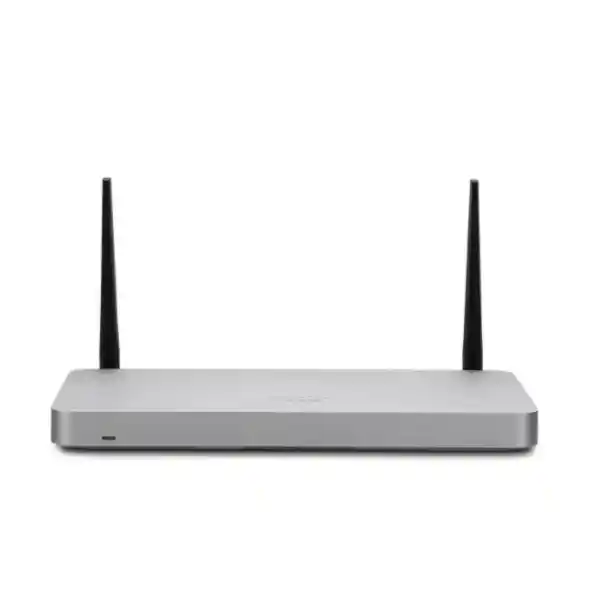
Cisco Meraki MX67C Tanzania
The Cisco Meraki MX67C is a compact cloud-managed security and SD-WAN appliance built for small branches and distributed organizations that need secure connectivity, centralized administration and integrated cellular resilience. Cisco positions the MX67C for small-branch deployments of up to 50 users. Current Cisco documentation lists 700 Mbps firewall throughput, 400 Mbps advanced-security throughput, up to 50 site-to-site VPN tunnels, four fixed Gigabit Ethernet LAN interfaces, a dedicated Gigabit Ethernet WAN interface, a convertible Gigabit Ethernet interface and an integrated Cat 6 LTE modem.
For businesses in Tanzania, the MX67C can be evaluated as a branch-edge platform where internet access, application control, site-to-site connectivity, remote management and cellular backup need to be coordinated through one operational model. Selection should still be based on actual bandwidth, security-service usage, VPN demand, user count, application profile and licensing requirements rather than on headline throughput alone.
MX67C quick facts
Recommended scale: small branch, up to 50 users.
Firewall throughput: 700 Mbps.
Advanced security: 400 Mbps.
Site-to-site VPN: up to 50 tunnels.
Cellular: integrated Cat 6 LTE modem.
What the Cisco Meraki MX67C solves
Many branch networks become unnecessarily complex because routing, firewall policy, VPN connectivity, failover and visibility are handled by separate tools. The MX67C is intended to simplify that edge architecture by combining cloud-managed security and SD-WAN functions in a compact appliance. Administrators can manage the device through the Meraki dashboard, monitor uplink health, apply network and security policy, review client and application activity, configure VPN connectivity and perform diagnostics without maintaining a local management server at every site.
The integrated Cat 6 LTE modem is an important differentiator for branch environments where resilience matters. It can be used for cellular failover or, where the deployment design and service plan make sense, as a cellular uplink. Because the cellular function is integrated into the appliance, status and configuration remain visible in the same management environment as wired connectivity. Organizations should confirm SIM format, carrier compatibility, supported bands for the specific worldwide or regional hardware SKU and local mobile-service requirements before procurement.
MX67C is especially relevant to distributed retail, professional offices, clinics, service locations, small warehouses, project offices and other sites that may not have permanent networking staff. Zero-touch deployment can reduce staging effort, while centralized policy templates help organizations keep multiple branches aligned. It is equally important to plan licensing correctly because Cisco Meraki appliances require an active Meraki license for operation and support. License tier and term should therefore be part of the quotation, not an afterthought.
Cloud management
Web-based Meraki dashboard administration provides centralized configuration, monitoring, alerts, diagnostics and policy visibility across distributed sites.
Integrated LTE
An integrated Cat 6 LTE modem helps support cellular failover or single-uplink designs without requiring a separate external cellular gateway.
Auto VPN and SD-WAN
Meraki Auto VPN simplifies branch-to-branch and branch-to-hub connectivity, while SD-WAN policies help steer traffic according to business needs and uplink conditions.
Layer 7 visibility
Application-aware traffic control and reporting help administrators understand usage, prioritize important services and enforce policy at the branch edge.
Verified Cisco MX67C technical highlights
| Recommended deployment | Small branch, up to 50 users |
| Firewall throughput | 700 Mbps |
| Advanced security services throughput | 400 Mbps |
| Maximum site-to-site VPN throughput | 400 Mbps in the current MX family datasheet |
| Maximum site-to-site VPN tunnels | 50, based on Cisco laboratory conditions |
| WAN interfaces | 1 × 1 GbE RJ45 dedicated WAN, 1 × integrated Cat 6 LTE modem, plus 1 × convertible 1 GbE RJ45 WAN/LAN interface |
| LAN interfaces | 4 × 1 GbE RJ45 fixed interfaces, with one interface usable as WAN/LAN according to Cisco model documentation |
| Cellular | Cat 6 LTE, 300 Mbps modem, nano-SIM form factor |
| Mounting | Desktop or wall mount |
| Dimensions | 239 × 176 × 27 mm |
| Weight | 0.85 kg |
| Operating temperature | 0°C to 45°C |
Security, licensing and management guidance
The MX platform includes core network and firewall capabilities such as stateful firewalling, NAT, VLAN services, DHCP, routing, Auto VPN, client VPN options, traffic analysis and WAN performance management. Advanced security functions such as intrusion prevention, malware protection and content filtering depend on the selected license tier. Because Meraki licensing influences both feature entitlement and the operational status of the appliance, buyers should request a quotation that clearly identifies hardware SKU, license tier, license duration and any optional services. A procurement decision based only on hardware cost can be misleading if the required licensing is omitted.
For multi-site organizations, dashboard templates, role-based administration, two-factor authentication, change logging, alerts and centralized monitoring can reduce the effort needed to manage branch infrastructure. The operational value is greatest when naming conventions, VLAN design, security rules, firmware policy and VPN architecture are standardized before rollout. That approach also makes it easier to troubleshoot new branches, document changes and transfer responsibility between internal teams or support partners.
Cisco Meraki MX67C Tanzania
Organizations evaluating the Cisco Meraki MX67C in Tanzania are often trying to solve a practical branch-network problem: how to keep security, internet access and inter-site connectivity manageable when IT staff may not be physically present at every location. The MX67C is well aligned to that requirement because policy, monitoring and troubleshooting are centered in the Meraki cloud dashboard. A branch can be prepared with its network settings in advance, shipped or installed at the destination, connected to the available internet service and then brought under centralized administration without maintaining a local controller. This model can be useful for retailers, professional-services firms, healthcare offices, education sites, field offices, financial-service branches and other distributed environments.
Tanzania deployments should be sized around real traffic rather than just user count. A branch with twenty users running cloud backup, video meetings and large file transfers may place more demand on a firewall than a site with forty users performing lighter business tasks. Security inspection, VPN traffic and future bandwidth upgrades should also be considered. Cisco’s current figures provide useful upper reference points, but the correct design needs headroom for normal peaks and growth. If Advanced Security services are planned, the relevant throughput value is more useful than the basic firewall figure.
The integrated LTE modem gives Tanzanian buyers another design option for resiliency. Before relying on it, confirm the correct worldwide hardware variant, supported LTE bands, nano-SIM requirements and compatibility with the intended mobile network service. Cellular backup works best when signal quality, data-plan limits, failover behavior and critical-application priorities are considered during deployment. It should not be treated as an automatic substitute for a properly engineered primary internet service.
For related planning, FourTeck Tanzania’s integrated IT, networking and security portfolio provides context for coordinating a firewall with switching, Wi-Fi, servers, voice, cabling and other infrastructure. A quotation request should include branch user count, internet bandwidth, number of sites, VPN destinations, required security features, preferred license term, cellular-backup need and any existing Cisco Meraki organization that the new appliance must join.
Cisco Meraki MX67C Dar es Salaam
For companies in Dar es Salaam, the Cisco Meraki MX67C fits a common branch profile: a compact office, retail outlet, service center or satellite location that needs business-grade firewalling and VPN connectivity without a large on-premises network-management footprint. Centralized dashboard administration is particularly useful where several sites must follow the same policy. An IT team can define VLANs, firewall rules, traffic preferences and VPN relationships consistently, then monitor connectivity and client activity from a single interface.
A sensible Dar es Salaam procurement plan should start with the internet circuit and application mix. If the site runs Microsoft 365, cloud ERP, VoIP, remote desktop, video conferencing or SaaS applications, those services should be ranked by business importance. SD-WAN policy and traffic shaping can then be designed around those priorities instead of simply applying equal treatment to all traffic. If a second wired connection is available, dual-uplink design may be considered; the integrated LTE modem can provide an additional resiliency option where supported by the deployment model.
Branch security also benefits from segmentation. Staff systems, guest Wi-Fi, IP phones, cameras and other devices should not automatically share one unrestricted broadcast domain. The MX67C can participate in a structured VLAN and policy design, while compatible managed switches and wireless access points extend segmentation deeper into the LAN. This is why firewall selection should be coordinated with the rest of the network rather than treated as an isolated purchase.
Buyers should also verify the required Meraki license tier and duration before approval. Enterprise licensing covers core networking and SD-WAN functions, while higher security tiers add threat-protection capabilities. The right choice depends on the organization’s policy requirements, not just price. For a Dar es Salaam quote, provide user count, branch count, public services, VPN needs, internet speeds, security requirements and the preferred licensing period so that hardware and subscription components can be matched correctly.
Cisco Meraki MX67C Mwanza
Businesses considering the Cisco Meraki MX67C in Mwanza may be looking for a branch-edge device that is straightforward to administer remotely and resilient enough for operations that depend on cloud applications. The MX67C supports that model with cloud-managed configuration, automatic firmware delivery, event visibility, VPN monitoring and remote diagnostic tools. These features can reduce the need for routine local console access, although good installation practices, physical security and documented cabling remain important.
For Mwanza sites connected to a head office, data center or cloud-hosted environment, Auto VPN can simplify encrypted site-to-site connectivity. The design should still define which subnets are advertised, which traffic is allowed, whether all internet traffic should exit locally or centrally, and what should happen during an uplink failure. Applications such as voice, payment systems, cloud productivity, ERP and video conferencing may have different latency and bandwidth sensitivities, so traffic priorities should be chosen according to actual business impact.
The cellular modem can be useful where the organization wants an integrated failover path. Before deployment, signal strength at the intended mounting location and carrier compatibility should be assessed. The worldwide MX67C variant supports a broad range of LTE bands, but the exact hardware SKU and mobile service still need confirmation. A backup link also needs a policy: organizations may choose to permit essential SaaS, VPN and transactional traffic while limiting large software downloads or noncritical media during failover.
A Mwanza quotation should therefore capture more than the appliance model. Include the number of users, wired and wireless segments, switch infrastructure, VPN peers, internet links, intended LTE carrier, security-inspection requirements and license term. If the branch is expected to grow beyond the MX67C’s recommended profile, model sizing should be revisited before purchase rather than waiting until performance becomes a constraint.
Cisco Meraki MX67C Arusha
The Cisco Meraki MX67C can suit Arusha organizations that operate a small business site but still require enterprise-style visibility and policy. Hospitality offices, tour operators, NGOs, professional firms, education facilities and distributed commercial organizations may all need secure connectivity between local users, cloud services and remote systems. The MX67C brings those functions into a single cloud-managed platform, making it practical to administer firewall policy and connectivity even when network specialists are not permanently based at the branch.
For Arusha deployments, guest access and internal business traffic should be considered separately. A hotel office, visitor center or customer-facing business may have public wireless demand while also handling confidential operations. The firewall can form part of a segmentation strategy that separates guest, employee, voice, camera and management networks. Managed switching and wireless infrastructure should carry those VLANs consistently, while firewall policy determines which segments may communicate and which should only reach the internet.
Remote management becomes more valuable when an organization has multiple tourism, logistics or project sites. Dashboard visibility can show uplink status, VPN performance, client activity and application usage without requiring travel for every routine check. However, centralization does not remove the need for good local installation: reliable power, appropriate UPS protection, secure placement, structured cabling and correct LTE antenna or device positioning all influence service continuity.
When requesting an MX67C quote for Arusha, specify whether the site is standalone or part of an existing Meraki organization, the expected number of active users, primary internet speed, backup-connectivity objective, license tier, VPN topology and any content-filtering or threat-protection needs. If the location has demanding video, backup or large file-transfer workloads, include those details so throughput sizing is based on applications rather than only on headcount.
Cisco Meraki MX67C Dodoma
In Dodoma, organizations evaluating the Cisco Meraki MX67C may be focused on secure branch access, centralized policy and predictable administration across offices that communicate with headquarters or cloud-hosted services. The appliance is designed for small branches of up to 50 users and can provide a practical combination of firewalling, SD-WAN, Auto VPN and integrated LTE. Its compact form factor makes it suitable where rack space is limited, while desktop or wall mounting gives installers flexibility.
Government-facing contractors, professional firms, associations, NGOs and business offices often need clear separation between user networks and service networks. The design might include employee data, guest internet, voice, cameras, printers and management interfaces. Rather than building one flat network, VLANs and firewall policies can be used to limit unnecessary lateral access. If remote users also need connectivity, the organization should decide which remote-access method and authentication controls align with its broader security standards.
Resiliency planning should consider both wired and cellular options. The MX67C’s integrated Cat 6 LTE modem can reduce the hardware required for a failover path, but the performance of any cellular backup depends on local signal, service availability and the data plan. Critical traffic should be identified in advance so a backup link is not consumed by low-priority transfers. Dashboard monitoring can then help operations teams see when failover occurs and investigate recurring primary-link problems.
For Dodoma procurement, ask for a complete bill of materials that separates the hardware, license tier and term, implementation requirements and any related switching or wireless components. Cisco Meraki licensing is an operational requirement, so renewals should be included in lifecycle planning. Organizations with strict procurement processes should also document the required worldwide hardware variant, serial-registration expectations and the Meraki organization into which the device will be claimed.
Cisco Meraki MX67C UAE
For UAE buyers, the Cisco Meraki MX67C is often considered for branch offices, retail stores, service counters, remote work locations and other compact sites where centralized security and SD-WAN administration are important. The core design principles remain the same as in Tanzania: size against real traffic, decide how many wired and cellular uplinks are required, identify which security services will be enabled and choose the correct Meraki license. The integrated Cat 6 LTE modem can simplify backup connectivity for sites where a cellular service is available and permitted by the organization’s network policy.
Multi-site businesses can use standardized dashboard templates and Auto VPN to reduce configuration differences between branches. That consistency is useful for franchises, retail networks, service businesses and organizations with temporary or satellite offices. It also makes it easier to apply common security policy while still allowing site-specific addressing or uplink choices. When performance-sensitive SaaS or collaboration traffic is important, SD-WAN policy can help select paths and preserve application experience within the available connectivity.
Licensing should be evaluated together with security policy. Organizations that only need core branch routing, firewalling and SD-WAN functions may have different requirements from those that need advanced malware protection, intrusion prevention and content filtering. Security teams should therefore define controls first, then choose the license tier. Procurement teams should request matching part numbers, duration and renewal information so that the commercial quote reflects the actual operating model.
For broader UAE technology sourcing and project coordination, buyers can review FourTeck UAE technology solutions. Where the MX67C will connect UAE branches with East African operations, planning should cover IP addressing, VPN topology, cloud destinations, failover behavior and common security rules across regions to avoid fragmented management.
Cisco Meraki MX67C Uganda
The Cisco Meraki MX67C can support Ugandan organizations that need a manageable security and connectivity platform for small branches. Centralized dashboard control is relevant when locations are geographically distributed and the internal IT team wants common policy without operating separate management infrastructure at every site. Auto VPN can connect branches to headquarters or other hubs, while integrated LTE provides a built-in cellular option for resilience or selected single-uplink scenarios.
Uganda deployments should be planned around the actual role of each branch. A sales office may prioritize CRM, cloud collaboration and voice; a retail site may depend on transactions and inventory; a clinic may need application access and controlled guest connectivity. Those differences affect traffic shaping, bandwidth, VPN priorities and security policy. Rather than installing the same configuration everywhere, organizations can use a standard baseline and then make controlled site-specific adjustments where operational requirements differ.
Cellular backup requires local validation. Confirm the worldwide MX67C variant, supported LTE bands and intended carrier service before relying on it. Signal quality should be checked at the installation point, and data-plan limits should be reflected in failover policy. It may be sensible to prioritize VPN, payment, voice and essential cloud applications while restricting large updates or streaming when the branch is on cellular service.
Organizations that want Uganda-specific sourcing context can use FourTeck Uganda alongside the Tanzania project discussion. A complete MX67C request should identify user count, existing Meraki environment, primary WAN service, backup-connectivity expectations, number of VPN sites, license tier and required security features so that the branch design can be checked before procurement.
Cisco Meraki MX67C Kampala
Kampala businesses frequently operate branch offices, retail locations and professional workplaces that depend on cloud services throughout the business day. The Cisco Meraki MX67C can be evaluated as the security and SD-WAN edge for this type of site, particularly where centralized administration is preferred. It provides visibility into clients, applications, uplinks and VPN status through the dashboard, while configuration can be maintained remotely without a local management appliance.
For a Kampala deployment, start by defining the critical applications. Payment services, ERP, Microsoft 365, hosted voice, customer portals, remote desktop and video meetings can all behave differently under congestion. Application-aware policy allows the branch design to favor business-critical services when necessary. If two wired links are available, they can be incorporated into resiliency planning; the integrated LTE modem can provide an additional path where carrier compatibility and service conditions are suitable.
Security should be aligned to the branch’s data and risk profile. An office handling only routine internet access may have different requirements from a site processing customer information or connecting to sensitive internal systems. The selected Meraki license tier determines which advanced security services are available, so the licensing decision should be based on required controls. Administrators should also use role-based access, two-factor authentication and change logging to protect the management plane.
Procurement teams in Kampala should ask suppliers to separate hardware and licensing clearly and to identify the term of the license. If the MX67C will join an existing Meraki organization, confirm dashboard ownership and network naming before deployment. A well-documented rollout includes WAN addressing, VLANs, VPN peers, DHCP scopes, security rules, failover policy and escalation contacts, reducing troubleshooting time after the branch goes live.
Cisco Meraki MX67C Arua
For branch environments in Arua, the Cisco Meraki MX67C may be useful where an organization wants centralized security management without relying on a permanently staffed local IT function. The cloud dashboard can provide remote configuration and monitoring, while Auto VPN helps connect the site securely to another office or hub. This operating model can be valuable for NGOs, service organizations, branch offices and distributed commercial teams that need consistent policy across locations.
Connectivity resilience deserves particular attention in any branch design. The MX67C includes an integrated Cat 6 LTE modem, which can form part of a failover strategy if the selected hardware variant and local mobile service are compatible. Before deployment, test signal quality and establish which applications should remain available during failover. A cellular connection should be treated as a managed resource, especially if the data package is limited or variable in performance.
The branch network should also be simple enough to support remotely. Clear VLAN naming, consistent IP addressing, documented switch ports and controlled firewall policy are more valuable than a large number of exceptions. Where cameras, phones or wireless access points are present, segmentation can prevent an issue in one device category from creating unnecessary access to another. Dashboard monitoring and remote packet capture can then be used more effectively because the environment is organized.
An Arua quotation request should state the number of users and endpoints, the primary WAN type, whether LTE backup is required, the destinations for site-to-site VPN, any remote-access requirements, expected security services and the preferred license duration. If growth is expected, include the anticipated future user and bandwidth figures. This helps determine whether MX67C remains the right model or whether a larger appliance should be considered before purchase.
Cisco Meraki MX67C Mbarara
Mbarara organizations looking for a manageable small-branch firewall can consider the Cisco Meraki MX67C when centralized administration, VPN and cellular resilience are priorities. The appliance’s cloud-managed approach can reduce the operational differences between branches because configuration, firmware, monitoring and troubleshooting can be coordinated from the Meraki dashboard. This is particularly useful when the local branch does not have a specialist network engineer on site.
Sizing should account for security processing and VPN, not just basic internet throughput. Cisco’s current data identifies 700 Mbps firewall throughput and 400 Mbps advanced-security throughput for the MX67C. Those figures are useful reference points, but real performance depends on traffic type, enabled features and configuration. A branch that expects heavier encrypted applications, cloud backup or intensive VPN use should preserve headroom instead of planning to operate continuously at the headline limit.
If LTE is used for failover, define how the branch should behave during the event. Essential transactional and communication traffic may continue, while large downloads, guest services or noncritical backups can be constrained. That policy protects limited mobile data and improves the chance that important applications remain usable. Dashboard alerts should be configured so the operations team knows when the primary circuit has failed rather than discovering the issue only after users report degraded performance.
Mbarara procurement should include the correct hardware variant, compatible Meraki license, implementation requirements and any related switching or wireless changes. If there is an existing firewall, migration planning should capture current addressing, port forwards, VPN peers, DHCP settings and access rules before cutover. Rebuilding these settings from memory during deployment creates avoidable risk, whereas a documented migration supports faster testing and rollback if needed.
Cisco Meraki MX67C Gulu
The Cisco Meraki MX67C offers Gulu branch sites a compact way to combine security, SD-WAN and cloud-based administration. For organizations that manage locations from another city or country, remote visibility can be as important as raw throughput. The dashboard provides health, usage and event information that helps an administrator distinguish between an ISP problem, a VPN issue, client congestion or a policy change without immediately dispatching someone to the site.
Auto VPN can be used to connect a Gulu office to headquarters, data centers or other Meraki branches. A good design defines hub selection, subnet advertising, local internet breakout, backup paths and the applications that need priority. The aim is not simply to establish an encrypted tunnel; it is to make sure business traffic follows a predictable path under both normal and degraded network conditions. When multiple uplinks are available, SD-WAN policy can help steer traffic based on application or uplink performance.
The built-in LTE modem can be valuable as an alternative path, but cellular performance should be validated during deployment. Check the intended SIM service, LTE bands, signal at the mounting position and data-plan terms. Businesses should also consider what happens if both wired internet and local power fail. UPS protection for the MX67C and the connected switch can help keep the network active during short interruptions, but runtime should be sized according to the actual power design.
For a Gulu quote, document user count, endpoints, internet bandwidth, VPN needs, license tier, cellular requirements and anticipated growth. If a branch network includes wireless, voice or CCTV, identify those services so VLANs and bandwidth priorities can be considered as part of the same design. This produces a more reliable outcome than buying the firewall first and adapting the rest of the network afterward.
Cisco Meraki MX67C Kenya
Kenyan organizations evaluating the Cisco Meraki MX67C may be planning a small branch, retail outlet, professional office or distributed service site that needs centrally managed security. The appliance can provide firewalling, Auto VPN, SD-WAN policy and integrated LTE from one dashboard-managed platform. For organizations already using Meraki switches or wireless, the common management environment can make branch operations more consistent by placing multiple network layers under the same administrative model.
The biggest buying decision is usually not whether the appliance has enough ports, but whether its capacity and license tier match the applications and security requirements. A site with up to 50 users can still vary widely in traffic demand. Collaboration, cloud backup, ERP, payment traffic and media can create different bandwidth patterns. Security services can also affect throughput, which is why Cisco publishes separate advanced-security performance figures. Procurement teams should base sizing on the intended configuration rather than the maximum basic firewall number.
Kenya deployments that use LTE should verify the worldwide SKU and local carrier compatibility before purchase. Integrated cellular can simplify hardware and dashboard visibility, but failover policy still needs design. Organizations should decide which traffic is allowed over the backup path, how long a branch can operate on its mobile data plan, and how administrators will be notified when failover is active.
For Kenya-specific sourcing and related network planning, visit FourTeck Kenya. Cross-border organizations with Tanzania and Kenya branches can benefit from a common addressing, VPN and security-policy standard so that branch changes can be managed consistently rather than maintaining unrelated configurations in each country.
Cisco Meraki MX67C Kuwait
Kuwait businesses can evaluate the Cisco Meraki MX67C for compact branch and satellite-office deployments where cloud-based administration and secure connectivity are required. The appliance is designed around centralized management, making it suitable for companies that want consistent policy across multiple locations without operating local controllers. Its small form factor also helps where network space is limited, while desktop or wall mounting gives installation flexibility.
The MX67C’s integrated Cat 6 LTE modem can support backup-connectivity strategies, but the correct regional hardware variant and service compatibility must be confirmed. A branch design should identify primary WAN bandwidth, business-critical applications and expected failover behavior. If collaboration, hosted voice or cloud applications are operationally important, traffic-shaping and SD-WAN settings can be used to protect them from lower-priority usage during congestion or failover.
Security licensing is another key consideration. The Meraki platform requires an active license, and higher tiers enable additional threat-protection functions. Buyers should compare the required controls with the available license options and avoid assuming that every security feature is included in the base hardware. License term should align with budgeting and lifecycle planning, with renewal dates recorded before deployment so service continuity is not left to last-minute procurement.
For Kuwait projects, the MX67C should be assessed as part of the whole branch stack: switching, Wi-Fi, power protection, IP addressing, VPN, cloud services and user authentication. A clean implementation record should include WAN details, VLANs, DHCP scopes, firewall policy, VPN peers, administrator roles and backup procedures. This documentation reduces support friction and makes later expansion or migration easier.
Cisco Meraki MX67C Ghana
The Cisco Meraki MX67C can support Ghanaian branch offices that need secure internet access, VPN connectivity and remote administration from a compact appliance. Its cloud-managed architecture is well suited to organizations with a small local IT footprint because routine configuration and monitoring can be handled through the dashboard. Branch deployments can also be standardized using templates and common security policy, reducing variation as new locations are added.
For Ghana deployments, internet reliability and application dependency should guide the WAN strategy. If the site depends on cloud ERP, productivity suites, payment systems or voice, the design should prioritize those applications and provide a tested backup path. The integrated LTE modem can form part of that resilience plan where the selected MX67C variant and local mobile service are compatible. During failover, organizations may want to restrict guest or bulk traffic so essential applications receive available bandwidth.
Security requirements determine the appropriate license. The appliance supports core firewall and SD-WAN functions, while Advanced Security capabilities require the corresponding licensing. Buyers should ask for a quote that clearly names the license tier and duration. They should also determine who will own and administer the Meraki organization, how multi-factor authentication is enforced and which administrators have permission to change firewall or VPN settings.
A Ghana branch rollout should include pre-deployment documentation of IP ranges, internet service, DNS, VLANs, switch uplinks, wireless networks and VPN destinations. This preparation turns the MX67C into part of a structured network rather than an isolated box. For organizations operating across African markets, FourTeck Africa can provide broader regional context for multi-country infrastructure planning.
Cisco Meraki MX67C Nigeria
Nigeria’s distributed business environment makes centralized branch management a useful consideration for organizations with multiple offices, service points or retail locations. The Cisco Meraki MX67C can act as a compact security and SD-WAN edge for small branches, providing firewall, VPN, application visibility and integrated LTE functionality through the Meraki dashboard. The ability to monitor and change policy remotely can reduce the operational burden of maintaining many individually configured branch routers and firewalls.
Bandwidth and resiliency should be planned together. Where two wired providers are practical, multi-uplink designs can reduce dependence on one circuit. The MX67C’s cellular modem provides another option for failover, subject to correct hardware variant and service compatibility. During a backup event, traffic priorities should favor revenue-generating, communication and operational applications. Large backups, recreational traffic and nonessential software downloads can be restricted until normal connectivity returns.
For security, avoid treating licensing as a generic bundle. Identify whether the branch needs content filtering, intrusion prevention, malware protection and other advanced services, then select the matching Meraki tier. If the organization has formal governance requirements, role-based dashboard access, MFA, audit logging and configuration review should also be part of the operating model. Centralized technology still needs disciplined administrative processes.
A Nigeria quotation request should specify the branch profile, internet links, user count, expected applications, VPN topology, security features and license period. If several locations are planned, include the rollout quantity and whether all sites will use the same template. Standardization can simplify support, but only after the template has been tested against the needs of different branch types and connectivity conditions.
Cisco Meraki MX67C Seychelles
For Seychelles organizations, the Cisco Meraki MX67C is relevant to small offices, hospitality administration sites, retail environments and other branch locations that benefit from centralized network security. Cloud-based management can be especially useful where specialist IT resources are centralized elsewhere. The administrator can monitor connectivity, VPN status, client activity and application usage remotely, reducing dependence on local console access for routine operations.
Connectivity planning should consider both the primary internet service and the practical value of cellular backup. The integrated Cat 6 LTE modem can simplify a failover design where compatible mobile service is available. Before relying on it, verify the worldwide hardware variant, supported bands, signal quality and data-plan conditions. A backup path should be tested during commissioning so the organization knows which applications remain usable and how quickly failover is detected.
Hospitality and visitor-facing sites may also need careful separation of guest traffic from business systems. VLANs, firewall rules and managed wireless configuration can prevent guest devices from reaching internal resources while still providing internet access. Administrative, voice, camera and payment networks can be separated according to risk and operational requirements. The MX67C becomes most effective when those segmentation decisions are coordinated with switching and wireless design.
For Seychelles procurement, include license tier and duration, expected user count, internet bandwidth, VPN destinations, cellular requirements and the existing LAN design in the quote request. Because logistics and replacement planning can matter on island deployments, organizations should also document the installed hardware, serial numbers, configuration backups and escalation process. That lifecycle discipline is as important as the original appliance specification.
Related branch-network planning
Switching and VLANs
The firewall should connect to managed switching that can carry the VLAN and segmentation design cleanly. Review port count, PoE, uplinks and growth before deployment.
Business Wi-Fi
Wireless staff, guest and device networks should map to the intended firewall policy. Coverage planning and radio capacity remain separate from firewall sizing.
Power resilience
LTE backup cannot keep a site online if the firewall and switch lose power. UPS capacity should be considered for the full network path that must survive short outages.
Cisco Meraki MX67C quotation checklist
✓ Number of users and connected devices at the branch.
✓ Primary and secondary internet bandwidth, handoff type and addressing.
✓ Whether integrated LTE failover is required and intended carrier/service.
✓ Number and destination of site-to-site VPN connections.
✓ Remote-access VPN or Cisco Secure Client requirements.
✓ Required security services and preferred Meraki license tier.
✓ Preferred license term and renewal planning.
✓ Existing VLANs, DHCP, public services and firewall rules to migrate.
✓ Existing Meraki organization details if the device will join an established dashboard environment.
Frequently asked questions
Is Cisco Meraki MX67C suitable for 50 users?
Cisco positions the MX67C for a small branch with up to 50 users. Actual suitability also depends on internet bandwidth, enabled security services, VPN traffic and application demand, so sizing should not rely on user count alone.
Does the MX67C include LTE?
Yes. Cisco documents an integrated Cat 6 LTE modem and nano-SIM slot for the MX67C. The correct worldwide or regional hardware SKU and carrier compatibility should be confirmed before deployment.
Does Cisco Meraki MX67C require a license?
Yes. Meraki hardware requires an active Meraki license. The appropriate tier and duration should be quoted with the hardware, and advanced security features depend on the selected entitlement.
Can MX67C be used for site-to-site VPN?
Yes. Cisco Meraki Auto VPN is designed to simplify site-to-site connectivity between Meraki networks, and Cisco’s current MX family documentation lists up to 50 site-to-site VPN tunnels for the MX67C under stated test conditions.
What should I provide for an MX67C quote in Tanzania?
Provide user count, internet speed, number of branches, VPN requirements, LTE requirement, current firewall details, required security functions, desired license term and whether the appliance must join an existing Meraki organization.
Decision recap
Cisco Meraki MX67C is best evaluated as a compact, cloud-managed branch security and SD-WAN platform rather than as a simple firewall. Its principal advantages are centralized dashboard management, Auto VPN, application visibility, SD-WAN capabilities and integrated Cat 6 LTE. The current Cisco performance profile makes it appropriate for many small-branch environments, but the final decision should account for advanced-security throughput, VPN usage, growth, license tier and the quality of primary and backup connectivity.
A strong procurement outcome combines the correct worldwide hardware variant, an appropriate Meraki license, documented VLAN and VPN design, compatible cellular service where required, tested failover and a clear support process. For businesses that need a broader multi-region technology view, FourTeck and the regional FourTeck network can help frame the MX67C within switching, wireless, server, voice and security requirements.
Consultation panel
When requesting guidance, include the existing WAN setup, number of sites, estimated concurrent users, critical applications, security controls, VPN destinations, intended LTE service and preferred licensing term. This allows the MX67C to be assessed against the real branch requirement and helps identify whether any related switching, Wi-Fi, UPS or migration work should be included in the same project scope.



Reviews
There are no reviews yet.