
FOURTECK TANZANIA · ENTERPRISE SECURITY
Cisco Secure Firewall 3140
Plan the appliance, security services, and connectivity together. Use this buying guide to define a suitable configuration and request a clear quotation for your Tanzania project.
Choose the appliance around the traffic you must protect
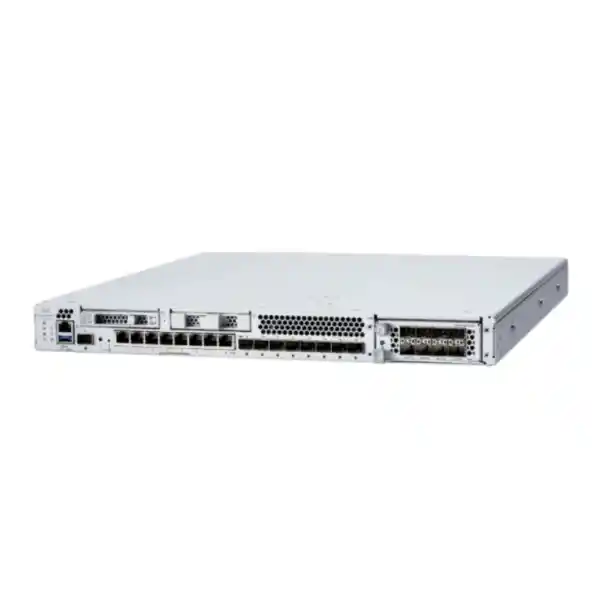
The Cisco Secure Firewall 3140 is a rack-mounted security appliance for organisations evaluating an enterprise internet edge, protected server boundary, or central connectivity hub. For a Tanzania deployment, begin with the traffic that needs inspection, the applications that must remain available, and the team that will operate the firewall. Request a configuration-specific quotation from FourTeck Tanzania with the software image, security subscriptions, management platform, connectivity accessories, and support scope stated separately.
A useful purchase decision starts with an agreed workload. Record internet and internal traffic separately, identify encrypted applications, and list branch tunnels and remote-access requirements. Include the expected inspection policies and growth over the intended ownership period. This gives the technical team a basis for checking whether the 3140 is appropriately sized and gives procurement a clear description of what the quotation must deliver.
The model name identifies a platform, while the ordered configuration determines the operational outcome. A hardware-only line item cannot establish which threat services, management resources, optics, or implementation activities are included. Treat the product selection as a documented design decision and ask for written confirmation of the complete proposed configuration before placing an order.
3140 specifications at a glance
| Item | Specification | Buying consideration |
|---|---|---|
| Software choice | Threat Defense or ASA | Specify the ordered image and licensing. |
| FTD: firewall + AVC + IPS | 45 Gbps, 1024-byte test | AVC means Application Visibility and Control. |
| FTD: TLS | 11.5 Gbps | Cisco test: 50% TLS 1.2; AES256-SHA; RSA 2048B keys (Cisco test notation). |
| FTD: concurrent sessions with AVC | 10 million | A capacity reference, not an application guarantee. |
| FTD: new connections with AVC | 300,000 per second | Evaluate connection churn separately from bandwidth. |
| FTD: IPsec VPN | 22.4 Gbps | 1024-byte TCP with Fastpath test. |
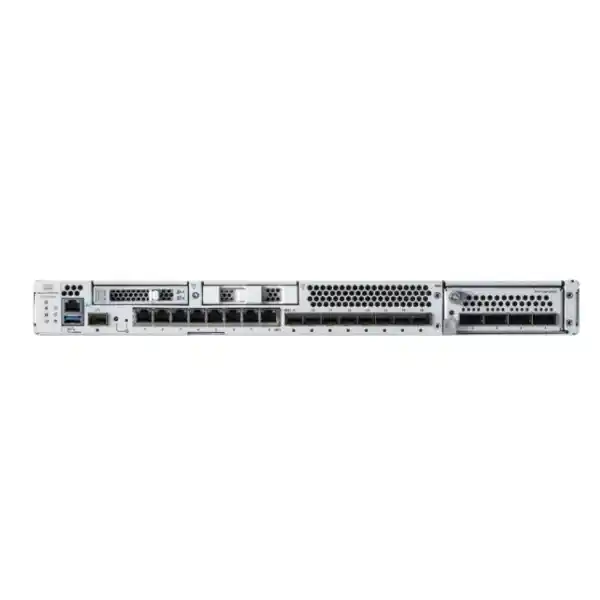
| Integrated copper ports | 8 × 10/100/1000BASE-T | Check the required physical handoffs. |
| Integrated optical ports | 8 × 1/10/25-Gbps | Select compatible transceivers or cables. |
| Form factor | 1RU | Check mounting and cable clearances. |
These are Cisco-published reference tests. Results depend on software, enabled features, traffic mix, and packet sizes. Use a configuration-specific sizing review for the intended workload.
Read performance figures in their proper context
Firewall throughput, intrusion inspection, encrypted traffic processing, connection establishment, and VPN capacity describe different workloads. A purchase specification should identify which workload matters to your environment instead of selecting the largest number in a product summary. For example, a busy application platform with many short connections places different demands on the firewall from a small number of long file transfers.
Use measured peak traffic and realistic growth assumptions when requesting sizing advice. Ask the designer to account for the policies that will actually run, including traffic inspection and any planned decryption. An available internet circuit is only one input: internal segmentation, backup movement, partner connections, and site traffic may also cross the same security boundary.
Published benchmarks are reference points rather than a guaranteed application experience. Latency, traffic mix, packet sizes, software, and enabled features can alter results. Document the sizing assumptions in the proposal, then agree how the deployed solution will be checked. A representative pilot or acceptance test is more useful than assuming that any single benchmark predicts every production workload.
Select Threat Defense or ASA before comparing quotations
Cisco lists separate 3140 ordering options for Firewall Threat Defense and ASA software. FPR3140-NGFW-K9 identifies the Threat Defense appliance option, while FPR3140-ASA-K9 identifies the ASA option. These are manufacturer ordering identifiers; the quotation should still specify the exact selected bundle and its components.
Start with the required security functions and the operational model. Ask whether the project needs integrated threat inspection, continuation of an existing ASA design, central policy administration, or a wider security architecture change. Have the proposed software choice explained against those requirements. The presence of the same chassis model in two quotations does not establish that the proposed security behaviour is equivalent.
For a replacement project, review the current configuration before deciding to preserve its operating approach. Long-standing rules may encode old application assumptions or unnecessary permissions. Equally, changing software can change management procedures, troubleshooting methods, and migration effort. Include training, policy translation, validation, and rollback in the comparison so the selected image fits both the network and the people responsible for it.
Build security subscriptions into the requirement
Threat Defense licensing distinguishes Essentials capabilities from subscription services such as IPS, Malware Defense, and URL Filtering. Cisco documents IPS as a prerequisite for Malware Defense and category or reputation-based URL Filtering. Remote-access VPN also requires the appropriate Cisco Secure Client entitlement. Confirm the applicable licensing against the selected software release and order.
Translate business requirements into a list of enabled services. If the organisation expects intrusion prevention, file-related protection, or browsing-category controls, show those expectations explicitly in the request for quotation. Ask for the subscription term, covered appliances, renewal responsibility, and activation arrangements. A bundle abbreviation should be accompanied by a readable explanation so procurement and security teams can assess the same offer.
Track ownership as carefully as entitlement. Record who administers the organisation’s Cisco Smart Account, who can resolve assignment problems, and who monitors renewal dates. Keep purchasing records and licensing administration available to authorised staff. Include these responsibilities in handover so a future change of administrator or supplier does not leave the organisation uncertain about its subscriptions.
Plan management as a separate part of the solution
Firewall Management Center provides a central management approach for Threat Defense deployments. Cisco’s 3100 getting-started workflow includes checking software, obtaining licenses, registering the appliance with its manager, configuring interfaces and policy, and deploying the configuration. Determine the management arrangement before installation rather than leaving it as an assumption in the hardware purchase.
Ask where management will run, who will operate it, how administrators will reach it, and what infrastructure is required. For an existing manager, request a compatibility and capacity review. For a new management deployment, identify compute, storage, backup, access control, and licensing responsibilities. Where local or cloud management is proposed, confirm exact platform, release, and feature suitability in writing.
Operational ownership should be explicit. Separate authority to approve a security change from the ability to implement it, and define how emergency access works. Agree who reviews alerts, checks device health, backs up configurations, and maintains software. A clear management plan gives the organisation a repeatable operating process after the initial project is complete.
Map copper and fibre connections before ordering
The integrated connectivity includes eight copper Ethernet interfaces and eight optical interfaces supporting 1/10/25-Gbps operation. Match each planned connection to the appropriate interface type and approved transceiver rather than assuming that an empty optical port includes everything needed for a working link.
Prepare a port schedule covering the internet edge, internal network, server zones, partner links, management access, and any resilience connections. For every fibre link, record the far-end device, required speed, fibre type, connector, distance, and optical specification. For direct-attach arrangements, check the cable and both endpoint requirements. This prevents a technically correct appliance order from arriving without usable connectivity.
Distinguish physical port count from the topology you intend to build. Several networks may share a tagged connection, while some failure boundaries may justify separate physical paths. Ask the designer to explain the resulting isolation, available capacity, and recovery behaviour. Label both ends of every installed cable and keep the final port schedule with the network diagram for easier fault investigation.
Use expansion modules for a defined connectivity need
The chassis has one network-module slot. Cisco’s hardware guide lists supported expansion choices including additional 1/10/25-Gbps connectivity, four-port 40-Gbps connectivity, and a two-port 100-Gbps option for the 3140. The required firmware, software, transceivers, and selected module must be checked together.
An expansion module changes connection options; its port speeds do not establish equivalent inspected throughput for the appliance. Specify why expansion is required, such as additional physical boundaries, a switch uplink standard, or a planned aggregation design. Then check the complete traffic path and the firewall workload against that use case.
Do not assume a network module is included in a base quotation. Ask for its exact part number and a matching optics or cable schedule. If the project anticipates changing module types later, include the maintenance implications in the lifecycle plan. Document spare capacity and the reason for each selected interface so future engineers can distinguish intentional design decisions from unused or unconfigured hardware.
Design availability around application recovery
For Threat Defense, active/standby high availability is a distinct design from clustering. Cisco’s compatibility guidance makes clustering support dependent on software and deployment mode. Select the intended architecture using the current compatibility and configuration documentation rather than treating every resilience feature as interchangeable.
Begin with the application recovery requirement. Identify which services can tolerate a brief interruption, which sessions matter most, and what failure conditions must be covered. Evaluate the firewall, upstream and downstream switching, power, routing, and external circuits as one service path. Two appliances connected through the same vulnerable dependency may leave a significant outage scenario unresolved.
A high-availability proposal should show peer connectivity, monitored paths, management access, and the behaviour expected during a failure. Ask for compatible hardware and subscriptions for the proposed arrangement, and make the test plan part of acceptance. Where clustering is justified, request a specific engineering design for the selected release, traffic flows, and control links. Define recovery expectations through tested scenarios rather than an unsupported promise of uninterrupted service.
Treat encrypted inspection as its own sizing exercise
Decide which encrypted flows should be inspected before estimating capacity. Some applications may be candidates for decryption, while other traffic may need a documented exception because of business, privacy, or technical requirements. Assign responsibility for those decisions and explain how exceptions will be reviewed over time.
Plan certificate distribution and application testing as separate work items. Managed workstations, mobile endpoints, server applications, and third-party clients may behave differently when an intermediary participates in encrypted connections. A controlled pilot should include business-critical services and representative endpoint types. Record failures and agree the remedy before applying a broad policy.
Measure the workload under the intended inspection policy. A basic firewall benchmark should not stand in for an encrypted inspection estimate. Ask the technical reviewer to consider the mix of protocols, certificate behaviour, application dependencies, and software release. During acceptance, check both successful application use and expected inspection events so the team can distinguish an accessible service from a correctly enforced policy.
Separate branch VPN requirements from remote-user access
Branch-to-site connections and individual remote-user sessions need separate requirements. For branches, list peers, traffic levels, addressing, routing, authentication approach, and recovery expectations. For remote users, identify user groups, expected concurrent access, endpoint types, identity integration, and the applications that should be reachable.
Check the proposed VPN design against the exact software, counterpart devices, and entitlements. A supported peer limit is not a guarantee that a given traffic volume or remote-work experience will be achieved. Ask for a sizing explanation that reflects both encrypted traffic and any inspection applied before or after it reaches the internal network.
For operational planning, assign ownership of identity services, certificates, endpoint preparation, and tunnel monitoring. Test connection establishment, application access, and recovery after an interrupted path. Where staff need access during a site incident, confirm the required management and authentication dependencies. Record who can diagnose the firewall, identity system, and endpoint so support does not stall between teams.
Create useful security boundaries for internal networks
An internal firewall project should start with application relationships. List the systems that need to communicate, the direction of each connection, and the business owner who can approve it. Separate user access, administrative activity, public-facing services, and application-to-database traffic in the requirements so the policy reflects meaningful boundaries.
Prioritise a manageable first scope. Moving every network behind a new inspection point at once can make troubleshooting difficult when undocumented dependencies appear. A phased approach allows the team to validate a small set of services, review logs, and refine permissions before expanding the design. Keep a record of temporary rules and their expiry or review conditions.
Check the traffic path before implementation. If communication between two systems does not traverse the firewall, adding a rule there will not create the intended control. Work through routing, switch connections, and return paths with the network team. This is particularly important when the same project changes server networks, VLANs, or uplinks, because application reachability and security enforcement must be validated together.
Assess whether the 3140 fits your environment
Consider this model when the design review calls for an enterprise appliance with substantial inspection capacity and flexible physical connectivity. Potential project patterns include a central internet boundary, a protected application environment, or a hub serving several sites. These are evaluation scenarios; the right fit depends on measured demand and the selected configuration.
A smaller deployment should ask whether a lower-capacity platform would meet its needs with the required subscriptions and operational tools. A much larger environment should ask whether another platform or architecture better meets its workload and recovery objectives. Compare the full solution against requirements instead of assuming that a larger model automatically provides greater practical value.
Give equal weight to operating capability. Confirm that the team or contracted service can maintain the selected software, review events, manage policy, and execute recovery procedures. The best procurement result is an appliance whose performance, connectivity, security services, and administration match the organisation’s actual environment, with enough documented headroom for the planned growth.
Prepare the rack, power, and management environment
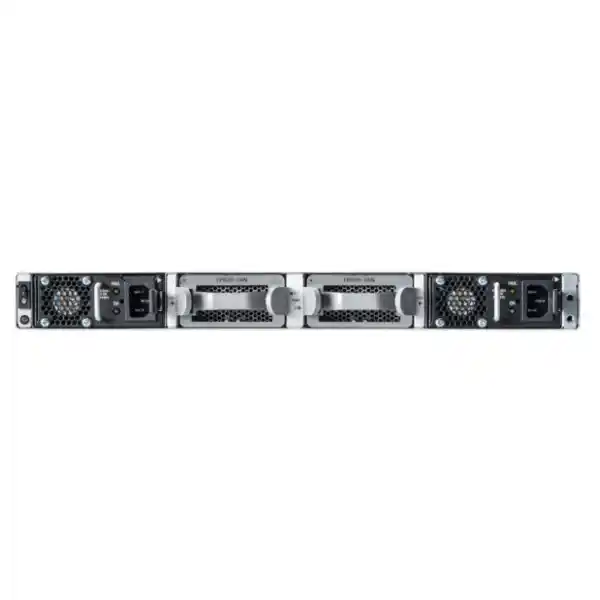
The 3140 uses a 1RU chassis. Check rack depth, cable clearance, airflow, mounting accessories, and maintenance access using the current hardware installation instructions. Confirm the exact power-supply arrangement and cables included in the proposed order; those details should appear in the bill of materials.
Review the full power path with the facilities team. Where separate feeds are intended, identify whether they remain independent upstream and how they are backed up. Include connected switches and management infrastructure in the continuity discussion. An available firewall is only useful when the network services around it can also operate.
Prepare management addressing and administrator access before the installation window. Identify how engineers will reach the appliance if the production path is unavailable, and keep the necessary access details in an approved internal system. Confirm site access, rack space, patching, and responsible contacts ahead of delivery. These practical checks make commissioning more predictable without relying on assumptions about local power conditions or site readiness.
Plan the Tanzania project around verified requirements
For procurement in Tanzania, state the actual installation location, delivery requirements, and site readiness in the quotation request. Ask FourTeck Tanzania to confirm the proposed commercial and implementation scope for that location. Obtain written details for availability, lead time, support arrangements, and any installation activities rather than relying on a generic model description.
Where the firewall connects several sites, gather each site’s circuit information and network responsibilities. Ask the relevant providers and internal teams to confirm handoff details, addressing, routing requirements, and escalation contacts. Keep these details in the deployment plan so the firewall team can coordinate testing with the people responsible for the surrounding connections.
Use the same discipline for cost comparison. Request a current quotation identifying what is included and what remains separate, including hardware, subscriptions, accessories, management, and services. This page does not establish a local selling price, stock commitment, regulatory approval, or service-response promise. Those commercial and project-specific points should be confirmed for the exact proposed order.
Build a migration plan that preserves a route back
Start with an inventory of the existing firewall configuration and the applications that depend on it. Capture interfaces, address objects, network translations, rules, routes, tunnels, and management dependencies. Ask application owners to identify transactions that must be tested, including less frequent activities such as scheduled transfers or external partner access.
Translate policy deliberately. Preserve necessary access while reviewing obsolete rules, duplicated objects, and broad permissions with the relevant owners. Avoid making undocumented security changes during a time-critical cutover. If policy cleanup and hardware replacement must happen together, separate the intended changes in the implementation plan so any unexpected behaviour can be investigated.
Define rollback before scheduling the migration. Record the trigger for reverting, who can make that decision, how the original traffic path will be restored, and how long restoration is expected to take under the agreed procedure. Keep approved backups and configuration records available to the implementation team. After the change, validate applications, monitoring, and support access before declaring the migration complete.
Agree acceptance tests before deployment begins
Acceptance should demonstrate the required business outcome. Select representative tests for user browsing, published applications, internal services, branch connections, and remote-user access where they form part of the scope. Include both permitted traffic and examples that should be blocked so the team can verify enforcement as well as reachability.
Record the test conditions. Note the software release, enabled policies, traffic generators or applications, duration, and observed device health. When performance is part of acceptance, agree a representative workload and an achievable measurement method before ordering. Avoid comparing a production application result with a vendor laboratory figure that used different conditions.
Include recovery and administration checks. Test the agreed failure scenarios, verify that events reach the intended monitoring destination, and confirm that authorised staff can perform routine management tasks. Keep the results with the final diagram and configuration record. A signed acceptance record should identify unresolved items and their owners so remaining work is visible after the project handover.
Document rule ownership and the exception process
Every important access rule should have an identifiable purpose. Record the application or service it supports, the responsible owner, and the reason for its scope. When a business requirement changes, this context helps the security team decide whether a rule can be tightened or removed without depending on the memory of the engineer who created it.
Create a consistent process for temporary exceptions. A project may need short-term access during testing or a supplier intervention, but the request should identify its duration, intended source and destination, and approving owner. Put the review date into the organisation’s change process. Reassess the requirement before extending it rather than allowing temporary permissions to become an undocumented permanent policy.
Include policy review in operational handover. Ask for a readable explanation of major security zones, public-service exposure, and administrative access paths. Keep diagrams and rule descriptions aligned after changes. This makes later audits, incident investigation, and application onboarding more efficient because the team can understand why access exists and who is accountable for it.
Identify the services the firewall project depends on
A successful cutover may depend on systems outside the appliance order. Identify time synchronisation, name resolution, authentication, certificate services, management connectivity, and monitoring as applicable to the proposed design. Assign an owner to each dependency and confirm how the implementation team will test it during preparation and acceptance.
Review external application relationships as well. A partner may restrict access to a particular public address, a hosted service may depend on an existing translation, or a scheduled process may run outside the normal change window. Ask application owners to confirm these dependencies before replacing the traffic path. Where an external party must change a setting, agree the timing and contact route in advance.
Maintain a short dependency register with a status and responsible contact. Use it to distinguish a firewall policy problem from an unavailable supporting service during commissioning. After handover, update it when systems move or credentials and certificates change. This practical record helps future engineers restore service without having to rediscover the entire environment during an outage.
Specify the documentation and handover you expect
Request deliverables that the operating team can use. These should include the final network diagram, interface schedule, selected software and subscription record, management responsibilities, approved configuration backup arrangements, and acceptance results. Where the project changes routing or external connectivity, include those details in the final design record.
Make handover a working session with the people who will operate the firewall. Walk through routine checks, change approval, event review, backup verification, and escalation. Confirm which tasks the internal team is expected to perform and which require a supplier or support agreement. Record outstanding actions with owners so completion can be tracked after commissioning.
Keep documents in an organisation-controlled location with appropriate access. Avoid leaving the only usable diagram or recovery procedure in a project participant’s personal files. A maintainable handover package should allow a new authorised engineer to understand the design, find the relevant support details, and follow the agreed recovery process without reconstructing the original purchase discussion.
Make event handling and maintenance sustainable
Choose the events that help the team operate the service. Identify who needs connection information, security alerts, administrative records, and device-health notifications. Agree where those records will be reviewed, how access is controlled, and how much information the organisation needs to retain for its own operational requirements.
Set a response process for useful alerts. An event should lead to a person or team that can investigate it, establish context, and decide the next action. Review noisy or unhelpful reporting during early operation so important activity is easier to identify. Include escalation between networking, security, application owners, and any external support provider.
Establish a maintenance calendar covering software review, configuration backup checks, account access, subscription renewal, and policy review. Test recovery procedures periodically and update documentation when the environment changes. Keep a clear distinction between routine administration included in an agreement and separately scoped engineering work. That distinction helps budget for the continued operation of the firewall after the initial appliance purchase.
Request a bill of materials that procurement can compare
A useful quotation should list the exact appliance option, quantity, chosen software image, security services, subscription term, and support scope. It should also identify management components, any network module, approved optics or cables, mounting accessories, and power cables required for the proposed site. Ask for the role of each item to be clear.
Where two appliances are proposed, request a complete description of the resilience design and the items required for both units. Where an existing management platform or accessory will be reused, identify it as a dependency and have its suitability checked. A proposal that assumes reusable equipment may differ materially from one that supplies a complete new system.
Compare offers by delivered function and responsibility. Check who handles activation, configuration, migration, testing, documentation, and handover. Ask for exclusions and customer prerequisites in readable language. This makes it easier to evaluate the total project cost and prevents a lower headline appliance price from obscuring missing components or work that the organisation still needs.
Choose the next step according to your buying stage
If you are defining requirements, prepare a short workload brief rather than committing immediately to a part number. Include traffic observations, application priorities, physical connections, security services, resilience expectations, and management preferences. Ask for the proposed model choice and configuration to be explained against that brief.
If you already have an approved design, request a quote against its exact bill of materials. Confirm subscription duration, quantities, accessory compatibility, support scope, and commercial validity. Identify any requested substitution and send it back for technical review before accepting it. A similar description is not enough to establish that two components have the same role in the design.
If you are replacing an existing firewall, provide a high-level environment summary and migration requirements first. Share detailed configurations only through an agreed private channel with authorised recipients. Ask for a statement of work that defines preparation, the change window, acceptance, rollback, and handover. The quotation can then reflect the work necessary to deliver the intended production outcome.
Buyer questions about the 3140
What is the Cisco Secure Firewall 3140 used for?
It is an enterprise security appliance that can be evaluated for an internet boundary, application-network protection, or central connectivity role. The appropriate use depends on traffic, security inspection, interfaces, software, and management requirements. Start with a workload assessment and ask for a configuration that matches the actual environment.
Is Threat Defense the same purchase as ASA?
Cisco lists separate appliance options for those software choices. Specify the intended image and required security functions in the quotation. For a migration, include configuration review, management procedures, policy translation, and application testing so the comparison reflects the complete operational change.
Does an appliance quote include all security services?
Only the exact quotation and entitlement schedule can establish what is included. Request an explicit list of enabled services, subscription terms, and covered appliances. Check management and remote-access licensing separately where relevant, and assign responsibility for activation and renewals before the deployment.
Can the optical ports be used without additional accessories?
A working link requires compatible optics or cabling and a suitable counterpart connection. Ask for every link to be checked against the selected hardware and software. Have the quotation identify which transceivers and cables are supplied, reused, or required from the customer.
Does a faster expansion port increase inspection throughput?
Interface speed and inspected workload capacity are different design inputs. Use expansion to meet a defined connectivity requirement, then size the appliance for the traffic and policies. Review the complete path, including connected switches, rather than deriving firewall processing capacity from an individual port speed.
Can the 3140 be part of a resilient firewall design?
Yes, subject to the selected software, configuration, and compatibility requirements. Ask for the precise architecture and its failure tests. Active/standby operation and clustering require different design decisions, and neither removes the need to review switching, power, routing, and other shared dependencies.
How should a Tanzania buyer request pricing?
Request a current configuration-specific quotation from FourTeck Tanzania. Provide the deployment location, required quantities, software preference, security services, connections, management arrangement, and implementation scope. Ask the quotation to confirm availability, delivery terms, support, and all included accessories for the proposed order.
What information is needed for a replacement project?
Begin with the existing model and software, a network overview, application priorities, traffic observations, and the proposed change window. Identify VPN and public-service dependencies, any existing manager, and required recovery behaviour. A detailed configuration review and agreed acceptance plan should follow through an appropriate private channel.
Related planning guidance
For a wider project scope, review Cisco firewall installation and configuration guidance. For server-network architecture, explore Cisco data center firewall planning. Use a model-specific design review to confirm the configuration for this appliance.
Request a 3140 configuration and quotation
Send FourTeck Tanzania your traffic requirements, preferred software image, interface schedule, security services, resilience plan, and management arrangement. Ask for a complete bill of materials with subscription terms and implementation responsibilities clearly identified.
Confirm the exact configuration, current price, availability, delivery arrangements, and support scope in the written quotation before ordering.



Reviews
There are no reviews yet.