
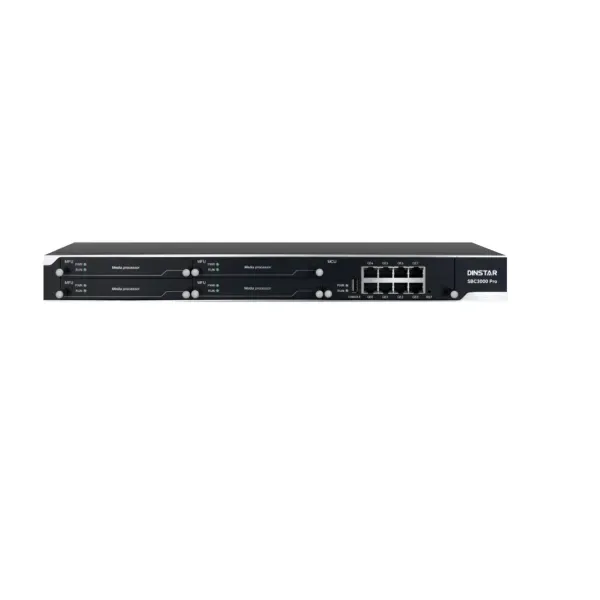
Dinstar SBC3000 Pro Session Border Controller
The Dinstar SBC3000 Pro is designed for organizations that need secure, scalable and policy-controlled SIP communications at the network edge. It combines session border control, SIP interoperability, topology hiding, media transcoding, flexible routing, quality-of-service functions and VoIP security in a platform that can scale to 5,000 concurrent SIP sessions. For telecom operators, service providers, hosted-voice platforms, large enterprises and multi-site communication environments, the appliance can provide a defined control point between trusted voice systems and external SIP networks.
What the SBC3000 Pro does
A Session Border Controller sits at the boundary of SIP networks and creates a controlled interconnection point for signaling and media. In practical terms, the Dinstar SBC3000 Pro can help an organization connect SIP trunks, softswitches, IP PBX platforms, IMS environments, WebRTC voice services and other SIP domains while applying routing rules, security checks and media handling in one managed appliance. That is valuable where direct exposure of PBX or softswitch infrastructure to external networks would create unnecessary operational and security risk.
Dinstar positions the SBC3000 Pro for small-to-medium telecom operators, but its capacity and feature set can also suit large enterprise voice environments and managed communication providers. The platform supports SIP 2.0 over UDP, TCP and TLS, B2BUA operation, SIP header manipulation, caller and called-number manipulation, NAT traversal, traffic control, dynamic load balancing, access policy control, registration controls and extensive troubleshooting tools. Media functions include common enterprise and carrier voice codecs plus transcoding for interoperability between systems that do not share the same codec set.
For buyers in Tanzania, the main procurement question is not simply whether the appliance has sufficient headline session capacity. A useful design should also consider peak call concurrency, registration volume, call attempts per second, media transcoding demand, WebRTC use, SIPREC requirements, encrypted-media requirements, redundancy objectives, number of upstream carriers, IP addressing, management segmentation and expected growth. Correct sizing reduces the risk of buying an SBC that is either under-provisioned for future growth or over-specified for the actual traffic profile.
Verified Dinstar SBC3000 Pro capabilities
Session and registration scale
The published platform range is 500 to 5,000 SIP sessions, with up to 20,000 SIP registrations and up to 5,000 IMS registrations. Call processing can reach up to 500 calls per second, while registration processing can reach up to 500 registrations per second.
Media and transcoding
Dinstar lists 300 to 1,500 concurrent transcoding sessions, up to 3,000 SRTP concurrent sessions, WebRTC voice capacity up to 2,000 and SIPREC concurrency up to 2,000. Supported codec families include G.711, G.723.1, G.729, iLBC, AMR and OPUS.
SIP security controls
Security capabilities include topology hiding, embedded VoIP firewall functions, B2BUA isolation, SIP compliance checks, SIP anti-attack controls, malformed-packet handling, DoS/DDoS protection, ACLs, blacklist and whitelist controls, rate limiting and TLS/SRTP support.
High availability
The SBC3000 Pro supports 1+1 active-standby high availability, dual hot-swappable power supplies, heartbeat monitoring, network-port bonding and separation of management, heartbeat and service interfaces to improve continuity and operational control.
Where the SBC3000 Pro fits in a voice architecture
The appliance is most useful where two or more SIP domains must communicate reliably without exposing their internal addressing, signaling assumptions or security posture to each other. Common deployment patterns include service-provider SIP peering, enterprise SIP trunking, hosted PBX edge security, interconnection between softswitches, migration between voice platforms, WebRTC-to-SIP voice access and multi-carrier routing. Because it can normalize SIP signaling and manipulate headers, it can also help resolve interoperability issues where two systems implement SIP differently even though both claim standards support.
A good design treats the SBC as part of the broader voice and network environment. Customers planning the SBC3000 Pro can also review FourTeck Tanzania’s IP PBX and VoIP communication portfolio, because PBX call flows, SIP trunk requirements and endpoint behavior directly influence SBC policy. Network readiness matters as well; VLAN design, routing and resilient uplinks should be coordinated with the Tanzania IT integration and services capability. For procurement and related infrastructure, the FourTeck Tanzania technology shop provides a broader view of available business technology categories.
Buying and sizing guidance
Start with actual traffic measurements where possible. Record normal and peak simultaneous calls, daily registration behavior, call attempts during the busiest hour, codec mix and any media services that force transcoding. A network carrying 1,500 calls that pass through unchanged is very different from one requiring 1,500 simultaneous codec conversions. Likewise, encrypted calling can increase processing requirements, so SRTP concurrency should be checked separately rather than assuming that SIP-session capacity automatically covers every media scenario.
Next, document interconnection points. List each SIP trunk or carrier, each internal PBX or softswitch, each public and private IP range, the expected signaling transport, authentication method, number normalization rules, codec preferences, failover routes and emergency-routing requirements. This information becomes the basis for trunk objects, routing policy, header manipulation, security rules and monitoring. Organizations using two carriers should define how calls are distributed and what happens if one path fails. Dynamic load balancing can be valuable, but business rules should determine which traffic moves and under what conditions.
Finally, define resilience. The SBC3000 Pro supports 1+1 active-standby HA, but true continuity also depends on redundant upstream networks, switch paths, power sources, DNS or routing design, carrier diversity and operational procedures. Dual hot-swappable power supplies improve appliance-level resilience; they do not remove external single points of failure. Buyers should therefore include the SBC within a complete availability plan instead of treating HA as a single checkbox.
Dinstar SBC3000 Pro Tanzania
For telecom operators, service providers and larger organizations in Tanzania, the Dinstar SBC3000 Pro can form a controlled boundary between internal voice infrastructure and external SIP services. A Tanzania deployment may involve a single SIP provider, multiple carriers, an enterprise IP PBX, hosted voice customers or a mixed environment that combines legacy telephony with IP communications. The value of the SBC is its ability to normalize these connections while protecting the core platform from direct exposure. Before procurement, buyers should map expected call volumes, number plans, signaling transports and media requirements so that licensing and capacity align with the real traffic profile.
Tanzania projects often need to account for branch connectivity, internet resilience and power continuity as carefully as they account for the voice platform itself. An SBC can enforce policy and provide high availability, but voice quality still depends on the underlying WAN. Organizations linking offices in different cities should therefore check latency, jitter, packet loss, carrier routing and failover behavior. Where calls leave through more than one provider, the project should define primary and secondary routing, CLI presentation, number translation and the operational response when a route is unavailable. These details should be documented before cutover rather than discovered during production traffic.
Security planning is equally important. Public-facing SIP services attract scanning, malformed signaling and abuse. The SBC3000 Pro provides topology hiding, rate controls, ACLs, blacklists and whitelists, SIP compliance checks and DoS/DDoS protection to reduce exposure. TLS and SRTP can protect signaling and media where supported by the connected platforms. Security policy should still be specific: permit only required peers, restrict management access, separate management networks, define trusted signaling sources and retain configuration backups. A strong SBC deployment is one where every allowed traffic path has a business reason.
For a Tanzania quotation, useful inputs include estimated concurrent calls, required registration capacity, number of SIP trunks, transcoding expectations, HA requirement, preferred rack location, power arrangement and whether implementation support is required. This allows a more accurate recommendation than asking only for a unit price. Customers can also consider broader regional architecture through FourTeck Africa solutions when the same SIP design must extend across multiple African operations.
Dinstar SBC3000 Pro Session Border Controller Dar es Salaam
Dar es Salaam is a natural location for high-capacity voice infrastructure because many headquarters, service providers, contact operations, financial organizations, logistics companies and multi-branch businesses concentrate critical communications in the city. For these environments, the Dinstar SBC3000 Pro can be used as the secure SIP edge between PBX or softswitch platforms and one or more external carriers. The design should begin with busy-hour calling patterns rather than total user count. A company may have thousands of registered extensions but only a fraction active at the same time, while a contact operation can produce much higher concurrency from a smaller user base.
Dar es Salaam deployments frequently benefit from clear separation between public voice interfaces and management interfaces. The SBC3000 Pro supports separate service, management and HA functions, making it easier to place administrative access on a restricted network while keeping SIP interconnections on controlled service networks. Where two appliances are deployed in active-standby mode, the switching, addressing and heartbeat design should be validated as a complete system. The objective is not only for the standby unit to exist, but for failover to preserve service in the scenarios the business considers important.
Carrier interoperability should also be tested before migration. SIP headers, number formats, privacy behavior, early media, DTMF transport and codec preferences can differ between platforms. The SBC3000 Pro supports SIP manipulation and media transcoding, which can help bridge these differences, but policies should be deliberate and documented. A controlled pilot with representative inbound, outbound, transfer, forwarding, voicemail and conference scenarios is preferable to assuming that a basic test call proves full compatibility.
Organizations requesting a Dar es Salaam quote should provide trunk counts, expected concurrent sessions, codecs, encryption requirements, existing PBX or softswitch details, WAN topology and redundancy expectations. If the project includes user endpoints, LAN upgrades or firewall segmentation as well, these dependencies can be coordinated with the wider Tanzania voice and networking environment rather than treated as separate purchases.
Dinstar SBC3000 Pro Session Border Controller Mwanza
In Mwanza, organizations evaluating the SBC3000 Pro may be linking a regional operation to a central voice platform, consolidating multiple SIP trunks or creating a resilient voice edge for customer-facing services. The strongest design starts by deciding whether calls should break out locally, route through a national core or use a hybrid model. Each approach changes the amount of SIP traffic crossing the WAN and therefore changes the required routing, QoS and failover policy. The SBC can enforce signaling and media rules, but the surrounding network must support the chosen architecture.
For a multi-site Mwanza environment, voice quality should be monitored independently from general internet usability. Web browsing may appear normal while jitter or packet loss creates poor call quality. QoS marking, bandwidth allocation and predictable routing therefore matter. The SBC3000 Pro supports QoS-related controls, but upstream routers, switches and service-provider networks must handle those markings consistently for end-to-end benefit. A design review should map every hop that carries RTP media rather than assuming the SBC alone can correct a congested circuit.
The device’s security functions are useful where SIP services are reachable from external networks. Administrators can use access policies, ACLs, rate limits, blacklists and whitelists to reduce unwanted signaling. Topology hiding and B2BUA behavior also help prevent external peers from learning internal network details. For remote administration, management access should be limited to approved addresses or secured administrative paths. Backup and restore procedures should be tested so that recovery does not depend on a single undocumented configuration file.
Mwanza buyers can prepare a better quotation request by documenting user registrations, peak call concurrency, remote branches, SIP carriers, existing IP PBX models, codec requirements and whether transcoding is expected. If growth is planned, the target capacity should include a defined headroom percentage based on realistic expansion rather than arbitrary over-sizing. This produces a more defensible procurement decision and simplifies future capacity reviews.
Dinstar SBC3000 Pro Session Border Controller Arusha
Arusha businesses with distributed reservations, hospitality, travel, service desks, corporate offices or regional coordination teams may need reliable SIP calling across multiple locations and providers. In such environments, the SBC3000 Pro can provide a consistent policy layer between external SIP services and internal communications platforms. This is especially useful when different sites use different number formats or when a central PBX must present standardized calling rules to several carriers. Header and number manipulation can normalize these differences without requiring every connected system to be redesigned.
When voice is business-critical, resilience planning should extend beyond the SBC pair. Arusha deployments should review redundant internet or private WAN options, power protection, network-switch redundancy, DNS dependencies and the availability of upstream SIP routes. The SBC3000 Pro supports 1+1 active-standby high availability and dual hot-swappable power supplies, giving architects useful building blocks, but continuity is only as strong as the weakest external dependency. Planned failover tests should therefore include carrier loss and network-path loss, not only appliance restart.
Codec strategy matters when sites use mixed endpoints or connect to different service providers. Native pass-through is generally simpler, while transcoding is valuable when two sides cannot agree on a common codec. Because transcoding consumes specific platform resources, the procurement estimate should identify the maximum number of calls likely to need conversion at the same time. The SBC3000 Pro can scale to 1,500 concurrent transcoding calls, but the chosen capacity level should match the actual service design.
For Arusha procurement, include the expected number of simultaneous sessions, registration count, carrier count, encryption needs, HA design, rack and power environment, and target go-live architecture. This allows the SBC to be positioned as part of a complete communications system rather than as a standalone box with unverified assumptions about compatibility or traffic.
Dinstar SBC3000 Pro Session Border Controller Dodoma
Dodoma organizations considering the Dinstar SBC3000 Pro may include government-facing service environments, enterprises, institutions, managed communication providers and businesses consolidating branch telephony. In these settings, an SBC can provide a formal boundary between the internal voice domain and carrier or partner networks. The device can enforce SIP rules, hide internal topology, normalize numbering and route calls according to policy, which is more manageable than allowing multiple external trunks to connect directly to separate PBX platforms with inconsistent security controls.
A practical Dodoma design should define trust zones. External carriers, partner networks, internal PBX systems and management interfaces should not all receive the same access rights. The SBC3000 Pro’s ACL, white-list, black-list, rate-control and SIP inspection functions can be mapped to these zones. Administrators should also decide which logs and reports are retained for troubleshooting and operational review. Packet captures and SIP flow analysis are valuable during incident investigation, but they are most effective when engineers already know the expected call path and routing logic.
The 5,000-session ceiling makes the platform capable of handling significant traffic, yet session count alone is not a sizing method. A busy environment with intensive transcoding, SRTP, SIPREC or WebRTC can place different loads on the appliance. Procurement teams should therefore request sizing around feature concurrency, not simply around the number of registered users. If call recording relies on SIPREC, the expected number of simultaneous recorded calls should be captured explicitly. If WebRTC is planned, the voice concurrency target should also be stated.
A well-prepared Dodoma quotation should describe current and future call volume, connected SIP systems, number plan, carrier interfaces, availability targets, security requirements and migration constraints. This information makes implementation more predictable and reduces the risk of late design changes when the voice service is already scheduled for production cutover.
Dinstar SBC3000 Pro Session Border Controller UAE
In the UAE, the Dinstar SBC3000 Pro can support service-provider interconnection, enterprise SIP trunking, hosted PBX infrastructure and regional voice hubs that connect several business locations. A regional hub design can simplify carrier management by terminating external SIP services at a controlled edge and then routing traffic to internal systems according to business policy. Because the SBC supports flexible routing and signaling manipulation, architects can create consistent number normalization and call treatment even when upstream providers use different SIP profiles.
UAE projects often require careful coordination between telecom services, firewall policy, public addressing, data-center networks and business-continuity objectives. The SBC should be deployed with clear network zones and least-privilege rules. TLS and SRTP may be used where supported by both ends, while topology hiding and B2BUA operation reduce direct exposure of internal SIP infrastructure. Availability planning can use 1+1 active-standby SBCs, dual power feeds and redundant network paths, but failover behavior should be tested with the actual carrier trunks before production acceptance.
Organizations consolidating calls from multiple countries should also evaluate numbering rules and regulatory requirements for each route rather than assuming one universal dial plan. The SBC can manipulate calling and called numbers, but the configured policy should reflect approved telecom arrangements. For a broader UAE technology environment, buyers can explore FourTeck UAE integrated IT and telecom solutions, especially where the SBC is part of a data-center, PBX or network modernization project.
A UAE quotation should include concurrent call targets, SIP trunk counts, codec and encryption requirements, public IP design, HA expectations, remote-site connectivity and any media services such as transcoding or recording. These details help determine whether the SBC3000 Pro is the right fit and which capacity level should be planned.
Dinstar SBC3000 Pro Session Border Controller Uganda
Uganda-based operators, managed service providers and enterprises can use the SBC3000 Pro to control SIP interconnections between carrier networks, hosted communication platforms and internal PBX infrastructure. The appliance is particularly relevant when the voice architecture must scale beyond basic branch PBX requirements and needs centralized security, routing and media policy. Up to 5,000 concurrent SIP sessions and 20,000 registrations give it room for substantial deployments, while license scalability allows capacity planning to be aligned with the intended service model.
A Uganda deployment should separate signaling capacity from user population. Registration count indicates how many SIP identities the platform can maintain, while concurrent sessions indicate active calls. Contact-center traffic, outbound campaigns or service-provider subscriber traffic can produce very different ratios between the two. Engineers should also measure call attempts per second, because short-duration calls can stress signaling even when average concurrency is moderate. The SBC3000 Pro supports up to 500 CPS for calls, but architecture should be based on observed or forecast traffic rather than maximum values alone.
For cross-border or multi-branch projects, routing policy should define which carrier is preferred for each destination and what happens when a trunk becomes unavailable. Dynamic load balancing and flexible routes can support this design, but the business should decide whether failover prioritizes cost, continuity or number presentation. Customers expanding regional voice infrastructure can reference FourTeck Uganda IT and communications solutions for related PBX, networking and infrastructure context.
Procurement teams should provide current SIP topology, expected session counts, carrier details, HA target, transcoding load and management requirements. This enables the project to include configuration, testing and migration effort in addition to the hardware itself.
Dinstar SBC3000 Pro Session Border Controller Kampala
Kampala is likely to host the highest concentration of Uganda enterprise headquarters, communications providers and customer-service operations, making it a practical location for centralized SIP edge infrastructure. A Kampala deployment of the SBC3000 Pro can terminate and secure external trunks before traffic reaches internal PBX or softswitch systems. This creates a single place to apply access policies, topology hiding, number translation, routing and media rules. Centralizing these controls can make troubleshooting simpler than distributing SIP logic across several firewalls and PBX systems.
For organizations with several branches, the choice between centralized and local breakout should be evaluated. Centralized breakout can simplify governance, while local breakout may reduce WAN dependence for specific sites. The SBC3000 Pro can participate in either model, but routing and failover logic should be documented carefully. If branch connectivity fails, the organization should know whether users lose all external calling, fail over to a secondary route or retain limited local service. These behaviors are architecture decisions rather than automatic properties of the SBC.
Security hardening should include source restrictions, rate limits, strong management authentication, encrypted administration paths, configuration backup and regular review of allowed trunks. SIP scanning is common on internet-facing addresses, so unused services should not be exposed. The embedded VoIP firewall and SIP anti-attack features provide useful controls, while TLS/SRTP can add confidentiality where supported. Logs and alerts should be integrated into the operations process so that administrators notice repeated failures or abnormal call patterns quickly.
A Kampala quote request should specify subscriber or extension count, maximum active calls, expected CPS, carriers, PBX platforms, codec profile, SRTP needs and HA goals. If migration from an existing SBC is planned, include current routing tables and known interoperability exceptions so they can be translated into the new design instead of rediscovered during cutover.
Dinstar SBC3000 Pro Session Border Controller Arua
Arua organizations may use the SBC3000 Pro as part of a branch-to-core voice design, regional service-provider edge or multi-site communication platform. In a branch-oriented architecture, the central SBC can provide consistent security and routing while the Arua site connects through an approved WAN or internet path. The benefit is centralized SIP policy, but the dependency is the quality and availability of that path. Before deciding on a centralized model, the business should assess acceptable downtime and whether a local fallback method is necessary.
Bandwidth planning should focus on concurrent media streams and codec choice. Different codecs use different bandwidth, and encryption adds overhead. Transcoding should be used where necessary for interoperability rather than enabled indiscriminately. If an Arua site sends all RTP media through the central SBC, engineers should size WAN links for simultaneous calls in both directions and include headroom for other business traffic. QoS can prioritize voice, but it cannot create bandwidth that does not exist.
Operational simplicity is another consideration. Centralized configuration, backup, monitoring and SIP-flow analysis can make support easier for geographically separated sites. The SBC3000 Pro supports web management, configuration backup and restore, logs, packet capture and tracing. These tools are most useful when naming conventions, trunk labels and route documentation are standardized across the organization. A clear configuration model helps support teams identify whether a call failed at the endpoint, PBX, SBC, WAN or carrier.
For an Arua procurement request, include how many users register locally, expected peak calls, WAN topology, the central PBX or softswitch location, carrier model and any requirement for local survivability. This creates a design conversation around service continuity instead of a simple appliance purchase.
Dinstar SBC3000 Pro Session Border Controller Mbarara
Mbarara enterprises and regional operations may need secure SIP interconnection when consolidating branch communications, adopting IP PBX platforms or linking to centralized hosted voice services. The SBC3000 Pro can provide a controlled boundary for these connections and can manipulate signaling where different platforms use incompatible SIP headers or number formats. This is useful during phased migrations, when an organization may need old and new voice systems to coexist while users or departments are moved gradually.
Migration planning should identify every feature that depends on SIP behavior. Basic inbound and outbound calls are only the beginning. Transfers, call forwarding, hunt groups, voicemail, conferencing, caller ID, emergency calls, fax and DTMF should all be tested where relevant. The SBC can correct some interoperability problems through header manipulation or transcoding, but a successful project still requires a structured test plan. Each critical business call flow should have an expected result before cutover begins.
If high availability is required, two SBC3000 Pro appliances can be used in active-standby mode. The associated network and power design should avoid shared single points of failure. Separate switch paths, independent power feeds or UPS coverage and redundant upstream carrier options may be appropriate depending on the service criticality. Planned maintenance should also be considered: the business should know how software updates or configuration changes affect the HA pair and how rollback will be performed if an issue occurs.
Mbarara buyers should include migration context, active-call forecasts, registration numbers, current PBX details, codec requirements and carrier interfaces in the quotation request. If the deployment is part of a larger Ugandan rollout, standardizing the SBC policy model across sites can simplify support and reduce configuration drift.
Dinstar SBC3000 Pro Session Border Controller Gulu
In Gulu, the SBC3000 Pro may be appropriate for organizations that need secure integration between a local communications platform and centralized or carrier SIP services. A regional site does not necessarily require its own SBC if a resilient central architecture already exists, so the first design decision is placement. If a local SBC is justified, it should have a clear role such as local carrier termination, survivability, security separation or interconnection between independent voice systems. Avoid adding appliances where they do not solve a defined operational requirement.
Where the SBC is centrally hosted, Gulu users may depend on WAN availability for voice. The project should assess whether dual links, alternate routing or mobile fallback are needed. The session border controller can reroute SIP traffic when configured with alternate trunks, but the network must still reach those trunks. Monitoring should distinguish SBC service state from WAN health so support teams can identify the actual cause of an outage quickly.
The SBC3000 Pro’s management and troubleshooting functions are valuable for remote sites because engineers can review logs, captures and SIP flow without being physically present at the branch. Secure remote administration is important: management services should be restricted and separated from public SIP traffic. Configuration backups should be retained after approved changes, with clear version notes. This makes recovery faster when a route or trunk change has unintended effects.
For a Gulu deployment proposal, specify whether the SBC is local or central, how the branch connects to the voice core, peak call counts, local carrier requirements, HA expectations and the consequences of WAN failure. These inputs help determine whether the SBC3000 Pro is needed at the site or whether a shared regional platform would be more efficient.
Dinstar SBC3000 Pro Session Border Controller Kenya
Kenya service providers and enterprises can deploy the Dinstar SBC3000 Pro where SIP traffic needs a secure, interoperable and scalable edge. Common use cases include carrier interconnection, enterprise SIP trunks, hosted PBX infrastructure, call-center platforms and multi-country voice hubs. Its combination of up to 5,000 SIP sessions, 20,000 registrations and 1,500 transcoding calls gives designers flexibility, but these capacities should be mapped to specific service workloads before purchase.
For Nairobi-centered or national designs, organizations may combine centralized call control with regional branches. The SBC can implement route preferences and failover between trunks, but the routing plan should account for number presentation, destination rules and carrier policy. Interoperability testing should cover more than signaling establishment. Codec negotiation, DTMF, early media, caller ID, transfer and fax behavior may all differ across networks. SIP header manipulation and transcoding can resolve many edge cases when configured correctly.
Security should be built around explicit trust. External SIP peers should be restricted to known addresses where possible; management traffic should use separate interfaces or VLANs; rate limits should be appropriate for expected traffic; and repeated authentication or scan activity should trigger review. The SBC’s topology hiding, anti-attack mechanisms and TLS/SRTP capabilities support this design. For customers planning broader infrastructure in Kenya, FourTeck Kenya IT, VoIP and network security solutions provide useful regional context for connected PBX, LAN and security requirements.
A Kenya quotation should state concurrent calls, registrations, carrier count, codecs, transcoding, encryption, HA and expected growth. Including current network diagrams and SIP trunk specifications can significantly improve implementation planning.
Dinstar SBC3000 Pro Session Border Controller Kuwait
Kuwait enterprises and communication providers can use the SBC3000 Pro to create a secure demarcation point between internal voice platforms and external SIP services. This is useful for organizations that need centralized control over routing, interoperability and security rather than connecting carriers directly to PBX systems. The appliance’s B2BUA behavior, topology hiding, policy controls and signaling manipulation can reduce the amount of carrier-specific configuration required inside the core voice system.
High-availability requirements should be written in operational terms. Instead of stating only that redundancy is required, define the acceptable interruption, the failures that must be tolerated and whether maintenance should occur without service loss. The SBC3000 Pro supports 1+1 active-standby high availability and dual hot-swappable power supplies, but the network, power and carrier architecture around the pair must also be redundant. Testing should confirm how active calls and new calls behave during each failover scenario.
Media policy is another important design area. Organizations should define approved codecs, when transcoding is permitted, whether SRTP is mandatory on specific legs and whether SIPREC is used for recording. These requirements consume different resources and may affect sizing. The SBC3000 Pro provides significant media capability, but capacity should be reserved according to the highest simultaneous feature demand expected during peak operation.
Kuwait procurement teams should request a solution based on actual architecture: trunk count, IP addressing, security zones, maximum calls, media requirements, HA and integration scope. If the project spans the Gulf and East Africa, route policy should be designed consistently while still respecting each carrier’s numbering and interconnection rules.
Dinstar SBC3000 Pro Session Border Controller Ghana
Ghana organizations evaluating an SBC often need to protect a hosted PBX, connect several carriers or create consistent SIP routing across branches. The Dinstar SBC3000 Pro can serve as this policy and security boundary. By terminating SIP on the SBC instead of directly on core systems, the organization can apply topology hiding, access restrictions, anti-attack controls and number manipulation centrally. That separation can also simplify future carrier changes because the internal PBX does not need to be redesigned for every external signaling difference.
Capacity planning should distinguish between registrations and calls. Service-provider environments may have many registered users but relatively few simultaneous calls, while contact centers may have much higher call concurrency. The platform supports up to 20,000 SIP registrations and 5,000 SIP sessions, but real deployments should include room for growth and for temporary traffic spikes. If the service includes transcoding, recording via SIPREC, WebRTC or SRTP at scale, those media functions should be forecast separately.
Ghana projects should also define operating procedures. Who can change routes? How are changes approved? Where are configuration backups stored? What alerts indicate abnormal SIP activity? The SBC provides monitoring, logging, packet capture and configuration backup functions, but these tools only create value when they are built into support processes. Customers can review FourTeck Ghana business technology solutions when the SBC must be integrated with PBX, LAN or wider IT infrastructure.
A Ghana request for quotation should include peak call volume, registrations, SIP carrier details, codec requirements, encryption, HA and deployment location. For replacements, existing SBC route and manipulation rules should be supplied wherever possible so that migration risk can be assessed in advance.
Dinstar SBC3000 Pro Session Border Controller Nigeria
Nigeria can involve large subscriber bases, distributed enterprises and high-volume customer communication environments, making SBC capacity and signaling resilience especially important. The SBC3000 Pro’s upper range of 5,000 simultaneous SIP sessions and 500 call attempts per second can suit substantial deployments when the workload falls within those verified limits. Designers should still model busy-hour traffic carefully, because rapid short-duration calls can create signaling load that is not obvious from average concurrency figures.
Multi-carrier routing is a common reason to deploy an SBC. The platform can apply flexible routing, dynamic load balancing and number manipulation, but route logic should be based on business policy. Examples include primary and backup carriers, destination-based routing or balancing traffic across trunks. The design should also address what happens to caller ID and numbering rules during failover. A technically successful alternate route can still create operational problems if the resulting caller identity or dial format is incorrect.
Security controls should be configured to match legitimate peak traffic so that protection mechanisms do not block real customers during busy periods. ACLs, rate limits and anti-attack thresholds therefore need testing. Encryption with TLS/SRTP can be applied where the connected carrier and PBX support it. For broader infrastructure planning, FourTeck Nigeria IT services and communications solutions can be considered alongside SBC requirements.
Nigeria buyers should prepare a traffic profile covering average and peak calls, registrations, CPS, trunks, codecs, transcoding, recording and encryption. An accurate traffic profile makes it easier to decide whether the SBC3000 Pro is appropriate and how much growth headroom to reserve without relying on arbitrary estimates.
Dinstar SBC3000 Pro Session Border Controller Seychelles
Seychelles organizations with hospitality, financial, government, service-provider or multi-island communications requirements may use a Session Border Controller to secure and normalize SIP connectivity. The Dinstar SBC3000 Pro offers far greater capacity than many individual enterprise PBX deployments require, so the business case should be based on aggregation, provider services, large centralized environments or planned regional growth. Correct sizing is important; capacity should match the service rather than assuming the largest model is automatically the best choice.
Connectivity resilience can be particularly important where voice relies on external links. The SBC can provide alternate SIP routes and high availability, but it cannot compensate for every upstream outage. Architecture should therefore review redundant connectivity, carrier diversity and the physical location of voice platforms. If the SBC is hosted in a central data center, branch and remote-site dependencies should be documented clearly. If local survivability is required, the design may need additional components beyond the central SBC.
Interoperability testing should include local carrier signaling, number presentation, codecs and DTMF. Where connected platforms use different codecs, SBC3000 Pro transcoding can bridge them, subject to licensed and platform capacity. Where privacy or encryption is required, TLS/SRTP support can secure signaling and media between compatible endpoints. Administrators should also enforce strict management access and keep approved configuration backups outside the appliance.
For a Seychelles proposal, useful inputs are the number of users, expected active calls, carrier interfaces, inter-island or overseas routes, WAN design, HA target and media requirements. If the deployment is part of a wider Indian Ocean or African voice architecture, common policy templates can help simplify management while keeping local trunk rules separate.
Technical planning checklist
Traffic
Document peak concurrent calls, registrations, calls per second, codec mix, expected transcoding, WebRTC, SIPREC and SRTP concurrency. Separate current demand from forecast growth.
Interconnection
List every carrier, SIP trunk, IP PBX, softswitch and partner network. Record signaling transport, authentication, number format, DTMF, codecs and expected route priority.
Security
Define trusted peer addresses, management sources, TLS/SRTP requirements, rate limits, ACLs, monitoring thresholds and the process for reviewing abnormal SIP activity.
Availability
Confirm whether 1+1 HA is required, how network and power paths are made redundant, what carrier failover exists and how planned failover will be tested and documented.
Frequently asked questions
How many SIP sessions does the Dinstar SBC3000 Pro support?
Dinstar publishes a scalable range from 500 to 5,000 concurrent SIP sessions. Final licensed capacity and configuration should be confirmed for the intended deployment.
How many SIP registrations are supported?
The published maximum is up to 20,000 SIP registrations, with up to 5,000 IMS registrations. Registration count should be considered separately from simultaneous call sessions.
Does SBC3000 Pro support transcoding?
Yes. Dinstar specifies 300 to 1,500 concurrent transcoding calls depending on capacity. Supported codec families include G.711, G.723.1, G.729, iLBC, AMR and OPUS.
Can it be deployed in high availability?
Yes. Dinstar lists 1+1 active-standby high availability, dual heartbeat management and dual hot-swappable power supplies. The surrounding network and carrier design should also be redundant where service continuity is required.
Does it support TLS and SRTP?
Yes. TLS can protect SIP signaling and SRTP can protect compatible media sessions. End-to-end use depends on support and configuration on the connected systems and carriers.
What information is needed for a quote?
Provide required concurrent calls, number of registrations, SIP trunk count, carrier details, codecs, transcoding expectations, encryption requirements, HA requirement, current PBX or softswitch details, deployment location and expected growth.
Quotation checklist for Dinstar SBC3000 Pro
To receive a technically useful quotation, send the information below with the request. Exact pricing, stock, warranty and delivery should be confirmed in the formal quote rather than assumed from a generic product page.
- Required concurrent SIP sessions now and within the planned growth period.
- Number of SIP and IMS registrations.
- Peak call attempts per second and registration rate where known.
- Number of SIP trunks, carriers, PBXs and softswitches to interconnect.
- Codecs in use and expected maximum transcoding concurrency.
- TLS, SRTP, WebRTC or SIPREC requirements.
- 1+1 HA requirement, network redundancy and power design.
- Public/private IP addressing, VLANs and management-network requirements.
- Migration, configuration, interoperability testing and support scope.
Decision recap
Choose the Dinstar SBC3000 Pro when the project needs a substantial SIP edge with scalable session capacity, high registration density, strong media handling, SIP security, interoperability controls and an HA option. The appliance is particularly relevant where multiple trunks or SIP systems must be connected without exposing the internal voice core directly to external networks.
Do not select it on capacity alone. The strongest deployment starts with measured or forecast traffic, clear carrier and PBX interoperability requirements, a defined security policy and an end-to-end resilience plan. FourTeck can use those inputs to help structure a quotation and deployment discussion for Tanzania or a regional multi-country rollout.
Plan your SBC3000 Pro deployment
Share your call concurrency, registration count, SIP providers, PBX or softswitch platforms, transcoding needs and HA requirement. A structured requirements review helps avoid over-sizing, under-sizing and late interoperability surprises during cutover.


Reviews
There are no reviews yet.