
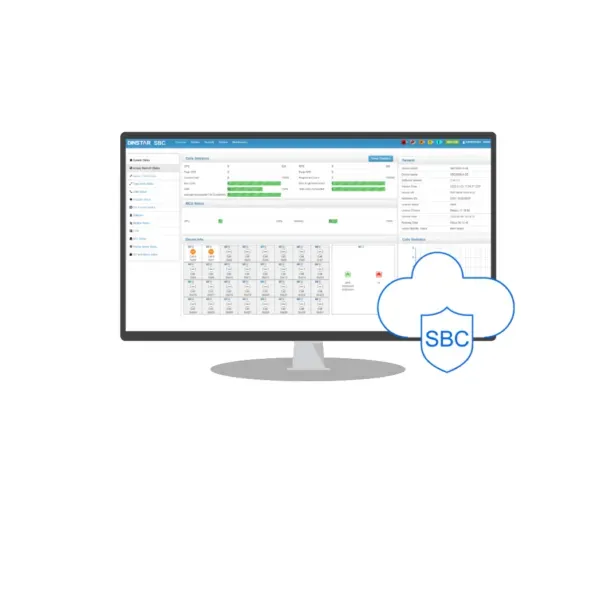
Dinstar SBC8000 Session Border Controller
The Dinstar SBC8000 is a software-based Session Border Controller developed for enterprise, service-provider and telecom SIP environments that need a controlled boundary between voice networks. It combines SIP security, topology hiding, NAT traversal, routing, media handling, transcoding and interoperability functions in a platform that can be deployed on dedicated servers, virtual machines or cloud infrastructure. Current Dinstar product information positions the SBC8000 for scalable deployments and lists support for up to 100,000 SIP registrations, up to 50,000 concurrent call sessions, up to 5,000 media transcoding sessions, license scalability and 1+1 high availability. Capacity planning should always be confirmed against the exact software release, license tier and deployment resources being quoted because historical manuals and datasheets may describe earlier limits.
Secure SIP edge
Designed to protect SIP and RTP services with features such as VoIP firewalling, topology hiding, access controls, rate limiting, anti-attack policies and encrypted signaling or media using TLS and SRTP.
Interoperability layer
Helps normalize communications between different SIP systems through message and header manipulation, B2BUA behavior, codec transcoding, IPv4/IPv6 interworking, DTMF handling and WebRTC gateway functions.
Flexible deployment
Suitable for centralized or distributed designs on x86 or ARM platforms, supported virtualized environments and cloud infrastructure where organizations want software-defined scaling rather than a fixed embedded appliance footprint.
What the Dinstar SBC8000 solves
Modern voice networks often connect internal IP PBX platforms, remote users, SIP trunks, carrier services, contact-center systems, collaboration platforms and branch offices across networks that do not share the same addressing, security policy or SIP behavior. The SBC8000 sits at that boundary and helps control how sessions are admitted, routed and translated. This is important when an organization is moving from isolated PBX systems toward centralized SIP architecture or when a service provider must interconnect multiple customer or carrier domains without exposing internal addressing and signaling details.
The platform can be relevant where NAT traversal creates one-way audio, where separate SIP implementations interpret headers differently, where codec mismatches require transcoding, or where public-facing SIP services need stronger controls against scanning, malformed packets, SIP/RTP flooding and denial-of-service attempts. It also gives engineering teams a policy point for routing calls according to prefixes, URI patterns, source, destination, time profile or other supported rules, while operational tools such as logs, network capture, reports and CDR export can assist troubleshooting.
For procurement, the key question is not simply whether the SBC8000 has enough headline capacity. A correct design should identify expected registered endpoints, normal and peak concurrent sessions, call attempts per second, required transcoding load, encrypted-session use, SIP trunk count, redundancy model, virtual or physical resource allocation and growth assumptions. FourTeck can use these inputs to prepare a more meaningful configuration discussion for Tanzanian customers rather than treating the SBC as a generic software license.
| Area | Verified SBC8000 capability | Planning relevance |
|---|---|---|
| Scale | Current Dinstar page lists up to 100,000 SIP registrations, 50,000 concurrent sessions and 5,000 media transcoding sessions. | Confirm license tier, software release and compute resources for the intended load. |
| Security | VoIP firewall, topology hiding, ACL, dynamic lists, TLS/SRTP and anti-attack controls. | Define exposed SIP interfaces, trust zones, carrier peers and remote-user access. |
| Interworking | NAT traversal, SIP/header manipulation, B2BUA, IPv4/IPv6 interworking, DTMF and media transcoding. | Document each PBX, trunk, carrier and codec requirement before migration. |
| Deployment | Dedicated server, VM, private cloud or public cloud; x86 and ARM architectures are listed by Dinstar. | Select compute, storage, networking and HA architecture appropriate to the service level. |
| Availability | 1+1 high availability is listed on the current product page. | Plan failure domains, heartbeat connectivity, routing behavior and upstream redundancy. |
Compatibility, deployment and buying guidance
SBC procurement should begin with the systems on both sides of the boundary. Record the PBX or softswitch platform, SIP trunk providers, public and private IP addressing, firewall topology, codec policy, number presentation requirements, DTMF method, encryption requirements, fax behavior if relevant, WebRTC use and any existing routing logic. If a replacement SBC is involved, export or document the current dial plan and interconnect rules before migration. This reduces the risk of recreating historical routing exceptions from memory during a cutover.
For virtual deployment, CPU, memory, storage latency and virtual NIC design should be sized for the target call and transcoding load. Media transcoding is particularly resource intensive compared with straightforward signaling pass-through, so a project with many codec conversions should not be sized only from registration count. Likewise, an environment with very high call setup rates may require different planning from one with long-duration calls and modest call attempts per second. Where high availability is required, the two SBC instances should be treated as part of a broader resilient design that includes network paths, upstream peers and operational monitoring.
FourTeck Tanzania can also help connect the SBC discussion to the surrounding voice and network stack. For broader technology planning, visit FourTeck Tanzania. Organizations operating regionally can also review FourTeck Kenya, FourTeck Uganda, the broader FourTeck Africa network and FourTeck UAE for related multi-country requirements.
Dinstar SBC8000 Session Border Controller Tanzania
For Tanzanian enterprises, operators and service providers evaluating a Dinstar SBC8000, the buying conversation should start with the voice architecture that exists today and the one the organization expects to operate in the next several years. A large corporate environment may need to interconnect an IP PBX cluster in a data center with SIP trunks, remote extensions, regional branches and collaboration services. A telecom or hosted-voice provider may need a policy boundary between subscriber access, upstream carriers and internal switching platforms. The SBC8000 can act as that SIP control layer, but its value depends on accurate design around call flows, trust zones and capacity rather than a simple software installation.
Tanzania deployments can vary widely in internet connectivity, carrier relationships, public-IP availability and branch topology. Before quotation, buyers should document every SIP trunk, the number of registered users, expected simultaneous calls, codecs in use, remote-worker requirements and whether encrypted signaling or media is mandatory. NAT and firewall behavior should be understood because many apparent PBX faults are actually created by address translation, asymmetric routing or blocked RTP ports. The SBC8000’s NAT traversal, SIP normalization and media anchoring functions can help create a more predictable border when these conditions are properly mapped.
High availability is another important decision. A business that depends on voice for sales, customer care or emergency coordination may want a 1+1 design, but HA should include more than two software instances. Network interfaces, switches, hypervisors, power, upstream carrier connectivity and DNS or routing dependencies all need attention. Organizations using VMware or KVM can consider virtual deployment, while dedicated x86 or ARM server options may suit environments that want direct control of compute resources. Cloud deployment can be attractive for centralized services, yet WAN latency and failure scenarios still need to be tested against the real sites that will use the platform.
When requesting a Tanzania quotation, include the number of SIP registrations, peak sessions, estimated call attempts per second, transcoding percentage, preferred deployment platform, HA requirement, number of SIP peers and any interoperability problems already known. That information allows the commercial discussion to focus on the correct software scale and implementation scope. It also helps determine whether the project needs migration assistance, dial-plan cleanup, security policy design, testing with local or international trunks, or integration with an existing firewall and monitoring environment.
Dinstar SBC8000 Session Border Controller Dar es Salaam
Dar es Salaam organizations often operate the most interconnected voice environments in Tanzania, particularly where head offices, call centers, financial operations, hospitality groups, logistics businesses and multi-branch companies concentrate their core communications. In these environments an SBC is useful not just for protecting an internet-facing SIP trunk, but for making multiple telephony domains behave consistently. The SBC8000 can separate internal PBX addressing from carrier-facing signaling, anchor media through complex NAT conditions and enforce routing or security rules at a defined demarcation point.
A head-office deployment should begin with a call-flow inventory. List the primary carrier, backup carrier if any, inbound number ranges, outbound routing preferences, office-hour policies, emergency or priority destinations, contact-center trunks and branch interconnects. Where several PBX systems are being consolidated, note differences in SIP headers, codecs, DTMF and caller-ID presentation. This is where header manipulation and interoperability functions become important: the objective is not to change signaling unnecessarily, but to standardize exactly what each side requires without creating brittle custom rules.
Dar es Salaam sites that host the SBC in a local server room or data center should also review power resilience, virtualization capacity and network redundancy. The software may run on a virtual machine, yet the service still depends on switches, upstream routers, firewalls, storage and power. If voice is business critical, separate failure domains and tested failover are more useful than simply checking a high-availability option during procurement. Monitoring should include SIP registration health, trunk availability, session utilization and infrastructure alarms so operations teams can distinguish a carrier outage from an application or network fault.
For companies with branches elsewhere in Tanzania, Dar es Salaam can become the centralized SIP hub, but centralized design should be tested against WAN failure. Some branches may need survivability through local trunks or alternative routing. Others may accept temporary loss of central voice services if mobile fallback procedures exist. A clear business continuity policy helps engineers decide whether the SBC8000 should be centralized, distributed or paired with supplementary branch components. A quotation request should therefore state not only the number of users, but which sites depend on the platform and what should happen when the primary connectivity path fails.
Dinstar SBC8000 Session Border Controller Mwanza
Mwanza businesses considering centralized SIP communications may use the SBC8000 to connect local offices, remote branches or service-provider trunks while keeping signaling and media policy under one administrative layer. This is particularly relevant for organizations that have expanded gradually and now operate a mixture of legacy PBX behavior, newer SIP services and remote extensions. Without an SBC, each connection may require separate firewall exceptions and vendor-specific workarounds. A policy-based border reduces that fragmentation by creating one controlled interconnection point.
For Mwanza procurement, bandwidth and link quality deserve attention alongside voice platform capacity. Even when the SBC itself is correctly sized, calls can suffer if the WAN path introduces loss, jitter or unstable latency. QoS markings such as ToS or DSCP can support traffic prioritization within networks that honor those policies, but they do not repair inadequate internet capacity or congested upstream links. Buyers should identify how many concurrent external calls a site is expected to carry and whether media stays local, traverses a central data center or crosses a public cloud region.
Remote extension security is another common requirement. If users connect from homes, field offices or temporary locations, exposing PBX services directly to the internet increases attack surface. SBC functionality such as topology hiding, ACLs, dynamic white and black lists, rate controls and TLS/SRTP support can help define a stronger edge. Security policy should still be practical: trusted carrier peers can be restricted to known addresses, remote endpoints can be segmented from administrative interfaces, and management access can be limited to approved networks rather than left openly reachable.
A Mwanza project brief should note whether the organization wants the SBC on local compute, a central Tanzanian data-center platform, a private cloud or public cloud. It should also indicate how much transcoding is expected because media conversion directly affects processing requirements. If all connected systems share the same codecs, pass-through may dominate. If trunks, endpoints and conferencing services use different codecs, the transcoding load may be substantial. Stating these assumptions before quotation supports more accurate license and infrastructure planning and reduces the chance of discovering resource constraints during acceptance testing.
Dinstar SBC8000 Session Border Controller Arusha
Arusha organizations in tourism, hospitality, professional services, education, NGOs and regional operations may use SIP systems that connect local staff with customers, overseas offices and cloud communication platforms. In such environments, the SBC8000 can provide a secure and manageable boundary between the internal telephony system and external SIP services. The practical benefit is control: calls can be routed through defined peers, signaling can be normalized when platforms interpret SIP differently, media can traverse NAT reliably and external networks do not need direct visibility of the internal voice topology.
Hospitality and service organizations should map guest-facing and operational calling separately from administrative communication. A hotel, for example, may have front-desk, reservation, office and room-phone requirements with different routing and availability expectations. An SBC does not replace the PBX logic, but it can provide the external interconnect layer and protect the PBX from direct carrier or internet exposure. Where multiple properties share a central PBX or SIP trunk, routing policies can help direct calls to the right destination while maintaining a consistent carrier interface.
Arusha buyers should also decide how maintenance will be handled. Configuration backup, logging, CDR export, network capture and system statistics are valuable only when a documented operating process exists. Changes to trunks, dial plans and security policies should be recorded, especially if several administrators or service providers touch the system. For critical deployments, maintain a tested rollback process and preserve known-good configuration snapshots before major upgrades. This reduces the operational risk of troubleshooting complex SIP problems under time pressure.
When planning capacity, use realistic busy-hour figures rather than total extension count alone. A 2,000-user organization may need far fewer simultaneous external sessions than its registered-user number suggests, while a contact-heavy business with fewer users may generate more concurrent traffic and call attempts per second. Transcoding, recording and encryption can also change resource demands. A useful Arusha quotation request will therefore include peak concurrency, expected registrations, trunk count, codecs, deployment platform, HA preference and integration targets. Those details let the SBC8000 configuration align with how the organization actually communicates.
Dinstar SBC8000 Session Border Controller Dodoma
Dodoma enterprises, institutions and public-sector environments evaluating SIP modernization can use an SBC to create a clearly governed boundary between internal voice systems and carrier or partner networks. The SBC8000 is suited to projects where security policy, interoperability and future scale matter as much as basic call completion. Rather than opening an IP PBX directly to every external peer, organizations can terminate or mediate SIP at the SBC and apply routing, access controls and media policy from a dedicated platform.
For regulated or policy-driven environments, documentation is especially important. Define which networks can establish SIP sessions, which destinations are allowed, how caller identity should be presented, whether TLS and SRTP are required, where logs are retained and who can administer the platform. The SBC8000 supports security and reporting functions that can contribute to this model, but governance comes from the organization’s configuration and operating procedures. Access to the management interface should be restricted and administrator changes should follow a formal process where the business requires it.
A Dodoma deployment can also support staged migration. Organizations do not always replace every PBX, trunk and endpoint at once. An SBC can help bridge the transition by connecting old and new SIP domains while routing decisions are gradually moved to the target architecture. Header manipulation, codec transcoding and DTMF interworking may reduce incompatibilities during this period. The migration plan should identify temporary rules so they can be removed later; otherwise transitional exceptions can become permanent complexity that makes future troubleshooting harder.
Procurement teams should ask for a solution scope that separates software licensing, compute infrastructure, implementation, testing and ongoing support. If high availability is required, confirm what components are actually redundant. If public cloud is preferred, identify region, connectivity, public addressing and security architecture. If local virtual infrastructure is used, confirm hypervisor capacity and network interfaces. The strongest Dodoma proposal is one that describes the full service path from SIP trunk through SBC to PBX and endpoints, with test cases for inbound calls, outbound calls, failover, codec behavior, caller identity and remote-user scenarios.
Dinstar SBC8000 Session Border Controller UAE
Organizations operating between Tanzania and the UAE may need a common SIP design across headquarters, regional offices, contact centers or cloud communication platforms. The SBC8000 can support such multi-country architectures by providing a software-based interconnect point that can be placed in an enterprise data center, virtual environment or cloud platform. The design should still respect the telecom, numbering and service conditions applicable in each market; an SBC is a technical control layer and does not replace carrier contracts or local regulatory obligations.
A UAE-linked deployment often raises questions about centralization. If the SBC is hosted near a regional data center, Tanzanian users may reach it across international connectivity. That may simplify administration, but voice quality becomes dependent on WAN performance and international routing. Alternatively, separate SBC instances can be deployed closer to each market while policy and management standards remain consistent. The correct choice depends on call patterns, resilience expectations, available cloud regions, cost, security policy and whether media must remain geographically local.
Interoperability testing should include every carrier and PBX combination that will be used. Two systems can both claim SIP compliance yet differ in header expectations, early media handling, DTMF, codec negotiation or caller-ID formatting. The SBC8000’s signaling and media interworking capabilities are valuable when used to resolve specific documented differences. Avoid unnecessary manipulation rules because each custom rule becomes another item to maintain through upgrades. A cleaner configuration usually separates generic policy from narrowly targeted interoperability fixes.
For procurement, multi-country businesses should define a standard design pack containing approved codecs, encryption policy, trunk naming, routing hierarchy, monitoring thresholds, backup procedures and change-control steps. This makes the SBC8000 easier to operate consistently across teams. FourTeck’s regional network can support conversations that span Tanzania and the UAE, while final implementation scope should clearly identify which site, carrier and infrastructure responsibilities are included. A complete quotation should also state the expected session scale and whether licensing must accommodate future branches or contact-center expansion.
Dinstar SBC8000 Session Border Controller Uganda
Ugandan organizations connected to Tanzanian operations can use an SBC architecture to standardize SIP security and routing across borders without forcing every office to run the same PBX platform. The SBC8000 can interconnect different SIP domains while hiding internal topology, enforcing access policy and translating signaling or media where necessary. This is useful for groups that acquire businesses, operate franchise or branch models, or migrate communications in phases rather than through a single cutover.
A cross-border project should first separate extension-to-extension traffic from carrier traffic. Internal calls between countries may use private WAN, VPN or internet-based SIP, while local outbound calls may need in-country trunks. Routing policy can then choose the appropriate path without sending every call through a distant gateway. Where centralized trunks are commercially or technically appropriate, the design must account for WAN failure and latency. Where local trunks are retained, the SBC can still provide a consistent security and interworking layer around each connection.
Security planning should classify peers rather than treating all SIP traffic equally. Carrier addresses, internal PBX nodes, remote endpoints and test systems can each have separate trust rules. Rate limiting and attack protection can be tuned to the expected traffic pattern, while topology hiding reduces unnecessary exposure of internal network details. TLS and SRTP may be used where supported end to end, but encryption policy should be tested with every peer because partial support can affect interoperability.
Uganda procurement should include future capacity assumptions, particularly if the platform will serve more than one country. Registration counts can grow quickly when remote users or hosted customers are added, while concurrent sessions and transcoding may grow at different rates. Capacity should therefore be modeled by function rather than by a single user number. A well-prepared request will list countries, sites, trunks, PBX platforms, expected peak sessions, codec requirements, HA expectations and preferred hosting location so that the SBC8000 can be scoped as part of an architecture rather than a stand-alone license.
Dinstar SBC8000 Session Border Controller Kampala
Kampala is a natural location for centralized communications within many Ugandan businesses, making the SBC8000 relevant to headquarters, service providers and multi-site enterprises that terminate several SIP connections in one place. The SBC can sit between carrier trunks and internal call-control systems, providing routing, security and normalization while allowing the PBX environment to remain more isolated from external networks. This separation simplifies responsibility: the carrier-facing behavior is handled at the border and the PBX can focus on user features and internal call control.
For a Kampala data-center or server-room deployment, network design should avoid creating a single hidden failure point. If two SBC instances are used for HA, they should not both depend on one switch, one hypervisor host or one power path. Upstream carrier routing should also be able to follow failover behavior. Test procedures should include loss of an SBC instance, loss of a WAN interface, carrier unavailability and restoration of service. A documented sequence is more valuable than assuming high availability will behave correctly without validation.
Call centers and service desks in Kampala may also care about call attempts per second, not only concurrent sessions. Campaigns, queue bursts and short-duration calls can produce a high signaling rate. The current Dinstar product material lists high-scale session capability, but the exact project design should validate software version, license, infrastructure and workload characteristics. Transcoding load should be measured separately because converting media consumes significantly more processing than passing matching codecs through the SBC.
A quotation brief should include the PBX or softswitch brand, carrier peers, contact-center platform, number ranges, codecs, expected CPS, concurrent sessions, encryption requirements, recording architecture if separate, and any existing SIP problems. It is also useful to state whether the organization wants implementation only or ongoing operational assistance. With these inputs, the SBC8000 can be evaluated against the real workload and a test plan can be prepared before production migration rather than after users encounter unexpected signaling or audio behavior.
Dinstar SBC8000 Session Border Controller Arua
Arua deployments may involve branch connectivity back to a central PBX, local SIP service, remote workers or organizations that need voice links across geographically separated sites. In these scenarios, the SBC8000 can support a centralized or distributed design depending on where call control and carrier termination are placed. The engineering decision should balance simplicity against resilience: centralization can make policy and maintenance easier, while local components may improve survivability when a wide-area connection is interrupted.
Connectivity assessment is especially useful before moving media through a distant central site. Measure the stability of the path during business hours and consider how failover links behave under load. Voice traffic typically uses less bandwidth than video, but it is more sensitive to jitter, packet loss and sudden routing changes. QoS can help within managed networks, though public internet segments remain outside direct enterprise control. The SBC’s routing and NAT functions can manage SIP behavior, but they cannot compensate for a severely unstable transport path.
For smaller branch populations, the SBC8000 may still be part of a larger centralized platform rather than installed locally. That is why the procurement question should focus on system architecture rather than matching one SBC per city. If Arua users register to a Kampala or cloud-hosted PBX through a central SBC, confirm what happens when the link fails and whether local calling remains necessary. If branch survivability is required, additional design elements may be needed beyond the SBC itself.
Security rules should remain simple and explicit. Limit SIP exposure to known peers where possible, separate management interfaces from voice traffic, apply strong administration controls and keep backups of the configuration. When troubleshooting, use logs and network captures methodically rather than adding broad firewall exceptions. A useful Arua project request includes endpoint count, external call concurrency, connectivity details, branch-to-head-office traffic, local carrier requirements, and acceptable outage behavior. This provides enough context to decide whether the SBC8000 should be centralized, how much capacity to allocate and which failover scenarios must be demonstrated before acceptance.
Dinstar SBC8000 Session Border Controller Mbarara
Mbarara businesses building more structured IP telephony can use an SBC to create a secure handoff between internal communications and external SIP services. The SBC8000 is particularly appropriate when several trunks, PBXs or remote sites need to be normalized under a common policy. Instead of maintaining many direct trust relationships between internal systems and outside networks, the organization can make the SBC the controlled border and apply routing, media and security rules there.
A good Mbarara design begins with number planning. Document extensions, public DIDs, outbound caller identity, prefixes, emergency or special numbers and branch dial patterns. This information is often more important to migration success than hardware sizing because a poorly documented dial plan creates user-facing problems even when the infrastructure is powerful. The SBC8000’s flexible routing and number manipulation functions can support the required logic, but rules should be based on a clean dial plan rather than a collection of undocumented exceptions.
If codec transcoding is required, identify exactly which paths need it. Some carriers may use G.711 while bandwidth-conscious remote environments prefer another supported codec. Contact-center platforms, mobile clients and WebRTC systems may introduce additional media formats. Transcoding should be enabled where necessary, because it consumes compute capacity and adds another processing step. The SBC8000 supports several telecom and internet codecs, but compatibility should be verified end to end with actual trunks and endpoints during testing.
Mbarara procurement can also include operational training. Administrators should know how to read SIP traces, check registrations, review alarms, export CDRs and restore configuration backups. A technically correct installation still becomes difficult to support if every incident requires rediscovering basic topology. Ask for a handover package that records interface addressing, peers, routes, security policies, HA configuration and test results. This gives internal IT teams a reference for future carrier changes, new branches or user growth and makes the SBC8000 a manageable platform rather than an opaque box in the voice path.
Dinstar SBC8000 Session Border Controller Gulu
Gulu organizations linking local offices with central or cloud telephony can use the SBC8000 as part of a controlled SIP architecture that protects core call systems from direct exposure. This becomes more important as businesses add remote users, cloud services and internet-based trunks. Each new connection expands the signaling surface and may introduce different SIP behaviors. An SBC gives engineers one place to apply security, topology hiding, NAT traversal and interworking policy instead of solving each connection with separate firewall rules.
For branch-heavy organizations, consider whether media should always pass through the central SBC. Anchoring media can simplify security and NAT, but it may also send local or regional voice traffic over longer paths. The best routing depends on branch connectivity, carrier topology and operational priorities. During design, draw both signaling and media flows for a normal call, a branch-to-branch call, a remote-user call and a failover call. This exposes unnecessary hairpinning and helps estimate WAN bandwidth more accurately.
Operational resilience should include basic recoverability. Keep configuration backups in a controlled repository, record software and license information, and document the procedure for rebuilding or moving the SBC if the underlying VM or server fails. Because the SBC8000 is software based, migration flexibility is an advantage, but only if the surrounding networking, addressing and license process are understood. Recovery drills can identify hidden dependencies before a real outage.
When requesting a Gulu quotation, give the project team a concise traffic profile: registrations, peak concurrent external calls, peak internal cross-site calls, codecs, expected transcoding, number of SIP peers, public IP availability, preferred deployment model and HA objective. Also describe any known symptoms such as one-way audio, dropped calls after a fixed duration, failed caller ID or incompatibility with a new carrier. These details help focus configuration planning on real issues and allow the SBC8000 to be sized and tested for the intended role instead of being installed with generic defaults.
Dinstar SBC8000 Session Border Controller Kenya
Kenyan businesses with Tanzanian operations often need voice systems that behave consistently across country boundaries while still using the most appropriate local carriers and infrastructure. The SBC8000 can provide a standardized SIP security and routing layer without requiring every branch to use the same PBX. A group can retain different call-control platforms during mergers, migrations or phased upgrades and use the SBC to normalize signaling between them and external services.
Regional design should avoid treating cross-border bandwidth as unlimited or failure free. If a Kenyan PBX depends on a Tanzania-hosted SBC, define what happens if the inter-country path is unavailable. The opposite is equally important for Tanzania branches using a Kenyan or cloud hub. Businesses that require local calling during outages may keep local trunks or deploy survivability mechanisms. Businesses with lower criticality may prefer the operational simplicity of centralization. The SBC8000 supports flexible architecture, but the right topology comes from business continuity requirements.
Security policy can be standardized across both countries. For example, carrier SIP peers can be restricted by IP, administrative access can be separated from signaling interfaces, TLS and SRTP can be used where end-to-end compatibility allows, and call routing can follow controlled destination patterns. Central logs and CDR exports can support troubleshooting and usage analysis. However, local telecom rules, numbering practices and service contracts should be checked separately; the SBC does not override market-specific obligations.
For a Kenya-Tanzania procurement project, prepare one architecture document listing every site and voice dependency. Include which country hosts the PBX, which carriers terminate where, whether media crosses borders, expected concurrency by site, codec policy, failover paths and growth plans. This allows capacity to be pooled intelligently rather than simply adding user totals. Organizations can also use the FourTeck Kenya regional site for related project discussions while coordinating the Tanzania requirement through the Tanzania team, helping multi-country IT managers keep architecture standards aligned even when procurement and telecom services differ by market.
Dinstar SBC8000 Session Border Controller Kuwait
Kuwait-linked enterprises may use the Dinstar SBC8000 as part of an international voice architecture connecting Middle East operations with Tanzania or other African offices. The platform’s software deployment model makes it possible to place SBC functions where the organization has appropriate compute and network connectivity rather than being tied to one hardware chassis. This flexibility can support regional data-center strategies, but location should be selected according to media path, latency, carrier connectivity and resilience instead of convenience alone.
When SIP trunks from different countries are involved, caller identity, number normalization and routing rules need careful testing. International prefixes, local dialing habits and carrier requirements can differ. A clean numbering plan should convert user-dialed formats into standardized internal patterns and then present the exact format required by each carrier. The SBC8000 can perform number and SIP header manipulation, but the design should document every transformation so later administrators can understand why it exists.
Encryption and security should also be negotiated with each peer. TLS can protect signaling and SRTP can protect media when both sides support compatible configurations. Where a carrier does not support encryption, the enterprise may still encrypt internal or remote-user segments and terminate encryption at the SBC boundary. This should be explicit in the security design so stakeholders know which call paths are protected and where traffic changes security domains.
A Kuwait procurement request should identify whether the SBC is intended for enterprise interconnect, hosted communications, service-provider traffic or a contact-center environment because each has different signaling patterns. Include expected peak sessions, CPS, registered endpoints, transcoding percentage and HA requirements. For multi-region operations, also state how many countries may be added within the planned license horizon. This supports a scalable license decision without assuming the maximum product capacity is automatically the right commercial tier for the first deployment.
Dinstar SBC8000 Session Border Controller Ghana
Ghanaian operations connected to East African or global voice systems can benefit from a Session Border Controller when multiple SIP trunks, PBXs and remote-user services need to share a consistent security and routing model. The SBC8000 can mediate signaling between domains, protect internal topology and provide media functions without requiring each PBX to be directly exposed to every external network. This is especially useful for regional groups that want common operational standards while allowing local telecom services to remain country specific.
Before selecting a hosting location, map where the majority of calls originate and terminate. If most Ghana calls are local, routing them through a distant Tanzania or UAE data center may increase latency and consume unnecessary international bandwidth. A distributed architecture may be more appropriate. If call traffic is predominantly between regional offices or a centralized contact center, centralization may still make sense. The SBC8000 can support either pattern, but the media route should be visualized and measured rather than assumed.
Interoperability projects should include a formal test matrix. Test inbound and outbound calling, caller ID, DTMF, hold and transfer, early media, fax if used, long-duration calls, failover and codec negotiation. Where manipulation rules are required, tie each rule to a documented test case. This approach prevents a configuration from accumulating broad fixes that later break a different trunk. The SBC’s network capture and signaling visibility can be used to isolate which side of the interconnect is sending unexpected behavior.
For Ghana procurement, describe the current problems as well as the desired scale. If the objective is to stop one-way audio, secure internet-facing SIP, consolidate trunks or connect incompatible systems, say so. Include expected registrations and concurrent sessions, but also state the target outcome and operating model. This lets the proposal cover the necessary design and migration work, not only licensing. Regional support planning should also identify who owns carrier escalation, PBX administration, SBC policy and network troubleshooting so incidents are routed to the correct team.
Dinstar SBC8000 Session Border Controller Nigeria
Nigeria’s large enterprise and service-provider environments can generate demanding SIP workloads, making capacity modeling particularly important when considering the SBC8000. Registration scale, concurrent sessions and call attempts per second can grow independently. A hosted-voice provider may have many registered users but moderate busy-hour concurrency, while a contact center may have fewer users and far higher call setup activity. Procurement should therefore use traffic data where available rather than multiplying user count by a generic ratio.
The SBC8000’s security functions are relevant to public SIP exposure because scanning and automated attack traffic can be persistent. Policy-based controls, ACLs, topology hiding, malformed-packet protection and rate limiting can reduce unnecessary risk when configured correctly. Security should still be layered: administrative access should be restricted, infrastructure should be patched, credentials protected, and upstream firewalls or cloud security groups should allow only the traffic that is genuinely required. The SBC is an important voice-security control, not a substitute for overall infrastructure security.
For telecom or service-provider interconnect, redundancy should extend beyond a single SBC pair. Carrier diversity, routing policy, DNS if used, network devices and compute hosts all influence availability. Large environments should define measurable recovery objectives and test failover under realistic call load. Monitoring should identify approaching session or transcoding capacity before users experience congestion. Capacity alerts are more useful when aligned to business thresholds rather than waiting until the platform reaches an absolute maximum.
A Nigeria-Tanzania project may also require careful separation of local and international traffic. Routing rules can direct calls to the appropriate trunk based on destination and policy, but commercial agreements and telecom requirements determine which paths are permitted. A good quotation request will list local carriers, international peers, PBX or softswitch platforms, expected volume, codec policy, HA architecture and planned growth. With this detail, the SBC8000 can be evaluated as a scalable interconnection platform and the implementation can include a meaningful test and acceptance plan.
Dinstar SBC8000 Session Border Controller Seychelles
Seychelles organizations often operate with a combination of local offices, hospitality sites, remote management and international business links, making a well-controlled SIP edge useful when voice services depend on external connectivity. The SBC8000 can provide a centralized security and interoperability layer for PBX systems, SIP trunks and remote endpoints, but the architecture should be sensitive to island connectivity and the practical impact of WAN outages. A technically elegant centralized design is not useful if it removes all local calling during a predictable link failure.
Hospitality and distributed properties should examine whether each site needs independent survivability or whether a central communication hub is sufficient. Some properties may require local reception and emergency calling even if access to a remote data center is interrupted. Others may use mobile fallback and accept central dependency. The SBC8000 can be part of either model, though local survivability may require additional PBX or gateway functions outside the SBC itself. These business continuity decisions should be made before selecting licenses and hosting locations.
Bandwidth efficiency can also affect media policy. Avoid unnecessary transcoding when endpoints and carriers already share suitable codecs, because transcoding consumes compute and can complicate troubleshooting. Where conversion is genuinely required, size resources for the expected simultaneous transcoded calls rather than total sessions. Network monitoring should track latency, jitter and packet loss on the links carrying media so voice-quality complaints can be correlated with transport conditions rather than attributed automatically to the PBX or SBC.
For Seychelles procurement, provide the number and type of sites, expected local and international call patterns, primary and backup connectivity, carrier trunks, PBX systems, remote-user count, security expectations and outage requirements. If the deployment will be shared with Tanzania or another regional hub, note which calls must continue when cross-border links fail. This information allows a more practical SBC8000 design that balances centralized control with operational resilience, and it gives procurement teams a clearer basis for comparing deployment options instead of focusing only on maximum capacity figures.
Quotation checklist for Dinstar SBC8000
Provide expected SIP registrations, peak concurrent sessions, call attempts per second, average call duration and estimated transcoding load.
List SIP carriers, PBX or softswitch platforms, contact-center systems, remote users, WebRTC requirements and branch connections.
State whether the preference is dedicated server, VM, private cloud or public cloud and provide relevant infrastructure details.
Define the required availability target, HA preference, carrier redundancy and what should happen when WAN or compute components fail.
Identify trusted peers, TLS/SRTP requirements, management-access policy, public IPs, firewall placement and any compliance constraints.
Share current dial plans, number ranges, caller-ID rules, known interoperability issues and the required cutover or rollback approach.
Dinstar SBC8000 FAQs
Is the Dinstar SBC8000 a hardware appliance?
The SBC8000 is positioned by Dinstar as a software-based Session Border Controller. It can be deployed on supported server, virtual-machine and cloud environments, including x86 and ARM architectures. The exact infrastructure and resource sizing should match the licensed capacity and expected workload.
What capacity does the current SBC8000 product page state?
Dinstar’s current product page lists up to 100,000 SIP registrations, up to 50,000 concurrent call sessions and up to 5,000 media transcoding sessions. Older manuals and datasheets can show different session figures, so the exact release and license being quoted should be confirmed before purchase.
Can SBC8000 help with one-way audio and NAT problems?
It supports NAT traversal and media interworking functions that can help manage SIP and RTP across network boundaries. One-way audio can also be caused by firewall, routing or endpoint configuration, so the complete media path should be diagnosed rather than assuming the SBC alone will fix every audio issue.
Does SBC8000 support encrypted voice traffic?
Dinstar lists TLS for SIP signaling and SRTP for media security. Successful encrypted deployment depends on compatible configuration at the connected peer or endpoint and should be verified in interoperability testing.
Why is transcoding capacity important?
Transcoding converts media between codecs when two sides cannot use the same format. It consumes more compute resources than simple media pass-through, so buyers should estimate the number of simultaneous calls that genuinely require conversion rather than using total concurrent sessions as the transcoding figure.
Can the SBC8000 be used with different PBX brands?
The product is designed for SIP interoperability and provides functions such as B2BUA operation, SIP and header manipulation, codec handling, DTMF interworking and IPv4/IPv6 interworking. Exact compatibility should still be validated with the specific PBX, carrier and features in the customer’s environment.
Decision recap
Choose the Dinstar SBC8000 when the project requires a software-based SIP border with high scale, security controls, NAT traversal, media transcoding, signaling normalization, flexible routing and deployment freedom across server, virtual or cloud infrastructure. Do not select capacity from headline figures alone. Confirm the specific software release, license, compute resources, concurrency, CPS, registration count, transcoding load and HA architecture for the final quotation.
For Tanzania projects, the most useful next step is to share the current voice topology and a realistic busy-hour traffic profile. FourTeck can then discuss deployment options, interoperability testing, migration scope and the surrounding network or security dependencies that determine whether the SBC will perform reliably in production.
Consultation panel
To prepare a Dinstar SBC8000 requirement, send the number of users and SIP registrations, peak simultaneous calls, expected transcoding, carrier and PBX details, deployment preference, redundancy objective and any known SIP issues. For an existing platform migration, include the current dial plan and a list of trunks or peers that must be tested. This information gives the technical and commercial teams a stronger basis for model, license and implementation planning.


Reviews
There are no reviews yet.