
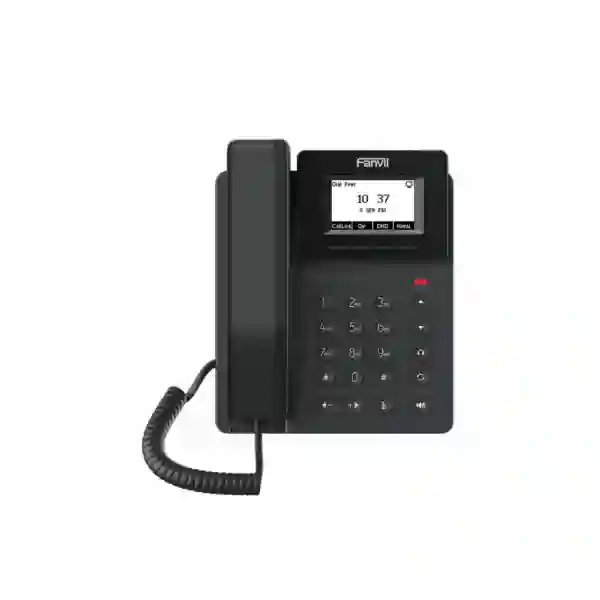
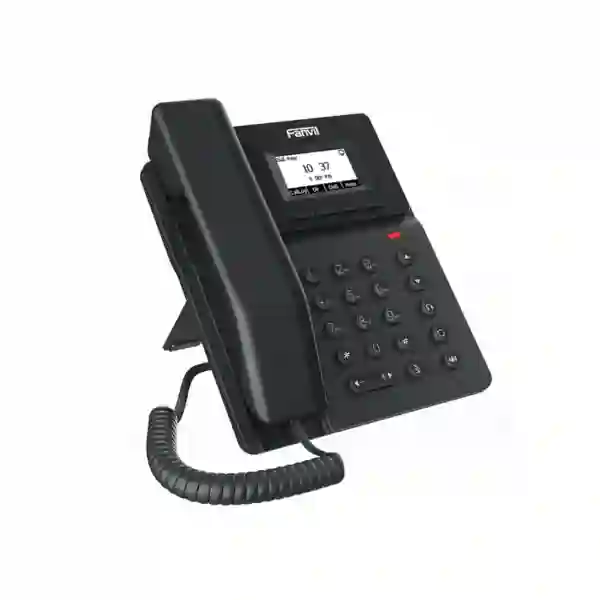
Fanvil V50G Basic IP Phone
The Fanvil V50G is a practical entry-level SIP desk phone for organisations that want dependable everyday calling without paying for features that standard users may not need. Fanvil specifies a 2.3-inch 132×64 pixel dot-matrix display with backlight, two SIP lines, HD voice, six-way audio conferencing, integrated PoE and dual Gigabit Ethernet ports. For businesses planning an IP PBX rollout in Tanzania, those fundamentals make the V50G especially relevant for general staff desks, departments, branches, counters and other positions where reliable wired VoIP, simple operation and manageable deployment matter more than touchscreens or wireless connectivity.
FourTeck Tanzania can help buyers evaluate the handset as part of a complete voice environment that includes the PBX or hosted SIP platform, PoE switching, VLAN design, Quality of Service, cabling, headsets, extension plans and power continuity. Product selection should always be based on the exact PBX, SIP account, network and user-role requirements rather than on the handset alone.
Quick answer
Choose the V50G when you need a wired, PoE-capable basic business IP phone with two SIP lines, Gigabit pass-through networking, HD audio, a backlit monochrome display, local conferencing and standard enterprise provisioning features. It is not a Wi-Fi, Bluetooth or touchscreen model, so those needs should be identified before ordering.
Verified Fanvil V50G specifications and practical meaning
Fanvil positions the V50G as a basic-level IP phone. The official datasheet specifies a 2.3-inch 132×64 pixel dot-matrix screen with backlight, two SIP lines, HD voice on the handset and speakerphone, six-way audio conference capability, and two 10/100/1000 Mbps Ethernet ports with the PC port bridged to the network port. The phone supports PoE compliant with IEEE 802.3af and can alternatively use a 5V/1A power adapter. It supports IPv4, IPv6 and dual-stack operation, static IP, DHCP and PPPoE, plus VLAN, LLDP, QoS and 802.1X network access control. These are useful capabilities in managed business LANs where voice endpoints need predictable addressing, segmentation and priority.
Calling
2 SIP lines, hold, transfer, call waiting, forwarding, speed dial, DND, auto-answer, hotline, hot desking, direct IP calls, intercom and 6-way audio conferencing.
Audio
Wideband G.722 and Opus plus common narrowband codecs; full-duplex acoustic echo cancellation, jitter buffering, packet-loss concealment and voice-quality monitoring.
Network
Dual Gigabit Ethernet, PoE, IPv4/IPv6, VLAN, LLDP, QoS, 802.1X, L2TP and OpenVPN support for managed enterprise connectivity.
Management
Auto-provisioning via FTP, TFTP, HTTP, HTTPS, DHCP Option 66, SIP PnP and TR-069, plus web management, configuration import/export, firmware upgrade and syslog.
The local phonebook stores up to 1,000 entries and the call logs support up to 1,000 records. Remote phonebooks through XML or LDAP are supported. The handset can be used with a wired headset through RJ9 and Fanvil documents electronic hook-switch support for compatible wireless headset arrangements. The phone provides handset, hands-free and headset operating modes. Installation can be on the included desktop stand or through an optional wall-mount arrangement. The official working-temperature range is 0°C to 45°C with 10% to 95% operating humidity, so buyers planning installations in unusually hot, dusty or uncontrolled environments should review the actual site conditions rather than assuming that an office desk phone is suitable everywhere.
Security and signalling features include SIP v1/v2, UDP/TCP/TLS, RTP/RTCP, SRTP, HTTPS, 802.1X and AES-related configuration support documented by Fanvil. Whether a specific secure transport method can be used in a deployment also depends on the PBX, SIP provider and certificates or policies in that environment. Buyers should therefore confirm interoperability during solution design. The V50G is a standards-based SIP endpoint, but standards support should not be treated as a guarantee that every vendor-specific PBX feature will operate identically without configuration testing.
Where the V50G fits in a business phone rollout
A basic IP phone is most valuable when it is assigned to the right user profile. The V50G can suit standard office users who mainly answer, transfer and place calls, use voicemail, work with a limited number of SIP identities and occasionally join local audio conferences. The dual Gigabit ports allow a desktop computer to share the same network drop through the phone, which can be useful where structured cabling provides one outlet per desk. In that design, the switch configuration, voice VLAN, data VLAN and security policy should be planned carefully so the convenience of a shared cable does not weaken network segmentation.
For a receptionist, executive assistant or heavy call-handling position, two SIP lines and four soft keys may not be enough. Those users may benefit from a phone with more programmable DSS keys, a larger colour display or expansion-module capability. Conversely, buying a premium endpoint for every employee can add cost without improving the daily experience of users who only need reliable business calling. A role-based handset standard is often better: choose a basic phone such as the V50G for standard desks, then use higher-tier models only where additional line keys, Bluetooth, Wi-Fi, video or advanced headset workflows provide real value.
Before procurement, document how many extensions are required, which users need a second SIP identity, whether calls traverse a SIP trunk, whether remote branches connect through VPN or the public internet, what power source will be used, and whether the existing switches provide sufficient PoE budget. If an adapter will be used instead of PoE, confirm that the required accessory is included in the quotation. Fanvil lists the phone as capable of DC 5V/1A or PoE power, but individual reseller bundles can differ, so quotation scope should be checked explicitly.
Compatibility, IP PBX integration and deployment planning
The V50G is a SIP phone, and its successful deployment depends on more than creating an extension number. Administrators should confirm registrar or proxy addresses, transport type, authentication credentials, codec policy, dial plan, time settings, VLAN parameters, provisioning URLs and any certificates required by the selected PBX or hosted service. The phone supports primary and backup SIP servers, which can be useful when the telephony design provides redundant registration targets. However, redundancy must be implemented consistently across the PBX, network and internet layers; a backup server alone does not protect against a failed access switch, unavailable WAN circuit or local power interruption.
Voice quality is strongly affected by the network. A managed switch can place the phone in a voice VLAN, apply suitable QoS treatment and power the handset through PoE. The router or firewall should preserve the call signalling and media flows expected by the PBX or SIP service. Excessive latency, packet loss, jitter or incorrect NAT handling can make a technically compatible phone perform poorly. For offices with cloud PBX platforms, stable internet and appropriate failover may be more important than the handset specification itself. For on-premises IP PBX systems, LAN design, local power resilience and trunk connectivity deserve similar attention.
For a wider communication project, review FourTeck Tanzania’s business technology shop and IP phone buying guidance for product-selection context, and the FourTeck Tanzania services overview when the requirement includes configuration, network preparation or integrated infrastructure. Multi-site teams can also review FourTeck IP phone and office telephony solutions, FourTeck Kenya business communications and FourTeck Uganda IP PBX and VoIP solutions when procurement spans regional offices. These links provide related context rather than a guarantee of stock, local delivery time or project coverage.
Fanvil V50G Basic IP Phone Tanzania
For organisations evaluating the Fanvil V50G Basic IP Phone in Tanzania, the most useful starting point is to define where the phone will sit in the communications architecture. A Tanzanian business may be replacing analogue handsets, extending an existing SIP-based PBX, opening a new branch, standardising phones across departments or moving selected users to cloud telephony. Each situation changes the checklist. If a PBX already exists, confirm that its current firmware, SIP profile and provisioning method can support the required Fanvil settings. If the deployment is new, decide whether the PBX is on-premises, hosted or cloud based before finalising extension numbering, trunking, security and WAN requirements.
The V50G is attractive for general desk users because it combines a simple interface with Gigabit Ethernet and PoE. In a modern office network, PoE can simplify desk installation by powering the handset from the access switch, reducing the need for a separate power adapter at each workstation. That benefit is only realised when the switch has an adequate total PoE budget and UPS strategy. A branch with forty phones should therefore calculate the aggregate load alongside wireless access points, cameras and other PoE devices. The V50G can also bridge a computer through its second Gigabit port, which may reduce cabling requirements, but VLAN and QoS policies should still separate voice and data appropriately.
Tanzania buyers should also plan for the quality and resilience of the connectivity used by the PBX. Cloud-hosted calling depends on the WAN path, while an on-premises system still depends on SIP trunk or gateway connectivity for external calls. Identify what should happen if the primary internet link fails, whether inbound numbers can fail over, and whether critical users need alternate communication methods. For organisations with offices in several Tanzanian cities, consistent phone templates, firmware policy, naming conventions and extension ranges simplify support.
When requesting a quotation, specify the quantity, current PBX or intended platform, PoE availability, headset needs, wall-mount requirements, preferred power method and any remote provisioning requirement. Avoid assuming that a power adapter, wall-mount accessory or wireless headset cable is automatically included. Ask for the exact bill of materials. A well-prepared quotation should distinguish the handset from optional accessories and deployment services, helping procurement compare like-for-like offers without relying on headline phone price alone.
Fanvil V50G Basic IP Phone Dar es Salaam
Businesses searching for the Fanvil V50G Basic IP Phone in Dar es Salaam often need an endpoint that can be deployed across offices, retail administration areas, service counters, hospitality back offices, clinics, education facilities, logistics organisations and branch operations. The V50G’s value in these environments is its focus on routine business calling: two SIP identities, HD audio, a clear backlit display, PoE and Gigabit Ethernet. That profile can be more appropriate for standard users than higher-cost phones loaded with wireless or touchscreen features that may remain unused.
In a Dar es Salaam office, network readiness should be checked before ordering a large quantity. Start with the switching layer. Confirm that enough Gigabit access ports are available and calculate the combined PoE demand of phones, access points, cameras and other powered devices. If PCs will connect through the phone’s second Ethernet port, determine how the switch and handset will assign voice and data VLANs. Then check QoS from the access switch through the router or firewall so interactive voice traffic is not unnecessarily delayed by backups, large downloads or surveillance traffic. This work is especially relevant in converged networks where many systems share the same infrastructure.
The next issue is call-flow design. A V50G at a general desk may need a personal extension, voicemail, transfer and perhaps a departmental ring group. A front-desk user may need more visible line keys than the V50G provides, in which case a higher-tier phone should be considered instead of forcing the basic model into the wrong role. Procurement becomes clearer when users are grouped into profiles such as general staff, reception, manager, contact-centre agent and meeting-room user. Each profile can then receive a handset with the right features.
For a quotation in Dar es Salaam, include user count, office location, PBX type, internet arrangement, switch models, headset requirements and expected installation date. This information allows the V50G to be evaluated as part of the complete telephony environment. Availability, delivery and installation terms should be confirmed in the live quotation rather than inferred from a product page, because stock and project logistics can change.
Fanvil V50G Basic IP Phone Mwanza
For buyers considering the Fanvil V50G Basic IP Phone in Mwanza, a practical decision is whether the site needs a straightforward fixed desk phone or a device with wireless features. The V50G is designed around wired Ethernet rather than built-in Wi-Fi or Bluetooth. That can be an advantage in offices where structured cabling and PoE are already available, because wired connections provide predictable network paths and centralised power. It can be a disadvantage in locations where desks cannot be cabled easily, so the physical environment should be reviewed before procurement.
A Mwanza branch connected to a central PBX in another city should assess WAN resilience as carefully as handset compatibility. Even a well-configured V50G cannot maintain external or inter-branch calling if the required IP path is unavailable. IT teams should understand whether extensions register directly across the internet, traverse VPN, connect to a cloud platform or use a local survivability method. Firewalls and routers must be configured for the selected architecture, and the organisation should decide what business process applies during a connectivity outage. These planning choices matter more than marketing claims about any individual phone.
The V50G can support local directories, remote XML or LDAP phonebooks, call history and server-based voicemail indication. In a multi-branch environment, central directory and provisioning methods can reduce the amount of handset-by-handset maintenance. Auto-provisioning through supported methods such as HTTPS, DHCP Option 66, SIP PnP or TR-069 can help standardise configuration where the PBX or management platform supports the chosen approach. Configuration files, credentials and provisioning servers should be protected and documented as part of the deployment.
Procurement teams in Mwanza should request the exact phone model, quantity, power method and accessories rather than simply asking for a generic Fanvil phone. Include wall-mount needs where relevant, because wall mounting is optional and may require additional hardware. If headsets are planned, identify the headset model and whether EHS is required. The objective is a bill of materials that can be installed without discovering missing power adapters, cables or headset interfaces at the final stage.
Fanvil V50G Basic IP Phone Arusha
Organisations assessing the Fanvil V50G Basic IP Phone in Arusha may include offices, tourism and hospitality operators, professional services, education organisations, clinics and businesses with distributed branch communication. The V50G is best understood as a reliable base-level SIP endpoint rather than a premium executive phone. Its two SIP lines, HD voice, PoE, Gigabit network interfaces and straightforward display align well with users who need efficient calling, transfer, hold, voicemail and directory functions without a complex user interface.
Hospitality and guest-facing organisations should distinguish between administrative desk phones and specialised hotel-room phones. The V50G can be appropriate for back-office staff or operational departments, but in-room deployments may have different needs such as custom faceplates, one-touch service keys, simplified guest controls or hotel-specific form factors. Similarly, reception teams may require more programmable keys than a basic handset provides. Defining the exact user role prevents overbuying or under-specifying the endpoint.
Network conditions in each building should also influence the plan. Where PoE switches are already installed, the V50G can receive power and data through Ethernet, simplifying desks and helping centralise power protection at the rack. If the network switch is not PoE-capable, the project may need injectors or 5V/1A adapters. The dual Gigabit ports can let a computer use the same physical desk connection through the phone, but the combined arrangement should be tested for VLAN tagging and security policy. Managed switch settings, LLDP behaviour and QoS must align with the intended design.
Arusha procurement requests should describe the PBX vendor or hosted service, required SIP accounts, headset use, number of users and existing network infrastructure. For businesses with seasonal staff changes or multiple sites, ask how extensions will be provisioned and reassigned. Hot desking, central provisioning and remote phonebooks can improve administration when configured correctly. A structured rollout plan should include a pilot group, validated configuration template, labelling, extension records and a documented process for firmware and replacement units.
Fanvil V50G Basic IP Phone Dodoma
For the Fanvil V50G Basic IP Phone in Dodoma, buyers should consider the endpoint in the context of administrative offices, professional workplaces, institutions and organisations that need predictable fixed voice communication. The phone supports standard SIP functions and enterprise networking features without requiring a large colour display. That can make it suitable for scaled desk deployments where IT teams value consistency, central provisioning and Gigabit connectivity while users mainly require familiar call handling.
A common planning issue is power. PoE reduces individual adapters at desks, but it shifts the power responsibility to the network cabinet. The switch must have sufficient per-port capability and overall power budget, and critical voice deployments should consider whether the switch and upstream network devices are protected by a correctly sized UPS. A phone that is powered from PoE will stop operating if the switch loses power, so resilience needs to be designed at the infrastructure level. If separate adapters are preferred, confirm the exact adapter requirement and electrical deployment conditions before purchase.
Another issue is extension security. SIP credentials should not be reused carelessly across devices, and the provisioning process should protect configuration files. Where the PBX supports encrypted signalling and media, the V50G includes TLS and SRTP capabilities that can be considered as part of the security design. Security settings need to be compatible end to end; enabling a protocol on the phone is not enough if the PBX, certificate infrastructure or SIP provider does not support the same configuration. 802.1X can also be relevant in organisations using network-access control.
Dodoma purchasers preparing a quotation should include extension count, desk locations, PBX or SIP platform, cabling status, PoE switching, expected headset use and any requirement for centralised provisioning. If deployment spans several departments, identify whether different user groups need different phone models. Standard users can use the V50G, while roles requiring more line keys or wireless functionality can be assigned an alternative. This tiered approach supports consistent procurement without forcing one handset to serve every requirement.
Fanvil V50G Basic IP Phone UAE
Companies evaluating the Fanvil V50G Basic IP Phone in the UAE often operate offices with structured Gigabit networks, cloud PBX services, on-premises IP PBX platforms or regional extension plans that span several countries. The V50G’s dual Gigabit Ethernet ports, PoE support and two SIP lines make it a logical entry-level endpoint for general staff positions where dependable desk calling is the priority. It should be selected based on the PBX feature set and the user’s role, not simply because it is the lowest-cost phone in a handset family.
In UAE deployments, the second Ethernet port can help maintain a clean desk cabling design by allowing a workstation to connect through the phone. IT teams should preserve voice and data separation with appropriate VLAN and QoS configuration, especially in busy offices where collaboration traffic, cloud applications and large data transfers share the same uplinks. If PoE is used, switch capacity and UPS protection should be calculated across all powered endpoints rather than checked one port at a time.
Regional companies may also want to standardise a single phone template across UAE, Tanzania, Kenya, Uganda and other branches. The V50G supports several central provisioning methods, which can simplify repeatable setup when used with a compatible platform. Standardisation should cover device naming, time zone, language, dial plan, codec preference, firmware, VLAN, QoS, directory configuration and security. Local telecom connectivity and numbering can differ by market, so the handset template should be separated from country-specific SIP trunk and routing policies.
For UAE procurement, the quotation should identify whether adapters are required, whether phones will be powered from PoE, what headset models are planned, and which PBX or hosted system will register the extensions. Avoid assuming warranty, stock status, delivery time or vendor authorisation from generic web listings. Those commercial details should be confirmed in the current proposal. For multi-country organisations, it is also useful to document which party owns configuration, firmware updates, PBX changes and user support after deployment.
Fanvil V50G Basic IP Phone Uganda
For buyers looking at the Fanvil V50G Basic IP Phone in Uganda, the product can serve as a wired SIP endpoint for organisations standardising basic office voice communication. Its two SIP lines and six-way audio conference capability can cover many everyday office requirements, while Gigabit Ethernet helps avoid reducing workstation link speed when a computer shares the phone’s network connection. Integrated PoE can also simplify desks where managed PoE switching is already part of the network design.
A Uganda deployment should start by validating PBX compatibility and the WAN model. If extensions connect to a hosted service, assess the primary internet connection, failover path and firewall policy. If an on-premises PBX is used, determine how external SIP trunks or gateways connect and what happens when those services are unavailable. Branches connected back to a central system may require VPN or other secure connectivity. The V50G supports L2TP and OpenVPN features, but the overall voice architecture should be designed centrally rather than relying on handset VPN functions as an automatic solution to every remote-site requirement.
Central provisioning can improve consistency when many phones are deployed. The official specification lists FTP, TFTP, HTTP, HTTPS, DHCP Option 66, SIP PnP and TR-069 provisioning methods. Organisations should choose the method supported by their PBX and security policy, protect credentials and restrict access to configuration resources. Firmware versions should be tested before mass rollout, especially when the PBX depends on particular SIP behaviours or security settings.
Uganda procurement teams can improve quotation accuracy by sharing phone quantity, PBX model, switch details, PoE requirements, headset types and planned branch locations. This allows the solution to account for supporting infrastructure rather than quoting handsets in isolation. If some users need Wi-Fi or Bluetooth, note that the V50G itself is a wired model and an alternative phone may be more appropriate. Matching phones by role is usually more efficient than choosing one model for every employee.
Fanvil V50G Basic IP Phone Kampala
The Fanvil V50G Basic IP Phone can be considered for Kampala offices that need a consistent, manageable desk phone for standard users. In corporate, service, education, retail-administration or professional environments, many employees mainly need extension calling, transfer, hold, voicemail access, caller identification and an occasional conference. The V50G provides those core functions alongside HD audio, PoE and Gigabit networking, making it a practical candidate when the organisation has already decided to use standards-based SIP telephony.
Before deployment in Kampala, the access network should be audited. Count available switch ports, calculate PoE budget, review VLAN capacity and identify any desks that depend on a single data outlet. Where a PC is connected through the handset, the phone becomes part of the workstation’s physical path. Good documentation should therefore record switch port, phone MAC address, extension, user, VLAN and desk location. This information can reduce troubleshooting time when staff move or devices are replaced.
Call quality should be validated during a pilot rather than assumed from codec support alone. The V50G supports G.722 and Opus for wideband audio plus established narrowband codecs, but the active codec is negotiated with the PBX or service. IT teams should test internal calls, external calls, transfers, voicemail, DTMF, caller ID and failover behaviour. Headset users should test the exact accessory combination. A successful pilot creates a reference configuration for the remaining phones.
When asking for a Kampala quotation, procurement should specify whether phones are new additions or replacements, whether the current PBX will remain, and whether installation or configuration is required. Include desired power method and any requirement for remote management. These details help separate hardware cost from the network or telephony work necessary to make the endpoints operate correctly. Commercial terms such as availability and delivery should be confirmed at quotation time rather than treated as fixed product specifications.
Fanvil V50G Basic IP Phone Arua
For the Fanvil V50G Basic IP Phone in Arua, branch connectivity and supportability can be more important than feature count. A branch office may only need straightforward extensions, but those phones still rely on stable network access, correct PBX registration and dependable power. The V50G’s basic interface can suit general staff, while its Gigabit ports, PoE and central provisioning capabilities make it practical for IT teams that want a standard endpoint across locations.
If the Arua site registers phones to a PBX hosted elsewhere, the network design should define how voice reaches that platform and what happens during an internet interruption. Options can include secondary WAN connectivity, local fallback arrangements or agreed business procedures, depending on the PBX architecture. The handset supports a primary and backup SIP server configuration, but the resilience of the total solution depends on DNS, routing, firewall, WAN and PBX availability. Resilience claims should therefore be evaluated at system level.
For sites with limited on-site IT support, consistent provisioning and documentation are especially useful. A pre-tested template can configure SIP accounts, time, codecs, directory settings, VLAN, QoS and security. The phone’s web management and configuration import/export features can assist administrators, while syslog and packet-dump capabilities can support troubleshooting. Administrative access should be secured, default credentials should be changed where applicable, and configuration records should be controlled by the organisation or responsible service provider.
Arua procurement should also consider spares and replacement processes. Standardising on a tested model can simplify keeping a small spare pool, but organisations should verify current product lifecycle and commercial availability at the time of purchase. The quotation should state what is included with each unit and whether optional wall-mount or power accessories are required. If a user’s role needs more keys, Wi-Fi, Bluetooth or a colour screen, it is better to identify a different endpoint at the planning stage than to add workarounds after installation.
Fanvil V50G Basic IP Phone Mbarara
Businesses evaluating the Fanvil V50G Basic IP Phone in Mbarara can use the model as part of an IP PBX refresh, new branch setup or migration from legacy analogue extensions. The V50G is intended for routine SIP calling and provides two lines, HD voice and conferencing in a compact desk-phone format. Its dual Gigabit Ethernet ports are particularly useful where an employee’s PC shares the same structured cabling outlet, provided the network is designed to keep voice and data traffic appropriately controlled.
During an analogue-to-IP migration, do not treat the handset replacement as the entire project. Existing numbers may connect through a SIP trunk, gateway or service provider; extension numbering and call routing may change; and the LAN must support voice traffic. Verify switch management capabilities, PoE, VLANs, DHCP, DNS and firewall behaviour. A small pilot can confirm that the V50G registers correctly, calls route as intended, DTMF works with IVR systems, and transfer or hold functions match user expectations.
Users should receive brief operational guidance. Even a basic IP phone offers features that may differ from the old desk phone, including soft keys, voicemail indication, directory search, call forwarding and DND. Clear instructions reduce support requests and help employees use the system consistently. If a department uses headsets extensively, validate the wired headset connection and any required EHS combination before purchasing at scale.
For Mbarara quotations, include the number of phones, expected growth, PBX type, switch ports, PoE capability, cabling status and any requirements for branch-to-head-office connectivity. If UPS-backed telephony is important, list the switches, PBX appliance, router and firewall that also need protected power. The phone itself cannot preserve service when upstream devices are unavailable. A complete bill of materials and responsibility matrix gives procurement a more reliable basis for comparing proposals than handset price alone.
Fanvil V50G Basic IP Phone Gulu
For a Fanvil V50G Basic IP Phone deployment in Gulu, standardisation can reduce support complexity for organisations operating several offices or departments. The phone offers the core features expected from a business SIP endpoint while retaining Gigabit networking and PoE. When staff roles are simple and consistent, the V50G can form the base handset profile, with more advanced phones reserved for reception, executives or users requiring additional programmable keys, wireless connectivity or richer displays.
A repeatable branch template should include IP addressing method, voice VLAN, LLDP behaviour, DNS, NTP, provisioning path, SIP server settings, codec order and emergency or service-number dialing rules where applicable. The V50G supports network time synchronization and several provisioning methods. Those capabilities help, but the template must still be tested against the actual PBX. A firmware update should not be pushed to every device without first validating critical call functions in a controlled group.
For remote troubleshooting, administrators can use the phone’s web interface, syslog and web-based packet-dump features. Access should be restricted and credentials secured. The organisation should document who is authorised to change phone settings and whether users are permitted to alter network or account configuration. Central administration is generally easier when the phone configuration is treated as part of the managed communications environment rather than as a personal desk device.
Gulu buyers should also verify physical installation requirements. The V50G includes a desktop stand and supports optional wall mounting, so wall installations need the appropriate accessory and cable routing. The published operating temperature range is 0°C to 45°C, reinforcing that it is a desk phone intended for controlled indoor environments. For locations exposed to extreme heat, dust, moisture or outdoor conditions, select equipment designed for those conditions instead. A procurement request should identify these environmental factors early to avoid using an office handset in the wrong setting.
Fanvil V50G Basic IP Phone Kenya
For the Fanvil V50G Basic IP Phone in Kenya, the model can be evaluated for organisations that need cost-conscious SIP endpoints without giving up Gigabit desktop connectivity. The combination of two SIP lines, PoE, HD voice and dual 10/100/1000 Mbps ports can suit general office users in Nairobi and other business locations where structured Ethernet and managed switching are already present. As with any SIP device, PBX and service-provider compatibility should be confirmed using the exact platform and firmware versions intended for production.
Kenyan businesses running multiple branches may benefit from central configuration standards. A common V50G profile can define extension behaviour, network VLAN, codecs, time server, remote directory and security settings while allowing site-specific SIP credentials and routing. This reduces variation between branches and makes replacements easier. The process should also document hardware labels, extension assignments and switch-port mapping so support teams can trace a problem without depending on local memory.
If cloud PBX is used, bandwidth calculations should focus on concurrent calls rather than total phone count, and the WAN should be monitored for latency, packet loss and jitter. Voice QoS within the LAN is valuable, but it cannot guarantee quality across an unmanaged public internet path. Where continuity is critical, consider WAN redundancy, provider options and failover procedures. For on-premises PBX environments, protect the PBX, switches, firewall and gateway with appropriate power planning.
Kenya quotation requests should distinguish handsets from optional power supplies, headset accessories and installation services. The V50G supports PoE, so an adapter may not be required in a correctly designed PoE network, but this should be stated explicitly in the bill of materials. Buyers comparing the V50G with the V50P or higher V-series models should focus on Ethernet speed, display requirements, number of lines, user role and expansion needs rather than comparing names alone.
Fanvil V50G Basic IP Phone Kuwait
Organisations considering the Fanvil V50G Basic IP Phone in Kuwait can use it as an entry-level endpoint within a managed SIP telephony deployment. Its backlit monochrome display and two SIP lines keep operation simple, while Gigabit pass-through networking prevents the phone from becoming a Fast Ethernet bottleneck for a connected desktop computer. Integrated IEEE 802.3af PoE can reduce local adapters when the access switch is designed to power phones.
Office environments should still account for network and power architecture. A high-density floor can contain phones, cameras and access points sharing the same PoE switch stack. The total power budget, UPS runtime and uplink capacity should be calculated across all endpoints. Voice VLAN and QoS policies should be standardised, and the firewall should be configured for the specific PBX or SIP provider rather than using broad rules that expose unnecessary ports. The V50G’s support for TLS and SRTP can be considered where the upstream platform supports the same security design.
Kuwait-based companies with branch operations in Africa may want one handset model for general staff across markets. That approach can simplify training and spares, but country-specific telecom routing, numbering, time settings and service-provider arrangements should remain separate from the common device template. Administrators should avoid copying one site’s SIP credentials or trunk assumptions into another market. Standardisation is strongest when it defines the endpoint configuration framework while preserving local service requirements.
A procurement checklist should include phone quantity, PBX or UC platform, SIP service, headset requirements, expected desk cabling, PoE capability and installation method. Confirm whether wall mounting is required and whether a power adapter is included where PoE will not be used. For executive users or staff needing Wi-Fi, Bluetooth or additional line keys, compare higher-tier Fanvil models. The V50G’s strength is disciplined basic functionality, so it is most cost-effective when assigned to the standard-user role it was designed to serve.
Fanvil V50G Basic IP Phone Ghana
For the Fanvil V50G Basic IP Phone in Ghana, businesses can evaluate the model as a standard desk endpoint for SIP-based office communication. Two SIP lines can handle a normal user profile, while HD voice and Opus/G.722 support provide the technical basis for wideband audio when the PBX and call path negotiate compatible codecs. The backlit 132×64 display prioritises readability and simple operation instead of premium visual features.
The dual Gigabit Ethernet design can be useful in Accra and other office environments where a PC is connected through the phone, but the topology should be documented. A voice VLAN can keep signalling and media logically separate from user data, while QoS can prioritise voice through congested internal links. Switches should provide the correct PoE standard and enough overall budget. Where phones are installed on non-PoE switches, include the approved 5V/1A power approach in the order rather than relying on a last-minute adapter solution.
Administrators should test the V50G against the intended PBX for registration, transfer, voicemail, caller ID, DTMF, conferencing, directories and any vendor-specific features. The phone supports common SIP protocols, but each PBX can implement features differently. A pilot of several users can uncover configuration details before hundreds of endpoints are commissioned. The final profile can then be distributed through the selected provisioning method and documented for support.
Ghana procurement teams should ask suppliers to identify the precise V50G model, quantity, optional accessories and service scope. Prices, stock levels, warranty and delivery terms are commercial variables and should be confirmed in the current quotation. If the organisation manages multiple sites, include branch count and network topology so the proposal can address WAN and support considerations. A phone quote becomes more useful when it identifies the infrastructure assumptions that must be true for the endpoint to work reliably.
Fanvil V50G Basic IP Phone Nigeria
The Fanvil V50G Basic IP Phone can fit Nigerian organisations that need a straightforward Gigabit SIP desk phone for standard employees, branches or service departments. It supports two SIP lines, HD audio, PoE and six-way audio conferencing, while the phonebook and call-log capacity can support everyday business use. The product should be assessed alongside the PBX, connectivity and power design rather than treated as a standalone communications system.
For offices in Lagos, Abuja or other business centres, power resilience may be a major design consideration. PoE can simplify endpoint power, but the access switch, PBX, firewall, router and internet equipment must remain powered for calling to continue. UPS and backup-power planning should therefore begin in the communications rack rather than at the handset. Where DC adapters are used, confirm the exact power specification and how desk power will be protected and organised.
Network quality should also be tested under realistic load. A phone may sound excellent during an isolated demonstration but experience jitter when the office link is busy. Segmenting voice, applying suitable QoS and monitoring WAN quality can help. Cloud PBX deployments should include failover thinking, while on-premises systems should include trunk resilience and backup configuration. The V50G’s primary/backup SIP-server support can form one part of a broader high-availability design, but it does not replace resilient infrastructure.
Nigeria quotation requests should describe the user roles and not simply the total handset quantity. Reception or contact-centre staff may need more programmable keys or dedicated headset workflows than a V50G provides, while ordinary desk users may be well served by the basic model. Grouping requirements by role can produce a blended bill of materials that is both more usable and more cost-efficient. Commercial conditions such as delivery, stock and warranty should be validated with the supplier at order time because they are not fixed technical attributes of the phone.
Fanvil V50G Basic IP Phone Seychelles
For the Fanvil V50G Basic IP Phone in Seychelles, the model can suit business offices, hospitality administration teams, service organisations and branches that require wired SIP telephony. Because the V50G is an office endpoint rather than a ruggedised or hospitality-room-specific phone, planners should identify exactly where each handset will be installed. Back-office departments may value its simple operation, PoE and Gigabit ports, while guest rooms or exposed environments may require specialised alternatives.
Island and multi-site operations should give particular attention to remote support and connectivity architecture. If the PBX is hosted outside the site, administrators need visibility into WAN quality and failover. If a local PBX is used, external trunk connectivity and remote management should still be documented. The V50G’s provisioning features can reduce local configuration work by allowing tested profiles to be distributed centrally, but the organisation should secure configuration files and maintain a record of assigned extensions and device identities.
A PoE design can be useful for central power management. Phones can draw power from rack-mounted switches that are easier to protect with UPS than many individual desk adapters. However, UPS runtime should be calculated against the full switch load and supporting network equipment. In sites where the computer shares the phone’s Gigabit Ethernet connection, network configuration should preserve voice/data separation and allow support teams to trace the desk path clearly.
Seychelles buyers should prepare a quotation brief with handset quantity, site count, PBX or cloud voice platform, network switches, internet connections, headset needs and optional wall-mount requirements. If the project supports hospitality operations, separate administrative users from guest-room users before choosing models. This prevents a generic desk phone from being applied to a role that needs dedicated service keys, special labelling or different physical design. As in other markets, current availability, delivery and commercial terms should be confirmed at quotation stage.
Quotation checklist for Fanvil V50G procurement
List standard users separately from reception, executives, contact-centre agents and meeting spaces so each role gets the right endpoint.
Identify the exact PBX, software version or cloud service and any known provisioning requirements.
Confirm port count, PoE standard, total PoE budget, VLAN support, Gigabit uplinks and UPS protection.
State whether power adapters, wall-mount accessories, headsets or EHS cables are needed. Do not assume bundle contents.
Document voice VLAN, QoS, firewall, VPN and internet failover requirements for the chosen telephony architecture.
Clarify who handles provisioning, PBX configuration, cabling, switch changes, testing, training and post-deployment support.
Fanvil V50G FAQs
Does the Fanvil V50G support PoE?
Yes. Fanvil specifies IEEE 802.3af PoE support. It can also use a 5V/1A power adapter. The quotation should confirm which power method and accessories are included.
How many SIP lines does the V50G support?
The official specification lists two SIP lines. This is suitable for many standard office users but may be limiting for users who require numerous visible line appearances.
Does it have Gigabit Ethernet?
Yes. The V50G has two 10/100/1000 Mbps RJ45 Ethernet ports, with one network port and one bridged PC port.
Does the V50G include Wi-Fi or Bluetooth?
No built-in Wi-Fi or Bluetooth is listed for the V50G. It is a wired Ethernet desk phone. Buyers requiring wireless connectivity should compare other models.
Can the V50G be wall mounted?
Fanvil lists desktop and wall-mounted installation, with wall mounting optional. Confirm the necessary mounting accessory in the bill of materials.
Which audio codecs are supported?
Wideband codecs include G.722 and Opus. Fanvil also lists G.711a/u, G.723.1, G.726, G.729 family codecs and iLBC among narrowband options.
Can it be centrally provisioned?
Yes. Fanvil lists provisioning through FTP, TFTP, HTTP, HTTPS, DHCP Option 66, SIP PnP and TR-069. The deployment method must also be supported by the PBX or management platform.
Is the V50G suitable for receptionists?
It may suit light call-handling positions, but receptionists who need many programmable line or DSS keys may be better served by a higher-tier model. Match the phone to the user workflow.
Decision recap: when to choose the Fanvil V50G
Choose the Fanvil V50G when the user needs a wired SIP desk phone with two SIP lines, Gigabit Ethernet, PoE, HD voice, standard call-control features and central management capability. It is particularly relevant for organisations that already have managed Ethernet and want a simple standard handset for many desks. Its straightforward feature set can keep training and support manageable while retaining useful enterprise network functions.
Do not choose it blindly for every position. Users who need numerous programmable keys, colour touchscreens, built-in Wi-Fi, Bluetooth or richer executive features should be assessed separately. Sites without structured Ethernet or suitable PoE may also need additional infrastructure or another endpoint strategy. The best procurement result comes from identifying user roles first and then selecting the least complex phone that fully meets each role.
For a complete decision, compare the handset with the PBX, SIP trunk, switching, power, cabling, headset and support requirements. This prevents a low-cost endpoint purchase from becoming an expensive troubleshooting exercise later. A pilot with representative users is a practical final step before a larger deployment.
Consultation panel
To prepare a useful Fanvil V50G quotation, share the number of users, your current or intended PBX, whether the site has PoE switches, the number of locations, any headset requirements, and whether you need installation or only product supply. For an existing phone system, include the PBX model and software version where possible. For a new system, describe the inbound numbers, departments, reception flow, remote users and branch requirements so the endpoint decision can be aligned with the wider call architecture.
FourTeck can then review whether the V50G is appropriate for all users or whether a mixed handset strategy would be better. The objective is to build a bill of materials that is technically coherent, commercially clear and ready for deployment without unsupported assumptions about compatibility, accessories, stock or delivery.



Reviews
There are no reviews yet.