
FortiGate 200F (FG-200F) Tanzania
FortiGate 200F is an enterprise-class next-generation firewall and secure WAN edge platform for organizations that need high-speed inspection, resilient site connectivity, segmented networks and centralized security policy. Fortinet specifies up to 27 Gbps firewall throughput, 5 Gbps IPS throughput, 3.5 Gbps NGFW throughput, 3 Gbps threat-protection throughput and 13 Gbps IPsec VPN throughput. These figures are laboratory maximums under defined test conditions, so practical sizing should consider enabled security profiles, SSL inspection, application mix, concurrent sessions, VPN usage, logging and expected growth.

FortiGate 200F overview and verified capabilities
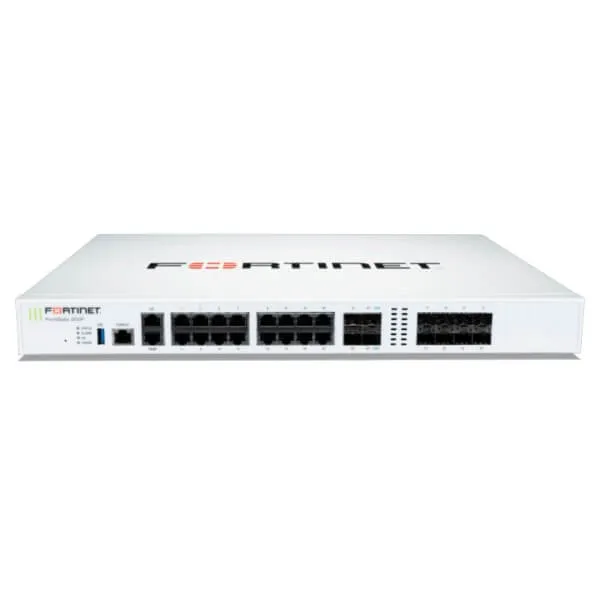
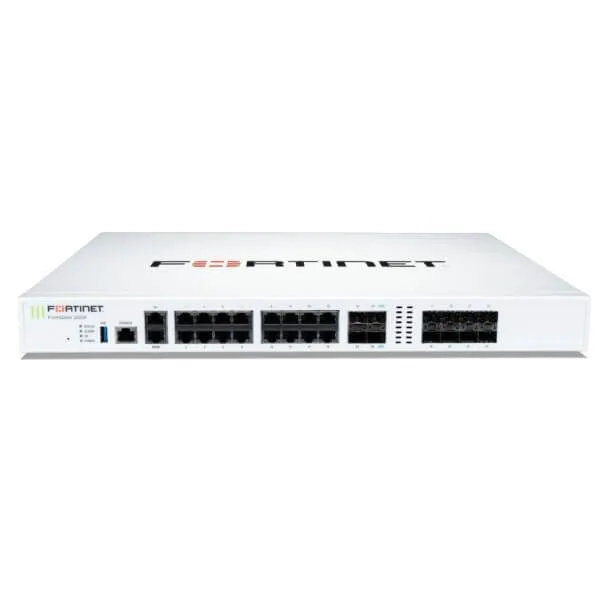
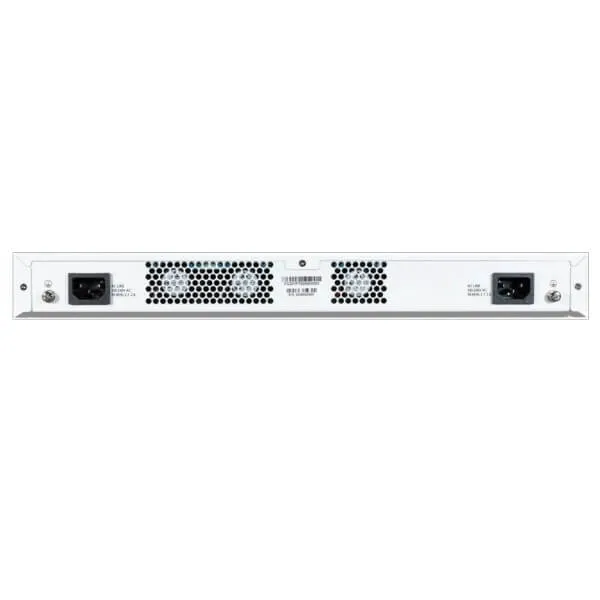
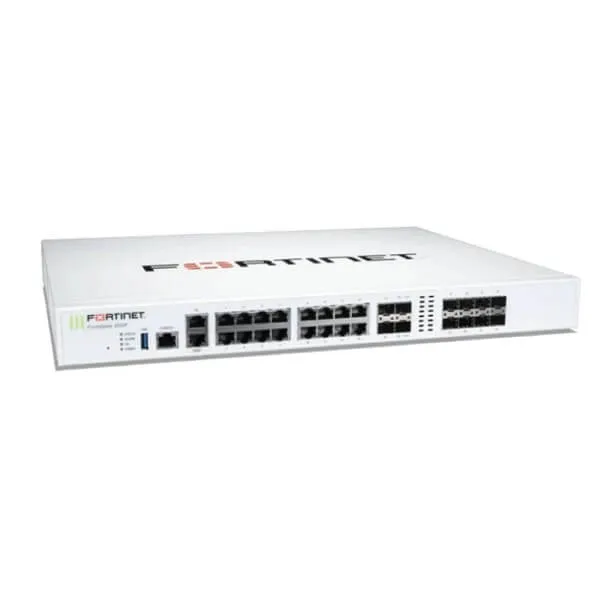
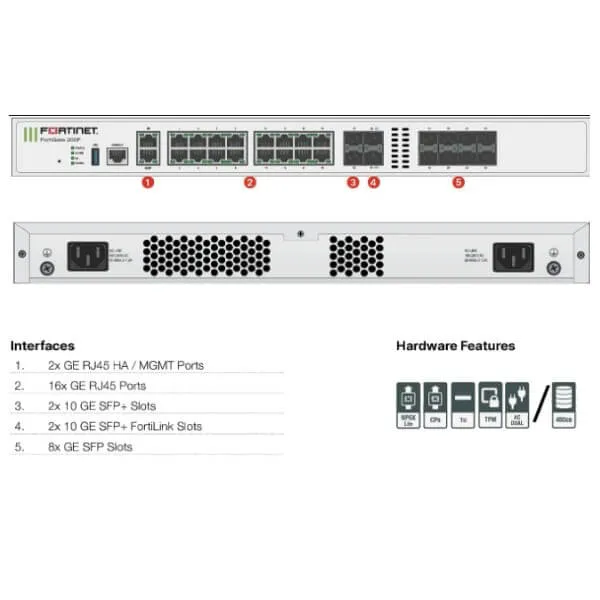
The FG-200F is positioned for demanding enterprise edge deployments where security inspection and WAN performance must coexist. Its physical interface set includes sixteen GE RJ45 data ports, dedicated GE RJ45 management and HA interfaces, eight GE SFP slots, two 10 GE SFP+ FortiLink slots and two additional 10 GE SFP+ slots. Fortinet lists redundant power supplies with default dual non-swappable AC PSUs in a 1RU form factor. This combination gives network architects flexibility for copper access, fiber uplinks, high-speed aggregation and resilient designs without treating the firewall as a simple internet gateway.
Fortinet reports three million concurrent TCP sessions, 280,000 new TCP sessions per second, 10,000 firewall policies, up to 2,000 gateway-to-gateway IPsec VPN tunnels and a recommended maximum of 500 concurrent SSL-VPN tunnel-mode users in the published data sheet. The appliance supports active-active and active-passive high availability. Those capabilities make the model relevant when a buyer is consolidating perimeter firewalling, site-to-site VPN, remote-access controls, application control, intrusion prevention and secure SD-WAN at an enterprise WAN edge.
Up to IPv4 firewall throughput for 1518-byte and 512-byte UDP test profiles.
IPS throughput using Fortinet’s enterprise traffic mix methodology with logging enabled.
Up to IPsec VPN throughput under Fortinet’s stated AES256-SHA256 test condition.
Published concurrent TCP session capacity for large, connection-dense enterprise networks.
What the FortiGate 200F solves
A modern firewall purchase is rarely only about blocking unwanted inbound traffic. Enterprises increasingly need encrypted-traffic inspection, application-aware policy, secure connectivity between offices, controlled remote access, multiple internet links, segmentation and operational visibility. The FortiGate 200F brings these functions into FortiOS so a network team can design security and connectivity as one operating model rather than maintaining unrelated appliances for every task.
For organizations with several branches, Secure SD-WAN can help define application-aware path selection across available WAN links while maintaining security policy at the edge. For headquarters and data-center edge roles, the mix of GE copper, GE fiber and 10GE SFP+ interfaces supports flexible handoffs to switches, service-provider circuits and internal network zones. High availability can be planned where business continuity requires a paired-firewall architecture. Exact topology, transceivers, subscriptions and configuration should be validated against the intended environment before procurement.
Technical specification guide
| GE RJ45 data ports | 16 |
| GE RJ45 management / HA | 1 / 1 |
| GE SFP slots | 8 |
| 10 GE SFP+ ports | 4 total; two designated FortiLink by default |
| Firewall throughput | Up to 27 / 27 / 11 Gbps for 1518 / 512 / 64-byte UDP |
| IPS / NGFW / threat protection | Up to 5 / 3.5 / 3 Gbps |
| IPsec VPN | Up to 13 Gbps |
| SSL-VPN | Up to 2 Gbps; recommended maximum 500 concurrent tunnel-mode users |
| Concurrent TCP sessions | 3 million |
| Form factor | 1RU |
| High availability | Active-active, active-passive and clustering |
Published performance values are maximum figures and vary with system configuration, traffic profile and enabled inspection. Use workload-based sizing rather than selecting a firewall from raw firewall throughput alone.
Licensing, subscriptions and procurement planning
A FortiGate hardware decision should be made together with the required security-service and support plan. The appliance can be deployed with different FortiGuard and FortiCare options depending on the security outcomes and operational support required. Procurement teams should specify the appliance model, desired subscription term, security services, support level, high-availability requirement, required optics or transceivers, rack and power considerations, and any centralized management or logging requirements. Avoid comparing quotations only by appliance price because two offers can represent materially different security and support scopes.
For renewals, record the existing device details, current services and intended renewal period before requesting a quotation. Security teams should also review the planned FortiOS release and supported upgrade path as part of change control. FourTeck can help translate a technical requirement into a quotation checklist, but final sizing should reflect real traffic, enabled inspection, user and device growth, VPN concurrency, application mix and resilience requirements.
For broader regional sourcing and specialist Fortinet information, buyers can also review FourTeck Fortinet UAE resources, FourTeck Uganda, FourTeck Kenya, and FourTeck Africa when a project spans multiple markets.
FortiGate 200F Tanzania
Organizations evaluating FortiGate 200F in Tanzania commonly need more than a firewall specification sheet. A useful buying process begins with the internet circuits, branch topology, applications, security inspection policies and expected growth. A head office with several WAN providers and encrypted cloud traffic has a different workload from a branch aggregation point, even when both have similar user counts. For this reason, Tanzanian buyers should document peak bandwidth in both directions, expected SSL inspection, IPS and application-control usage, remote-access demand, site-to-site VPN traffic and whether the firewall will participate in Secure SD-WAN.
The FG-200F can be relevant for enterprise headquarters, financial and professional-service environments, universities, hospitality groups, industrial organizations, healthcare networks and multi-site businesses that need a substantial security edge. Its 10GE interfaces provide room for high-speed internal or WAN-side connections, while GE copper and SFP interfaces support varied access and fiber designs. When uptime is important, procurement can consider a pair of appliances in a supported HA design rather than treating redundancy as an afterthought.
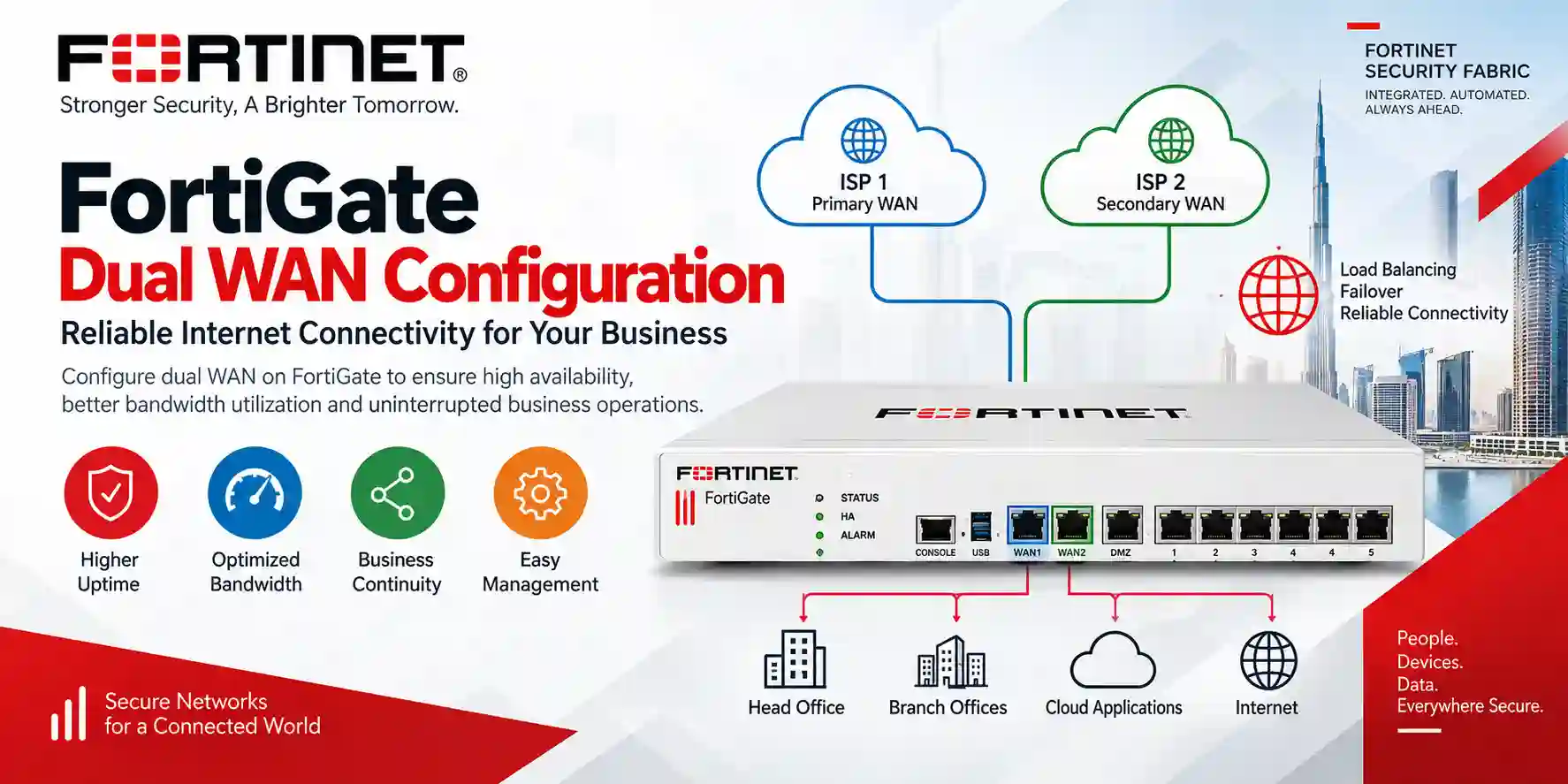
Tanzania procurement planning should include the required subscription bundle, support term, optics, cabling, rack space, power feeds, logging destination and implementation scope. If the firewall is replacing an existing platform, capture the current VLANs, routes, NAT policies, VPN peers, public services and security rules before migration. That inventory reduces uncertainty and helps identify policies that should be redesigned rather than blindly copied. For multi-WAN environments, the supplied FortiGate dual-WAN configuration visual can support planning discussions, while the product page remains focused on verified platform capabilities.
FortiGate 200F Dar es Salaam
For a Dar es Salaam enterprise, the FortiGate 200F can be assessed as a secure edge for headquarters, campus, data-center access or a multi-branch WAN. Organizations with primary and backup connectivity can design policies that consider application importance, link health and business continuity rather than relying only on static default routes. Secure SD-WAN is especially relevant when different circuits must carry cloud applications, internet browsing, voice, collaboration and private site traffic with defined priorities.
A procurement team should start by separating raw circuit speed from inspected throughput. If SSL inspection, IPS, application control and malware protection are enabled, the security workload becomes more important than the basic firewall number. Fortinet publishes 3 Gbps threat-protection throughput for the 200F under its defined enterprise test methodology, which provides a more useful reference for heavily inspected traffic than the 27 Gbps headline firewall figure. Actual results depend on configuration and traffic characteristics.
Dar es Salaam projects should also document fiber handoffs, required SFP or SFP+ modules, switch uplinks, public IP assignments, HA cabling and the expected demarcation between the firewall and LAN core. For migrations, schedule policy review and staged testing for business-critical VPNs and public-facing services. A quotation request is more actionable when it includes appliance quantity, subscription term, support requirement, optics, HA expectation and implementation scope. This approach helps buyers compare like-for-like proposals and reduces the risk that essential licensing or accessories are discovered only after the hardware decision.
FortiGate 200F Mwanza
Businesses evaluating the FG-200F in Mwanza may be connecting a regional operation to headquarters, protecting a growing campus or consolidating security for multiple business systems. The right design depends on the role of the site. A regional hub carrying VPN traffic for satellite locations needs careful tunnel and routing design, while a standalone enterprise site may prioritize secure internet access, segmentation and resilient connectivity. The 200F supports a broad interface mix that can accommodate copper LAN segments, fiber connections and higher-speed 10GE uplinks.
For organizations using cloud applications and centralized systems, link reliability can be as important as security inspection. Multi-WAN design should define which applications can fail over, how quickly link health is detected and what happens to active sessions during a path change. Where the site hosts services accessed from elsewhere, public NAT, DNS dependencies and inbound security policy must also be included in the migration plan. Site-to-site IPsec VPN can provide encrypted connectivity between FortiGate locations or compatible peers, while routing and security policies determine how traffic actually moves.
Before ordering, Mwanza buyers should estimate current and future bandwidth, concurrent users and devices, VPN usage, security profiles and logging needs. They should also identify whether a single appliance is acceptable or whether business continuity calls for HA. The published capacity figures are useful boundaries, not substitutes for workload sizing. A well-scoped request should state whether the project needs hardware only, security subscriptions, support, configuration, migration, documentation or post-deployment assistance so the commercial proposal matches the intended outcome.
FortiGate 200F Arusha
Arusha organizations in hospitality, tourism, education, professional services and distributed enterprises may need a firewall that handles both user internet access and secure connectivity to remote systems. The FortiGate 200F can serve as a consolidated security and WAN platform when the requirement includes application control, intrusion prevention, VPN, segmentation and SD-WAN. A hospitality or campus environment, for example, should distinguish guest, staff, operational and server traffic rather than applying one broad policy to every device.
Network segmentation planning should identify trust boundaries and the applications that legitimately cross them. Firewall interfaces, VLANs and upstream switching can then be arranged around those requirements. When encrypted inspection is planned, certificate deployment and application compatibility should be tested before broad enforcement. Some applications require exceptions or special handling, so a pilot phase is preferable to enabling deep inspection across all traffic without validation.
For Arusha procurement, buyers should ask how the proposed FortiGuard services align with the security functions they intend to use and whether the support period matches the organization’s lifecycle plan. The appliance itself is only one part of a production deployment; transceivers, rack power, backup connectivity, logging, configuration backup and operational ownership also matter. If remote sites will connect to Arusha, document the addressing plan and VPN topology early. A hub-and-spoke, partial mesh or SD-WAN overlay can each be appropriate in different environments, and the choice should be based on application flows and resilience rather than a generic template.
FortiGate 200F Dodoma
For organizations in Dodoma, the FG-200F can be considered where a secure enterprise edge must support substantial user traffic, site connectivity and policy enforcement. Government-related organizations, institutions, enterprises and service providers often have formal change-control, documentation and segmentation requirements. A firewall project should therefore include architecture and migration planning, not only hardware acquisition. Current routes, network zones, VPN peers, public services, administrator access methods and logging requirements should be documented before cutover.
The FortiGate 200F supports high-availability configurations, which can be important where maintenance windows or appliance failure must not create a single avoidable point of interruption. HA design still depends on the surrounding network: switches, WAN handoffs and power must also be resilient if the objective is end-to-end availability. The default redundant power-supply design of the appliance can be incorporated into separate power feeds where the facility architecture supports it.
Dodoma buyers should use a security workload estimate to determine whether the 200F provides suitable headroom. Fortinet’s published NGFW and threat-protection figures are more relevant than basic firewall throughput when multiple inspection engines are enabled. For VPN-heavy deployments, expected encrypted traffic and tunnel topology should be included. Procurement documentation should state the desired subscription and support term, quantity, optics, HA requirements, implementation scope and acceptance criteria. This makes it easier to evaluate proposals on the same basis and to plan licensing and support throughout the intended lifecycle.
FortiGate 200F UAE
UAE organizations evaluating FortiGate 200F may be designing a high-speed headquarters edge, branch aggregation platform or secure SD-WAN deployment spanning offices and cloud services. The 200F’s four 10GE SFP+ interfaces, GE fiber slots and copper interfaces provide a flexible physical foundation for enterprise networks with mixed handoffs. The appliance’s published security performance should be matched to the inspection profile rather than only to nominal ISP bandwidth.
Multi-site UAE projects often benefit from standardized templates for routing, security zones, VPN, SD-WAN health checks, logging and administrative access. Standardization can reduce configuration drift while still allowing site-specific addressing and provider details. Where the 200F is deployed as a pair, HA dependencies on switches, carrier circuits and power should be mapped so the overall design does not retain hidden single points of failure.
Buyers should also distinguish between appliance-only pricing and a complete security lifecycle proposal. Subscription bundles, FortiCare support, centralized management, analytics, optics and professional services can materially change scope. Cross-border projects can consult FourTeck UAE for regional coordination while using the Tanzania page for Tanzania-focused requirements. A complete RFQ should state quantity, intended role, bandwidth, inspection requirements, VPN usage, subscription term, support level and any implementation or migration expectations.
FortiGate 200F Uganda
Uganda deployments can use the FortiGate 200F as a secure WAN edge for enterprises that require integrated firewalling, IPS, application control, VPN and SD-WAN. A multi-country organization should first decide whether policy will be centrally standardized or locally administered. That decision affects logging, configuration management, change control and how branch exceptions are handled. Consistent object naming, zone design and VPN templates can simplify operations when several sites use FortiGate appliances.
The 200F’s published three-million concurrent-session capacity and high new-session rate can suit connection-dense environments, but sizing still depends on inspection and traffic behavior. A large number of users does not automatically mean a large security workload, and a smaller user population can generate substantial encrypted traffic. Measure peak throughput, application mix and expected inspection before selecting the model.
Uganda buyers should prepare a bill of requirements covering appliance count, HA, subscriptions, support, optics, WAN links, VPN peers and migration services. Projects coordinated with Tanzania can use common security standards while adapting carrier details and addressing per country. For Uganda-specific commercial coordination, the FourTeck Uganda website provides a regional path, while technical sizing should remain tied to the actual network workload and current Fortinet documentation.
FortiGate 200F Kampala
In Kampala, an FG-200F project may involve a headquarters with several business applications, internet links and remote sites. Secure SD-WAN can combine path selection with the firewall role, but successful deployment requires clear application priorities and measurable link-health criteria. Define which traffic should prefer which circuit, what latency or loss thresholds matter, and which applications must retain a stable public IP path.
Security policy should be built around business zones and application needs. Users, servers, guest networks, voice systems, management interfaces and public services should not automatically share identical trust levels. The FortiGate can enforce inter-zone controls, but the quality of the policy depends on the underlying network design and accurate object definitions. Logging should be planned so security teams can investigate events without overwhelming storage or retaining insufficient detail.
Kampala procurement should account for optics and fiber requirements because SFP and SFP+ interfaces need the correct transceivers for the intended links. The 200F data sheet lists no included transceivers, so required modules should be explicitly scoped. When migrating from another firewall, collect configuration details and test VPNs, NAT, published applications and failover behavior before production cutover. A staged implementation with rollback criteria is generally more manageable than treating the change as a simple appliance swap.
FortiGate 200F Arua
Arua organizations considering the FortiGate 200F may be building a regional hub, strengthening a business-critical site or connecting securely to centralized systems. In locations where WAN resilience is a key concern, the firewall design should consider multiple providers or access technologies where commercially available and appropriate. SD-WAN policy can then make path decisions based on defined service objectives, while security controls remain applied to traffic regardless of the selected WAN path.
For a branch-hub role, VPN architecture matters. The 200F supports a large published number of gateway-to-gateway IPsec tunnels, but operational simplicity should still guide design. Naming standards, route summarization, address planning and standardized security policies can make a distributed deployment easier to support. Centralized logging and configuration management may also be considered when many sites are involved.
Before procurement, an Arua buyer should identify the expected traffic crossing the firewall, which security engines will be enabled and whether the appliance needs HA. It is also useful to identify future bandwidth changes so the selected platform has reasonable headroom without being dramatically oversized. Subscription and support terms should match the organization’s lifecycle plan. A complete quote request should describe the intended deployment role and services instead of asking only for an FG-200F price, because licensing, support and accessories determine the usable solution.
FortiGate 200F Mbarara
For Mbarara enterprises, the FortiGate 200F can support a security architecture that combines protected internet access with encrypted connectivity to headquarters, cloud services and other sites. The platform is particularly relevant where the organization expects growth in bandwidth, inspection or branch connectivity and wants a 1RU appliance with 10GE options. Model selection should nevertheless follow measured requirements rather than using company size alone as the sizing metric.
A useful assessment records peak WAN utilization, internal uplink speeds, user and device counts, application categories, remote-access concurrency, site-to-site VPN traffic and planned security profiles. If SSL inspection is required, include that workload and test important applications. If guest or IoT networks exist, define segmentation and internet-access policies separately from corporate users. These details shape both firewall sizing and implementation effort.
Mbarara procurement should also include operational questions: who will administer the firewall, where backups are stored, how logs are reviewed, how firmware changes are approved and what support response is required. The hardware can provide capabilities, but sustainable security depends on the operating process around it. When requesting a quote, specify hardware quantity, subscription duration, FortiCare level, optics, HA requirements and whether migration, configuration or documentation services are expected.
FortiGate 200F Gulu
Gulu deployments may use the FG-200F to secure a regional enterprise, institutional network or distributed organization that needs reliable access to centralized resources. If the site connects to other offices, the design should map business applications to WAN and VPN requirements. Critical transactional systems may need different path priorities from software updates or general web browsing, and those priorities can inform SD-WAN rules.
The interface mix can be useful when a site combines copper access, fiber uplinks and high-speed aggregation. Network architects should confirm transceiver types, switch compatibility and link speeds before purchase. Where HA is required, both firewalls need a complete surrounding design including redundant switching or carefully planned connections, synchronized configuration and appropriate power. A second firewall alone does not guarantee end-to-end resilience.
For Gulu buyers, subscription selection should reflect the security services that will actually be operated. A firewall that is licensed for advanced inspection but deployed without policy tuning and monitoring will not deliver the intended security outcome. Procurement and technical teams should therefore align on scope, acceptance testing and post-deployment ownership. A clear RFQ should include current bandwidth, growth assumptions, security features, VPN needs, appliance count, license term, support level and implementation expectations.
FortiGate 200F Kenya
Kenya enterprises considering the FortiGate 200F may be consolidating WAN routing and next-generation firewall functions at a headquarters, data-center edge or major branch. The model’s published performance and 10GE connectivity can provide useful headroom for organizations with substantial encrypted traffic, multiple WAN circuits and many network segments. Security sizing should focus on the inspection mix and not simply on the fastest interface.
For regional businesses operating in Kenya and Tanzania, standardized FortiGate policy architecture can simplify administration across borders. Common naming, security profiles, logging standards and VPN templates can reduce operational differences while still accommodating local addressing and connectivity. Centralized management may be considered for larger estates, and centralized analytics can support consistent event review.
Kenya procurement should define whether the quote covers appliance hardware only or includes subscriptions, support, optics and professional services. A migration plan should inventory existing NAT, routes, VPNs and public services. For Kenya-specific engagement, visit FourTeck Kenya. For a Tanzania-led regional project, requirements can be coordinated from a common technical design while commercial and deployment details are confirmed for each market.
FortiGate 200F Kuwait
Kuwait buyers may evaluate the FG-200F for enterprise perimeter security, branch aggregation, secure SD-WAN or VPN concentration. The 1RU platform offers a broad interface set and published security performance that can fit substantial business networks. Selection should consider the actual security stack enabled on the appliance, especially when encrypted inspection and multiple threat-prevention functions will run concurrently.
For WAN-edge use, document all carrier circuits, public addressing, BGP or static-routing requirements, VPN peers and failover expectations. If the firewall will connect directly to a core switch at 10GbE, confirm optics and link compatibility. If HA is required, design the adjacent network and power architecture around the availability objective rather than treating the firewall pair in isolation.
Commercial comparison should normalize the subscription and support term across quotations. A low hardware-only price cannot be directly compared with a bundle containing multi-year security services and support. Buyers should state required services, quantity, optics, support term and implementation scope in the RFQ. For projects involving Kuwait alongside Tanzania or other African operations, use a common technical requirements document so each regional quote maps back to the same intended security outcomes.
FortiGate 200F Ghana
Ghana organizations can consider the FortiGate 200F when they need a high-capacity enterprise firewall with secure WAN capabilities and flexible fiber connectivity. Typical design questions include how many internet links are present, how much traffic is encrypted, whether the firewall terminates site VPNs, and which security profiles are required. These factors determine whether published performance provides adequate production headroom.
Distributed organizations should also plan how policies are managed across sites. Consistent segmentation and logging can make incident investigation and change management easier. For VPN connectivity, document all peer networks and overlapping-address risks before deployment. Where public services are hosted, map inbound NAT and security rules carefully and test them during migration.
Ghana procurement should specify license duration, FortiCare requirement, appliance count, HA, optics and implementation services. If the 200F is replacing an older firewall, use the project as an opportunity to remove obsolete rules and improve network-zone definitions rather than copying every legacy entry. For cross-market coordination, FourTeck’s African network resources can support commercial discovery while the final technical configuration remains based on Fortinet documentation and the customer’s measured workload.
FortiGate 200F Nigeria
Nigeria enterprises evaluating the FG-200F may have demanding multi-WAN, VPN and segmentation requirements. The platform can consolidate firewall, application control, intrusion prevention and secure SD-WAN functions, reducing the need to treat security and WAN routing as completely separate projects. The design should still establish clear operational ownership for policy, routing, monitoring and firmware lifecycle.
For sites with several connectivity providers, define health-check targets and failover behavior carefully. Not every application responds identically to path changes, and public-facing services may depend on provider-specific addressing. SD-WAN rules should reflect business intent, while security policies remain explicit about permitted traffic. If large volumes of encrypted traffic will be inspected, size against the relevant security-performance figures and test application compatibility.
Nigeria procurement teams should request a fully scoped proposal: appliance model and quantity, security bundle, support duration, optics, HA, centralized management or logging requirements, and professional services. Comparing complete scope reduces surprises after purchase. Regional organizations can also standardize documentation across Nigeria, Ghana, Kenya, Uganda and Tanzania so branch deployments share policy principles while respecting local network details.
FortiGate 200F Seychelles
Seychelles organizations assessing the FortiGate 200F may prioritize resilient connectivity, secure access to cloud services and protected links between sites. Where external connectivity options are limited or expensive, WAN policy should be designed around application importance and business continuity. Secure SD-WAN can help use available links according to defined performance objectives, while the firewall enforces security policy across those paths.
The appliance’s interface flexibility can support fiber and copper environments, but optics and carrier handoffs must be confirmed before ordering. If the site hosts public services or remote-access VPN, public IP addressing and DNS dependencies should be included in the cutover plan. For organizations with strict uptime requirements, an HA pair can be considered together with resilient switching and power.
Seychelles procurement should account for lifecycle support and security subscriptions as well as hardware. Remote administration should be secured with strong access controls and restricted management exposure. Configuration backups, monitoring and documented recovery procedures are important where on-site intervention may not always be immediate. A detailed RFQ that includes security functions, bandwidth, VPN, optics, HA and support requirements gives suppliers the information needed to produce a meaningful proposal rather than a bare appliance price.
Deployment, migration and integration checklist
Before purchase
Record peak WAN bandwidth, security inspection requirements, SSL inspection, VPN throughput, concurrent remote users, branch count, routing protocols, public services, VLANs, HA requirements, optics, power and growth assumptions. Select subscriptions and support according to the security functions and lifecycle required.
Before cutover
Inventory existing policies, NAT, routes, VPNs and administrator access. Build and review the target configuration, test critical applications, establish backups and rollback criteria, and confirm monitoring and logging. Validate provider handoffs and transceivers before the migration window.
After deployment
Review logs, tune security profiles, validate SD-WAN and failover behavior, confirm VPN stability, remove temporary migration rules, document the final configuration and establish firmware, backup and renewal processes. Capacity should be reviewed as traffic and inspection requirements change.
FortiGate 200F buying questions
Is FortiGate 200F suitable for a headquarters?
It can be suitable for headquarters and enterprise WAN-edge roles when its inspected-throughput, session, interface and resilience capabilities match the measured workload. Sizing should account for security services and encrypted traffic rather than relying only on raw firewall throughput.
Does FG-200F support 10GbE?
Yes. Fortinet lists four 10 GE SFP+ interfaces in total, including two FortiLink slots by default. Required SFP+ transceivers should be scoped separately because the data sheet lists no included transceivers.
What is the FortiGate 200F threat-protection throughput?
Fortinet publishes up to 3 Gbps threat-protection throughput under its stated test methodology with firewall, IPS, application control and malware protection enabled with logging. Production results vary by configuration and traffic.
Can FortiGate 200F be deployed in high availability?
Yes. Fortinet lists active-active, active-passive and clustering HA configurations. The surrounding switching, WAN and power architecture must also be designed for the intended availability objective.
How should I request a FortiGate 200F quote?
Provide the appliance quantity, required subscription and term, FortiCare support level, HA requirement, optics, WAN bandwidth, security functions, VPN needs and whether configuration or migration services are required. This allows a quote to represent the complete intended deployment.
Quotation checklist
For a precise FortiGate 200F Tanzania quotation, prepare: number of appliances; single-unit or HA design; internet and private-WAN speeds; number of sites; approximate remote-access users; expected IPsec VPN traffic; required security inspection; subscription term; support level; SFP/SFP+ optics; centralized management or logging needs; migration scope; and target implementation schedule. Include current firewall details when this is a replacement project.
Decision recap
The FortiGate 200F is a 1RU enterprise NGFW and secure WAN platform with high session capacity, 10GbE connectivity, IPsec VPN, Secure SD-WAN and FortiOS security functions. Its strongest fit is determined by workload: inspected throughput, encrypted traffic, VPN demand, interface needs, resilience and future growth. The next step is to translate those requirements into a correctly licensed and accessorized bill of materials rather than purchasing from the model number alone.
Plan your FortiGate 200F deployment with FourTeck Tanzania
Share your WAN bandwidth, security requirements, site count, VPN needs, HA preference and subscription term. FourTeck can use that information to prepare a product and licensing quotation aligned with the intended deployment. Availability, pricing, delivery and service scope should be confirmed in the quotation rather than assumed from general product information.




Reviews
There are no reviews yet.