
FORTINET HIGH-END NEXT-GENERATION FIREWALL
FortiGate 3000F (FG-3000F) Tanzania
The FortiGate 3000F is designed for organizations that need to protect high-volume data-center, campus and hybrid-IT traffic without separating core networking and security into disconnected platforms. Fortinet positions the 3000F series for high-performance secure networking, with purpose-built NP7 and CP9 security processing, FortiOS, FortiGuard services and extensive high-speed interfaces. For Tanzania procurement teams, the practical question is not simply whether the appliance is fast; it is whether the chosen hardware, inspection profile, links, subscriptions, transceivers, redundancy and operating model fit the real network.
IPS throughput published by Fortinet for the 3000F series enterprise traffic mix.
NGFW throughput for sizing security inspection beyond basic stateful firewalling.
Threat-protection throughput, useful when comparing realistic inspected workloads.
Published IPv4 firewall throughput at the 1518-byte packet profile.
FortiGate 3000F Overview
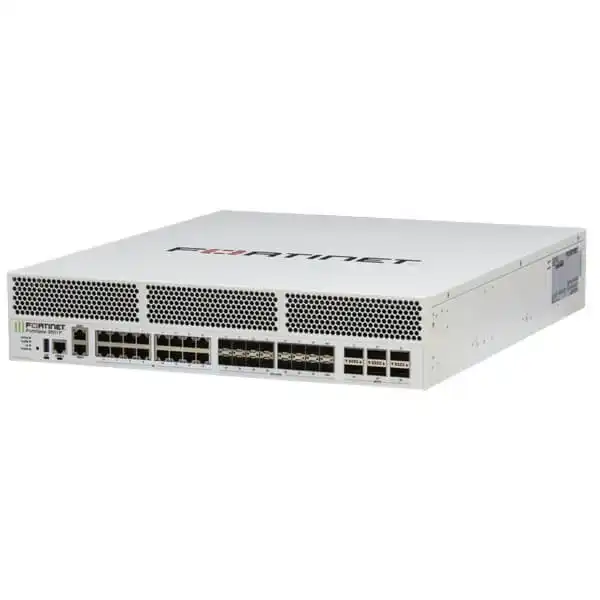
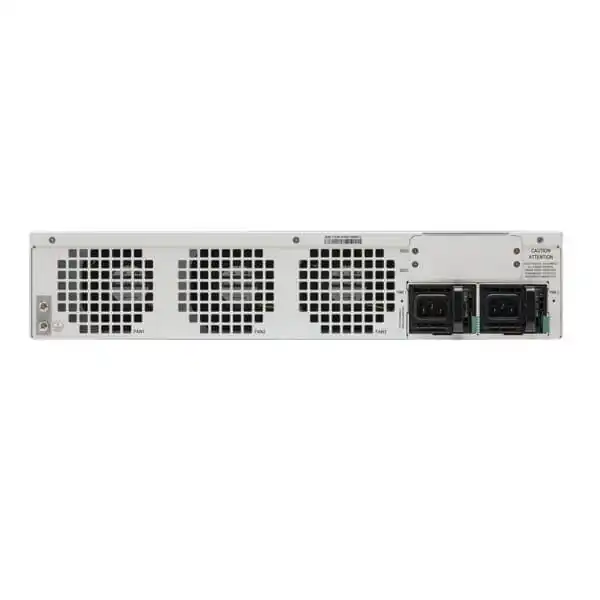
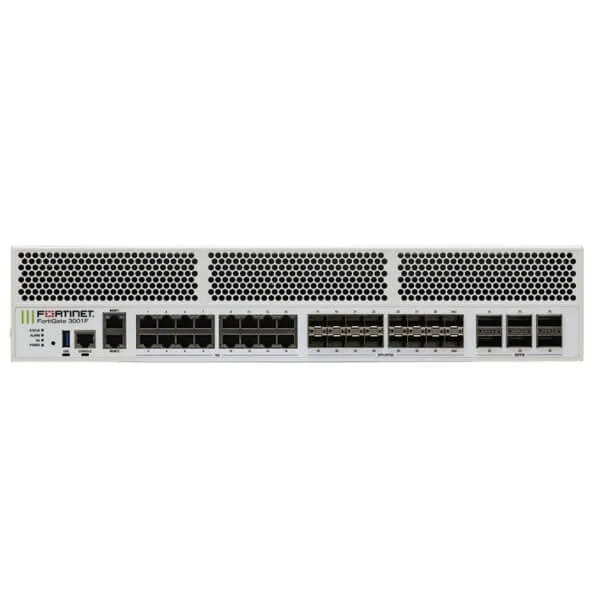
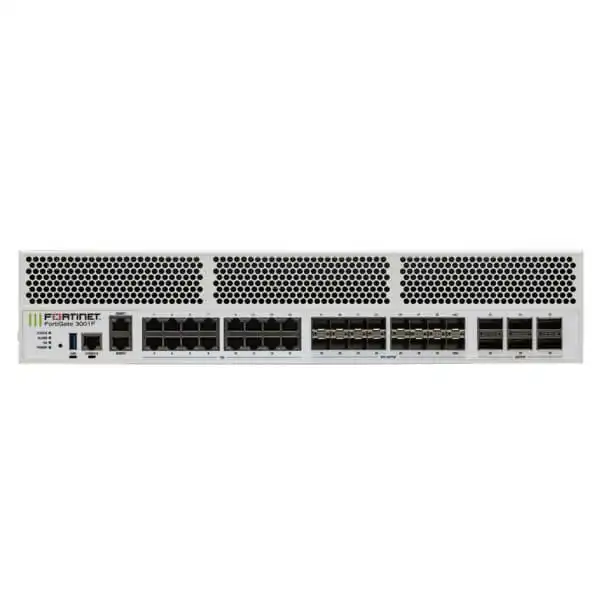
FortiGate 3000F belongs to Fortinet’s high-end firewall portfolio and is intended for demanding enterprise and data-center use. The base FG-3000F uses dual AC power supplies and provides six hardware-accelerated 100GE QSFP28/40GE QSFP+ slots, sixteen hardware-accelerated 25GE SFP28/10GE SFP+/GE SFP slots including two HA slots, sixteen hardware-accelerated 10GE/5GE/2.5GE/GE RJ45 data ports and two 10GE/GE RJ45 management ports. This port mix matters to buyers because a firewall refresh is often also a topology decision: upstream internet handoffs, core switching, server zones, HA links and management networks must all be mapped before optics and cabling are ordered.
Fortinet lists the appliance as a 2RU platform. The published chassis dimensions are 88.9 x 443 x 556 mm and the FG-3000F weight is approximately 16.9 kg. Redundant hot-swappable power supplies are included. These physical details should be checked against rack depth, power distribution, cooling and cable-management plans before installation. For environments that require DC power, Fortinet publishes a separate FG-3000F-DC orderable model; procurement teams should not treat AC and DC variants as interchangeable SKUs.
The platform runs FortiOS, bringing firewall policy, routing, SD-WAN, VPN, segmentation, security inspection and Security Fabric integration into a common operating environment. FortiGuard services can add security intelligence and inspection capabilities according to the subscription selected. Buyers should therefore evaluate the appliance and subscription as one operational design rather than comparing only hardware prices.
Why enterprises consider FG-3000F
Large networks frequently need to inspect encrypted application traffic, support large session counts, segment sensitive systems, terminate VPNs and connect multiple high-speed network zones at the same time. FortiGate 3000F is engineered for this class of workload. Fortinet publishes 70 million concurrent TCP sessions for the standard test profile and 331.5 million packets per second of firewall throughput. These headline figures are useful for architectural comparison, but they are not a promise that every production policy set will produce the same result. Real performance depends on packet sizes, enabled security services, SSL inspection, logging, application mix, firmware, routing design and traffic direction.
For a data center, the 100GE and 25GE interface options can help avoid placing a low-speed security bottleneck between high-capacity switching domains. For a headquarters or campus, the appliance can consolidate internet edge security, inter-VLAN controls, SD-WAN and VPN functions. For hybrid IT, integrated ZTNA and policy controls can support a design in which access decisions are tied more closely to identity and application requirements. The appropriate architecture should still be documented before purchase, particularly when replacing another firewall whose interface naming, NAT behavior, VPN design or routing policy differs from FortiOS.
Verified FG-3000F Technical Highlights
| IPS throughput | 36 Gbps |
| NGFW throughput | 34 Gbps |
| Threat protection | 33 Gbps |
| IPv4 firewall throughput | 397 / 389 / 221 Gbps for 1518 / 512 / 64-byte UDP |
| Concurrent TCP sessions | 70 million under Fortinet’s published standard profile |
| 100GE / 40GE slots | 6 hardware-accelerated QSFP28 / QSFP+ slots |
| 25GE / 10GE / GE fiber slots | 16, including 2 HA slots |
| Multi-gig RJ45 | 16 accelerated 10GE / 5GE / 2.5GE / GE ports plus 2 management ports |
| Form factor | 2RU rack mount |
Performance figures are vendor-published test results and should be validated against the intended inspection profile and current Fortinet documentation during solution design.
Security, SD-WAN, VPN and Hybrid IT
A high-end firewall is most valuable when its capabilities are mapped to a security architecture. FortiGate 3000F can participate in Fortinet Secure SD-WAN designs, allowing routing and security policy to work together when multiple WAN links are used. This can be relevant for enterprises that operate several internet circuits, private WAN services or regional branches. Link steering should be based on measurable service-level objectives rather than a simple primary-and-backup configuration, especially when business applications have different latency, jitter and packet-loss tolerances.
VPN design can include site-to-site IPsec connectivity and secure remote-access patterns depending on the broader Fortinet solution and software choices. Before migration, document tunnel counts, encryption requirements, peer addressing, dynamic routing, overlapping networks and failover behavior. For large organizations, a clean VPN inventory prevents old tunnels and undocumented exceptions from being copied into a new platform.
ZTNA capabilities are integrated into the FortiGate platform and can help organizations move beyond broad network-level trust. A ZTNA project should still define user identity, device posture, application ownership, authentication dependencies and exception handling. The firewall is an enforcement component; successful zero-trust adoption also requires accurate identity and application information.
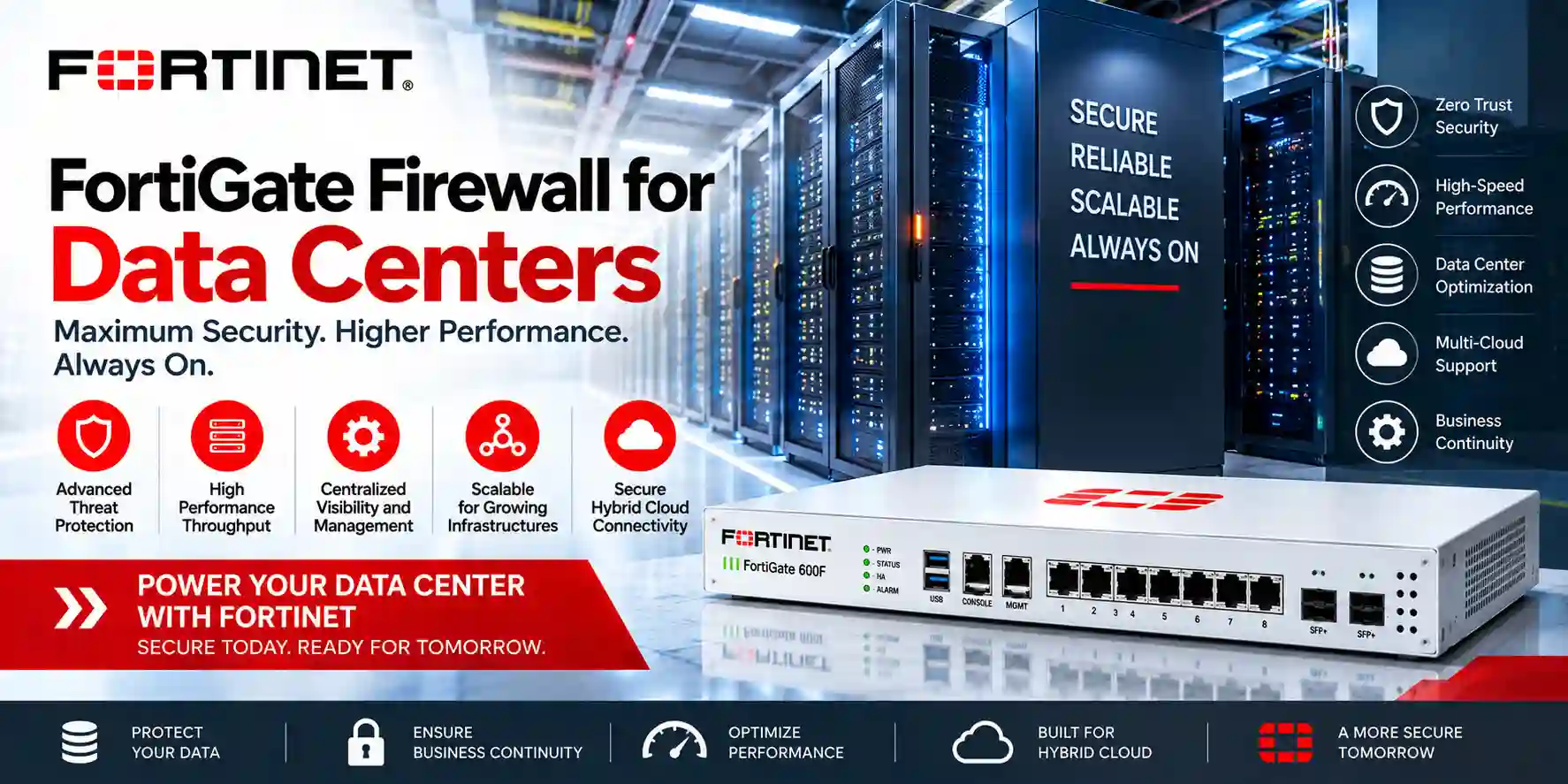
FortiGate 3000F for Data Centers and Head Offices
In a data center, FG-3000F can be considered for north-south internet or WAN security, segmentation between security zones, high-capacity VPN termination and inspection at important trust boundaries. A design should identify which traffic actually crosses the firewall. East-west inspection can increase the volume dramatically, so application flows, server dependencies and peak utilization need to be measured rather than estimated from internet bandwidth alone.
At a large head office, the same platform can sit between campus cores, internet services, DMZs and WAN connections. High availability is commonly important at this scale because the firewall may become a critical path for many business systems. HA planning should include physical diversity, switch design, link aggregation, management access, synchronized configuration, failover testing and maintenance procedures. Buying two appliances does not by itself create resilient service; the surrounding network must also avoid single points of failure.
Licensing and Subscription Planning
The base appliance and the security-service entitlement are different procurement components. Organizations should specify the required FortiGuard security bundle and FortiCare support term when requesting a quotation. The right subscription depends on which inspection and intelligence services the security policy will use. Procurement teams should also align renewal dates where possible, particularly when several FortiGate devices are managed as one estate.
Before approving a quote, ask for a line-by-line bill of materials that identifies the exact appliance SKU, subscription or bundle, term length, support level, transceivers or accessories and any implementation services. This makes competing quotations easier to compare and reduces the risk of selecting a low hardware price that excludes necessary subscriptions or optics. FourTeck can use this information to prepare a more precise commercial response rather than relying on an ambiguous request for a single firewall price.
FortiGate 3000F Tanzania
Tanzania organizations considering FortiGate 3000F are typically dealing with a security requirement beyond a small branch firewall: high-capacity internet gateways, data-center traffic, large campus networks, regional WAN hubs, service-provider environments or consolidation of multiple security functions. The selection process should begin with measured traffic and a diagram of the intended trust boundaries. Internet circuit speed alone is not enough. Teams should quantify encrypted traffic, internal server flows, VPN demand, concurrent sessions, expected growth and the security profiles that will be enabled.
For Tanzanian enterprises with sites connected through different carriers, Secure SD-WAN can be evaluated alongside the NGFW function. This is useful where business continuity depends on more than one circuit, but the design should consider how applications behave during path changes and how DNS, public addressing, inbound services and VPN peers respond to failover. Organizations operating ERP, payment, voice, collaboration, cloud and remote-access services may need different path priorities instead of one universal WAN rule.
Procurement should also cover rack, power and optics. FG-3000F is a 2RU appliance with redundant hot-swappable supplies and high-speed QSFP28, SFP28 and RJ45 connectivity. Confirm rack depth, PDU capacity, airflow, fiber type, optic reach and switch compatibility before placing the order. If a DC-powered installation is required, specify FG-3000F-DC rather than assuming the power system can be changed after purchase.
FourTeck Tanzania can help structure the enquiry around model, quantity, subscription term, HA requirement, interface plan and deployment scope. For related Fortinet planning, review FourTeck Tanzania technology solutions and use the contact channel to request a project quotation. A useful enquiry includes the current firewall model, peak traffic, WAN speeds, number of sites, VPN count, expected security inspection and target implementation window.
FortiGate 3000F Dar es Salaam
Dar es Salaam buyers may evaluate FG-3000F for headquarters, financial environments, data centers, large hospitality groups, logistics operations, service providers and enterprises with many connected sites. In these environments the firewall often protects more than web browsing. It may carry cloud access, private applications, public-facing services, remote users, branch VPNs and traffic between server networks. That makes architecture discovery a critical first step.
Start by separating traffic into business categories and security zones. Identify public services, user networks, server networks, management networks, guest access, voice, operational technology where applicable and external partner connections. Then decide which flows require IPS, application control, malware inspection, SSL inspection or other security services. This provides a more defensible sizing basis than simply multiplying the number of employees by a bandwidth assumption.
Connectivity diversity is another consideration. A large Dar es Salaam site may use multiple providers or different access technologies. FortiGate Secure SD-WAN can help use those links according to application health and policy. The implementation should test carrier failure, degraded performance and restoration, not just cable removal. For inbound applications, public IP and DNS dependencies also need a failover plan.
When requesting a FortiGate 3000F Dar es Salaam quotation, include whether the design needs a single appliance or HA pair, AC or DC power, subscription duration, optics, rack accessories, migration and post-change support. This produces a clearer bill of materials and helps technical reviewers confirm that the commercial offer matches the network design.
FortiGate 3000F Mwanza
For Mwanza organizations, FG-3000F is most relevant where a site operates as a major enterprise hub, data-center location or aggregation point for substantial regional traffic. A smaller office may be better served by another FortiGate model, so the first objective should be right-sizing rather than choosing the largest available appliance. Fortinet publishes a broad firewall portfolio, and inspection throughput, port density and resiliency should match the workload.
Organizations linking Mwanza facilities with other Tanzanian locations should document WAN topology before deployment. Hub-and-spoke VPN, partial mesh, SD-WAN overlays and private circuits create different session, routing and troubleshooting requirements. If Mwanza acts as a regional hub, resilience of upstream links and the ability to maintain secure connectivity during provider problems can be as important as raw firewall throughput.
The FG-3000F’s high-speed interfaces are valuable only when connected infrastructure can use them. Confirm core-switch port types, transceiver standards, fiber runs and link speeds. A 100GE slot does not automatically mean an existing switch or optic is compatible. Procurement should therefore include an interface matrix showing each firewall port, neighboring device, medium, optic and expected speed.
Security operations should also be planned. Decide where logs will be retained, who reviews alerts, how configuration backups are handled and how firmware changes are approved. A high-capacity firewall can enforce sophisticated policy, but operational discipline determines whether those controls remain effective over time. Include these requirements when defining the Mwanza deployment scope.
FortiGate 3000F Arusha
Arusha enterprises with large hospitality, institutional, regional-office or multi-site networks may consider FortiGate 3000F when traffic and inspection requirements justify a high-end platform. Environments that support many guests, staff, cloud applications and remote sites should separate user experience requirements from security controls during planning. Guest traffic, for example, may need different segmentation and application policy from finance or administrative systems.
For organizations with geographically distributed operations, secure VPN and SD-WAN can reduce dependence on a single path design. Define critical applications and acceptable performance thresholds first. Voice and interactive cloud applications may prioritize latency and jitter, while backups may prioritize capacity and cost. Policy-driven path selection becomes more useful when it reflects those differences.
High availability should be evaluated if the Arusha site is business-critical. This means more than ordering a second FG-3000F. Both upstream and downstream switching, power feeds, management access and provider links should be reviewed for redundancy. Maintenance procedures should include a controlled failover test so administrators understand session behavior and routing convergence before an actual incident.
A quotation request should state current and future bandwidth, required interfaces, number of protected zones, VPN and remote-access needs, subscription preference and whether migration assistance is required. That information helps distinguish a straightforward hardware supply from a full security transformation project.
FortiGate 3000F Dodoma
Dodoma organizations evaluating FG-3000F may include large institutions, national operations, campuses and enterprises that need resilient secure connectivity between central systems and distributed users. In such networks, policy governance is often as important as performance. Firewall rules should be tied to applications and business owners, with obsolete exceptions removed during migration rather than copied indefinitely.
Segmentation can help separate public services, internal applications, administrative users, guest networks and other trust zones. The exact design depends on the organization’s risk model and network architecture. FortiGate can enforce controls between those zones, while FortiOS provides routing and security functions within one platform. Before implementation, map dependencies so segmentation does not unexpectedly block legitimate application flows.
For multi-site operations centered on Dodoma, the firewall may also serve as a VPN or SD-WAN hub. Capacity planning should include aggregate branch traffic and the possibility that failover concentrates traffic on fewer paths. The security team should define monitoring and alert thresholds so degradation is detected before users report it.
Procurement documentation should identify FG-3000F precisely, including power variant, subscriptions and support. Add optics and accessories only after the physical interface design is confirmed. This disciplined approach reduces change orders and makes it easier to validate delivered equipment against the approved bill of materials.
FortiGate 3000F UAE
UAE enterprises can use FortiGate 3000F for high-throughput data-center, campus and hybrid-cloud security designs where dense high-speed connectivity and advanced inspection are required. Organizations comparing models should focus on threat-protection throughput, interface architecture, HA design and subscription requirements rather than basic firewall throughput alone. Encrypted application traffic and east-west inspection can materially change the sizing requirement.
For UAE procurement and Fortinet-specific regional information, FourTeck maintains a dedicated Fortinet products UAE resource. Cross-border projects should confirm the exact destination, support requirements and commercial terms before ordering. If an organization operates UAE and African sites, standardizing FortiOS policy and management practices can simplify operations, but local network conditions and circuit designs should still be modeled independently.
Data-center deployments should verify QSFP28 and SFP28 optics, switch interoperability and rack/power requirements. HA designs should account for separate power and switching failure domains. Security teams should also determine whether logging and centralized management will be local, cloud-based or integrated into a broader Fortinet Security Fabric architecture.
A useful UAE quote request includes appliance quantity, AC/DC requirement, FortiGuard and FortiCare term, HA plan, transceiver count and implementation scope. This makes the commercial comparison consistent and prevents a bare-appliance quote from being mistaken for a complete production solution.
FortiGate 3000F Uganda
Uganda organizations considering FortiGate 3000F should first establish whether the requirement is a national hub, major campus, data center or other high-capacity security edge. The model’s performance and interface density are designed for demanding networks, so smaller branches should be sized independently. A central 3000F can coexist with smaller FortiGate appliances at remote sites where a common FortiOS-based architecture is desirable.
Multi-site businesses can evaluate secure SD-WAN for application-aware use of multiple links and VPN connectivity for protected site-to-site traffic. When the central firewall aggregates branches, sizing should account for total inspected traffic during normal operation and failure scenarios. Logging volume and centralized management also become more important as the number of sites grows.
FourTeck’s Uganda technology site can provide regional context for organizations planning Fortinet projects. Procurement teams should share the exact model, subscription term, power type, interface needs and destination so the quote can be aligned with the intended architecture.
Migration planning should include routing, NAT, VPN, object naming, security policies, certificates and administrative access. A staged cutover with rollback criteria is preferable for critical networks. After implementation, test failover, key applications, VPNs, public services and monitoring before closing the project.
FortiGate 3000F Kampala
Kampala headquarters and data-center environments can generate a mix of internet, branch, cloud, remote-user and server traffic that makes firewall sizing more complex than a single WAN-speed figure. FG-3000F is positioned for high-end workloads, but the design should still measure peak traffic and determine which security services apply to each flow.
Enterprises with many branches can use the Kampala site as a secure aggregation point, provided resilience is designed across firewall, switching and carrier layers. If branches depend on the hub for cloud or internet access, the impact of hub maintenance must be considered. Some architectures may use local breakout with centralized policy, while others backhaul selected applications.
For high-speed interfaces, confirm whether neighboring switches use 100GE QSFP28, 25GE SFP28, 10GE SFP+ or copper. Optic selection should be based on link distance and supported standards. Procurement teams should not add generic transceivers without validating compatibility.
Kampala buyers should request a quote that distinguishes hardware, FortiGuard services, FortiCare support, optics and implementation. This makes renewal obligations visible and helps finance teams compare total solution cost rather than only the initial appliance purchase.
FortiGate 3000F Arua
For Arua, a FortiGate 3000F deployment is most likely to make sense when the site serves as a major regional aggregation point or supports unusually high traffic and security requirements. A typical small branch should not be assumed to need a high-end 2RU firewall. Right-sizing protects budget while preserving enough performance headroom for inspection and growth.
Where connectivity options differ between sites, SD-WAN policy can help select paths according to measured health. The design should define what happens when the preferred path degrades rather than fails completely. Application-aware thresholds and monitoring can improve continuity for critical services.
Remote locations also benefit from clear operational procedures. Administrators need secure management access, configuration backup, alerting and a tested process for changes. If central teams manage the appliance from Kampala or another location, out-of-band access and escalation procedures should be considered as part of resilience.
Before ordering for Arua, provide the network diagram, link speeds, required ports, subscription term and HA expectations. FourTeck can then frame the bill of materials around the actual project instead of assuming that every FG-3000F deployment uses the same accessories or services.
FortiGate 3000F Mbarara
Mbarara enterprises may consider FG-3000F when a facility hosts central applications, aggregates regional branches or operates a high-capacity campus. The decision should be driven by inspected traffic, session scale, interface requirements and availability objectives. A capacity model should include expected growth so a firewall refresh does not immediately create another upgrade cycle.
If the network uses multiple WAN providers, document routing and failover behavior before migrating. Secure SD-WAN can use performance information to steer traffic, but public services and external VPN peers may require additional DNS, addressing or routing design. Test the complete failure sequence rather than only the firewall configuration.
Security policies should be rationalized during migration. Group rules by business purpose, identify owners and remove unused objects after validation. This improves maintainability and makes audits easier. High-performance hardware does not compensate for an unmanageable rule base.
Mbarara procurement teams should specify whether the requirement includes installation, policy migration, testing, documentation or training. Separating these service elements from hardware and subscriptions creates a transparent project scope and clearer acceptance criteria.
FortiGate 3000F Gulu
Gulu organizations with a large regional network or high-capacity institutional environment can evaluate FortiGate 3000F as part of a broader security architecture. The appliance provides substantial throughput and high-speed connectivity, but its value depends on matching those capabilities to real traffic and risk requirements.
A branch aggregation design should model both normal and degraded states. If one WAN path fails, remaining links and the firewall must carry the redistributed traffic. Similarly, if an HA peer fails, the surviving unit should have enough capacity for the production workload. These scenarios should be included in sizing rather than treated only as operational tests.
For applications hosted centrally, segmentation and controlled access can reduce unnecessary exposure between user groups and servers. Map dependencies before tightening policy, especially for legacy systems that may use undocumented ports or fixed IP assumptions. Pilot changes can reveal these dependencies with less disruption.
When requesting FG-3000F for Gulu, include circuit speeds, interface media, HA requirements, subscriptions and support expectations. A detailed requirement enables a more accurate quote and gives technical teams a checklist for validating the delivered solution.
FortiGate 3000F Kenya
Kenya enterprises can consider FortiGate 3000F for high-end firewall requirements in data centers, large campuses and regional hubs. Organizations operating across East Africa may use a common Fortinet architecture while adapting capacity and connectivity to each country. Standardization can simplify policy and skills, but it should not become an excuse to deploy the same appliance size everywhere.
The FourTeck Kenya site provides a regional route for technology enquiries. For an FG-3000F project, specify whether the appliance protects internet edge traffic, internal data-center zones, branch aggregation or a combination. This determines how throughput figures should be interpreted.
High-speed links require careful optic and switch planning. Six 100GE-capable slots and multiple 25GE/10GE interfaces give architectural flexibility, but each connection must be matched to the neighboring platform. Include transceiver type, fiber medium and link distance in the bill of materials.
Licensing should be quoted for the intended security services and term. If the firewall is part of a multi-country rollout, coordinate renewal dates and management standards where practical. Consistent naming, policy templates and change procedures can reduce operational complexity across the estate.
FortiGate 3000F Kuwait
Kuwait organizations with high-capacity enterprise or data-center networks can evaluate FG-3000F where large session counts, high-speed interfaces and advanced inspection are required. Sizing should use threat-protection and NGFW performance relevant to the intended policy, not only stateful firewall throughput.
Environmental and rack planning are important for a 2RU high-end appliance. Confirm cooling direction, rack depth, redundant power and maintenance access. Where the facility uses a specific power architecture, validate the AC or DC model before ordering.
For regional procurement context, organizations can consult FourTeck Kuwait. A detailed enquiry should include model, quantity, subscription term, interface requirements and implementation scope. If the appliance will form an HA pair, state this explicitly so supporting links and design assumptions are reviewed together.
Migration from an existing firewall should include a configuration assessment rather than a blind conversion. Old rules, objects and NAT entries can accumulate over years. Use the project to identify what is still required and create a cleaner policy baseline for the new platform.
FortiGate 3000F Ghana
Ghana enterprises can deploy high-end FortiGate platforms at data centers, headquarters and network hubs where inspection and connectivity requirements exceed branch-class firewalls. FG-3000F offers the port density and vendor-published security performance needed for demanding architectures, but the final selection should follow measured capacity planning.
Organizations with multiple sites should decide whether internet security is centralized or distributed. Centralized inspection can simplify some controls but increases dependence on the hub and WAN. Distributed breakout can reduce backhaul but requires consistent policy and visibility across more devices. Fortinet Secure SD-WAN and centralized management options can support either strategy depending on design.
For procurement, document FortiGuard and FortiCare terms, optics, HA and service scope. Cross-border supply projects should also confirm destination and commercial requirements before purchase. Avoid assuming stock, delivery times or support coverage until these are confirmed in the quotation.
Operational readiness includes logging, alerting, configuration backup, administrator authentication and change control. These processes should be agreed before go-live so the new firewall becomes a managed security control rather than simply a faster gateway.
FortiGate 3000F Nigeria
Nigeria’s large enterprise, financial, telecom, energy and data-center environments can create traffic volumes and segmentation requirements suited to high-end firewall platforms. FG-3000F should be assessed against the exact workload, particularly encrypted inspection, east-west traffic, VPN aggregation and public application protection.
Where enterprises use several carriers, Secure SD-WAN can help select links according to application policy and path quality. Large sites should define service-level thresholds and monitor them continuously. Carrier diversity is most effective when physical paths and upstream dependencies are genuinely diverse rather than simply purchased under different service names.
HA pairs can reduce firewall-level single points of failure, but the design must also cover switching and power. Test planned maintenance and unplanned failure behavior. For public services, verify NAT, routing, DNS and upstream dependencies after failover.
Procurement teams should request a complete bill of materials and clearly distinguish the base appliance from subscriptions, support, optics and implementation. This allows technical and commercial reviewers to compare equivalent solutions and understand ongoing renewal commitments.
FortiGate 3000F Seychelles
Seychelles organizations with centralized infrastructure, hospitality groups, service providers or critical enterprise networks may evaluate FG-3000F where high-capacity security is justified. Because island connectivity can make resilience planning especially important, firewall selection should be considered together with WAN architecture, provider diversity and recovery procedures.
If multiple internet links are available, SD-WAN policy can steer applications based on link health. Teams should test how cloud applications, VPNs and public services react to failover. The objective is not merely to keep a link active, but to maintain usable business services when a path changes.
For hardware planning, verify rack space, power, airflow and the required optics before shipment. High-speed transceivers and accessories should be identified in advance to avoid an appliance arriving without the components needed to connect it to the production network.
A Seychelles quotation request should state the exact FG-3000F variant, quantity, subscription term, HA requirement, interface plan and deployment expectations. For remote support scenarios, also consider secure management and out-of-band access so administrators have a recovery path if the primary network is unavailable.
Integration and Deployment Checklist
Before installation, build a port and zone matrix. Record every physical connection, VLAN, IP subnet, routing relationship and security zone. Document existing NAT, VPN and public-service dependencies. Identify authentication systems, DNS, NTP, logging and monitoring integrations. Confirm certificates and renewal responsibilities. This discovery work reduces the chance that an undocumented dependency appears during the cutover.
For HA, document heartbeat links, monitored interfaces, switch connections and management addressing. Define which failures should trigger failover and which should generate an alert without moving traffic. Test firmware upgrade procedures and configuration synchronization in a controlled window.
For SSL inspection, establish a certificate and endpoint trust plan before enabling deep inspection broadly. Application compatibility and privacy requirements should be reviewed. Exclusions should be documented with business justification rather than added ad hoc when users report problems.
FortiGate 3000F Quotation Checklist
To receive a useful commercial and technical response, prepare the following: exact model and quantity; AC or DC requirement; single unit or HA pair; current and projected internet/WAN bandwidth; peak inspected traffic; number of sites and VPNs; required 100GE, 25GE and 10GE connections; transceiver and fiber requirements; FortiGuard bundle preference; FortiCare term; migration scope; installation location; centralized management and logging requirements; target implementation window; and any mandatory security or change-control requirements.
If some items are unknown, share the current network diagram and firewall model. The goal is to identify missing design inputs before a purchase order, not after the equipment arrives.
Related Fortinet and FourTeck Resources
Useful for reviewing other FortiGate, FortiAnalyzer and Fortinet product families for regional projects.
Regional technology resource for Uganda procurement and project enquiries.
Regional route for Kenya technology and Fortinet-related project requirements.
Regional technology resource for Kuwait business infrastructure enquiries.
Primary Tanzania site for related business technology solutions and consultation.
FortiGate 3000F FAQs
What is the FortiGate 3000F used for?
It is a high-end next-generation firewall designed for demanding enterprise, data-center, campus and hybrid-IT security requirements. It combines high-throughput firewalling with security inspection, high-speed interfaces, SD-WAN, VPN and FortiOS networking and security functions.
What are the published IPS, NGFW and threat-protection figures?
Fortinet’s current 3000F series datasheet publishes 36 Gbps IPS throughput, 34 Gbps NGFW throughput and 33 Gbps threat-protection throughput under its defined enterprise traffic test methodology. Production performance varies with configuration and traffic.
Does FG-3000F support 100 Gigabit Ethernet?
Yes. Fortinet lists six hardware-accelerated 100GE QSFP28 / 40GE QSFP+ slots on the FG-3000F, alongside 25GE, 10GE and multi-gigabit interfaces.
Should I buy one FG-3000F or an HA pair?
That depends on the availability requirement. If the firewall is a critical path, an HA design is often evaluated, but resilience also requires appropriate switching, power, links and operational testing. The architecture should determine quantity.
Is FortiGuard included with the hardware?
Security-service subscriptions and support should be specified in the quotation rather than assumed from the appliance name. Ask for the exact bundle, service term and FortiCare level as separate identifiable line items.
How should a FortiGate 3000F be sized?
Use measured traffic, security inspection requirements, SSL inspection, session demand, VPN traffic, interface needs, expected growth and failure scenarios. Do not size solely from internet circuit speed or maximum stateful firewall throughput.
Decision Recap
FortiGate 3000F is a strong candidate when an organization needs high-end Fortinet NGFW capacity, 100GE/25GE connectivity, large session scale and a converged FortiOS platform for secure networking. The buying decision should validate inspected throughput, physical interfaces, HA, subscriptions, optics, power and operational requirements. If those inputs are documented before quotation, the project can move from a model-name enquiry to a defensible architecture and bill of materials.
Consult FourTeck Tanzania About FG-3000F
Share your current firewall, WAN bandwidth, number of sites, security services, HA requirement and desired subscription term. FourTeck can use those details to prepare a FortiGate 3000F quotation and discuss the surrounding deployment requirements. Availability, price, delivery timing and service scope should be confirmed in the formal quotation rather than assumed from web content.



Reviews
There are no reviews yet.