
FortiGate 401F (FG-401F) Tanzania
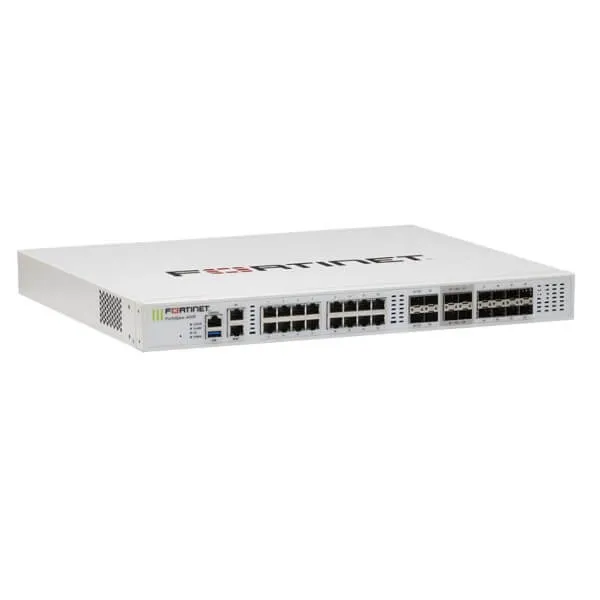
FortiGate 401F is the storage-equipped model in Fortinet’s 400F Series, built for organizations that need a high-capacity next-generation firewall, secure SD-WAN, IPsec VPN, application visibility and coordinated threat protection. The FG-401F combines a 1RU enterprise platform with 960 GB local storage, giving security teams a practical foundation for headquarters, campuses, data centers, regional hubs and demanding multi-site networks.
FortiGate 401F Overview and Verified Platform Facts
Fortinet positions FortiGate appliances as converged networking and security platforms running FortiOS and integrating with FortiGuard AI-powered security services and the broader Fortinet Security Fabric. For the 400F family, Fortinet’s published product information identifies the platform as an enterprise-class NGFW and secure networking appliance. The FG-401F is differentiated from the FG-400F by onboard storage: Fortinet’s product matrix lists 960 GB for the 401F. This distinction matters for organizations that want local capacity for logs and operational data while retaining the same family-level security and networking architecture.
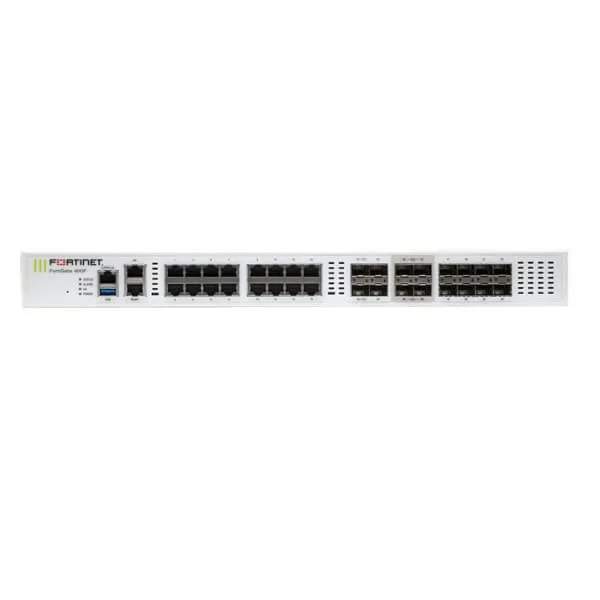
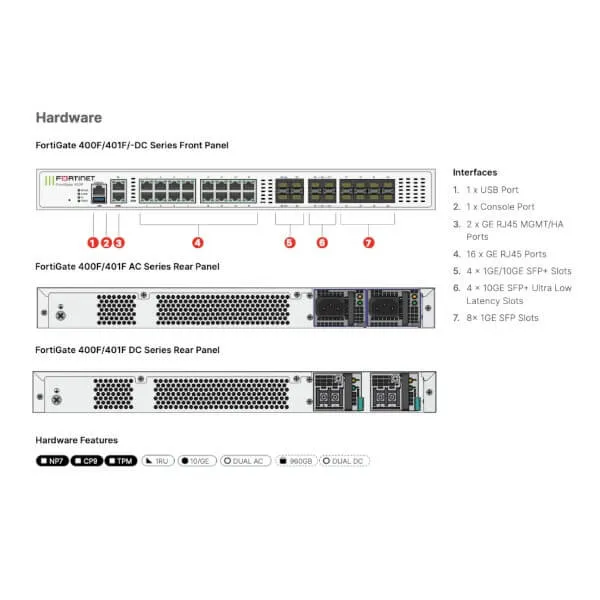
The 400F family provides a dense mix of copper and fiber connectivity intended for substantial network designs. Published Fortinet material identifies 18 GE RJ45 ports, 8 GE SFP ports and 8 10GE SFP+ interfaces for the family, alongside dedicated management and console connectivity. Exact port assignment, transceiver requirements and deployment topology should always be checked against the current Fortinet data sheet and the intended FortiOS release before purchase. Performance should also be sized against enabled security services, traffic mix, SSL inspection, logging, VPN usage and future growth rather than choosing a firewall from raw firewall throughput alone.
960 GB local storage on FG-401F, useful when the design benefits from onboard logging capacity.
Enterprise copper and fiber interface options support LAN, WAN, uplink, server and aggregation designs.
FortiOS combines firewalling, VPN, SD-WAN and security policy with optional FortiGuard services.
Suitable for designs requiring high-capacity edge security, segmentation, branch aggregation or data-center protection.
What the FG-401F Helps Organizations Solve
A large network firewall is not simply an internet gateway. In a well-planned architecture it becomes a policy enforcement point between users, servers, internet services, cloud applications, remote sites and sensitive network zones. The FortiGate 401F can support this role by combining routing and firewall policy with application control, intrusion prevention, VPN, secure SD-WAN and other FortiGuard-enabled controls. This consolidation can simplify architecture, but only when the appliance, subscriptions and policies are selected for the actual traffic profile.
For procurement teams, the most important question is therefore not “How fast is the firewall?” but “What security functions will be active at peak load?” A quotation request should document internet bandwidth, east-west traffic, number of users, VPN requirements, WAN circuits, expected SSL inspection, high-availability design, required interfaces, logging strategy and subscription term. FourTeck can use this information to help buyers define a cleaner bill of materials instead of treating the FG-401F as a standalone box.
Security, SD-WAN, VPN and Integration Planning
FortiGate combines networking and security through FortiOS. For multi-link sites, secure SD-WAN can be used to steer traffic according to policy and link health rather than relying on a simple primary/backup internet arrangement. Organizations considering two or more internet providers can review FourTeck’s Tanzania IT and network security solutions and discuss how WAN design, firewall policy and business applications should work together. For broader African deployments, FourTeck IT Solutions Africa provides related infrastructure context for multi-country projects.
VPN design is equally important. Site-to-site IPsec VPN can connect branches or partner networks, while remote-access requirements should be evaluated against the FortiOS version, authentication architecture and current Fortinet guidance. Enterprises may also integrate FortiGate with FortiManager for centralized management and with other Security Fabric components where required. A design review should include VLANs, routing, dynamic routing requirements, identity services, DNS, DHCP, high availability, switch and wireless integration, logging destinations, SIEM requirements and change-control processes.
Licensing and FortiGuard Subscription Guidance
The hardware platform provides the foundation, while FortiGuard security services and FortiCare support options determine which subscription-based protections and support entitlements are available. Buyers should avoid assuming that every advertised security capability is permanently included with appliance-only hardware. The correct bundle depends on the organization’s security policy, desired protection services, support expectations and subscription duration. When requesting pricing, specify whether the requirement is hardware only, a security bundle, a renewal, or a complete deployment with support.
For renewal planning, record the firewall serial information, existing contract details, required term and desired service level. Renewal should be planned before expiry so security operations do not depend on last-minute procurement. Organizations with multiple FortiGate devices should also maintain a simple asset register showing model, site, role, FortiOS version, subscription status, high-availability partner and change owner.
FortiGate 401F Tanzania
For Tanzania organizations, the FortiGate 401F is relevant where a network has moved beyond a small branch firewall and needs substantial capacity for secure internet access, internal segmentation, VPN connectivity and multi-site traffic. Typical evaluation environments include large corporate headquarters, financial and professional services networks, universities, hospitality groups, industrial organizations, data-center-connected businesses and institutions with many users or demanding applications. The FG-401F should be selected from measured requirements rather than from organization size alone. A business with fewer users but heavy server traffic, multiple 10GbE uplinks or extensive inspection can have a very different requirement from a larger office with lighter application usage.
Tanzania buyers should begin with the current and planned WAN design. Document every ISP circuit, expected bandwidth, public IP addressing, failover requirement and application dependency. If the organization uses cloud services, video collaboration, ERP, hosted voice or inter-branch applications, the firewall design should account for how those services behave when a circuit degrades or fails. Secure SD-WAN policies can help use multiple links intelligently, but they require sensible SLA measurements, route design and application-aware policy. The appliance should also be connected to resilient power and appropriate rack infrastructure, particularly where it protects business-critical services.
Security sizing should include encrypted traffic. Modern business traffic is heavily encrypted, and inspection can materially affect real-world throughput. Procurement teams should therefore provide a realistic estimate of traffic that will be inspected, the security profiles expected to run, and the growth horizon. High availability is another important question: if the firewall is a single point of failure for a major site, the project may require a second compatible unit and a carefully planned HA design. That decision affects budget, rack space, switching, cabling and operational procedures.
For a Tanzania quotation, provide the exact model FG-401F, quantity, subscription requirement, term, interface/transceiver needs, HA requirement, VPN scope, implementation expectations and any existing Fortinet environment. This makes it easier to compare proposals on the same basis and reduces the risk of buying hardware without the required services or accessories. The supplied FourTeck Tanzania security resources also cover FortiGate dual-WAN, VPN, FortiGuard renewal and enterprise security themes that can support the wider design conversation.
FortiGate 401F Dar es Salaam
Dar es Salaam organizations often operate network environments that combine headquarters users, internet-facing services, cloud applications, branch connectivity and third-party access. In this context, evaluating the FG-401F should start with traffic flows rather than a generic user count. Map the connections between office VLANs, server networks, guest access, voice systems, CCTV, wireless infrastructure, remote users and external services. The firewall can then be positioned to enforce meaningful zones instead of allowing a flat network to grow around it.
Businesses with multiple ISP links should decide whether the objective is simple resilience, active use of both circuits, application-specific steering or a combination of these. A FortiGate secure SD-WAN design can monitor link health and apply policy, but success depends on accurate thresholds and clear business priorities. Real-time voice and collaboration may need different path selection from backups or software updates. Public services may require separate inbound design and DNS considerations. These details should be captured before implementation.
For offices with significant fiber infrastructure, the 400F family’s mix of copper and SFP/SFP+ interfaces can support flexible aggregation, but optics and cabling must match the connected equipment. Buyers should list required media types and distances rather than assuming transceivers are included. If the FG-401F will connect to core switches, servers or upstream routers at higher speeds, confirm interface compatibility on both ends and preserve spare capacity for expansion.
Dar es Salaam procurement teams can make quotation comparison easier by requesting the same scope from every supplier: appliance, subscription bundle and term, support level, required transceivers, rack/power accessories, configuration scope, migration tasks, documentation and post-change validation. Avoid comparing a hardware-only quote with a security bundle as though they were equivalent. The goal is a complete operational solution that matches the network’s security and availability requirements.
FortiGate 401F Mwanza
Organizations evaluating the FortiGate 401F in Mwanza may be planning a regional hub, large office, campus, industrial site or centralized security gateway serving multiple smaller locations. The right architecture depends on whether traffic exits locally, returns to a central data center, or uses cloud applications directly. Before sizing the firewall, identify these patterns and estimate both normal and peak traffic. Include backup windows, software distribution, video, cloud synchronization and inter-site transfers, not just ordinary web browsing.
Where connectivity resilience is important, multiple WAN paths can reduce dependence on one circuit. The design should define which applications must remain available during failure and what reduced performance is acceptable. Secure SD-WAN can assist with path selection, while IPsec VPN can protect site-to-site connectivity across internet links. The project should also define how routes change during a failure and how administrators will monitor tunnel and link health.
The FG-401F’s onboard storage can be useful in environments that value local logging capacity, but retention objectives should still be planned. Security teams may need centralized analytics, SIEM integration or Fortinet management and logging products depending on compliance and operational needs. Local storage is not a substitute for a deliberate log-management policy. Decide which events must be retained, for how long, who reviews them and how incident data is protected.
A Mwanza request for quotation should state whether this is a new deployment, replacement or expansion. For a replacement, include the current firewall model, active services, WAN circuits, VPN tunnels, major policies and downtime constraints. For a new site, provide network diagrams, VLAN requirements and expected growth. These inputs allow a more accurate discussion of FG-401F suitability, licensing and implementation effort.
FortiGate 401F Arusha
Arusha businesses considering the FG-401F may include hospitality groups, corporate offices, institutions, service organizations and multi-site operations that need dependable security between users, guest networks, operational systems and the internet. Network segmentation is especially valuable when different groups of devices have different trust levels. Staff endpoints, visitor Wi-Fi, CCTV, building systems, payment environments and servers should not automatically share unrestricted access simply because they are in the same property.
A FortiGate design can use interfaces, VLANs and policy to create controlled zones, but segmentation should be driven by business workflows. Identify which systems actually need to communicate and on which services. This produces clearer rules and easier troubleshooting than a large collection of broad allow policies. Application control and security profiles can then be applied according to risk and operational need.
For organizations with remote sites or lodges, VPN and SD-WAN planning should include the quality and diversity of available connections. A branch with constrained bandwidth may require different routing and security policy from a headquarters link. The FG-401F may function as a central hub while smaller FortiGate models serve branches, subject to sizing and current compatibility. Centralized management can become increasingly valuable as the number of devices grows because it supports more consistent policy and change control.
Arusha procurement should include lifecycle planning. Confirm the desired FortiCare and FortiGuard term, the process for renewals, who owns firmware maintenance, and how configuration backups are protected. Also document the implementation acceptance criteria: internet access, critical applications, VPN tunnels, failover, logging, administrative access and security-policy validation. A firewall project is complete when these operational outcomes are tested, not merely when the appliance is mounted in a rack.
FortiGate 401F Dodoma
Dodoma organizations assessing the FortiGate 401F should consider governance, availability and documentation alongside technical capacity. Institutional and enterprise networks often have formal approval processes, multiple departments and sensitive systems. A strong firewall deployment begins with an agreed security policy describing network zones, administrative roles, permitted services, remote access and logging responsibilities. The device configuration should implement that policy rather than becoming the policy itself.
For environments with many departments or buildings, segmentation can limit unnecessary lateral communication and make access rules easier to audit. The FG-401F provides an enterprise platform for this kind of architecture, but the design should account for core-switch routing, VLAN ownership and whether traffic must traverse the firewall between internal zones. East-west inspection can create substantial load, so it belongs in the sizing calculation alongside internet traffic.
High availability deserves early consideration where the firewall protects critical public or internal services. An HA pair can reduce appliance-level single points of failure, but resilient design also requires redundant switching, power and upstream connectivity. Maintenance procedures should explain how firmware upgrades, failover tests and configuration changes are performed. Backup configurations should be stored securely and restoration procedures should be known before an incident.
For a Dodoma procurement package, include a clear statement of work and acceptance checklist. Specify whether migration from an existing firewall is included, how many VPNs and security zones are in scope, whether remote access is required, which FortiGuard services are expected, and whether administrators need knowledge transfer. This helps prevent ambiguity between hardware supply and a complete security deployment.
FortiGate 401F UAE
UAE buyers considering the FortiGate 401F typically need a clear enterprise bill of materials that separates appliance hardware, FortiGuard subscriptions, FortiCare support, optics and implementation services. The 401F’s 960 GB local storage differentiates it from the non-storage 400F model and should be selected deliberately when onboard storage is part of the operational requirement. Organizations should also check current Fortinet lifecycle information and supported FortiOS releases during procurement.
For high-bandwidth UAE office and data-center environments, raw internet speed is only one sizing input. Security inspection, internal segmentation, VPN, application mix and session behavior can determine real requirements. If 10GbE connectivity is planned, document each uplink, transceiver type and connected switch or router. If redundant firewalls are required, plan the adjacent network and power design so the HA pair does not simply move the single point of failure elsewhere.
Multi-site enterprises can combine the platform with Fortinet secure SD-WAN and centralized management strategies. The goal should be repeatable policy and predictable failover across branches, cloud connectivity and headquarters. For UAE-focused Fortinet information, buyers can also review FourTeck’s Fortinet UAE resource and use it as a regional starting point for broader Fortinet requirements.
When requesting a UAE quotation, identify the exact FG-401F requirement, quantity, security bundle, support term, HA requirement, optics and installation scope. Avoid assuming that a reseller’s displayed bundle is equivalent to another supplier’s offer; compare Fortinet service SKUs and terms line by line. This is particularly important for multi-year security projects where support and subscription components can represent a significant part of the solution.
FortiGate 401F Uganda
Uganda enterprises can evaluate the FG-401F as a central security platform for large offices, regional hubs, data-center edges and multi-branch networks. The first design task is to identify which traffic should be inspected centrally and which can exit directly from branches. Backhauling every application may simplify control but can increase bandwidth use and latency; direct internet access can improve efficiency but requires consistent security policy at the edge. Fortinet’s converged networking and security approach supports several architectures, so the topology should follow business requirements.
Where branches depend on multiple internet services, secure SD-WAN can evaluate link health and steer traffic according to policy. VPN encryption can protect traffic between sites over public networks. The central FG-401F must be sized for aggregate branch traffic, tunnel counts, inspection services and future expansion. Administrators should also consider centralized management as the estate grows.
Uganda procurement teams should ask for a complete description of included FortiGuard and FortiCare services. Hardware-only offers are not directly comparable with UTP or other security bundles. Confirm the subscription term and renewal path before purchase. If the firewall will replace an existing appliance, capture current policies and VPNs early so migration effort can be estimated.
For regional context, FourTeck Uganda can be referenced for Uganda-focused IT requirements. For a cross-border project, standardizing naming, policy templates, logging and change procedures across countries can make the FortiGate estate easier to operate and audit.
FortiGate 401F Kampala
Kampala headquarters and enterprise networks often combine large user populations, cloud applications, local servers, voice, wireless and branch VPN traffic. A FortiGate 401F evaluation should model these flows during busy periods. Security inspection is not uniform: some traffic may require deeper controls while trusted internal flows may have different policies. Build a traffic matrix that records source zone, destination, application, expected bandwidth and required security profile.
Internet resilience should be tested rather than assumed. If two circuits are available, define health checks that reflect actual application reachability, not merely whether a gateway responds. Establish which applications should move to the secondary path and whether inbound services require DNS or routing changes. These decisions belong in the deployment plan before cutover.
For remote-access security, organizations should align VPN and identity controls with current Fortinet recommendations and the selected FortiOS version. Administrative access should be restricted, logged and protected with strong authentication. Configuration backups and privileged accounts require the same governance attention as the firewall hardware itself.
A Kampala buyer can improve procurement accuracy by sharing a sanitized network diagram and requirement sheet with the supplier. Include WAN speeds, VLANs, core-switch interfaces, server networks, number of branches, VPN needs, security services and expected growth. This gives the supplier enough information to validate whether the FG-401F is appropriate and what licenses and accessories belong in the quotation.
FortiGate 401F Arua
For an Arua organization, an FG-401F project may be driven by the need to centralize security for a regional operation, consolidate several network functions or create a resilient hub for connected sites. The architecture should reflect the actual scale. If the site itself does not require an appliance of this capacity, the 401F may instead belong at a central location serving multiple remote networks. Right-sizing prevents unnecessary cost while preserving capacity where it is needed.
Connectivity quality can vary between locations, making WAN policy important. A branch architecture should distinguish critical applications from bulk traffic and establish clear failover behavior. IPsec VPN can secure inter-site communication, while SD-WAN policies can select paths based on defined conditions. The design should also consider what happens when all primary links fail and which operations must continue locally.
Operational simplicity is another buying criterion. A technically capable firewall can still become difficult to maintain if rules are undocumented, objects are inconsistently named and changes are made without review. Use structured naming for addresses, services, VPNs and policies, and maintain a change record. Centralized management can be considered where multiple FortiGate appliances are deployed.
Arua procurement requests should separate hardware, licensing and services. Specify whether the supplier is expected only to provide equipment or also to configure, migrate, test and document the system. This distinction helps buyers compare quotations fairly and makes responsibility clear during implementation.
FortiGate 401F Mbarara
Mbarara organizations planning network growth can use an FG-401F evaluation to review the wider security architecture rather than simply replacing an old firewall port for port. Start by identifying business systems, network zones and trust relationships. Legacy configurations often contain rules that are no longer required; migration is an opportunity to validate them rather than copying years of accumulated policy into a new platform.
If the firewall will protect server workloads, account for east-west traffic and backup flows. If it primarily protects internet access, focus on peak WAN use, security inspection and sessions. If it is a VPN hub, include aggregate encrypted traffic and branch growth. These scenarios place different demands on the same appliance, which is why a single headline throughput figure is not a complete sizing method.
The FG-401F’s local storage can support logging needs, but organizations should define whether centralized log retention or analytics is required. Incident investigation benefits from consistent timestamps, adequate retention and protected records. Establish who reviews security events and how alerts are escalated rather than collecting logs without an operational process.
For quotation preparation in Mbarara, include required security services, desired contract term, HA expectations, rack and power details, interface media and implementation scope. If existing Fortinet equipment is present, identify it so integration and centralized management options can be assessed. Clear inputs produce a more useful technical and commercial proposal.
FortiGate 401F Gulu
Gulu buyers considering the FortiGate 401F should determine whether the appliance will operate as a local enterprise edge, a regional aggregation point or part of a broader multi-site security architecture. This role determines how much WAN, VPN and internal traffic the device must process. It also affects the required interfaces, routing design and resilience strategy.
For distributed organizations, branch continuity should be designed explicitly. Identify applications that can continue locally if a central tunnel is unavailable, applications that require the data center, and services that can use direct internet access. Secure SD-WAN and VPN capabilities can support flexible architectures, but the policy should be tested under failure conditions before the deployment is considered complete.
Security services should be selected according to risk rather than enabled without planning. Intrusion prevention, application control, malware protection and web controls can contribute to layered defense, while encrypted traffic inspection may be important for visibility. Each control has operational and performance implications, so policies should be introduced with testing and exception handling.
Gulu procurement teams should request documentation as part of deployment services where needed. A useful handover includes network diagrams, interface assignments, routing, VPN definitions, HA status, administrative access procedures, backup instructions and subscription information. Documentation reduces dependence on individual engineers and makes future troubleshooting more efficient.
FortiGate 401F Kenya
Kenya enterprises looking at the FortiGate 401F may be consolidating high-speed internet, data-center connectivity, branch VPN and security inspection on one platform. The 400F family’s enterprise interfaces make it relevant to environments where copper and fiber connections coexist. Before procurement, map every physical connection and determine which ports require specific optics, link aggregation or redundancy.
For multi-branch networks, centralized policy can reduce configuration drift. Secure SD-WAN can support multiple WAN services while FortiManager can be considered for managing FortiGate estates. The architecture should define templates, local exceptions, change approval and monitoring responsibilities. This operational model is as important as the initial hardware choice when dozens of sites are involved.
Security subscription selection should align with the organization’s threat model and compliance requirements. Request exact Fortinet service SKUs and terms in the commercial proposal so renewal planning is straightforward. For cross-border East African operations, align subscription dates where practical to simplify annual budgeting and asset management.
Kenya-focused procurement and infrastructure requirements can also be explored through FourTeck Kenya. For a regional deployment spanning Kenya and Tanzania, use common configuration standards but allow site-specific routing, ISP and application requirements to remain explicit.
FortiGate 401F Kuwait
Kuwait organizations evaluating the FG-401F should focus on the complete security lifecycle: specification, licensing, deployment, monitoring, renewal and replacement planning. The appliance is one part of that lifecycle. Define which FortiGuard services are required and which support entitlement matches the organization’s operational expectations. Record these choices in the procurement documents so hardware-only and bundled offers are not confused.
High-speed enterprise networks should model encrypted traffic and security inspection carefully. If the firewall connects to 10GbE infrastructure, confirm optics, cabling and upstream switch compatibility. Where HA is required, verify that both units, links and power paths are designed to preserve service during maintenance or failure. A redundant pair connected through a single switch or single power source still contains avoidable risk.
Kuwait deployments with branches can use VPN and SD-WAN strategies to create resilient connectivity. Establish application priorities and link-health thresholds before deployment, then test failover with real business services. Monitoring should report both link state and application experience so administrators can distinguish an available circuit from a usable circuit.
For regional FourTeck information, see FourTeck Kuwait IT and network security solutions. A quotation request should include FG-401F quantity, subscription term, HA requirement, optics, VPN scope, migration services and documentation needs.
FortiGate 401F Ghana
Ghana businesses considering the FortiGate 401F should start with a capacity and architecture review. A headquarters firewall may carry internet access, site-to-site VPN, remote access, cloud traffic, server publishing and internal segmentation simultaneously. Each workload contributes to the sizing requirement. Collect utilization data from the current network where possible and include planned growth rather than basing the decision on today’s average traffic.
Security policy should separate user groups and systems according to business need. Sensitive servers, administrative networks, guest Wi-Fi, CCTV and ordinary users may require different access controls. The FortiGate platform can enforce segmentation, but the organization must define the intended trust model. Clear zone design produces simpler rules and more meaningful logs.
If multiple WAN services are available, define whether the second link is for backup, active traffic distribution or selected applications. Secure SD-WAN can implement policy-based path selection, while IPsec VPN can maintain protected connectivity between sites. Test how routes, DNS and cloud sessions behave when links change.
Ghana procurement should request exact subscription details and implementation scope. Include the desired FortiCare level, FortiGuard bundle, term, optics, HA design and migration requirements. Where the project spans several African countries, consistent documentation and asset tracking can reduce long-term operational complexity.
FortiGate 401F Nigeria
Nigeria enterprise networks can place significant demands on a central firewall through high user counts, cloud adoption, multiple branches, data-center traffic and diverse WAN connectivity. An FG-401F assessment should therefore distinguish north-south internet traffic from east-west internal traffic and encrypted VPN traffic. The security services applied to each path affect real-world capacity and should be part of the sizing model.
Large distributed networks benefit from standardized policy and management. If many FortiGate devices are used, consider how configuration templates, firmware, logging and change control will be coordinated. The central appliance can function as a VPN and policy hub, but hub capacity must include aggregate branch demand and failure scenarios in which traffic shifts between links or sites.
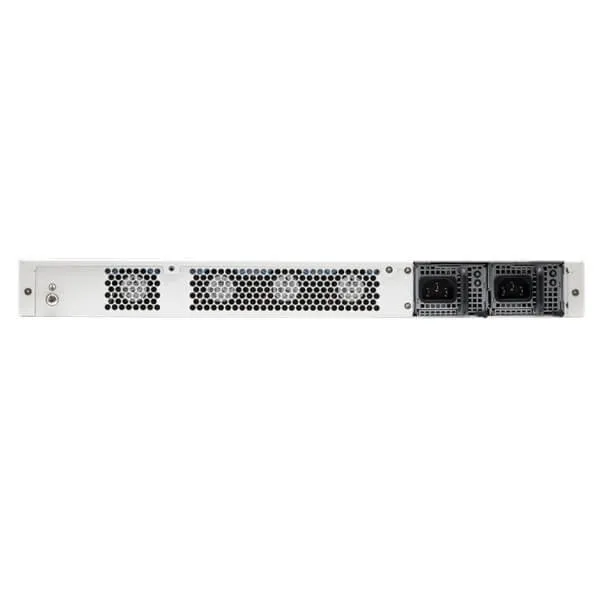
Power and physical infrastructure should not be overlooked. Enterprise firewalls should be installed in suitable racks with stable power, environmental control and protected management access. Redundant architecture should include the surrounding network rather than only duplicating the firewall. Maintenance windows and rollback procedures should be documented before major changes.
Nigeria buyers should ask suppliers to itemize the appliance, security subscription, FortiCare, optics and professional services. This makes commercial comparison clearer and simplifies renewals. A complete requirement should also state the number of WAN links, VPN sites, security zones, expected inspected bandwidth and desired support model.
FortiGate 401F Seychelles
Seychelles organizations evaluating the FortiGate 401F may prioritize reliable connectivity, secure remote administration and resilient access to cloud or off-island services. The appliance should be sized against the site’s actual WAN capacity, internal traffic and security requirements. Where the 401F exceeds a single site’s needs, it may be more appropriate as a central platform for a larger group or data-center-connected environment.
WAN resilience should be designed around available connectivity options and business-critical applications. If multiple paths exist, secure SD-WAN can apply link-health and application policy. Site-to-site VPN can protect communications to remote offices or hosted resources. Administrators should test failover and recovery because application sessions, DNS and routing can behave differently when paths change.
Remote management deserves strict controls. Limit administrative interfaces to trusted networks, use strong authentication, log privileged activity and keep configuration backups protected. Firmware maintenance should follow supported Fortinet guidance and be scheduled with a rollback plan. Subscription renewals should be tracked well before expiry.
For a Seychelles quotation, provide the exact model, quantity, FortiGuard/FortiCare requirement, desired term, WAN interfaces, transceivers, HA requirement and implementation scope. If equipment must integrate with existing switches, access points or management platforms, list current models and software versions so compatibility can be reviewed rather than assumed.
Related Security and Infrastructure Planning
A FortiGate deployment works best when adjacent systems are planned with it. Switching must support the required VLAN and uplink design; wireless networks need clear staff and guest segmentation; servers and storage need appropriate protected zones; and remote sites need consistent routing and VPN standards. FourTeck’s regional resources can help buyers frame the firewall as part of a wider infrastructure project rather than an isolated appliance.
FortiGate 401F Buying and Sizing Checklist
Record peak WAN traffic, internal routed traffic, branch aggregation, user count, sessions and expected growth.
List IPS, application control, malware protection, web controls and encrypted traffic inspection requirements.
Document WAN links, copper/fiber interfaces, optics, switch uplinks, routing and public services.
Decide whether HA, dual WAN, redundant switching and redundant power paths are required.
Specify FortiGuard services, FortiCare level, subscription term and renewal ownership.
Define configuration, migration, testing, documentation, knowledge transfer and ongoing support scope.
Frequently Asked Questions
What is the difference between FortiGate 400F and FortiGate 401F?
The key model distinction documented by Fortinet is local storage. The FG-401F includes 960 GB local storage, while the FG-400F is the corresponding model without that listed onboard storage. Confirm current specifications before ordering.
Is the FG-401F suitable for a data center?
It can be relevant to data-center edge and enterprise segmentation designs, but suitability depends on inspected traffic, interfaces, redundancy, session behavior, VPN load and growth. A technical sizing exercise is required.
Does FortiGate 401F support secure SD-WAN?
FortiGate integrates secure SD-WAN capabilities through FortiOS. Deployment should define WAN health checks, application priorities, failover behavior and routing before implementation.
Do I need a FortiGuard subscription?
The appliance can provide core platform functions, while many advanced security services and support entitlements depend on the selected FortiGuard and FortiCare offerings. Choose a bundle based on the required protection and support scope.
Can the FG-401F be deployed as a high-availability pair?
FortiGate platforms support high-availability designs. The complete architecture should also account for redundant switching, WAN paths and power so other single points of failure are not left in place.
What information is needed for a FortiGate 401F quote?
Provide model and quantity, subscription bundle and term, support requirement, HA needs, WAN bandwidth, required optics, VPN scope, migration/configuration services and target deployment timeline.
Decision Recap: Is FG-401F the Right Platform?
Choose the FortiGate 401F for evaluation when the project needs an enterprise 400F-family firewall with 960 GB local storage and substantial connectivity for a high-capacity security design. Do not choose it solely because a headline throughput number looks large. Validate the design against enabled security services, encrypted traffic, VPN, internal segmentation, interfaces, high availability and the expected growth period.
For procurement, request an itemized proposal that clearly identifies hardware, FortiGuard, FortiCare, optics and professional services. This makes the offer easier to validate, compare and renew.
Prepare Your FortiGate 401F Consultation
Send the planned site, WAN speeds, user count, major applications, VPN sites, current firewall model, required security services, HA requirement and preferred subscription term. If available, include a sanitized network diagram. FourTeck can use these details to structure the product and licensing discussion around the actual deployment rather than a generic appliance quotation.



Reviews
There are no reviews yet.