
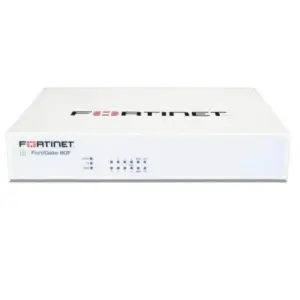
FortiGate 4400F Series Tanzania
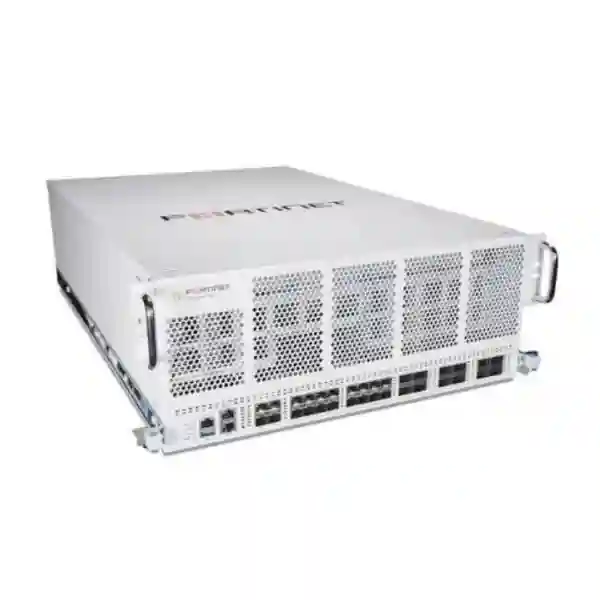
FortiGate 4400F Series is designed for organizations that need very high firewall capacity, deep security inspection and dense high-speed connectivity at enterprise edges, data centers and large internal network boundaries. Fortinet positions the platform for high-performance secure networking with FortiOS, FortiGuard security services and purpose-built security processors. For Tanzania buyers, the important purchasing question is not simply whether the appliance is powerful; it is whether the selected 4400F configuration, subscriptions, optics, high-availability design and deployment scope match the actual traffic profile and security policy.
What the FortiGate 4400F Series is built to solve
Large networks rarely have a single security bottleneck. Internet edge traffic, east-west data-center flows, encrypted applications, remote connectivity, branch aggregation, cloud access and internal segmentation can all compete for inspection capacity. The FortiGate 4400F Series addresses this class of problem with a high-end architecture intended for large enterprises and service providers. It is particularly relevant when a security design requires high throughput while retaining next-generation firewall controls rather than treating inspection as an optional secondary layer.
Fortinet documents 94 Gbps IPS throughput, 82 Gbps NGFW throughput and 75 Gbps threat-protection throughput for the series. These published figures are useful sizing references, but a procurement decision should also consider the enabled security profiles, traffic mix, packet size, SSL/TLS inspection policy, logging requirements, VPN load, session behavior and growth margin. Production performance is therefore a design exercise rather than a single datasheet-number comparison.
The platform runs FortiOS and can participate in the broader Fortinet Security Fabric. That creates a path for organizations that want firewall policy, routing, SD-WAN, VPN, segmentation and security-service integration within one operational environment. Teams planning a new deployment should document existing VLANs, routing protocols, public IP addressing, NAT rules, critical applications, maintenance windows and rollback requirements before migration begins.
Enterprise Edge
Use the 4400F where large internet, WAN or partner-facing connections require substantial firewall and inspection headroom, resilient design and high-speed interfaces.
Data Center
High port density and 100GbE-class connectivity make the series relevant to data-center edge and core security designs where large traffic volumes cross trust boundaries.
Internal Segmentation
Organizations can place security controls between major network zones to reduce unrestricted lateral movement and apply policy closer to critical systems.
Service Provider Scale
The platform is positioned for environments with high connection rates, large session requirements and demanding multi-tenant or carrier-oriented security use cases.
FortiGate 4400F Series verified technical highlights
| Area | Published Fortinet detail | Planning relevance |
|---|---|---|
| IPS throughput | 94 Gbps | Reference capacity for intrusion-prevention workloads. |
| NGFW throughput | 82 Gbps | Useful when sizing application control plus IPS-oriented policy. |
| Threat protection | 75 Gbps | Important for security-service-heavy perimeter designs. |
| Processing | Six NP7 processors documented for 4400F/4401F | Purpose-built acceleration supports high-throughput networking workloads. |
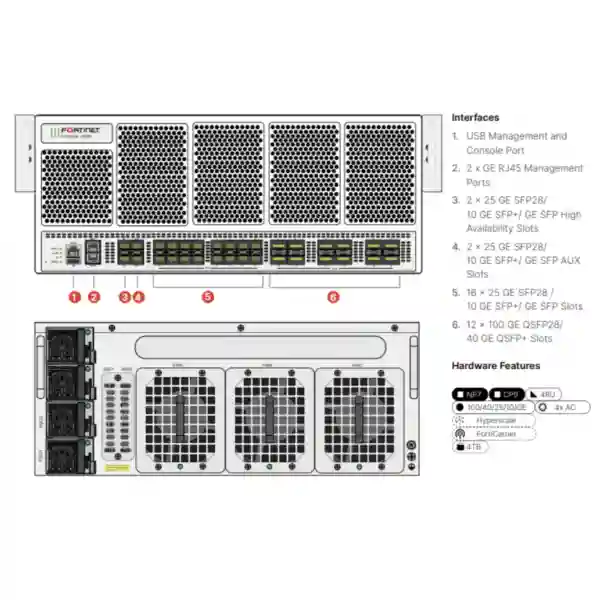
| Data interfaces | 16 x 25/10/1GbE SFP28 data ports plus 12 x 100/40GbE QSFP28 data ports; dedicated management/HA/AUX interfaces also documented | Supports high-speed aggregation, redundant uplinks and data-center connectivity planning. |
| Platform | FortiOS with FortiGuard and Security Fabric integration | Allows security and networking functions to be designed in a unified Fortinet environment. |
Published performance values are vendor reference figures. Real deployment results depend on configuration, traffic characteristics, FortiOS version and enabled services. Confirm current datasheet, support status and exact bill of materials before purchase.
Security, networking and operations
FortiGate 4400F combines next-generation firewall policy with Fortinet secure-networking capabilities. In practical enterprise architecture, this can reduce the need to treat routing, WAN path selection and security inspection as unrelated projects. Security teams can define application-aware controls while network teams design resilient paths, segmentation and VPN connectivity on the same platform. This convergence is especially useful when an organization wants consistent policy at the internet edge, data-center boundary and selected internal zones.
FortiGuard services can add threat intelligence and security capabilities according to the subscription selected. Procurement teams should avoid ordering a high-end appliance without mapping subscriptions to required controls. A quote should identify the appliance model, support term, FortiGuard bundle or individual services, required transceivers, power requirements, high-availability quantity, centralized management or logging requirements and professional-service scope. Renewal ownership should be assigned before deployment so security services do not become an afterthought.
Operational design matters as much as initial installation. Administrators should plan role-based access, configuration backup, change control, logging, alerting, firmware lifecycle, HA testing, interface labeling and documented recovery procedures. A high-capacity firewall can become a critical dependency, so monitoring and maintenance processes should reflect its role in the business.
Sizing the FortiGate 4400F correctly
A firewall should be sized against inspected traffic rather than raw internet bandwidth alone. Begin with peak and expected three-to-five-year traffic, then identify how much traffic will use IPS, application control, malware protection, web controls and SSL inspection. Add site-to-site and remote-access VPN requirements, expected concurrent sessions, connection bursts, east-west traffic, data-center uplinks and planned segmentation. The design should retain sensible headroom for failures, maintenance, new applications and future growth.
Interface planning is equally important. The 4400F family offers high-speed SFP28 and QSFP28 connectivity, but the correct optics and cabling depend on the switches, routers, distances and media already deployed. Confirm transceiver compatibility, breakout requirements, port-speed grouping behavior, LACP design and redundancy before the bill of materials is approved. For HA, document independent power feeds, upstream/downstream redundancy and heartbeat topology rather than assuming a second firewall alone creates resilience.
For migrations, collect the existing firewall configuration and translate policy intent rather than copying years of accumulated rules blindly. Identify unused objects, expired NAT rules, shadowed policies, legacy VPNs and overly broad access. A migration is an opportunity to improve segmentation and documentation while preserving business-critical connectivity.
FortiGate 4400F licensing and subscription planning
The appliance and its security services should be planned together. FortiGuard service selection influences the protection capabilities available to the deployment, while FortiCare supports the product lifecycle according to the purchased service level. Exact bundle names and entitlements can change over time, so the quotation should use current Fortinet ordering information rather than an old project list.
Before requesting pricing, state whether the project is a new deployment, renewal, HA expansion, hardware refresh or migration. Include the desired term, security-service requirements and centralized management/logging environment. This allows the commercial proposal to be compared on equivalent scope rather than hardware price alone.
FortiGate 4400F Series Tanzania
For Tanzania enterprises, the FortiGate 4400F Series is most relevant where network security has moved beyond branch-firewall scale. Examples include major corporate headquarters, financial and digital-service environments, large campuses, data centers, telecom-facing infrastructure, government-scale networks, hosting platforms and organizations aggregating many remote sites. These environments commonly need high-speed interfaces, strong segmentation and enough inspection capacity to enforce security controls without designing the perimeter around a low firewall ceiling.
A Tanzania procurement exercise should begin with an architecture brief. Record ISP bandwidth, private WAN capacity, data-center switching speeds, internet exchange or upstream connectivity where applicable, number of protected zones, VPN requirements, critical public services, cloud connectivity and business continuity expectations. Then map the security policy: IPS, application control, encrypted-traffic inspection, web security, malware controls, DNS-related protection, remote access and logging. This creates a realistic basis for deciding whether the 4400F class is appropriate and which subscriptions belong in the quote.
Power and rack planning also deserve attention. High-end security appliances should be treated as core infrastructure. Confirm rack space, cooling, redundant power paths, UPS/generator strategy, cable management and service access. Where the firewall protects a data center or essential digital service, design HA with upstream and downstream redundancy and test failover as an operational process, not only during installation.
FourTeck can assist with requirement capture, quotation preparation, licensing discussions, interface planning and deployment scope. Buyers should share enough technical detail to avoid receiving a generic hardware-only proposal. For wider Fortinet project context, review FourTeck’s Fortinet product portfolio, which helps procurement teams understand related firewall and security-platform options.
FortiGate 4400F Series Dar es Salaam
Dar es Salaam organizations often concentrate headquarters users, internet-facing applications, private connectivity, cloud access and data-center resources into the same metropolitan network. In that type of environment, the firewall is not merely an internet gateway; it can become a policy boundary between public services, corporate users, server networks, partner connections and remote locations. FortiGate 4400F provides the performance class and interface density suited to designs where these traffic domains must remain secure at substantial scale.
Before selecting the platform for a Dar es Salaam deployment, measure peak traffic across all protected paths. A business may have multiple ISPs, MPLS or carrier Ethernet, SD-WAN links, cloud VPNs and data-center interconnects. Adding those headline bandwidths is not enough. Determine which flows will be inspected, which need low latency, which are encrypted and which must survive a link or appliance failure. This helps engineers select interfaces and security profiles with realistic headroom.
Procurement teams should request a complete bill of materials that separates appliance, support, FortiGuard services, optics and professional services. If two units are required for HA, confirm the design and licensing scope for both. If the firewall connects to 100GbE switching, identify the exact QSFP28 media and whether breakout is required. If 25GbE connections are used, check port grouping and switch-side compatibility before installation day.
Dar es Salaam buyers planning an enterprise firewall refresh should also define migration acceptance tests: internet access, published applications, NAT, site-to-site VPNs, remote access, routing convergence, logging, failover and critical application reachability. Clear tests reduce risk and give both IT and management a measurable completion standard.
FortiGate 4400F Series Mwanza
Mwanza enterprises evaluating the FortiGate 4400F Series may be supporting regional operations, large institutional networks, logistics, financial services, industrial environments or a central site that aggregates many smaller locations. In such projects, the key question is whether the firewall must protect only local internet access or act as a high-capacity hub for branch VPN, SD-WAN, private WAN and data-center traffic. The latter scenario places much greater importance on session scale, encrypted traffic, routing and resilience.
For a hub design, document every remote location and its expected bandwidth, critical applications and failover method. The central firewall should be sized for normal traffic plus realistic failure scenarios. If one WAN path fails and traffic shifts to another, the security appliance still needs to process the resulting load. The same principle applies to maintenance: capacity planning should not assume that every component is always available.
Organizations with server workloads should define internal security zones around sensitive applications, management networks, user segments, backup systems and externally published services. FortiGate policy can then be built around business communication requirements rather than a flat network. Logging and monitoring should be included in the design so administrators can investigate denied traffic, anomalous sessions and policy changes.
When requesting a Mwanza quotation, include current firewall model, target bandwidth, number of sites, VPN requirements, high-availability requirement, preferred subscription term, interface speeds and any centralized Fortinet management already in use. This information allows a proposal to address the whole deployment instead of treating the 4400F as an isolated chassis.
FortiGate 4400F Series Arusha
Arusha organizations with multi-site operations, hospitality groups, institutions, large offices and regional service environments may need a security architecture that connects branches while maintaining strong control at the central edge. The FortiGate 4400F Series belongs to a high-end class, so it should be considered when traffic aggregation and inspection requirements justify enterprise-scale capacity rather than simply because a larger model appears safer.
A useful Arusha design exercise separates user internet traffic, business applications, guest services, voice/video, site-to-site traffic, public servers and management access. Each category can have different security and quality requirements. If SD-WAN is part of the architecture, define link health metrics and application steering objectives. If VPN is critical, define encryption requirements and the number of remote networks or users. If SSL inspection is required, assess certificate deployment and application exceptions before rollout.
For organizations operating remote sites, centralized policy can improve consistency, but governance is essential. Establish who can approve firewall changes, how emergency rules are documented, how configurations are backed up and how firmware is tested. High-end infrastructure deserves disciplined operations because an incorrect policy can affect a large part of the organization quickly.
Arusha procurement teams should request current Fortinet support and subscription options and avoid assuming that an older bill of materials remains valid. Share the deployment objectives with the supplier so the quotation includes appropriate optics, services and support terms. If the organization is comparing broader East African deployment approaches, the FourTeck FortiGate Kenya guide provides related regional firewall-selection context.
FortiGate 4400F Series Dodoma
Dodoma deployments can include public-sector, institutional, education, financial and large enterprise networks where availability, segmentation and policy governance are central requirements. A FortiGate 4400F project should therefore start with information classification and network boundaries: which systems are public, which are internal, which contain sensitive data, which partners need access and which administrators require privileged management paths.
The 4400F platform offers substantial inspection capacity, but good architecture still requires least-privilege policy and controlled change. Define zones for users, servers, management, external services and inter-site connectivity. Where possible, avoid broad any-to-any rules that undermine the purpose of segmentation. Use logging to create an evidence trail for troubleshooting and security review, and establish retention requirements based on organizational policy.
Business continuity should be designed from end to end. Two firewalls in HA do not protect against every failure if both rely on the same upstream switch, power source or carrier path. Map redundant power, switching, routing and ISP connectivity. Test failover during a controlled window and record expected convergence behavior for important applications and VPNs.
For quotation preparation in Dodoma, provide network diagrams where possible, current and projected bandwidth, number of protected networks, public IP/NAT requirements, remote sites, support term and required security services. This allows technical and commercial teams to identify dependencies before procurement approval and makes later implementation more predictable.
FortiGate 4400F Series UAE
UAE buyers commonly evaluate high-end FortiGate platforms for enterprise headquarters, data centers, service providers, cloud-connected networks and large distributed organizations. The FortiGate 4400F Series fits projects where 25GbE and 100GbE connectivity, high inspection throughput and large-scale segmentation are important. A UAE procurement team should compare the design requirement with current Fortinet high-end models rather than selecting on firewall throughput alone.
For data-center deployments, confirm the switching topology and optics before ordering. The firewall may sit between internet routers and core switches, between security zones, or in a services layer. Each placement changes the traffic pattern and failure domain. Engineers should model north-south and east-west traffic separately, then decide which flows need full security inspection. This prevents over-simplified sizing based only on WAN bandwidth.
UAE projects may also serve regional networks extending into Africa or the GCC. In that case, the 4400F can be evaluated as a central VPN or SD-WAN hub, but tunnel count, aggregate encrypted throughput, routing design and operational ownership should be documented. Centralized logging and management can help teams maintain policy consistency across distributed FortiGate environments.
For UAE-specific product research and related enterprise Fortinet options, visit FourTeck’s Fortinet NGFW appliance guide for UAE. It provides a broader model-selection context for organizations comparing firewall classes before requesting a final bill of materials.
FortiGate 4400F Series Uganda
Uganda organizations considering a FortiGate 4400F are likely dealing with enterprise-scale requirements: large headquarters, central data centers, multi-branch aggregation, high-speed internet edges or service-provider infrastructure. The model is far beyond typical small-office needs, so requirement validation is essential. A properly scoped project should document traffic, inspection features, high availability, interface speeds, subscriptions and support before pricing is compared.
For multi-branch networks, model the central site as a shared dependency. If dozens of locations connect through IPsec VPN or SD-WAN, estimate aggregate traffic during normal operation and link-failure events. Determine whether branch internet traffic breaks out locally or traverses the central firewall. This has a direct effect on sizing and bandwidth planning. Critical branches may also require redundant tunnels and diverse connectivity.
Security teams should define segmentation between users, servers, payment or financial systems, management networks, guest access and public services. The FortiGate can enforce policy between these zones, but the design should be based on required communication flows. Logging, administrator authentication, configuration backups and change approvals should be incorporated into the operational plan from the beginning.
For a broader view of Fortinet deployment options in the country, the FourTeck Uganda Fortinet product content illustrates the wider FortiGate/FortiWiFi ecosystem and regional procurement considerations, while enterprise buyers can request a separately sized high-end solution.
FortiGate 4400F Series Kampala
Kampala is a natural concentration point for corporate headquarters, financial organizations, technology operations and large institutions. When those environments consolidate internet access, application hosting, branch connectivity and partner networks, the firewall may need to inspect very large volumes of traffic while preserving predictable application performance. FortiGate 4400F is designed for this high-end security tier.
A Kampala deployment should start with traffic baselining. Collect interface utilization, session counts, application mix and growth trends from the existing environment. Identify traffic that will require IPS, application control and encrypted inspection. Document public services and NAT dependencies, because these often create migration risk. For VPN hubs, inventory tunnels, peer addressing, routing and encryption settings before cutover.
High availability should include a written failure matrix. Consider loss of a firewall, power feed, switch, ISP circuit and routing peer. Define what should happen in each case and how administrators will verify recovery. For critical sites, maintenance procedures should specify how upgrades are performed and how rollback occurs if a new FortiOS release creates an unexpected issue.
Commercial evaluation should compare equivalent configurations. One quote may include a broader FortiGuard bundle or longer support term than another. Normalize hardware, subscriptions, support, optics, installation, migration and training scope before comparing totals. This produces a more meaningful procurement decision than focusing on the appliance line item.
FortiGate 4400F Series Arua
Arua organizations may encounter a different architecture question from a capital-city data center: should high-end security be placed locally or centralized at a national or regional hub? The answer depends on local bandwidth, business criticality, application hosting, user scale and resilience requirements. FortiGate 4400F should be selected only where local or aggregated traffic justifies its enterprise performance class.
If Arua is a major regional hub, document every downstream site and service. Consider whether local applications need protection even when connectivity to a central data center is unavailable. If internet access is local, determine which security policies must remain enforced during WAN failures. If traffic is backhauled, make sure central links and firewalls have sufficient capacity for the aggregate load.
Physical deployment planning should cover stable power, UPS capacity, cooling, secure rack access and redundant connectivity. High-end network equipment should not be treated as a desktop appliance; environmental and power design directly influence service reliability. Remote management access should be protected and separated from ordinary user traffic where practical.
A useful quotation request includes the reason for choosing the 4400F class, current network diagram, bandwidth, expected growth, interface media, required security services, HA requirement and deployment responsibilities. If those inputs are not yet known, a discovery phase is more valuable than prematurely locking a model into the project.
FortiGate 4400F Series Mbarara
Mbarara enterprises planning regional expansion can use firewall architecture as a foundation for secure growth. A central security platform may need to support additional branches, cloud services, remote users and data-center workloads over several years. FortiGate 4400F offers substantial performance headroom, but the design should still be tied to measurable business growth rather than oversized without purpose.
Start with application dependency mapping. Identify which services users access locally, across private WAN links, over the internet and through VPN. Define which applications are latency-sensitive and which contain sensitive data. Then map security inspection and segmentation to those flows. This produces a firewall policy architecture that supports the business rather than merely filtering ports.
Where multiple carriers are available, SD-WAN can be evaluated for path selection and resilience. Define performance thresholds and failover objectives for business-critical traffic. For site-to-site VPN, establish consistent addressing and routing standards so future branches can be added without overlapping networks or ad-hoc exceptions. Central management becomes increasingly useful as the Fortinet estate grows.
For Mbarara procurement, request an itemized proposal and confirm the current lifecycle and support information for every component. Include implementation tasks such as configuration migration, testing, documentation and administrator handover. A clear scope reduces the risk that essential deployment work is discovered only after hardware arrives.
FortiGate 4400F Series Gulu
Gulu projects may involve institutional networks, regional service organizations, large commercial operations or connectivity hubs. When evaluating a FortiGate 4400F, first determine whether the site is a true high-capacity aggregation point. If the primary requirement is branch-office protection, a smaller FortiGate class may be more appropriate. If the site aggregates many networks or protects a data center, the 4400F becomes a more relevant candidate.
For an aggregation site, calculate traffic from branch connections, local users, internet services and server networks separately. Consider backup paths and disaster-recovery traffic, which can create temporary peaks much larger than normal daily usage. Define which traffic needs deep inspection and whether encrypted traffic inspection is planned. These choices influence real security throughput requirements.
Network teams should also plan addressing, dynamic routing, VLANs, link aggregation and interface redundancy before firewall configuration begins. Security teams should define policies and logging. Treat these as one coordinated design because routing and security changes affect each other during migration. A staged cutover can reduce risk where the existing environment is complex.
Gulu buyers should ask for current support and licensing terms and verify that optics and accessories are included where required. A complete project proposal should identify who supplies configuration, testing, documentation and post-cutover support. This is especially important when the firewall sits at a regional hub with many dependent users.
FortiGate 4400F Series Kenya
Kenya has enterprise, data-center, financial, cloud, telecom and regional headquarters environments where a high-end firewall can be justified by substantial traffic and security requirements. FortiGate 4400F is suited to evaluation when organizations need large-scale inspection, high-speed interfaces and the ability to enforce policy across major trust boundaries. It can also be considered for central hubs serving East African branch networks.
For a Nairobi or national data-center project, map 25GbE and 100GbE switching connections, internet/transit links, private WAN, cloud on-ramps and disaster-recovery connectivity. Determine whether the firewall is inline for all data-center traffic or only selected zones. This prevents the design from confusing total switch fabric capacity with traffic that actually crosses the security boundary.
Organizations serving multiple countries should plan routing and VPN standards centrally. Consistent address allocation, tunnel templates, security profiles and logging reduce operational complexity. Where different local teams administer firewalls, define role-based permissions and change-control procedures. Centralized visibility can help detect configuration drift and simplify incident investigation.
FourTeck’s FortiGate Kenya product category provides additional context on the wider Fortinet firewall family. Enterprise buyers should still size the 4400F against their exact inspected-throughput, port, session, VPN and redundancy requirements rather than extrapolating from smaller models.
FortiGate 4400F Series Kuwait
Kuwait enterprises and data-center operators evaluating FortiGate 4400F may be supporting high-bandwidth internet edges, critical applications, distributed sites or security segmentation between major network zones. The platform’s high-end throughput and 100GbE-class connectivity make it relevant where conventional branch firewalls would create a performance or interface bottleneck.
Data-center architecture should identify north-south and east-west security requirements. Some organizations need firewall inspection primarily between internet and servers; others also need controls between production, development, management, backup and user environments. Each additional inspection path changes the traffic profile. Use actual telemetry where possible rather than estimating solely from switch port speeds.
For encrypted traffic, define what will be inspected and which applications require exceptions. Certificate management, privacy requirements and application compatibility should be tested before broad SSL inspection is enabled. For VPN and remote connectivity, identify authentication, routing and redundancy requirements. For high availability, validate power and switching diversity in addition to appliance pairing.
Kuwait procurement teams should compare current Fortinet subscription options, support levels and lifecycle information at quotation time. The commercial package should clearly state hardware, services, optics, installation and support scope so competing proposals can be compared on the same basis.
FortiGate 4400F Series Ghana
Ghana organizations with large data centers, financial platforms, nationwide branches or high-capacity digital services can evaluate FortiGate 4400F as an enterprise security platform. The most suitable deployments are those where substantial traffic must cross controlled security boundaries and where high-speed interfaces, resilience and centralized operations are core requirements.
A multi-branch organization should decide whether branch internet access is centralized or local. Central backhaul can simplify some controls but increases hub bandwidth and dependency; local breakout can improve path efficiency but requires consistent distributed policy. FortiGate and Fortinet management technologies can support either architecture, but the operating model should be defined before hardware is purchased.
For data-center use, document server segments, public applications, partner links, backup traffic and management networks. Establish policy objectives for each boundary and decide where threat inspection is required. Logging should be designed for operational troubleshooting and security investigation, with retention and access controls aligned to organizational requirements.
Ghana procurement teams should share expected bandwidth, security features, VPN load, interface requirements, HA design and subscription term when requesting a quote. This helps distinguish a complete deployable solution from a hardware-only price and gives stakeholders a clearer total project scope.
FortiGate 4400F Series Nigeria
Nigeria’s large enterprise, financial, telecom, hosting and distributed business environments can generate the scale at which FortiGate 4400F becomes a meaningful candidate. High-capacity internet connections, large user populations, multiple data centers and extensive branch networks create security requirements that cannot be evaluated using WAN speed alone. Inspection features, sessions, encrypted traffic, VPN and interface density all contribute to sizing.
For large Lagos or national networks, start with a traffic matrix showing sources, destinations, bandwidth and security requirements. Identify public-facing applications and DDoS exposure, although DDoS architecture should be treated as a layered design rather than assuming one firewall solves every volumetric threat. Define upstream protections, routing behavior and incident procedures alongside firewall policy.
Organizations with many branches should standardize VPN and SD-WAN architecture, address plans and security profiles. A central high-end firewall can aggregate traffic, but resilience must cover carrier diversity, power, switching and geographically separate recovery where required. Regular failover testing should validate that the documented design works under real operating conditions.
When requesting Nigeria pricing, specify the exact project scope and avoid ambiguous requests for a bare appliance. FortiGuard services, FortiCare, optics, HA quantity, management/logging and implementation can materially affect the proposal. A clear technical schedule improves procurement comparison and reduces surprises during deployment.
FortiGate 4400F Series Seychelles
Seychelles organizations evaluating a high-end FortiGate may have specialized requirements such as national-scale services, large hospitality or financial platforms, data-center operations, critical infrastructure or centralized security for multiple business units. Because local network scale can vary significantly, the 4400F should be justified by actual inspected traffic, interface and resilience requirements rather than product tier alone.
Connectivity resilience is especially important when external links are business critical. Document primary and backup carrier paths, routing, VPN connectivity and the applications that must continue operating during link changes. SD-WAN can be considered for policy-based path selection, but success depends on clear health checks, application priorities and tested failover behavior.
For organizations with local data centers or server rooms, physical design should include secure racks, cooling, redundant power and appropriate high-speed optics. If equipment procurement involves international logistics, project schedules should leave time for correct bill-of-material validation rather than substituting components at the last moment. Licensing and support terms should be confirmed for the intended deployment region and project.
A Seychelles quotation request should include current architecture, target performance, security-service requirements, number of appliances, support term and deployment responsibilities. This gives the supplier enough information to propose a technically coherent solution and allows internal stakeholders to evaluate total project scope.
Compatibility and integration planning
FortiGate 4400F can operate as part of a larger Fortinet environment, but integration should be planned rather than assumed. Identify FortiManager, FortiAnalyzer, identity systems, SIEM platforms, switches, routers, authentication services and cloud environments that must exchange information with the firewall. Confirm supported versions and integration methods against current Fortinet documentation before production rollout.
For third-party networks, focus on standards and actual configuration requirements: Ethernet speeds, VLAN tagging, LACP, routing, IPsec parameters, certificates, syslog and authentication. Lab testing is valuable when migrating complex routing or security policy. The objective is predictable interoperability, not simply physical link-up.
FortiGate 4400F deployment checklist
Measure current and projected throughput, sessions, VPN load and inspection requirements.
Confirm 25/100GbE connectivity, optics, breakout, LACP, switching and redundancy.
Choose inspection and FortiGuard requirements based on policy, not bundle names alone.
Include power, switching, routing and carrier diversity in the failure model.
Inventory NAT, VPN, routes, objects and policies; define acceptance tests and rollback.
Establish backups, logging, admin roles, firmware processes and renewal ownership.
Related Fortinet and FourTeck resources
Organizations comparing the FortiGate 4400F with other Fortinet models should evaluate the complete network rather than using a single performance metric. Smaller sites may use branch-class FortiGate appliances while the 4400F acts as a central enterprise or data-center platform. This tiered design can create consistent FortiOS policy and operational processes without placing the same hardware at every location.
Review related FortiGate, FortiSwitch, FortiAnalyzer and security-platform options for wider architecture planning.FortiGate Firewall Kenya
Regional guidance for East African firewall selection, sizing and business network security.Fortinet Uganda Product Reference
Explore regional Fortinet procurement context and branch-security planning within the wider ecosystem.Fortinet NGFW Appliances UAE
Compare firewall classes and deployment fit for enterprise, campus, branch and data-center environments.FortiGate Kenya Product Category
Browse additional FortiGate options when designing mixed-size regional deployments.
Quotation checklist for FortiGate 4400F Series
A detailed request helps produce a useful quotation and reduces repeated clarification. Send the current firewall model, number of users or sites, peak internet and private-WAN bandwidth, target growth, required interface speeds, VPN usage, security services, HA requirement, support term, centralized management/logging environment, migration needs and deployment location.
For data-center projects, include switch models and media type, rack/power constraints, routing protocols, public services, segmentation zones and maintenance-window requirements. For replacement projects, include the current configuration or a sanitized summary so migration effort can be estimated. Final pricing should be based on the exact current bill of materials and availability at quotation time.
FortiGate 4400F Series FAQs
What is FortiGate 4400F designed for?
Fortinet positions the 4400F Series for high-performance enterprise and service-provider security, including enterprise edge, hybrid and hyperscale data-center core and internal segmentation use cases.
What are the main published security throughput figures?
Fortinet’s current 4400F Series datasheet lists 94 Gbps IPS throughput, 82 Gbps NGFW throughput and 75 Gbps threat-protection throughput. Treat these as vendor reference figures and size against the actual production traffic and enabled services.
Does FortiGate 4400F support 100GbE?
Yes. Fortinet documentation lists twelve 100/40GbE QSFP28 data interfaces, alongside SFP28 interfaces for 25/10/1GbE connectivity. Exact optics and breakout design should be validated for the connected switches and FortiOS release.
Should FortiGate 4400F be deployed as an HA pair?
For critical environments, high availability is commonly evaluated, but the correct design depends on business continuity requirements. Resilience should include power, switches, routing and carrier paths, not only two firewall appliances.
What information is needed for a FortiGate 4400F quote?
Provide bandwidth, traffic profile, security features, VPN requirements, interface speeds, HA needs, support/subscription term, management and logging requirements, deployment location and implementation scope. This helps build a complete bill of materials.
Can the 4400F be used for internal segmentation?
Yes. Fortinet identifies internal segmentation as a use case. Organizations can place policy boundaries between major zones, but the design should be based on required application flows and performance requirements.
How should FortiGuard licensing be selected?
Select services according to the required security controls and current Fortinet offerings. Confirm the exact bundle, support term and entitlements at quotation time rather than relying on an old bill of materials.
Decision recap
FortiGate 4400F Series is a high-end Fortinet NGFW for organizations that need substantial inspected throughput, dense high-speed connectivity and enterprise-scale secure networking. Its strongest fit is at large enterprise edges, data centers, service-provider environments and major internal segmentation boundaries. The decision should be driven by measured traffic, enabled security services, interface design, VPN load, HA requirements and operational maturity.
For Tanzania and regional projects, prepare a complete technical requirement before asking for final pricing. The appliance, FortiGuard services, FortiCare, optics, HA design, centralized management/logging and implementation scope together determine whether the project is deployable and supportable.
Plan your FortiGate 4400F deployment with FourTeck
Share your network diagram, bandwidth, interface requirements, security-service needs, number of sites, VPN design and desired support term. FourTeck can use those inputs to structure a quotation discussion around the correct hardware, licensing and deployment scope rather than a generic product price.
For an enterprise refresh, also include the current firewall model, migration deadline and business-critical services that must be validated after cutover. A well-defined discovery and acceptance plan makes high-end firewall projects easier to approve, implement and operate.



Reviews
There are no reviews yet.