
FortiGate 600F (FG-600F) Tanzania
The FortiGate 600F (FG-600F) is a mid-range Fortinet next-generation firewall for organizations that need high-throughput perimeter security, encrypted-traffic inspection, secure SD-WAN, segmentation and VPN capacity in a compact 1RU platform. It is suited to demanding headquarters, campus, data-center edge and hybrid-network environments where security policy and network performance must be planned together rather than treated as separate projects.
For Tanzanian enterprises evaluating the FG-600F, the important buying question is not simply maximum firewall throughput. Correct sizing should account for the security services that will actually be enabled, expected encrypted traffic, application mix, concurrent sessions, WAN design, branch connectivity, redundancy, interface requirements, growth and subscription strategy. FourTeck can help translate those requirements into a practical bill of materials and quotation.
Fortinet-published enterprise-mix IPS throughput for the 600F series.
Published NGFW throughput with firewall, IPS and application control enabled.
Published threat-protection figure with multiple security functions enabled.
Published IPsec VPN throughput under Fortinet’s stated test conditions.
FG-600F Hardware, Interfaces and Capacity
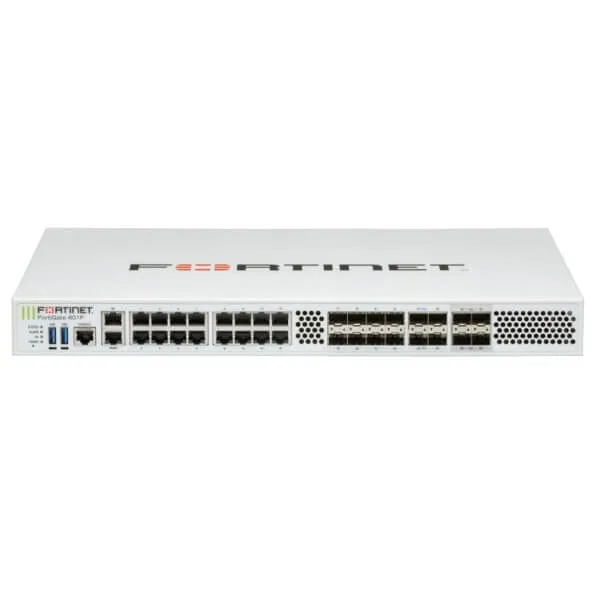
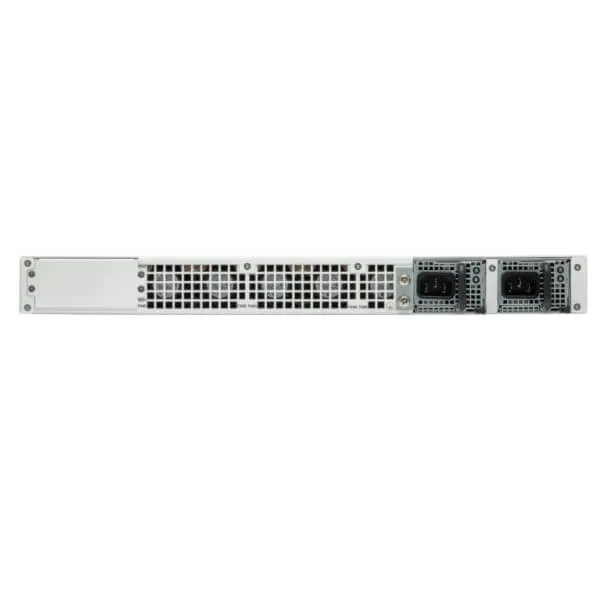
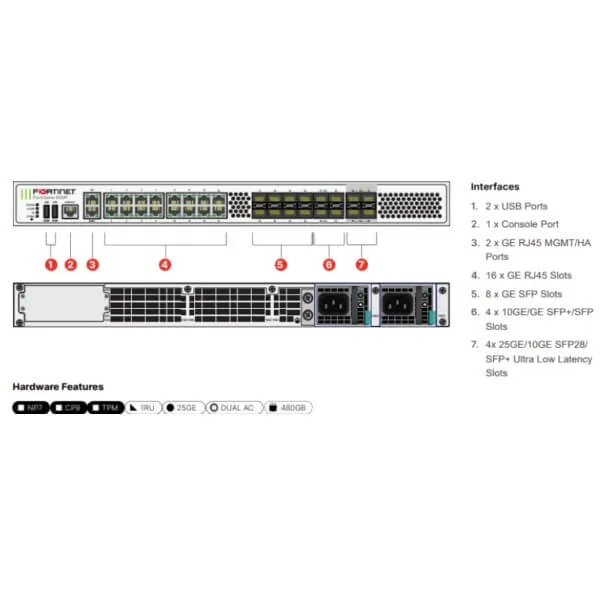
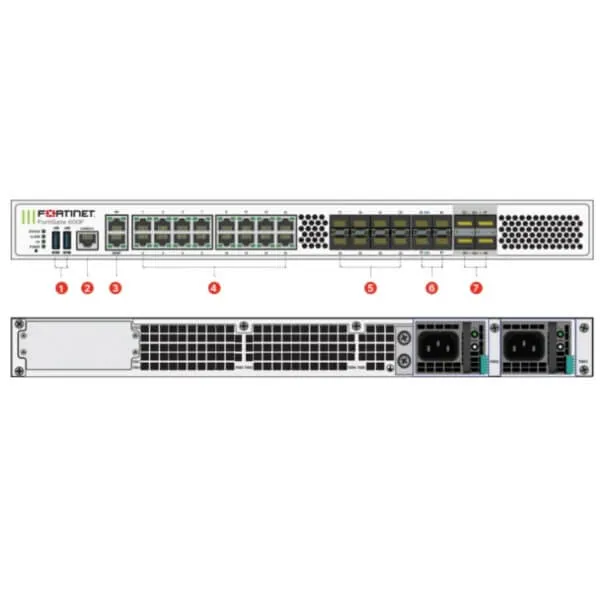
Fortinet lists the FG-600F with sixteen hardware-accelerated GE RJ45 interfaces, eight hardware-accelerated GE SFP slots, four hardware-accelerated 10GE SFP+/GE SFP slots and four hardware-accelerated 25GE SFP28/10GE SFP+ ultra-low-latency slots. Two GE RJ45 management/HA ports, USB connectivity and an RJ45 console interface support administration and deployment. The appliance is a 1RU system measuring approximately 44.45 × 432 × 380 mm and uses redundant hot-swappable power supplies supplied as standard. The FG-600F has no onboard storage; organizations that specifically require integrated SSD storage should distinguish it from the FG-601F variant.
Published system figures include up to 139/137.5/70 Gbps IPv4 firewall throughput depending on packet size, 105 million packets per second, eight million concurrent TCP sessions, 550,000 new TCP sessions per second, 30,000 firewall policies, 9 Gbps SSL inspection throughput, 32 Gbps application-control throughput and high-availability support for active-active, active-passive and clustering configurations. Performance values are laboratory ‘up to’ figures and vary with configuration, traffic profile and enabled services, so production sizing should use realistic workloads rather than headline throughput alone.
| Area | Fortinet-published FG-600F series figure |
|---|---|
| IPS throughput | 14 Gbps |
| NGFW throughput | 11.5 Gbps |
| Threat protection | 10.5 Gbps |
| IPsec VPN | 55 Gbps |
| Concurrent TCP sessions | 8 million |
| Form factor | 1RU, redundant hot-swappable PSUs |
Security, SD-WAN, VPN and Integration Planning
The 600F series is powered by FortiOS and is positioned by Fortinet as a converged networking and security platform. Typical projects can combine next-generation firewall controls, intrusion prevention, application control, web and content security, SSL inspection, IPsec VPN, secure SD-WAN, network segmentation and zero-trust network access capabilities. FortiGuard security subscriptions are relevant when planning advanced protection, and buyers should define the required security bundle and subscription term before comparing quotations because hardware-only and bundled offers are not equivalent.
Integration planning should document WAN circuits, routing protocols, VLANs, existing switching, identity sources, logging requirements, branch VPN topology, public services, cloud connectivity and high-availability expectations. A staged migration plan can reduce disruption by separating physical installation, base networking, policy migration, VPN cutover, security-profile activation, inspection tuning and monitoring. Organizations with multiple sites should also decide whether centralized management and analytics are needed so the firewall purchase fits a broader operational model.
FortiGate 600F Tanzania
Organizations searching for FortiGate 600F Tanzania commonly need an enterprise firewall that can consolidate perimeter protection, WAN connectivity and encrypted branch communications without forcing every function onto a separate appliance. The FG-600F is relevant to larger offices, campuses, service environments, financial operations, educational institutions, healthcare networks, hospitality groups, industrial businesses and public-sector networks where many users, applications and sites share critical connectivity. A Tanzania deployment should begin with measured traffic rather than only the ISP package speed. Teams should estimate peak north-south traffic, internal segmentation flows, encrypted sessions, remote-access demand and the proportion of traffic that will pass through IPS, application control and SSL inspection. This produces a more defensible sizing decision and leaves room for business growth.
Procurement teams should request a quotation that clearly identifies the FG-600F appliance, FortiGuard subscription bundle and term, support entitlement, optics or transceivers where needed, rack and power requirements, and any centralized management or logging components. The appliance includes a broad mix of copper, SFP, SFP+ and SFP28 connectivity, but the correct interface design still depends on the customer’s switches, WAN handoffs and server uplinks. High availability should be discussed early because an HA design normally affects appliance quantity, cabling, switch ports, rack capacity and licensing considerations. Buyers should also distinguish the FG-600F from the FG-601F, because the 600F itself has no onboard SSD storage.
For deployments spanning Tanzanian branches, secure SD-WAN can be evaluated alongside IPsec VPN to steer applications across multiple WAN paths and maintain consistent security controls. Policy design should consider business-critical SaaS, voice and collaboration traffic, internet browsing, partner connectivity and administrative access. A well-planned migration also includes configuration backup, change windows, acceptance testing and monitoring after cutover. FourTeck can assist customers preparing a technical requirement and quotation request. Related guidance is available through FourTeck’s Fortinet specialist resources, while FourTeck Africa provides broader regional technology context.
FortiGate 600F Dar es Salaam
Dar es Salaam businesses evaluating the FortiGate 600F often operate in connectivity-intensive environments: headquarters linked to branches, logistics operations, professional services, hospitality, financial services, retail networks and organizations using cloud applications alongside on-premises systems. In these settings, firewall selection should reflect both security inspection and WAN architecture. The FG-600F’s published enterprise-mix security performance makes it a candidate for networks that expect multi-gigabit protected traffic, but actual design should be based on measured peak loads and enabled inspection profiles. SSL inspection, IPS, application control and malware protection can materially change effective throughput, which is why sizing from raw firewall throughput alone can produce misleading expectations.
A Dar es Salaam deployment may also benefit from deliberate multi-WAN planning. Where an organization has two or more internet services, secure SD-WAN policies can be designed around application importance, latency, packet loss and link availability. Business systems, voice, video meetings and cloud services can have different steering requirements from general browsing. IPsec VPN can connect remote offices or partner networks, while segmentation can separate users, servers, guest access, operational systems and management networks. The firewall policy set should remain understandable and maintainable, with naming conventions and documentation that make future audits and troubleshooting easier.
When requesting a quotation, Dar es Salaam buyers should provide the number and speed of WAN links, expected user and device counts, server and DMZ requirements, existing switches, required fiber or copper interfaces, VPN topology, subscription term and whether high availability is required. If replacing an existing firewall, an anonymized configuration summary can help identify NAT, routing, VPN and policy dependencies before migration. The goal is to procure a complete solution rather than discover missing optics, subscriptions or capacity after purchase. For complementary WAN design topics, FourTeck’s Tanzania resources on dual-WAN, failover and IPsec VPN can support the planning discussion, while the final configuration should always be tailored to the customer’s actual topology.
FortiGate 600F Mwanza
For organizations in Mwanza, the FortiGate 600F can fit projects where a central office or regional hub must securely connect multiple departments, sites, cloud applications and remote users. The purchasing conversation should begin with workload and resilience. A firewall at a regional hub may carry internet traffic, site-to-site VPNs, remote administration, application publishing and inter-VLAN security at the same time. Each workload has different session, throughput and inspection characteristics. Fortinet publishes substantial capacity for the 600F series, including eight million concurrent TCP sessions and 55 Gbps IPsec VPN throughput under its stated test conditions, but production performance depends on configuration and traffic. Capacity planning should therefore include realistic security services and a growth margin.
Mwanza buyers should also assess physical and operational readiness. The FG-600F is a 1RU appliance with redundant hot-swappable power supplies, so rack space, protected power, grounding, cooling and upstream switch connectivity should be prepared before installation. Fiber uplinks may require compatible transceivers and correct cabling. If the design uses HA, the network must provide appropriate interfaces and adjacent switching so a firewall failure does not leave another single point of failure. Logging and monitoring requirements should be defined at the same time, particularly for organizations that need security-event review, audit evidence or centralized administration.
A practical quotation request for Mwanza should specify current internet capacity, planned upgrades, number of locations, VPN needs, public-facing services, expected encrypted traffic and the security subscription term. It should also state whether implementation assistance, policy migration, testing or administrator handover is required. This information helps separate a hardware purchase from a complete deployment requirement. Customers considering a broader East African network can also review FourTeck Kenya and FourTeck Uganda when coordinating related regional technology requirements.
FortiGate 600F Arusha
Arusha organizations may evaluate the FG-600F for headquarters, hospitality groups, institutions, multi-site businesses and environments where reliable access to cloud and centralized applications is operationally important. In these projects, firewall design should balance protection with user experience. Security profiles such as IPS and SSL inspection provide visibility and control, but they must be deployed with appropriate policy scope, certificate planning and exception handling. Application control can help administrators understand and govern application use, while segmentation can limit unnecessary lateral access between user, server, guest and management networks.
Secure SD-WAN is particularly relevant when a site uses multiple connectivity options and wants policy-based path selection rather than simple static failover. Before configuration, the business should identify applications that are sensitive to latency, jitter or loss and define acceptable behavior during link degradation. This allows health checks and steering policies to reflect operational priorities. Site-to-site IPsec VPN can then provide protected connectivity to other offices, data centers or cloud gateways. Remote-access requirements should be treated separately, with identity, authentication and user-group policies documented before deployment.
For procurement in Arusha, compare quotations on equivalent scope. Confirm the exact FG-600F model, subscription bundle, subscription duration, support coverage, transceivers, any management or logging components and implementation services. Do not assume every quoted firewall includes the same security services. If high availability is required, request the full HA architecture and quantity explicitly. The design should also consider maintenance access, configuration backup, software lifecycle practices and a rollback plan for major changes. These details help ensure that the firewall becomes an operational security platform rather than an isolated box installed at the edge. FourTeck can work from a customer requirement list to prepare a suitable quotation and deployment discussion.
FortiGate 600F Dodoma
In Dodoma, the FortiGate 600F can be considered by organizations that need controlled access between users, applications, branch sites and internet services while maintaining room for network growth. Public-sector, education, professional and enterprise environments often require policy clarity as much as raw performance. A firewall architecture should map security zones, data flows and administrative responsibilities before rules are migrated. This reduces overly broad policies and helps teams identify which services genuinely require access across network boundaries. FortiOS combines routing and security functions, allowing network and security decisions to be coordinated within one platform.
The FG-600F’s interface mix supports copper and fiber connectivity at multiple speeds, which is useful when integrating WAN handoffs, core switches and server networks. However, port count alone does not determine the final design. Teams should document link speeds, connector types, VLAN trunking, redundancy and transceiver requirements. For organizations with strict availability goals, the redundant power supplies and supported HA modes can form part of a resilient architecture, but adjacent switches, power sources and WAN circuits must also be designed to avoid hidden single points of failure.
Dodoma procurement teams should ask technical stakeholders for a short sizing worksheet before seeking pricing. Useful inputs include peak internet throughput, expected encrypted traffic, number of users and devices, concurrent sessions, branch count, VPN topology, public services, required inspection features, logging retention expectations and the desired FortiGuard subscription term. If the project replaces an older firewall, capture existing routing, NAT, VPN and authentication dependencies. This makes quotation comparison more accurate and reduces scope changes during implementation. A phased cutover with pre-change backup, connectivity testing, security validation and documented rollback is generally safer than an unstructured migration, especially where the firewall protects business-critical services.
FortiGate 600F UAE
UAE enterprises considering the FortiGate 600F frequently operate high-bandwidth headquarters, campuses, distributed branches and hybrid-cloud environments. The 600F series combines high-speed interfaces with FortiOS networking and security capabilities, making it relevant where firewalling, segmentation, secure SD-WAN and VPN are expected to work as one architecture. Buyers should size against inspected traffic rather than internet bandwidth alone, particularly when TLS inspection, intrusion prevention, application control and malware protection are enabled across large user populations.
For multi-site UAE deployments, centralized design standards can reduce operational inconsistency. Branch naming, VPN templates, routing policy, SD-WAN health checks, security profiles and logging should be documented before rollout. High availability at the central site may be appropriate where internet, cloud or branch connectivity depends on the firewall, but the HA design should include switch and circuit resilience. The FG-600F supports active-active, active-passive and clustering configurations according to Fortinet’s published specifications, allowing architects to evaluate the mode that aligns with the wider topology and operational model.
Commercial evaluation should compare like-for-like FortiGuard bundles, terms and services. Hardware price without the intended subscription scope does not represent the complete security solution. Buyers should also confirm optics, rack requirements, management, analytics and migration work. Organizations coordinating UAE and African deployments can use FourTeck UAE for broader regional technology engagement and Fortinet-focused FourTeck UAE resources for firewall-related enquiries. The design process should still be based on each site’s actual bandwidth, application and security requirements rather than duplicating one configuration across different environments.
FortiGate 600F Uganda
Ugandan organizations can evaluate the FortiGate 600F when a central firewall must protect substantial internet traffic while connecting branches, cloud applications and remote users. The model’s published security throughput and session capacity position it for demanding enterprise environments, but sizing should account for the inspection stack that will run in production. A network enabling IPS, application control, web security, SSL inspection and malware protection will behave differently from a simple stateful firewall, so requirements should be documented in terms of protected throughput and application behavior.
For organizations with branches across Uganda, secure SD-WAN and IPsec VPN can be planned together. SD-WAN policies can steer important applications according to measured path quality, while encrypted tunnels provide protected site-to-site connectivity. Network segmentation can separate departments, guests, servers and administrative systems, helping reduce unnecessary lateral communication. The policy model should remain simple enough to audit and support, with clear object naming and change control. Central logging and management may be useful where multiple FortiGate appliances are deployed.
Procurement requests should identify the appliance, subscription bundle and term, required transceivers, HA requirements, support expectations and any implementation scope. Customers should also clarify whether they need migration from another firewall, VPN recreation, SD-WAN design or administrator handover. This avoids comparing a bare hardware quotation with a bundled solution. For Uganda-specific coordination, FourTeck Uganda can complement the Tanzania engagement when a project spans both markets. Regional architecture should use consistent security principles while allowing each location’s WAN availability, user load and application dependencies to drive the final configuration.
FortiGate 600F Kampala
Kampala headquarters and campus networks often concentrate users, servers, internet circuits and branch connectivity at one location, making the central firewall a critical design point. The FG-600F can support high session counts and multi-gigabit security workloads, but successful deployment depends on understanding traffic paths. Architects should map internet egress, DMZ services, inter-VLAN flows, cloud connections and branch tunnels before assigning interfaces and zones. This mapping makes it easier to create least-privilege policies and identify which traffic requires deeper inspection.
Where Kampala sites use multiple providers, secure SD-WAN can provide application-aware path selection and controlled failover. The organization should define link-health thresholds and application priorities before deployment rather than relying on default behavior. Voice, collaboration and transactional applications may need different steering rules from bulk downloads or general browsing. For branch VPNs, tunnel addressing, routing, encryption settings and failover behavior should be documented consistently. Remote-access users require a separate identity and access policy, ideally aligned with broader zero-trust principles.
A complete Kampala quotation should cover hardware, FortiGuard subscriptions, support, optics, management requirements and professional services where needed. If HA is required, specify two appliances and the associated network design rather than assuming resilience is included. Rack power and cooling should be checked because the appliance uses redundant AC supplies and is designed for a controlled equipment environment. Migration planning should include backups, a tested rollback method and an acceptance checklist covering internet access, published services, VPNs, routing and security logs. This disciplined approach reduces uncertainty during cutover and creates a better foundation for ongoing firewall operations.
FortiGate 600F Arua
For an Arua site acting as a regional office, operational hub or branch aggregation point, the FortiGate 600F may be appropriate when local and wide-area security demands exceed the scope of smaller branch appliances. The first step is to establish whether the site genuinely needs this performance class. Teams should document peak WAN throughput, number of users, local servers, branch or partner tunnels, inspection requirements and growth. Oversizing can increase procurement cost unnecessarily, while undersizing can constrain inspection or future connectivity. The right decision comes from workload evidence.
If the Arua environment relies on multiple WAN services, SD-WAN design can prioritize business applications and provide controlled failover. Site-to-site IPsec VPN can secure connectivity to Kampala, Tanzania or other regional sites. Segmentation is useful where office users, guests, servers, cameras, operational devices or management systems should not share unrestricted access. Each segment should have a documented purpose and policy. Security profiles can then be applied according to risk rather than identically to every flow.
Procurement should include the exact appliance, security subscription term, interfaces and optics, support requirements and any implementation assistance. The FG-600F includes redundant hot-swappable power supplies, but overall availability also depends on upstream switches, WAN circuits and power design. A project plan should cover installation, base configuration, policy migration, VPN testing, security-profile activation and post-cutover monitoring. If centralized operations are needed, management and logging should be discussed before purchase. FourTeck can use this information to help structure a quotation request, while Uganda-wide projects can coordinate requirements through the wider FourTeck regional network rather than treating each firewall as an unrelated purchase.
FortiGate 600F Mbarara
Mbarara enterprises planning a firewall refresh should evaluate the FG-600F in the context of current traffic and the next several years of network change. New SaaS applications, cloud migration, video collaboration, additional branches and more encrypted traffic can increase inspection demand even when user count changes only modestly. Fortinet publishes 10.5 Gbps threat-protection throughput and 11.5 Gbps NGFW throughput for the series under defined test conditions, giving buyers useful reference points, but real deployment performance should be validated against the intended security profiles and traffic mix.
The interface design can accommodate varied copper and fiber connections, including higher-speed uplinks, which can be useful for integration with core switching. Teams should plan zones and VLANs before physical installation so ports are allocated intentionally. If the firewall will perform inter-segment inspection, east-west traffic should be included in sizing rather than considering only internet traffic. For multi-site organizations, IPsec VPN and SD-WAN policies should follow a consistent template, with exceptions documented for sites that have different circuits or applications.
Mbarara buyers should request transparent quotation components: appliance, subscription bundle, term, support, optics and services. Where resilience is important, include HA requirements and adjacent network changes. Installation planning should cover rack position, redundant power feeds where available, management access, configuration backup and software version policy. A structured acceptance test can verify routing, NAT, VPN, security policies, internet performance and logging before the old firewall is decommissioned. This turns procurement into a controlled security transition rather than a simple hardware swap and helps administrators inherit a documented environment they can maintain after project completion.
FortiGate 600F Gulu
In Gulu, a FortiGate 600F project may serve a large institutional site, enterprise hub or organization consolidating connectivity for multiple remote locations. Because the appliance is capable of substantial throughput, a requirements assessment should confirm the expected role: internet edge, data-center edge, segmentation firewall, VPN concentrator, SD-WAN hub or a combination. Each role changes which performance figures matter most. A VPN-heavy hub should consider tunnel and encryption requirements, while an internet edge with deep inspection should focus on threat-protection, SSL-inspection and session behavior.
Operational simplicity is another important consideration. Firewall rules, address objects, services and security profiles should use a naming convention that future administrators can understand. Logging should be sufficient for troubleshooting and security review without creating unmanaged data. For distributed environments, centralized management can help maintain consistent policies, but governance is still needed to control who can change configurations and how changes are approved. Backups should be taken before major updates and migrations.
A Gulu quotation request should specify WAN connections, branch count, user and device estimates, interface types, required subscriptions, VPN topology and availability objectives. Customers should identify any existing firewall rules or tunnels that must be migrated and any services that cannot tolerate extended downtime. If HA is planned, both firewall and network dependencies should be included in the architecture. Fortinet’s published specifications provide a useful technical baseline, while the final solution should be sized to the organization’s own workload. This requirement-led approach helps buyers avoid paying for features they do not need while ensuring that essential inspection, connectivity and resilience capabilities are included from the beginning.
FortiGate 600F Kenya
Kenyan enterprises with regional headquarters, campuses and branch networks can consider the FG-600F for secure internet edge and WAN consolidation. The platform is relevant when organizations want next-generation firewall functions, VPN, secure SD-WAN and segmentation within a common FortiOS environment. A proper assessment should use peak traffic measurements and expected inspection settings. As encrypted traffic becomes dominant, SSL inspection capacity and certificate deployment can be as important as raw firewall throughput. Applications with strict latency requirements should also be identified before security and SD-WAN policies are finalized.
Regional businesses operating between Kenya and Tanzania may benefit from standardized VPN, object naming, logging and change-control practices. Standardization does not mean every site needs the same appliance; branch sizes and connectivity differ. Instead, a common policy framework can simplify operations while each location is sized independently. The FG-600F can act as a larger hub while smaller sites use appropriately sized appliances. Central management and analytics can be evaluated when the estate grows beyond a few devices.
For Kenyan procurement, quotations should be compared on complete scope, including hardware, FortiGuard services, term, support, optics and deployment work. High availability, migration and centralized management should be explicit line items or documented inclusions. Buyers can coordinate Kenya-specific requirements through FourTeck Kenya while using the Tanzania team for cross-border project alignment where appropriate. A clear pre-sales worksheet covering users, bandwidth, branches, security features, interfaces and resilience will make both technical evaluation and commercial comparison more useful.
FortiGate 600F Kuwait
Kuwait organizations evaluating the FortiGate 600F may be planning a headquarters refresh, data-center edge, campus security project or SD-WAN hub. In each case, security throughput should be evaluated with the intended inspection stack. The published 600F figures provide a reference for IPS, NGFW, threat protection, SSL inspection and VPN workloads, but production traffic can differ substantially from standardized tests. Capacity planning should therefore combine measured utilization, application mix, encryption levels, session counts and expected growth.
High-speed SFP+ and SFP28 connectivity can support integration with modern switching and WAN environments. Network teams should confirm transceiver compatibility, fiber type, link speeds and redundancy before ordering. For HA deployments, design the surrounding switching and power so both firewalls have independent paths where practical. Security teams should simultaneously define zones, inspection profiles, logging and administrative access. This parallel planning avoids a situation where physical installation is complete but the security policy remains undefined.
Commercially, buyers should confirm the exact subscription bundle and duration, because FortiGuard services materially affect both capability and total solution cost. Implementation scope may include configuration migration, VPN recreation, SD-WAN policy design, testing and handover. These services should be distinguished from the appliance itself. For broader regional coordination, FourTeck’s network can support multi-country technology requirements while the final firewall configuration remains specific to each environment. A documented bill of materials and acceptance checklist provides a stronger basis for procurement than a model number alone.
FortiGate 600F Ghana
Ghanaian organizations may consider the FortiGate 600F when consolidating perimeter security, branch VPN, segmentation and WAN controls for a substantial enterprise site. The appliance’s high session capacity can be useful in environments with many users, devices and cloud connections, while FortiOS provides a common policy framework across networking and security. Before selecting the model, teams should establish whether traffic will be inspected for IPS, application control, web threats and encrypted content, because those functions are more representative of real NGFW workloads than simple packet forwarding.
For distributed operations, an FG-600F can be evaluated as a hub for site-to-site IPsec VPN and secure SD-WAN. Application steering can be based on link quality and business priority, while segmentation can separate corporate, guest, server and management networks. The architecture should include DNS, authentication, routing and logging dependencies so cutover does not overlook services that sit outside the firewall configuration. Administrators should also plan how software updates, backups and policy changes will be governed after deployment.
A Ghana quotation request should identify bandwidth, branch count, VPN needs, interface types, HA objectives and the required FortiGuard subscription term. If replacing another platform, include the approximate policy and VPN scope so migration effort can be estimated. Organizations should compare complete solution scope rather than hardware price alone. This is especially important when one proposal includes security subscriptions or implementation and another does not. A requirement-led bill of materials gives procurement teams a clearer basis for evaluation and helps technical teams avoid unexpected additions after the purchase decision.
FortiGate 600F Nigeria
Nigerian enterprises with large headquarters, campuses, distributed branches and cloud-heavy application environments can evaluate the FG-600F as part of a converged security and networking design. Its combination of high firewall capacity, enterprise-mix security performance and VPN throughput makes it relevant to demanding deployments, but a sizing exercise should identify which traffic will actually traverse the appliance. Internet access, inter-zone traffic, branch tunnels, published applications and cloud connections can all contribute to load.
Multi-WAN environments should define desired behavior during congestion and outage. Secure SD-WAN can steer applications across available paths, but useful policies depend on meaningful health checks and application priorities. Critical transaction systems, voice and collaboration may need stricter thresholds than general web access. For branch connectivity, IPsec tunnel design should include routing and failover behavior. Segmentation should reflect business trust boundaries rather than simply mirroring existing VLANs without review.
Nigeria procurement teams should request the exact FG-600F hardware, FortiGuard bundle and term, support, optics, HA components and services. The 600F has no onboard SSD, so storage or logging architecture should be discussed where local retention is a requirement. High availability should include the surrounding network design, not only a second appliance. Migration projects should inventory current rules, NAT, VPNs, routing and authentication before change day. This preparation reduces avoidable downtime and gives stakeholders a clear acceptance test for the new environment. FourTeck can use these inputs to structure a quotation and technical discussion for regional deployments.
FortiGate 600F Seychelles
Seychelles organizations evaluating the FortiGate 600F may have centralized infrastructure supporting hospitality, professional, public-sector or multi-site operations where resilient connectivity and secure access are important. Firewall sizing should reflect the role of the site and available WAN capacity, but also the inspection functions that will be enabled. A high-performance appliance can provide growth headroom, yet the business should still confirm that its interface, subscription and operational requirements justify the selected model.
Where connectivity resilience is important, secure SD-WAN can be designed around multiple paths and application priorities. The architecture should define how critical applications behave when a preferred circuit degrades, and whether VPN tunnels must move between links automatically. Segmentation can reduce exposure between user, guest, server and management networks, while SSL inspection and threat-prevention policies can provide deeper visibility into internet traffic. These controls require planning, testing and ongoing tuning rather than simply enabling every feature globally.
A Seychelles procurement request should include WAN details, user and device estimates, required interfaces, branch VPNs, security subscriptions, availability objectives and support expectations. If the firewall will be installed in HA, power and switching redundancy should be considered together. Customers should also determine how configurations and logs will be backed up and reviewed. For a multi-country organization, standardized design principles can simplify operations, while each location should retain a configuration suited to its actual connectivity and applications. FourTeck can help turn these technical inputs into a clearer bill of materials and quotation discussion.
Licensing, Subscription and Renewal Guidance
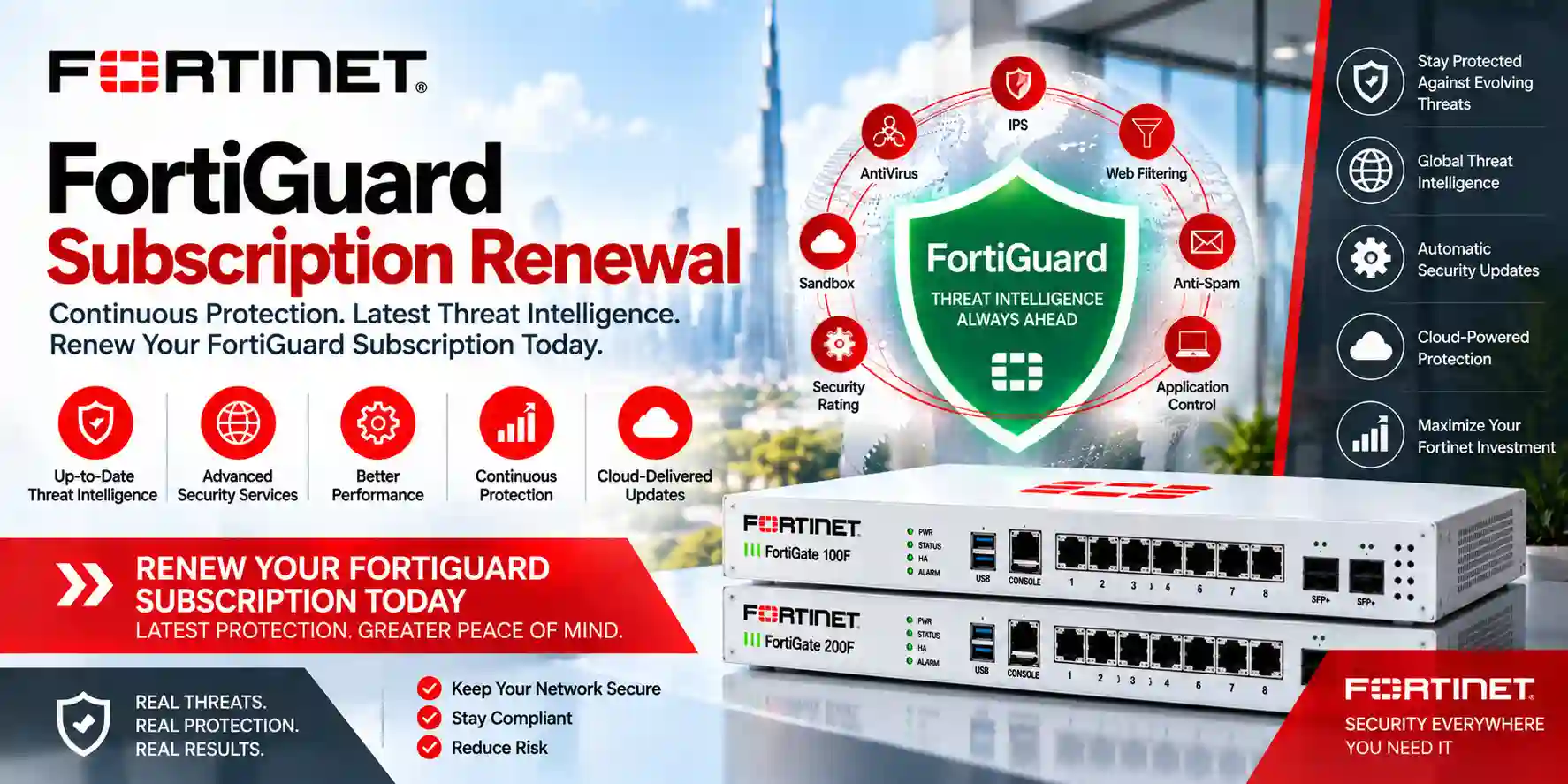
The FG-600F hardware and FortiGuard security services should be evaluated as separate but connected parts of the solution. Subscription bundles determine access to specific security services and support entitlements, and the appropriate term depends on procurement policy and lifecycle planning. Before ordering, confirm which security functions are required, how long the subscription should run and whether centralized management or analytics are part of the project. Renewal planning should begin before expiry so the organization has time to review service requirements, budgets and appliance lifecycle without a last-minute decision.
Quotation Checklist for FortiGate 600F
✓ Peak and expected WAN throughput
✓ Number of users, devices and sites
✓ Required IPS, web, application and SSL inspection
✓ Site-to-site and remote-access VPN requirements
✓ Secure SD-WAN and multi-WAN requirements
✓ Copper/fiber interface and transceiver needs
✓ HA and power-resilience requirements
✓ FortiGuard bundle and subscription term
✓ Central management/logging requirements
✓ Migration, configuration, testing and handover scope
FortiGate 600F FAQs
What is the difference between FG-600F and FG-601F?
The main hardware distinction in Fortinet’s published specifications is onboard storage: the FG-600F lists no onboard storage, while the FG-601F lists two 240 GB SSDs. Buyers should confirm which variant matches their logging and architecture requirements.
Can the FortiGate 600F be used for secure SD-WAN?
Yes. Fortinet positions the 600F series as part of its converged secure networking portfolio, and FortiOS includes secure SD-WAN capabilities. Actual design should define WAN links, health checks, application priorities and failover behavior.
Does the FG-600F support high availability?
Fortinet lists active-active, active-passive and clustering HA configurations. A resilient solution also requires appropriate switching, cabling, WAN and power design around the firewalls.
How should an organization size the FG-600F?
Use expected inspected throughput, encrypted traffic, session counts, application mix, VPN demand, interface requirements and growth. Raw firewall throughput alone is not a sufficient sizing method when multiple security services will be enabled.
What information should be supplied for a quotation?
Provide bandwidth, users and devices, branch count, VPN topology, security features, interface types, HA needs, subscription term, management/logging needs and any migration or implementation scope. This allows a more complete bill of materials.
Decision Recap
The FortiGate 600F is designed for organizations that need substantial next-generation firewall, VPN and secure networking capacity in a 1RU platform. Its value depends on correct architecture: match the appliance to inspected traffic, select the appropriate FortiGuard services, plan interfaces and transceivers, decide on HA and management, and document migration requirements. Buyers should compare complete solution scope rather than hardware-only pricing.
For related regional requirements, explore FourTeck Africa, FourTeck Kenya, FourTeck Uganda, FourTeck UAE and Fortinet-focused FourTeck resources.
Discuss Your FG-600F Requirement
Prepare your bandwidth, site count, interface, VPN, security-service, HA and subscription requirements before requesting a quotation. A concise technical brief helps align the appliance, licenses and implementation scope with the network you actually need to protect.


Reviews
There are no reviews yet.