
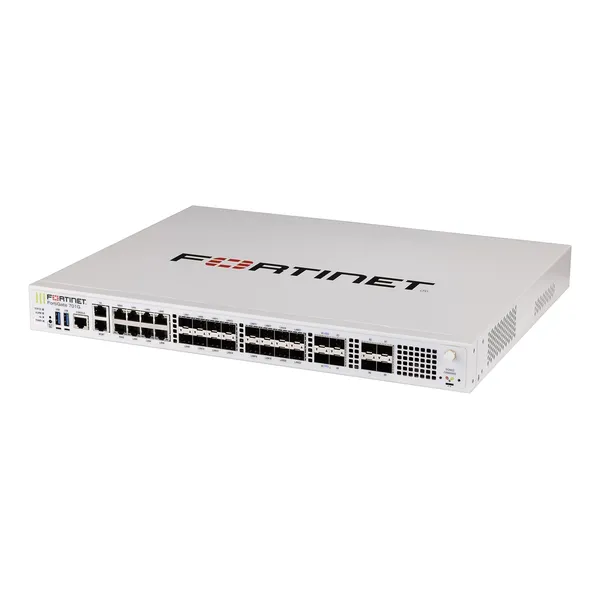
FortiGate 701G (FG-701G) Tanzania
FortiGate 701G is designed for organizations that need substantial firewall capacity, high-speed interfaces, security inspection, VPN, segmentation and secure SD-WAN in a compact enterprise appliance. For Tanzanian head offices, large campuses, service environments and data-center edge deployments, the model provides a practical path to consolidate networking and security while retaining the interface density needed for mixed copper and fiber infrastructure.
Accelerated architecture
Fortinet documents the FortiGate 700G and 701G with one NP7 network processor and one CP10 content processor. Supported data traffic can be offloaded through the NP7 path, helping the platform handle demanding security and networking workloads efficiently.
Flexible connectivity
The front panel combines eight multi-gigabit BASE-T RJ45 ports, sixteen 1 Gigabit Ethernet SFP interfaces, four 10/1 Gigabit Ethernet SFP+/SFP interfaces and four 25/10 Gigabit Ethernet SFP28/SFP+ interfaces, plus dedicated management and HA connectivity.
Storage-equipped variant
FG-701G is the storage-equipped member of the 700G pair. This makes it relevant where local logging and storage are part of the design. Storage requirements should still be validated against retention, analytics and compliance objectives before procurement.
FortiGate 701G overview and buying guidance
The FortiGate 701G sits in a performance class intended for organizations that have moved beyond branch-firewall requirements. Its value is not simply a headline throughput number. The more important design question is whether the appliance can support the combination of encrypted traffic, security inspection, east-west and north-south segmentation, WAN services, remote connectivity, application controls and interface speeds required by the real network. A procurement team should therefore begin with traffic profiles, user and device counts, internet circuit capacity, internal routing requirements, VPN demand, expected growth and the security services that will actually be enabled.
Fortinet’s published product matrix for the 700G family lists IPv4 firewall throughput of 164/163/145 Gbps for 1518/512/64-byte UDP traffic, IPsec VPN throughput of 55 Gbps, IPS throughput of 38 Gbps, NGFW throughput of 29 Gbps and threat-protection throughput of 26 Gbps. These are vendor test figures measured under defined conditions and should be treated as sizing references rather than promises of application-level production performance. Real results depend on configuration, enabled inspection, traffic composition, firmware, logging, encryption and surrounding infrastructure.
The interface mix is particularly useful for modernization projects. Organizations can connect multi-gigabit copper services, existing 1GE fiber distribution, 10GE server or aggregation links and 25GE uplinks without forcing every adjacent system into the same media type. Fortinet documents X1 and X2 as FortiLink-capable interfaces, supporting designs where FortiGate participates in coordinated management with compatible Fortinet switching. Dedicated management and HA paths also help separate operational and clustering traffic from ordinary data flows.
Verified technical highlights
| Processors | NP7 network processor and CP10 content processor |
| High-speed fiber | 4 × 25/10GE SFP28/SFP+ and 4 × 10/1GE SFP+/SFP |
| 1GE fiber | 16 × 1GE SFP |
| Copper data ports | 8 × 5G/2.5G/1G/100M BASE-T RJ45 |
| Dedicated control | 2.5GBASE-T HA and 1GE management RJ45 interfaces |
| Storage | 960GB onboard SSD storage for the FG-701G variant |
Security, SD-WAN, VPN and segmentation planning
A FortiGate 701G project should be treated as a security architecture exercise rather than a box replacement. FortiOS brings firewalling, routing, secure SD-WAN, VPN and security controls into one operating environment. That convergence can reduce the number of independent policy points, but it also increases the importance of disciplined configuration. Teams should document security zones, trusted and untrusted paths, application requirements, identity sources, internet breakout policy, inter-VLAN controls, public services, remote-access requirements and business-critical SaaS destinations before migration.
For WAN designs, the eight multi-gigabit copper ports and multiple fiber options give architects room to separate internet, MPLS, private circuits, campus aggregation and server networks. SD-WAN policy can then be designed around application intent and available paths. Where resiliency is required, avoid reducing the design to dual links alone: consider provider diversity, physical path diversity, DNS dependencies, upstream routing, power resilience and how security policy behaves during failover. High availability can also be considered when the business impact of a single appliance outage justifies a clustered design.
VPN sizing deserves similar care. The vendor’s 55 Gbps IPsec reference figure provides useful context, but the expected number of tunnels, cryptographic choices, packet sizes, latency, remote-site capacities and inspection policy all affect real deployments. Site-to-site VPNs may connect branches, data centers, cloud networks and partners, while remote-access architecture may require identity, endpoint and MFA planning beyond the firewall itself. FourTeck can use these inputs to prepare a more accurate bill of materials and deployment scope.
FortiGate 701G licensing and lifecycle considerations
The hardware is only one part of a FortiGate procurement. Organizations should decide which FortiGuard security services, support coverage and management components match their risk and operational model. Do not select a bundle solely by name or by the largest feature list. Start with the controls the security team intends to operate, the applications and data that require protection, the organization’s monitoring workflow, and who will own policy changes and incident response. Subscription duration should align with budgeting and refresh planning so that renewal is not treated as an emergency purchase.
Firmware compatibility is also a project consideration. Fortinet documentation identifies FortiGate 700G/701G support on specific FortiOS branches and management-product releases. Before rollout, confirm the target FortiOS version against FortiManager, FortiAnalyzer and other Security Fabric components already in use. This is especially important in environments with formal change windows, standardized firmware trains or multi-appliance estates. A controlled migration plan should include configuration review, backup, rollback criteria, testing and post-change monitoring.
FortiGate 701G Tanzania
Organizations evaluating FortiGate 701G in Tanzania are typically looking for more than perimeter filtering. Large offices, universities, financial organizations, service providers, industrial groups, hospitality operators and multi-site enterprises may need a security gateway that can connect high-capacity internet circuits, private WANs, server networks and campus distribution while maintaining inspection and segmentation. The FG-701G’s combination of multi-gigabit copper, 1GE fiber, 10GE and 25GE interfaces makes it suitable for mixed-generation networks where a complete switching refresh is neither necessary nor desirable.
For a Tanzania procurement, begin by documenting current and expected internet bandwidth, peak east-west traffic, public-facing applications, remote sites, cloud dependencies and the number of security zones. If the firewall will sit between campus and data-center segments, internal throughput can be as important as internet speed. If it will terminate multiple VPNs, record tunnel counts and cryptographic standards. If local storage is a reason for choosing the 701G rather than 700G, define retention objectives and how logs will also be centralized or analyzed.
Power and rack planning should be included in the bill of materials rather than left for installation day. Confirm rack space, power feeds, UPS capacity, transceiver types, fiber standards, patching and cable distances. High availability should be evaluated from business-continuity requirements, not assumed automatically. A resilient pair can reduce appliance-level risk, but upstream circuits, switches and power paths must also be designed without hidden single points of failure.
FourTeck can prepare a project quotation around the required appliance, security subscription, support term and deployment scope. Buyers can also review broader FourTeck Tanzania technology solutions when the firewall is part of a larger network refresh. The goal is to align the FG-701G with measurable capacity, security and operational requirements instead of oversizing or undersizing the platform.
FortiGate 701G Dar es Salaam
In Dar es Salaam, FortiGate 701G can be evaluated for headquarters, corporate campuses, data-center edge environments and organizations consolidating connectivity from several business sites. Dense business networks often combine internet access, private links, cloud applications, VoIP, collaboration, Wi-Fi, ERP traffic and partner connections. A firewall in this role must be sized for the security services enabled during busy periods, not merely for an ISP circuit’s advertised rate.
The 701G interface layout is useful where existing distribution uses fiber while WAN handoffs or server connections use copper. The 16 SFP ports can accommodate numerous 1GE fiber connections, while 10GE and 25GE interfaces can serve higher-capacity aggregation. During design, confirm exact optics and cabling rather than assuming that every SFP-family module is interchangeable. Link speed, fiber type, wavelength and adjacent-device compatibility should be verified as part of the BOM.
Dar es Salaam projects should also consider operational continuity. If internet connectivity is business critical, dual-provider design may be paired with secure SD-WAN policies to steer important applications according to link health and business intent. If a firewall pair is proposed, document heartbeat and HA connections, switch dependencies and failover testing. The dedicated HA interface helps support a clean architecture, but resilience still depends on the full topology.
For quotation preparation, provide current firewall model, WAN speeds, expected growth, user/device scale, VPN requirements, desired security services, rack and power constraints, required transceivers and any FortiManager or FortiAnalyzer integration. These details allow a Dar es Salaam deployment to be scoped around real requirements and help avoid late changes during installation.
FortiGate 701G Mwanza
For Mwanza organizations, the FG-701G may suit centralized environments that serve multiple offices, operational sites or large user populations from one security edge. The design can consolidate routing, firewall policy, VPN and SD-WAN while retaining enough interface diversity to connect legacy 1GE fiber and newer high-speed aggregation. This is valuable when network modernization is phased and the security platform needs to bridge current infrastructure with future upgrades.
Sizing should reflect the actual traffic pattern. A company with moderate internet bandwidth can still require a powerful firewall if it performs intensive internal segmentation, carries many site-to-site VPNs, inspects encrypted applications or supports a large number of concurrent sessions. Conversely, buying solely from a headline throughput figure can lead to unnecessary expenditure. Document the expected security profile and compare it with vendor test methodology before selecting the final model and subscription.
For distributed operations around Mwanza, WAN resiliency can be planned using multiple carriers or access technologies where available. Secure SD-WAN can help apply application-aware path policy, but technical teams should define what happens when a preferred link degrades, not only when it fails completely. Voice, ERP, cloud applications and interactive services may need different latency, loss and jitter thresholds. Monitoring and escalation processes should be agreed alongside the firewall configuration.
A complete request for quotation should include the hardware, support period, FortiGuard services, optics, rack requirements and any professional services. If migration is from another firewall, include the approximate policy count, VPN inventory, NAT rules, objects, authentication sources and maintenance window. That creates a clearer basis for implementation planning and reduces the risk of treating migration as a simple configuration copy.
FortiGate 701G Arusha
Arusha businesses evaluating FortiGate 701G may include hospitality groups, large offices, institutions, multi-site enterprises and organizations whose operations depend heavily on cloud and internet services. These environments benefit from a design that treats the firewall as a policy and connectivity platform. Guest networks, staff systems, servers, building systems, voice, payment applications and administrative networks can be separated into appropriate security zones instead of sharing broad trusted segments.
The platform’s port density provides flexibility for this segmentation. Multiple physical interfaces can be combined with VLAN-based logical segmentation where appropriate, while high-speed fiber uplinks connect distribution infrastructure. Network architects should decide where routing boundaries belong, how inter-zone policy is enforced, which services require inspection and how logs are retained. The 701G’s onboard storage can contribute to local logging strategy, but centralized visibility may still be desirable for broader estates.
Remote connectivity is another common planning area. Organizations with branch sites, remote workers or external partners should distinguish site-to-site tunnels from user remote access and document identity requirements. VPN design should include address planning, route control, DNS behavior, MFA expectations and failover behavior. Where several internet links are available, VPN continuity during path changes should be tested rather than assumed.
For an Arusha quotation, identify whether the deployment is a new installation, capacity upgrade, firewall replacement or consolidation project. Include the current topology, WAN providers, switching environment, expected inspection features and target support term. This enables the proposed FG-701G configuration to be connected to business outcomes such as improved segmentation, scalable connectivity, simpler policy control and stronger operational visibility.
FortiGate 701G Dodoma
In Dodoma, the FortiGate 701G can be considered for large administrative, institutional and enterprise networks requiring a high-capacity security gateway with room for network growth. Procurement teams should translate organizational requirements into technical inputs before requesting pricing. These include internet and private-WAN capacity, internal segmentation, application criticality, remote sites, VPN usage, security inspection and required retention of security events.
Where formal governance is important, policy design should map to documented network zones and application flows. A new firewall is an opportunity to remove obsolete rules, identify overly broad access and establish clearer ownership for policy changes. Migration should not automatically reproduce every legacy rule. Instead, validate active services, required sources and destinations, NAT behavior, authentication dependencies and monitoring expectations. This approach can improve security while simplifying the resulting configuration.
The FG-701G’s mix of 25GE, 10GE, 1GE fiber and multi-gigabit copper helps accommodate networks with different generations of infrastructure. Before procurement, verify optics and adjacent switch capabilities, especially where fiber connections span buildings or equipment from different vendors. For high availability, ensure both appliances can be connected to resilient upstream and downstream infrastructure and that configuration synchronization and failover procedures are included in acceptance testing.
Dodoma buyers should request a quotation that separates hardware, subscriptions, support and implementation components so lifecycle costs are clear. Renewal dates, firmware governance and responsibility for ongoing administration should be recorded from the start. This makes the firewall a managed security asset rather than a one-time appliance purchase.
FortiGate 701G UAE
For UAE deployments, FortiGate 701G is relevant to enterprises requiring high-speed secure connectivity between internet edges, campuses, data centers and cloud-connected environments. The model’s interface density supports architectures where 25GE or 10GE aggregation coexists with numerous 1GE fiber and multi-gigabit copper connections. This can reduce the need for media compromises during migration, provided the exact optics and adjacent equipment are validated.
UAE projects often involve strict uptime requirements, so high availability and multi-WAN architecture should be designed as complete systems. A firewall pair alone does not remove dependence on a single switch, carrier path or power feed. Map each failure domain and determine the expected behavior during circuit degradation, appliance maintenance and upstream outages. Secure SD-WAN policies can then be tied to business applications and measurable link conditions.
Security subscriptions should be chosen from the organization’s control objectives and operating model. Consider which inspection and protection functions will be enabled, how alerts are handled, whether centralized management and analytics are required, and what support response is appropriate. Performance sizing should use the throughput metric closest to the intended security profile rather than basic firewall throughput alone.
For broader regional procurement and specialist firewall information, buyers can reference FourTeck Fortinet UAE resources. A quotation request should include appliance quantity, HA requirements, FortiGuard and FortiCare term, optics, rack and power details, migration scope and any integration with FortiManager, FortiAnalyzer or existing Security Fabric components.
FortiGate 701G Uganda
Ugandan enterprises can evaluate FortiGate 701G when a central firewall must serve high-capacity WAN, data-center, campus or multi-site security requirements. The appliance is especially relevant where the network contains both established 1GE fiber infrastructure and newer 10GE or 25GE aggregation. The broad interface mix allows designers to preserve useful infrastructure while introducing higher-speed links where demand justifies them.
A sound Uganda deployment begins with application and traffic discovery. Record internet capacity, internal routing throughput, branch connectivity, cloud services, remote users and public applications. Identify which traffic will receive IPS, application control, web filtering, malware protection or SSL inspection. The resulting security profile is a better sizing basis than port speed alone. Vendor performance figures should be interpreted in the context of those enabled controls.
For organizations with sites across the country, secure SD-WAN and IPsec can help consolidate connectivity policy. The design should define preferred and backup paths, application priorities and failover thresholds. Addressing, routing and DNS should be checked for behavior during failover. Where centralized operations are desired, management and analytics integration should be considered at the same time as the appliance rather than added after rollout.
Buyers can review FourTeck Uganda solutions for regional context. For an FG-701G quote, provide desired support duration, subscription requirements, HA design, transceiver needs, current firewall information and migration window. These details support a more precise scope and a smoother implementation plan.
FortiGate 701G Kampala
Kampala headquarters and campus networks considering the FG-701G should focus on the workloads that will cross the firewall. Internet traffic is only one component. Inter-department segmentation, server access, branch VPNs, cloud connections and public services can produce substantial internal traffic and concurrent-session demand. The 701G is positioned for environments where these requirements justify enterprise-class capacity and interface density.
The appliance’s dedicated management interface is useful for keeping administrative access separate from ordinary data paths. The dedicated HA connection likewise supports clean clustering design. These features should be complemented by operational controls: restrict management sources, use strong administrator authentication, maintain configuration backups, define change approval and monitor system health. Security depends on administration discipline as much as appliance capability.
For campus modernization, the 1GE SFP ports can connect existing fiber segments while 10GE and 25GE ports support higher-capacity cores. Confirm the physical topology before ordering optics. If multiple buildings are involved, document fiber type, distance and connector standards. If the firewall will manage or integrate with Fortinet switching, validate the intended FortiLink topology and firmware compatibility.
Kampala procurement teams should also plan subscriptions and renewal ownership. Decide whether the organization requires a one-year or multi-year commercial term based on budget policy and lifecycle plans, and make sure the chosen services correspond to controls that will actually be configured and monitored. A structured BOM should make hardware, licenses, support, optics and services visible as separate decision items.
FortiGate 701G Arua
For Arua deployments, FortiGate 701G can serve as a central security platform where organizations need to connect several network zones, remote locations or high-value applications through one policy framework. The model should be selected after confirming that its performance and port mix match the environment. Smaller sites may not need this class of appliance, while a regional hub aggregating many connections may benefit from its headroom and fiber density.
Connectivity resilience deserves attention in locations where WAN options may differ by site. Secure SD-WAN can use multiple available paths, but the design should account for actual provider diversity and service characteristics. Define which applications must remain available, acceptable degradation, and how routes and VPNs change when a circuit fails. Test procedures should cover partial degradation as well as complete link loss.
The security policy should also reflect the business structure. Separate users, servers, guest access, management systems and operational devices where appropriate, then permit only required flows. This is more sustainable than relying on one broad internal trust zone. If SSL inspection is planned, account for certificate deployment, application compatibility and user experience during the project rather than enabling it without preparation.
An Arua quotation request should state whether local logging is a key requirement for choosing the 701G, how many sites and VPNs are expected, what WAN speeds are planned and whether centralized management exists. Include transceiver and fiber requirements to prevent an otherwise complete firewall order from arriving without the components needed for connectivity.
FortiGate 701G Mbarara
Mbarara organizations can consider FortiGate 701G for enterprise hubs, campuses and multi-site networks where security and routing requirements exceed typical branch-firewall scale. The model offers a useful combination of high-speed uplinks and numerous lower-speed fiber connections, allowing the firewall to participate in both modern aggregation and existing distribution designs. This flexibility can simplify phased upgrades.
Before selecting the appliance, collect utilization data from the current network where possible. Peak throughput, session counts, VPN use and application mix reveal more than nominal circuit speed. Also document expected growth over the intended service life. A sizing exercise should leave sensible headroom without turning unused maximum capacity into the primary buying objective.
Security services influence performance and licensing. Determine whether IPS, application control, web security, malware protection and encrypted-traffic inspection will be part of the operational policy. Decide who reviews alerts and how events are retained. The 701G includes onboard SSD storage, but organizations with broader estates may still choose centralized analytics for cross-device visibility and longer retention.
For implementation, create an acceptance checklist covering interface status, routing, internet access, DNS, critical applications, VPNs, logging, administrator access and failover. If replacing an existing firewall, retain a rollback path until business owners validate important services. This disciplined approach reduces migration risk and makes the procurement outcome measurable beyond simply powering on the new appliance.
FortiGate 701G Gulu
In Gulu, FortiGate 701G may be appropriate for organizations operating a central network hub with demanding security, WAN or segmentation requirements. The appliance should be evaluated in relation to the whole topology: internet circuits, branch connectivity, campus switching, server networks and cloud services. Its high-capacity interfaces are most valuable when adjacent infrastructure and traffic demand can use them.
For branch aggregation, site-to-site IPsec can provide encrypted connectivity while secure SD-WAN policies determine how traffic uses available links. Plan route advertisements, overlapping addresses, application priorities and failover. If remote locations use different access technologies, define realistic service-level thresholds for each rather than applying identical rules to every circuit.
Operational security should include role-based administration, protected management access, configuration backup, controlled firmware changes and periodic rule review. A large firewall policy can become difficult to maintain if objects and rules are created without naming standards or ownership. Migration is a useful point to clean up expired VPNs, unused objects and legacy access that no longer has a business justification.
For a Gulu project, include future network plans in the quotation discussion. If 10GE or 25GE core upgrades are expected, the selected optics and topology can be planned in advance. If the firewall will initially connect mostly 1GE links, the sixteen SFP ports provide flexibility while retaining faster interfaces for future aggregation. This makes lifecycle planning part of the purchasing decision.
FortiGate 701G Kenya
Kenyan enterprises assessing FortiGate 701G may use it at headquarters, campus cores, data-center edges or as a consolidation point for branch and cloud connectivity. The model’s NP7 and CP10 acceleration and diverse interface set make it suitable for environments where security processing and high-speed routing must coexist. Selection should still be driven by the intended inspection profile and network design rather than model positioning alone.
Where Nairobi or regional sites use multiple internet and private-WAN providers, secure SD-WAN can help express business policy across those paths. Define application categories, link health metrics, preferred exits and fallback behavior. For cloud applications, consider where internet breakout occurs and whether traffic should be backhauled or exit locally. The firewall architecture should support business performance as well as security control.
The 701G’s 25GE interfaces provide room for high-speed aggregation, while 10GE, 1GE fiber and multi-gigabit copper accommodate mixed environments. Optics should be selected only after checking the connected equipment and physical media. High availability, where required, should include resilient switch and power design so the firewall pair is not undermined by another single point of failure.
For related regional procurement information, visit FourTeck Kenya. A complete FG-701G request should specify quantity, subscription and support term, expected security services, HA requirements, optics, VPN scale, current platform and migration expectations. That information helps turn a product inquiry into an implementable solution.
FortiGate 701G Kuwait
Kuwait organizations can evaluate FortiGate 701G for enterprise perimeter, campus, data-center edge and multi-site security roles. Its interface mix is useful when high-speed fiber uplinks must coexist with multiple 1GE connections and multi-gigabit copper. A procurement team should map every planned connection before ordering so interface counts, transceivers and cable standards are confirmed rather than assumed.
Performance planning should use the security metric that resembles the intended configuration. Basic firewall throughput represents a different workload from IPS, NGFW or threat protection. Encrypted traffic inspection can add another dimension. Use vendor figures as comparative sizing data and maintain headroom for traffic growth, software changes and peak periods. Production outcomes depend on traffic composition and enabled features.
For business continuity, define the required recovery behavior for firewall, carrier and upstream-switch failures. HA can address appliance failure, while multiple WANs and redundant switching address other layers. Document maintenance procedures so planned upgrades do not create unnecessary downtime. If centralized management is used, verify supported FortiOS and management-product versions before deployment.
Licensing should be matched to the security operating model. Decide which FortiGuard services are required, who will monitor alerts and how renewals will be budgeted. Include implementation and migration services where the existing policy base is complex. A well-defined scope makes it easier to compare quotations on equivalent terms rather than comparing hardware prices that omit different supporting components.
FortiGate 701G Ghana
Ghanaian enterprises considering FortiGate 701G can position it as a central security and connectivity platform for large offices, campuses, service environments or multi-site networks. The combination of 25GE and 10GE uplinks with 1GE fiber and multi-gigabit copper allows the appliance to fit into heterogeneous network estates. This can be useful during staged infrastructure upgrades where not every switch or circuit changes at the same time.
The design process should identify security zones and important application flows before migration. Internet access, public servers, cloud connections, branch networks, guest services and management systems often require different policies. Clear segmentation makes policy easier to audit and reduces unnecessary trust. If SSL inspection is required, plan certificate distribution and application testing so deployment does not unexpectedly disrupt critical services.
Organizations with multiple Ghana locations can use IPsec and SD-WAN capabilities as part of a consolidated WAN architecture. Evaluate provider diversity, latency and reliability at each site and set path policies accordingly. Critical applications may need different rules from general browsing or software updates. Monitoring should show not only whether a link is up, but whether it is meeting the performance needed for the applications assigned to it.
For regional context, see FourTeck Ghana. When requesting FG-701G pricing, include the required security subscription, support duration, optics, HA requirements and migration scope. This produces a more useful commercial comparison and reduces the chance of missing essential components.
FortiGate 701G Nigeria
For Nigerian enterprises, FortiGate 701G can be assessed for high-capacity headquarters, campus and data-center edge deployments where network security must scale with large user populations, multiple sites and cloud adoption. The model provides substantial interface density, enabling direct connection to varied network segments without forcing every link into a single speed or media standard.
In multi-site designs, secure SD-WAN and IPsec can support resilient connectivity, but successful deployment depends on routing and application policy. Map primary and secondary paths, determine how cloud and internet traffic should exit, and define thresholds for latency, loss and jitter. For applications such as voice, video or transaction systems, link quality may matter more than raw bandwidth.
Security inspection requirements should be agreed with application owners. IPS, application control, web security and encrypted-traffic inspection can improve protection but must be sized and tested. The vendor’s NGFW and threat-protection metrics are more relevant to these workloads than basic firewall throughput. Keep capacity headroom for growth and avoid treating laboratory figures as guaranteed production results.
Buyers can consult FourTeck Nigeria for regional solution context. For an FG-701G proposal, document site count, WAN speeds, VPN scale, security services, support term, HA needs, transceivers, existing firewall and target migration window. This information helps align the commercial offer with the intended architecture rather than producing a hardware-only quote.
FortiGate 701G Seychelles
Seychelles organizations evaluating FortiGate 701G may include hospitality groups, institutions, service businesses and multi-site operators that need centralized policy, secure internet access and encrypted connectivity. The appliance’s performance class may be relevant when a central site aggregates many users, applications and remote locations, but the correct model should always be validated against actual demand.
WAN planning is particularly important for environments where connectivity resilience has a direct operational impact. If multiple links are available, secure SD-WAN policy can prioritize critical business traffic and provide alternative paths. Define how DNS, VPNs, public services and cloud applications behave when the preferred circuit changes. A failover design is only complete after it has been tested with real application scenarios.
The 701G’s fiber and copper options provide flexibility for campus and server connectivity. Before procurement, confirm whether adjacent equipment uses 1GE, 10GE or 25GE, what optical modules are required and whether link distances influence transceiver selection. If high availability is planned, duplicate critical connectivity paths where practical so a switch or cable does not become the remaining single point of failure.
A Seychelles quotation should clearly identify appliance quantity, support and security subscriptions, optics, implementation services and any centralized management or analytics components. For migration, include existing policy, VPN and routing complexity. This allows the deployment plan to account for configuration conversion, testing and rollback rather than assuming a direct one-for-one replacement.
Related Fortinet security planning
The firewall should be planned as part of the broader security architecture. Switching, wireless, endpoint controls, identity, centralized management and analytics can influence how policies are enforced and how incidents are investigated. Integration should be selected where it solves a real operational problem, not simply because products share a vendor. Start with required visibility, control points and workflows, then decide which components belong in the project.
For Tanzania, a practical architecture workshop can review the current topology, pain points and growth plan before the BOM is finalized. This is especially valuable where a firewall replacement also involves VLAN redesign, new WAN circuits, cloud migration, server changes or security-policy cleanup. The result should be a documented target design with clear assumptions and acceptance criteria.
FortiGate 701G quotation checklist
FortiGate 701G FAQs
What is the difference between FortiGate 700G and 701G?
The 701G is the storage-equipped variant. Fortinet documentation shows the 700G and 701G sharing the same NP7/CP10 accelerated architecture and front-panel interface layout, while the 701G includes onboard SSD storage. Confirm current ordering details when preparing the final BOM.
Does FG-701G support 25 Gigabit Ethernet?
Yes. Fortinet documents four 25/10 Gigabit Ethernet SFP28/SFP+ front-panel interfaces, alongside four 10/1GE SFP+/SFP ports, sixteen 1GE SFP ports and eight multi-gigabit copper data ports.
Is FortiGate 701G suitable for high availability?
The platform includes a dedicated HA interface and FortiGate supports HA architectures. Whether a pair is appropriate depends on uptime requirements and the surrounding network. Redundant switching, carrier paths and power should be evaluated with the firewalls.
How should we size security subscriptions?
Choose services from the controls the organization will operate, not from hardware alone. Identify IPS, application, web, malware, encrypted-traffic inspection and support requirements, then size the appliance using the vendor performance metric closest to that enabled profile.
What information is needed for a Tanzania quote?
Provide appliance quantity, WAN bandwidth, network topology, user and device scale, VPN requirements, HA needs, desired FortiGuard and support term, optics, existing firewall information and migration expectations. This supports a more accurate commercial and technical proposal.
Decision recap
FortiGate 701G is a strong candidate when an enterprise requires high security throughput, dense mixed-speed connectivity, hardware acceleration, secure SD-WAN, VPN, segmentation and onboard storage in one platform. The final decision should be based on the enabled security profile, expected growth, topology, resilience targets and lifecycle requirements. A correctly scoped project includes subscriptions, support, optics, migration and operational ownership as well as the appliance.
Plan your FortiGate 701G deployment
Share your current firewall, internet capacity, network diagram, VPN requirements and security objectives with FourTeck. The project can then be scoped around the correct appliance configuration, FortiGuard services, support term, transceivers, high-availability requirements and migration activities. This reduces procurement uncertainty and creates a clearer path from quotation to acceptance testing.



Reviews
There are no reviews yet.