
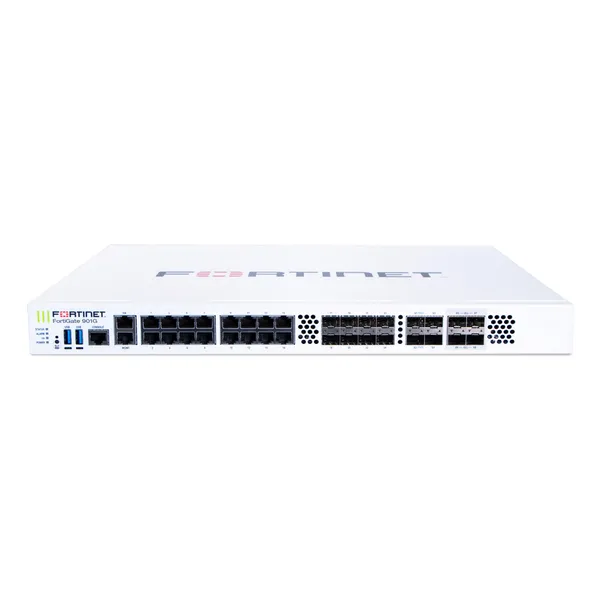
FortiGate 900G (FG-900G) Tanzania
FortiGate 900G is designed for organizations that need high-throughput network security without separating firewalling, secure networking and policy enforcement into disconnected platforms. The appliance combines FortiOS, Fortinet security processing technology and FortiGuard services to support enterprise perimeter security, segmentation, encrypted traffic inspection, secure SD-WAN, VPN and zero-trust access strategies. For Tanzanian organizations planning a headquarters refresh, data-center edge, large campus, aggregation point or hybrid-cloud security project, the FG-900G offers substantial interface density and security performance in a compact 1RU platform.
FortiGate 900G Overview and Verified Capabilities
Fortinet positions the FortiGate 900G Series as an AI/ML-enabled next-generation firewall family with deep visibility into applications, users and devices. The FG-900G uses Fortinet security processors and FortiOS to converge networking and security functions. According to Fortinet’s published specifications, the FG-900G provides firewall throughput up to 164 Gbps, IPS throughput of 42 Gbps, NGFW throughput of 31 Gbps and threat-protection throughput of 30 Gbps. Performance figures are vendor test results and should be interpreted against the intended policy set, traffic mix, inspection profile and enabled security services rather than treated as a guarantee for every production network.
Connectivity is suited to dense enterprise environments: the platform provides four 25GE SFP28 slots, four 10GE SFP+ slots, eight GE SFP slots, sixteen GE RJ45 switch ports, a dedicated management interface and a dedicated high-availability interface. Dual hot-swappable AC power supplies support resilient appliance design. Organizations should select optics, transceivers, cabling, rack power and upstream switching only after checking the exact bill of materials and deployment topology.
Use FortiOS policy, routing, segmentation and SD-WAN functions to bring connectivity and security decisions into one operational plane.
Plan SSL/TLS inspection carefully around privacy, certificate deployment, application behavior and the real throughput profile required by the organization.
ZTNA and identity-aware policy can help reduce broad network access by aligning application access with verified users, devices and policy context.
FG-900G Technical Planning Snapshot
| Form factor | 1RU rack-mount appliance |
| IPS throughput | 42 Gbps |
| NGFW throughput | 31 Gbps |
| Threat protection | 30 Gbps |
| High-speed interfaces | 4 × 25GE SFP28 and 4 × 10GE SFP+ |
| Additional data interfaces | 8 × GE SFP and 16 × GE RJ45 switch ports |
| Power | Dual hot-swappable AC power supplies on FG-900G |
Sizing should consider inspected throughput rather than raw firewall throughput alone. Capture WAN bandwidth, east-west traffic, expected growth, concurrent users and sessions, SSL inspection scope, VPN load, application control, IPS, malware protection, logging, redundancy and future connectivity before finalizing a design.
Deployment, Licensing and Procurement Guidance
A useful FG-900G quotation begins with the architecture rather than the appliance alone. Identify whether the firewall will be deployed as a single unit or high-availability pair; map internet, MPLS, leased-line, cloud and inter-site links; define the number and speed of copper and fiber connections; and document the optics required at each side. Security policy requirements should state whether IPS, application control, malware protection, web security, DNS security, sandboxing, ZTNA, centralized management or analytics are needed. FortiGuard and FortiCare choices should then be matched to those operational requirements and the desired support term.
For organizations replacing an existing firewall, migration planning should include object and policy review rather than blindly reproducing legacy rules. Remove obsolete services, identify shadowed policies, document NAT behavior, validate VPN peers, inventory certificates and confirm routing dependencies. High-availability deployments also need rack space, independent power paths where possible, compatible links and a tested failover procedure. A structured acceptance plan can cover routing, application access, VPN, logging, security inspection, SD-WAN behavior, failover and rollback.
FortiGate 900G (FG-900G) Tanzania
Organizations searching for FortiGate 900G in Tanzania are typically evaluating a firewall for a high-capacity enterprise edge, large headquarters, data-center perimeter, campus core security layer or consolidated WAN security design. The right starting point is to translate business connectivity into measurable technical requirements. Record present and expected internet bandwidth, private WAN capacity, inter-VLAN traffic that will traverse the firewall, VPN requirements, critical applications, public services, remote-user demand and expected growth. Then determine which traffic must receive IPS, malware inspection, application control or SSL inspection. This distinction matters because security services consume processing resources differently from basic stateful firewalling.
The FG-900G’s 25GE and 10GE interfaces can be useful where upstream switching, server aggregation or carrier handoffs exceed traditional 1GbE. Tanzanian buyers should verify the exact optical standards, transceiver types, fiber plant and switch compatibility before ordering accessories. A complete bill of materials may include the appliance, security and support subscriptions, transceivers, patching, rack accessories, management or analytics components and a second appliance where high availability is required. Avoid treating a bare hardware quote as equivalent to a production-ready security solution.
For geographically distributed Tanzanian networks, secure SD-WAN can combine application-aware path selection with security policy, while IPsec VPN can connect branches or partner environments. ZTNA can support more granular application access where identity and device context are part of the design. These capabilities still require careful architecture, policy governance and testing. FourTeck can be approached for a project quotation based on required interfaces, subscriptions, deployment model and support expectations rather than an unqualified stock or price assumption. For broader Fortinet project context, review FourTeck Fortinet solutions and use the Tanzania consultation path for a requirement-led proposal.
FortiGate 900G (FG-900G) Dar es Salaam
Dar es Salaam organizations evaluating the FG-900G may include enterprises with high user density, multi-building campuses, internet-facing services, large VPN populations or multiple carrier circuits. In these environments, firewall selection should be tied to peak traffic and security inspection rather than average internet usage. A design workshop should identify which applications are latency sensitive, which workloads are hosted locally or in cloud platforms, which networks require segmentation and whether internet links will operate active-active, active-standby or under application-aware SD-WAN rules.
The interface mix on the FortiGate 900G is relevant when a Dar es Salaam data center or head office uses a combination of copper access, 1GE fiber, 10GE aggregation and 25GE uplinks. Port count alone is not enough: confirm media type, connector standard, optics, link distance, LACP requirements and switch configuration. If the firewall is positioned between core and edge networks, model both north-south and any intended east-west traffic. If SSL inspection is planned, identify certificate distribution methods and exceptions for applications that cannot be transparently inspected.
Resilience planning is equally important. A high-availability pair can reduce dependence on a single firewall, but the surrounding design must also avoid single points of failure in switches, carrier links and power. Document HA heartbeat links, monitored interfaces, session behavior, routing convergence and operational procedures. Logging should be sized according to retention and investigation requirements, with centralized analytics considered where the security team needs longer history or cross-device visibility. A Dar es Salaam quotation request should therefore state appliance quantity, subscription term, required FortiGuard services, support expectations, optics, management needs and migration scope. This creates a clearer procurement comparison than asking only for an FG-900G unit price.
FortiGate 900G (FG-900G) Mwanza
For a Mwanza enterprise, the FortiGate 900G may be considered when network growth, centralized applications, branch connectivity or security inspection has moved beyond the capacity of smaller firewall platforms. Begin by measuring actual utilization on WAN and internal links and by identifying busy-hour patterns. Organizations with multiple sites should separate branch-to-headquarters traffic, internet breakout, cloud application traffic and backup or replication flows. This helps determine whether the FG-900G will serve primarily as an internet edge, VPN concentrator, segmentation firewall or a combination of roles.
Connectivity planning should account for the platform’s high-speed fiber interfaces while respecting the capabilities of existing switches and service-provider equipment. A 25GE-capable firewall does not create 25GE end-to-end performance when the upstream or downstream infrastructure is limited. Procurement teams should therefore request a topology review before finalizing transceivers and cables. Where multiple WAN circuits are available, secure SD-WAN policies can be designed around business intent such as application quality, path health and failover, but the actual rule set should reflect the characteristics of each circuit.
Security policy design for Mwanza deployments should classify applications and trust zones, minimize unnecessary inbound exposure and define how remote administration is protected. If site-to-site VPNs connect branches, document peer devices, encryption requirements, routing method and overlapping address risks. For remote users, define identity, MFA and application-access requirements before selecting the access approach. Maintenance planning should include configuration backups, firmware lifecycle procedures, security subscription renewals, log review and change control. When requesting an FG-900G proposal, include these operational needs together with expected bandwidth and growth so the quotation can address the complete security lifecycle rather than only initial hardware acquisition.
FortiGate 900G (FG-900G) Arusha
Arusha businesses considering FortiGate 900G may have mixed requirements spanning corporate users, guest networks, voice and collaboration systems, public-facing services, cloud applications and connections to other offices. Segmentation is a practical design priority in such mixed environments. Instead of placing all users and systems behind broad allow rules, define security zones for servers, administration, users, guests, operational systems and external services, then permit only required flows. This improves visibility and makes policy review more manageable.
The FG-900G can support high-speed network designs, but an effective project depends on how security profiles are applied. IPS, application control, web security and malware defenses should be aligned with risk and application behavior. SSL inspection requires additional planning because encrypted applications may need certificate trust, exceptions or compatibility testing. Pilot critical business applications before broad enforcement. For organizations that use cloud services heavily, also measure internet-bound traffic and consider whether direct cloud access, centralized breakout or SD-WAN policy best fits the operating model.
Arusha procurement teams should ask for a clearly itemized proposal. Hardware, support, security subscriptions, optics, deployment services and optional management or analytics should be distinguishable so renewal obligations are understood. If high availability is required, verify that the design includes two compatible appliances and the surrounding network paths needed to preserve service during a device or link event. Migration scope should identify whether existing rules, VPNs, objects and routes will be rationalized or simply transferred. A well-prepared quotation request can include a sanitized network diagram, bandwidth figures, interface schedule, current firewall model, required VPN count, security features and target implementation window, allowing the FG-900G solution to be evaluated against real operational needs.
FortiGate 900G (FG-900G) Dodoma
Dodoma organizations planning a FortiGate 900G deployment should place governance and continuity alongside throughput. Networks supporting administrative, institutional or enterprise services often have diverse user groups and systems with different sensitivity levels. Start by defining security zones and data flows, including internet access, public services, inter-department traffic, remote administration, branch connectivity and cloud services. Policy should be traceable to a business requirement, with unused or temporary rules reviewed rather than allowed to accumulate indefinitely.
Capacity planning should include both present demand and an evidence-based growth margin. Fortinet’s published FG-900G performance provides a useful reference, but production results depend on packet sizes, enabled inspection, encrypted traffic, policy complexity and traffic characteristics. If the firewall will terminate many IPsec tunnels or remote sessions, capture those requirements separately. If it will perform internal segmentation at multi-gigabit rates, measure east-west traffic rather than relying only on ISP bandwidth. The available 25GE and 10GE interfaces provide architectural flexibility when matched with suitable switching and optics.
Operational readiness is another procurement requirement. Decide who will administer policies, approve changes, monitor events, manage firmware and track subscription renewals. Centralized logging and analytics may be important for incident investigation or retention objectives. High availability should be tested under realistic failure scenarios, including link loss and device failover, and the organization should maintain documented rollback procedures. For Dodoma buyers, a useful FG-900G request for quotation therefore combines technical sizing, licensing, resilience, migration and ongoing support needs. This approach makes it easier to compare proposals on complete scope and reduces the risk of discovering missing optics, subscriptions or implementation tasks after the hardware has been selected.
FortiGate 900G (FG-900G) UAE
UAE projects involving the FG-900G often emphasize high-speed enterprise connectivity, resilient internet edges, data-center security and hybrid-cloud integration. The platform’s 25GE and 10GE interfaces make it relevant to environments where multiple high-bandwidth links converge, but correct sizing still depends on inspected traffic. Separate raw firewall requirements from IPS, NGFW and threat-protection requirements, then model SSL inspection, VPN and application control based on the intended policy. This prevents a headline throughput figure from becoming the sole design criterion.
For multi-site organizations, secure SD-WAN can be used to steer applications according to path quality and business policy while applying integrated security controls. Architecture should document carrier diversity, addressing, dynamic or static routing, cloud on-ramps and failover expectations. Where ZTNA is being considered, identify the applications to protect, identity sources, device posture expectations and user groups. A staged rollout is usually easier to validate than a broad access-model change introduced at the same time as a firewall migration.
Procurement should distinguish the FG-900G appliance from subscriptions and lifecycle support. Security service bundles can change the capabilities available to the deployment, so the bill of materials should be checked against required features and term length. Organizations with formal change windows should also include migration preparation, testing, rollback and post-cutover validation in the project plan. For regional projects, FourTeck UAE provides a relevant network reference, while Fortinet-focused FourTeck resources can support solution research. Tanzania-based requirements should still be quoted against the actual Tanzanian deployment scope rather than assuming that regional pricing, stock or service conditions are identical.
FortiGate 900G (FG-900G) Uganda
Ugandan organizations evaluating FortiGate 900G can use the same disciplined sizing process: map traffic, security services, interfaces, VPNs and growth before choosing the appliance and license term. The FG-900G is a substantial enterprise platform, so it is most appropriate where the workload can justify its security performance and port density. A headquarters with many branches, a large campus, a data-center edge or an organization consolidating multiple security and WAN functions may have a clearer use case than a small office with modest bandwidth.
For branch-heavy networks, consider how the central firewall will handle aggregate VPN traffic and whether internet access is centralized or locally broken out. Secure SD-WAN can support multiple transports and path-selection policy, but branch equipment, routing and application behavior must be considered as part of the same design. IP addressing and route summarization can become important as the site count grows. Security teams should also decide whether branch traffic needs the same inspection profiles as internet traffic or whether segmentation policies vary by site and application.
The procurement document should identify appliance quantity, high-availability requirement, FortiGuard services, FortiCare term, transceivers, centralized management, analytics and deployment assistance. Include the current network diagram and expected bandwidth at the central site. For projects spanning Tanzania and Uganda, regional coordination may benefit from FourTeck Uganda as a related regional resource, while the Tanzania contact path can be used for the Tanzanian portion. Do not assume that availability, delivery schedules or commercial terms are the same between countries; request a project-specific quotation with the destination and implementation scope clearly stated.
FortiGate 900G (FG-900G) Kampala
Kampala enterprise networks can generate concentrated traffic at headquarters, especially where branch VPNs, cloud access, internet browsing, voice, video and business applications converge. An FG-900G assessment should therefore look beyond ISP speed. Measure aggregate encrypted traffic, internal segmentation flows, peak sessions and application behavior. If the firewall will inspect traffic between internal zones, those flows may materially exceed internet bandwidth and should be included in the capacity model.
A resilient design should map two dimensions: firewall redundancy and path redundancy. Deploying two firewalls does not eliminate outages caused by a single upstream switch, carrier circuit or power dependency. Likewise, multiple carriers provide limited benefit if routing and SD-WAN policy are not tested under failure. Define which sessions must survive or quickly recover, how health checks determine path quality and how administrators will verify failover. For critical environments, schedule controlled tests rather than waiting for a real outage to reveal design gaps.
Security operations should be considered before purchase. Determine where logs will be stored, how alerts will be reviewed, who can make policy changes and how configuration backups are protected. If encrypted inspection is planned, create a certificate deployment and exception process. If remote users require application access, evaluate ZTNA or VPN according to identity, endpoint and application needs. Kampala buyers can prepare a stronger request by listing current firewall constraints, desired improvements, required ports, link speeds, security services, HA needs and subscription duration. This turns the conversation from a generic FortiGate 900G price request into an architecture and procurement exercise that can be validated against measurable requirements.
FortiGate 900G (FG-900G) Arua
An Arua deployment may involve a central organization that needs secure connectivity to other Ugandan sites, Tanzanian operations, cloud platforms or external partners. The FG-900G can act as a high-capacity policy and VPN point when the overall traffic profile warrants it. Start by documenting site-to-site connections, applications carried across each tunnel, expected aggregate throughput and failover behavior. Where address ranges overlap between organizations or acquired networks, identify the issue early because it can complicate routing and VPN design.
WAN resilience should reflect the circuits actually available to the site. Secure SD-WAN can make policy decisions using link health and application requirements, but the implementation should define realistic thresholds and recovery behavior. For example, a backup link may have lower capacity and should not automatically receive all traffic without prioritization. Critical applications can be identified separately from bulk transfers, updates or backups. Test the policy during both normal operation and simulated link degradation.
The FG-900G hardware offers extensive copper and fiber connectivity, but the project should only include optics and interfaces required by the topology. Confirm handoff types with carriers and switch vendors, and document whether links are 1GE, 10GE or 25GE. If high availability is planned, ensure both units have compatible connectivity and that surrounding equipment supports redundant paths. Arua procurement requests should also identify licensing term, security services, support expectations, logging, management and implementation scope. This prevents ambiguity about whether a quote covers hardware only or the complete operational solution. For cross-border organizations, country-specific commercial and delivery details should be requested separately rather than inferred from another market.
FortiGate 900G (FG-900G) Mbarara
Mbarara organizations considering the FG-900G should first decide the role the firewall will perform. A device at the internet edge has different traffic patterns from an internal segmentation firewall or a central VPN hub. Combining roles can be efficient, but it increases the importance of policy design, interface planning and capacity headroom. Build a traffic matrix showing sources, destinations, applications and inspection requirements, then estimate peak rather than average demand.
For networks modernizing from legacy firewalls, migration is an opportunity to simplify. Review old objects, duplicate rules, unused NAT entries, expired VPN peers and broad service groups. Recreate only justified access and establish naming standards that make future audits easier. Where application control or IPS is introduced more broadly, stage policy changes and monitor impact. Encrypted inspection should be tested with business-critical applications before enforcement across the entire user base.
Operational resilience should include more than an HA checkbox. Confirm rack capacity, power feeds, cabling, switch redundancy and management access during failures. Decide how configurations will be backed up and how firmware upgrades will be tested. If centralized analytics are required, include them in the architecture from the start so logging volume and retention can be planned. For an Mbarara quotation, provide the required appliance count, security bundle, subscription term, interfaces, transceivers, VPN needs and implementation expectations. Ask suppliers to identify assumptions and optional components clearly. This makes competing proposals easier to compare and helps avoid a low initial hardware price that omits subscriptions, optics or deployment work needed for a functional security platform.
FortiGate 900G (FG-900G) Gulu
Gulu buyers assessing FortiGate 900G can focus on scalability, secure connectivity and manageable operations. If the firewall will aggregate traffic from remote sites, calculate the combined bandwidth and session load rather than sizing from the Gulu site’s local internet circuit alone. Include backup, replication and cloud traffic that may run outside normal office hours but still affect security processing. If internal segmentation is part of the project, account for those flows as well.
A multi-WAN design should document the characteristics of every circuit, including bandwidth, latency expectations and intended role. Secure SD-WAN policies can then be aligned with application importance instead of simple primary/backup routing. For site-to-site VPN, decide whether dynamic routing is useful as the network grows and establish consistent encryption and key-management standards. Where remote access is required, integrate identity and MFA requirements into the design rather than adding them after rollout.
The hardware bill of materials should be verified against the physical environment. The FG-900G is a rack appliance with high-speed fiber options, so check rack space, power, cooling, switch interfaces and optical requirements. High availability may call for two appliances and redundant connectivity. Security subscriptions and support terms should match the organization’s desired protection and lifecycle. Gulu procurement teams should also define acceptance tests covering routing, internet access, VPN, security profiles, logging, SD-WAN and failover. A written acceptance checklist creates a clear finish line for implementation and helps operations staff understand how the new platform is expected to behave before it becomes a critical production dependency.
FortiGate 900G (FG-900G) Kenya
Kenyan enterprises researching FortiGate 900G may be comparing high-performance firewalls for headquarters, data centers, campus networks or regional hubs. A fair comparison should normalize the security workload. Compare IPS with IPS, threat protection with equivalent enabled services and SSL inspection under similar assumptions. Raw firewall throughput is useful for understanding the platform ceiling but does not represent every production policy. Fortinet’s published figures provide a starting point, while actual architecture should be validated against the organization’s traffic profile.
High-speed interface requirements deserve equal attention. The FG-900G includes 25GE SFP28 and 10GE SFP+ slots alongside GE fiber and copper connectivity. A Kenyan data-center project should map each interface to a switch, carrier or server zone and specify the required optic. If link aggregation is planned, confirm the design at both ends. For HA, document heartbeat connectivity and redundant upstream/downstream paths. A second firewall alone does not protect against all network or power failures.
Regional businesses operating between Kenya and Tanzania can standardize policy concepts while still treating each site’s bandwidth, carrier and compliance requirements independently. Centralized management and logging may simplify operations where multiple FortiGate appliances are deployed, but retention, access control and operational ownership should be defined. For Kenya-specific FourTeck information, see FourTeck Kenya. Tanzania procurement should use a separate project scope and quotation. In either market, include subscription duration, FortiGuard services, FortiCare level, optics, HA, migration and implementation in the request so the commercial comparison reflects the complete deployment rather than a standalone appliance.
FortiGate 900G (FG-900G) Kuwait
Kuwait organizations considering the FortiGate 900G may prioritize high-throughput inspection, resilient data-center connectivity and secure access to cloud and branch resources. The planning process should begin with application and traffic discovery. Determine peak internet use, east-west flows, VPN traffic and the proportion of encrypted sessions. Identify which security controls will be applied to each zone. This creates a workload model that can be compared with Fortinet’s published performance figures without assuming that every figure is simultaneously achievable under every policy configuration.
The FG-900G’s high-speed ports are useful where network cores and upstream services operate above 1GbE. Procurement teams should verify SFP/SFP+/SFP28 requirements, supported optics and cable distances. For high availability, plan redundant switch paths and power as well as the firewall pair. If the environment has strict maintenance windows, document the expected behavior during firmware upgrades and failover. Configuration backups and out-of-band management procedures should be established before the device becomes production-critical.
Security subscriptions are part of the solution design rather than an afterthought. Decide which FortiGuard capabilities are required and how long the organization wants the initial term to run. Also determine whether centralized management or analytics is needed for operational scale and log retention. Cross-regional buyers should avoid assuming identical commercial conditions between Kuwait, Tanzania and other markets. Request destination-specific pricing, licensing and implementation details. A well-structured FG-900G quotation request should include topology, bandwidth, interface schedule, security services, VPN counts, HA, support term and migration expectations, enabling a more accurate technical and commercial response.
FortiGate 900G (FG-900G) Ghana
Ghanaian organizations evaluating the FG-900G can treat it as an enterprise security platform whose suitability depends on workload and architecture. For a data-center edge, examine public application traffic, upstream bandwidth, DDoS strategy, segmentation and encrypted inspection. For a headquarters edge, include user internet access, SaaS, VPN and branch aggregation. For an internal segmentation role, measure east-west flows between server, user and restricted zones. These use cases can produce very different performance requirements even when the same firewall model is considered.
Network design should use the available 25GE, 10GE and GE interfaces intentionally. Create an interface schedule before ordering optics, and confirm the switch ports and fiber type at each endpoint. If multiple internet providers are used, secure SD-WAN can support path steering and failover, but health checks and business rules need to be designed and tested. Where site-to-site VPNs are numerous, consistent naming, addressing and routing standards can reduce operational complexity.
Procurement should account for ongoing security and support. FortiGuard services and FortiCare are typically evaluated as part of the required protection and support model, while centralized tools may be appropriate for larger estates. Document who will manage renewals, firmware, policy changes and incident investigation. Regional enterprises with both Ghana and Tanzania operations can refer to FourTeck Africa for broader regional context, while each country’s deployment should have its own scope. The final request for quotation should clearly separate hardware, subscriptions, optics, HA, professional services and optional management components so decision-makers can understand both initial and lifecycle requirements.
FortiGate 900G (FG-900G) Nigeria
Nigeria’s large enterprise environments can place significant demands on perimeter and data-center firewalls, especially when multiple sites, cloud services and high-capacity internet links converge. An FG-900G assessment should quantify peak bandwidth and security inspection by traffic class. Distinguish user internet traffic, server publishing, branch VPN, cloud connectivity, backups and internal segmentation. This makes it easier to decide where inspection is required and how much capacity headroom is appropriate for growth or failure scenarios.
The platform’s 25GE and 10GE interfaces can fit high-bandwidth aggregation designs, but the surrounding network must be engineered to match. Validate optics, switch capabilities, routing, link aggregation and redundancy. If a pair of FG-900G appliances is planned, define HA behavior and make sure both upstream and downstream paths can survive a device failure. For multiple carriers, secure SD-WAN can add application-aware steering, but policy should account for differences in circuit capacity and quality rather than treating all links as interchangeable.
Security operations can become the limiting factor in a large deployment if governance is weak. Define administrators and roles, change approval, backup, firmware procedures, logging, alert review and subscription renewal ownership. If SSL inspection is introduced, create a certificate and exception workflow. If ZTNA is part of the access strategy, identify protected applications and identity requirements before rollout. Nigeria-specific pricing and availability should be requested for that destination; Tanzania projects should be quoted separately. For regional planning, the FourTeck network can provide cross-market context, but procurement assumptions should always be confirmed for the exact country, scope and implementation schedule.
FortiGate 900G (FG-900G) Seychelles
Seychelles organizations considering the FortiGate 900G should evaluate whether the appliance’s enterprise-scale capacity aligns with the network’s actual role. A regional hub, data-center edge or organization with substantial inter-site and internet traffic may justify a high-performance platform, while smaller environments should avoid oversizing without a clear growth or consolidation case. Measure current throughput, peak sessions, VPN traffic and security inspection, then identify expected changes over the planned lifecycle.
Connectivity resilience can be especially important when applications depend on external cloud services or remote data centers. If multiple WAN paths are available, secure SD-WAN can apply health-aware routing and application policy. The design should define which applications receive priority and how traffic behaves when a higher-capacity link fails. VPN architecture should also account for headquarters, branch, cloud and partner connections, with consistent encryption and routing practices. If the firewall provides internal segmentation, include those flows in sizing.
The FG-900G’s fiber and copper interfaces allow flexible integration, but every optic and link should be verified before purchase. For high availability, plan redundant power and switching paths in addition to the firewall pair. Licensing and support should be selected according to required security services and operational expectations, and renewal dates should be tracked from deployment. Seychelles procurement teams can improve quote accuracy by providing a topology, bandwidth figures, interface requirements, required FortiGuard services, support term, HA preference and migration scope. Cross-border suppliers should be asked to state destination-specific commercial terms rather than relying on assumptions from another market.
Compatibility, Integration and Security Architecture
The FG-900G can participate in a broader Fortinet Security Fabric architecture and can be managed as part of an enterprise security estate. Integration planning should identify authentication sources, switches, wireless networks, cloud platforms, SIEM or logging systems, VPN peers and management tools. Compatibility should be validated against the exact software releases and feature requirements in use. For third-party systems, document standards-based dependencies such as routing protocols, VLANs, IPsec parameters, syslog and authentication rather than assuming interoperability from brand names alone.
Segmentation policy should reflect trust boundaries. Internet-facing servers, internal applications, management systems, users, guests and operational devices often warrant separate zones. A rule base should be explicit, logged where useful and periodically reviewed. Security profiles should be attached according to risk and traffic type. The goal is not to enable every feature everywhere, but to apply controls where they provide measurable security value while preserving application reliability and operational clarity.
FortiGate 900G Quotation Checklist
Decision Recap
FortiGate 900G is best evaluated as a complete enterprise security architecture rather than a standalone firewall appliance. Its 42 Gbps IPS, 31 Gbps NGFW and 30 Gbps threat-protection ratings, high-speed 25GE and 10GE interfaces, FortiOS secure networking, SD-WAN and ZTNA capabilities make it relevant to demanding environments. The final decision should be based on inspected traffic, interface requirements, resilience, licensing, operational ownership and growth. A project-specific bill of materials can then align hardware, subscriptions, optics and services with the intended deployment.
FortiGate 900G Frequently Asked Questions
What is the FortiGate 900G designed for?
It is a high-performance enterprise NGFW suited to demanding edge, campus, data-center and hybrid-network security roles where substantial inspected throughput and high-speed interfaces are required.
What are the published FG-900G security throughput figures?
Fortinet publishes 42 Gbps IPS, 31 Gbps NGFW and 30 Gbps threat-protection throughput for the FG-900G. Production results depend on configuration and traffic characteristics.
Does the FG-900G support 25 Gigabit Ethernet?
Yes. Fortinet lists four 25GE SFP28 slots and four 10GE SFP+ slots, in addition to GE fiber and copper interfaces.
Should I buy one FG-900G or an HA pair?
That depends on business continuity requirements. Critical environments often evaluate HA, but the design must also address redundant switches, links and power. A project review should determine the appropriate topology.
What information is needed for an accurate quotation?
Provide bandwidth, interface speeds, security services, VPN needs, HA requirement, subscription term, optics, logging or management requirements, migration scope and deployment destination.
Consult FourTeck Tanzania About FG-900G
Prepare your current topology, bandwidth figures, security requirements and desired subscription term before requesting a quotation. This allows the discussion to cover sizing, interfaces, licensing, HA, migration and support scope. FourTeck network resources for Tanzania, Kenya, Uganda, UAE and Africa can support regional solution discovery without implying identical availability or commercial terms in every market.

Reviews
There are no reviews yet.