
Industrial cybersecurity for demanding operational environments
FortiGate Rugged 60G (FGR-60G) Tanzania
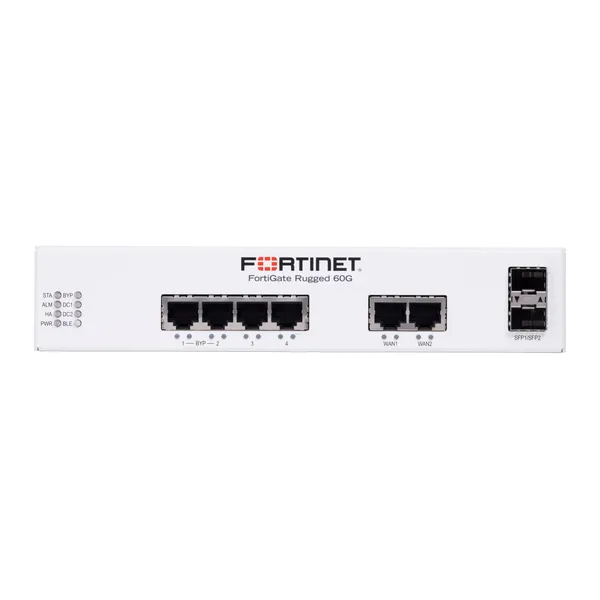
FortiGate Rugged 60G is a purpose-built Fortinet next-generation firewall for industrial and operational technology networks that need security controls close to machines, substations, transport systems, production assets and remote infrastructure. The FGR-60G combines FortiOS security and networking capabilities with ruggedized hardware intended for harsh environments, giving engineering and IT teams a practical platform for segmentation, protected connectivity, threat inspection, VPN and secure industrial edge design.
Fortinet purpose-built security processing architecture used by the FGR-60G.
Copper LAN/WAN interfaces for flexible industrial network connectivity.
Dedicated SFP slots support fiber-oriented network designs.
Fortinet-published threat-protection performance for the Rugged 60G family.
FortiGate Rugged 60G Overview
Industrial networks have different constraints from ordinary office networks. Equipment may operate for long periods, maintenance windows can be limited, legacy protocols can remain in use, and network devices may sit close to electrical, mechanical or transportation systems. Fortinet positions the FortiGate Rugged Series specifically for mission-critical industrial environments. For the FGR-60G, the current Fortinet Rugged product matrix identifies six GE RJ45 LAN/WAN interfaces, two dedicated GE SFP slots, an RJ45 serial interface, USB-A 2.0, an RJ45 console port, FortiSP5 processing, a Trusted Platform Module and a digital I/O module.
The platform is useful when an organization wants to place policy enforcement between industrial zones, protect an OT site’s connection to corporate or cloud resources, build encrypted links between facilities, or improve visibility at an industrial edge. Buyers should size the solution around inspected traffic, required security profiles, VPN load, network zones, port and fiber requirements, redundancy objectives, environmental conditions and the FortiGuard/FortiCare package rather than relying on raw firewall throughput alone.
Verified FGR-60G Hardware and Industrial Highlights
| Item | FGR-60G |
|---|---|
| GE LAN/WAN interfaces | 6 × RJ45 |
| Bypass GE port pair | PORT1–2 RJ45 |
| Dedicated GE SFP slots | 2 |
| Serial interface | 1 × RJ45 |
| Processor | FortiSP5 |
| TPM / Digital I/O | Supported |
| Industrial certifications | IEC 61850-3 and IEEE 1613 certified; rolling-stock environmental, shock and vibration certifications are also listed by Fortinet. |
These hardware characteristics make the appliance relevant where copper and fiber links coexist, serial-connected industrial equipment remains part of the environment, or bypass behavior and resilient edge design are important. Certification requirements should always be checked against the exact project specification and current Fortinet documentation before procurement.
OT Security, Segmentation and Integration
A strong FGR-60G design starts with network architecture. Industrial assets should be grouped into meaningful security zones according to function, trust, operational dependency and communication requirements. Firewall policies can then permit only necessary traffic between zones while logging and security inspection are applied according to risk and performance requirements. This approach is particularly useful when separating production cells, engineering workstations, supervisory systems, vendor access, corporate services and internet-facing connections.
FortiGate can also participate in broader Fortinet Security Fabric deployments. Organizations using FortiSwitch, FortiAP, FortiManager, FortiAnalyzer or FortiClient can evaluate how centralized policy, visibility, logging and access controls should fit the OT security program. The exact architecture depends on the site: a remote utility location may prioritize encrypted backhaul and resilient WAN, while a factory may prioritize east-west segmentation, controlled engineering access and visibility between production zones.
FortiGate Rugged 60G Tanzania
Tanzania organizations evaluating the FortiGate Rugged 60G commonly have a different requirement from a normal branch-office firewall project. Industrial cybersecurity can involve factories, processing facilities, utilities, transport infrastructure, mining operations, logistics sites, energy installations, water systems and remote technical facilities where the network is closely tied to physical operations. The FGR-60G gives these buyers a rugged FortiGate platform that can sit at an industrial edge while providing security policy enforcement, segmentation, VPN connectivity and FortiOS-based management.
For a Tanzania procurement exercise, the first step is to document the environment rather than simply request a firewall by model number. Record the number and type of copper and fiber connections, VLANs or security zones, WAN services, serial requirements, expected inspected traffic, remote-access needs, site-to-site VPN requirements, logging expectations and environmental constraints. The FGR-60G provides six GE RJ45 LAN/WAN interfaces and two dedicated GE SFP slots, so the physical design should be checked against the intended topology. Where additional switching is required, the firewall should be sized as the security gateway rather than expected to replace the full industrial switching layer.
Licensing is another important Tanzania buying consideration. The appliance and the security-service package are separate parts of the decision. FortiGuard services can add current threat intelligence and security functions, while FortiCare addresses support entitlement. The appropriate bundle and term depend on the organization’s security controls, operating model and renewal plan. Procurement teams should therefore request a quotation that clearly identifies hardware, subscription term, support term and any configuration or deployment scope instead of comparing only a single headline price.
For buyers planning a wider Fortinet architecture, review the FourTeck Tanzania technology portfolio for related network and security requirements. Regional teams can also compare East African procurement considerations through FortiGate firewall solutions in Kenya and Fortinet firewall options in Uganda. These links help multi-country organizations plan a more consistent security platform while keeping each site’s bandwidth, environmental and operational requirements distinct.
FortiGate Rugged 60G Dar es Salaam
Dar es Salaam buyers may consider the FGR-60G for industrial estates, port and logistics environments, manufacturing operations, warehouses with operational systems, energy-related sites and organizations that maintain technical infrastructure outside conventional office conditions. A typical project may need to protect the boundary between production or facility networks and business IT while retaining controlled communication with ERP, monitoring, cloud or remote-support systems.
The purchasing conversation should include more than internet bandwidth. Identify which assets communicate across the firewall, which protocols are essential, whether connections are copper or fiber, whether any serial integration is required and how maintenance access will be controlled. Where operational uptime matters, change windows and rollback procedures should be documented before policy migration. The FGR-60G’s bypass port pair can be relevant to some resilience designs, but the exact behavior and topology should be validated against Fortinet documentation and the project’s engineering requirements.
Security inspection should be introduced with awareness of operational traffic. Policies can be designed around known source, destination, service and application requirements, with unnecessary paths removed. Logging should provide enough evidence for troubleshooting and security monitoring without creating an unmanageable operational burden. If the project connects multiple facilities, IPsec VPN and SD-WAN capabilities can be assessed for protected site connectivity, but actual design choices depend on carrier links, latency, availability objectives and routing architecture.
A useful Dar es Salaam quotation request includes the exact FGR-60G model, required FortiGuard and FortiCare term, number of sites, WAN links, fiber transceiver requirements, intended security zones, VPN scope, installation responsibilities and expected handover documentation. This makes supplier comparisons more meaningful and reduces the risk of receiving quotes that look similar but contain different service entitlements or deployment assumptions.
FortiGate Rugged 60G Mwanza
In Mwanza, the FortiGate Rugged 60G can be evaluated for industrial, processing, logistics, utilities and remote-infrastructure projects where the firewall must operate as part of a broader operational network rather than as a simple office internet gateway. Organizations with distributed technical sites can use a rugged security gateway to create controlled boundaries between local operational assets and central applications, monitoring platforms or engineering teams.
Network discovery is especially important before deployment. Teams should map existing IP ranges, unmanaged or managed switches, industrial controllers, supervisory systems, engineering stations, cameras, telemetry equipment and upstream WAN connections. This inventory helps determine where segmentation is practical and which communications must remain uninterrupted. A phased policy approach can reduce migration risk: first establish visibility and known traffic paths, then progressively narrow access according to approved operational requirements.
The FGR-60G offers both RJ45 and SFP connectivity, which can help where an industrial site combines local copper runs with fiber uplinks. Buyers should still verify transceiver compatibility, distances, environmental requirements and downstream switching needs before ordering. If the project needs cellular connectivity, note that the standard FGR-60G is not the same as the FGR-60G-5G variant; the exact model must be selected according to the requirement rather than assuming an integrated modem is present.
Mwanza procurement teams should ask for clear line items covering the appliance, subscription services, support, accessories and professional services. They should also define who will own firmware planning, backups, configuration changes, monitoring and incident escalation after commissioning. A rugged firewall is most effective when hardware selection is matched with an operating process that keeps policies, subscriptions, administrator access and logs under deliberate control throughout the device lifecycle.
FortiGate Rugged 60G Arusha
Arusha organizations may need industrial-grade network security for production facilities, utilities, logistics operations, building and facility systems, remote technical locations or distributed infrastructure. The FGR-60G is relevant when conventional office firewall hardware is not the preferred form factor and the project calls for Fortinet security functions in a rugged platform designed for operational environments.
A good design begins by separating business requirements from technical controls. Business stakeholders may describe a need for reliable operations, secure vendor support or protection of production systems. The technical team should translate those needs into zones, approved communication paths, authentication requirements, VPN rules, monitoring, logging and recovery procedures. This makes the firewall policy understandable and auditable rather than building a collection of broad rules that become difficult to maintain.
For sites with engineering contractors or equipment vendors, remote access deserves particular attention. Avoid treating remote access as a permanent unrestricted path into the operational network. Instead, define who can connect, when access is allowed, which destination systems are reachable and how activity is logged. FortiGate capabilities can support secure connectivity, but identity architecture and operational approval procedures should be designed around the organization’s governance requirements.
When requesting an FGR-60G quotation in Arusha, provide expected traffic levels with security inspection enabled, number of zones, fiber and copper port needs, VPN requirements, management preference and desired FortiGuard/FortiCare duration. If centralized reporting or multi-site management is required, include FortiManager or FortiAnalyzer considerations in the architecture discussion. Clear requirements help ensure the selected hardware and subscriptions support the actual operational objective instead of focusing only on purchase price.
FortiGate Rugged 60G Dodoma
Dodoma deployments can involve public infrastructure, utilities, facilities, transport-related systems and distributed technical networks that benefit from stronger separation between operational assets and general-purpose IT. The FortiGate Rugged 60G can act as a security enforcement point at such boundaries, using FortiOS policy controls while providing ruggedized hardware characteristics intended for demanding environments.
Project teams should identify critical services before changing the network. Operational systems often rely on fixed addresses, legacy devices or communications that are poorly documented. Capturing existing flows and confirming them with system owners reduces the chance that a new firewall policy interrupts an essential process. After necessary traffic is understood, rules can be made more specific, administrative access can be restricted and logging can be aligned with monitoring and audit needs.
The FGR-60G includes a serial interface and digital I/O capability in addition to Ethernet connectivity, characteristics that distinguish it from many ordinary branch firewalls. Whether those interfaces are required depends on the project. They should not be included in a design merely because they are available. The same principle applies to security services: choose the FortiGuard functions that support the organization’s security plan and size performance around enabled inspection rather than theoretical maximum forwarding.
Dodoma buyers should request documented model identification, subscription duration, support entitlement, accessories, installation scope and configuration deliverables. For multi-site deployments, standard templates can improve consistency, but each location still needs site-specific addressing, routing, WAN and operational-system validation. The goal is a repeatable security architecture with enough local detail to protect availability and simplify future troubleshooting.
FortiGate Rugged 60G UAE
UAE buyers often evaluate rugged firewalls for utilities, oil and gas, transport, industrial automation, manufacturing, smart infrastructure and remote operational sites. The FGR-60G’s industrial positioning, FortiSP5 architecture, mixed copper/fiber connectivity and Fortinet security ecosystem make it a candidate for projects that need policy enforcement close to operational assets.
For GCC projects, environmental and compliance requirements should be reviewed line by line against the current Fortinet datasheet and the project specification. Fortinet lists IEC 61850-3 and IEEE 1613 certification for the FGR-60G, alongside regulatory and rolling-stock-related certifications. Buyers should confirm which standards are mandatory for the specific tender and avoid assuming that one industrial certification automatically satisfies every sector requirement.
Architecture planning should cover redundant power design, network paths, fiber optics, routing, security zones, VPN, management and logging. If the firewall is part of a larger Fortinet deployment, centralized administration and analytics can be considered to reduce policy drift across multiple industrial sites. For regional procurement and Fortinet-focused information, buyers can review FourTeck Fortinet UAE resources and FourTeck UAE technology solutions.
A UAE request for quotation should identify whether the requirement is specifically FGR-60G, FGR-60G-M12 or a 5G-equipped Rugged model, because these variants have different interfaces and connectivity characteristics. Include support term, security-service bundle, accessories and any commissioning requirement. Exact model discipline prevents a common procurement problem in which similar product-family names are treated as interchangeable even though the intended physical deployment requires a particular connector or modem option.
FortiGate Rugged 60G Uganda
Uganda organizations with industrial facilities, utilities, transport operations, distributed infrastructure and remote technical sites can evaluate the FGR-60G when they need a rugged Fortinet security gateway rather than a standard office appliance. The design objective may be segmentation of operational assets, protected communication to a central site, secure remote maintenance or improved visibility at the boundary between OT and IT.
The most important sizing input is the traffic that will actually cross the firewall with required inspection enabled. A plant network with many local machine-to-machine flows may send only a portion of traffic through the security gateway, while a hub design may concentrate multiple segments. Document these flows, VPN needs, internet paths and logging requirements before choosing subscription services and finalizing policy architecture.
Uganda projects can also benefit from a standardized regional approach if an organization operates across East Africa. Standard naming, administrator roles, backup processes and policy templates can reduce support complexity. However, each site should retain a validated local design covering addressing, ISP behavior, fiber/copper links, operational equipment and maintenance procedures. See FourTeck Uganda FortiGate guidance for a regional view of Fortinet procurement and firewall planning.
Before purchase, confirm exact model, required security services, FortiCare term, transceivers and installation responsibility. If integrated cellular connectivity is a requirement, specify that separately because the standard FGR-60G should not be confused with the FGR-60G-5G family. Accurate model selection at quotation stage avoids redesign and accessory changes during commissioning.
FortiGate Rugged 60G Kampala
Kampala-based engineering, utility and industrial teams may manage both city facilities and remote operational sites. The FGR-60G can serve as a consistent rugged firewall platform for locations where secure site connectivity, segmentation and controlled administration are more important than consumer-style gateway features. Its mix of RJ45 and SFP interfaces supports designs that connect local Ethernet equipment and fiber uplinks.
For a multi-site rollout, develop a baseline configuration with security zones, administrator controls, logging, time synchronization, update policy and backup procedures. Then adapt the baseline to each location’s IP addressing, WAN links and operational equipment. This approach can reduce configuration drift while still respecting the fact that OT networks cannot always be standardized as aggressively as office branches.
Kampala procurement teams should separate capital hardware from recurring subscriptions in their comparison. A low initial appliance price does not describe the full security lifecycle. Clarify FortiGuard services, FortiCare level and term, renewal responsibilities and any management or analytics licenses. If professional services are included, define whether they cover rack or panel installation, policy migration, VPN, testing, documentation, training and post-cutover support.
Where a project includes vendor remote access, build a controlled workflow rather than a broad permanent tunnel. Define identity, approval, permitted systems and logging. The FGR-60G provides the enforcement platform, while the organization’s operational process determines how safely privileged access is used. This combination of technology and governance is particularly important for industrial systems whose availability has direct business consequences.
FortiGate Rugged 60G Arua
Arua and surrounding remote-site deployments can place special emphasis on resilient connectivity, straightforward support procedures and secure links back to central systems. The FGR-60G can be evaluated for utility, logistics, energy, communications and technical infrastructure sites where the firewall must protect operational traffic in a rugged deployment context.
Remote sites should be designed for recoverability. Maintain configuration backups, document cabling and interface assignments, define who can make changes and establish a process for replacing hardware or restoring service. If WAN connectivity is intermittent, monitoring and log-forwarding architecture should account for periods when a central platform cannot be reached. Local operational continuity should not depend on constant cloud or headquarters connectivity unless the application explicitly requires it.
The standard FGR-60G has six GE RJ45 LAN/WAN ports and two dedicated GE SFP slots. These interfaces can support a compact industrial edge, but projects with many local devices will normally use appropriate switching downstream. Port count should therefore be planned around routed/security boundaries and uplinks, not the total number of endpoints at the site.
When obtaining a quote for Arua, include deployment location characteristics, power arrangements, WAN design, fiber requirements, security-service term and remote-support expectations. Ask for the exact model and accessories to be itemized. This creates a clearer basis for procurement and helps technical teams prepare the site before equipment arrives, reducing avoidable commissioning delays.
FortiGate Rugged 60G Mbarara
Mbarara industrial and distributed-business environments may use rugged network security at production, processing, utilities, warehouse or remote infrastructure locations. The FGR-60G provides a Fortinet platform for enforcing boundaries between operational systems and other networks while supporting secure connectivity and centralized security operations where required.
A practical deployment starts with a communications matrix. List each source zone, destination zone, required service and business owner. This is more useful than copying an office firewall policy into an OT environment. Operational networks benefit from deliberate allow rules because many devices communicate predictably. At the same time, legacy dependencies and maintenance tools must be identified before restrictive policies are activated.
For fiber-connected facilities, the two dedicated GE SFP slots may help integrate the firewall into existing topology. Confirm optic type and compatibility separately. For copper-connected zones, the six GE RJ45 interfaces offer flexibility, while the bypass port pair may be relevant to particular resilience strategies. Every such design choice should be tested against the actual failure scenarios the business wants to address.
Mbarara buyers should plan subscription renewal from the beginning. Security services and support should have an owner, budget and renewal calendar. Firmware maintenance also requires planning because industrial change windows may be infrequent. A documented lifecycle process makes the firewall a maintained security control rather than a one-time appliance purchase.
FortiGate Rugged 60G Gulu
Gulu projects can include remote infrastructure, logistics, utilities, processing operations and facilities that need protected communications to a central network. The FortiGate Rugged 60G is suited to evaluation where environmental robustness and industrial network positioning are part of the requirement alongside firewall, VPN and security inspection functions.
Site surveys should capture power, grounding, enclosure, temperature, cabling, fiber, WAN and maintenance-access requirements. Ruggedized hardware reduces some environmental concerns but does not remove the need for proper installation engineering. The device should be deployed within the conditions and electrical specifications documented by Fortinet, with accessories and power design selected for the project.
For secure branch or site connectivity, IPsec VPN can be combined with routing and policy controls so operational traffic reaches only approved central services. Where multiple WAN links exist, SD-WAN can be evaluated for path selection and resilience. The exact configuration should reflect application sensitivity, failover behavior and monitoring requirements rather than using a generic branch template without testing.
Gulu procurement requests should state whether the project is a new deployment, migration or replacement. Include existing firewall model, addressing, required downtime, VPN peers and subscription expectations. This context helps technical teams estimate configuration and migration work and allows commercial teams to quote the correct hardware and service scope.
FortiGate Rugged 60G Kenya
Kenya has a broad mix of manufacturing, logistics, utilities, transport, energy and distributed infrastructure use cases where rugged cybersecurity can be relevant. The FGR-60G can be considered when a Fortinet firewall must operate near operational systems and provide segmentation, secure site connectivity and threat controls without relying on an office-oriented hardware design.
Industrial firewall selection should consider the trust boundaries in the architecture. A perimeter connection to the internet is only one boundary; important controls may also be needed between corporate IT and OT, between production areas, or around sensitive supervisory and engineering systems. The FGR-60G can enforce these boundaries when routing and switching architecture sends the relevant traffic through it.
For organizations comparing options in Kenya, the FourTeck Kenya FortiGate firewall guide provides regional context for Fortinet model selection and security planning. An industrial buyer should additionally validate environmental certifications, port requirements and operational protocol needs against the Rugged Series documentation.
A procurement checklist should cover hardware model, FortiGuard package, FortiCare term, optics, power accessories, management and analytics requirements, configuration, testing and documentation. If the firewall will be standardized across several plants or sites, request a reference architecture and repeatable configuration approach while keeping enough flexibility for local operational differences.
FortiGate Rugged 60G Kuwait
Kuwait industrial projects in energy, utilities, transport, manufacturing and critical facilities may require cybersecurity appliances that combine enterprise security functions with hardware intended for harsh operational environments. The FGR-60G’s Rugged Series positioning makes it relevant for such designs, particularly where Fortinet is already part of the wider network or security architecture.
Environmental suitability should be checked alongside cybersecurity features. Review project requirements for temperature, power, shock, vibration, electromagnetic conditions and industry standards, then compare them with the latest Fortinet datasheet. Procurement should preserve the exact model because the Rugged family includes variants with different connector and cellular options.
Security architecture can include segmentation, VPN, application control, intrusion prevention and centralized visibility. However, inspection settings should be selected based on the traffic and operational risk. Some industrial protocols and legacy devices require careful testing before deeper inspection or policy changes are introduced. A staged commissioning plan with operational stakeholder sign-off is preferable to an abrupt policy cutover.
Kuwait buyers should ask for a complete commercial breakdown including appliance, subscriptions, support and professional services. If the project has tender compliance requirements, request current vendor documentation for each claimed certification. This ensures technical evaluation is based on traceable evidence rather than reseller descriptions alone.
FortiGate Rugged 60G Ghana
Ghana industrial and infrastructure organizations can consider the FGR-60G for secure connectivity at production, utility, energy, logistics and remote operational locations. The device can provide a controlled boundary between OT assets and external networks while supporting Fortinet security services and encrypted communications.
For remote or distributed sites, standardization can simplify administration. Common interface naming, policy conventions, VPN templates and backup procedures reduce support effort across locations. At the same time, each site should be surveyed for WAN quality, fiber/copper topology, local operational systems and maintenance requirements before the template is applied.
The six GE RJ45 interfaces and two GE SFP slots provide useful flexibility for a compact industrial gateway. Buyers should map each interface to a clear security role and avoid creating unnecessary flat networks. If additional endpoint density is required, use appropriate industrial switching and keep the firewall focused on routed boundaries and security enforcement.
A Ghana quotation request should include subscription duration, FortiCare support, security services, accessories, configuration scope and expected documentation. Organizations with compliance requirements should also define logging retention and reporting needs so management and analytics components can be included where necessary. This produces a more complete lifecycle cost and deployment plan than comparing appliance-only pricing.
FortiGate Rugged 60G Nigeria
Nigeria has extensive energy, industrial, manufacturing, logistics and infrastructure environments where OT cybersecurity is an important design concern. The FortiGate Rugged 60G can be evaluated as a rugged NGFW for segmenting operational networks, protecting site communications and enforcing policy between industrial and enterprise systems.
Large or distributed organizations should decide whether the FGR-60G will be managed locally, centrally or through a hybrid operating model. Central policy and logging can improve consistency, but site teams still need documented recovery procedures and sufficient access to restore operations during connectivity problems. Administrator privileges should be limited according to role and changes should be tracked.
When sizing the firewall, consider security inspection and VPN throughput rather than only raw packet forwarding. Fortinet publishes multiple performance measures for the Rugged Series, including threat-protection figures. Actual performance varies with traffic profile, packet size, enabled features and configuration, so engineering headroom should be part of the design.
Nigeria procurement teams should specify exact model, quantity, subscription bundle, term, support, optics, power accessories and services. If the site has cellular-backup requirements, verify whether a cellular Rugged variant or separate connectivity device is required; do not assume the standard FGR-60G includes a 5G modem. Precise requirements reduce commercial ambiguity and help ensure the delivered platform matches the intended architecture.
FortiGate Rugged 60G Seychelles
Seychelles organizations operating utilities, transport, hospitality infrastructure, marine-related facilities or remote technical sites may need secure network boundaries in environments where reliability and manageable remote administration are important. The FGR-60G can be considered for these industrial-edge roles when its interfaces and environmental specifications match the project.
Island and remote-site logistics make planning particularly valuable. Confirm all required optics, cables, power accessories and subscription entitlements before deployment. Keep current configuration backups and document interface assignments so replacement or recovery can be handled efficiently. Remote management should be protected through appropriate administrative controls and secure connectivity.
If a site depends on more than one WAN path, evaluate routing and SD-WAN behavior against real carrier characteristics and application needs. Critical operational traffic may require different failover priorities from general business traffic. Testing should include link loss, restoration and VPN behavior so the organization understands what happens during outages rather than discovering failover behavior during an incident.
For procurement, request the exact FGR-60G model with FortiGuard and FortiCare options shown separately. Include installation and commissioning requirements if local technical resources are limited. A complete bill of materials and documented handover can be more valuable than an appliance-only purchase because it reduces uncertainty during deployment and future support.
Licensing, FortiGuard and Lifecycle Planning
The FGR-60G hardware provides the platform, while FortiGuard services and FortiCare support determine important parts of the security and support lifecycle. Buyers should select service bundles according to required protections, organizational policy and renewal planning. Security subscriptions should be kept current when the design depends on updated threat intelligence, filtering or prevention services.
Firmware management is equally important. OT environments often have restricted maintenance windows, so upgrades should be planned, tested and documented. Keep configuration backups, review release notes, confirm compatibility with management platforms and schedule changes with operational stakeholders. High availability, redundancy and rollback procedures should be designed according to the business impact of downtime.
FGR-60G Buying and Quotation Checklist
✓ Exact model and quantity
✓ Copper and fiber interface plan
✓ Security zones and VLANs
✓ WAN links and VPN peers
✓ Inspected traffic requirement
✓ FortiGuard service bundle
✓ FortiCare term
✓ Optics and accessories
✓ Power and installation conditions
✓ Central management requirement
✓ Logging and reporting scope
✓ Migration and cutover work
✓ Documentation and training
✓ Renewal ownership
Frequently Asked Questions
What is the FortiGate Rugged 60G used for?
It is a ruggedized Fortinet next-generation firewall intended for industrial and operational technology environments. Typical roles include OT/IT segmentation, industrial edge security, secure site connectivity, VPN and policy enforcement around mission-critical networks.
Does the standard FGR-60G include 5G cellular?
The standard FGR-60G should not be confused with the FGR-60G-5G family. If integrated cellular connectivity is required, specify that requirement and verify the exact Fortinet model before ordering.
How many network interfaces does FGR-60G have?
Fortinet’s current Rugged product matrix lists six GE RJ45 LAN/WAN interfaces and two dedicated GE SFP slots, plus serial, console and USB connectivity.
Which industrial certifications are listed for FGR-60G?
Fortinet lists IEC 61850-3 and IEEE 1613 certification and also documents rolling-stock environmental, shock and vibration certifications. Tender requirements should always be checked against the latest official datasheet.
What should be included in an FGR-60G quote?
Request the exact appliance model, quantity, FortiGuard bundle, FortiCare term, required optics and accessories, management or analytics components, and any configuration, migration, testing or documentation services.
Decision Recap
Choose the FortiGate Rugged 60G when the project requires Fortinet security capabilities in a rugged industrial form factor and its verified interface, performance and certification profile fits the site. Confirm topology, environmental requirements, inspection load, subscriptions and lifecycle responsibilities before procurement. For standard office branches without industrial requirements, compare conventional FortiGate models rather than assuming a rugged platform is necessary.
Plan Your FGR-60G Deployment
Share the site type, number of security zones, WAN links, copper and fiber requirements, expected traffic, VPN needs and desired FortiGuard/FortiCare term. FourTeck can use these inputs to prepare a more relevant commercial and technical discussion for your industrial firewall project.




Reviews
There are no reviews yet.