
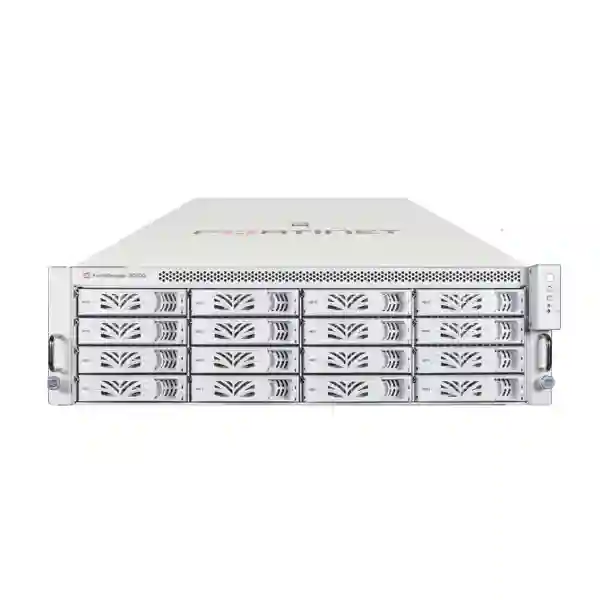
FortiManager FMG-3100G Tanzania
FortiManager FMG-3100G is designed for organizations that need a dedicated platform to standardize, automate and govern management across large Fortinet estates. Fortinet specifies 4,000 devices or VDOMs by default, expansion to 8,000 with supported device add-on licensing, 64 TB of raw SAS self-encrypting disk storage plus 3.84 TB NVMe SSD, and high-speed 25GbE connectivity. For enterprises, service providers, financial institutions, government environments, universities, healthcare groups and multi-country businesses, the practical value is centralized operational control: administrators can work from a common management plane instead of treating every firewall or security domain as an isolated configuration project.
Raw storage using 16 × 4 TB SAS SED HDD, with 56 TB usable after the default RAID 50 arrangement.
Fortinet lists a sustained log rate of 150 and 10 GB/day for this model in the current FortiManager data sheet.
Redundant hot-swap power supplies support enterprise rack designs where serviceability and continuity matter.
Trusted Platform Module support is listed for the FMG-3100G, alongside removable drives and platform sensors.
What FortiManager FMG-3100G solves
Large security estates create an operational problem long before they create a hardware problem. As branches, data centers, cloud-connected sites, subsidiaries and virtual domains multiply, policy consistency becomes harder to maintain. Administrators can spend significant time repeating changes, checking configuration differences, coordinating firmware activity, validating objects and documenting what changed. FortiManager is Fortinet’s centralized management platform for this type of environment. The FMG-3100G provides a dedicated hardware platform for teams that want substantial device capacity, local storage, rack-based deployment and a management architecture that can grow beyond a few hundred appliances.
A well-planned FortiManager deployment can help security teams organize devices into administrative domains, establish repeatable policy workflows, standardize object naming, control administrator permissions and maintain a clearer record of changes. This does not eliminate the need for network design or change control. Instead, it gives those processes a central operational system. Buyers should therefore evaluate the FMG-3100G as part of a management architecture rather than as a standalone box. Device count, VDOM count, ADOM structure, FortiOS versions, administrative teams, high-availability requirements, logging expectations, backup policy and support subscriptions all influence the final design.
Verified FMG-3100G technical specifications
| Specification | FortiManager FMG-3100G |
|---|---|
| Default devices/VDOMs | 4,000 |
| Maximum devices/VDOMs | 8,000 with supported device add-on license |
| Storage capacity | 64 TB (16 × 4 TB) SAS SED HDD + 3.84 TB (2 × 1.92 TB) NVMe SSD |
| Usable storage after RAID | 56 TB |
| Default RAID | RAID 50 |
| Supported RAID | RAID 0/1, 1s/5, 5s/6, 6s/10/50/60 |
| Interfaces | 2 × GbE RJ45, 2 × 25GbE SFP28 |
| Console | DB-9 |
| Form factor | 3RU rackmount |
| Dimensions | 13.0 × 44.0 × 65.0 cm |
| Weight | 31.57 kg |
| Power consumption | 395 W average / 510 W maximum |
| Operating temperature | 0°C to 40°C |
Capacity should be validated against the current Fortinet data sheet and ordering guide at procurement time because licensing, bundles and platform specifications can change.
Licensing, ADOM and support planning
Fortinet’s current ordering guide lists 4,000 default devices/VDOMs for the FMG-3100G and a maximum of 8,000 with supported add-on licensing. It also lists 4,000 default ADOMs and expansion to 8,000 with add-on licensing. These figures are useful for initial sizing, but procurement should not stop at the appliance model. The quote should identify the hardware, applicable FortiCare support term, any device or ADOM expansion requirement, optional services, and the intended software lifecycle. Fortinet also lists FortiAI Assistant subscription availability for the platform. Organizations should confirm whether such optional services are required rather than assuming they are included.
For change-controlled enterprises, support planning should align with internal maintenance windows, upgrade governance and incident escalation. A three- or five-year planning horizon can simplify budgeting, but the correct term depends on the organization’s refresh cycle and procurement policy. If the environment contains several FortiOS branches or separate business units, ADOM design should be decided before onboarding thousands of devices. This is especially important when operational teams have different permissions or when policies must be separated by geography, customer, subsidiary or lifecycle stage.
Deployment and integration guidance
Management architecture
Document device groups, ADOM boundaries, administrator roles, naming standards and approval workflows before mass onboarding. Centralization is most effective when operational standards are agreed before migration.
Rack and power
Allow 3RU of rack space, front-to-back airflow, suitable power feeds and cabling for redundant hot-swap power supplies. Verify data-center cooling against the published maximum power and heat profile.
Network paths
Plan resilient management connectivity between FortiManager and managed devices. The 25GbE interfaces provide high-speed attachment options, but interface speed alone does not replace routing, redundancy and management-plane security design.
Operational migration
Onboard in controlled waves. Validate policy packages, objects, revision history, administrative permissions, backups and rollback procedures before scaling the migration across the full estate.
FortiManager FMG-3100G Tanzania
For Tanzanian organizations operating many Fortinet security devices, the FMG-3100G is relevant when management scale, governance and repeatability are more important than managing each firewall individually. A national enterprise may have a head office, regional branches, warehouses, customer-facing sites, data-center services and remote locations connected through different carriers. Each location can introduce firewall policies, VPN definitions, address objects, administrator accounts and firmware requirements. As this estate grows, configuration consistency becomes a measurable operational requirement. The FMG-3100G provides the capacity to manage 4,000 devices or VDOMs by default, which positions it for large environments rather than ordinary single-site deployments.
Procurement in Tanzania should begin with an inventory rather than only a model request. Count physical Fortinet devices and VDOMs, identify current FortiOS versions, separate production from test environments, document branch growth plans and decide how many administrative domains are required. A business expecting acquisitions or rapid branch expansion should also consider the licensed path to 8,000 devices/VDOMs. The appliance’s 64 TB raw storage and redundant power design make rack planning important: buyers should confirm rack depth, power feeds, cooling, management network connectivity and change-control procedures before installation.
FourTeck Tanzania’s verified contact page invites buyers to provide user or device quantities, existing infrastructure, site type and desired outcome when requesting a quotation. That approach is particularly useful for FortiManager because the correct commercial package depends on more than the hardware SKU. Share the current FortiGate estate, expected device growth, ADOM requirement, support term, high-availability expectations and any integration with FortiAnalyzer or automation processes. For broader firewall architecture, review FourTeck Tanzania business technology solutions, which explains the site’s firewall, VPN, network and integrated infrastructure planning scope.
FortiManager FMG-3100G Dar es Salaam
Dar es Salaam organizations with large branch networks, financial operations, logistics systems, telecom infrastructure, hospitality groups or managed security environments can use centralized management to reduce the operational friction created by repeated firewall administration. The FMG-3100G is not intended merely to replace a web interface on one FortiGate. Its value appears when teams need consistent policy deployment, controlled revisions and structured administration across hundreds or thousands of managed domains. In a headquarters-led design, the platform can become a central point for configuration governance while branch firewalls continue to enforce security at their respective sites.
A Dar es Salaam deployment should consider the management network separately from ordinary user traffic. Determine where the appliance will be hosted, how managed sites reach it, which administrators can access it, and how management traffic is protected. For an enterprise data center, verify the 3RU footprint, 65 cm chassis length, redundant power arrangement, front-to-back airflow and maximum 510 W power specification against the rack and facility plan. The 2 × 25GbE SFP28 ports can support high-speed data-center connectivity, while the two GbE RJ45 ports provide additional interface options. Exact transceiver and cabling choices should be validated for the final topology rather than assumed from the port type.
Before requesting a Dar es Salaam quotation, provide a device/VDOM count, current FortiManager status if migrating, expected growth over the support term, ADOM design, FortiOS version mix and preferred support period. If FortiAnalyzer is part of the security operations design, document which functions belong on each platform so management and analytics requirements are not conflated. FourTeck’s Tanzania contact and quotation page specifically asks firewall buyers to share internet, VPN, branch and infrastructure context, helping turn a model request into a better-scoped project discussion.
FortiManager FMG-3100G Mwanza
Mwanza-based enterprises can encounter a different management challenge from a single metropolitan campus: remote branches and operational sites may depend on varied WAN links, local IT resources and maintenance windows. Centralized management helps a core security team establish a repeatable operating model even when sites are geographically distributed. For businesses in manufacturing, distribution, education, healthcare, retail or regional services, this can mean maintaining common firewall objects, standardized policy packages and clearer configuration history while allowing controlled exceptions where a branch has a genuine local requirement.
The FMG-3100G’s scale should be justified by the actual estate. An organization with only a small number of firewalls may be better served by another FortiManager model, VM or cloud option, while an enterprise planning thousands of devices or VDOMs can benefit from the dedicated capacity of the 3100G. Sizing should therefore include current and projected counts rather than selecting the largest appliance by default. Buyers should also map administrative responsibilities: a central security team may own policy standards while local administrators receive limited permissions for monitoring or site-specific tasks. ADOM structure can help separate operational boundaries when planned correctly.
For Mwanza procurement, include the data-center location, rack and power readiness, device inventory, planned branch additions, support term and deployment responsibilities in the request for quotation. If implementation will occur in phases, identify the first migration group and the success criteria before moving to the next. A disciplined pilot can validate connectivity, policy installation, revision management and rollback. The result is a safer path to centralized control than attempting to onboard a large estate in one change window.
FortiManager FMG-3100G Arusha
Organizations in Arusha that coordinate hospitality, tourism, education, international programs, professional services or distributed branch operations may need security policies to remain consistent across locations that have different user populations and connectivity profiles. FortiManager can provide a common administrative layer for Fortinet devices while preserving structured separation through administrative domains. The FMG-3100G is particularly relevant when the organization expects substantial scale, because its default capacity of 4,000 devices/VDOMs is far beyond the requirements of a typical single-office deployment.
A strong Arusha design begins with policy ownership. Decide which rules are global, which objects should be standardized, which locations require exceptions and who can approve changes. Central management is most valuable when it supports a clear operating process. It should not become a mechanism for pushing unreviewed changes faster. Use revision history, controlled administrator roles, backup routines and maintenance windows as part of the deployment plan. When branches use different FortiOS releases, confirm version compatibility and ADOM strategy before migration so that policy workflows remain predictable.
Physical deployment also deserves attention. The FMG-3100G weighs about 31.57 kg and occupies 3RU, so rack installation should be planned as data-center equipment rather than treated like a small network appliance. Confirm rack support, airflow, dual power availability and service access for removable drives. Organizations requesting an Arusha quote should provide the appliance quantity, support term, expansion expectations and any associated Fortinet management components. The verified Tanzania contact page lists Arusha among its office contacts and provides the central enquiry path for product selection and quotation discussions.
FortiManager FMG-3100G Dodoma
Dodoma enterprises and public-sector environments can use centralized management to strengthen consistency across distributed security infrastructure, particularly where change approval, administrator separation and documentation are important. A large Fortinet estate may contain branch firewalls, virtual domains, data-center gateways and specialized security segments. Without a central process, teams can accumulate configuration drift: similar sites end up with different object names, policy order, firmware levels or VPN settings. FortiManager is designed to give administrators a common platform for managing this complexity.
For projects with formal governance requirements, the FMG-3100G should be integrated into the organization’s change-management procedure. Define who can create policy changes, who reviews them, how changes are scheduled, what evidence is retained and how rollback is handled. Administrative domains can support separation between environments, but the design should follow the actual organizational structure and software compatibility requirements. Capacity planning should include both devices and VDOMs because Fortinet counts each VDOM on a physical or virtual device as a licensed network device for the published capacity figures.
Dodoma buyers should also distinguish centralized management from centralized analytics. FortiManager has logging capabilities, but organizations with extensive analytics, reporting or long-term log requirements may need to assess FortiAnalyzer separately. The procurement checklist should therefore state the desired operational outcomes rather than simply naming appliances. Provide current device counts, projected growth, management workflows, reporting requirements, support period, rack environment and connectivity design. The FourTeck Tanzania contact page identifies Dodoma among its listed office locations and can be used to begin a scoped quotation discussion.
FortiManager FMG-3100G UAE
UAE enterprises often operate dense multi-site networks spanning headquarters, branches, retail locations, hospitality properties, warehouses, data centers and cloud-connected workloads. In this environment, centralized security administration can reduce repetitive device-by-device work and support common policy standards across business units. The FMG-3100G offers a hardware option for organizations that prefer a dedicated rack appliance and require the scale of thousands of devices or VDOMs. Its 25GbE interfaces are especially relevant to data-center designs where the management platform connects into high-speed switching infrastructure.
Commercial planning should separate hardware capacity from licensing and support. Fortinet’s ordering guide lists 4,000 default devices/VDOMs for the 3100G and expansion to 8,000 with supported add-on licensing. Organizations should confirm the exact bill of materials for their required term, including FortiCare and any optional service. If a group manages security across several countries, ADOM design can reflect operational separation, but it should be based on administrative and versioning needs rather than geography alone. A central team can use standardized policy packages while delegated teams receive permissions appropriate to their responsibilities.
For UAE procurement and specialist Fortinet context, FourTeck’s Fortinet UAE specialist site is the most relevant network link. When requesting the FMG-3100G, provide the number of managed devices and VDOMs, data-center location, rack readiness, software versions, high-availability expectations, support term and whether the project includes migration from an existing FortiManager platform. This information makes it easier to validate fit and avoid purchasing capacity that does not match the operational design.
FortiManager FMG-3100G Uganda
Ugandan organizations with distributed FortiGate deployments can use FortiManager to coordinate policy and configuration from a central platform while maintaining local enforcement at branches. The FMG-3100G is most appropriate when the scale is genuinely large or when the organization is building a regional management hub. A bank, telecom operator, large retailer, government environment, managed service provider or enterprise group may have hundreds of sites and multiple VDOMs per appliance, making the licensed count grow faster than the physical firewall count.
The first sizing exercise should therefore count VDOMs as well as hardware. Fortinet’s current documentation states that each VDOM operating on a physical or virtual device counts as one licensed network device. This detail can materially affect model selection. Teams should also review how many ADOMs they need, whether separate business units run different FortiOS versions, and how policy packages will be organized. If a deployment starts below the 4,000-device default capacity but expects major growth, the supported path to 8,000 can provide expansion headroom, subject to the appropriate add-on license.
For Uganda-focused Fortinet product context, visit FourTeck Uganda. A quotation request should state whether the requirement is appliance-only, appliance plus FortiCare, migration and configuration, or a broader management project. Include branch count, VDOM count, current FortiManager version if any, FortiOS mix, planned growth and data-center requirements. This avoids treating a high-capacity management appliance as a commodity purchase without the deployment information needed to use it effectively.
FortiManager FMG-3100G Kampala
Kampala can serve as the operational center for organizations that manage security infrastructure across Uganda and neighboring markets. A centralized FortiManager deployment can support this model by giving the security team a common place to manage devices, policy packages, objects and revisions. For large environments, the FMG-3100G provides substantial capacity while retaining the operational characteristics of a dedicated hardware appliance: local storage, redundant hot-swap power supplies, removable drives and high-speed network interfaces.
Before deploying in a Kampala data center, confirm physical and logical prerequisites. The chassis is 3RU and approximately 65 cm deep, with front-to-back airflow. Power planning should account for a published average consumption of 395 W and maximum of 510 W. Network planning should identify which interfaces connect to management networks, how remote sites reach the platform and how access is restricted. Management traffic should not be exposed casually to the public internet; secure routed connectivity, VPN architecture or other controlled paths should be designed according to the organization’s security model.
Operationally, use a phased onboarding process. Begin with representative devices, validate policy import and installation behavior, confirm administrator permissions and establish backup and recovery procedures. Only then expand to larger site groups. Kampala procurement teams should request an itemized commercial proposal showing the FMG-3100G hardware, support term and any required add-on licensing. If professional services are needed, define whether the scope includes architecture, migration, policy cleanup, onboarding, testing, documentation and administrator knowledge transfer.
FortiManager FMG-3100G Arua
Arua-based branches are more likely to consume centralized FortiManager services than to host an FMG-3100G locally, unless the organization has a specific regional data-center requirement. This distinction matters for buying decisions. The management appliance can be placed in a central facility while FortiGate devices at remote sites communicate with it over appropriately secured network paths. The operational benefit for a remote site is that policy standards, configuration changes and administrative controls can be coordinated by a central security team without requiring every change to be performed independently at the branch.
For organizations with sites in Arua and other Ugandan cities, WAN reliability and maintenance procedures should be part of the management design. Administrators should understand what happens if a branch temporarily loses connectivity to FortiManager and ensure local firewall operation remains aligned with the intended architecture. Change windows should consider branch connectivity, business hours and rollback procedures. Standardized site templates can reduce mistakes, but each location’s WAN addressing, local networks and required services must still be documented accurately.
When a procurement team includes Arua sites in an FMG-3100G project, it should provide the total estate count rather than asking for one management appliance per branch. State how many sites exist, how many VDOMs are used, which policies are common, which sites require exceptions and what growth is expected. This helps determine whether the 3100G’s scale is appropriate and whether centralized management should be combined with separate analytics or monitoring platforms. A clear inventory is more useful than a generic request for “FortiManager for branches.”
FortiManager FMG-3100G Mbarara
Mbarara branches in a national enterprise can benefit from centrally governed firewall configuration while keeping local security enforcement close to users and applications. Retail groups, healthcare networks, education organizations and logistics operations often repeat similar branch designs. FortiManager can help administrators turn that repetition into a controlled standard by using consistent objects, policy structures and change workflows. This reduces the risk that each branch becomes a unique configuration that is difficult to audit or support.
The FMG-3100G is sized for large aggregate estates, so its business case should be calculated across the organization. A company might have a modest number of physical appliances but many VDOMs, or it may be planning significant expansion over several years. Since the published default capacity is 4,000 devices/VDOMs, buyers should compare that scale with their realistic growth plan. Over-sizing can consume budget unnecessarily, while under-sizing can create a future migration project. The goal is a management platform aligned with the lifecycle of the security estate.
For Mbarara site planning, document the branch firewall model, WAN connectivity, VPN topology, local subnets and any site-specific policy requirements. For the central FMG-3100G, document rack, power, storage, backup and administrator access requirements. During onboarding, verify each branch after policy installation rather than assuming a successful central job means every business service is working. Test critical applications, VPN paths and management connectivity, then record the validated configuration. This operational discipline is what converts centralized tooling into reliable security management.
FortiManager FMG-3100G Gulu
Gulu locations can fit into a centralized Fortinet operating model where branch firewalls are managed from a main security operations or network team. The practical objective is consistency: similar sites should not accumulate different firewall objects, undocumented local changes or outdated policies simply because they are geographically distant. FortiManager provides the platform for central control, while internal procedures determine how effectively that capability is used.
A useful rollout pattern is to classify branches by design. For example, small offices may share one standard policy package, larger regional sites another, and data-center or public-service locations a separate structure. Site-specific values can then be managed without duplicating every rule manually. Before adopting this model, the security team should review existing configurations and remove unnecessary differences. Migrating inconsistent configurations into a central manager without cleanup can preserve the same complexity in a new interface.
For a Gulu-inclusive FMG-3100G project, procurement should ask the technical team for a full inventory and migration scope. The commercial request should specify the appliance, support period, any device/ADOM expansion licensing and required implementation services. The technical scope should cover connectivity, ADOM design, policy packages, object standards, administrator roles, backups, pilot migration, testing and documentation. Separating commercial and technical requirements while keeping them aligned helps the buyer compare quotations accurately and reduces the risk of missing essential services after hardware delivery.
FortiManager FMG-3100G Kenya
Kenyan enterprises with national or regional Fortinet deployments can use the FMG-3100G as a centralized management platform when the number of devices, VDOMs and administrative domains justifies high-capacity hardware. Multi-branch organizations often need a repeatable way to apply security policy across headquarters, offices, warehouses, retail locations and data centers. FortiManager supports this operating model by centralizing configuration and policy administration while allowing teams to organize devices according to business and technical boundaries.
A Kenya deployment should be sized from verified inventory data. Count managed devices, count VDOMs, identify FortiOS versions and estimate growth through the intended support term. If the estate is much smaller than the FMG-3100G’s 4,000 default device/VDOM capacity, compare other FortiManager deployment models before committing. If the estate is already large or expected to expand through acquisitions, managed customer environments or branch rollout, the 3100G’s expansion path to 8,000 can be relevant. Licensing and support should be quoted explicitly rather than inferred from the hardware price.
For local Fortinet solution context, FourTeck Fortinet Kenya covers FortiManager as part of a broader Fortinet security architecture. Buyers should also decide whether centralized logging and analytics require FortiAnalyzer, and whether high availability is part of the management design. Provide these requirements at quotation stage so the commercial proposal reflects the complete operational need instead of only the base appliance.
FortiManager FMG-3100G Kuwait
Kuwait organizations operating regulated, distributed or high-availability networks can use centralized management to improve control over Fortinet security infrastructure. The FMG-3100G is suited to large estates where administrators need more than occasional remote access to individual firewalls. Central policy packages, configuration revisions and role-based administration can help teams create a more repeatable change process across branches and data-center environments.
Data-center readiness is a significant part of the Kuwait deployment plan. The appliance requires 3RU, weighs approximately 31.57 kg and uses front-to-back forced airflow. The published operating range is 0°C to 40°C, so it should be installed in an appropriately controlled rack environment. Redundant hot-swap power supplies support resilient power design, while removable drives and RAID options support serviceability and storage protection. These hardware characteristics should be mapped to rack space, PDU capacity, cooling and maintenance procedures before delivery.
Commercially, buyers should request a clear bill of materials that identifies the FMG-3100G, FortiCare term, any device or ADOM expansion licensing and optional services. Technically, they should provide the number of managed devices and VDOMs, version mix, administrative structure and migration requirements. For regional FourTeck procurement context, FourTeck Kuwait can be referenced for the Kuwait market. The final architecture should be validated against current Fortinet documentation before purchase and implementation.
FortiManager FMG-3100G Ghana
Ghanaian enterprises expanding branch security can reach a point where the operational cost of individual firewall management becomes more important than the number of appliances alone. Different administrators may create different objects, naming conventions or change habits. Central management helps establish a common operational standard. The FMG-3100G provides the capacity for very large estates and can be considered for regional headquarters, service providers or enterprise groups that manage thousands of devices or virtual domains.
A Ghana deployment plan should identify whether the management system is being introduced into an existing Fortinet estate or designed for a new rollout. Existing environments need discovery and cleanup: inventory devices, review firmware versions, document policy differences and decide what should be standardized. New environments can establish naming, ADOM and policy conventions from the beginning. In either case, administrators should pilot onboarding before mass migration and keep tested backups and rollback procedures.
Procurement should include infrastructure requirements as well as licensing. The appliance’s 3RU size, redundant power, 25GbE interfaces and substantial storage make it a data-center platform rather than a desktop management device. Confirm rack and cooling readiness, network interface requirements and operational ownership. If the project includes FortiAnalyzer, SIEM integration or automation, document the responsibilities of each component. A complete quotation request should therefore cover hardware, support, licensing, migration scope, testing, documentation and training rather than only asking for the lowest FMG-3100G unit price.
FortiManager FMG-3100G Nigeria
Nigeria’s large enterprise, financial, telecom, energy, retail and service-provider environments can create substantial Fortinet management estates. A business with many branches may need to coordinate firewall policy across cities, business units and data centers while maintaining separation between teams and environments. FortiManager is designed for this centralized administration requirement, and the FMG-3100G offers a dedicated high-capacity hardware platform for organizations that need thousands of managed devices or VDOMs.
The management architecture should account for connectivity quality between the central platform and remote sites. Branches may use different carriers or redundant WAN designs, and management connectivity should be resilient enough for planned operations. Administrators should define what can be changed centrally, what emergency local access remains available and how configuration changes are reconciled after connectivity events. This is a governance issue as much as a networking issue. A strong deployment includes documented administrator roles, approval workflows, backups and recovery procedures.
For Nigerian procurement, avoid comparing quotations solely on appliance price. Confirm the exact hardware SKU, FortiCare term, device/ADOM licensing, implementation scope and any required optics or rack accessories. Ask whether migration, policy cleanup, documentation and knowledge transfer are included or separate. Capacity should be calculated from devices and VDOMs, with realistic growth. This creates a commercial proposal that can be evaluated against the actual operating requirement and reduces the risk of discovering licensing or services gaps after purchase.
FortiManager FMG-3100G Seychelles
Seychelles organizations with multiple properties, offices, islands or distributed service locations can benefit from central firewall management even when remote sites are relatively small. The central platform can help a core IT team maintain consistent security standards across locations where local technical resources may vary. However, the FMG-3100G is a high-capacity model, so organizations should compare its 4,000-device/VDOM default capacity with their actual estate before selecting it. Regional groups that manage infrastructure beyond Seychelles may have a stronger scale case than a standalone local organization.
Connectivity planning is especially important for distributed sites. Central management should use secure, resilient network paths, and the organization should document how branch firewalls operate during temporary WAN interruptions. Configuration standards can reduce support complexity: consistent objects, VPN naming, interface roles and policy structures make remote troubleshooting easier. At the same time, island or property-specific internet services may require local exceptions, so the policy model should allow controlled variation without abandoning central governance.
If the FMG-3100G is selected, host it in a facility that can support its 3RU chassis, power, cooling and service requirements. Procurement should identify the support term, licensing, implementation responsibilities and any dependency on FortiAnalyzer or other Fortinet platforms. For multi-country groups, decide whether the appliance will be a regional manager and how administrative domains will separate countries or business units. These decisions should be made before onboarding begins, because restructuring a large management estate later can be more disruptive than designing the hierarchy correctly at the start.
Buying and sizing checklist
A useful RFQ should state the exact model FMG-3100G, quantity, desired support term, current and future device/VDOM count, software versions, required migration services, target installation location and expected project timeline. If the requirement is part of a broader Fortinet refresh, include the relevant FortiGate, FortiAnalyzer and network components so dependencies can be reviewed together.
Related Fortinet architecture considerations
FortiManager is primarily a centralized management platform. FortiGate appliances continue to enforce firewall and security policy at network edges and data centers. FortiAnalyzer is commonly evaluated where organizations need dedicated logging, analytics and reporting. FortiGuard and FortiCare subscriptions relate to protection services and support across the wider Fortinet estate. The exact combination depends on operational objectives. A business should not purchase every component simply because it exists; it should map each platform to a defined requirement.
For organizations building a broader cybersecurity program, FourTeck’s main technology site provides regional IT context, while the Tanzania site covers integrated firewall, switching, Wi-Fi, servers and supporting infrastructure. This matters because management systems rely on dependable network paths, rack power, switching and administrator access. Treating FortiManager as part of the infrastructure architecture leads to a more supportable deployment than installing it without considering those dependencies.
Frequently asked questions
How many devices can FortiManager FMG-3100G manage?
Fortinet’s current data sheet and ordering guide list 4,000 devices/VDOMs by default and up to 8,000 with supported device add-on licensing. Each VDOM on a physical or virtual device counts as one licensed network device for this capacity calculation.
What storage does the FMG-3100G include?
Fortinet lists 64 TB raw capacity using 16 × 4 TB SAS self-encrypting HDDs plus 3.84 TB from 2 × 1.92 TB NVMe SSDs. Published usable storage after RAID is 56 TB, with RAID 50 as the default.
Does FMG-3100G support 25GbE?
Yes. The current Fortinet specification lists two 25GbE SFP28 ports and two GbE RJ45 ports. Final optics and cabling should be selected for the actual network design.
Is FortiManager the same as FortiAnalyzer?
No. FortiManager focuses on centralized management, configuration and policy workflows. FortiAnalyzer is a separate Fortinet platform focused on logging, analytics and reporting. Large deployments often assess both roles as part of the architecture.
What should I provide for an FMG-3100G quotation?
Provide quantity, current and projected device/VDOM counts, ADOM requirements, FortiOS versions, support term, migration scope, data-center location, rack/power readiness and any FortiAnalyzer or high-availability requirements. This helps validate the appliance and licensing rather than quoting hardware in isolation.
Can the FMG-3100G be used for multi-country management?
It can be considered for multi-country Fortinet estates when connectivity, administrative boundaries, licensing, software versions and governance are designed appropriately. Geography alone does not determine ADOM structure; operational ownership and compatibility should guide the design.
Decision recap
Choose the FMG-3100G when a dedicated hardware management platform matches the scale and governance needs of a large Fortinet estate. Its defining buying factors are the 4,000 default device/VDOM capacity, supported expansion to 8,000, high-capacity local storage, 25GbE connectivity, 3RU rack form factor and enterprise serviceability features. Do not select it only because it is powerful. Validate device and VDOM counts, ADOM design, software versions, support term, rack requirements and migration scope first.
For FourTeck Tanzania quotation preparation, include the exact FMG-3100G model, quantity, target location, required support period and a concise description of the Fortinet estate. A technically complete request enables a more useful commercial response than asking for price alone.
Consultation panel: prepare your FMG-3100G requirement
Before contacting sales, gather your managed-device list, VDOM totals, current FortiManager version if applicable, FortiOS versions, branch count, ADOM plan, desired support term, rack location and migration timeline. If you are replacing an older manager, include the current configuration and operational pain points. If this is a new deployment, describe the policy standardization and administrative separation you want to achieve. FourTeck can then discuss product fit, quotation structure and deployment scope using concrete information rather than assumptions.



Reviews
There are no reviews yet.