
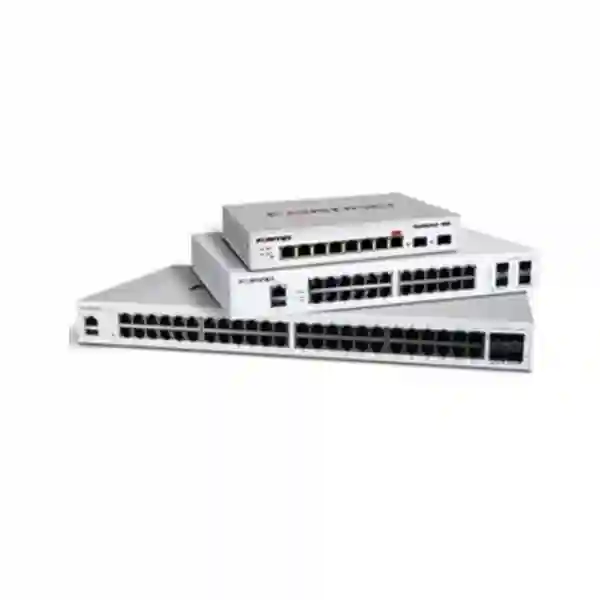
FortiSwitch 2000 Series Tanzania
FortiSwitch 2000 Series is a high-performance campus-core switching platform for organizations building dense, resilient and security-integrated enterprise LANs. Fortinet positions the series for larger and more complex campus environments, where the core must aggregate high-performance access switches without becoming a bottleneck. For Tanzania buyers planning headquarters, university, hospital, government, hospitality, industrial or multi-building networks, the central design question is not simply how many ports a switch has, but how access-layer bandwidth, uplink capacity, redundancy, optics, segmentation and security management work together.
The current FortiSwitch 2048F provides 48 × 25GE SFP28 interfaces, 8 × 100GE QSFP28 interfaces and 2 × 10GE SFP+ interfaces, creating a compact platform for aggregating access, distribution and server-facing links.
Dual AC power supplies support resilient campus-core designs. Power-path redundancy should still be planned end to end, including UPS, PDU and upstream electrical diversity.
FortiSwitch can operate standalone or through supported Fortinet management approaches including FortiGate/FortiLink, FortiEdge Cloud and FortiSwitch Manager, allowing architects to select an operational model that fits their environment.
FortiSwitch 2000 Series overview
Modern campus cores must carry traffic generated by Wi-Fi, endpoints, voice, video, cameras, application servers, cloud access and inter-VLAN services while providing predictable paths between buildings and access blocks. Fortinet introduced the FortiSwitch 2000 family specifically as a campus-core option for larger environments and describes it as a platform for aggregating high-performance access switches such as the FortiSwitch 600 family. That positioning matters for procurement: the 2000 Series is not a routine edge switch selected primarily by desktop port count. It belongs where high-speed fiber aggregation, core resilience and centralized policy are architectural priorities.
The FortiSwitch 2048F is the current 2000-series model documented in Fortinet’s campus core and data-center family. Its 48 25GE SFP28 ports can provide dense aggregation, while eight 100GE QSFP28 interfaces give architects high-capacity options for uplinks, inter-core connectivity or high-throughput infrastructure. Two additional 10GE SFP+ interfaces are included. The appliance is Layer 2/3 capable and compatible with FortiGate switch-controller deployments. A back-to-front airflow variant, FS-2048F-B2F, is also documented for environments where rack airflow direction is an important data-center or equipment-room consideration.
Before requesting a quotation, buyers should document port-speed requirements, fiber distances, optic types, redundancy design, expected east-west and north-south traffic, FortiGate integration, routing requirements and support expectations. SFP28 and QSFP28 slots are only part of the bill of materials: compatible transceivers, patching, fiber type and rack power should be validated for the actual topology. FourTeck can use this information to prepare a more precise solution discussion rather than treating the switch as an isolated hardware purchase.
Technical planning snapshot
| Area | FortiSwitch 2048F planning point |
|---|---|
| High-speed interfaces | 48 × 25GE SFP28, 8 × 100GE QSFP28, 2 × 10GE SFP+ |
| Power | Dual AC power supplies |
| Network role | Campus core, aggregation and high-density data-center/campus switching |
| Management | Standalone or supported Fortinet management including FortiGate/FortiLink, FortiEdge Cloud and FortiSwitch Manager |
| Optional software | Fortinet lists FS-SW-LIC-2000 as the Advanced Features License for FS-2000 Series switches; confirm required features and current ordering details for the intended design. |
Architecture, compatibility and integration
A FortiSwitch 2000 design should begin with topology. In a campus, access switches may connect users, FortiAP wireless access points, phones, cameras and other devices, while the core aggregates those access blocks and carries traffic toward firewalls, servers, internet edges and other buildings. High-speed 25GE aggregation can help prevent access-layer capacity from being constrained by older uplink designs, while 100GE interfaces provide room for high-throughput backbone connections. Actual utilization, oversubscription and resilience targets should be calculated from the organization’s traffic rather than assumed from interface speed alone.
FortiLink is especially relevant when FortiSwitch is deployed with FortiGate. It allows compatible FortiSwitch devices to become a managed extension of the FortiGate environment, combining network and security administration and supporting access-control workflows. Organizations already standardized on FortiGate should therefore include firewall model, FortiOS version, FortiSwitch software compatibility and intended FortiLink topology in their design review. Organizations choosing standalone or other management models should similarly define monitoring, configuration backup, authentication, change control and lifecycle procedures.
Optics require deliberate validation. The presence of SFP28, QSFP28 and SFP+ cages does not mean every optic or cable is interchangeable. Buyers should identify link speed, connector, fiber mode, distance, patch-panel path and Fortinet compatibility for every critical link. This is particularly important for campus links that cross buildings, data-center rows or telecom rooms. A procurement request that includes a simple port map and approximate distances will normally produce a more accurate bill of materials than a switch-only request.
FortiSwitch 2000 Series Tanzania
For Tanzanian enterprises, FortiSwitch 2000 Series is most relevant when network growth has moved beyond conventional access switching and the organization needs a deliberate campus-core or aggregation layer. Typical projects may include a headquarters with multiple wiring closets, a university campus with several buildings, a hospital environment with large numbers of wired and wireless endpoints, a hospitality property with high wireless density, or an industrial and administrative campus that must consolidate many high-speed links. The procurement process should therefore start with architecture rather than price alone. A useful Tanzania quotation brief identifies the number of access switches, required uplink speed per switch, expected backbone capacity, fiber distances, desired core redundancy, firewall integration and any routing functions required at the switching layer.
Tanzania deployments can vary widely in physical layout. A single-building office may concentrate switching in one equipment room, while a multi-building campus may depend on fiber distribution across longer distances. Those differences affect transceiver selection, fiber type, patching and resilience. Buyers should inventory existing multimode or single-mode fiber, connector standards and available rack power before finalizing optics. Where new fiber is being installed, the network team should coordinate switching requirements with the cabling contractor so that link budgets, termination and testing align with the planned Ethernet speeds.
Organizations using FortiGate can also evaluate FortiLink as part of a broader secure-networking design. This can reduce the operational separation between firewall policy and access switching, but the exact topology and compatibility should be confirmed against the deployed FortiGate and software versions. For broader Fortinet planning, visit FourTeck Tanzania for regional technology enquiries and FourTeck Fortinet solutions for related Fortinet solution context. These resources can help procurement teams frame switching as part of the complete security and connectivity stack.
A Tanzania buyer should request validation of the exact FortiSwitch model, airflow option where relevant, compatible optics, support term and any required advanced-feature licensing. Stock, lead time and commercial pricing should be confirmed at quotation time rather than assumed. The result should be a bill of materials that maps directly to the intended topology and avoids discovering missing optics, incompatible fiber or overlooked redundancy components during installation.
FortiSwitch 2000 Series Dar es Salaam
Dar es Salaam organizations frequently concentrate users, internet connectivity, server infrastructure and branch connectivity in headquarters or major operational sites. In that setting, a campus core must handle traffic from many access switches while preserving capacity for applications, voice, video, wireless and security services. FortiSwitch 2000 Series can be evaluated for this aggregation role where 25GE access aggregation and 100GE backbone connectivity align with the network design. Enterprises should first map current 1GE, 10GE and higher-speed uplinks and then identify where congestion or future growth justifies migration.
A practical Dar es Salaam design workshop should include IT, security, facilities and cabling stakeholders. IT defines VLANs, routing and application traffic; security defines segmentation and FortiGate integration; facilities confirms rack space, power and cooling; cabling teams validate fiber routes and termination. The FS-2048F also has a documented back-to-front airflow variant, making airflow direction an item to check when integrating with established rack practices. Dual power supplies are valuable only when the surrounding power architecture provides appropriately resilient feeds.
For organizations consolidating Fortinet security and switching, FortiLink can provide centralized control through FortiGate. That can be useful for headquarters environments where the operations team wants a common view of access devices and security policy. However, the exact FortiGate model, FortiOS release and FortiSwitch release should be recorded during planning. Compatibility and maintenance windows matter because core-switch changes can affect many downstream users.
Procurement teams in Dar es Salaam should provide an interface schedule with switch-to-switch distances and desired media. This enables correct evaluation of SFP28, QSFP28 and SFP+ transceivers and avoids treating optics as an afterthought. For related enterprise infrastructure, FourTeck IT services provides additional solution context for implementation-oriented enquiries. A complete quotation request should cover hardware, optics, licensing if needed, support, configuration scope and deployment expectations separately so each commercial component is clear.
FortiSwitch 2000 Series Mwanza
Mwanza organizations considering a high-capacity core should assess whether their network has enough distributed access, wireless density, server traffic or building-to-building connectivity to justify 25GE and 100GE aggregation. The strongest use case is not simply a large number of users; it is a topology where multiple access or distribution links converge and require predictable backbone performance. Educational campuses, healthcare environments, large commercial operations and multi-building enterprises can use a structured traffic assessment to determine whether the FortiSwitch 2000 architecture fits.
Start by documenting every telecom room and the fiber path back to the core. Record existing optic speed, fiber type, connector, distance and redundancy. If two core switches are planned, determine how access switches will be dual-homed and how failure scenarios should behave. Network resilience depends on topology and configuration as much as hardware. Dual AC supplies on the switch support power redundancy, but resilient operation also requires suitable UPS capacity, independent power paths where available, tested configuration backups and operational procedures.
Where FortiGate is already deployed, Mwanza customers can consider FortiLink management and policy integration. This is especially useful to evaluate when the same IT team manages firewall, switching and access security. Where independent switching administration is preferred, Fortinet also documents standalone and alternative management options. The choice should follow operational ownership, scale and security requirements rather than being made only from product defaults.
A procurement request should include the expected number of 25GE connections, required 100GE uplinks, any 10GE legacy connections and the anticipated growth horizon. Buyers should also identify whether the standard airflow model or back-to-front model is appropriate for the rack environment. These details make it possible to compare the proposed bill of materials with the real network design and reduce expensive changes after equipment arrives.
FortiSwitch 2000 Series Arusha
Arusha has organizations whose networks may span hospitality, tourism, education, administration and multi-site business operations. For a large property or campus, the core switch often becomes the meeting point for wireless access, CCTV, voice, business applications and internet-bound traffic. FortiSwitch 2000 Series is suited to evaluation when these access domains require high-density fiber aggregation and the organization wants to align switching with a Fortinet security architecture.
Hospitality and campus networks should pay particular attention to wireless growth. Newer access layers can generate substantially more aggregate traffic than legacy networks, and uplink design must prevent the core from constraining that capacity. The 2048F’s 25GE and 100GE interface mix provides design flexibility, but planners should still calculate oversubscription and real traffic patterns. A 100GE interface is not automatically necessary on every path; it should be placed where backbone demand, resilience or future expansion supports the investment.
Arusha projects should also separate physical and logical planning. Physical planning covers racks, power, cooling, fiber routes and optics. Logical planning covers VLANs, routing, link aggregation, segmentation, management access, monitoring and security policy. If FortiLink will be used, FortiGate capacity and compatibility become part of the switching decision. If dynamic routing or other advanced functions are required, confirm licensing and feature availability for the exact software release and intended mode.
For quotation preparation, provide a simple diagram showing core, access switches, firewalls, servers and building links. Add distances and required speeds to each fiber connection. This small amount of planning helps identify compatible transceivers and the number of each optic required. FourTeck can then discuss the FortiSwitch hardware in the context of the actual Arusha deployment rather than offering an isolated chassis that may not reflect the full project.
FortiSwitch 2000 Series Dodoma
Dodoma enterprises and institutional networks may need a core that supports structured segmentation, high availability and scalable fiber aggregation across offices, campuses or public-facing facilities. FortiSwitch 2000 Series can be considered for environments where many access switches converge at a central core and where high-speed backbone links are important for application availability. The design should be based on measured or estimated traffic, critical services and failure tolerance.
Government and institutional procurement often benefits from a detailed technical schedule. Rather than specifying only “FortiSwitch 2000,” the schedule should state the exact required model, interface quantities, optic types, power requirements, support period, management mode and any software features. Fortinet currently documents FS-2048F and FS-2048F-B2F ordering options in the 2000 family. The back-to-front option can be relevant when equipment-room airflow standards dictate a particular direction.
Security architecture should be planned alongside switching. FortiGate-managed FortiSwitch deployments can use FortiLink to integrate network access and security operations, while standalone or other management approaches may fit different organizational structures. In either case, administrative access, authentication, logging, backups and change control should be defined before production deployment. Core switches deserve stricter operational discipline because a configuration error can affect many downstream services at once.
Dodoma buyers should also validate fiber infrastructure early. Long building links, existing patch panels and mixed generations of optics can complicate migrations. Documenting these dependencies allows the project team to decide whether to reuse existing cabling, replace transceivers or phase upgrades. A well-prepared quotation therefore includes both network hardware and the connectivity components needed to place the core into service.
FortiSwitch 2000 Series UAE
UAE campus and data-center environments often place strong emphasis on high-density connectivity, operational resilience and standardized rack design. FortiSwitch 2000 Series fits evaluation for campus-core aggregation where many high-performance access switches converge and 25GE/100GE connectivity matches the architecture. The 2048F provides a dense 1RU-style core proposition with dual AC power and an airflow variant for environments that need back-to-front cooling alignment.
For UAE procurement, define whether the project is a new core, a replacement of legacy aggregation, or an expansion. Replacement projects need a migration map showing old and new uplink speeds, optic compatibility, VLAN/routing dependencies and rollback procedures. New builds can be cleaner, but still require careful fiber and transceiver selection. Data-center-style deployments should additionally review airflow, rack power, patching and redundant paths.
Organizations already using FortiGate can evaluate FortiLink to converge switching and security operations. Fortinet also supports FortiSwitch management through other documented approaches, allowing teams to match administration to scale and organizational responsibility. For UAE-specific Fortinet context, FourTeck Fortinet UAE can complement the Tanzania project discussion when a customer operates across both markets.
Commercial requests should avoid assuming price, stock or delivery dates. Instead, provide exact interface and support requirements and request a current quotation. This is particularly important when optics, licensing and service terms are part of the solution. A structured bill of materials makes cross-country standardization easier for organizations operating both in Tanzania and the UAE.
FortiSwitch 2000 Series Uganda
Uganda organizations planning a high-speed campus backbone can evaluate FortiSwitch 2000 Series when access-layer growth requires dense 25GE aggregation and 100GE uplink capacity. Large enterprises, universities, hospitals and multi-building institutions should first identify the number of aggregation links, required redundancy and security architecture. The 2048F is designed for core and data-center roles rather than routine desktop access, so its value is strongest when the topology can use its high-speed interfaces.
Cross-building fiber deserves careful attention. Record distances, existing cable type and connector format, then select compatible optics from Fortinet’s supported transceiver information. Do not assume that an existing 10GE optic can be repurposed for a 25GE or 100GE design. Where migration must be phased, the two 10GE SFP+ interfaces can be considered as part of the transition design, but the full topology should be validated before procurement.
FortiGate integration is another decision point. FortiLink can centralize switching and security management for compatible deployments, which may reduce administrative fragmentation. Teams should confirm software compatibility, FortiGate sizing and operational ownership. For country-specific enquiries, FourTeck Uganda provides a related regional resource for organizations standardizing Fortinet infrastructure across East Africa.
The quotation checklist should include switch model, airflow direction, transceivers, patching assumptions, support term, required licensing and implementation scope. This makes it easier to compare offers and prevents core dependencies from being hidden in miscellaneous project costs.
FortiSwitch 2000 Series Kampala
Kampala headquarters and campus environments may have concentrated connectivity from many floors, buildings or business units. A FortiSwitch 2000 core can be evaluated where access switches need high-bandwidth aggregation and the backbone must support significant wireless, server and internet traffic. Planning should distinguish current utilization from future capacity so the organization does not overbuild every link while still leaving room for growth.
A useful design starts with an access-switch inventory and identifies uplink speed, redundancy and endpoint type. Wireless-heavy floors may justify higher uplink capacity than conventional office areas. Server or storage zones may have different east-west traffic patterns. The 2048F’s 48 25GE ports allow many high-speed aggregation links, while eight 100GE interfaces can serve high-capacity backbone paths. Actual assignments should follow the architecture.
For Fortinet estates, FortiLink can make the switching layer part of the broader security-management workflow. That does not remove the need for network engineering: VLAN design, routing, spanning-tree or other loop-prevention strategy, link aggregation and failure testing still require deliberate planning. Core upgrades should include a migration plan and maintenance window.
Kampala procurement teams can improve quotation accuracy by attaching a port matrix and fiber-distance schedule. This clarifies transceiver requirements and highlights any links that need special consideration. It also allows support and licensing requirements to be discussed before purchase rather than after installation begins.
FortiSwitch 2000 Series Arua
Arua deployments should evaluate FortiSwitch 2000 Series according to topology and growth rather than organization size alone. A distributed institutional campus with several fiber-connected buildings may have a stronger need for high-speed aggregation than a larger organization occupying a single simple LAN. The key questions are how many access links converge, how much bandwidth they need, and how resilient the core must be.
Physical infrastructure can determine project success. Core equipment needs appropriate rack space, power, cooling and clean fiber management. The 2048F includes dual AC power supplies, but resilient design requires the surrounding electrical system to support redundancy. Where back-to-front airflow is needed, Fortinet documents a B2F variant. These details should be included in procurement specifications rather than discovered during rack installation.
If the network uses FortiGate, planners can assess FortiLink for integrated switching management and security visibility. If the environment uses a different operational model, standalone or other Fortinet management approaches can be considered. In all cases, software versions and compatibility should be validated before change windows are scheduled.
For Arua projects, a phased deployment may be practical when existing access switches still use lower-speed uplinks. Document which links will migrate immediately and which remain legacy connections. This allows optics and patching to be purchased deliberately and gives the organization a clear roadmap toward the intended core architecture.
FortiSwitch 2000 Series Mbarara
Mbarara organizations with expanding campuses can use the FortiSwitch 2000 Series evaluation process to examine whether the network core is ready for faster access and wireless infrastructure. As endpoint counts and application traffic increase, older aggregation layers may become the limiting factor even when access switches still have available ports. A core refresh should therefore measure uplink utilization and consider future Wi-Fi, video and application demand.
The 2048F interface profile is oriented to high-speed fiber aggregation. That means optics and fiber are integral to the solution. Procurement teams should inventory existing transceivers and cabling, but compatibility must be checked rather than assumed. Link distance, fiber type and connector format all influence the correct transceiver choice. Long campus links may require different optics from short equipment-room connections.
Logical design should define segmentation and routing boundaries. If FortiGate controls FortiSwitch through FortiLink, security and access policy can be coordinated through the Fortinet architecture. If routing functions or advanced features are required on the switch itself, validate the exact feature and licensing requirements. Fortinet lists an Advanced Features License for FS-2000 Series, so feature requirements should be identified before the commercial order.
A strong Mbarara quotation request includes a network diagram, desired redundancy, port counts by speed, optics list, support duration and installation responsibilities. That documentation creates a clearer basis for comparing the proposed solution with operational needs.
FortiSwitch 2000 Series Gulu
Gulu campus and enterprise networks considering a core upgrade should focus on reliability, maintainability and a realistic growth plan. FortiSwitch 2000 Series can serve as a high-density aggregation layer when the design requires 25GE links from access or distribution switches and 100GE connectivity toward other core devices or high-capacity infrastructure. It should be selected as part of a topology, not simply as a higher-numbered switch.
Resilience planning should test failure scenarios on paper before installation. What happens if one uplink fails, one core member is unavailable, or one power source is lost? Which services are critical and what convergence behavior is acceptable? Hardware redundancy provides building blocks, while topology and configuration determine the actual outcome. Maintenance procedures and configuration backups should also be part of the deployment plan.
Where FortiGate is present, FortiLink offers a path toward converged network and security management. This can simplify visibility and policy administration, but the team should confirm the supported design and software compatibility for its exact devices. Monitoring and logging requirements should be agreed before the core enters production.
Gulu buyers should request current commercial information rather than relying on online price assumptions. Enterprise switching quotations can vary with optics, support, licensing and project scope. Supplying the technical bill of materials makes the quotation more useful and reduces ambiguity around what is included.
FortiSwitch 2000 Series Kenya
Kenyan enterprises operating large campuses or regional headquarters can evaluate FortiSwitch 2000 Series as a core aggregation platform where high-density 25GE connectivity and 100GE uplinks fit their performance model. Organizations standardizing infrastructure across East Africa may also value a common Fortinet switching and security architecture between Kenya, Tanzania and Uganda, provided each site is sized for its own traffic and physical layout.
Standardization should not mean copying a bill of materials unchanged. Fiber distances, access-switch quantities, wireless density, rack airflow and power arrangements differ by site. Each Kenya deployment should therefore maintain its own port map and optic schedule while following common architecture and configuration standards. This approach combines operational consistency with correct local engineering.
For FortiGate environments, FortiLink can support integrated switching management. Cross-country IT teams should document approved software versions and upgrade procedures so sites do not drift into incompatible combinations. Where centralized cloud or FortiSwitch Manager operations are considered, management licensing and operational requirements should be confirmed for the intended scale.
For Kenya-specific enquiries, FourTeck Kenya is a relevant regional resource. Multi-country customers can use a common quotation template covering core switch, optics, support, licensing and deployment scope, making technical and commercial comparisons easier without assuming identical site conditions.
FortiSwitch 2000 Series Kuwait
Kuwait enterprises and campus operators can consider FortiSwitch 2000 Series for high-speed aggregation where access networks, wireless systems and data-center resources converge. The product’s 25GE and 100GE interface mix is particularly relevant to modern campus designs that are moving beyond 10GE aggregation. The design should still be driven by measured bandwidth and redundancy objectives rather than interface capability alone.
Equipment-room engineering is important in dense deployments. Confirm rack airflow direction, available power, UPS architecture and patching before ordering. Fortinet documents both standard FS-2048F and back-to-front airflow FS-2048F-B2F variants. Selecting the correct airflow option helps align the switch with the facility’s cooling design.
Optics should be specified per link. QSFP28 and SFP28 connectivity can support multiple reach and media options, but compatible Fortinet transceivers must be chosen for the actual fiber and distance. This is especially important when connecting separate buildings or integrating with existing structured cabling.
For Kuwait-specific technology enquiries, FourTeck Kuwait provides a regional point of reference. Organizations operating in both Kuwait and Tanzania can standardize architecture while maintaining separate site surveys and bills of materials for each deployment.
FortiSwitch 2000 Series Ghana
Ghana organizations with high-density campus networks can evaluate FortiSwitch 2000 Series when the core needs to aggregate many high-speed access links and provide resilient paths toward firewalls, servers or other core infrastructure. The strongest projects begin with traffic and topology data. Count access switches, identify current uplink speeds, record peak utilization and map future wireless or application growth.
Fiber planning is central because the 2048F is a high-speed SFP28/QSFP28 platform. Procurement should identify whether links use multimode or single-mode fiber, their approximate distance and the required connector path. Compatible optics should then be selected against Fortinet documentation. This avoids mismatches that can delay commissioning.
Security integration can be considered at the same time. FortiGate-managed FortiSwitch environments can use FortiLink for centralized switching and security operations. Other documented management options are available when the organization needs a different operating model. The selected model should reflect staffing, scale, visibility and change-management requirements.
Ghana buyers should separate hardware, optics, software/support and professional services in the quotation. That makes scope easier to understand and supports accurate lifecycle budgeting. If the network is part of a wider African standardization project, common design principles can be shared while site-specific fiber and power details remain locally engineered.
FortiSwitch 2000 Series Nigeria
Nigeria’s large enterprise, financial, education, healthcare and multi-site environments can create significant aggregation demands at campus cores. FortiSwitch 2000 Series can be evaluated where many access blocks converge and where 25GE/100GE capacity supports current and planned traffic. The core should be sized not only for user count but for application patterns, wireless density, east-west traffic and resilience requirements.
Power architecture deserves particular attention in any mission-critical switching project. Dual switch power supplies support redundancy, but they should be connected to a resilient electrical design where possible. UPS capacity, PDU layout and generator transition behavior should be reviewed by facilities teams. Network availability is an end-to-end property and cannot be guaranteed by a redundant PSU alone.
Organizations with FortiGate can evaluate FortiLink for a converged operational model. This can help align segmentation and network access with security controls. For larger estates, teams may also consider Fortinet’s documented management platforms according to their scale and operating model. Compatibility and licensing should be confirmed for the final architecture.
Nigeria procurement teams should attach a topology and port schedule to requests for quotation. This makes the need for SFP28, QSFP28 and any SFP+ connectivity explicit and allows optics to be included correctly. It also provides a basis for discussing implementation, support and lifecycle planning without relying on generic product bundles.
FortiSwitch 2000 Series Seychelles
Seychelles organizations may have smaller physical campuses than some regional markets but can still require resilient, high-performance aggregation for hospitality, government, education or service environments. FortiSwitch 2000 Series should be considered when the network topology genuinely needs its high-speed fiber density, particularly where multiple access blocks, server resources or high-capacity wireless networks converge.
For island deployments, careful bill-of-material preparation is especially valuable because missing optics or accessories can complicate project schedules. Before ordering, record every high-speed link, distance and fiber type and verify compatible transceivers. Include spare strategy and support expectations in the procurement discussion rather than treating them as post-installation decisions.
The switch’s dual power supplies support resilient design, while the availability of a back-to-front airflow model allows alignment with specific rack layouts. Facilities teams should verify cooling, UPS and rack requirements. Network teams should separately validate VLAN, routing, aggregation and management design, including FortiLink if FortiGate integration is planned.
A Seychelles quotation request should therefore be complete: exact model, optics, power and airflow preference, management approach, support term, licensing needs and deployment scope. This structured approach helps the organization purchase the network solution required for commissioning rather than only the core chassis.
Selection and quotation checklist
Before requesting a FortiSwitch 2000 Series quotation, confirm the intended network role, exact number of 25GE aggregation links, number of 100GE uplinks, any required 10GE connectivity, desired redundancy, fiber type and distance, compatible transceivers, airflow direction, FortiGate/FortiLink integration, routing functions, management platform, advanced-feature requirements, support duration, rack power and installation responsibilities. Also identify the FortiOS and FortiSwitch software versions expected in the environment. A concise diagram and port schedule can prevent many procurement errors.
Do not assume that optics, advanced licenses, implementation or support are included unless the quotation states them. Likewise, availability, lead time and pricing should be confirmed for the specific project and country. For broader multi-country planning, FourTeck Africa can provide regional solution context while the Tanzania requirement remains anchored through the Tanzania team.
Frequently asked questions
What is FortiSwitch 2000 Series used for?
Fortinet positions the 2000 Series as a campus-core switch for larger, more complex environments. It is designed to aggregate high-performance access switching and is also included in Fortinet’s campus core and data-center switching family.
What ports are available on FortiSwitch 2048F?
Fortinet’s current data sheet lists 48 × 25GE SFP28 ports, 8 × 100GE QSFP28 ports and 2 × 10GE SFP+ ports. Optics and cabling should be selected according to link distance, media and Fortinet compatibility.
Can FortiSwitch 2000 be managed by FortiGate?
Yes. Fortinet documents the 2048F as FortiGate switch-controller compatible, and FortiLink provides integrated management between FortiGate and FortiSwitch. Confirm model and software compatibility for the planned deployment.
Does the 2000 Series have redundant power?
The documented FortiSwitch 2048F includes dual AC power supplies. Overall power resilience still depends on the surrounding UPS, PDU and facility power design.
Is an Advanced Features License available?
Fortinet’s ordering information lists FS-SW-LIC-2000 as the FortiSwitch Advanced Features License for FS-2000 Series switches. Confirm whether the intended Layer 3 or other advanced functions require it in the chosen software and management mode.
How should I request a FortiSwitch 2000 quote in Tanzania?
Provide the site topology, required port speeds, fiber distances, optic requirements, FortiGate integration, redundancy expectations, support term and installation scope. This allows a more accurate bill of materials than requesting only a switch model.
Decision recap
Choose FortiSwitch 2000 Series for evaluation when your project needs a genuine high-performance campus-core or aggregation platform, not merely additional edge ports. Its dense 25GE connectivity and 100GE uplinks are designed for environments where access capacity, backbone performance and resilience matter. The most important next step is to turn the product specification into a site-specific architecture: count links, map fiber, calculate capacity, define redundancy and confirm Fortinet integration.
FourTeck can review these requirements for Tanzania and multi-region projects and help structure the commercial request around the exact model, optics, management, licensing and support components required.
Consultation panel
For a useful FortiSwitch 2000 Series consultation, send your current or proposed network diagram, number of access switches, desired uplink speeds, approximate fiber distances, FortiGate model if applicable, redundancy target and required project location. FourTeck can use that information to discuss an appropriate bill of materials and quotation scope without making assumptions about your infrastructure.



Reviews
There are no reviews yet.