
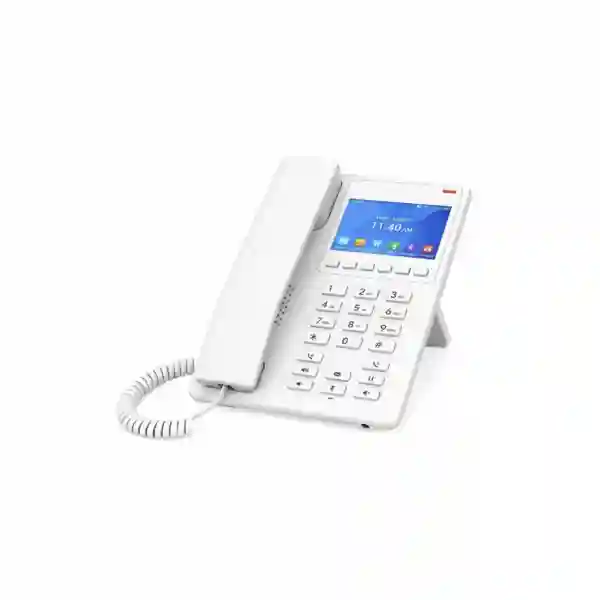

Grandstream GHP630 Tanzania
The Grandstream GHP630 is a compact hotel IP phone built for guest rooms and other environments that need a simple SIP endpoint with clear on-screen information, centralized administration and practical room-side controls. For Tanzanian hotels, serviced apartments, hospitals, dormitories and similar properties, the value of the GHP630 is not only the handset itself. The more important question is how well the phone fits the property’s IP PBX, Ethernet switching, PoE capacity, voice VLAN, extension plan, room numbering, emergency-call policy and day-to-day support process. FourTeck Tanzania can help buyers review those dependencies before a quotation is finalized, reducing the risk of ordering a room phone that is technically suitable in isolation but poorly matched to the wider voice network.
What the Grandstream GHP630 is designed to solve
Guest-room telephony has a different job from a normal office desk phone. A hotel guest should be able to understand the handset quickly, reach reception or common services with minimal effort and use basic calling features without navigating a complicated interface. At the same time, the property’s IT or telecom team may need to configure hundreds of endpoints consistently, apply firmware updates, maintain extension mappings and troubleshoot devices without visiting every room. Grandstream positions the GHP630 within its GHP Series for exactly this kind of environment. It combines a compact physical design with a 3.5-inch color display, two SIP accounts and lines, ten speed-dial keys, six context-sensitive soft keys, an HD handset, three-way conferencing and support for centralized configuration through Grandstream Device Management System (GDMS).
The wired GHP630 includes one auto-negotiation 10/100 Mbps Ethernet port with integrated PoE Class 2. That makes it particularly relevant where a hotel or institution already has structured Ethernet cabling and PoE switching at rooms. Unlike the GHP630W, the standard GHP630 does not include integrated Wi-Fi 6, so procurement teams should verify whether the planned room topology is wired or wireless before choosing between variants. The phone can be desktop- or wall-mounted and also includes a USB Type-C charging port for external devices, Hearing Aid Compatibility, secure boot and other security controls documented by Grandstream. For voice media, the family supports full-band Opus along with standard codecs, and Grandstream highlights an advanced jitter-resilience algorithm designed to tolerate substantial packet loss without degrading voice quality.
Verified GHP630 features and practical buyer meaning
Color LCD
A 3.5-inch 480×320 display gives room users clear visual information while allowing administrators to create a more informative guest-facing experience than a screenless hospitality handset.
Two SIP lines
Two SIP accounts and lines are suitable for common hotel-room call flows and can also support use in hospitals, apartments, dormitories and other managed facilities.
PoE network connection
The GHP630 uses a 10/100 Mbps Ethernet port with integrated PoE Class 2, helping simplify room installations where compatible PoE switches and structured cabling are already available.
GDMS management
Grandstream Device Management System can be used to configure, provision, manage and monitor supported Grandstream endpoints, which is useful when a deployment contains many rooms or multiple properties.
Guest convenience
Ten speed-dial keys, context-sensitive soft keys, an HD handset and USB Type-C charging support common hospitality workflows without turning the room phone into an unnecessarily complex office device.
Security foundation
Grandstream documents secure boot, unique security certificates, encrypted configuration support, TLS, SRTP and administrator-level controls. Actual security still depends on correct PBX, VLAN, firewall and credential configuration.
Deployment, compatibility and selection guidance
Before ordering GHP630 units, confirm the PBX or hosted SIP platform, number of rooms, extension numbering plan, Ethernet cabling, PoE switch capacity, voice VLAN strategy, DHCP and DNS availability, network security controls, emergency-call requirements and whether wall mounting is required. The phone supports SIP and common networking and security protocols, but interoperability should still be validated against the target PBX and the features the property intends to use. A room phone may register successfully yet still need additional PBX configuration for voicemail, transfer, front-desk routing, speed-dial destinations, wake-up or hospitality integration workflows.
For network planning, the handset itself does not demand high Ethernet bandwidth, but voice quality is sensitive to delay, jitter, packet loss and congestion. Managed switching, appropriate QoS, a clean voice VLAN and stable upstream routing can matter more than raw link speed. A property with hundreds of phones should also plan addressing, naming, room mapping, device templates, configuration backups and firmware-control procedures. FourTeck Tanzania’s integrated technology overview explains why voice endpoints should be planned together with switching, Wi-Fi, security and cabling. The Tanzania technology shop provides a wider procurement context, while FourTeck Tanzania services is relevant when the project also requires design, installation, configuration or lifecycle support. For quotation and project discussions, use the verified FourTeck Tanzania contact page.
Grandstream GHP630 Tanzania
For buyers searching for Grandstream GHP630 Tanzania, the strongest use case is a property or institution that wants a compact wired SIP phone with a color screen and centralized management. Tanzania’s hospitality market includes city hotels, business lodges, resorts, serviced apartments, safari accommodation, hospitals, dormitories and institutional residences. In each case, the phone should be selected as part of a room-communications design rather than as an isolated handset purchase. A hotel may need every room to reach reception, housekeeping, reservations or emergency contacts through consistent speed-dial assignments. A hospital may use the same compact form factor for patient-room or ward calling. A serviced apartment operator may value the ability to maintain the endpoint fleet centrally while keeping the guest interface straightforward. The GHP630’s two SIP lines, ten speed-dial keys, six context-sensitive soft keys and 3.5-inch display provide a useful balance between guest usability and administrative control.
A Tanzania deployment should begin with the existing voice and network environment. If the property already has a SIP PBX, confirm registration parameters, codec policy, call routing, extension ranges and any hospitality-specific integrations. If the property is building a new system, create the room numbering and extension strategy before devices are staged. Check PoE budgets carefully because every wired GHP630 depends on compatible powered Ethernet unless an alternative supported power method is planned. Where guest-room cabling is old or shared with other services, test cable quality and switch behavior before a large rollout. Voice VLANs can improve administrative clarity and security, while QoS can help protect calls from congestion when the same uplinks carry guest internet, CCTV, cloud applications and other traffic.
Procurement teams should also separate the GHP630 from the GHP630W during quotation review. The standard GHP630 is the wired PoE model; integrated Wi-Fi 6 belongs to the W variants. This distinction matters for hotels where room Ethernet points are unavailable or where renovation constraints favor wireless endpoints. Buyers should request the exact model number on the quotation, the required quantity, mounting expectations, PBX compatibility confirmation, configuration scope and any accessories or supporting network equipment. FourTeck can discuss the handset within a broader IP telephony plan and can also coordinate related switching, VLAN, cabling and security requirements where they are part of the same project. That approach gives Tanzanian buyers a clearer bill of materials and reduces deployment surprises after the phones arrive.
Grandstream GHP630 Dar es Salaam
Dar es Salaam buyers often evaluate hotel telephony in the context of busy commercial properties, city hotels, apartment buildings, hospitals, education facilities and mixed-use developments. In those environments, the Grandstream GHP630 can serve as a room endpoint where administrators want wired SIP connectivity, a visible color interface and repeatable centralized provisioning. The practical planning challenge is scale. A property may have tens or hundreds of rooms spread across floors, wings or separate buildings. Each phone needs a predictable extension, network location, PBX profile and support path. Before deployment, it is useful to build a room-to-extension map, define reception and service numbers, decide which speed-dial functions are needed and document any special call restrictions. This creates a cleaner operational handover for front-desk and IT teams.
Networking should be reviewed floor by floor. PoE switches must have enough powered ports and total wattage for the planned device count, and uplinks should be sized for the broader site workload rather than voice alone. If the same switch stack also serves access points, CCTV cameras and business workstations, segmentation and QoS policies can help preserve a predictable service experience. Dar es Salaam properties with multiple internet circuits or central data rooms may also want resilient PBX and upstream network design so room extensions remain useful during maintenance or partial network faults. The GHP630 supports industry-standard SIP and common security mechanisms, but those capabilities provide value only when matched with a well-managed network and disciplined configuration.
For refurbishment projects, confirm whether existing guest-room cable routes can support Ethernet and PoE without rework. Wall mounting can help keep nightstands uncluttered, while USB Type-C charging may provide a convenient room-side charging option for compatible external devices. The handset’s Hearing Aid Compatibility is also relevant to accessibility planning. A quotation for Dar es Salaam should clearly state the exact GHP630 model, quantity, PBX or SIP service to be used, whether configuration and installation are included, the expected room mapping and any switching or cabling additions. FourTeck Tanzania can review these project details through its contact and quotation channel, helping buyers compare complete deployment scope rather than handset price alone.
Grandstream GHP630 Mwanza
For Grandstream GHP630 Mwanza enquiries, procurement often begins with a straightforward request for hotel room phones but quickly expands into questions about PBX compatibility, cable readiness and centralized support. The GHP630 is well suited to environments that already favor wired Ethernet because the standard model includes one 10/100 Mbps port with integrated PoE. In a hotel, lodge, hospital or residential facility, this can reduce dependence on separate power adapters and help administrators keep room endpoints connected to managed network infrastructure. The 3.5-inch display is useful where operators want a modern visible interface, while ten speed-dial keys can be programmed around the property’s service model, for example reception, housekeeping, room service or security where those services exist.
A Mwanza deployment should account for the physical layout and the distance between telecom rooms. Multi-floor or multi-building sites may require carefully placed access switches and fiber uplinks before room phones can be connected reliably. The handset’s low access-link speed is adequate for voice, but the surrounding network may also be carrying CCTV video, guest Wi-Fi traffic and business applications. That is why the switch architecture must be sized for the entire site rather than for the phone alone. A voice VLAN, controlled DHCP environment and documented port assignments can simplify troubleshooting. Administrators should also decide whether device configuration will be managed through GDMS, local provisioning infrastructure or another supported method so that room-by-room manual setup does not become the default.
When comparing quotations in Mwanza, buyers should verify whether the proposal includes only handsets or also staging, firmware alignment, account configuration, extension labeling, mounting and user or administrator handover. They should also confirm whether the PBX already exists and whether SIP trunks, call routes, voicemail or hospitality functions require separate work. GHP630 is not the same as GHP630W; the W model adds Wi-Fi 6, so projects with no room Ethernet should not assume wireless capability in the standard GHP630. A precise bill of materials protects the budget and avoids model substitutions. For organizations planning wider network upgrades, the FourTeck Tanzania services page is a useful reference for integrating telephony with switching, cabling and infrastructure work.
Grandstream GHP630 Arusha
Arusha’s hospitality and tourism environment makes room telephony a practical operational tool rather than simply a legacy guest amenity. A hotel, safari-oriented property, serviced lodge, hospital or institutional residence may need every room to reach reception quickly, while management wants consistent configuration and minimal desk clutter. The Grandstream GHP630 addresses that profile with a compact body, a 3.5-inch color LCD, two SIP accounts, three-way conferencing and ten speed-dial keys. Administrators can use those programmable functions to present a predictable calling experience across rooms. For guests, the important result is simplicity. For technical teams, the important result is a fleet of endpoints that can be provisioned and monitored more systematically through supported Grandstream management tools.
The best Arusha project plan begins with the site topology. Hospitality properties can include detached blocks, villas, garden rooms or buildings separated by outdoor areas. If wired GHP630 phones are chosen, each location requires suitable Ethernet and PoE. Network designers should verify copper distance limits, outdoor inter-building links, surge exposure, switch placement and UPS support. Where copper cannot reach cleanly between buildings, fiber distribution may be a better backbone while local PoE switches serve rooms. The phones themselves use modest bandwidth, but an unstable uplink or poor power environment can still create call problems. Voice traffic should therefore be planned together with internet, guest Wi-Fi, CCTV and other IP systems that share the property network.
A quotation request should include room count, building count, existing PBX make and model, whether the network is already PoE-capable, preferred room and service speed-dial assignments, wall or desk mounting preference and whether remote management is required. It is also useful to identify future expansion. A property that expects new rooms should reserve switch ports, addressing space and extension ranges now. If wireless room phones are being considered because cabling is difficult, compare the GHP630 with the GHP630W rather than assuming the base model includes Wi-Fi. FourTeck can help Arusha customers assess the endpoint, IP PBX and network dependencies together so the procurement decision reflects the whole guest-communication environment.
Grandstream GHP630 Dodoma
Organizations searching for Grandstream GHP630 Dodoma may include hotels, government-related accommodation facilities, healthcare environments, education residences and apartment operators that need a managed SIP phone for rooms. The GHP630’s design is intentionally simpler than a feature-heavy executive desk phone, but it still provides a 3.5-inch color display, two SIP accounts, programmable room-oriented keys, an HD handset and three-way conferencing. This makes it suitable where the goal is straightforward room communication supported by a modern IP telephony platform. The phone can be installed on a desk or wall, which gives facilities teams flexibility when furniture layouts or room-space standards vary.
In Dodoma, the procurement process should treat power and network continuity as part of the telephony design. The wired GHP630 relies on PoE from the Ethernet infrastructure, so switch selection, UPS protection and rack organization can directly influence phone availability. If a central switch fails or loses power, every connected room endpoint on that switch is affected. Larger sites can therefore benefit from distributing access switching sensibly, keeping configuration backups and documenting room port assignments. PBX resilience should also be considered. The handset supports SIP, but call availability depends on the registration server, routing logic and any upstream trunk or gateway services. A complete design should identify which internal calls must remain available when external connectivity is interrupted.
For administration, GDMS can reduce the need to configure each endpoint manually and can support a more repeatable deployment process. Before importing or applying templates, however, administrators should define the naming standard, room extension mapping, time settings, language choice, speed-dial services and firmware policy. Buyers should ask for the exact model on the quotation and should distinguish GHP630 from GHP630W because only the latter adds integrated Wi-Fi 6. If the project also needs PoE switching, VLANs or structured cabling, these should appear explicitly in the scope. FourTeck Tanzania’s business technology overview is relevant for customers who want telephony planned alongside the rest of the site infrastructure rather than delivered as a disconnected device purchase.
Grandstream GHP630 UAE
The Grandstream GHP630 UAE use case is strongly aligned with hotels, serviced apartments, healthcare facilities, dormitories and other room-based environments that standardize communication endpoints at scale. UAE properties often operate sophisticated IP networks and centralized management platforms, so the ability to provision phones consistently can be as important as the room-facing features. The GHP630 offers two SIP accounts and lines, a 3.5-inch color LCD, ten speed-dial keys, six context-sensitive soft keys, HD handset audio, three-way conferencing and support for GDMS. The standard GHP630 connects through wired Ethernet with integrated PoE; the GHP630W is the related variant for integrated Wi-Fi 6 deployments.
For UAE hospitality projects, integration planning may involve the IP PBX, property-management workflows, emergency calling, call accounting, front-desk operations, service shortcuts, VLAN policy and structured cabling. Not every property requires the same feature set, so technical validation should focus on what the deployment must actually do. A phone can be SIP compatible yet still require additional configuration for specific PBX functions, speed-dial behavior or hospitality interfaces. Large properties should also plan bulk staging and standardized templates. GDMS can help with device management, but successful mass deployment depends on accurate MAC-to-room mapping, extension assignment, firmware control and a documented rollback or replacement process.
Procurement teams working across Tanzania and the UAE may also want consistent standards across regions. FourTeck’s verified UAE technology site covers local IT, telecom and infrastructure requirements, while FourTeck’s wider integrated technology site provides a broader multi-solution reference. Where a regional group uses one extension plan, one security baseline and one endpoint policy across branches, the handset configuration can be standardized even when the exact PBX trunking or telecom provider differs by country. Buyers should therefore request a quotation that separates hardware, configuration, mounting, network readiness, PBX work and support expectations. This makes the UAE GHP630 project easier to compare and manage.
Grandstream GHP630 Uganda
Grandstream GHP630 Uganda enquiries typically fit hotels, apartments, hospitals, student residences and institutional facilities that want a compact SIP phone with centralized management. The handset’s 3.5-inch display and programmable keys make it more informative than basic screenless room phones, while the two SIP accounts and three-way conferencing cover common calling needs without introducing the complexity of a full executive desk phone. In a hospitality deployment, the operational value comes from how easily guests can reach common services and how consistently the IT team can maintain every room endpoint. Speed-dial layouts, extension ranges and room naming should therefore be planned before mass provisioning begins.
Ugandan sites should examine cabling and PoE carefully. The base GHP630 is a wired model with one 10/100 Mbps Ethernet port and integrated PoE. If a property has no suitable room Ethernet points, the related GHP630W may be a more appropriate comparison because it adds Wi-Fi 6. Where wired deployment is practical, PoE simplifies power management but makes switch capacity and UPS planning important. Hotels that run CCTV cameras and wireless access points from the same PoE switches need to confirm the total power budget and reserve adequate headroom. Voice VLANs and QoS can also help separate room-phone traffic from guest networks and other applications.
For multi-site organizations, management consistency is especially useful. Administrators can standardize configuration templates, security settings and firmware policy across locations while keeping local extension numbers or call routing specific to each property. The phone supports secure boot and common voice security protocols, but administrators must still protect credentials, restrict management access and keep the PBX and switching environment properly configured. Customers coordinating Tanzanian and Ugandan technology projects can reference the wider FourTeck regional network; if local website availability varies, use the Tanzania contact team to establish the current project path rather than assuming stock or service coverage. A complete Uganda quotation should name the GHP630 model explicitly, state quantity and configuration scope, and list any supporting switches, cabling or PBX changes separately.
Grandstream GHP630 Kampala
For Kampala hotels and serviced properties, the Grandstream GHP630 can be a practical room phone where network administrators want wired PoE, a color interface and centralized provisioning. Urban properties may have dense room counts, multiple floors, meeting facilities, restaurants and administrative areas on the same network. The phone itself requires only modest bandwidth, yet voice quality depends heavily on how that shared network is designed. Congested uplinks, poorly segmented guest traffic or unstable PoE can create problems that appear to be handset faults. A Kampala deployment should therefore begin with switch-port capacity, PoE budget, uplink design, VLANs, DHCP and PBX reachability before hundreds of devices are connected.
The GHP630’s ten speed-dial keys are useful when the property wants predictable one-touch access to services. The exact labels and destinations should be decided with hotel operations, not only the IT team. Reception, emergency, housekeeping, restaurant or other service points can be mapped according to the property’s workflow. The 3.5-inch LCD and context-sensitive soft keys provide a more guided interaction than a traditional analog room phone. Administrators can also benefit from GDMS for supported management functions, but large-scale provisioning still requires disciplined inventory control. Each phone should be associated with the correct room, MAC address, extension and switch port so replacements or moves can be handled cleanly.
Kampala buyers should ask whether the quotation includes endpoint staging, PBX account creation, VLAN configuration, mounting, extension testing and administrator handover. They should also verify the exact variant. GHP630 is the standard wired PoE model, whereas GHP630W adds dual-band Wi-Fi 6. A hotel renovating floor by floor may choose different deployment timing from a new-build property, and this can affect how templates and room mappings are prepared. If the voice platform must integrate with a wider regional IT standard, the project team should document security, numbering and firmware requirements in advance. That makes future branch support easier and reduces the risk of inconsistent configurations across properties.
Grandstream GHP630 Arua
A Grandstream GHP630 Arua deployment may be smaller than a major capital-city rollout, but the same design principles apply. Hotels, hospitals, education residences and accommodation facilities can benefit from a compact SIP endpoint that combines a color display with simple guest-facing controls and centralized administration. The GHP630 supports two SIP accounts and lines, an HD handset, three-way conferencing, ten speed-dial keys and a 3.5-inch 480×320 display. These features are most useful when the property has already defined how room communication should work. A short list of service numbers, a consistent extension pattern and clear call-routing rules create a much better user experience than simply installing handsets with default settings.
For Arua sites, infrastructure readiness may deserve extra attention. The standard GHP630 needs wired Ethernet and PoE, so room cabling quality and switch power availability should be confirmed before purchase. If the site is spread across several buildings, the backbone between those buildings should be designed for reliability and protection. The phone’s Ethernet requirement is modest, but the access layer may also be supporting surveillance cameras, access points and office devices. Separating traffic logically and documenting switch ports can make maintenance easier. UPS protection for network equipment can also be valuable where short power events would otherwise interrupt all connected room phones at once.
Remote management can reduce travel and support effort if the organization has multiple sites, but it does not eliminate the need for local physical troubleshooting when cables, switches or handsets fail. A sensible support plan therefore combines centralized configuration with clear room identification and spare-device procedures. When requesting a quotation, Arua buyers should specify room count, exact handset model, whether wall mounting is needed, the current PBX or SIP service, PoE availability and whether configuration is expected. They should avoid assuming that the GHP630 has Wi-Fi; the integrated Wi-Fi 6 capability belongs to the GHP630W. A carefully scoped order can deliver a more predictable installation and make future expansion easier.
Grandstream GHP630 Mbarara
Businesses and hospitality operators searching for Grandstream GHP630 Mbarara are often looking for a room phone that is modern enough for IP telephony but simple enough for guests and non-technical users. The GHP630 fits that requirement through two SIP accounts, a color LCD, ten speed-dial keys, context-sensitive soft keys and an HD handset. It is compact, can be desk- or wall-mounted and supports centralized management through GDMS. These characteristics make it relevant not only for hotels but also for serviced accommodation, hospitals, dormitories and other facilities where many similar endpoints must be administered consistently.
A successful Mbarara rollout starts with room and network information. Create an inventory of rooms, intended extensions and physical Ethernet outlets. Check whether access switches provide sufficient PoE capacity and whether those switches are backed by appropriate UPS power. Test older cabling before relying on it for every room. If voice and data share the same switching infrastructure, define VLAN and QoS policies before staging the handsets. This allows technicians to validate one pilot area and then repeat the configuration with less risk. For properties using cloud or remote SIP services, internet stability and firewall rules also need to be verified, because registration and call quality rely on more than the handset.
The procurement team should compare the exact GHP630 model to the deployment need. The standard unit is wired and PoE-powered through its 10/100 Mbps port. The GHP630W variant adds integrated Wi-Fi 6, which may be useful where Ethernet is unavailable but wireless coverage is designed appropriately. A quotation should state whether provisioning templates, speed-dial programming, PBX account setup, mounting and testing are included. If the property expects future room additions, reserve extension numbers, switch ports and management naming conventions now. Good documentation of the final installation can save significant troubleshooting time later, especially when local staff need to identify which room, port or account is affected by a fault.
Grandstream GHP630 Gulu
Grandstream GHP630 Gulu projects can serve hotels, healthcare sites, educational residences and accommodation facilities that want to replace analog room phones with centrally managed SIP endpoints. The GHP630 adds a 3.5-inch color display and programmable keys while keeping the physical experience compact. Guests can use the handset in a familiar way, while operators can build a clearer set of service shortcuts and extension rules around the property. Because the device supports two SIP accounts and three-way conferencing, it can handle common room-communication scenarios without requiring a larger enterprise desk phone at every location.
The network design remains critical. The GHP630 uses wired Ethernet with integrated PoE, so Gulu properties should verify cable condition, PoE switch budgets and access-layer resilience. If a building has several wings or blocks, technicians should map where switches are located and whether each room run stays within proper Ethernet distance. Larger sites may use fiber between buildings and local PoE switches closer to room areas. The voice system should also be isolated from guest traffic where appropriate, with QoS and security policies suited to the overall network. This is particularly important if the same infrastructure carries camera streams or high-volume wireless traffic.
Centralized management can make firmware and configuration work more consistent, but operational processes still matter. Every handset should have a documented room assignment and extension. Spare phones should be staged so replacements can be made without rebuilding configuration from scratch. Administrators should keep PBX and device credentials secure and review firmware release practices rather than updating a large fleet without testing. Procurement should clearly distinguish the GHP630 from the wireless GHP630W and should ask the supplier to state model, quantity, mounting, configuration and network dependencies in writing. This turns the quotation into a deployment plan instead of a simple hardware list and gives Gulu buyers a more reliable basis for comparing proposals.
Grandstream GHP630 Kenya
Grandstream GHP630 Kenya deployments are relevant to city hotels, resorts, hospitals, student accommodation, serviced apartments and multi-property hospitality groups that standardize on SIP telephony. The GHP630’s 3.5-inch color LCD, two SIP accounts, ten speed-dial keys, context-sensitive soft keys, HD handset and GDMS support make it suitable for large fleets where the front-end user experience should remain simple but administration must be controlled. Properties with existing wired room Ethernet can use the standard GHP630’s integrated PoE connection, while projects that specifically need integrated wireless should compare the GHP630W.
For Kenya projects, the endpoint should be validated against the chosen IP PBX, SIP service and network security policy. Larger hotel groups can benefit from standardized extension templates and room-service shortcuts across properties, but local call routing, emergency requirements and telecom services may differ. Centralized management can assist with repeatable configuration, yet it should be supported by accurate inventory data. Room number, extension, device MAC address, switch port and property location should be recorded together. This becomes particularly useful when a device is moved, replaced or reassigned during renovations.
Networking teams should size PoE switches for all powered devices, not just phones. A hospitality access switch may also supply cameras and wireless access points, so total power and uplink capacity need headroom. Voice VLANs and QoS can improve operational separation, while secure PBX and firewall rules reduce unnecessary exposure. Regional customers can use the verified FourTeck Kenya site for Kenya technology context, while Tanzania-based procurement teams can coordinate through the Tanzania contact page. A cross-border group can standardize handset configuration and network principles without assuming that every country has identical telecom conditions or support scope. That distinction helps organizations create repeatable technical standards while still planning each property realistically.
Grandstream GHP630 Kuwait
The Grandstream GHP630 Kuwait use case centers on hotels, serviced residences, healthcare facilities and other managed properties that require compact SIP room phones with centralized configuration. The handset provides a 3.5-inch color display, two SIP accounts and lines, ten speed-dial keys, an HD handset, three-way conferencing and GDMS support. Its wired PoE design is especially practical in properties with structured Ethernet cabling and managed access switches. The USB Type-C charging port can also add a convenient guest-facing utility, while Hearing Aid Compatibility supports accessibility considerations.
Kuwait hotel projects should validate room-network infrastructure before committing to a handset quantity. Existing buildings may have legacy analog cabling, while newer properties may already have structured Ethernet in guest rooms. If the intended model is the standard GHP630, wired network access is essential; if wireless is required, the related GHP630W should be evaluated instead. PoE switch sizing, VLAN design and PBX reachability need to be confirmed floor by floor. In a large property, the operational burden of manual phone setup can be significant, so centralized provisioning and clear room-to-device mapping are important elements of the rollout plan.
Regional procurement teams can also coordinate with the verified FourTeck Kuwait technology site when planning local infrastructure requirements. If a group also operates in Tanzania, it can adopt a common endpoint policy covering firmware, security, button layout and naming while allowing the PBX trunks, emergency dialing and telecom provider details to remain country-specific. Quotations should make the scope explicit: handset supply, provisioning, PBX configuration, mounting, testing, cabling and switching are separate elements unless they are specifically bundled. This disciplined approach helps Kuwait buyers compare proposals on the same assumptions and avoids hidden deployment costs after hardware delivery.
Grandstream GHP630 Ghana
Grandstream GHP630 Ghana buyers may be planning hospitality, healthcare or residential communication systems where a managed SIP endpoint is preferred over traditional analog room phones. The GHP630 gives each room a 3.5-inch color interface, two SIP accounts and lines, programmable service access through ten speed-dial keys, HD handset audio and three-way conferencing. For administrators, GDMS support can simplify consistent configuration across many devices. The standard model uses a wired 10/100 Mbps Ethernet port with integrated PoE, making it a natural choice where structured cabling and managed PoE switches are already part of the building design.
Ghana deployments should focus on the entire voice path. The handset registers to a SIP platform, but call reliability also depends on switching, addressing, routing, firewall policy, PBX performance and any external voice service. Hotels that share infrastructure between guest Wi-Fi, CCTV, business data and room phones should separate traffic logically and make sure high-volume applications do not affect voice. PoE capacity should be calculated across all powered devices. If a property has remote blocks, fiber or distributed switching may be needed before phones are installed. A small pilot section can validate the PBX template, speed-dial behavior and network policy before the full room count is staged.
FourTeck’s verified Ghana technology site describes local IT, networking and business-communication context that can complement a GHP630 project. For organizations operating across Ghana and Tanzania, a common device baseline can simplify documentation and staff training. However, local telecom services and exact support arrangements should be confirmed rather than assumed. Procurement should request the exact GHP630 model, quantity, mounting requirement, PBX details and any configuration scope. The GHP630 should not be confused with the GHP630W, which is the Wi-Fi 6 variant. Clear model identification is especially important in international purchasing where shorthand descriptions can otherwise lead to incorrect substitutions.
Grandstream GHP630 Nigeria
Grandstream GHP630 Nigeria projects can support hotels, apartment operators, hospitals, dormitories and other properties that need many compact SIP endpoints under one administration model. The GHP630 includes a color display, two SIP accounts, ten speed-dial keys, six context-sensitive soft keys, an HD handset and three-way conferencing. It is designed for room environments where users should not need to learn a complex enterprise phone. At the same time, GDMS support gives technical teams a path for more centralized provisioning and management across larger fleets.
In Nigeria, site diversity makes pre-deployment assessment especially important. A modern city hotel may already have Ethernet and PoE to every room, while an older property may require cabling upgrades before the standard GHP630 can be used effectively. Because the base model is wired, buyers should not assume Wi-Fi capability; integrated Wi-Fi 6 is a feature of the GHP630W variant. Access switches must be sized for both port count and total PoE draw, particularly when cameras and access points share the same infrastructure. UPS planning, rack ventilation and cable documentation can also affect long-term reliability. Voice VLANs and QoS are useful tools where the property network carries several traffic classes.
Organizations can use the verified FourTeck Nigeria site for local business technology context. Multi-country hotel groups can standardize the handset template, button layout, firmware policy and security baseline while keeping local PBX trunks and emergency-call configuration country-specific. A Nigerian quotation should identify hardware and services separately, including any network assessment, cabling, switch upgrades, PBX account creation, room mapping, provisioning and testing. Buyers should also define how replacement units will be handled and how configurations will be backed up. A well-documented deployment is easier to expand and support than a phone fleet installed room by room without a common standard.
Grandstream GHP630 Seychelles
Grandstream GHP630 Seychelles projects are particularly relevant to resorts, hotels, villas, serviced residences and healthcare or staff-accommodation facilities where room communication must be simple for users and manageable for operators. Island and resort environments can include multiple buildings, detached villas and longer infrastructure paths, so the handset should be selected together with a realistic network architecture. The GHP630 provides a 3.5-inch color LCD, two SIP accounts and lines, programmable keys, HD handset audio and three-way conferencing. It also supports centralized management through GDMS and uses wired Ethernet with integrated PoE in the standard model.
For a Seychelles resort, the building layout may be more important than the number of phones. Detached accommodation blocks can require fiber backbones or weather-protected network distribution, with local PoE switches closer to the rooms. The GHP630 itself is an indoor endpoint, so cable pathways, equipment-room conditions and protection of outdoor infrastructure should be planned carefully. UPS support for switching and PBX equipment can improve service continuity during short power events. Where guest Wi-Fi, surveillance and room telephony share the same uplinks, network segmentation and capacity planning become important for predictable calling. A pilot in one room block can validate provisioning, numbering and service buttons before a property-wide rollout.
Buyers should also decide whether the standard wired GHP630 or the Wi-Fi-enabled GHP630W better fits the property. Wireless can reduce cabling dependence in some locations but must be supported by properly designed coverage and capacity; it should not be treated as a shortcut around weak infrastructure. Quotations should state the exact model, room count, mounting requirement, PBX integration, programming and testing scope. For regional organizations coordinating Seychelles with Tanzania, Kenya, the UAE or other markets, a common handset standard can simplify training and documentation, but local network topology and telecom services still require separate validation. FourTeck Tanzania can help shape the cross-system requirements and route the commercial discussion through the verified Tanzania contact channel.
Related infrastructure for a reliable GHP630 deployment
A room phone rollout is more dependable when the supporting infrastructure is specified at the same time. Start with the IP PBX or hosted SIP platform, then confirm switch port availability, PoE capacity, voice VLANs, QoS, DHCP, DNS, firewall rules, structured cabling and UPS protection. If the property also has guest Wi-Fi, cameras or access control, calculate shared uplink and power requirements rather than sizing each subsystem independently. For Tanzania projects, the FourTeck Tanzania shop is relevant for connected technology categories, the services page covers project implementation context, and the Tanzania home page explains how IP telephony fits with networking, security and infrastructure. Regional groups can also review FourTeck UAE, FourTeck integrated IT and telecom solutions, FourTeck Kenya, FourTeck Ghana, FourTeck Nigeria, FourTeck Kuwait and FourTeck UAE IT services when cross-border or specialist infrastructure support is part of the wider requirement.
Grandstream GHP630 buying checklist
Specify GHP630 if wired PoE is required. If integrated Wi-Fi 6 is needed, evaluate GHP630W instead.
State the IP PBX or SIP platform and the exact calling, voicemail, transfer and service-key behavior expected.
Prepare a room list, extension plan and service speed-dial matrix before phones are provisioned.
Verify powered switch ports, total PoE budget, cable condition, VLAN design and uplink capacity.
Decide how GDMS, firmware, configuration templates, credentials and replacement devices will be administered.
Ask the quotation to distinguish handset supply, mounting, configuration, PBX work, cabling, switching and testing.
Decision recap
Choose the Grandstream GHP630 when the requirement is a compact wired hotel-style SIP phone with a color display, two SIP lines, PoE, programmable service access and centralized Grandstream management. Confirm the GHP630W instead when integrated Wi-Fi 6 is a requirement. For every deployment, validate the PBX, room extension plan, Ethernet and PoE readiness, security policy, mounting and provisioning process before ordering at scale. The endpoint is only one part of a reliable guest-communication service; switching, cabling, PBX configuration and disciplined device management determine how well the solution works after installation.
Frequently asked questions
Does the Grandstream GHP630 have Wi-Fi?
No. The standard GHP630 is the wired model with a 10/100 Mbps Ethernet port and integrated PoE. Integrated dual-band Wi-Fi 6 is provided on the GHP630W and GHP631W variants.
How many SIP lines does the GHP630 support?
Grandstream specifies two SIP accounts and two lines for the GHP630 family.
Can the GHP630 be wall mounted?
Yes. Grandstream documents desktop and wall-mount installation for the GHP630/GHP631 family.
Does the GHP630 support centralized provisioning?
Yes. The GHP Series is supported by Grandstream Device Management System (GDMS), which can provide centralized configuration, provisioning, management and monitoring for supported Grandstream endpoints.
Is the GHP630 only for hotels?
No. Grandstream also positions the series for apartments, dormitories, hospitals, retail and similar deployments where a compact centrally managed IP phone is useful.
What should I provide for a GHP630 quotation?
Provide the exact model, quantity, room count, current or proposed PBX, Ethernet and PoE availability, wall or desk mounting preference, service speed-dial requirements, desired configuration scope and any network or cabling work that should be included.
Consult FourTeck Tanzania about the GHP630
For an accurate GHP630 proposal, share your room count, property type, existing PBX, network switch details, whether PoE is available, the preferred room extension plan and whether phones need to be desk- or wall-mounted. If you are replacing an existing analog or IP room-phone system, include the current model and any functions that must be retained. FourTeck can then review the handset requirement together with the surrounding voice and network environment. Use the verified FourTeck Tanzania contact page to request a quotation or technical discussion.




Reviews
There are no reviews yet.