
Grandstream GWN7661 Tanzania
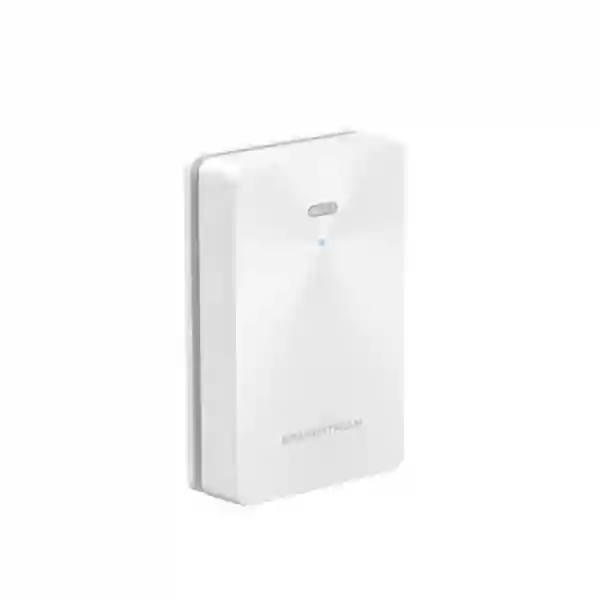
The Grandstream GWN7661 is an in-wall 802.11ax Wi-Fi 6 access point designed for indoor environments that need reliable wireless access plus practical wired connectivity at the room, desk or wall-outlet level. It combines 1.77 Gbps aggregate wireless throughput, dual-band 2×2:2 MU-MIMO with downlink and uplink OFDMA, support for 500+ concurrent Wi-Fi client devices, three local Gigabit Ethernet ports and a Gigabit uplink with PoE/PoE+. That combination makes the model especially relevant for offices, hotels, apartments, training facilities, clinics, retail spaces and other sites where a single wall-mounted device can serve phones, computers, televisions or similar endpoints while extending Wi-Fi 6 coverage.
Quick buying view
Choose the GWN7661 when you need a clean in-wall form factor, Wi-Fi 6 efficiency, multiple local Ethernet connections, PoE-powered installation and centralized or embedded management without adding a separate hardware WLAN controller for many common deployments.
What the Grandstream GWN7661 delivers
Grandstream positions the GWN7661 as an in-wall Wi-Fi 6 access point for small-to-medium businesses, offices, residential and commercial locations, hotels and related indoor deployments. The device supports IEEE 802.11 a/b/g/n/ac/ax, operates across 2.4 GHz and 5 GHz bands, and uses four internal single-band antennas. Official specifications list 573.5 Mbps on the 2.4 GHz 802.11ax radio and 1201 Mbps on the 5 GHz 802.11ax radio, giving the published 1.77 Gbps aggregate wireless throughput figure. Actual throughput depends on client capability, distance, interference, channel planning, building materials and other environmental factors, so procurement should be based on a site design rather than headline data rate alone.
Wireless capacity
Dual-band 2×2:2 operation, MU-MIMO and DL/UL OFDMA help the access point schedule multiple users and traffic types more efficiently in modern dense-device environments.
Four Gigabit interfaces
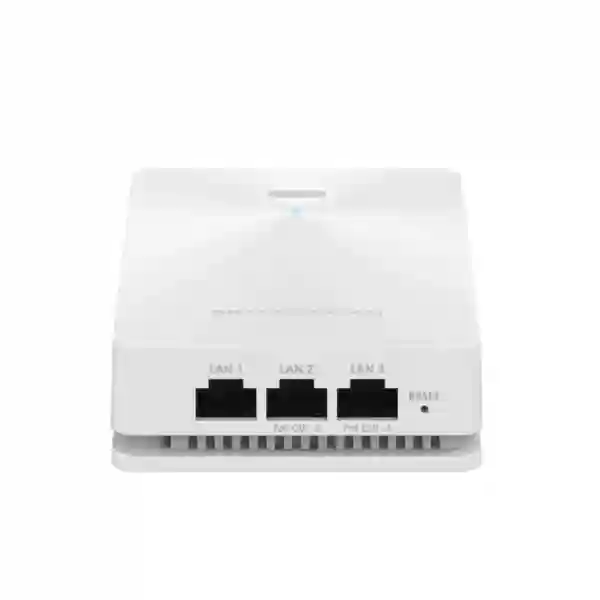
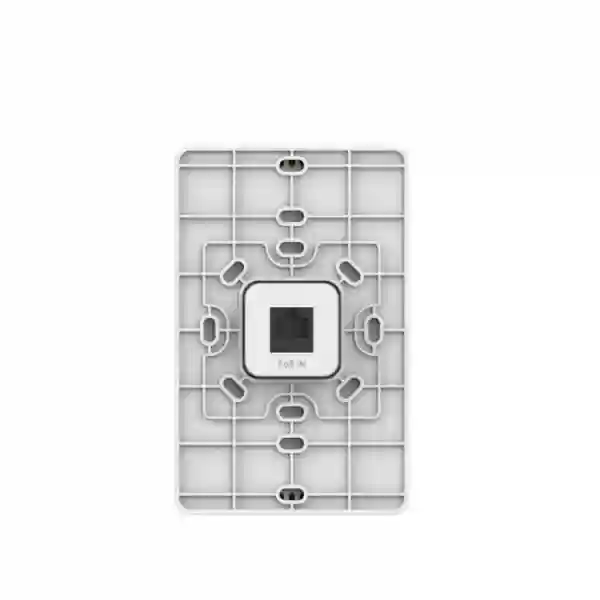
The unit provides one Gigabit uplink port with PoE/PoE+, two Gigabit PSE Ethernet ports and one additional Gigabit Ethernet port, supporting a practical room-edge topology.
Flexible management
An embedded controller can manage up to 50 local GWN APs, while GDMS Networking provides cloud management and GWN Manager provides an on-premise software option.
Security and segmentation
WPA3, WPA/WPA2 options, 802.1Q VLAN support, 802.1x and secure-boot protections give administrators useful tools for business wireless segmentation and access control.
Verified technical specifications
| Wi-Fi standards | IEEE 802.11 a/b/g/n/ac/ax |
| Wireless throughput | Up to 573.5 Mbps at 2.4 GHz and 1201 Mbps at 5 GHz under listed 802.11ax rates; 1.77 Gbps aggregate published throughput |
| MIMO | 2×2:2 on 2.4 GHz and 2×2:2 MU-MIMO on 5 GHz |
| Concurrent clients | 500+ Wi-Fi client devices |
| Published coverage | Up to 100 metres; actual coverage varies with environment |
| Ethernet | 1× 10/100/1000M uplink with PoE/PoE+, 2× 10/100/1000M PSE ports, 1× 10/100/1000M Ethernet port |
| Power | 802.3af/802.3at PoE, self-power adaptation; PSE maximum output per port 6W; maximum device power consumption 25W |
| SSIDs | 32 total, 16 per radio |
| Security | WEP, WPA/WPA2-PSK, WPA/WPA2 Enterprise, WPA3, secure boot and signed critical data/control protections |
| QoS and network | 802.11e/WMM, VLAN, TOS, IPv4, IPv6, 802.1Q, 802.1p and 802.1x |
| Dimensions | 135 × 86 × 38.5 mm; unit weight 185 g |
Planning, installation and integration guidance
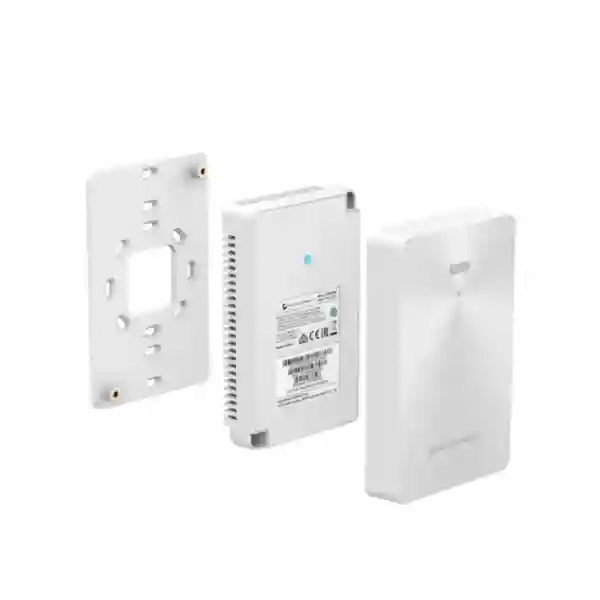
The GWN7661 is intended for in-wall installation, so project planning should begin with the physical wall-box location, cable route, PoE budget and the devices that will use its local Ethernet ports. A hotel room might connect an IP phone and television while providing Wi-Fi to guest devices; an office might connect a desk phone and workstation while using the wireless radios for laptops and mobile devices. The two PSE ports can supply up to 6W per port according to Grandstream’s specification, but the complete power design still needs to account for the upstream PoE or PoE+ source, the access point’s own consumption and the requirements of downstream devices. Engineers should verify the final power budget rather than assuming every endpoint can be powered in every cabling scenario.
Radio planning matters just as much as cabling. The published range is up to 100 metres, but walls, doors, reinforced concrete, furniture, neighbouring WLANs and client-device radio characteristics can shorten practical coverage. For multi-room and multi-floor projects, perform a predictive design or site survey, select appropriate channel widths, set transmit power deliberately and validate roaming behavior. The GWN7661 supports up to 32 SSIDs in total, but a production network rarely benefits from using the maximum. A smaller SSID design mapped to VLANs can reduce management complexity and wireless overhead while still separating staff, guest, voice, IoT and operational traffic.
Management can be matched to the scale and policy of the organization. For a localized installation, the embedded controller can manage up to 50 local GWN access points. Organizations that prefer cloud administration can use GDMS Networking, while teams requiring on-premise software management can use GWN Manager. Before deployment, decide who owns configuration, firmware maintenance, access control and backups, then document SSIDs, VLANs, authentication methods, captive-portal requirements and change-management responsibility.
Grandstream GWN7661 Tanzania
For organizations evaluating the Grandstream GWN7661 in Tanzania, the strongest use case is a structured indoor WLAN where room-level or workspace-level connectivity must combine Wi-Fi 6 with local Ethernet. Procurement teams in hospitality, professional offices, apartment developments, clinics, education facilities and branch operations can use the GWN7661 to simplify edge connectivity where a conventional ceiling AP would still require separate wall outlets or a small switch near the user. The in-wall format keeps the installation visually contained while three local Gigabit Ethernet ports support nearby endpoints. Two of those ports provide PSE capability, which can be useful for low-power compatible devices when the full PoE design has been checked.
A Tanzania deployment should be planned from the building outward. Start with floor plans and wall construction, identify where Ethernet already terminates, and map the rooms or user zones that require coverage. Do not treat the published 100-metre figure as a guaranteed radius; indoor propagation varies materially between open offices, hotel corridors, masonry structures and reinforced concrete buildings. A better specification process combines expected user density, device types, application mix, roaming requirements, VLAN design and upstream switching capacity. The GWN7661 supports 500+ concurrent client devices on paper, but actual user experience is determined by airtime demand, client capabilities and the traffic profile, not the client-count ceiling alone.
For purchasing in Tanzania, request a quotation that identifies the number of access points, required PoE switch capacity, cabling condition, VLANs, internet uplink design, management preference and any guest-portal or authentication requirements. If the network will also use Grandstream IP phones or other business communication devices, describe those endpoints during design so wired and wireless requirements can be coordinated. Explore the FourTeck Tanzania technology portfolio for related networking and communications planning, and use the quotation process to validate model suitability, current commercial terms and project scope rather than relying on a generic one-device estimate.
Grandstream GWN7661 Dar es Salaam
In Dar es Salaam, the Grandstream GWN7661 is well aligned with commercial buildings, hotels, serviced apartments, medical practices, training centres, retail environments and office floors that need a neat combination of Wi-Fi 6 and desk-level wired connectivity. A common design problem in dense business premises is that wireless users, IP phones, computers and room devices all converge at the same location, yet adding a separate small Ethernet switch at every desk or room increases equipment count and power requirements. The GWN7661 can reduce that edge complexity by placing an in-wall access point at the point of use and providing three local Gigabit interfaces while taking its own uplink through PoE or PoE+.
Dar es Salaam projects should pay particular attention to interference and construction materials. Multi-tenant buildings may contain many neighbouring Wi-Fi networks, while concrete walls and service shafts can significantly alter signal propagation. Use a channel plan rather than leaving every access point at default settings, and validate both 2.4 GHz and 5 GHz coverage after installation. Where voice applications or collaboration traffic are important, Grandstream’s advanced QoS capabilities and 802.11e/WMM support can be incorporated into an end-to-end quality design, but QoS works best when upstream switches, gateways and WAN policies are configured consistently.
When requesting a GWN7661 quotation for Dar es Salaam, include the approximate number of rooms or work areas, floor count, expected client density, existing switch model, available PoE budget and desired management method. State whether the wireless network requires staff, guest and IoT separation, captive portal access or enterprise authentication. This information helps determine whether the GWN7661 should be used throughout the site, only in selected rooms, or alongside other GWN access-point models. A mixed design can often be more appropriate than forcing one model into every physical environment.
Grandstream GWN7661 Mwanza
For Mwanza businesses, institutions and hospitality sites, the GWN7661 offers a practical way to modernize indoor access where users need both wireless mobility and wired room connectivity. The model’s in-wall format suits offices, accommodation rooms, consulting spaces and branches in which Ethernet is already delivered to wall locations. Instead of treating Wi-Fi as a separate ceiling-only service, network designers can place the access point close to users and also connect equipment such as an IP phone, computer or compatible television through local Gigabit ports. That can simplify cable presentation and create a more integrated room network.
The main design decision in Mwanza is not simply how many access points to purchase, but where they will be installed and how traffic will be segmented. The GWN7661 supports VLAN-related capabilities, 802.1x and multiple SSIDs, allowing administrators to create separate logical networks for employees, guests, voice devices or operational equipment. Each SSID and VLAN should have a clear purpose, firewall policy and addressing plan. In a hospitality setting, for example, guest Internet traffic should be separated from management systems. In an office, corporate devices may use stronger authentication while visitors use a controlled guest network.
Before ordering for Mwanza, check upstream PoE capability and Ethernet cabling quality. PoE 802.3af/802.3at support makes centralized power convenient, but the PSE output available from the access point is limited and must be matched to downstream device requirements. Plan firmware maintenance and remote administration at the same stage as hardware procurement. GDMS Networking can suit organizations seeking cloud management, while the embedded controller or GWN Manager may better fit local or on-premise administration policies. A clear deployment plan makes the purchase more predictable and helps avoid over-specifying hardware while under-specifying switching, cabling or configuration work.
Grandstream GWN7661 Arusha
The Grandstream GWN7661 can be a strong fit for Arusha hotels, lodges, offices, conference facilities, travel businesses, educational spaces and professional services that need discreet indoor wireless coverage. The access point’s wall-mounted form factor is particularly useful in guest rooms and office rooms where the network termination point is already at wall level. It brings Wi-Fi 6 into the same location while also providing three Gigabit Ethernet ports for nearby devices. For properties seeking a clean installation, this reduces the need for visible desktop switching hardware and can simplify the user-facing network layout.
Hospitality and conference environments in Arusha frequently have traffic patterns that change by time and event. A room may have a few regular devices, while meeting areas can become dense when many attendees connect simultaneously. The GWN7661’s OFDMA and MU-MIMO capabilities are designed to improve efficiency with multiple active clients, but capacity planning should still consider airtime-intensive applications such as video meetings, cloud backups and streaming. A site survey can determine where in-wall units are enough and where higher-capacity or different-form-factor access points should complement them.
A useful Arusha quotation request should describe the building type, number of guest or office rooms, event-space requirements, existing Ethernet terminations, switching and internet capacity. Ask for a topology that shows which ports will carry uplink, which local ports will serve wired devices and how VLANs map to SSIDs. Also decide whether management will be handled through the built-in controller, GDMS Networking or GWN Manager. These choices influence operations long after installation. For projects that also serve neighbouring East African operations, the FourTeck Kenya site can provide regional context for related technology requirements without changing the need to validate each local project independently.
Grandstream GWN7661 Dodoma
Organizations in Dodoma considering the Grandstream GWN7661 may be looking for a controlled, professional Wi-Fi 6 upgrade for administrative buildings, offices, training rooms, accommodation facilities and branch locations. The device is attractive when Ethernet is already present in wall boxes and the installation needs both Wi-Fi and multiple wired connections at that location. Its Gigabit uplink receives PoE or PoE+ while three additional Gigabit interfaces serve local equipment; two support PSE output within the published power limits. This can be useful for converged room designs, especially where voice endpoints and workstations sit close to the AP.
For Dodoma procurement, focus on service continuity and manageability instead of buying access points as isolated devices. Decide how configurations will be standardized, who will control firmware updates and how failed units will be replaced. The embedded controller can manage up to 50 local GWN APs, which may suit smaller sites, while GDMS Networking or GWN Manager can provide a broader management approach. Document administrator roles, backup procedures and naming standards from the beginning so expansion does not create inconsistent settings across rooms or buildings.
Coverage planning should also account for the specific construction of each site. The manufacturer’s up-to-100-metre range is an environmental maximum rather than a promise for every building. Thick masonry, metal partitions, storage areas and interference can reduce reach substantially. Use expected user density and applications to decide access-point spacing, then validate after installation. If the project carries VoIP, business applications or cloud collaboration, ensure that LAN switching and internet capacity are sized for the same traffic. A good quote should therefore include the WLAN design, PoE switching, cabling checks, configuration, testing and documented handover rather than just unit quantity.
Grandstream GWN7661 UAE
For UAE deployments, the Grandstream GWN7661 is relevant to hotels, serviced residences, office suites, clinics, education environments and multi-room commercial properties where a compact in-wall access point can combine Wi-Fi 6 coverage with wired endpoint access. The product’s 1.77 Gbps aggregate wireless throughput and three local Gigabit ports make it suitable for room-centric designs where users need laptops and phones on Wi-Fi while fixed equipment remains wired. Two PSE ports can support compatible low-power Ethernet devices within the documented per-port budget, creating a flexible edge topology when the upstream PoE design is correctly engineered.
A UAE project should distinguish between room coverage and high-density common areas. The GWN7661 may be ideal inside rooms or suites, while lobbies, conference halls and open-plan offices may call for access points with different antenna patterns or higher radio capacity. Wi-Fi design should use a survey or predictive model, coordinated channels and intentional transmit-power settings. For organizations with multiple sites, cloud or centralized management can simplify configuration consistency. GDMS Networking provides cloud management for GWN deployments, while GWN Manager provides a premise-based software option and the embedded controller supports up to 50 local GWN APs.
When the procurement spans UAE and Tanzania operations, standardization can reduce training and configuration overhead, but each region should still be designed for local cabling, regulatory settings, building structure and user density. The FourTeck UAE technology site is relevant for UAE-side project discussions, while the Tanzania product page can remain focused on Tanzanian procurement. Request a project-specific quote that states quantity, power-source requirements, management platform, installation scope, testing and any integration with IP telephony or switching.
Grandstream GWN7661 Uganda
In Uganda, the Grandstream GWN7661 can support organizations modernizing room-level Wi-Fi in offices, hospitality sites, residential developments, clinics, schools and distributed branches. Its in-wall installation helps create a tidy finish where Ethernet is terminated inside wall boxes. At the same location, the AP provides dual-band Wi-Fi 6 plus three wired Gigabit ports for nearby equipment. This architecture can be especially valuable when a room needs an IP phone and workstation or a guest room needs wired connectivity for fixed entertainment or communication devices alongside wireless access.
The network design should start with segmentation and power. Staff, guest, voice and IoT devices often have different security policies, so use SSIDs and VLANs according to a documented design rather than simply creating many networks. WPA3 support is useful for modern clients, while compatibility requirements may determine whether mixed security modes are needed. On the power side, verify the upstream PoE switch and the downstream PSE demand. Grandstream lists a 6W maximum output per PSE port and 25W maximum access-point consumption, so the complete PoE budget must be validated at the switch and cabling level.
For multi-site Uganda operations, management choice has a major operational impact. Cloud management through GDMS Networking can provide a unified view, while GWN Manager supports on-premise administration and the embedded controller can handle up to 50 local GWN APs. When planning cross-border procurement or deployment standards, the FourTeck Uganda site can be used for Uganda-specific inquiries. A quotation should still identify site count, floor plans, expected clients, applications, existing switches, internet capacity and installation responsibility so the proposed solution reflects actual conditions.
Grandstream GWN7661 Kampala
Kampala businesses often need wireless networks that support both mobile users and a large installed base of wired business devices. The GWN7661 addresses that combined requirement in a compact in-wall device. An office can connect a workstation and IP phone through local Gigabit Ethernet while serving laptops and smartphones over Wi-Fi 6. A hotel or serviced apartment can use the same principle for room electronics and guest wireless access. Because the access point is installed at wall level, it can also be easier to integrate into rooms where ceiling access is limited or where the visual design favors discrete wall hardware.
Dense urban environments can contain substantial 2.4 GHz and 5 GHz interference, so a Kampala deployment should avoid default-only radio configuration. Survey neighbouring networks, select channels deliberately and consider lower transmit power where APs are closely spaced. The aim is not to maximize signal from every unit but to produce balanced coverage and predictable roaming. Wi-Fi 6 OFDMA and MU-MIMO can improve efficiency in multi-client environments, while advanced QoS can prioritize delay-sensitive applications, but the LAN and WAN must also avoid congestion for users to see the full benefit.
When seeking pricing for Kampala, specify whether the quote is for supply only or a complete deployment. A complete scope can include AP quantity planning, PoE switching, VLANs, SSID design, guest access, authentication, installation, firmware setup, testing and documentation. For an organization that expects expansion, decide in advance whether the embedded controller will remain sufficient or whether centralized cloud or on-premise software management is preferable. This turns the GWN7661 from a standalone access point into a manageable component of a repeatable network architecture.
Grandstream GWN7661 Arua
For Arua organizations, the Grandstream GWN7661 can be considered for offices, accommodation facilities, education sites, clinics and branch environments that need straightforward indoor Wi-Fi 6 with wired connectivity at the same wall location. The product is especially practical when an Ethernet cable already terminates in each room and the network team wants to avoid deploying separate desktop switches. The single uplink carries both data and PoE or PoE+, while the three local Gigabit ports can serve nearby devices. Two ports provide PSE output within the product’s documented limits.
Arua deployments should prioritize maintainability. If technical staff are not permanently present at every site, use consistent device naming, documented management credentials, configuration backups and remote monitoring. GDMS Networking can be valuable when cloud administration fits policy, while the embedded controller may suit self-contained sites and GWN Manager can support an on-premise management model. Whatever method is chosen, establish an update process so firmware does not remain unmanaged for long periods.
Connectivity constraints also shape wireless design. A high-performance WLAN cannot compensate for an undersized internet service, congested router or overloaded uplink. Estimate typical and peak traffic for users, voice, cloud applications and any streaming services, then size WAN and switching accordingly. If multiple APs are planned, assess cabling and PoE capacity together. A quotation request that includes these details helps avoid a hardware-only proposal and makes it easier to determine the right combination of GWN7661 units, switches, gateway capacity and configuration services for the site.
Grandstream GWN7661 Mbarara
In Mbarara, the GWN7661 can suit hospitality properties, offices, health facilities, educational buildings and mixed-use locations where the wireless network must coexist with wired room devices. Its wall-mounted design allows a network installer to place Wi-Fi close to users while providing Gigabit ports for fixed endpoints. This can be simpler than installing a separate AP and switch in every room, provided the upstream cabling and PoE budget are properly designed. The compact deployment model also helps maintain a consistent look in guest-facing or client-facing rooms.
For performance planning, separate headline specifications from expected application experience. The GWN7661 supports 1.77 Gbps aggregate wireless throughput and 500+ concurrent client devices according to Grandstream, but actual throughput depends on the client radio, signal conditions, interference and airtime demand. A site with a small number of high-bandwidth clients may stress the network differently from a site with many low-traffic devices. Build the design around applications, not only device count.
Security planning should include WPA3 where client support allows, VLAN segmentation, enterprise authentication where appropriate, guest isolation and clear firewall policies upstream. Multiple SSIDs are available, but using too many can increase administrative and airtime overhead. Keep the architecture purposeful. For procurement, provide a room count, floor plan, expected client types, existing switch details, cable category and internet service. Request testing criteria such as coverage validation, client onboarding and wired-port checks. That makes the acceptance process measurable and helps ensure the installed GWN7661 network performs as intended.
Grandstream GWN7661 Gulu
The Grandstream GWN7661 gives Gulu buyers a room-focused Wi-Fi 6 option for sites that need both wireless coverage and local Ethernet. Its use is easy to understand in a branch office: the wall unit can connect upstream through PoE, serve user laptops and phones wirelessly, and provide wired ports for a workstation, IP phone or other endpoint. In accommodation or institutional buildings, the same architecture can be repeated room by room, creating a consistent connection point while keeping the AP physically integrated into the wall environment.
Repetition makes standards important. Before deploying many units, define a template for SSIDs, VLAN assignments, security settings, radio parameters, device names and administrative access. This minimizes configuration drift. The embedded controller, GDMS Networking and GWN Manager provide different paths for administration, so select one based on site count, internet availability, security policy and technical-team workflow. Do not wait until after installation to decide who owns ongoing updates and monitoring.
For a Gulu quote, include the project’s wired-device needs because they affect both port use and power. Two of the three local ports can provide PSE, but each has a documented 6W maximum output, so higher-power endpoints may need their own power source or a different topology. Confirm the upstream PoE source as well. Wireless planning should then validate where in-wall placement gives adequate 5 GHz coverage and whether additional AP models are required in corridors, halls or outdoor areas. The goal is a complete WLAN design, not simply the maximum number of identical access points.
Grandstream GWN7661 Kenya
Kenyan organizations evaluating the Grandstream GWN7661 can use it in offices, hotels, apartments, clinics, schools and commercial sites where Ethernet and Wi-Fi need to converge at room level. The in-wall form factor is useful when structured cabling already terminates near desks, televisions or phones. Instead of dedicating separate devices to wired and wireless access, the GWN7661 combines a PoE/PoE+ uplink, three local Gigabit Ethernet ports and dual-band Wi-Fi 6. This is especially useful for repeatable room designs in accommodation, managed residences and distributed office suites.
A Kenya deployment should consider future management scale. The embedded controller is convenient for up to 50 local GWN access points, while GDMS Networking can centralize cloud administration and GWN Manager offers a premise-based software path. Multi-branch organizations should standardize firmware, configuration templates and naming conventions so a network in one city does not diverge unnecessarily from another. Operational consistency often provides more long-term value than small differences in initial device configuration.
For procurement, compare the GWN7661’s room-oriented design with other access-point forms rather than looking at throughput alone. Ceiling APs may be better for open spaces, long-range or outdoor models for different coverage requirements, and higher-capacity APs for very dense halls. The GWN7661 is strongest where its wired ports and in-wall mounting are real benefits. Use the FourTeck Kenya platform for Kenya-specific project discussions, and provide floor plans, AP quantities, expected users, switch infrastructure and management preferences when requesting a tailored quotation.
Grandstream GWN7661 Kuwait
For Kuwait, the Grandstream GWN7661 can be specified for indoor office, hospitality, apartment and commercial projects where a discreet wall installation and local Ethernet connectivity are priorities. The access point brings Wi-Fi 6 service to a room while also providing three wired Gigabit ports. That combination can simplify a room design that includes an IP phone, television, workstation or other networked device. The upstream Gigabit port uses PoE/PoE+, which allows centralized power from compatible switching infrastructure and can reduce the need for a separate local power adapter.
Indoor radio planning remains essential even when rooms are compact. Adjacent APs can interfere if channels and power settings are not coordinated, while thick walls can create dead zones. Use the published up-to-100-metre range only as a reference, not a design promise. Dense hotels and offices usually need more careful cell sizing, especially on 5 GHz. The Wi-Fi 6 radio features improve multi-user efficiency, but they work best within a well-engineered channel and coverage plan.
A Kuwait quote should document the number of rooms, expected wired endpoints per room, client density, security policy and management platform. If the site uses voice-over-Wi-Fi or Grandstream IP phones, include those requirements because roaming, QoS and VLAN settings may need specific coordination. Also review the upstream switch’s PoE budget, especially if the access point will power downstream devices. Planning these elements before purchase helps prevent late changes and makes it easier to define an installation and acceptance test that covers both wireless and wired functionality.
Grandstream GWN7661 Ghana
Ghanaian businesses and institutions can consider the Grandstream GWN7661 when their indoor network needs Wi-Fi 6 together with room-level wired ports. The access point is not simply a radio device: its three Gigabit local interfaces make it a useful edge node for environments such as hotels, offices, schools, clinics and managed residential properties. A structured deployment can reduce the number of separate small switches required at user locations while supporting wireless clients through the same wall-mounted unit.
The model’s support for WPA3, VLANs, 802.1x and enterprise security options gives administrators a foundation for segmented business networks. Use those tools within a larger security design that includes gateway firewall rules, user authentication, strong administration credentials and firmware maintenance. Guest traffic should be isolated from internal resources, while operational or IoT devices can be placed on dedicated VLANs with only the access they require. Keep SSID count controlled even though the hardware supports many SSIDs.
For Ghana procurement, assess whether in-wall placement matches the building’s cable routes. If existing cabling terminates in ceiling points, another AP format may be more economical; if every room already has a wall outlet, the GWN7661 may integrate naturally. Request a proposal that identifies quantity, PoE switch requirements, management method, VLAN/SSID configuration, installation and testing. If the project is part of a broader African standardization program, document which settings are global and which must remain site specific, particularly radio regulations, channel plans, WAN capacity and physical installation conditions.
Grandstream GWN7661 Nigeria
In Nigeria, the Grandstream GWN7661 can be used as a repeatable room-edge access point in offices, hotels, serviced apartments, healthcare environments, schools and other commercial sites. The design is compelling where users need strong Wi-Fi plus wired ports at the same location. A single Ethernet uplink can provide data and PoE/PoE+ to the AP, while three local Gigabit interfaces serve endpoints. This can make room-by-room deployments simpler and more visually organized than combining a standard access point with an additional small switch.
Large Nigerian sites should treat management architecture as a core procurement choice. The embedded controller can manage up to 50 local GWN APs, while GDMS Networking can provide cloud management and GWN Manager can provide an on-premise software platform. The best choice depends on site count, policy, administrator location and resilience requirements. Standardized templates for VLANs, SSIDs, authentication and radio settings can improve consistency across branch networks.
Power planning deserves special attention. The access point supports 802.3af/802.3at and has a maximum power consumption of 25W; each PSE port has a published maximum output of 6W. Engineers should therefore calculate the total PoE draw at the upstream switch and confirm that downstream devices fit the AP’s output limits. For purchasing, send a requirements list rather than just asking for a unit price. Include site quantity, wired endpoints, expected wireless clients, floor plans, switch models, internet connection, security requirements and desired services. That produces a more useful commercial proposal and reduces the risk of overlooking necessary infrastructure.
Grandstream GWN7661 Seychelles
For Seychelles hotels, guest properties, offices and commercial environments, the Grandstream GWN7661 is relevant where a clean in-room installation and combined wired/wireless connectivity are important. Hospitality rooms are a natural example: the access point can provide Wi-Fi 6 for guest devices while local Gigabit ports connect fixed equipment such as a phone, workstation or compatible room device. The unit’s in-wall design can reduce visible equipment and keep the network edge close to the user, while upstream PoE or PoE+ simplifies centralized power delivery.
Island and hospitality projects often need careful remote-management planning. If technical staff are not always on site, choose a management method that allows administrators to monitor configuration and maintain firmware efficiently. GDMS Networking supports cloud management, while GWN Manager supports premise-based software administration and the embedded controller can handle up to 50 local GWN APs. Management connectivity should be secured, documented and tested before handover.
A Seychelles design should also distinguish indoor coverage from outdoor or semi-outdoor areas. The GWN7661 is an indoor in-wall model; terraces, gardens and exposed public areas may require suitable outdoor access points rather than extending an indoor unit beyond its intended environment. Within buildings, survey room construction and corridor layouts to determine AP density. For quotation accuracy, provide room counts, floor plans, cable termination details, wired endpoint requirements and expected guest density. This allows the design to combine the GWN7661 with complementary equipment where necessary instead of treating every area as identical.
Buying guidance: when GWN7661 is the right fit
Strong fit
Choose it for indoor rooms or offices where wall-level Ethernet is available, Wi-Fi 6 is required and two or three local wired devices can benefit from integrated Gigabit connectivity.
Evaluate alternatives
Consider another GWN model when the requirement is outdoor coverage, very large open-area range, substantially higher radio capacity, multi-gigabit uplinks or a ceiling-mount format.
The GWN7661 should be selected because its physical and network architecture solves the project problem, not merely because it carries a Wi-Fi 6 label. In-wall mounting is valuable where wall cabling already exists and where local Ethernet connections save equipment. In a wide open hall, a ceiling AP may provide a better antenna position. In outdoor areas, use hardware built for weather exposure. In very high-density environments, compare available GWN models by radio architecture, uplink speed and client needs. Good WLAN design often uses multiple access-point types across a site.
Related FourTeck resources
For Tanzania-side product and project enquiries, start with FourTeck Tanzania. For East African deployments extending across borders, the FourTeck Uganda and FourTeck Kenya sites provide country-focused entry points. Organizations with UAE operations can review FourTeck UAE. These links are useful when the same organization is coordinating networking standards across multiple offices or countries, while each individual installation should still be validated against its own building, regulatory, cabling and user requirements.
When discussing the GWN7661, ask for related items that complete the deployment rather than treating the access point as an isolated purchase. Typical requirements can include PoE switches, structured cabling, gateway and firewall capacity, VLAN configuration, IP telephony, network management, installation and wireless survey work. The correct list depends on the existing infrastructure and project scope.
Quotation checklist for Grandstream GWN7661
Providing these details makes a quote more useful because it allows the proposed bill of materials and services to reflect the actual network. If information is unavailable, begin with floor plans and current switch details; those are usually enough to identify the major questions that need to be answered before finalizing quantity and installation scope.
Frequently asked questions
Is the GWN7661 a Wi-Fi 6 access point?
Yes. The GWN7661 supports IEEE 802.11ax Wi-Fi 6 along with earlier 802.11 standards listed by Grandstream. It is a dual-band 2.4 GHz and 5 GHz indoor in-wall access point.
How many Ethernet ports does the GWN7661 have?
It has four Gigabit interfaces in total: one 10/100/1000M uplink Ethernet port with PoE/PoE+, two 10/100/1000M Ethernet ports with PSE and one additional 10/100/1000M Ethernet port.
Can the GWN7661 power other devices?
Two local Ethernet ports support PSE. Grandstream specifies a maximum output of 6W per PSE port. Always verify the downstream device’s power requirements and the upstream PoE budget before designing the connection.
How is the GWN7661 managed?
The device includes an embedded controller that can manage up to 50 local GWN access points. Grandstream also supports GDMS Networking for cloud management and GWN Manager for on-premise software management.
Does the GWN7661 support WPA3?
Yes. Grandstream lists WPA3 along with WPA/WPA2 options and enterprise authentication capabilities. The exact security mode selected should reflect client compatibility and the organization’s access-control policy.
Is 100 metres of coverage guaranteed?
No. Grandstream publishes coverage up to 100 metres and explicitly notes that coverage can vary by environment. Walls, interference, client radios, mounting position and channel settings all affect actual coverage. Site validation is recommended.
Is the GWN7661 suitable for hotels?
Yes, hotels are one of the deployment types identified by Grandstream. The in-wall form factor, wired ports and Wi-Fi 6 capabilities make it particularly relevant to room deployments, though common areas and outdoor spaces may require complementary access-point models.
Decision recap
The Grandstream GWN7661 is best understood as a converged in-wall connectivity point rather than only a Wi-Fi access point. It combines dual-band 802.11ax wireless, 1.77 Gbps aggregate published throughput, 500+ concurrent-client support, four Gigabit interfaces, PoE/PoE+ input, two PSE ports, WPA3, QoS and flexible management. These characteristics make it a practical choice when a room or office needs both Wi-Fi and nearby wired connections.
The next decision is architectural: where should each unit be mounted, how many are needed, what will connect to the wired ports, what is the upstream PoE budget, and how will the WLAN be managed and segmented? A project-specific quotation should answer those questions and identify the complete equipment and service scope. For Tanzania, use the contact action below to request pricing or discuss a GWN7661 deployment based on your actual site requirements.
Plan your GWN7661 deployment with FourTeck Tanzania
Share your location, quantity, floor plan, existing PoE switch details and expected wired and wireless devices. A clearer requirements brief makes it easier to prepare a relevant quotation and determine whether the GWN7661 should be used on its own or alongside other access-point models, switching and network services.




Reviews
There are no reviews yet.