
Grandstream GWN7803 Tanzania
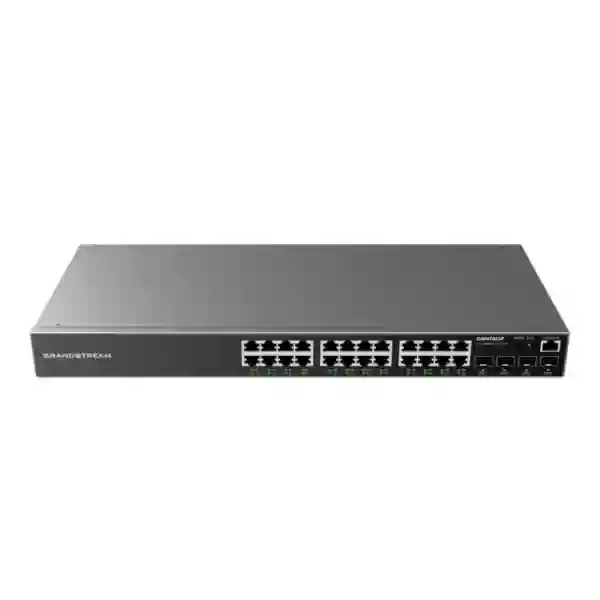
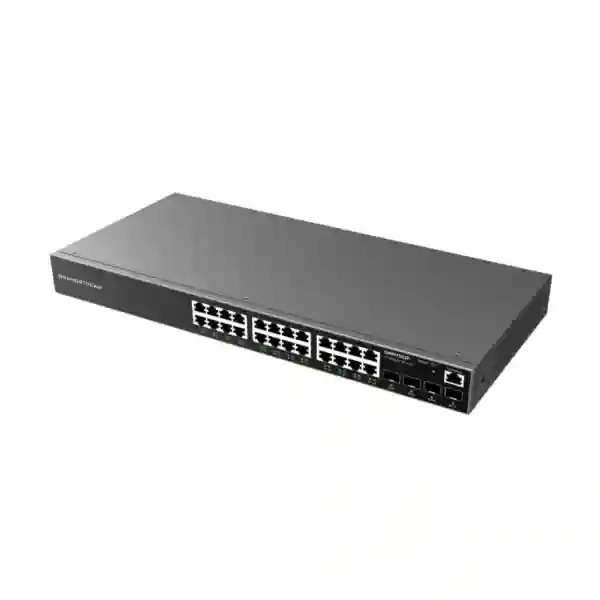
The Grandstream GWN7803 is a 24-port Gigabit Layer 2+ managed network switch designed for organizations that need a controlled, scalable wired LAN without PoE output on the access ports. It combines twenty-four 10/100/1000 Mbps Ethernet interfaces with four 1 Gigabit SFP uplinks, a console interface, VLAN and QoS functions, link aggregation, multicast controls, static routing features and a broad set of switch-security tools. For Tanzanian businesses building office, branch, education, hospitality, clinic, retail or mixed data networks, the key buying question is not simply whether twenty-four ports are enough. A sound decision also considers uplink media, VLAN design, endpoint power requirements, management preference, fiber distances, future expansion and whether some devices should instead sit on a PoE-capable switch.
Access ports for workstations, servers, printers, phones with separate power, downstream switches and other Ethernet devices.
Fiber-capable uplink interfaces for rack, floor or building interconnection when suitable SFP modules and cabling are selected.
VLAN, QoS, link aggregation, spanning tree, multicast management, ACL and static-routing functions for structured business networks.
What the Grandstream GWN7803 is designed to solve
An unmanaged switch can connect devices, but it offers limited control when a business needs separate staff, voice, guest, camera, server or management traffic. The GWN7803 addresses that gap by giving network administrators a managed access layer with up to 4K VLANs, voice-VLAN functions, access-control capabilities and traffic-prioritization tools. The platform supports IPv4 and IPv6 environments and provides security functions that include 802.1X authentication, RADIUS and TACACS+ support, storm control, port isolation, port security, sticky MAC, IP source guard, denial-of-service protection, ARP inspection and DHCP snooping.
Grandstream documents a 56 Gbps switching capability, 28 Gbps total non-blocking throughput and a forwarding rate of 41.66 million packets per second for the GWN7803. It uses store-and-forward switching and supports link aggregation so multiple physical connections can be grouped where the design and connected equipment allow it. The four SFP interfaces are 1 Gigabit ports rather than SFP+ 10 Gigabit uplinks, so buyers planning high-volume server aggregation or very fast inter-switch trunks should compare their traffic profile with newer or higher-capacity switch families before selecting this model.
The GWN7803 is the non-PoE model. It does not provide IEEE 802.3af/at power to endpoints. If the same switch must directly power IP phones, wireless access points, cameras or other PoE devices, the GWN7803P or another suitable PoE switch should be evaluated instead. This distinction is important for quotations because the correct model depends on the electrical requirements of the connected devices as well as the Ethernet port count.
Verified GWN7803 technical highlights
| Product class | Enterprise Layer 2+ managed network switch |
| Ethernet ports | 24 × 10/100/1000 Mbps RJ45 |
| Uplink ports | 4 × 1000 Mbps SFP |
| PoE | No PoE output on GWN7803 |
| Switching capability | 56 Gbps |
| Non-blocking throughput | 28 Gbps |
| Forwarding rate | 41.66 Mpps |
| Management | Local web UI, CLI, GDMS Networking, GWN Manager and supported GWN routing/controller options |
Management, VLAN, QoS and security planning
The GWN7803 can be administered through its local web interface or command-line access, while Grandstream also supports centralized management through GDMS Networking and GWN Manager. That flexibility is useful when one organization has a single office today but may later operate multiple branches. Central management does not eliminate the need for network design: VLAN numbers, IP addressing, uplink tagging, loop prevention, administrative credentials, logging and backup settings should still be documented so the switch can be maintained consistently.
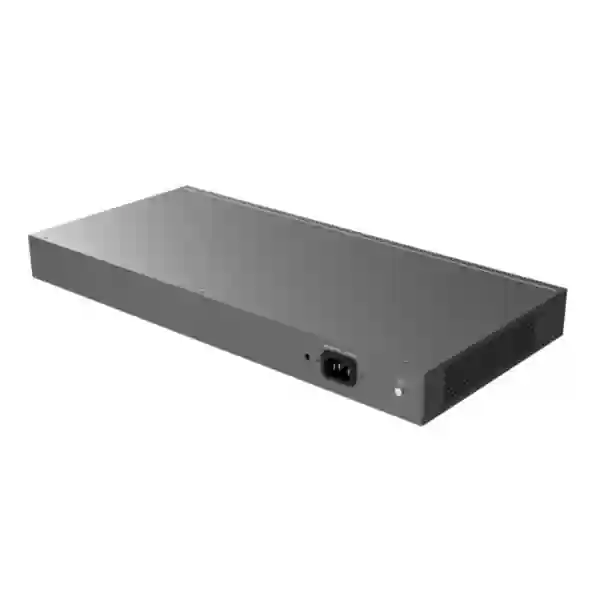
For converged business networks, QoS can be used to prioritize delay-sensitive services such as voice where the end-to-end network is configured correctly. VLANs can separate departments or device types, while ACL and security features can restrict unwanted traffic between segments. IGMP and MLD snooping can help manage multicast behavior. Buyers should also plan how configuration backups, firmware maintenance, UPS protection, rack ventilation, labeling and spare uplink modules will be handled after installation.
Grandstream GWN7803 Tanzania
For organizations in Tanzania, the Grandstream GWN7803 fits best when the requirement is a manageable twenty-four-port access switch with fiber-ready 1 Gigabit uplinks and no need to power endpoints from the switch itself. Corporate offices can use it to separate finance, administration, guest, voice and server traffic with VLANs. Schools can segment laboratories, administration and staff networks. Hotels can use managed switching for front-office, back-office and guest-service systems while keeping traffic domains organized. Retail groups and professional firms can use the switch as part of a standardized branch template where identical port profiles and VLAN conventions simplify rollout and support.
A Tanzanian procurement review should start with an endpoint schedule rather than the model number alone. Count every desktop, printer, phone, access point, camera, server link, uplink and spare port. Mark which devices require PoE. If a large share of the endpoints depend on switch-supplied power, the non-PoE GWN7803 may be the wrong primary access switch even though its data features are suitable. If phones and cameras already use separate PoE switches, injectors or local power, the GWN7803 can provide a clean data-switching layer without paying for unused PoE capability.
Fiber planning also matters. The four SFP interfaces are useful for connecting racks, floors or buildings, but module type must match the fiber plant, connector, distance and optical specification. Single-mode and multimode systems are not interchangeable by assumption. The switch’s 1 Gigabit SFP uplinks also need to be assessed against expected aggregate traffic. Where many access devices simultaneously move large files, video or backup traffic, a design with 10 Gigabit uplinks may be more appropriate.
FourTeck Tanzania can place the GWN7803 in a broader LAN discussion covering managed switching, structured cabling, Wi-Fi, firewalls, racks and UPS planning. See the FourTeck Tanzania IT and networking portfolio for the related infrastructure context. For customers whose network includes wireless access points or voice endpoints, the switch should be selected together with the intended VLAN and power architecture rather than as an isolated hardware purchase.
Grandstream GWN7803 Dar es Salaam
Businesses in Dar es Salaam commonly need switching for multi-department offices, commercial buildings, hospitality sites, professional services, education facilities and branch operations. In these environments, the GWN7803 is most useful when network administrators want to replace unmanaged switching with a structured Layer 2+ design. Twenty-four Gigabit access ports provide room for a typical access layer, while four Gigabit SFP ports can be allocated to backbone connections, rack-to-rack links or fiber runs where suitable transceivers and cabling are used.
A Dar es Salaam quotation should identify whether the switch will sit in a main rack, floor cabinet or branch communications room. That affects fiber path, patch-panel requirements, rack space, UPS sizing and environmental planning. Dense office sites may need several access switches, in which case uplink topology and spanning-tree behavior should be planned before installation. Link aggregation can be considered where the connected device and design support it, but it should not be treated as a substitute for sufficient backbone capacity.
Voice and wireless integration deserve particular attention. The GWN7803 supports traffic prioritization and voice-VLAN functions, but it does not power phones or access points. A business that wants one cable to deliver both data and power to desk phones or ceiling APs should budget for PoE switching elsewhere in the design. Where separate PoE switches are already present, the GWN7803 can be used for desktops, printers, servers, management interfaces and non-powered infrastructure.
For growing Dar es Salaam sites, document VLAN IDs, uplink assignments, switch management addresses, allowed trunks, administrative access and port labels from day one. This reduces troubleshooting time when the network expands. A managed switch is valuable because it provides control, but that value depends on configuration discipline. FourTeck can use the model as part of a broader bill of materials that includes firewall, Wi-Fi, cabling and rack dependencies rather than quoting a switch without checking how it will be used.
Grandstream GWN7803 Mwanza
For Mwanza offices, education facilities, clinics, retail sites and branch operations, the GWN7803 can provide a controlled wired-network layer where twenty-four Gigabit copper ports are appropriate. The practical advantage over an unmanaged switch is the ability to segment users and devices, apply traffic controls, monitor network behavior and manage the switch through several supported methods. Organizations that have grown by adding small unmanaged switches over time can use a managed-switch refresh to simplify topology and establish clearer VLAN and uplink standards.
Before selecting the GWN7803 for a Mwanza deployment, inventory the powered devices. Cameras, Wi-Fi access points and many IP phones are commonly powered through Ethernet. Because the GWN7803 does not provide PoE, those endpoints need separate power, injectors or PoE-capable switches. This is not a limitation when the network intentionally separates powered devices from general data access, but it can create unnecessary complexity if PoE is actually required at most ports.
The four SFP uplinks can support fiber-based connectivity within a building or campus where the optical system is designed correctly. Buyers should confirm whether existing fiber is single-mode or multimode, the connector type, distance, patching arrangement and compatible module specifications. If the site has large east-west data flows or high-volume server traffic, the 1 Gigabit uplink ceiling should be evaluated carefully. A switch can have enough user ports while still becoming constrained at its backbone connection.
For maintainability, include configuration backup, firmware policy, UPS protection and labeling in the rollout. Network admins can use VLANs for departmental separation, ACLs for traffic policy and security mechanisms such as DHCP snooping or ARP inspection as appropriate to the design. The objective for Mwanza buyers should be a switch deployment that is easy to understand and expand, not simply a device installed with its default configuration.
Grandstream GWN7803 Arusha
Arusha organizations in tourism, hospitality, professional services, education, administration and retail often operate networks that carry several kinds of business traffic at once. The GWN7803 is suitable where a non-PoE twenty-four-port managed access switch can be used to organize those services with VLANs, QoS and managed uplinks. Front-office systems, staff workstations, printers, booking applications, management devices and back-office resources can be separated logically even when they share the same physical switching infrastructure.
Hospitality and guest-service environments should be especially careful not to confuse segmentation with security isolation by itself. VLANs provide logical separation, but firewall policy, access rules and secure management are also needed when guest traffic must be kept away from business systems. The GWN7803 can participate in that architecture through tagged uplinks and access ports, while a firewall or routing layer enforces inter-network policy according to the overall design.
Because the GWN7803 is non-PoE, hotels, lodges and offices with many ceiling access points or IP cameras may prefer to reserve it for data devices and use PoE switches for powered endpoints. This can be a sensible architecture when the roles are clearly documented. It can also make troubleshooting easier because power-delivery issues are concentrated on dedicated PoE hardware rather than mixed across every access port.
For Arusha procurement, request a quote that includes the expected number of switches, required SFP modules, rack or shelf arrangement, patching and any configuration assistance. State whether centralized management through Grandstream’s platform is desired. If the network is expected to expand to multiple sites, use consistent VLAN IDs, naming conventions and configuration templates from the beginning. That approach turns the GWN7803 from a standalone switch into a repeatable component of a wider network standard.
Grandstream GWN7803 Dodoma
In Dodoma, the Grandstream GWN7803 can serve business offices, institutions, training facilities, professional organizations and branch sites that need managed Gigabit connectivity for up to twenty-four copper access links. Its Layer 2+ functions support a more deliberate LAN design than basic unmanaged switching, including VLAN segmentation, traffic prioritization, multicast controls, link aggregation, spanning-tree functions and static-routing capabilities for appropriate use cases.
Institutional deployments should plan for user groups, shared services and network administration before cabling ports. For example, administration, finance, staff, lab devices, guest access and infrastructure management may require different VLANs or firewall policies. The switch can carry these VLANs over tagged uplinks, but the exact design should match the site’s addressing and routing architecture. Where authentication is required, features such as 802.1X and RADIUS integration can be evaluated as part of access-control policy.
Endpoint power remains a decisive factor. The GWN7803 does not power PoE devices, so a Dodoma site with IP phones, cameras and APs should map those endpoints to PoE-capable switching or another suitable power method. For general workstations, printers, servers and management interfaces, the non-PoE design may be entirely appropriate. Keeping power requirements explicit in the bill of materials prevents a common procurement error: selecting enough network ports but not enough powered ports.
Operational planning should include a UPS-backed rack where practical, clear patch-panel labeling, configuration backups and documented uplink routes. Fiber modules should be selected from the actual cable plant rather than by guessing from connector appearance alone. If a project includes several buildings or high-bandwidth server traffic, verify whether 1 Gigabit SFP uplinks provide sufficient headroom. This design review is often more important than small differences in switch purchase price.
Grandstream GWN7803 UAE
For UAE projects, the GWN7803 remains relevant as a non-PoE 24-port Layer 2+ access switch when organizations need managed Gigabit Ethernet and fiber-capable uplinks without direct endpoint power. It can fit office floors, branch locations, retail back offices and service environments where phones, wireless access points or cameras are powered separately or connected to dedicated PoE switches. Buyers should avoid substituting the GWN7803 for the GWN7803P solely because the model names look similar; the power-delivery difference changes the deployment design.
UAE networks often combine internet security gateways, business Wi-Fi, IP telephony, CCTV and server resources. In that context, VLANs can separate traffic classes and QoS can support latency-sensitive applications. The switch’s management options allow local administration as well as integration with Grandstream centralized tools. For multi-branch rollouts, standardized configuration profiles and naming conventions help keep sites consistent while still allowing location-specific addressing and uplinks.
A project quote should list copper port count, SFP requirements, fiber type, rack size, patch panels, UPS capacity and expected management approach. For Grandstream-focused deployments in the Gulf, the FourTeck Grandstream UAE specialist site is a useful regional reference, while exact current stock, price and delivery should always be confirmed at quotation time rather than assumed from a product page.
If the network has high aggregation traffic, compare the GWN7803’s four 1 Gigabit SFP ports with newer models offering faster SFP+ uplinks. The best choice depends on real application flows, not only user count. A twenty-four-port access switch can be adequate for endpoints while still being undersized for backup, video or server traffic if its uplink layer is not planned properly.
Grandstream GWN7803 Uganda
Ugandan businesses evaluating the GWN7803 should focus on whether they need managed data switching without PoE. The model provides twenty-four Gigabit access ports and four 1 Gigabit SFP uplinks, with VLAN, QoS, multicast and security controls that suit structured business LANs. It can be used in offices, education sites, clinics, hospitality environments and branches where administrators want more visibility and policy control than an unmanaged switch provides.
For multi-site organizations, management consistency can be more valuable than one isolated hardware feature. Using the same VLAN plan, switch naming structure, management-address scheme and configuration-backup process across branches simplifies support. Centralized Grandstream management options can complement that approach, but every site still needs correct physical cabling, uplink design and security policy. The FourTeck Uganda IT solutions site provides the regional context for networking, communications and infrastructure planning.
The non-PoE design should be checked against phone, Wi-Fi and CCTV plans. If most endpoints require electrical power over Ethernet, specify a PoE switch instead or place powered devices on separate PoE hardware. If the GWN7803 is being used primarily for computers, printers, servers, uplinks and non-powered infrastructure, its port mix can be efficient and straightforward.
When requesting a Uganda quotation, include quantities, preferred delivery destination, fiber requirements, SFP module needs and whether preconfiguration is required. Avoid purchasing transceivers before confirming fiber mode and distance. For sites with several switches, consider how uplink redundancy and spanning-tree policy will be configured. A good deployment plan defines what happens when a link fails as well as how the network works during normal operation.
Grandstream GWN7803 Kampala
Kampala offices and commercial sites often combine user devices, IP telephony, Wi-Fi, surveillance and shared applications on the same physical network. The GWN7803 can provide a managed access layer for the non-powered portion of that environment. Its VLAN and QoS functions allow administrators to organize traffic classes, while ACL and switch-security capabilities can support a more controlled LAN design. The key is to define which systems belong on each VLAN and where routing or firewall policy will be enforced.
Twenty-four Gigabit ports can fit a medium office or a portion of a larger floor, but port planning should reserve capacity for growth. Do not calculate only today’s desktops. Include printers, meeting-room devices, servers, uplinks, management interfaces and spare ports. If a site expects rapid expansion, purchasing a switch that begins nearly full can create an avoidable second procurement soon after installation.
Kampala projects using fiber between floors or racks can use the four 1 Gigabit SFP interfaces with suitable optics. Fiber design should confirm mode, connector, patching and supported distance. Where the backbone must carry heavy traffic from many access users or centralized servers, assess whether 1 Gigabit uplinks provide sufficient capacity or whether a faster aggregation design is required.
Operational readiness is equally important. Use UPS protection for network racks where practical, document switch credentials securely, back up configuration files and record the purpose of every trunk and access port. If Grandstream centralized management is selected, decide who owns administrative roles and how changes are approved. These steps reduce the risk that a well-featured managed switch becomes difficult to support because the configuration was never documented.
Grandstream GWN7803 Arua
For Arua branch offices, institutions, clinics, schools and growing commercial sites, the GWN7803 offers a way to standardize wired access with managed Gigabit switching. It is particularly useful when the local site should follow the same VLAN and security conventions as a head office. A repeatable branch template can define user VLANs, voice VLANs, guest access, infrastructure management and uplink settings so troubleshooting does not start from zero at each location.
The switch’s non-PoE nature should be treated as a design choice. A branch that uses locally powered phones and access points, or a separate PoE switch for those devices, can dedicate GWN7803 ports to ordinary data endpoints and uplinks. A branch that expects every phone, camera and AP to draw power from the access switch should consider the PoE version or another properly sized PoE model instead.
Arua deployments may also benefit from careful spares planning. A switch itself is only one part of the connectivity chain; compatible SFP modules, patch leads, labeled copper cabling, UPS protection and documented configuration can be equally important to recovery when something fails. When fiber is involved, keep a record of module type and link specification so replacement optics are not selected by guesswork.
For remote administration, decide whether the device will be managed through its local interface, CLI or a supported centralized Grandstream platform. Management traffic should be protected and administrative credentials controlled. The objective is not to expose switch management broadly for convenience, but to provide authorized administrators with predictable access while keeping the management plane separate from general user traffic where the design permits.
Grandstream GWN7803 Mbarara
Mbarara organizations looking for a managed twenty-four-port switch can consider the GWN7803 for office, education, healthcare, retail and branch-network roles where Gigabit access and 1 Gigabit fiber uplinks are sufficient. The switch supports traffic segmentation and prioritization so a network can move away from a flat design in which every endpoint shares one broadcast domain. This can improve manageability and make security policy easier to apply at the routing or firewall layer.
Network segmentation should be based on function and risk, not simply on department names. User workstations, guest access, infrastructure devices, cameras, voice systems and servers may need different controls. The GWN7803 can carry and enforce parts of this structure through VLAN and port configuration, while the complete policy also depends on upstream routing, firewall rules and identity systems. A managed switch is one component of the architecture rather than a complete security solution by itself.
For procurement, identify all PoE needs before ordering. The GWN7803 supplies data only; it does not deliver power over Ethernet. If the project includes many IP cameras or ceiling access points, a separate PoE strategy is essential. Also verify whether four 1 Gigabit SFP uplinks are sufficient for the intended backbone. A site with modest office traffic may be well served, while a data-heavy server or video environment could require faster uplink technology.
Mbarara deployments should include clear documentation: switch location, rack unit, management IP, VLAN assignments, uplink ports, fiber module details and configuration backup location. This information lowers support time during expansion or fault diagnosis. If several branches use the same model, a standardized configuration checklist can help ensure that security and management settings are applied consistently rather than relying on default installation habits.
Grandstream GWN7803 Gulu
In Gulu, the Grandstream GWN7803 can be considered for organizations that need a business-grade managed access switch but do not require PoE from the switch. Twenty-four Gigabit Ethernet ports give a useful endpoint density for many branch and institutional networks, while four 1 Gigabit SFP ports support fiber uplink options. Layer 2+ management features provide the structure needed for VLAN-based segmentation, QoS and controlled network growth.
For a branch deployment, simplicity and documentation often matter more than adding every possible feature. Start with a clear addressing plan, a small number of purposeful VLANs, secure administrative access and correctly configured trunks. Add QoS where there is a real application requirement, such as voice, and enable security controls in a way that aligns with the broader network architecture. Overcomplicated configuration can be as difficult to maintain as an unmanaged network if nobody can explain why each rule exists.
PoE planning remains separate. IP phones, cameras and APs connected to the GWN7803 require an external power method. Where a Gulu project has a high count of those devices, it can be more efficient to select a PoE switch for that access layer. Where the switch is primarily serving desktops, printers, servers and uplinks, the non-PoE model avoids unnecessary power-budget planning.
Before installation, confirm rack space, ventilation, mains power and UPS strategy. If fiber uplinks are planned, verify the optics and cable plant. Keep spare patch leads and document critical uplinks. For centralized management, define who receives administrative access and how backups or firmware updates are handled. These operational details determine whether the switch remains easy to support after the initial project team has moved on.
Grandstream GWN7803 Kenya
Kenyan businesses evaluating the GWN7803 can use it as a non-PoE managed access switch for offices, branches, schools, hospitality and professional environments. Its 24 Gigabit Ethernet ports and four 1 Gigabit SFP uplinks fit common access-layer designs where endpoints need high-speed LAN connectivity and administrators need VLAN, QoS, security and monitoring functions. The FourTeck Kenya technology solutions site provides a regional point of reference for enterprise networking and related infrastructure.
A Kenya project should distinguish access switching from aggregation. The GWN7803 can connect many user devices, but its uplinks are 1 Gigabit SFP rather than 10 Gigabit SFP+. If multiple access switches feed large server, storage or video workloads into one backbone, faster aggregation may be justified. For ordinary office applications, carefully planned Gigabit uplinks can still be practical, especially where traffic is distributed rather than concentrated.
The model does not provide PoE. That means powered phones, cameras or wireless APs require dedicated PoE switches, injectors or local adapters. Procurement teams should therefore request a bill of materials based on endpoint categories rather than assuming every 24-port switch is interchangeable. Port count, PoE demand, uplink speed and management ecosystem should all be considered together.
For multi-branch Kenyan deployments, configuration standardization can reduce support effort. Use common naming, VLAN numbering and documentation conventions while allowing each site to retain its own addressing where required. Central management can help monitor multiple devices, but secure administrative access and change control remain important. Include SFP compatibility, rack layout, patching, UPS and backup configuration in the implementation checklist, not just the switch chassis.
Grandstream GWN7803 Kuwait
For Kuwait business networks, the GWN7803 can fill a conventional managed access-switch role where twenty-four Gigabit copper ports, four 1 Gigabit SFP uplinks and Layer 2+ functions are appropriate. Offices, retail operations, clinics and branch sites can use VLANs to separate user groups and services, while QoS and multicast controls help manage traffic behavior. Security features such as 802.1X support, port isolation and DHCP snooping can contribute to a broader network-access policy when configured correctly.
The procurement decision should begin with the connected-device list. The GWN7803 is non-PoE, so phones, cameras and APs need separate power or dedicated PoE switching. In a mixed environment, it can be useful to separate general data endpoints onto the GWN7803 while keeping powered infrastructure on another switch. That design can make power budgeting more predictable, but it requires clear patching and documentation.
Kuwait installations should also consider rack temperature, ventilation, UPS capacity and cable management. Managed switches often remain in service for years, so serviceability matters. Label SFP links, keep a record of optical module types and save configuration backups after approved changes. Where several switches are installed, document spanning-tree roles and link aggregation so redundancy does not accidentally create loops.
If the network is intended for high-volume server or storage traffic, review whether 1 Gigabit uplinks are adequate. Newer switch families with SFP+ may be more suitable for demanding aggregation. For ordinary office access, the GWN7803 can still offer a balanced managed feature set. FourTeck quotations should be based on current availability and project requirements rather than fixed assumptions about stock or delivery time.
Grandstream GWN7803 Ghana
Ghanaian organizations can consider the Grandstream GWN7803 for non-PoE business access switching where 24 Gigabit ports are sufficient and four 1 Gigabit SFP interfaces meet the uplink requirement. The model supports a broad managed feature set, making it useful for offices, schools, hospitality, healthcare and branch environments that need traffic segmentation and administrative visibility rather than simple plug-and-play switching.
For a growing Ghana network, VLAN planning is a practical first step. Separate ordinary users, guests, infrastructure management, voice, surveillance and servers where appropriate, then define how those segments communicate through the routing or firewall layer. The switch can carry tagged VLANs and apply port policies, but the complete security model depends on the rest of the network. Avoid treating VLAN separation as a replacement for firewall policy where sensitive systems are involved.
The GWN7803 does not provide PoE, so powered endpoints require another solution. This should be explicit in any project quotation, especially where IP phones, cameras and access points form a large part of the device count. If powered devices dominate, compare the PoE variant or other PoE switches. If the majority of endpoints are ordinary computers, printers and server links, the non-PoE model can be a sensible fit.
Fiber uplink planning should verify optic type, distance and available cable plant. Where many users share a single uplink to servers or the internet edge, monitor expected utilization and leave headroom. Include rack, patch panels, UPS, labeling and configuration backup in the implementation plan. A well-documented managed switch is easier to expand and troubleshoot than a device that was installed without a record of VLAN and port assignments.
Grandstream GWN7803 Nigeria
For Nigerian offices, branches, schools, healthcare facilities, hospitality and retail environments, the GWN7803 can serve as a managed non-PoE access switch where twenty-four Gigabit ports and four Gigabit SFP uplinks fit the network design. Its Layer 2+ feature set supports structured VLAN segmentation, QoS, multicast handling, link aggregation, static routing and security controls. These capabilities are useful when an organization is standardizing a network that has outgrown unmanaged switching.
Large or distributed Nigerian organizations should consider whether the switch will be part of a repeatable branch architecture. Standard templates for VLANs, management addressing, port descriptions and uplinks can reduce configuration drift between sites. Central Grandstream management options may assist with visibility, but a centralized platform should be accompanied by secure credentials, controlled roles and a documented change process.
Power architecture can be decisive. Because the GWN7803 does not deliver PoE, it is best suited to data endpoints or networks where powered devices use other PoE hardware. If a branch uses many IP phones and cameras, specify the number and power class of those devices before choosing the switch family. This prevents a situation where data ports are available but the project lacks sufficient powered ports.
For backbone design, the four SFP ports are 1 Gigabit. That can be appropriate for typical office access, but organizations moving large backups, video streams or server traffic should evaluate faster uplinks. Procurement should also include the correct optics, rack accessories, cabling and UPS requirements. FourTeck can use the GWN7803 as part of a network bill of materials rather than treating the chassis as the entire solution.
Grandstream GWN7803 Seychelles
Seychelles organizations in hospitality, professional services, administration, retail and education can use the GWN7803 when they need a managed 24-port Gigabit access switch without PoE. Hospitality sites in particular often carry guest, operations, voice, CCTV and management traffic across the same physical infrastructure. A managed switch allows those services to be separated with VLANs and prioritized where required, provided upstream routing and firewall policy are designed consistently.
Island and multi-building deployments should plan spare components and documentation carefully. Compatible SFP modules, known fiber types, spare patch leads and saved configurations can shorten recovery time when replacement equipment is needed. The four 1 Gigabit SFP ports can support fiber connections between racks or nearby buildings within the chosen optical specification, but long-distance or high-capacity links may require different hardware and optics.
The GWN7803 does not power devices over Ethernet. Hotels and resorts with many access points, cameras and IP phones should therefore decide whether those endpoints will sit on separate PoE switches or whether a PoE-capable switch is the better primary platform. Separating data and PoE switching can be valid, but only when rack space, uplinks and management complexity are accounted for.
A Seychelles quotation should include destination, required quantity, SFP specifications, cable and rack dependencies and whether configuration support is needed. Current stock and delivery should be confirmed during quotation rather than assumed. For a resilient design, include UPS protection and configuration backup, and ensure network documentation remains available to local administrators. The most valuable outcome is not simply buying a managed switch; it is creating a network that can be maintained predictably as the site changes.
Related network planning resources
Review the Grandstream GWN7803 Africa product page for additional regional procurement and deployment context.
The FourTeck Uganda site covers networking, structured cabling and communications for Ugandan deployments.
Use the FourTeck Kenya site when planning regional networking, communications and security requirements in Kenya.
For Gulf-focused Grandstream requirements, see the Grandstream UAE FourTeck resource.
Quotation checklist for Grandstream GWN7803
For a more accurate quotation, prepare the following project information: required switch quantity; number of active and future Ethernet endpoints; count of devices that need PoE; required VLANs; existing firewall or router platform; preferred local or centralized management method; number of fiber uplinks; fiber type, connector and approximate distance; rack location and available rack space; UPS availability; expected server, CCTV or backup traffic; and whether configuration, installation or migration assistance is required.
This information helps determine whether the GWN7803 itself is the right model, whether the GWN7803P or another switch is more appropriate, which SFP modules are needed and whether uplink capacity is sufficient. It also helps avoid purchasing accessories that do not match the installed cable plant.
Frequently asked questions
Does the Grandstream GWN7803 provide PoE?
No. The GWN7803 is the non-PoE model. If the switch must power IP phones, access points, cameras or other PoE endpoints, evaluate the GWN7803P or another PoE-capable model and size the total power budget.
How many ports does the GWN7803 have?
It provides 24 Gigabit Ethernet RJ45 access ports and four 1 Gigabit SFP interfaces, plus a console interface for management.
Can the GWN7803 be centrally managed?
Yes. Grandstream supports local web management and CLI, together with centralized management through GDMS Networking and GWN Manager. The best method depends on the number of switches, administrative model and network policy.
Is the GWN7803 suitable for VLAN-based business networks?
Yes. It supports up to 4K VLANs and multiple VLAN methods, including IEEE 802.1Q tagging and voice VLAN features. VLAN design should still be coordinated with routing and firewall policy.
Should I choose GWN7803 or a faster switch?
Choose according to actual traffic. The GWN7803 has four 1 Gigabit SFP uplinks. If your design requires 10 Gigabit aggregation for servers, storage, heavy video or multiple high-traffic access switches, compare models with SFP+ uplinks before ordering.
Decision recap
Choose the Grandstream GWN7803 when you need twenty-four Gigabit non-PoE access ports, four 1 Gigabit SFP uplinks, managed Layer 2+ features, VLAN and QoS control, switch-security functions and flexible local or centralized administration. Choose a PoE model when the switch must power endpoints. Choose a model with faster uplinks when aggregate traffic requires more than 1 Gigabit backbone links.
For Tanzania procurement, the next step is to confirm port count, PoE demand, fiber requirements and the intended network topology. FourTeck can then align the switch, optics, rack components and related LAN infrastructure with the actual deployment rather than quoting an isolated part number.
Consultation panel
Send your endpoint count, existing firewall/router model, required VLANs, PoE device list, fiber type and site location. FourTeck can use those details to review whether the Grandstream GWN7803 is suitable and identify any required SFP modules, PoE alternatives, cabling or configuration items before the final quotation.


Reviews
There are no reviews yet.