


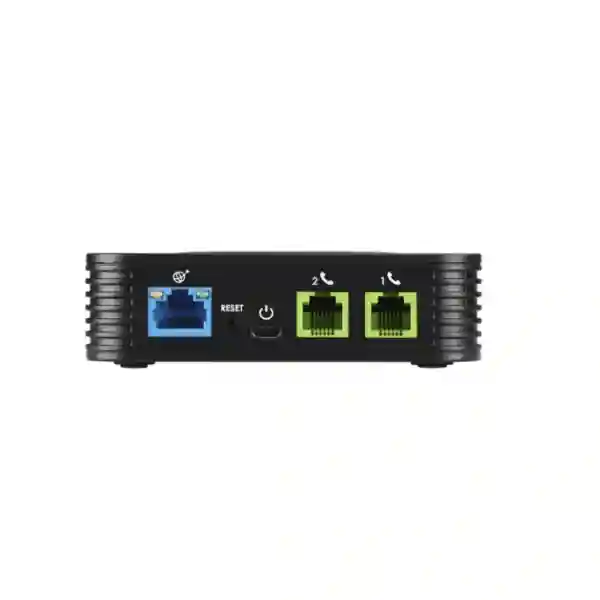
Grandstream HT802 Tanzania
The Grandstream HT802 is a compact two-port analog telephone adapter built for organisations that want to connect conventional analog telephones or fax machines to a SIP-based VoIP platform without immediately replacing every endpoint. For a small office, branch, reception point, security desk, hotel back office, clinic, school, warehouse or distributed business site, the HT802 can provide a practical bridge between familiar analog devices and an IP telephony environment. It supports two SIP profiles through two RJ11 FXS ports and uses a single 10/100 Mbps Ethernet connection to reach the IP network.
For buyers in Tanzania, the most important question is not simply whether an ATA has two phone sockets. A successful deployment depends on SIP compatibility, network quality, dial-plan design, power continuity, fax requirements, security settings, provisioning method and the way the adapter will connect to an IP PBX or hosted voice service. FourTeck Tanzania can help buyers frame those requirements before requesting a quotation so the selected hardware fits the actual voice environment.
2 FXS ports
Connect two analog phones, fax devices or other compatible analog endpoints using standard RJ11 interfaces.
SIP and secure voice
The platform supports SIP with TLS for signalling and SRTP for media protection where the connected voice service supports those methods.
T.38 fax support
T.38 Group 3 fax relay and G.711 pass-through options make the HT802 relevant where organisations still depend on fax workflows.
Provisioning options
TR-069, XML configuration and supported provisioning methods can simplify repeated configuration across multiple endpoints.
What the Grandstream HT802 solves
Many businesses still have useful analog phones, fax machines, door phones, lift phones, legacy extensions or operational devices that should not be discarded merely because the organisation is moving toward SIP and IP telephony. The HT802 provides an interface between those analog endpoints and an IP-based voice service. It is especially useful when a business wants to migrate in stages: an IP PBX can be introduced first, while selected analog devices remain in service through the ATA. This reduces unnecessary replacement and gives procurement teams more control over the transition.
The HT802 supports common telephony features such as caller ID, call waiting, call transfer, forwarding, hold, do not disturb and three-way conferencing. It also supports a broad codec set including G.711, G.722, G.723.1, G.729A/B, G.726, iLBC and OPUS, although the actual codec used in a call depends on the PBX, provider and configured policy. The unit connects to the LAN through one auto-sensing 10/100 Mbps Ethernet port. It is not a replacement for a business router, managed switch or firewall; rather, it is an endpoint that should operate on a properly designed network.
Organisations using Grandstream UCM IP PBXs can also benefit from Grandstream’s zero-configuration provisioning capability for supported deployments. For other SIP systems, compatibility should be validated using SIP credentials, registration requirements, DTMF method, NAT handling, security parameters and fax settings. Buyers can review FourTeck Tanzania’s integrated IT and telecom solutions, business technology shop, technology services, company overview and quotation contact page when planning a broader deployment.
Verified Grandstream HT802 technical overview
| Area | Verified capability | Buyer significance |
|---|---|---|
| Telephone interfaces | Two RJ11 FXS ports | Supports two analog endpoints or lines according to configuration. |
| Network interface | One 10/100 Mbps Ethernet RJ45 port | Connects the ATA to the existing LAN, switch, router or gateway. |
| SIP | Two SIP profiles through two FXS ports | Allows two analog interfaces to participate in a SIP telephony design. |
| Security | TLS and SRTP supported | Enables encrypted signalling/media when supported and correctly configured end to end. |
| Fax | T.38 Group 3 relay up to 14.4 kbps; G.711 pass-through | Useful for legacy fax workflows, subject to PBX/provider compatibility. |
| Provisioning | TR-069, XML and other documented provisioning methods | Supports repeatable deployment and central administration strategies. |
| UCM integration | Grandstream UCM Zero Configuration support | Can simplify deployment where a compatible UCM IP PBX is used. |
Compatibility, installation and procurement guidance
Before ordering the Grandstream HT802, confirm the exact analog device type, SIP service, IP PBX, available Ethernet connection, power arrangement and any fax requirement. A standard deployment normally connects the analog telephone or fax to an FXS port with RJ11, connects the HT802 Ethernet interface to the LAN, then provisions SIP credentials and required voice settings. In a business network, voice traffic may also need a dedicated VLAN, Quality of Service policy, firewall allowance and dependable DNS/NTP access. If the SIP service sits across the public internet, NAT behaviour and session timers may also matter.
A two-port ATA is appropriate when the requirement is small and defined. If a site needs four, eight or many analog interfaces, a higher-port gateway may be easier to manage than a collection of two-port adapters. Likewise, if the site requires integrated routing or Gigabit WAN/LAN capability, compare the HT802 with other Grandstream HT-family models rather than assuming every two-port ATA has the same network architecture. Procurement should also confirm the exact hardware revision being quoted because the market may include the original HT802 and the HT802 V2. This page describes the original HT802 unless a quotation specifically states V2.
Grandstream HT802 Tanzania
For organisations buying the Grandstream HT802 in Tanzania, the strongest use case is often a controlled transition from analog telephony to SIP. A business may already operate analog handsets at reception, stores, workshops, guard stations, apartments, guest rooms or administrative desks. Replacing every device at once may not be necessary if the existing endpoints remain serviceable. The HT802 can connect two such devices to an IP telephony system, allowing the organisation to preserve user familiarity while gaining the flexibility of SIP call routing, central PBX administration and internet-protocol transport.
Tanzania buyers should plan around connectivity and power rather than treating the ATA as an isolated box. The device uses Ethernet, so the switch port, IP addressing method, VLAN policy and firewall path to the SIP platform should be known. Where internet quality varies, voice performance will depend heavily on latency, jitter, packet loss and congestion. A low-cost adapter cannot compensate for a poorly designed WAN. For branch and remote sites, consider whether the SIP platform is on premises, hosted or located in another country, then test registration stability and codec behaviour under real network conditions.
Fax is another common reason Tanzanian organisations retain analog interfaces. The HT802 supports T.38 fax relay and G.711 pass-through, but successful faxing over IP requires compatible settings across the ATA, PBX and service provider. Before procurement, identify the fax model, expected destinations and whether the SIP trunk supports T.38. For voice endpoints, verify caller ID, dial plan, DTMF and emergency or service-number requirements. If the deployment is part of a broader phone-system refresh, FourTeck Tanzania’s published portfolio includes IP PBX, SIP, call routing, voicemail, queues and IP phone solutions that can be planned alongside the adapter.
For quotation preparation, share the quantity of HT802 units, number and type of analog devices, existing PBX model, SIP provider if already selected, branch count, expected call pattern, fax requirement and whether centralized provisioning is needed. This gives a supplier enough context to check the architecture rather than quoting only a model number. For wider regional support, FourTeck also operates specialist and regional sites including FourTeck Africa, which can be relevant to cross-border technology planning.
Grandstream HT802 Dar es Salaam
Dar es Salaam businesses frequently operate mixed communication environments where new IP systems coexist with older analog devices. Corporate offices, logistics companies, hotels, clinics, education providers, retailers and service organisations may have already moved core users to IP phones while retaining analog devices at reception desks, security points, fax stations or legacy extensions. The Grandstream HT802 is suited to this type of incremental migration because its two FXS ports can connect two analog endpoints to a SIP platform without requiring the user-facing device to become an IP phone.
In dense commercial environments, network design deserves attention. Voice packets may share the same switching and internet infrastructure as cloud applications, video meetings, CCTV and large file transfers. A stable HT802 deployment therefore benefits from correct VLAN design, sensible Quality of Service and adequate upstream bandwidth. Procurement teams in Dar es Salaam should ask who controls the SIP platform, whether registration is local or cloud based, which codecs are approved, and how firewall/NAT policies will be handled. The HT802 supports multiple codecs and SIP over TLS, but those functions must be matched to the service.
For locations relying on fax, confirm T.38 support throughout the voice path instead of assuming fax-over-IP will work automatically. If T.38 is unavailable, G.711 pass-through may be considered, although results can depend on network conditions and the provider. Reception or operational phones may also require specific caller-ID standards, transfer behaviour, call waiting, three-way conferencing or DTMF methods. These items are configurable but should be documented during deployment so later troubleshooting is easier.
A Dar es Salaam quotation should therefore include more than product quantity. State whether each port will serve a phone, fax or other compatible analog device; provide the PBX or hosted service model; note existing VLANs and switches; identify any UPS-backed network requirement; and specify whether configuration is expected as part of the project. Where the deployment forms part of a larger office build, related FourTeck Tanzania services in switching, cabling, firewalling and IP telephony can be reviewed on the services page.
Grandstream HT802 Mwanza
In Mwanza, the Grandstream HT802 can be useful for businesses that need modern SIP connectivity while preserving a small number of analog endpoints at branch or operational locations. A warehouse, clinic, school office, hospitality property, retail site or administrative branch may have only one or two analog devices that still perform a useful function. Rather than maintain a separate legacy PBX solely for those endpoints, the HT802 can translate the analog interface into SIP and bring it into a centrally managed voice environment.
The design should begin by mapping each device to a business function. A basic analog desk phone has different needs from a fax machine or a line connected to an operational device. For voice, confirm numbering, extension assignment, inbound routing, outbound caller identity and transfer expectations. For fax, confirm T.38 availability and test with the intended service. If a line is business critical, include the ATA, switch and router in the site’s power-continuity plan; an analog handset connected to an ATA will not remain useful during an outage if the Ethernet network and SIP path lose power.
Mwanza sites may also connect back to a central PBX in another city. In that case, WAN performance becomes part of the voice solution. Monitor latency, jitter, packet loss and link stability, and avoid saturating the connection with unmanaged data transfers. QoS can prioritise voice within the local network, but it does not magically fix a poor internet service. If the PBX is cloud hosted, confirm that the local firewall allows the required SIP and media flows while keeping unnecessary services closed.
For procurement, count the number of analog ports required today and over the next few years. Two ports make the HT802 efficient for small requirements, but a larger gateway can be easier if a site needs many analog lines. Buyers should also confirm whether the quoted unit is the original HT802 or HT802 V2 so documentation and firmware guidance match the delivered hardware. A good quotation request includes quantity, application, PBX/service, network topology, fax needs and any configuration support expected.
Grandstream HT802 Arusha
Arusha organisations in hospitality, tourism, professional services, education, healthcare and administration can encounter a specific telephony challenge: modernising the central phone platform without replacing every analog endpoint embedded in daily operations. The Grandstream HT802 addresses this narrow requirement by providing two FXS analog interfaces and SIP connectivity over Ethernet. It can therefore preserve useful analog phones or fax devices while allowing the broader system to move toward IP-based call control.
Hospitality-related environments are a good example of why planning matters. A property may have front-desk IP phones and an IP PBX but retain analog devices in service areas or smaller locations. Before selecting an HT802, identify whether only two analog ports are required and whether those devices need basic extension service, caller ID, transfer, waiting, conferencing or fax support. The device supports these functions, but the PBX dial plan determines how users actually place and receive calls.
Network readiness is equally important. The HT802 uses a single 10/100 Mbps Ethernet interface. It should connect to a reliable LAN with appropriate addressing and a clear path to the SIP server. For a branch that reaches a PBX over the internet or VPN, voice quality will be influenced by the WAN. Segmenting voice traffic and applying QoS can help within the managed network, while UPS protection can keep the ATA, switch and router available during short power interruptions. These infrastructure details should be considered during design rather than discovered after installation.
Arusha buyers should also distinguish an analog telephone adapter from an FXO gateway. The HT802 provides FXS ports for connecting analog endpoints; it is not intended to connect ordinary PSTN trunk lines as FXO ports would. This distinction prevents incorrect purchasing. When preparing a quotation, specify the endpoint type, number of ports, PBX, SIP trunk or hosted service, configuration responsibility and whether the project includes network changes. FourTeck Tanzania can be contacted through its verified sales enquiry page for a requirement-led discussion.
Grandstream HT802 Dodoma
For offices, institutions, NGOs, educational organisations and branch operations in Dodoma, the Grandstream HT802 offers a practical way to retain two analog endpoints within a SIP telephony architecture. It is especially appropriate where a new IP PBX or hosted voice platform has already been selected but certain rooms, desks or equipment still depend on analog interfaces. By placing the conversion at the endpoint, the organisation can modernise call control while avoiding unnecessary replacement of functioning analog devices.
A procurement assessment should begin with exact port requirements. The HT802 has two RJ11 FXS interfaces. Each should be mapped to an intended endpoint and SIP account strategy. If the requirement is one analog phone plus one fax, confirm the fax service design separately because fax traffic is less tolerant of network problems than normal voice. The HT802 supports T.38 fax relay and G.711 pass-through, yet compatibility still depends on the SIP trunk or PBX. Test real destinations before assuming production reliability.
Dodoma deployments may include central government-style office networks or structured enterprise LANs with strict security. In such environments, document the ATA’s IP address assignment, VLAN, provisioning source, firmware policy and administrator credentials. TLS and SRTP can protect SIP signalling and media where the service supports them, while secure provisioning practices reduce configuration exposure. Central management also becomes important when several offices use the same ATA model because standard templates can reduce human error.
When requesting a quotation, include the current PBX or hosted voice platform, the number of HT802 units, connected analog device types, expected calling patterns, need for encrypted SIP, fax requirements and installation responsibility. If the deployment includes switching, wireless, firewall or structured cabling work, these dependencies should appear in the same project plan. The objective is to purchase a working voice solution rather than a collection of unrelated devices. FourTeck Tanzania’s integrated technology overview explains this broader planning approach.
Grandstream HT802 UAE
The Grandstream HT802 is also relevant to UAE organisations that operate legacy analog devices alongside modern SIP-based communications. Multi-site groups with offices in Tanzania and the UAE may prefer a consistent endpoint strategy so branch configurations, documentation and support procedures remain similar across countries. The two-port architecture suits small analog requirements at reception areas, service desks, remote offices, warehouses and specialist devices that do not justify a larger analog gateway.
In the UAE, hosted telephony and enterprise SIP deployments are common, but service-provider requirements can vary. Buyers should confirm that the intended provider accepts customer-premises ATAs, verify SIP credentials, approved transport, codec policy and any restrictions on direct registration. If a corporate PBX is used instead, confirm the extension provisioning method and remote-site firewall rules. TLS and SRTP support can be useful, but secure voice depends on the full path rather than the ATA alone.
Cross-border organisations should also standardise configuration records. A repeatable profile for NTP, DNS, SIP server, outbound proxy, codec order, dial plan, DTMF, security and provisioning can reduce troubleshooting time. Grandstream’s automated provisioning mechanisms are particularly useful when several small sites use the same model. If UCM systems are used, zero-configuration support can simplify supported local deployments. However, production settings should always be validated against the exact PBX and firmware in service.
For UAE-side sourcing and broader telephony projects, buyers can review FourTeck UAE and the specialist IP phone and voice solutions site. When comparing quotations, check whether the price includes only the ATA or also power adapter, configuration, PBX work, cabling, testing and support. This avoids misleading comparisons between bare-hardware and fully deployed offers.
Grandstream HT802 Uganda
Ugandan businesses that are introducing SIP can use the Grandstream HT802 to preserve two analog endpoints without maintaining a complete analog phone platform. The adapter is useful in branches, clinics, schools, lodges, offices, retail environments and operational sites where a conventional phone or fax still meets the user’s needs. Its role is focused: provide FXS analog ports, convert calls to SIP, and connect to the IP network through Ethernet.
Before procurement, organisations should decide where SIP registration will occur. A local IP PBX, a PBX in Kampala, a regional data centre or a hosted service each creates different network considerations. For remote registration, firewall policy, NAT traversal, DNS and internet reliability can affect performance. The HT802 supports SIP failover server behaviour, but redundancy planning should include the WAN and PBX architecture as well. A secondary SIP server cannot help if the branch has no usable network path.
Analog device compatibility also deserves attention. Standard phones generally connect directly to the FXS ports, but special equipment should be checked for signalling expectations. Fax users should validate T.38 across the service path. Caller-ID presentation, pulse or DTMF dial requirements and ring characteristics may matter for older devices. In multi-site rollouts, test a representative device first, then use a documented template for the remaining units.
For organisations procuring across Tanzania and Uganda, consistent models can simplify spares and administrator training, but local carrier and network conditions may still differ. The regional FourTeck Uganda site can support country-specific discussions, while the Tanzania page remains the appropriate source for Tanzania quotations. A strong request for quotation should state quantity, deployment cities, PBX model, SIP service, analog endpoint type, required call features, fax use and whether configuration is included.
Grandstream HT802 Kampala
Kampala organisations often need to integrate new VoIP services with existing communications infrastructure rather than rebuild everything at once. The Grandstream HT802 can support this approach where only one or two analog interfaces are required at a location. By connecting an analog phone or fax to an FXS port and registering the device to a SIP platform, the business can centralise call routing while retaining selected legacy endpoints.
In a busy Kampala office, voice traffic may compete with cloud applications, video conferencing, CCTV uploads and guest internet use. Network segmentation and traffic prioritisation therefore matter. The HT802 itself needs only a 10/100 Mbps Ethernet connection, but voice quality depends on the wider LAN and WAN. Ensure the switch port is stable, avoid duplex or cabling faults, and monitor packet loss or jitter before blaming the ATA for poor calls. If the PBX is outside the site, review firewall session handling and SIP ALG behaviour carefully.
Security should also be designed rather than assumed. TLS and SRTP are useful capabilities when enabled on both sides. Administrator access should use strong credentials, firmware should be maintained, and provisioning files should be controlled. For organisations deploying many units, central provisioning is preferable to hand-configuring every adapter because it reduces configuration drift and creates an auditable baseline.
When the requirement includes fax, test T.38 with the actual SIP trunk. Different carriers can handle fax-over-IP differently, and international destinations may introduce additional variables. For phone use, confirm transfer codes, voicemail access, feature codes and dial plan before handover. A procurement team should also compare the HT802 with higher-port gateways when more than two analog devices exist at the same site. Standardising on the right port density can reduce power supplies, switch ports and maintenance effort.
Grandstream HT802 Arua
In Arua, the Grandstream HT802 can suit branch offices and operational locations where a small analog-to-SIP requirement must be met without overcomplicating the phone system. A two-port ATA is often more sensible than a large gateway when the site only needs a pair of analog extensions. The unit can support ordinary analog phones, fax devices and compatible analog endpoints while registering to a SIP system over the data network.
The main planning issue for a remote or branch deployment is network dependence. Once an analog phone is connected through an ATA, its calling capability depends on the ATA, Ethernet switch, router, internet or WAN and SIP server. Each layer therefore needs reasonable resilience. If the site experiences frequent power interruptions, consider UPS protection for the entire voice path rather than the HT802 alone. If connectivity is limited, select codecs and QoS policies according to the PBX design and test under realistic traffic loads.
Remote support also benefits from consistent addressing and documentation. Record the ATA’s MAC address, assigned extension, port usage, SIP server, provisioning profile and physical location. When dozens of branches use small ATAs, this inventory can save substantial troubleshooting time. Grandstream’s provisioning capabilities support centralised configuration, although the organisation must still secure its provisioning infrastructure and change default administrative practices.
Arua buyers should avoid purchasing by model number alone if the analog device is specialised. Confirm ring load, dial method and line behaviour where appropriate, especially for older equipment. For fax, test T.38 or pass-through with representative documents. The HT802 is a voice adapter rather than a general-purpose router, so a site still needs proper network infrastructure. A complete quotation request should state the analog devices, PBX location, internet method, quantity, support expectations and whether remote provisioning is required.
Grandstream HT802 Mbarara
Mbarara businesses that are upgrading from traditional telephony to SIP may find the Grandstream HT802 useful for retaining a small number of analog devices during the transition. Its two FXS interfaces allow a business to keep conventional phones or fax equipment while centralising extensions and call routing on an IP PBX. This can be a cost-conscious migration path when existing analog devices remain adequate for their users.
The purchasing decision should consider scale. If only two analog ports are needed at a branch, the HT802 is compact and focused. If eight or more ports are required, a multi-port gateway can reduce the number of devices, power supplies and Ethernet connections. Buyers should count the present requirement and expected growth so the solution does not become fragmented. It is also wise to distinguish FXS and FXO requirements: the HT802 provides FXS for analog endpoints, not FXO ports for traditional carrier trunks.
For businesses with a central PBX in another city, ensure the WAN path is voice ready. Establish a voice VLAN if appropriate, configure QoS, use reliable DNS and NTP, and document firewall rules. If encrypted signalling and media are required, confirm the PBX supports compatible TLS and SRTP configurations. Successful encryption is an end-to-end design decision, not simply a checkbox on the adapter.
Fax deserves a separate acceptance test. The HT802 supports T.38 fax relay, but the service provider and PBX must also support a compatible implementation. Test inbound and outbound fax to typical destinations before declaring the solution complete. For procurement, ask whether configuration, firmware check, testing and documentation are included. A slightly higher project price that includes verified configuration may deliver more value than bare hardware that still requires specialist setup after arrival.
Grandstream HT802 Gulu
Gulu organisations planning a gradual VoIP migration can use the Grandstream HT802 as a bridge for two analog endpoints. This is practical when a branch has a modern data network and SIP service but still needs analog phones in selected areas. The adapter can register two SIP profiles, present analog dial tone through its FXS ports and provide standard telephony features through the configured PBX or hosted voice platform.
For dependable operation, treat the HT802 as part of the network rather than an isolated telephone accessory. Check Ethernet cabling, switch health, DHCP or static addressing, DNS, NTP and the route to the SIP server. If the site uses a VPN to reach a central PBX, verify that voice traffic is permitted and prioritised. If the adapter registers directly over the internet, ensure the edge firewall is configured securely and avoid unnecessary port exposure.
The device’s support for automated provisioning can be valuable in distributed environments. Instead of configuring every unit by hand, an organisation can develop a controlled baseline with account-specific parameters. This reduces deployment time and makes later changes easier. However, provisioning systems themselves should use secure protocols and access controls because configuration files can contain sensitive SIP credentials.
For Gulu procurement, describe the use case in operational terms. State whether the ports connect phones, fax devices or specialised equipment; identify the PBX and SIP carrier; indicate whether call transfer, caller ID, voicemail or feature codes are required; and define who will perform installation and testing. If the business expects growth beyond two analog ports at the site, request a comparison with a higher-port gateway. Buying the right port density from the start usually produces cleaner racks, simpler support and fewer power adapters.
Grandstream HT802 Kenya
Kenyan organisations can deploy the Grandstream HT802 where two analog endpoints need to participate in a SIP-based phone system. This can include branch offices, hospitality, retail, healthcare, education and logistics sites that retain conventional telephones or fax machines. The adapter helps businesses modernise call control without forcing every endpoint to be replaced in a single project phase.
A cross-border group operating in Kenya and Tanzania may choose the same ATA model for standardisation. That can simplify spares, templates and administrator training, but the SIP provider, internet connection and network policies may differ by country. Each site should therefore be validated individually. Confirm whether the PBX is central or local, where SIP traffic terminates, and whether voice is transported across public internet, MPLS, SD-WAN or VPN. The right QoS and security approach depends on this architecture.
Fax users should test real workflows. T.38 is supported by the HT802, yet fax success depends on service compatibility and network stability. If the organisation is replacing PSTN fax with SIP, include acceptance criteria such as inbound and outbound transmission to common destinations. For normal phone use, document dial plan, caller ID, DTMF, transfer and voicemail access so the end-user experience is predictable.
For Kenyan sourcing and multi-country projects, FourTeck’s Kenya technology site can provide region-specific context. When comparing offers, verify whether the quoted model is HT802 or HT802 V2, whether configuration is included, and whether the power adapter and support scope are clearly stated. A procurement specification should also mention quantity, required delivery city, PBX model, SIP service and analog endpoint type to reduce ambiguity.
Grandstream HT802 Kuwait
The Grandstream HT802 can support Kuwait businesses that require a compact analog-to-VoIP interface for two endpoints. It is suitable for controlled legacy integration rather than large analog estates. Typical applications include keeping an existing analog phone, fax machine or compatible device connected while the wider organisation runs SIP extensions through an IP PBX or cloud telephony platform.
Service-provider policy should be checked before deployment. Some hosted voice platforms have approved devices, specific authentication methods or defined transport settings. Obtain the SIP parameters and confirm that the service supports the features needed. The HT802 offers TLS, SRTP, T.38 fax, multiple codecs and provisioning capabilities, but those features must align with the provider. If an enterprise PBX is used, test the adapter against the exact software version and dial plan.
Where offices operate across Kuwait, UAE and East Africa, central provisioning can reduce administrative overhead. A common configuration baseline can define time settings, codec order, security, feature codes and management access, while site-specific values handle SIP accounts and addressing. Maintain an inventory that links each HT802 to its location and port assignments. This is particularly useful when the analog device has an operational purpose and support teams need to identify it quickly.
For regional sourcing, buyers can reference FourTeck Kuwait. A quotation should state whether the project needs hardware only, preconfiguration, remote commissioning or complete on-site integration. If fax is involved, include a test plan. If the site has more than two analog devices, ask for a gateway comparison rather than automatically purchasing multiple HT802 units. The goal should be a maintainable design with clear port mapping and a documented SIP path.
Grandstream HT802 Ghana
For organisations in Ghana, the Grandstream HT802 provides a straightforward method for bringing two analog endpoints into a SIP environment. This is useful for offices and branches that are already adopting IP PBX or hosted telephony but still depend on a small number of analog devices. Rather than keeping a separate analog PBX or replacing functioning endpoints prematurely, the ATA can extend the life of those devices while call control moves to IP.
A Ghana deployment should be designed around network quality. SIP calls rely on timely packet delivery, so bandwidth alone is not the only consideration. Latency, jitter and packet loss can influence audio quality, while unstable NAT sessions can affect registration or one-way audio. The HT802 should connect to a properly configured Ethernet network, and remote SIP deployments should be tested through the actual firewall and internet connection before rollout.
For organisations with legacy fax requirements, verify whether the chosen SIP service supports T.38 and whether the PBX is configured to pass it correctly. If fax is business critical, define measurable acceptance criteria. For ordinary phones, confirm which telephony features users need and configure them consistently. The HT802 supports common functions such as call waiting, forwarding, transfer, hold and three-way conferencing, but the user experience depends on the attached analog phone and PBX feature implementation.
Cross-border procurement teams can review FourTeck Ghana for localised commercial discussions. Ask suppliers to identify the exact HT802 revision being quoted and avoid mixing documentation between original and V2 hardware. The quotation request should include quantities, analog device types, PBX or hosted platform, fax use, required provisioning method and support expectations. This gives both technical and purchasing teams a clearer basis for comparison.
Grandstream HT802 Nigeria
Nigerian businesses with large branch networks often face mixed telephony estates, and the Grandstream HT802 can solve the small-site part of that challenge. A branch that has only two analog devices does not necessarily need a large gateway. The HT802 can connect those endpoints to a central or hosted SIP platform while keeping call routing under one administrative system.
Because branch connectivity can vary, standardisation should include a network checklist. Verify addressing, DNS, NTP, firewall rules, SIP registration interval, NAT behaviour and codec policy. If there are multiple internet links or SD-WAN, ensure voice traffic follows the intended path and avoids unnecessary changes in public IP that could disrupt sessions. The HT802 supports failover SIP server configuration, but real service continuity depends on the full architecture including network access, routing and PBX redundancy.
Security also matters when many devices are deployed. Use strong administrative credentials, restrict management access, maintain firmware and consider TLS/SRTP where the SIP platform supports them. Central provisioning can reduce configuration errors and make mass changes more practical. For support, document each unit by serial or MAC address, site, connected analog devices, extensions and provisioning profile.
Nigeria buyers can review FourTeck Nigeria for regional procurement context. If a project spans Tanzania and Nigeria, keep country-specific carrier requirements separate even when the hardware model is the same. A complete RFQ should state site count, units per site, connected device type, PBX location, hosted provider if relevant, fax requirements and desired configuration scope. This makes it easier to compare a hardware-only quote with a deployed solution.
Grandstream HT802 Seychelles
Seychelles organisations in hospitality, government, education and professional services may need compact telephony interfaces for small sites or operational devices. The Grandstream HT802 is relevant when just two analog endpoints need access to a SIP phone system. It can support staged modernisation: the central PBX and many users move to IP, while selected analog phones or fax devices remain in service through the ATA.
For island or multi-property environments, remote management and documentation are important. A technician may not be physically present at every site, so standard configuration templates, clear device naming and remote access policy can improve support. The HT802 supports automated provisioning mechanisms that can help at scale, but the provisioning server must be secured because configuration files can contain account information. Maintain a record of port assignments and connected devices so remote teams know what each interface serves.
Connectivity is another design factor. If the SIP server is hosted outside the site, measure WAN performance and test calls during busy periods. Voice requires consistent packet delivery, and international paths can introduce delay. Select codecs based on the service design, use QoS on the managed LAN, and avoid saturating uplinks with background traffic. If the organisation depends on fax, test T.38 end to end rather than relying on specification sheets alone.
For procurement, confirm the exact hardware revision, accessories and configuration scope. Compare a two-port ATA with higher-port gateways if several analog devices exist in one property. The HT802 is usually most attractive when the requirement is small and well-defined. A strong quotation request includes quantity, site locations, PBX, SIP carrier, endpoint types, fax requirements and support expectations, which helps suppliers propose the correct deployment rather than simply confirming that the model is available.
Grandstream HT802 selection checklist
Choose HT802 when
You need exactly one or two analog endpoints, have a SIP-compatible PBX or provider, can provide Ethernet and power, and want a compact migration bridge.
Compare another gateway when
You need many analog ports, FXO trunk interfaces, integrated routing, additional Ethernet functionality or a higher port density at one location.
Test before scale rollout
Validate SIP registration, inbound/outbound calling, DTMF, caller ID, transfers, voicemail, fax and failover behaviour with the real PBX and network.
Frequently asked questions
What is the Grandstream HT802?
It is a two-port analog telephone adapter that connects analog phones or fax devices to SIP-based VoIP systems through two RJ11 FXS ports and one Ethernet interface.
Does the HT802 support two SIP accounts?
Grandstream specifies support for two SIP profiles through the two FXS ports. The practical account design should be matched to the PBX or hosted voice service.
Can I use the HT802 for fax?
Yes. It supports T.38 Group 3 fax relay and G.711 pass-through. Successful fax-over-IP still depends on the PBX, SIP provider and network.
Does it work with Grandstream UCM IP PBX?
Grandstream lists UCM series Zero Configuration support for the HT802, making it a logical option where a compatible UCM platform is used.
Is HT802 the same as HT802 V2?
No. They are related products but separate hardware revisions. Procurement should confirm the exact model being supplied and use the matching firmware and documentation.
Does the HT802 provide PSTN FXO ports?
No. The HT802 provides FXS ports for analog endpoints. If the requirement is to connect traditional carrier trunks, an FXO-capable gateway is required.
Quotation checklist
To receive a useful Grandstream HT802 quotation, provide: required quantity; exact city and country; whether the quote is for original HT802 or HT802 V2; number and type of analog devices; existing PBX or hosted voice service; SIP provider; fax requirement; VLAN and network details if known; encryption requirement; central provisioning need; installation scope; testing expectations; and desired support. This information helps avoid quoting a two-port ATA where a larger gateway or different interface is actually required.
Decision recap
Choose the Grandstream HT802 when your requirement is specifically to connect up to two analog endpoints to a SIP environment using a compact, manageable ATA with secure signalling/media options, automated provisioning, broad codec support and T.38 fax capability. Confirm the exact hardware revision and validate the complete SIP path before a large rollout.
Consult FourTeck Tanzania
FourTeck Tanzania can help frame the requirement around the phone system, network and deployment rather than treating the adapter as a standalone purchase. Use the verified contact page to request pricing, availability and project guidance without assuming stock, delivery date or commercial terms before confirmation.




Reviews
There are no reviews yet.