
Grandstream WP810 Tanzania
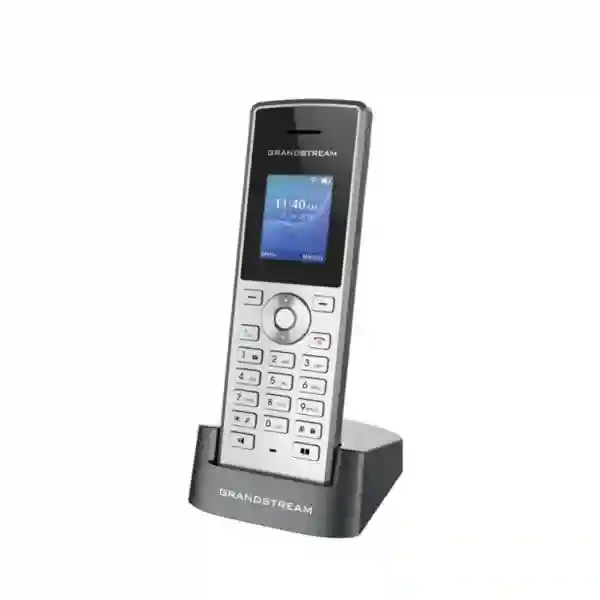
The Grandstream WP810 is a cordless Wi‑Fi IP phone designed for people who need to remain reachable on a business extension while moving around a covered site. Instead of tying a user to an Ethernet desk phone, the WP810 connects to a compatible SIP voice platform over business Wi‑Fi. That makes it relevant to retail floors, warehouses, clinics, hospitality operations, security teams, offices and other environments where staff frequently leave a fixed workstation but still need dependable internal and external calling.
What is the Grandstream WP810?
The WP810 is Grandstream’s basic cordless Wi‑Fi IP phone for SIP-based voice deployments. Grandstream specifies integrated dual-band 802.11a/b/g/n/ac Wi‑Fi, roaming support, two SIP accounts, two lines, HD audio, dual microphones and a rechargeable 1500mAh lithium-ion battery. The handset is designed to connect through a wireless LAN rather than through a dedicated DECT base station, so the quality of the user experience depends not only on the phone but also on the design and health of the Wi‑Fi network carrying the calls.
For Tanzania buyers, that distinction matters. A WP810 can be a practical way to give mobile staff an extension without installing a wired phone at every working position, but it should be treated as part of a complete voice-and-wireless system. Before purchase, verify the PBX or hosted SIP platform, extension count, SSID and VLAN design, access-point coverage, roaming behavior, security settings, call-routing requirements and the number of handsets expected to be active at the same time. FourTeck Tanzania can help buyers frame those requirements through its business technology services, where IP telephony, Wi‑Fi, switching and related infrastructure are considered together rather than as isolated devices.
Verified WP810 feature overview
Dual-band Wi‑Fi
Integrated 802.11a/b/g/n/ac wireless support allows the handset to use compatible 2.4GHz and 5GHz business Wi‑Fi networks. Roaming support is intended to help users move between access-point coverage areas.
2 SIP accounts and lines
The phone supports two SIP accounts and two lines, which can suit users who need separate identities, services or call handling while remaining on one handset.
HD voice
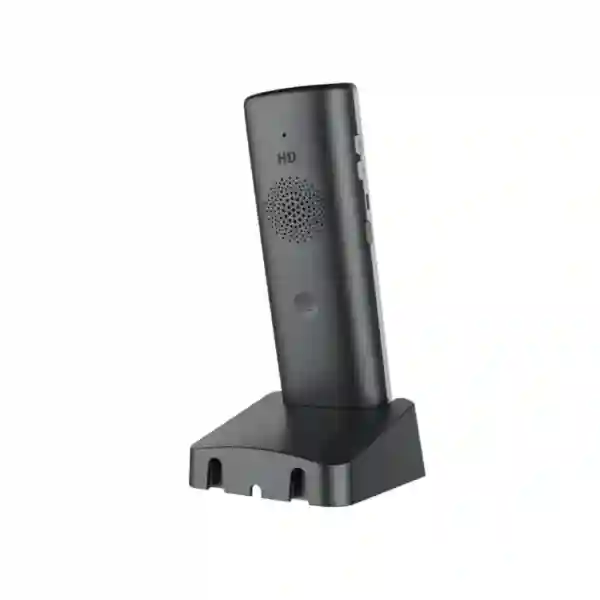
Grandstream lists HD audio on the handset and speakerphone, dual microphones, acoustic echo cancellation and Noise Shield technology among the WP810’s voice capabilities.
Battery mobility
The 1500mAh rechargeable battery is rated by Grandstream for up to 6 hours of active talk time and up to 120 hours of standby, depending on actual use and conditions.
Push-to-talk button
A configurable PTT key can support workflows where rapid group or dispatch-style communication is useful, subject to system configuration and operating requirements.
Business interfaces
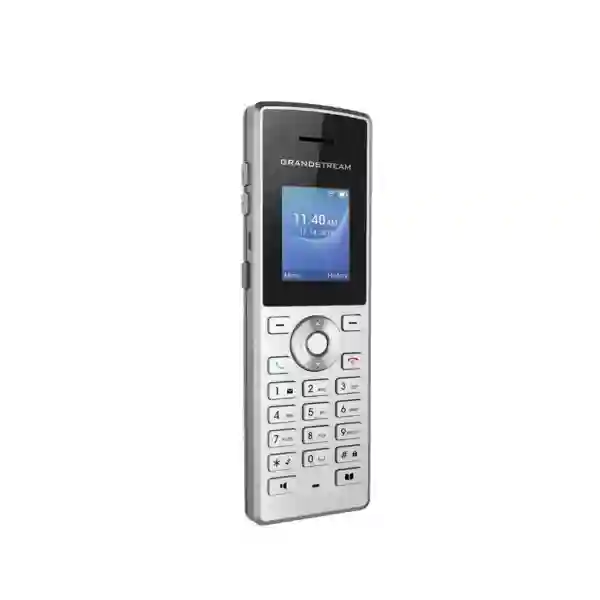
The WP810 includes a 1.8-inch 128×160 TFT color LCD, 3.5mm headset jack, Micro-USB charging port, speakerphone, backlit keypad and charging cradle.
Technical specifications that matter in a business deployment
| Area | WP810 specification |
|---|---|
| Wireless | Dual-band 802.11a/b/g/n/ac Wi‑Fi with roaming support |
| SIP | 2 SIP accounts, 2 lines; SIP RFC3261 |
| Display | 1.8-inch 128×160 TFT color LCD |
| Audio codecs | G.711μ/a, G.729A/B, G.722, iLBC and Opus |
| Call functions | Hold, transfer, forwarding, call waiting, 3-way audio conference, auto answer, call log and configurable dial plan |
| Security | TLS, SRTP, 802.1X, encrypted configuration support and role-based passwords |
| Battery | 1500mAh rechargeable Li-ion; up to 6 hours talk and 120 hours standby |
| Physical | Handset approximately 158.5 × 50 × 22.5mm; approximately 120g |
Specifications should be validated against the current Grandstream documentation and the exact unit supplied. Firmware capabilities can evolve, and the complete deployment should be tested with the selected SIP platform, wireless infrastructure and security policies.
WP810 compatibility, Wi‑Fi roaming and deployment planning
The main buying question is not simply whether the WP810 can connect to Wi‑Fi. Voice calls are sensitive to delay, jitter, packet loss and roaming interruption, so a usable voice deployment requires consistent radio coverage and a network designed for real-time traffic. A handset may show a visible wireless signal while still suffering poor call quality if the access point is overloaded, channels are congested, roaming thresholds are unsuitable or uplinks are saturated. For a warehouse, hotel, hospital corridor, multi-floor office or retail site, a wireless survey and practical walking-call test can be more valuable than relying only on floor area or the number of access points.
The WP810 supports roaming and quality-of-service mechanisms, but those capabilities should be coordinated with the WLAN. Access-point placement, transmit power, channel reuse, band steering, voice VLAN design, SSID security and handoff behavior can all influence user experience. Where multiple access points are involved, the goal is predictable overlap rather than maximum signal strength everywhere. The handset should be able to move through working areas without repeatedly falling back to marginal coverage or holding on too long to a distant access point.
The PBX side also deserves attention. Confirm SIP account details, codecs, extension permissions, caller ID behavior, transfer methods, voicemail, emergency-call policy, dial plans and any security requirements. A buyer considering the WP810 can also review the broader FourTeck Tanzania technology shop to consider supporting IP PBX, network and wireless requirements alongside the handset rather than placing the phone on an unprepared network.
Who is the WP810 for?
Retail and customer service
Supervisors, floor staff and service teams can remain reachable while moving between counters, shelves, stock rooms and customer areas, provided wireless coverage has been designed for voice.
Warehousing and logistics
A portable SIP extension can help coordinators, dispatch personnel and supervisors who need internal calls without staying next to a desk phone. PTT can be considered where the workflow requires fast team communication.
Hospitality and facilities
Housekeeping, facilities, operations and duty staff can use mobile extensions across covered indoor areas while remaining integrated with reception, departments and PBX call flows.
Grandstream WP810 Tanzania
For organizations evaluating the Grandstream WP810 in Tanzania, the most useful starting point is to define mobility, voice-platform and Wi‑Fi requirements together. A portable SIP handset can solve a very specific problem: users who need a normal business extension but do not spend the day at one desk. That need appears in warehouses, retail operations, hotels, clinics, offices, educational campuses, security teams and maintenance environments. The WP810’s dual-band Wi‑Fi radio, two SIP accounts and compact handset format can suit these roles, but the deployment should be planned around the existing wireless LAN rather than assuming that any available Wi‑Fi signal is sufficient for voice.
Procurement teams in Tanzania should confirm the PBX or hosted voice service, the number of WP810 handsets, expected concurrent calls, access-point locations, wireless security method and the areas in which users will walk while talking. It is useful to identify stairwells, corridors, stock rooms, loading zones and back-of-house areas that may have weaker coverage than ordinary desk spaces. The network should be reviewed for channel utilization, capacity and roaming. For organizations already using a Grandstream UCM platform or another SIP-compatible system, the extension plan and provisioning method can be established before deployment so that handsets arrive with a clear configuration baseline.
The Tanzania quotation should also clarify what is included. Buyers can ask whether the handset package contains the charging cradle, battery, belt clip and power supply, and whether configuration, PBX programming, Wi‑Fi optimization or user training is part of the project scope. No assumption should be made about stock, delivery time or warranty until the actual quotation is issued. For a complete project, the WP810 may need to be paired with access points, switching, internet connectivity, firewall rules and an IP PBX or hosted SIP service. FourTeck’s Tanzania business technology portfolio is useful when these dependencies need to be evaluated as one communication solution.
A strong buying decision therefore combines verified handset capability with site-specific design. The WP810 is not intended to replace every class of cordless phone; it is best considered where business Wi‑Fi already exists or where a well-planned wireless network is part of the project. If long daily calling periods, stronger environmental protection or other wireless features are required, compare the WP810 with newer or higher-tier Grandstream Wi‑Fi handset models before finalizing the specification.
Grandstream WP810 Dar es Salaam
Businesses in Dar es Salaam often operate across offices, retail sites, hospitality properties, warehouses and mixed commercial facilities where employees move frequently between working zones. In those environments, the Grandstream WP810 can be considered when a standard SIP extension needs to travel with the user. A warehouse supervisor may need to answer calls while checking a dispatch area, a hotel duty manager may move between reception and back-of-house spaces, and a retail supervisor may need to remain reachable while working away from a fixed counter. The Wi‑Fi handset format helps bridge that mobility requirement without creating a separate cellular workflow for every internal call.
For Dar es Salaam deployments, wireless planning should be treated as a voice-quality exercise rather than a simple internet-coverage exercise. Concrete walls, glass, shelving, equipment rooms, elevators and dense client usage can affect 2.4GHz and 5GHz performance in different ways. A site that works adequately for email or web browsing may still experience short audio gaps during roaming. Before ordering a fleet of handsets, businesses should identify the exact movement paths users follow and test representative calls across those areas. Where coverage needs improvement, access-point placement and radio tuning should be addressed before blaming the handset.
The PBX design should reflect local operating roles. Reception, security, facilities, sales and logistics teams may need different ring groups, call permissions, extension names or after-hours behavior. Because the WP810 supports two SIP accounts and two lines, one handset may support more than one logical voice identity when the PBX design calls for it. Procurement documentation should record the required handset quantity, charger locations, headset needs, extension plan and the network credentials to be used. That record makes later expansion easier and helps avoid inconsistent configurations across a multi-handset rollout.
When requesting a WP810 quotation for Dar es Salaam, include the business location type, number of floors, approximate Wi‑Fi coverage area, current PBX model, quantity of users and whether staff must roam while actively talking. These details allow the proposed solution to address more than the device itself and reduce the risk of ordering handsets that are technically compatible but poorly supported by the site network.
Grandstream WP810 Mwanza
In Mwanza, the WP810 can be evaluated for organizations that need mobile voice communication within a defined business Wi‑Fi footprint. Practical examples include hotels with staff moving between floors, healthcare or service environments with roaming supervisors, warehouses where coordinators work between office and storage areas, and retail businesses where managers spend much of the day away from a desk. Because the handset uses SIP over Wi‑Fi, it can integrate into a structured IP telephony environment without requiring a separate desk telephone at every operating point.
The quality of the user experience depends on how the wireless network is engineered. A Mwanza site should be reviewed for dead zones, channel congestion and access-point overlap. If staff need continuous calls while moving between rooms or floors, the roaming path must be tested under realistic conditions. A Wi‑Fi design that was originally installed only to provide general internet access may need adjustments to support voice reliably. Access points should have stable wired backhaul, the network should avoid unnecessary bottlenecks, and voice traffic may be separated logically from guest or general user traffic where appropriate.
Battery planning is another operational consideration. Grandstream rates the WP810 for up to six hours of talk time and 120 hours of standby, but real results depend on usage, signal conditions and battery age. Organizations with long or intensive calling shifts should define where charging cradles will be placed and whether the phone’s duty cycle fits the intended role. If users are on calls throughout most of a long shift, another model with longer rated talk time may deserve comparison. If calling is intermittent, the WP810 may offer an effective balance of mobility and simplicity.
For procurement in Mwanza, a useful quotation request includes handset quantity, expected call volume, Wi‑Fi details, PBX or SIP provider, extension requirements, charging locations and any headset or PTT workflow. This information helps convert a model request into a workable deployment scope instead of treating the handset as a standalone commodity.
Grandstream WP810 Arusha
Organizations in Arusha looking for a cordless business extension can consider the Grandstream WP810 when users need to move throughout a Wi‑Fi-enabled site while remaining connected to an IP PBX. Hospitality operations are a natural example because supervisors, facilities personnel, housekeeping coordinators and duty managers often work across guest-facing and service areas rather than at one fixed desk. The same principle applies to offices, logistics facilities, educational environments and service businesses where a mobile extension can reduce missed internal calls.
A successful installation begins by mapping the areas in which the phone must work. Guest rooms, corridors, outdoor transitions, service zones, kitchens, utility areas and stairwells can have different RF characteristics from reception areas or meeting rooms. The WP810 supports 2.4GHz and 5GHz Wi‑Fi and roaming, but the access-point infrastructure still needs to provide appropriate coverage and handoff behavior. Voice testing should include walking calls through the actual operational route, because a brief interruption that is barely noticeable during web browsing can be disruptive during a conversation.
Arusha buyers should also review how the handset will participate in the business call flow. A hospitality site might route calls to a duty manager group, while an office might assign individual extensions. Security teams may value the configurable push-to-talk capability, subject to the intended communication design. The WP810 can also support a headset through its 3.5mm port where hands-free work is useful. These workflow details should be decided before provisioning so that button behavior, extension labels and call permissions remain consistent across the deployment.
When asking for a quotation, provide current PBX information, Wi‑Fi platform, user count, expected movement area and whether the project includes new access points or only handsets. This allows the supplier to distinguish a straightforward endpoint purchase from a larger voice-and-wireless integration project. The objective should be dependable operational communication, not merely successful initial registration of the phone to a SIP account.
Grandstream WP810 Dodoma
For Dodoma organizations, the Grandstream WP810 is relevant where mobility inside a business site is more important than the large display or many programmable keys of a desk telephone. Administrative offices, service organizations, educational institutions, hospitality properties and facilities teams can all have users who need to answer a business extension while moving around. With SIP-based calling over Wi‑Fi, the WP810 can become part of an existing IP PBX design, provided compatibility and network readiness are confirmed.
The purchase decision should start with the expected user role. A receptionist who handles many simultaneous calls may still be better served by a desktop phone with more keys and visibility. A roaming supervisor, however, may benefit more from a compact cordless handset. Similarly, a user who spends most of the day on calls should compare battery requirements against Grandstream’s rating of up to six hours active talk time. Matching the endpoint to the role avoids forcing one device type across every employee simply for standardization.
Dodoma deployments should also consider network resilience. If the Wi‑Fi and PBX infrastructure depend on a single power source without backup, cordless calling may still stop during a power interruption even though the handset battery remains charged. UPS protection for network equipment and appropriate resilience for the PBX, internet link or SIP trunk may be important depending on the organization’s continuity requirements. The handset should therefore be evaluated as one endpoint within the full communication chain.
A useful request for quotation should specify the number of WP810 units, PBX model, existing wireless vendor, building layout and expected call behavior. If the organization is still selecting a phone platform, the quotation can include design assistance rather than assuming a pre-existing SIP environment. By documenting those dependencies, procurement can compare proposals based on the complete operating requirement rather than on handset price alone.
Grandstream WP810 UAE
The Grandstream WP810 can also suit UAE organizations that need a portable SIP extension across offices, retail sites, hospitality spaces, clinics, warehouses and operational facilities. In a well-designed business WLAN, the phone can allow staff to move between covered areas without being tied to a desk. This can be useful for supervisors, maintenance personnel, store teams and duty managers who need normal PBX functions while remaining mobile. The handset’s dual-band Wi‑Fi and roaming capability make the wireless design a central part of any deployment discussion.
High-density wireless environments in large UAE commercial properties can create different challenges from a small office. Multiple SSIDs, guest traffic, neighboring networks, reflective surfaces and high client counts may all affect airtime and roaming. The correct design should identify voice coverage targets, channel plans and the operational path of users. Where businesses already use enterprise access points, the WP810 should be tested with the specific controller settings and security configuration rather than relying only on standards-level compatibility.
PBX integration should be equally structured. Two SIP accounts and two lines can support flexible user configurations, while standard functions such as hold, transfer, forwarding, call waiting and 3-way conferencing can support everyday business communication. For deployments spanning several branches, centralized provisioning and consistent naming can make support simpler. Organizations working across the UAE and East Africa may also want a common handset policy while adapting the network design to each site.
For broader UAE infrastructure and voice planning, buyers can reference FourTeck UAE IT and telecom solutions. A quotation should still confirm exact project scope, quantity, compatibility, commercial terms and delivery conditions rather than assuming that regional information applies automatically to every location.
Grandstream WP810 Uganda
Uganda businesses can evaluate the WP810 for mobile SIP calling inside Wi‑Fi-enabled workplaces where staff need to stay connected to a company extension. Retail, hospitality, warehousing, healthcare, security and multi-room office environments are relevant because the user can carry the handset rather than returning to a fixed desk whenever the phone rings. The practical value comes from combining business call control with wireless mobility, not simply from replacing a wired handset with a cordless one.
The first technical check should be the wireless network. A stable internet connection alone is not enough; internal Wi‑Fi performance, roaming and LAN quality can influence every call. Sites with several access points should review coverage overlap and channel usage, while sites with only one access point should confirm that all required operational areas have strong enough signal. A warehouse with metal shelving or a hotel with thick walls may require more planning than an open office of the same floor area.
The second check is the SIP platform. Confirm extension registration, codec support, transfer behavior, voicemail, ring groups and call-routing rules. If a hosted PBX is used, firewall and NAT behavior may also affect registration or audio. Testing one handset before a larger rollout can help validate real conditions. Once the design is proven, consistent provisioning and labeling can make additional units easier to deploy and manage.
Organizations sourcing communication systems in Uganda can also review FourTeck Uganda IP PBX and VoIP solutions for the regional context around voice and networking. The WP810 itself should still be quoted according to exact quantity, project scope and availability at the time of purchase.
Grandstream WP810 Kampala
In Kampala, the WP810 can be particularly relevant for busy commercial environments where staff move frequently within one building or campus. A hotel operations team, retail supervisor, warehouse coordinator or clinic administrator may need to receive and transfer calls while away from a desk. If the site already has reliable business Wi‑Fi, a SIP handset can reduce the need to create separate wired phone points for every mobile role. It can also keep staff on the same extension system used by reception and desk-based colleagues.
However, the handset should not be deployed solely on the basis that Wi‑Fi is visible throughout the building. Kampala offices and commercial properties may contain many wireless networks and client devices competing for airtime. A practical voice design should evaluate congestion, access-point positioning and movement patterns. Calls should be tested at peak usage where possible, especially in corridors, back rooms and transitions between access points. The goal is to identify weak handoff points before the deployment grows to many users.
For organizations using Grandstream PBX platforms, centralized management can simplify account creation and handset administration, while mixed-vendor SIP systems may also be possible when standards and features align. The exact feature behavior should be validated because SIP compatibility does not guarantee identical implementation of every supplementary function. Users may need training on call transfer, hold, directory access, speakerphone, push-to-talk and charger usage to ensure the device fits everyday operations.
A Kampala quotation request should therefore contain more than a model number. Include the current PBX, number of extensions, building type, user roles, Wi‑Fi platform and whether installation or configuration is required. This makes it easier to compare total project scope and reduces the chance of discovering network or integration gaps only after the phones arrive.
Grandstream WP810 Arua
For businesses and institutions in Arua, a WP810 deployment can be a practical option when cordless voice is needed within a controlled Wi‑Fi environment. The phone can extend an organization’s SIP call system to users who move between rooms, counters, storage areas or service zones. Instead of relying on personal mobile numbers for every internal communication, staff can remain part of the PBX extension plan, subject to the selected calling platform and network design.
Smaller sites should still check Wi‑Fi carefully. A single access point can appear to cover a building but may produce weak voice performance at edges, behind dense walls or in outdoor transition areas. If users must move while talking, test the real path rather than only stationary signal strength. Where multiple access points are deployed, make sure their channels and power settings are coordinated so the handset can roam without excessive interference or sticky-client behavior.
The WP810’s battery profile should be matched to duty cycle. Up to six hours of rated talk time can be appropriate for intermittent business use, but the exact working day should be assessed. Charging habits, spare-device strategy and the location of charging cradles can matter for teams that operate long shifts. Because the handset is compact, belt-clip use and headset requirements can also be considered for users who need their hands free while moving.
For procurement in Arua, document the quantity, intended users, current wireless coverage, PBX details and any need for installation support. If the site has limited existing network infrastructure, treat the quotation as a voice-and-Wi‑Fi solution rather than only a handset order. That approach gives procurement a clearer view of what is required to make the WP810 useful in practice.
Grandstream WP810 Mbarara
Mbarara organizations evaluating the Grandstream WP810 should focus on the jobs that require mobility. A handset carried by a supervisor, duty manager or operations coordinator can reduce missed calls when that person spends much of the day away from a desk. Since the WP810 registers to SIP over Wi‑Fi, it can fit into an IP PBX environment where calls, transfers and internal extension dialing are already centrally managed. The phone therefore works best when the business treats it as part of the communication architecture rather than as a standalone cordless device.
Wireless coverage should be measured against actual working areas. Offices may be straightforward, while warehouses, hospitality sites and clinics can contain long corridors, storage zones, dense partitions or outdoor edges that create weak spots. For voice, packet stability matters more than seeing a strong Wi‑Fi icon at one point in time. Testing should include calling while walking through the site and observing whether audio remains continuous during access-point transitions.
System administrators should define how each WP810 is provisioned and maintained. This can include SIP credentials, firmware policy, security settings, phonebook entries, button functions, ringtones and extension labels. A consistent configuration template is especially useful when more than a few handsets are deployed. The WP810 also supports encrypted signaling and media mechanisms such as TLS and SRTP where the corresponding PBX and network design support them, so security requirements can be incorporated into the project plan rather than added later.
A useful Mbarara quotation should state the current voice platform, expected number of phones, Wi‑Fi vendor, building profile and whether handsets need to roam during live calls. Commercial terms, delivery, warranty and support should be confirmed in the actual proposal instead of inferred from generic product information.
Grandstream WP810 Gulu
In Gulu, a cordless Wi‑Fi IP phone can be useful for organizations that need staff to carry a business extension between work areas. The WP810 offers that mobility through standard Wi‑Fi and SIP, which can suit operational teams in hospitality, education, healthcare, retail, logistics and office facilities. For these users, the main benefit is not a large feature display but the ability to answer, transfer and place business calls while moving through the areas where the work happens.
The wireless LAN remains the foundation. If the organization uses consumer-grade access points placed for convenience rather than designed coverage, voice quality may vary as users move. A project can begin by identifying coverage gaps and the areas in which calls must remain active. Where multiple access points are necessary, they should be coordinated for coverage, channels and roaming. If the WLAN also serves guest internet, staff devices, cameras and other systems, segmentation and capacity planning can prevent unrelated traffic from degrading voice.
The PBX should also be configured around business processes. A hotel may need department ring groups; a clinic may use extensions by function; a warehouse may assign portable phones to shifts instead of individuals. The WP810’s two SIP accounts can support flexible designs, but the simplest configuration is often the easiest to maintain. Administrators should decide who manages accounts, how phones are named, and what happens when a handset is replaced or reassigned.
When requesting pricing in Gulu, include any requirement for PBX setup, Wi‑Fi improvement, user training and post-deployment support. This helps the proposal separate device supply from professional services and makes project comparison more transparent. Buyers should confirm exact stock and delivery details only from the current quotation.
Grandstream WP810 Kenya
Kenyan businesses use Wi‑Fi-based telephony in many of the same environments where mobility and centralized calling intersect: hospitality, retail, distribution, healthcare, campuses and multi-floor offices. The Grandstream WP810 can support these scenarios by connecting a SIP extension to the existing wireless network. Rather than installing a fixed desk phone wherever a user may work, the organization can assign a portable handset, provided coverage and PBX design support the user’s movement pattern.
Before choosing the WP810, buyers should compare the handset’s capabilities with the demands of the role. The 1.8-inch display keeps the device compact, while the up-to-six-hour talk-time rating is more suited to intermittent or moderate calling than extremely heavy all-day voice use. The 3.5mm headset port can help users who need hands-free operation, and the push-to-talk button may be useful for certain team workflows. A newer model may be preferable where longer battery life, more advanced wireless features or greater ruggedness is required.
For organizations operating between Tanzania and Kenya, standardizing on compatible SIP endpoints can simplify training and spares, but each site still requires its own wireless validation. A phone that roams well in one building may behave differently in another because access-point placement, radio settings and interference are different. The right approach is to keep device configuration consistent while validating site-specific network conditions.
Regional buyers can review FourTeck Kenya business communications and IT solutions when a project spans that market. For Tanzania orders, the local product scope should still be quoted through the Tanzania workflow so commercial and deployment assumptions are clear.
Grandstream WP810 Kuwait
The WP810 can support Kuwait businesses that want a portable extension across indoor business Wi‑Fi. Warehouses, clinics, hospitality operations, retail environments and facilities teams are typical examples where an employee needs to remain contactable while moving. The handset can register to a compatible SIP platform and provide normal business telephony functions without requiring a dedicated Ethernet connection at the user’s current position.
In larger buildings, RF planning can be more important than handset selection. Dense construction, multiple neighboring networks and high client counts can affect roaming and audio quality. A proper deployment should verify both bands, access-point overlap and the path staff follow during calls. Because voice traffic is real-time, brief radio interruptions that have little impact on ordinary internet use can be noticeable immediately. Quality-of-service settings may help prioritize traffic, but QoS cannot compensate for poor RF coverage or congestion.
The voice platform should also be assessed for security and provisioning. TLS and SRTP can be used where supported by the PBX and deployment policy, while 802.1X can be relevant in enterprise wireless environments. Organizations should establish a consistent process for account creation, firmware updates and replacement devices. If handsets are shared between shifts, naming conventions and charger locations should be especially clear.
A Kuwait procurement request should specify quantity, user role, wireless infrastructure, PBX model, expected movement area and any service requirements. Buyers should avoid assuming regional stock, lead time or local support arrangements unless those items are explicitly confirmed in the quotation.
Grandstream WP810 Ghana
Ghana organizations can consider the Grandstream WP810 when staff require a mobile SIP handset inside a managed wireless environment. The concept is straightforward: the PBX extension follows the employee through Wi‑Fi-covered work areas. This can reduce dependence on personal mobile phones for internal operational calls and maintain familiar PBX features such as transfer, forwarding, call waiting and conferencing. Retail supervisors, hotel teams, warehouse coordinators and facilities staff are examples of users who may benefit.
The WLAN should be assessed before scale deployment. Coverage must extend to every operational area in which the phone is expected to work, not only public or office spaces. Roaming should be validated by active calls while users walk between access points. If voice and other services share the same Wi‑Fi, the network design should account for client density and traffic competition. Backhaul, switching and internet or SIP-trunk reliability also contribute to the total call path.
From a procurement perspective, buyers should evaluate the WP810 against user duty cycle. The handset is compact and its battery is rated for up to six hours of talk time, which can suit users who alternate between calling and other work. Heavy call-center-style users are generally better served by dedicated desk phones or devices with different battery expectations. Matching the product to actual work avoids buying based only on the convenience of cordless operation.
A Ghana request for proposal should document user quantity, expected call patterns, existing PBX and wireless technology, required configuration and project responsibilities. Exact pricing, delivery and warranty should be provided only in the current commercial offer rather than assumed from online listings or another market.
Grandstream WP810 Nigeria
Nigerian businesses with distributed indoor operations can use cordless SIP phones to keep mobile staff connected to the organization’s central call system. The Grandstream WP810 is relevant where users move around retail floors, warehouses, hospitality properties, clinics, offices or operational facilities while still needing an extension. Its two SIP accounts, dual-band Wi‑Fi and roaming support provide the endpoint capabilities, but successful deployment depends on the network and voice platform behind it.
Network resilience deserves particular attention for any IP telephony project. The handset battery can remain charged during a short power interruption, yet calling still depends on the access points, switches, PBX and potentially internet or SIP-trunk infrastructure. Where communication continuity is important, UPS protection and recovery planning for those components should be considered. This systems view is more useful than judging cordless reliability from the handset battery alone.
Wireless design should account for both coverage and capacity. A large number of data users or video devices can compete for airtime if the network is not planned correctly. Segmenting voice traffic, selecting suitable channels and maintaining reasonable access-point loads can improve consistency. Administrators should also test roaming during real calls and not just verify that the phone associates with each access point independently.
For Nigerian procurement, compare the WP810 with alternatives according to actual user role, battery requirement, ruggedness, screen size and wireless features. A quotation should confirm the exact handset model, included accessories, configuration scope and commercial terms. This protects the buyer from relying on assumptions borrowed from other countries or from unrelated reseller listings.
Grandstream WP810 Seychelles
Seychelles hospitality, facilities and service organizations may find a Wi‑Fi SIP handset useful where staff need to move across a property while remaining part of the business phone system. The WP810’s compact form factor and support for wireless roaming can fit operational roles such as duty managers, maintenance teams, supervisors and selected service staff. The value comes from integrating mobile employees into the PBX rather than giving every role a separate mobile-number workflow.
Property layout is a major factor. Hospitality sites may contain guest buildings, service corridors, outdoor transitions and areas separated by thick structural materials. These environments should be surveyed for voice coverage. Outdoor use should also be evaluated carefully because the WP810 is not positioned as an IP67 rugged waterproof model. If exposure to water, harsh cleaning routines or drops is expected, a more rugged Grandstream handset may be more appropriate. Product selection should reflect the physical environment, not only the call features.
For indoor deployments, roaming tests should follow the actual paths of staff. A user moving from reception to a back-office zone or between floors should be able to remain on a call with minimal interruption. The wireless network may need separate treatment for guest and operational traffic so heavy visitor usage does not compromise staff voice services. PBX rules can also separate guest-facing call flows from internal operations.
A Seychelles quotation request should include building type, handset quantity, required coverage areas, current access-point platform, PBX or SIP service and any need for configuration assistance. Commercial availability, delivery arrangements and warranty should be confirmed for the specific order rather than inferred from international listings.
Buying guidance: WP810 or another Wi‑Fi handset?
Choose the WP810 when the requirement is for a straightforward cordless SIP handset with dual-band Wi‑Fi, two SIP accounts, HD voice and moderate battery demand. It is attractive for users whose work is mobile but whose call volume is not continuous all day. If the role needs longer rated talk time, a larger display, newer wireless capabilities, Bluetooth or a more rugged enclosure, compare other models in Grandstream’s Wi‑Fi handset family before purchase. Grandstream’s own portfolio differentiates WP8xx models by battery, durability and wireless features, so model selection should follow the operating environment.
The procurement team should avoid selecting purely by unit price. A less expensive handset becomes costly if it requires network redesign after deployment or fails to match the user’s duty cycle. Conversely, buying a higher-tier model for every user may add cost without business benefit. Group users by role—light mobile user, heavy mobile user, rugged environment, supervisor, reception, desk-based staff—and select the endpoint class that fits each group.
Quotation checklist for Grandstream WP810
Providing these details helps the quotation address the complete deployment instead of only the hardware line item. It also creates a clearer basis for comparing alternatives and deciding whether the existing network is ready for voice mobility.
Frequently asked questions about the Grandstream WP810
Does the WP810 need a DECT base station?
No. The WP810 is a Wi‑Fi IP phone. It connects to a compatible wireless LAN and registers to a SIP platform. The wireless network therefore plays the role of connectivity infrastructure.
How many SIP accounts does the WP810 support?
Grandstream specifies two SIP accounts and two lines. The actual account setup depends on the PBX or SIP service used.
What is the rated WP810 battery life?
Grandstream rates the 1500mAh rechargeable battery for up to 6 hours of active talk time and up to 120 hours of standby. Real performance varies with usage, signal conditions, configuration and battery age.
Can the WP810 roam between access points?
Yes, roaming support is part of the product design. Good results still depend on access-point coverage, channel planning, wireless settings and the environment. Live walking-call tests are recommended for important deployments.
Can the WP810 work with third-party PBX systems?
The phone uses SIP, so interoperability with compatible SIP platforms is possible. Specific features, provisioning and security behavior should be tested with the chosen PBX because implementations can differ.
Is the WP810 suitable for warehouses?
It can be suitable where indoor Wi‑Fi coverage is strong and the environment does not demand a higher ruggedness rating. Metal shelving, machinery and large open spaces can affect RF behavior, so a wireless survey and roaming test are valuable.
Does the WP810 support push-to-talk?
Yes. It includes a configurable button for push-to-talk workflows. The final operating experience depends on how PTT is configured in the system and organization.
What should I provide for a Tanzania quote?
Provide the quantity, intended user roles, PBX or SIP platform, Wi‑Fi access-point details, building type, coverage areas and whether configuration or installation support is required. This gives the sales team enough context to quote the endpoint and any supporting requirements accurately.
Decision recap
The Grandstream WP810 is a focused business mobility handset: dual-band Wi‑Fi, roaming, two SIP accounts, HD voice, push-to-talk and a compact rechargeable design. It is best suited to organizations that already have, or are willing to build, a voice-ready wireless LAN. Its strengths are portability and straightforward SIP functionality; its limitations should be considered in roles that demand very long talk time, advanced wireless features or rugged environmental protection.
For a Tanzania deployment, evaluate the handset, PBX and Wi‑Fi as one system. Verify coverage, roaming, call routing, security, charger placement and user workflow before ordering at scale. This approach provides a more dependable result than selecting a cordless phone only by specification sheet.
Talk to FourTeck about your WP810 requirement
Share your required quantity, current PBX, Wi‑Fi environment and user workflow. FourTeck can help you determine whether the WP810 is the correct handset class and identify any network, configuration or deployment items that should be included in the quotation. This is especially useful for multi-floor sites, warehouses, hotels, clinics and other workplaces where reliable roaming is part of the requirement.
Commercial availability, pricing, delivery timing, warranty and project services should always be confirmed in the current quotation. Product information on this page is intended to support selection and planning, not to imply stock or guaranteed service coverage in any location.



Reviews
There are no reviews yet.