
CORDLESS BUSINESS VOICE • WI-FI 6 MOBILITY
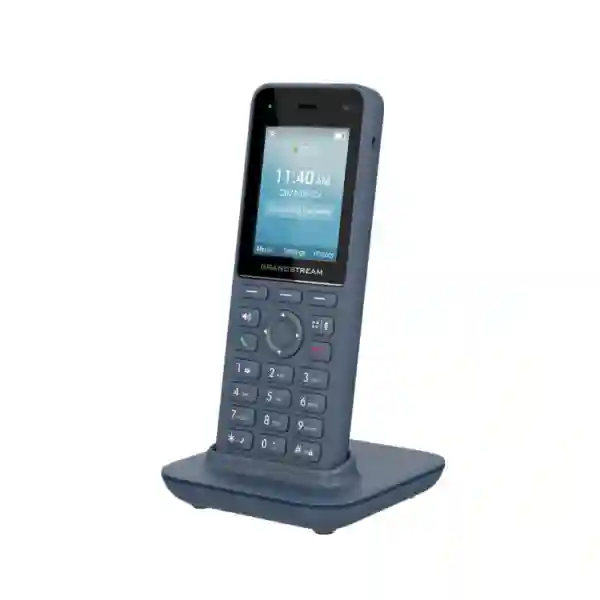
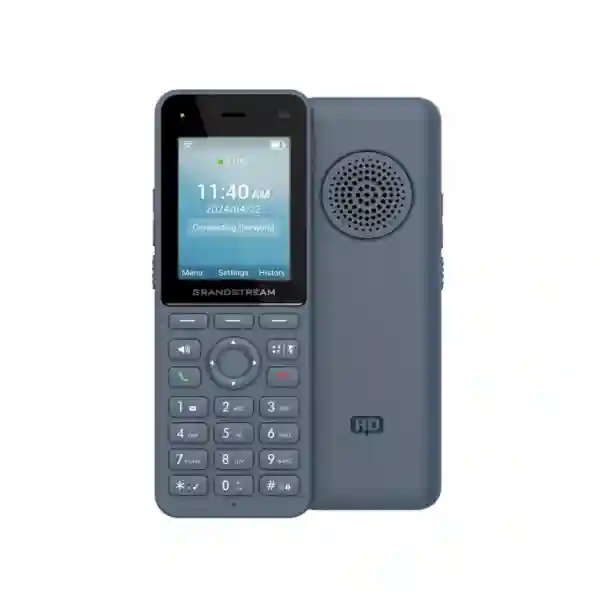
Grandstream WP826 Cordless Wi-Fi IP Phone
The Grandstream WP826 is built for employees who need a professional SIP extension without being tied to a desk. It combines dual-band Wi-Fi 6, roaming support, three SIP accounts and three lines, HD voice, integrated Bluetooth, a configurable push-to-talk button, USB-C charging and long battery endurance in a compact cordless handset. For organisations in Tanzania, it is especially relevant where staff move between reception points, stock rooms, corridors, service counters, wards, classrooms, hospitality areas, warehouses or other working zones while remaining reachable on the business telephone system.
Useful for staff who require multiple identities, departments or line appearances on one mobile handset.
Supports 2.4 GHz and 5 GHz wireless operation with 802.11k/r/v roaming support for properly designed WLANs.
Grandstream specifies up to 12 hours talk time and up to 240 hours standby under laboratory conditions.
Integrated Bluetooth supports headset connectivity, while the configurable key can be used for push-to-talk workflows.
What the Grandstream WP826 solves
Traditional desk phones work well for fixed users, but many teams spend much of the day away from a desk. Retail supervisors walk between counters and stock rooms. Hospitality staff move across floors and service areas. Warehouse teams shift between receiving, picking and dispatch. Healthcare personnel move between workstations and patient areas. Security staff patrol premises. In these situations, forwarding calls to personal mobile numbers can complicate administration, call identity and business continuity. The WP826 offers another approach: keep the user on the organisation’s SIP platform while giving that user a portable Wi-Fi handset.
The handset is not a cellular phone and should not be selected as if it were independent of the local network. Its real value appears when the business already has, or plans to deploy, a voice-ready wireless environment. Wi-Fi coverage, roaming behaviour, authentication, VLAN design, internet quality for hosted systems, PBX compatibility and QoS can all affect the experience. A strong procurement decision therefore considers both the handset and the infrastructure around it. FourTeck can help buyers define handset quantity, extension requirements, headset needs, charger location, PBX integration and Wi-Fi readiness before a quotation is finalised.
For a broader view of business technology planning, visit FourTeck Tanzania. Buyers comparing endpoint categories can also review the FourTeck Tanzania technology shop, while organisations that need design, installation or integration can review FourTeck Tanzania services.
Verified WP826 feature overview
| Product type | Cordless Wi-Fi IP phone |
| Wireless | Integrated dual-band Wi-Fi 6, 802.11a/b/g/n/ac/ax, with 802.11k/r/v roaming support |
| Voice capacity | 3 SIP accounts and 3 lines; 4-way voice conferencing |
| Audio | HD voice, dual microphones, AEC and Noise Shield Technology; Opus codec support |
| Bluetooth | Integrated Bluetooth for compatible headset connection |
| Battery | Rechargeable 3000mAh Li-ion; up to 12 hours talk time and 240 hours standby under stated test conditions |
| Controls | Configurable push-to-talk button, customizable keys, accelerometer and emergency-button capability as documented by Grandstream |
| Charging | USB Type-C with fast-charging support |
Specifications can change with firmware, production revision or regional packaging, so buyers should confirm the exact current datasheet, included accessories and software version before a purchase order is issued.
Deployment and compatibility guidance
The WP826 should be evaluated as part of a complete voice and wireless design. Start with the PBX or hosted SIP platform. Confirm that the required SIP registration method, codec policy, authentication details, NAT behaviour, extension features and provisioning approach are compatible with the deployment. Then examine the WLAN. Portable voice is more sensitive to wireless gaps and roaming delays than ordinary web browsing because a call is continuous. A user can tolerate a webpage pausing briefly; a live conversation makes interruption immediately obvious.
For this reason, organisations should check access-point placement, signal overlap, channel planning, client capacity, 2.4 GHz and 5 GHz policy, roaming assistance, voice VLAN design and firewall treatment. Wi-Fi 6 capability on the handset is useful, but it does not compensate for weak coverage or unmanaged interference. In warehouses, metal shelving, cold rooms, machinery and high ceilings can change radio behaviour. In hotels, reinforced walls, lift shafts and long corridors matter. In clinics and offices, dense device populations can affect airtime. A pre-deployment survey or at least a structured coverage review can reduce surprises.
Centralised management can also matter when several handsets are deployed. Grandstream’s GDMS platform is designed to help provision, manage, monitor and troubleshoot supported endpoints. Businesses should decide who owns provisioning, firmware policy, extension templates and change control. A good rollout records each handset, user, extension, MAC address, charger location and support status so future troubleshooting is faster.
Grandstream WP826 Tanzania
For businesses searching for the Grandstream WP826 in Tanzania, the strongest use case is mobile business communication inside premises where staff already depend on Wi-Fi and SIP telephony. The handset can suit offices, hotels, hospitals and clinics, schools, distribution centres, retail environments, workshops, security operations and service organisations. Instead of giving every mobile staff member a desk phone they rarely sit beside, the organisation can assign a portable extension that remains part of the central call-flow design. This can simplify internal calling, departmental reachability and customer transfers when the user’s work naturally takes place across a site.
Procurement in Tanzania should begin with the existing voice platform. Buyers should state whether they use an on-premises IP PBX, hosted PBX, SIP service or are planning a new system. The number of WP826 handsets, required extensions, preferred headset model, charger requirements and expected working hours should be documented. It is also useful to identify whether staff need push-to-talk, four-way conferencing, multiple SIP accounts or only basic calling. This prevents overbuying and makes the quotation easier to compare.
Wireless readiness is equally important. A Tanzania deployment may span concrete office walls, multi-storey buildings, hospitality corridors, warehouses with metal racking, retail floors or campus-style facilities. These spaces can produce very different radio conditions. Before ordering a large quantity, confirm access-point density, roaming behaviour and whether voice traffic will be prioritised and separated from guest Wi-Fi. If the existing wireless network was designed only for occasional laptop browsing, it may require optimisation before cordless voice is introduced.
FourTeck Tanzania can structure the requirement around model confirmation, PBX compatibility, wireless readiness, handset quantity and related infrastructure. Buyers should request a quotation that clearly identifies the exact model, quantity, included accessories, supply scope and any optional configuration or installation work. For organisations planning an integrated telephony upgrade, the WP826 can be considered alongside IP PBX, switching, Wi-Fi, firewall and SIP requirements rather than purchased as an isolated endpoint.
Grandstream WP826 Dar es Salaam
Dar es Salaam businesses often operate in environments where teams move constantly between customer-facing and operational areas. A hotel may need staff to remain reachable across reception, housekeeping and service zones. A distributor may need supervisors to move between office space, warehouse aisles and loading areas. A clinic may need administrative and support staff to answer internal calls away from a fixed desk. The Grandstream WP826 fits these patterns when the site has dependable Wi-Fi and a compatible SIP phone system.
For a Dar es Salaam deployment, start by mapping where calls must work rather than simply where Wi-Fi bars appear on a laptop. Voice mobility requires consistent coverage along walking paths, stairwells, corridors and transitions between access points. Buildings with reinforced concrete, tinted glass, metal partitions or dense stock can produce coverage pockets. Where the handset will roam while a call is active, access-point configuration and overlap deserve particular attention. The WP826 supports 802.11k/r/v roaming features, but the surrounding network also needs to be designed and configured appropriately.
Buyers should also define the operational role of each handset. Reception supervisors may need multiple SIP identities, while warehouse or security teams may value a push-to-talk workflow. Headset users should confirm Bluetooth compatibility and comfort for long shifts. Battery planning should include charging habits, spare-device strategy where continuous coverage is critical, and the physical location of charging stations. Grandstream states up to 12 hours of talk time and 240 hours of standby under laboratory conditions, but actual runtime depends on use patterns, radio conditions, configuration and battery age.
When requesting a WP826 quotation for Dar es Salaam, provide site type, quantity, existing PBX platform, Wi-Fi brand or controller, number of access points, extension plan and whether provisioning support is required. This gives suppliers and integrators a better basis for discussing compatibility and deployment scope. The goal is not only to obtain the handset, but to make sure it behaves predictably in the real workspace where employees will rely on it.
Grandstream WP826 Mwanza
In Mwanza, the Grandstream WP826 can be considered by businesses that need staff to stay connected while moving between work areas rather than remaining at fixed desks. Distribution operations, hospitality properties, healthcare facilities, education environments, workshops and multi-room offices are examples where a cordless SIP handset may be more useful than a conventional desktop endpoint. The WP826 keeps the user within a managed IP-telephony environment while using the site’s wireless LAN for connectivity.
A practical Mwanza procurement process should separate handset capability from site capability. The handset supports dual-band Wi-Fi 6 and roaming assistance, but real call quality still depends on access-point design, interference, backhaul, switching and the PBX path. Businesses should identify zones where a user must be reachable, then verify coverage and capacity in those zones. This is particularly important in sites with mixed indoor and semi-open areas, storage spaces, thick walls or long travel paths between departments.
The phone’s three SIP accounts and three lines can help users who need more than one business identity or line appearance, but the requirement should be confirmed against the PBX configuration. Push-to-talk can be useful for quick team coordination, while Bluetooth can support compatible headsets for employees who need hands-free operation. HD voice, dual microphones, acoustic echo cancellation and Noise Shield Technology are designed to improve clarity, although the surrounding acoustic environment and network quality remain important.
For buyers in Mwanza, a complete request should state handset quantity, the existing or planned PBX, whether users roam during active calls, expected shift duration, headset requirements and any need for central provisioning. If the deployment is part of a broader office upgrade, it is sensible to review wireless access points, managed switching, firewall policy and internet resilience at the same time. A coordinated design reduces the risk of blaming the handset for problems that actually originate in coverage or network configuration.
Grandstream WP826 Arusha
Arusha has a broad mix of hospitality, tourism, professional, education, healthcare and service organisations where mobile staff communication can be important. The Grandstream WP826 is particularly relevant for premises where employees move between reception, guest-service areas, offices, maintenance zones, stores or operational spaces and still need a business extension. Because the device is a Wi-Fi SIP handset rather than a cellular phone, it can remain integrated with the organisation’s call routing, extension numbering and PBX policies.
Hospitality deployments deserve careful wireless planning. Guest Wi-Fi and staff voice should not automatically be treated as the same service. A hotel may have strong guest coverage in rooms but weaker signal in service corridors, back-office spaces, utility areas or outdoor transitions where employees actually work. Separate SSIDs or VLANs, controlled authentication and QoS can help create a more predictable voice environment. The WP826 supports dual-band Wi-Fi 6 and roaming technologies, but an appropriate WLAN architecture remains essential.
For tourism and service businesses, staff may also need hands-free operation or rapid team coordination. The handset’s integrated Bluetooth can connect compatible headsets, while its configurable push-to-talk button can support workflows that favour quick communication. The 3000mAh rechargeable battery is specified for up to 12 hours of talk time and 240 hours of standby in laboratory testing, which may suit long shifts when charging is managed correctly. Actual performance will vary with use, coverage and battery condition.
Arusha buyers should include the building type and movement pattern in the quotation discussion. State where users start and end their shifts, which zones require continuous calling, whether the device will be shared or individually assigned, and how many concurrent calls the organisation expects. For a new site, it can be efficient to plan voice and Wi-Fi together. For an existing site, a pilot handset can help reveal roaming or coverage issues before a wider rollout is approved.
Grandstream WP826 Dodoma
In Dodoma, organisations evaluating the Grandstream WP826 may include offices, institutions, educational facilities, healthcare sites, hotels and operational teams that need structured internal calling without requiring employees to remain at a desk. The handset can provide a portable SIP extension over the business WLAN, allowing users to participate in central call flows, answer internal or external calls according to the PBX configuration and use common business telephony functions while moving around the premises.
A deployment plan should begin with user roles. Some employees need only one extension and basic calling, while supervisors may benefit from multiple SIP accounts or line appearances. Teams working across larger premises may value push-to-talk. Users who handle calls while typing, scanning or carrying equipment may prefer a Bluetooth headset. Defining these roles makes it easier to decide whether WP826 is the correct handset for every user or whether a mixed endpoint strategy would be better.
Network assessment is the second step. Wi-Fi voice requires reliable signal and low interruption throughout the work path. Dodoma sites with multiple blocks, thick masonry, outdoor walkways or separate departments should not assume one wireless design will cover every operational zone. Review access-point placement, roaming transitions, channel reuse and wired uplinks. The PBX, firewall and internet route should also be checked, particularly when the SIP service is hosted outside the building.
For procurement, ask for the exact Grandstream WP826 model and document whether chargers, power accessories, headsets, provisioning and configuration are included. If the organisation uses central device management, confirm how handsets will be enrolled and maintained. FourTeck can help structure the discussion around handset selection, Wi-Fi readiness, SIP compatibility and implementation scope. This approach is more reliable than buying cordless phones first and discovering later that the existing wireless network was never designed for roaming voice.
Grandstream WP826 UAE
For organisations in the UAE, the Grandstream WP826 can support mobile voice users in offices, warehouses, hospitality properties, clinics, schools, retail environments and service facilities. The commercial value is similar across these settings: give staff a managed SIP extension that follows them within the wireless environment rather than forcing calls back to a fixed desk. Businesses operating across multiple countries can also use a common handset model as part of a standardised communication design, provided local PBX, wireless and procurement requirements are checked for each site.
UAE deployments may involve dense offices, high-rise buildings, large logistics facilities or hospitality spaces with many wireless clients. These are environments where WLAN design matters. The WP826 supports dual-band Wi-Fi 6 and 802.11k/r/v roaming assistance, but administrators still need to plan access-point density, channel allocation, client steering, authentication and voice prioritisation. In a warehouse, metal racks can create reflections and shadowing. In hotels, guest-device density can compete for airtime if staff voice is not separated properly.
A multi-site organisation should also think about provisioning and support. Grandstream’s GDMS can centralise management of supported devices, which may help standardise firmware and configuration across branches. The final design should define who owns extensions, firmware approvals, Wi-Fi credentials, PBX templates and incident handling. For regional technology projects, FourTeck’s wider IT and telecom practice can provide context around IP PBX, networking and business communications.
When requesting UAE pricing, specify quantity, delivery destination, intended PBX, expected user roles, headset needs and installation scope. Avoid assuming stock, warranty, delivery time or regional package contents until they are confirmed in a current quotation. The model is most effective when purchased with a clear deployment plan rather than treated as a standalone consumer cordless phone.
Grandstream WP826 Uganda
Businesses in Uganda can consider the Grandstream WP826 when they want mobile staff to remain part of an IP PBX or hosted SIP environment. It can be suitable for warehouses, hospitality sites, hospitals, schools, retail businesses, offices and security operations where a conventional desk phone does not match the user’s movement. Three SIP accounts and three lines offer flexibility for users who need more than one identity or call path, while Bluetooth and push-to-talk support different working styles.
The most important implementation question is whether the site Wi-Fi can support voice consistently. A handset moving between access points during a live call places different demands on the network than a laptop used at a fixed desk. Uganda deployments should review coverage in corridors, staircases, stock areas, reception spaces and outdoor transitions where employees travel. Signal strength alone is not enough; roaming behaviour, congestion, packet loss and upstream connectivity all affect call continuity.
Organisations that already use Grandstream access points or PBX platforms may find device standardisation attractive, but compatibility should still be verified against the exact firmware and configuration. For businesses with other SIP-compatible systems, the same principle applies: test registration, codecs, call transfer, DTMF, voicemail indication, directory functions and any special features needed by users. A small pilot can reveal operational issues before a large purchase.
FourTeck’s regional presence can help buyers frame requirements across voice and networking. See FourTeck Uganda for broader IP PBX, VoIP and networking context. When requesting a WP826 quote, include city, quantity, PBX type, Wi-Fi environment, user roles, project date and whether configuration or deployment support is expected. Clear inputs make it easier to separate product supply from implementation services and reduce ambiguity during procurement.
Grandstream WP826 Kampala
Kampala organisations evaluating the Grandstream WP826 may be looking for a cordless business handset that works with SIP calling and modern Wi-Fi rather than traditional DECT infrastructure. This can be attractive in offices and facilities where a well-designed wireless LAN already covers the spaces in which staff work. The handset supports Wi-Fi 6, three SIP accounts, Bluetooth, HD voice features, push-to-talk and long stated battery endurance, making it suitable for users who need mobility without abandoning the business telephone system.
A Kampala rollout should identify high-traffic and high-noise areas. Reception, loading zones, shops, clinics and hospitality spaces may have different acoustic and wireless conditions. Grandstream’s dual-microphone design, AEC and Noise Shield Technology are intended to improve voice clarity, but they do not remove the need for good network conditions or sensible user practices. Where staff work with both hands occupied, compatible Bluetooth headsets may improve usability, but headset selection should be tested for comfort, controls and pairing behaviour.
Roaming is another key topic. Users should be able to walk between work zones without the call dropping because the device remained associated with a distant access point or encountered a coverage gap. The WP826 supports 802.11k/r/v features, yet the WLAN controller or access points must also be configured appropriately. A voice survey can reveal whether additional APs, power adjustments, channel changes or VLAN policy are required.
For procurement teams, the quotation should separate hardware, optional accessories, configuration, installation and support. If the organisation already has a PBX, include the vendor and model in the inquiry. If the telephone system is also being upgraded, specify expected extension count, external lines or SIP trunks, reception workflows and branch connectivity. Treating the WP826 as one component in a larger communication design helps ensure the handset, WLAN and PBX are aligned before deployment.
Grandstream WP826 Arua
In Arua, the WP826 can be relevant for organisations that need mobile extensions across business premises and prefer to use an IP network rather than separate analogue or consumer cordless systems. A portable SIP handset can help supervisors, service teams, administrators, healthcare workers or security personnel remain reachable while moving between work areas. Because the phone relies on Wi-Fi, the quality of the surrounding network becomes part of the telephony solution.
For sites where connectivity resources must be used carefully, it is worth reviewing the entire call path. On-premises PBX deployments may keep internal calling local even when internet availability fluctuates, while hosted PBX services depend more directly on WAN stability. The correct design depends on the organisation’s architecture. Buyers should explain whether calls are mostly internal, whether external SIP trunks are used, and how critical continuous calling is during internet or power interruptions.
Power resilience can also matter. The handset has its own rechargeable battery, but the wireless network and PBX infrastructure still require power. If the access points, switches, firewall or PBX lose power, the handset may remain on but lose service. For critical environments, consider UPS protection for network equipment and define a realistic outage strategy. The WP826 itself uses a 3000mAh battery and supports USB-C fast charging, which can simplify everyday charging compared with older connector types.
Arua buyers should ask for the exact model, quantity, charging accessories, current lead time and warranty terms in writing rather than relying on assumptions. If the deployment is new, include a Wi-Fi coverage review and SIP compatibility check in the planning process. A small proof-of-concept can be especially useful where building layout or network quality is uncertain. This lets staff test call quality, roaming and battery behaviour in the real environment before a broader purchase is approved.
Grandstream WP826 Mbarara
For Mbarara businesses, the Grandstream WP826 offers a way to extend SIP communication to staff who work across a site rather than at a single workstation. It can support mobile roles in healthcare, hospitality, retail, warehousing, education and general business operations. The handset’s three SIP accounts and three lines may be useful for supervisors or shared roles, while Bluetooth and push-to-talk can support hands-free and rapid team-communication scenarios.
Before buying, map the workflow. Identify who will carry the handset, which calls they receive, where they normally walk and how the device will be charged between shifts. Shared handsets may need a sign-out process and regular cleaning. Individually assigned devices may need naming, extension labels and asset records. If employees use push-to-talk, define groups and operational etiquette so the feature adds speed rather than creating constant interruptions.
The wireless environment should then be tested. A Mbarara facility with multiple buildings, courtyards, thick walls or warehouses may require more than simple office Wi-Fi. Access points should overlap appropriately for roaming, and the wired network should provide stable uplinks. Voice traffic can benefit from segmentation and prioritisation, especially when the same WLAN also serves guest devices, video streaming, cloud applications or large data transfers.
Procurement teams should compare total deployment scope, not only handset price. One supplier quotation may include configuration and support while another may be hardware-only. Confirm what is included, whether firmware will be updated, who provisions SIP accounts, whether Wi-Fi credentials are preloaded and how post-deployment support is handled. If the site already uses Grandstream infrastructure, mention the existing models and firmware. If it uses another vendor, request a compatibility check before committing to quantity. Clear technical context helps turn the WP826 from a product purchase into a dependable business communication endpoint.
Grandstream WP826 Gulu
Gulu organisations seeking portable IP telephony can evaluate the Grandstream WP826 for staff who need to answer business calls while moving through a site. The device is designed around Wi-Fi connectivity and SIP, so it can fit environments where the wireless LAN is already a core business service. Typical roles include supervisors, facility teams, nurses and administrative staff, hotel personnel, warehouse coordinators and security teams.
The WP826’s Wi-Fi 6 radio can operate on both 2.4 GHz and 5 GHz bands, and Grandstream documents support for 802.11k/r/v roaming. In practice, administrators should still decide how bands are used and whether the access-point layout supports mobile voice. 2.4 GHz can reach farther in some conditions but has fewer non-overlapping channels and may be more congested; 5 GHz can offer more capacity but may require denser coverage. The best policy depends on the building and RF environment.
Battery planning should match shift patterns. The manufacturer states up to 12 hours of talk time and 240 hours standby under laboratory conditions, but a busy user making frequent calls and roaming continuously can experience different runtime. Charging stations should be positioned where devices will actually be returned, and the organisation should assign responsibility for charging shared handsets. If communication is mission-critical, a spare-device strategy can be considered rather than assuming one handset will always be available.
When requesting supply in Gulu, include the PBX platform, Wi-Fi environment, quantity and whether the project needs installation or configuration. Ask for current availability and delivery terms instead of assuming immediate stock. For larger deployments, consider a phased rollout with a pilot group. User feedback on coverage, audio, headset comfort, key configuration and charging habits can then be incorporated before the remaining devices are provisioned.
Grandstream WP826 Kenya
Kenyan businesses can use the Grandstream WP826 where mobile staff require a business extension across offices, warehouses, hotels, medical facilities, campuses, retail environments or service sites. The model combines modern Wi-Fi connectivity with SIP calling rather than relying on a separate cordless base station. This can simplify deployment in organisations that already have a strong managed WLAN and want voice mobility to use the same network infrastructure.
A Kenya project should still avoid assuming that data-grade Wi-Fi is automatically voice-ready. Portable voice exposes roaming gaps, congestion and inconsistent RF conditions very quickly. Site teams should review access-point placement, controller settings, wired uplinks, voice VLANs, firewall rules and internet quality for hosted PBX services. In large warehouses or multi-floor offices, a survey may be worthwhile before quantity is finalised.
From a user perspective, the WP826 provides three SIP accounts and three lines, four-way voice conferencing, HD voice technologies, Bluetooth headset support and a programmable push-to-talk function. The 3000mAh battery is rated for up to 12 hours of talk time and 240 hours of standby under specified test conditions. These features make it flexible for different roles, but they should be mapped to a real workflow. A standard office user may not need push-to-talk, while a warehouse supervisor may find it valuable.
For regional context, visit FourTeck Kenya, which covers IP PBX, VoIP, networking and related business IT requirements. When requesting WP826 supply, provide quantity, destination, PBX platform, wireless environment and required services. Confirm price, taxes, availability, warranty handling and delivery scope in the live quotation. This ensures procurement decisions are based on current project terms rather than generic web assumptions.
Grandstream WP826 Kuwait
The Grandstream WP826 can suit Kuwait organisations that need mobile SIP telephony inside offices, hospitality premises, clinics, schools, warehouses and operational facilities. Where the WLAN is already designed for business use, a Wi-Fi handset can reduce dependence on fixed desk endpoints for users who spend most of their working time moving between areas. The user stays on the PBX extension plan while gaining the freedom to carry the handset through the covered site.
Kuwait deployments should pay attention to dense indoor RF environments. Office towers, hotels, malls and shared commercial buildings can have many nearby wireless networks. Channel planning and access-point power settings therefore matter. The WP826 supports Wi-Fi 6 and roaming assistance, but overall performance depends on the access points, controller policy and interference environment. Voice traffic should be protected from heavy guest or data usage where possible.
For warehousing or industrial use, physical conditions may introduce additional challenges. Metal structures, racking and large open spaces can affect propagation. A handset might show adequate signal in one aisle and encounter a sharp drop after turning a corner. Before large-scale deployment, test common walking routes and call handovers. If users wear headsets, verify Bluetooth pairing and controls under actual working conditions. If push-to-talk is part of the workflow, define how groups will be administered.
A quotation request should specify whether the organisation needs hardware only or a complete service that includes PBX registration, Wi-Fi integration, provisioning and user handover. Confirm exact model, quantity, included charger accessories and warranty terms. For multi-country businesses standardising on WP826, document a common configuration baseline while allowing local SIP, network and regulatory requirements to differ. Standardisation is useful when it reduces support complexity, not when it forces every site into identical settings regardless of local conditions.
Grandstream WP826 Ghana
Businesses in Ghana can evaluate the Grandstream WP826 when users need portable access to the company phone system across a site. It is designed for SIP calling over Wi-Fi and can be useful for hospitality staff, warehouse and logistics teams, healthcare employees, schools, service centres, security personnel and managers who cannot remain near a fixed telephone. The design allows the handset to function as a managed business endpoint rather than as a separate personal mobile line.
Planning should begin with wireless coverage. The device’s support for dual-band Wi-Fi 6 and 802.11k/r/v roaming can help on a suitable network, but access-point layout, RF interference, wired backhaul and QoS still determine the experience. If the site has guest Wi-Fi, staff voice should be considered separately from guest traffic. Administrators may choose dedicated SSIDs or VLANs depending on their security and support model.
The phone supports three SIP accounts and three lines, giving flexibility to users who may answer more than one departmental identity. Integrated Bluetooth can support compatible headsets, while push-to-talk can be configured for team communication. Grandstream also documents HD voice, dual microphones, acoustic echo cancellation and Noise Shield Technology. These are useful endpoint features, but the organisation should still test audio in the actual workplace, especially where machinery, crowds or strong background noise are present.
Ghana buyers should request current supply terms rather than relying on static pricing from other markets. State the city, quantity, project date, PBX system, wireless design and required support scope. If the organisation has multiple sites, central provisioning through an appropriate management platform can simplify configuration consistency. A documented rollout process that records each handset, extension and user also makes future support easier. The best purchasing decision combines verified product capability with a realistic view of the site’s telephony and network infrastructure.
Grandstream WP826 Nigeria
For Nigerian organisations, the Grandstream WP826 can be part of a business telephony strategy for employees who need to stay reachable across large or busy premises. Warehouses, hospitals, schools, hotels, retail operations, offices and service environments may all have roles where a fixed IP phone is inconvenient. A Wi-Fi SIP handset allows the user to remain on the business extension system while moving through the areas covered by the WLAN.
Network resilience deserves particular attention. The WP826 itself has a rechargeable battery, but it depends on powered access points, switches, firewalls and PBX services. If power continuity is important, UPS protection for the network can be as relevant as handset battery capacity. For hosted SIP platforms, internet resilience may also matter. Organisations with dual WAN links should ensure failover is designed in a way that does not introduce avoidable call disruption.
The handset supports three SIP accounts, Wi-Fi 6, roaming, Bluetooth, push-to-talk and four-way voice conferencing. These features make it versatile, but procurement should still begin with user groups. Security teams may value push-to-talk, supervisors may need multiple lines, and call-intensive staff may prefer a Bluetooth headset. A mixed deployment can be more cost-effective than assigning the same endpoint profile to every employee.
Nigeria buyers should document delivery city, quantity, PBX platform, extension requirements, access-point environment and implementation scope when asking for a quote. Large projects benefit from a pilot that validates roaming and call quality under real conditions. Current pricing, stock, delivery time and warranty handling should be confirmed at the time of purchase. Where the WP826 is part of a larger communications upgrade, review switching, wireless design, firewall policy and PBX capacity together so that the portable handsets are supported by a stable platform.
Grandstream WP826 Seychelles
In Seychelles, hospitality, resorts, healthcare, offices and service organisations can consider the Grandstream WP826 for employees who move around a property while still needing access to the business phone system. Wi-Fi calling can be attractive in properties where wireless coverage is already a critical service, but the staff voice network should be planned deliberately rather than simply sharing guest connectivity without controls.
Resort and hospitality layouts can be challenging because they may include multiple buildings, outdoor paths, thick walls, service corridors and areas near water or open spaces. The WP826 supports Wi-Fi 6 and roaming technologies, but coverage boundaries should be tested along the routes staff actually use. An employee may move from reception to back office, kitchen, store, guest area and service building during a single shift. Each transition should be evaluated if calls need to remain active.
The phone is not advertised as weatherproof, so buyers should not treat it as an outdoor rugged handset for exposure to rain or harsh environmental conditions. Use it within the manufacturer’s intended operating environment and select a ruggedised alternative when the job requires impact or weather protection. This distinction is important in island hospitality and maintenance operations where users may move between indoor and outdoor areas.
Seychelles procurement should include the exact location, quantity, PBX platform, wireless infrastructure, user roles and expected service scope. Confirm shipping, availability, warranty handling and lead time in the current quotation. For sites spread across several buildings, consider whether the WLAN uses a common controller or management platform and whether roaming is consistent throughout the property. A pilot handset can provide valuable evidence before a larger deployment. The WP826 is strongest when its mobility features are matched with a wireless network designed to support voice continuously.
Related buying decisions
PBX compatibility
Confirm SIP registration, codecs, call transfer, voicemail, DTMF, directory features and provisioning with the exact PBX or hosted service.
Wireless readiness
Check signal coverage, roaming, capacity, VLANs, QoS, AP density and interference across every route where calls must remain active.
User profile
Match push-to-talk, multiple SIP accounts, Bluetooth and battery expectations to specific roles rather than deploying one configuration blindly.
Frequently asked questions
Is the Grandstream WP826 a DECT phone?
No. The WP826 is a cordless Wi-Fi IP phone. It connects to a compatible wireless LAN and registers to a SIP-based phone system or service.
How many SIP accounts does WP826 support?
Grandstream specifies three SIP accounts and three lines for the WP826.
Does WP826 support Wi-Fi 6?
Yes. It supports integrated dual-band 802.11a/b/g/n/ac/ax Wi-Fi and Grandstream lists 802.11k/r/v roaming support.
What is the WP826 battery life?
The handset uses a rechargeable 3000mAh battery. Grandstream states up to 12 hours of talk time and 240 hours standby under laboratory conditions. Actual runtime varies with usage, wireless conditions, configuration and battery age.
Can I use a Bluetooth headset?
The WP826 includes integrated Bluetooth for headset connectivity. Compatibility should be confirmed with the intended headset model.
Is the WP826 weatherproof?
Grandstream’s product information lists the WP826 as not weatherproof. If outdoor exposure, drops or harsh conditions are expected, evaluate a ruggedised model intended for that environment.
Can FourTeck help with configuration?
Configuration scope should be agreed in the quotation. Share your PBX, Wi-Fi environment, quantity and required features so the supply and service scope can be defined clearly.
Quotation checklist
For a useful WP826 quotation, include the details below. Better input usually leads to faster model confirmation and fewer assumptions during procurement.
- Required quantity and delivery city or country
- Existing PBX or hosted SIP platform
- Number of SIP extensions and any multi-account requirement
- Wi-Fi access-point brand, controller and approximate coverage area
- Whether users roam during active calls
- Bluetooth headset requirement
- Push-to-talk requirement
- Expected shift length and charging workflow
- Need for provisioning, installation, testing or user handover
- Any multi-site standardisation requirement
Decision recap
Choose the Grandstream WP826 when the user needs a portable SIP extension, the workplace has or can support reliable Wi-Fi voice, and features such as three SIP accounts, Bluetooth, push-to-talk, roaming and long battery endurance match the role. Do not choose it simply because it is cordless. If the Wi-Fi network has gaps, if the environment requires a weatherproof or ruggedised handset, or if the phone system cannot support the required SIP features, another design may be more appropriate.
For regional communication and technology projects, FourTeck can help businesses align endpoint selection with PBX, network and wireless requirements. This reduces the risk of purchasing a capable handset that underperforms because the infrastructure around it was never prepared for mobile voice.
Consult FourTeck about WP826
Share your quantity, location, PBX platform, Wi-Fi environment and required service scope. FourTeck can help structure the request around compatibility, handset selection, wireless readiness and quotation preparation without assuming stock, delivery time or final commercial terms before they are confirmed.


Reviews
There are no reviews yet.