
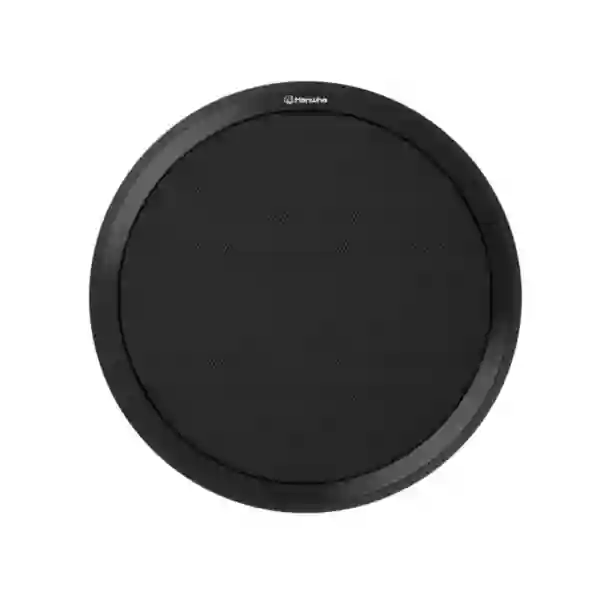
Hanwha Vision | Network Audio | Ceiling Speaker
SPA-C200B: Intelligent Indoor IP Audio for Planned Spaces
The Hanwha SPA-C200B IP ceiling speaker brings a black, two-way ceiling speaker and a built-in amplifier into a managed Ethernet audio environment. It is a candidate for indoor paging, prerecorded announcements and carefully configured communication workflows. Discuss room acoustics, network readiness and the exact regional variant before requesting a Tanzania project quote.
PoE / PoE+
10/100 Ethernet
Black ceiling finish
At a glance: verified technical details
| Manufacturer and model | Hanwha Vision SPA-C200B, black |
|---|---|
| Product type | Two-way IP ceiling speaker |
| Speaker assembly | 8-inch low-frequency and 2-inch high-frequency drivers |
| Amplification | Integrated 10W Class D |
| Network | 10/100 Base-T Ethernet |
| Power | IEEE 802.3af PoE Class 3 or IEEE 802.3at PoE+ Class 4 |
| Maximum sound pressure | 96dB (PoE); 100dB (PoE+) in detailed specification |
| Speaker frequency range | 120Hz–20kHz (-10dB) |
| Sensitivity | 90dB (1W) |
| Internal memory | 1GB |
| Approximate size | 269mm diameter × 142.5mm high |
| Weight | Approximately 1.8kg |
| Operating conditions | -20°C to +50°C; 10–85% RH noncondensing |
| IP protection code | None published |
Specifications are based on Hanwha Vision’s model information. Regional availability, firmware behavior, accessories, installation requirements and software compatibility must be confirmed for the actual proposed supply.
What this ceiling speaker is designed to do
The Hanwha SPA-C200B IP ceiling speaker is intended for network-managed audio communication in spaces where a permanently installed, ceiling-mounted loudspeaker is preferable to a portable or wall-mounted device. Instead of receiving only a traditional analogue speaker feed, it becomes an addressable network endpoint that can take part in a planned IP audio system. That makes it relevant to organizations evaluating routine announcements, operational messages, scheduled audio and selected security-related workflows. The principal value is not simply that sound comes from the ceiling. It is that administrators can plan how audio is delivered, which locations receive messages and how speakers fit into the wider communications architecture. An appropriate deployment still requires suitable switching, configuration, mounting hardware and a clearly defined operational process.
For a Tanzania buyer, the most useful starting point is the site rather than the specification sheet alone. Consider whether the intended room is an office, classroom, reception, hallway, shared workspace or similar indoor environment; whether announcements need to be heard above normal background noise; and whether one or several areas must be addressed independently. Then consider who will operate the system, how the voice or audio source is generated and what happens during a network or power failure. These questions determine whether the SPA-C200B is a sensible candidate and how many network audio endpoints, controllers or supporting devices may be required. Regional supply and the exact firmware configuration must be confirmed before committing to a design.
Two-way speaker assembly and the listening experience
Hanwha lists the SPA-C200B as a two-way ceiling speaker using an 8-inch low-frequency driver and a 2-inch high-frequency driver, with a built-in 10W Class D amplifier. This arrangement is relevant where speech announcements must be intelligible and occasional audio content needs a broader frequency response than a simple tone emitter. The published speaker frequency range is 120Hz to 20kHz at the -10dB reference, and sensitivity is stated as 90dB at one watt. These figures help an integrator compare the model against other speaker types, but they do not predict intelligibility throughout a specific room. Ceiling height, wall and floor finishes, ambient noise, playback level and the position of listeners all affect the result.
A successful speech system prioritizes words being understood instead of merely being loud. A busy workshop, open corridor or reverberant hall can make speech hard to follow even when a loudspeaker has ample nominal output. Before specifying quantity, ask the installer to examine room geometry, seating or working positions and typical activity. In larger spaces, multiple sensibly positioned speakers at moderate levels may be preferable to a single device driven very loudly. The black finish is a visual design consideration: it can suit dark architectural ceilings, but the visible grille and surrounding installation details should be checked against the interior design. Never infer coverage area or a guaranteed listening distance from the driver dimensions alone.
Power over Ethernet: one cable, carefully planned
The SPA-C200B supports IEEE 802.3af PoE Class 3 and IEEE 802.3at PoE+ Class 4, according to Hanwha’s published specifications. This allows network connectivity and operating power to be delivered over the Ethernet infrastructure rather than requiring a conventional mains socket beside each ceiling speaker. For facility managers, that may simplify cable routing and ongoing maintenance, provided the building already has suitable structured cabling and appropriate power-sourcing network equipment. PoE is not a guarantee of a simpler installation in every building. The switch must have sufficient available power, the cabling must be correctly installed and the equipment room must be secured and ventilated.
The manufacturer distinguishes peak acoustic output by power mode: its detailed specification lists 96dB maximum sound pressure level using PoE and 100dB using PoE+. That distinction should be considered when evaluating a noisy area or an installation that may demand higher sound output. A PoE+ label on a switch does not establish that every port can supply the full required budget simultaneously. Confirm the switch’s per-port capability, total power budget, cable condition and the number of connected powered devices. If audio operation is important during a utility outage, assess an appropriately designed backup-power strategy for the switch, network equipment, controllers and any upstream voice sources. Backup capability is a system design decision, not a built-in promise of this speaker.
Ethernet, IP addressing and everyday manageability
Hanwha specifies a 10/100 Base-T Ethernet interface for this model. In practice, the speaker needs an accessible and appropriately configured wired network connection, addressing, a way for the audio source or controller to reach it and suitable permission to exchange the intended traffic. A network administrator should decide whether IP addresses are allocated automatically or reserved, how names are documented, how the audio devices are separated from unrelated traffic and how settings are backed up. IP speakers benefit from the discipline applied to other managed network endpoints: documented inventories, stable connectivity, change control and routine firmware review. They should not be treated as anonymous accessories that can be forgotten after installation.
Before hardware is ordered, confirm that a network port is available at every proposed speaker location and that cabling distance and installation workmanship comply with the relevant structured-cabling design. Ask the integrator to account for switch cabinet capacity, port labeling, network-segment design and practical access for future maintenance. Where multicast is used for zoned audio, networking teams may need to review how multicast traffic is managed so the intended messages reach the correct recipients without unintended distribution. The published protocol list includes common networking and application protocols, but individual features should still be tested with the specific controller, software version and network policies planned for the project. The buyer should request a simple system diagram that identifies every component.
SIP paging and telephone-system integration
The manufacturer identifies SIP as one of the SPA-C200B’s supported protocols and describes tested use with selected SIP clients and PBX software in its product specifications. This makes the device relevant for organizations that want to investigate voice announcements initiated from a phone, softphone or communications platform. The existence of SIP support, however, does not mean every business telephone system can be connected without configuration or additional components. The installer must examine call routing, registration behavior, authentication, codec support, paging permissions and the handling of simultaneous calls or audio requests. A brief lab demonstration using the actual proposed environment is much more useful than relying on a generic compatibility claim.
In procurement discussions, distinguish one-to-one speaker calls from group paging and emergency announcements. A reception team might want to address a single area, while an operations manager might need a message across several zones. These workflows can require different control mechanisms and may be affected by licensing or server arrangements outside the speaker. The manufacturer lists PCMU, PCMA and selected Speex codecs for the SIP implementation, with DTMF support described in its specification; installers should check the codec and call-control settings on both ends. Do not assume that one IP speaker replaces a complete public-address controller, PBX, paging gateway or emergency communications system. Its role depends on the rest of the design.
Zones, groups and targeted announcements
Network-managed speakers are especially useful when the business needs to direct different messages to different areas. For example, a facility might separate front-of-house spaces from staff corridors or divide a training center into areas that require independent operational information. The SPA-C200B is described by Hanwha as supporting multi-source dynamic public-address control and grouped or zoned operation. Those capabilities create design options, but the practical number of usable zones is determined by the entire solution, the chosen transport method, controller configuration and performance requirements. Buyers should not equate a headline maximum with the number of simultaneous announcements their intended system can reliably handle.
Plan the proposed zone map before cabling. Give every physical area a clear name, decide whether overlapping announcements are allowed, define which operators can address particular zones and document what message takes priority when multiple requests arrive. An education environment may need classroom-specific communication alongside campus-wide information, while an office may separate public reception messages from staff-only instructions. The configuration should also address how operators confirm that a message was sent to the intended destination and what procedure applies when a device is offline. Request a demonstration that reflects real operations, including one normal announcement, a scheduled message and a priority-message scenario, rather than a single isolated sound test.
Recorded messages, audio files and built-in storage
Hanwha lists 1GB of internal memory for the SPA-C200B, together with supported WAV and MP3 audio formats. It also identifies an external microSD option in the specification, subject to the stated compatibility conditions. Local media storage can be valuable for commonly repeated prompts, scheduled announcements and selected event-triggered playback, depending on the configured system. It should not be interpreted as unlimited recording capacity, a substitute for document management or a guarantee that any uploaded file will work. Confirm audio encoding, sample-rate compatibility, bit rate, file naming, storage allocation and firmware behavior in the exact system that will be delivered.
Good audio-message management starts with clear scripts. Prepare recordings that are short enough to hold attention, use language familiar to the intended audience and deliver one action at a time. Keep a version-controlled list of approved files, their purpose, the zones in which they may play and the person authorized to replace them. Test levels with real listeners in the actual environment; audio that sounds clean at a desk may be difficult to understand beneath air-conditioning or machinery. When business processes change, remove outdated recordings instead of leaving contradictory instructions stored on devices. Ask the integrator who is responsible for maintaining the media library after handover and how restored devices will receive approved content.
Text-to-speech and language suitability
Text-to-speech can reduce the time needed to prepare some routine spoken announcements, but language support must be verified for the exact SKU, region and firmware. Hanwha’s product information contains differing language descriptions between its feature summary and detailed integration section. That is an important procurement signal: do not presume that a particular natural-language voice will be available merely because the product family advertises TTS. In particular, an organization planning English, Swahili or bilingual messages in Tanzania should request an explicit confirmation and live demonstration of the relevant voice or plan to use approved prerecorded audio instead. The existence of a language setting does not guarantee correct pronunciation of names, technical terms or local place names.
Evaluate text-to-speech from the perspective of the listener. Consider speed, pauses, numerical information, pronunciation, accents and whether an unfamiliar visitor can understand the instruction without context. For safety-related scenarios, have the message content and operational process reviewed by the responsible facility or safety team, and do not rely on automated speech output without appropriate validation. A simple controlled trial can compare recorded announcements against generated speech in the spaces where messages will be heard. If two languages are required, decide whether they will be played sequentially, assigned to different areas or selected by an operator, and make sure the schedule and message duration remain practical. Language capability is a solution-level acceptance criterion.
Event-triggered audio and security workflows
The SPA-C200B may be considered for carefully designed event-driven announcements. Hanwha documents audio playback triggered by IP speaker alarm input and describes IP-audio integration workflows using event rules in its support materials. These examples show why a network speaker can be useful beyond scheduled paging: an authorized system can play a prerecorded instruction or attention message when a defined event occurs. Nevertheless, the event source, controller and speaker must be explicitly integrated and tested. Do not assume that connecting any CCTV camera or alarm sensor will automatically create a working announcement. Different software platforms use different APIs, authentication rules and event logic.
A practical implementation should begin by deciding what the announcement is meant to achieve. A door event could call for an internal operational notice, whereas a public-facing instruction may require human review and stricter message governance. Define the event, its validity conditions, intended audience, activation frequency, volume, priority and reset behavior. Test for false triggers and repeated announcements that could frustrate occupants. In environments where the wording carries safety or legal significance, involve the responsible stakeholders before enabling automation. The speaker’s presence does not certify the overall solution as a life-safety, fire-alarm or emergency-evacuation system. Those applications may require separate purpose-built equipment, standards assessment and formal design approval.
Physical inputs, outputs and practical controls
The manufacturer’s specification lists one dry-contact input and one normally open dry-contact output for the SPA-C200B. These interfaces may help an integrator build a local control or notification workflow when used within their documented electrical and software limits. They are not a general-purpose replacement for the control interfaces provided by a building management system, access-control panel or industrial controller. Before wiring an external device, the installer should check the connection diagram, signal type, permitted electrical ratings and event behavior in the model-specific manual. No assumption should be made that contacts can carry arbitrary voltage or control a high-load appliance directly.
For the purchaser, the key question is not how many contacts appear on the datasheet but what useful, reliable behavior is required. Write down the proposed trigger condition, what happens when the input changes, whether the output is momentary or sustained, what happens after a restart and how the operator can disable or test the routine. The project documentation should identify terminal functions and external devices without exposing sensitive security details unnecessarily. Commissioning should include normal events, disconnected wiring and a simulated device failure where safe to perform. A small contact-control feature can be powerful, but it becomes dependable only when its dependencies, permissions and maintenance responsibilities are clear.
Ceiling fit, size and structural preparation
Hanwha publishes an outer dimension of approximately 269mm in diameter by 142.5mm high and a weight of about 1.8kg for the SPA-C200B. These numbers are useful for the early fit assessment, particularly where ceiling cavities contain ducts, lights, cable trays, services or restricted access. They are not a substitute for the official installation drawing, cutout requirements or support instructions. The specified ceiling opening, anchoring method and any additional retention arrangements must be checked against the exact manufacturer guide and the actual ceiling construction. Suspended tiles, plasterboard, concrete and decorative ceiling systems can have very different loading and access constraints.
Installation planning should identify who has authority to make a ceiling opening and whether work above the ceiling requires special precautions. Determine the intended mounting height, clearance from lights and sprinklers, accessibility for servicing, route of the Ethernet cable and the location of any nearby electrical or mechanical services. Consider how the grille can be reached for cleaning or inspection after furniture and partitions are in place. A site survey is particularly important when retrofitting an occupied workplace, where dust control, noise, work hours and reinstatement affect the project cost. Request a method statement and a marked-up speaker layout, rather than using the speaker’s external diameter as an improvised ceiling cutout measurement.
Indoor environmental limits and enclosure protection
The SPA-C200B’s manufacturer specification gives an operating-temperature range of -20°C to +50°C and a noncondensing relative-humidity range of 10% to 85%. It also lists no enclosure IP code. That last point matters: an operating-temperature figure does not mean the speaker is sealed against rain, water jets, dust ingress or prolonged outdoor exposure. Treat it as an indoor network-audio candidate unless the manufacturer provides project-specific guidance proving otherwise. Ceiling voids can experience heat buildup, condensation or airborne dust even when the occupied room seems comfortable. Inspect the actual location, not just the climate outside the building.
In Tanzanian commercial settings, installers should pay attention to ventilation around equipment, roof heat, humidity, cleaning practices and how building operations may change over time. Avoid placing an unprotected speaker where it may be washed down or exposed to weather through an open-sided structure. A kitchen-adjacent or industrial area may require an enclosure rating or construction material that this model does not advertise. If the environment is exposed, the correct answer may be a different speaker type rather than an improvised protective cover that changes acoustics or obstructs maintenance. Ask the project team to record environmental acceptance criteria, including the ceiling space, intended cleaning procedures and any expected water or dust exposure.
Speaker placement, audibility and acoustic design
Placement influences whether an announcement feels clear and consistent across a room. Hanwha lists a coverage pattern of approximately 90 degrees at 1kHz and 60 degrees at 4kHz for this speaker. Those are frequency-dependent figures, not a promise that every listener within a drawn cone will hear equally well. As people move farther from the speaker or the room becomes more reverberant, intelligibility can decline. A strong design checks ceiling height, speaker spacing, ambient noise, reflective surfaces and the areas in which listeners normally stand or sit. Speech tests should use representative content at the expected operational volume.
For offices, reception areas and classrooms, consider whether announcements will interrupt conversation, teleconferencing or concentration. The goal may be consistent moderate-level paging rather than maximum output. In corridors, test the transition between adjacent speakers and determine whether someone walking through the space will hear the complete message. Large open-plan areas may benefit from multiple zones that reflect occupancy patterns, not simply floor-plan boundaries. Ask the integrator to mark listening areas and identify any potentially weak locations such as corners, enclosed booths or heavily furnished zones. If the system must meet a defined audibility or intelligibility target, use a qualified acoustic design and measurement procedure rather than relying on nominal loudspeaker sensitivity alone.
Wired network resilience and operational continuity
A networked speaker relies on more than its own hardware. Announcements can be affected by a failed switch, damaged cable, addressing error, controller outage, expired credentials or unavailable source system. Before buying, decide which business messages are routine conveniences and which processes have a more demanding continuity requirement. That decision guides the level of network redundancy, backup power, monitoring and local-content planning that is justified. The manufacturer’s support for local storage does not by itself mean every message remains available during every type of network fault. Confirm the intended fallback behavior in the actual configuration.
Document the full audio path, from microphone or scheduling application through the controller and switches to the speaker. At acceptance testing, deliberately assess how operators discover an offline device and what they should do next. If an organization needs to maintain communications during planned maintenance, establish an approved alternative method. Keeping the system simple can sometimes make it more dependable than layering on integrations that no one is trained to maintain. Where announcements must continue through power disturbances, the network and upstream systems need appropriate backup facilities and testing. Avoid describing any IP audio design as fail-safe without documented evidence, independent design review and a clear statement of the specific failures it can tolerate.
Cybersecurity, credentials and access roles
The SPA-C200B is a network endpoint, so its security should be considered from the beginning of a project rather than after users have been trained. Hanwha documents role-based password protection and authentication features for the model. The system designer should still review the firmware level, secure access methods, relevant protocol settings and organizational IT policies before deployment. Default credentials must be changed using the current official setup guidance, and administrative privileges should be limited to authorized staff. A speaker that can issue public announcements is not a harmless device if unauthorized users can reach its control functions.
Consider separating audio equipment from guest networks and limiting communications to known management systems, depending on the wider infrastructure. Maintain an approved inventory of device names, IP assignments, administrators, firmware versions and update records. Determine how password changes will be handled when the original installer is no longer available. If the network is accessed remotely, use the organization’s approved secure method; avoid unnecessary direct exposure of device interfaces to the public internet. Log review, account management and controlled change procedures should be scaled to the site, not forgotten because the device is physically hidden above a ceiling. Cybersecurity responsibility is shared between the equipment supplier, integrator and the customer’s IT team.
Firmware, configuration and maintenance
Hanwha provides product documentation and firmware information through its official support channels. That is valuable for long-term planning, but buyers should not assume a unit supplied at one time has the latest firmware or identical features to every other unit in the same family. Ask the supplier to identify the exact variant, shipped firmware version and recommended supported upgrade path. Keep the device configuration backed up according to the manufacturer’s supported method, and record any settings required for SIP registration, audio sources, zone membership and event rules. Firmware changes should be evaluated for compatibility before being introduced to a working installation.
An effective maintenance plan addresses the practical issues people notice first: a missing announcement, inconsistent levels, an offline device or an outdated message. Assign responsibility for checking logs, performing listening tests, reviewing stored audio and tracking network changes. A speaker-test function or software status indicator is useful, but it does not replace hearing an actual announcement in the occupied space. Schedule periodic checks at times that respect normal operations and keep evidence of completed tests when the application requires it. Verify that staff know who to contact if a message fails and that the organization has access to the installation records. The intended service life depends on proper installation, environment and ongoing support, not a guarantee in marketing copy.
Reception, offices and workplace communication
In an office or professional workplace, a ceiling speaker can support announcements that should reach a particular room or corridor without relying on someone carrying a portable device. Possible examples include a reception notification, a scheduled operational reminder or a staff-only message when a facility procedure changes. The SPA-C200B’s black ceiling design may be appealing where the equipment should blend into a darker interior. Whether it is the best model depends on room acoustics, the network infrastructure and the proposed way of generating announcements. For a small single-room office, the cost and complexity of a managed IP audio system may be harder to justify than for a larger multi-zone workplace.
Before deciding, map typical communication journeys: who initiates an announcement, which staff need to hear it, how often it occurs and whether the message contains confidential information. Do not automatically page visitors with internal operational details. If audio playback accompanies reception or access-control workflows, confirm how false triggers will be handled and whether staff can easily stop an unnecessary announcement. Include a volume-control and acceptance process so the system is audible without being intrusive. A short pilot in one representative room can reveal challenges with placement, voice clarity or telephone integration before equipment is specified for an entire floor.
Education, training rooms and managed campuses
Schools, training centers and learning facilities may need to direct routine information to groups of rooms or common areas. A ceiling-mounted IP speaker can be considered where the network already reaches the building and the administrators want structured paging rather than ad hoc communication. Potential uses include timetable reminders, operational notices and controlled playback of approved prerecorded material. These are examples of possible system design, not assertions that the SPA-C200B has been certified for any particular school safety function. A campus environment often introduces special requirements for permissions, scheduling, language, acoustic comfort and communication when classrooms are in use.
The design team should document when classrooms may receive ordinary messages, who can make a site-wide announcement and how recorded files are reviewed. Work with teaching and facilities staff to establish appropriate volume, message duration and quiet periods. If several buildings share a network, make sure the IT team understands the controller and multicast design and confirms that delays or packet loss will not undermine the intended communication. Any emergency or evacuation function should be assessed against the applicable institution’s formal safety requirements and purpose-built systems, rather than assumed to be delivered by a commercial IP speaker alone. A commissioning plan should cover occupied-room trials, authorized operators and routine maintenance ownership.
Retail, hospitality and visitor-facing spaces
Retail showrooms, visitor centers and hospitality reception areas may value a ceiling speaker that can provide operational announcements without visible wall brackets or free-standing audio equipment. The SPA-C200B can be evaluated for such projects when the ceiling structure and wired network make an IP design practical. A visitor-facing deployment demands particular attention to speech clarity, tone, privacy and language selection. Recorded prompts need to sound welcoming and be useful, not merely technically functional. The project should make a deliberate choice between live paging, scheduled playback and automated triggers, because each option creates different staffing and quality-control requirements.
Think about the intended message path through the customer experience. A notice at a busy entrance may need greater clarity than an announcement in a quiet service corridor, while a restaurant area might require careful control to avoid excessive disturbance. Do not assume that every room should be placed in a single group or that identical settings will work everywhere. Consider staff and customer reactions during a trial, then adjust zone boundaries and levels before full roll-out. The product does not automatically include a music licensing arrangement, advertising service or content subscription. Organizations are responsible for securing any rights needed for music or other third-party material they choose to play.
How this model differs from conventional speakers
A conventional passive loudspeaker is normally part of an analogue amplifier-and-cabling arrangement, whereas the SPA-C200B incorporates amplification and connects to an Ethernet-based IP audio workflow. That difference changes the cost model and the skills required to install the solution. An IP endpoint can offer convenient addressability, management and integration options, but it depends on network configuration and powered switching. A traditional public-address system might be more straightforward for a very small site or a building where suitable network cabling is absent. Neither approach is inherently better for every project; the right choice follows the site requirements and the total system architecture.
When comparing quotations, include more than speaker unit prices. Ask whether the proposal includes mounting, structured cabling, PoE switching, controller or server software, paging interfaces, configuration, testing, operator training and documentation. It is also important to understand which components can be serviced independently and what happens if the control system changes in the future. Avoid evaluating the SPA-C200B as if the purchase of a speaker alone includes a complete communications platform. A well-scoped bill of materials prevents unexpected integration costs and clarifies who is accountable for delivering a working system rather than a collection of compatible-looking devices.
Comparing ceiling, wall, pendant and horn formats
Speaker form factor should match the physical space and the listeners. A ceiling speaker is often a logical candidate for finished indoor rooms with appropriate ceiling cavities. Wall-mounted options may be easier in spaces with solid ceilings or limited access above them. Pendant speakers can be worth investigating in areas with high open ceilings, while horn speakers may be more suitable for situations where sound must project in a particular direction or overcome challenging background noise. These are general design differences; exact comparisons require the specifications of the alternatives under consideration, including their environmental protection, mounting methods and acoustic behavior.
For the SPA-C200B, the buyer should focus on whether its 269mm body diameter, mounting depth, two-way arrangement and available PoE power mode align with the proposed room. If the brief calls for a wash-down location, an outdoor walkway or an open-sided loading bay, do not use the absence of a published IP rating as a minor afterthought. Seek an appropriate weather-rated design instead. If the site has very low ceilings, check the visual appearance and useful coverage rather than assuming more powerful equipment is always preferable. Request a comparative recommendation based on the actual installation drawings, not just product-family photographs or generic claims of better sound.
Compatibility with cameras, analytics and management platforms
The manufacturer identifies SUNAPI and ONVIF Profile S among the SPA-C200B’s integration-related specifications. These are important technical clues, but they do not prove that every ONVIF device, third-party video platform or camera analytic rule will support the buyer’s desired audio action. Integration often depends on specific software features, user permissions, API calls, event mapping and firmware versions. Hanwha support materials describe IP speaker audio triggered through alarm events and selected video-management workflows. Those examples are helpful evidence that integration concepts exist, but the project should still test the exact model and intended software together before purchase.
For an automation brief, list the event source, the action expected at the speaker, who can override it and what will appear in the operator’s logs. A motion event should not automatically become a public warning without consideration of false alarms, customer impact and consent policies. If a surveillance system will control the speaker, assign clear ownership across the video, networking and facilities teams. Test normal behavior, event priority, repeated events, speaker unavailability and manual cancellation. A useful proof-of-concept demonstrates the entire process with the right network segmentation and real message files. Avoid making vague ‘works with CCTV’ claims that hide licensing, platform or configuration dependencies.
Choosing the right quantity and project bill of materials
The number of speakers needed cannot be calculated reliably from the model name or the ten-watt amplifier rating. A survey should consider floor area, ceiling height, room subdivisions, reverberation, background noise, expected voice level and the areas that must receive messages. Start with a floor plan marked with current room functions and likely listening points. Ask the designer to explain why each proposed loudspeaker position has been chosen and whether any location is at risk of poor coverage. Where the intended usage includes audio across multiple buildings or floors, account for independent zones, network boundaries and system management requirements as well as the hardware count.
A useful bill of materials identifies the speaker quantity and exact finish, PoE or PoE+ switching capacity, network cabling, mounting accessories and any needed controller, microphone, software or gateway. It should state what is included for installation, configuration, acceptance testing and staff training. Ask for clarity on consumables, building work, access equipment and replacement of damaged ceiling tiles. Without a defined bill of materials, buyers may compare a speaker-only offer with a fully commissioned audio system and draw the wrong conclusion about price. Confirm the regional product variant, available technical documentation and any nonstandard lead-time considerations before issuing a final purchase order.
Questions to ask before requesting a Tanzania quotation
An effective quotation request begins with the use case. Tell the supplier how many buildings or rooms are involved, whether the ceiling is suspended or solid, what network infrastructure is available and whether the main purpose is live paging, recorded announcements, event-triggered audio or a combination. Provide a floor plan if one can be shared safely, plus the ceiling height and a description of typical background noise. Mention any required telephony or video-management platform, including its current version. If languages are important, state them clearly and request evidence that the exact proposed firmware or a supported recorded-audio workflow meets that need.
Ask the supplier to confirm whether the black SPA-C200B variant is intended for your regional market, whether it is obtainable for the project and which equipment or licenses are needed to make the requested workflows function. Request a transparent scope of supply, clearly separating hardware from integration, wiring, testing and support. Obtain the manufacturer documentation relevant to the delivered variant and establish who will be responsible for compatibility validation. Do not rely on an overseas listing price to estimate a Tanzania invoice; taxes, sourcing, freight and commercial terms vary and are not verified here. A precise request is more likely to produce comparable, useful proposals than the question ‘How much is one speaker?’ alone.
A practical site-survey checklist
Before installation, have the project team verify that every proposed ceiling position is structurally suitable and accessible. Confirm there is enough space above the finished ceiling for the speaker, mounting arrangement and cable routing. Inspect the planned network path and identify the switch port that will provide PoE or PoE+. Check the building’s usual temperature, humidity and cleaning conditions; the manufacturer does not publish an enclosure IP protection code for this model. Review whether sound should enter adjacent rooms and whether any occupants are particularly sensitive to noise. Record the acceptance conditions in a way the installer and purchaser can both understand.
The survey should also identify operational dependencies. Which team administers the speaker? Who manages the switch and VLAN? Where are the approved audio files stored? Which users are permitted to broadcast to each zone? Is the proposed voice source a SIP telephone, computer application, audio server or event-rule system? The answers influence not only hardware selection but also system configuration and training. Agree on a commissioning date and the parties who must witness testing. A concise survey record with photographs of installation positions, approved drawings and a signed checklist can prevent expensive changes when ceiling work begins. Keep confidential layout and security details inside the project documentation rather than public product copy.
Commissioning and handover acceptance
A professional handover should prove that the installed speaker delivers the intended outcome in the actual building. Start by confirming physical installation quality, cable labeling, network reachability and correct PoE operating mode. Then test each audio source, each defined zone and each authorized operator role. Play a representative speech recording and listen at the planned audience positions under realistic background-noise conditions. The test should assess intelligibility and appropriate volume, not merely whether the device produces a sound. Verify that the black grille and mounting fit the architectural finish and that servicing access remains practical.
Where the proposal includes SIP, scheduling, contact inputs, event-triggered playback or video-system integration, demonstrate each included function explicitly. Test what happens when a device loses network access and how the operator is notified. Confirm that the customer receives as-built drawings, supported configuration backups, user instructions, firmware information and an agreed maintenance procedure. If an advertised feature is available only with separate equipment, that equipment should be part of the witnessed test. Create an issue list for any incomplete items and agree who resolves them. The objective is a functioning, documented audio service that staff can operate confidently after the installer leaves, not a successful demonstration performed under unrealistic conditions.
Operating policies for clear, responsible announcements
Technical features only become useful when operators follow a consistent communication policy. Define which teams may use live paging, which messages may be automated and which areas are appropriate for each type of announcement. Prepare short, plain-language scripts that tell listeners what action is required. Avoid unnecessary background audio that competes with conversation or work. Where a message affects visitors, think about accessibility, clarity and the need for more than one language. If the application is security-sensitive, establish a review and approval process for recordings and event triggers before making them available to operators.
Set a process for reporting confusing or excessively loud announcements and for changing the approved audio content. Make sure users know how to cancel a message if it is incorrect and how to reach someone responsible when a device is offline. Train a backup operator rather than depending on a single staff member. Periodically review zone membership when buildings are reconfigured, departments move or a space changes function. A technically capable speaker can still deliver a poor customer experience if messages are long, unclear or repeatedly triggered by incorrect events. Good system governance is therefore as important as the selection of the hardware model.
Model identification and regional verification
The model discussed here is specifically SPA-C200B, the black ceiling speaker identified on Hanwha Vision’s Korean product information. The shared SPA-C100/SPA-C200 family documentation has historically marked certain C200 variants for the Korean market, while the manufacturer’s product page also says availability can vary by region. These points make regional verification essential for a Tanzania purchase. Do not assume that a product seen in a Korean catalog is in stock locally, approved for import or offered with identical language features and support arrangements. Ask the supplier to confirm the exact model marking and supported regional configuration on a formal quotation.
Also verify the practical difference between this black variant and any suggested white or alternative model. A similarly named speaker may differ in color, region, documentation or other details even if some headline specifications look alike. The buyer should request matching datasheets and confirm whether any replacement requires changes to mounting, audio configuration, cable or network design. No local SKU has been supplied for the FourTeck Tanzania listing, so the manufacturer’s model number should remain distinct from an internal stock-keeping identifier. Clarifying these small details before purchase avoids confusion when goods are received, installed, registered or serviced.
How to decide whether the SPA-C200B is the right fit
Choose the SPA-C200B for further evaluation when the project calls for a black ceiling-mounted IP audio endpoint in an appropriate indoor setting, existing or planned wired networking and a deliberate paging or announcement workflow. Its published specifications give concrete starting points: a two-way speaker, built-in 10W amplifier, PoE and PoE+ support, 10/100 Ethernet, local audio storage and manufacturer-described SIP and system-integration capabilities. These are compelling reasons to investigate the product, not promises that every requested application is already solved. An installation still needs the right controller strategy, security policy, audio design and verified compatibility.
It may be the wrong first choice where a site has no suitable Ethernet cabling, an exposed outdoor installation, very challenging acoustics or a requirement for a certified emergency voice-alarm system. In those cases, request a comparison with equipment designed for the actual use case. Even a technically suitable unit should not be specified until the regional variant, installation drawing and audio-language needs have been checked. FourTeck Tanzania can use a clear project brief to assess the proposed configuration and provide a quotation when product sourcing and the scope of work have been confirmed. The sensible next step is a solution review, not an unsupported guarantee about price or availability.
Frequently asked questions about the Hanwha SPA-C200B IP ceiling speaker
Is the Hanwha SPA-C200B a network speaker or a conventional analogue speaker?
It is an IP ceiling speaker with 10/100 Ethernet connectivity and an integrated 10W Class D amplifier. It is intended for network-audio workflows rather than being treated as an ordinary passive speaker connected directly to a traditional amplifier output. The complete system may still require suitable software, audio sources, PoE switching and configuration.
Does the SPA-C200B need a separate power adapter?
Hanwha lists IEEE 802.3af PoE and IEEE 802.3at PoE+ as supported powering methods. An appropriately rated PoE-capable network device and correctly installed Ethernet connection are required. The power budget for all connected equipment and any continuity requirements should be checked before installation.
What is the difference between its PoE and PoE+ audio ratings?
The manufacturer’s detailed specification lists maximum sound pressure levels of 96dB with PoE and 100dB with PoE+. That is a published product rating under specified conditions, not a promise of intelligibility throughout any particular room. Room acoustics and speaker placement still require assessment.
Can it be used outside a building?
Do not assume so. The manufacturer’s product specification lists no enclosure IP code for this model. Rain, dust, wash-down procedures and condensation may require a different product with explicitly documented environmental protection. Seek installation guidance before selecting hardware for any exposed location.
Can the SPA-C200B receive SIP telephone paging?
SIP is among the manufacturer’s listed protocols, with tested integrations and codec details described in its technical information. Actual compatibility depends on the customer’s PBX, SIP settings, software versions, paging workflow and network design. Request a live compatibility test for the proposed setup.
Can it play prerecorded voice announcements?
Hanwha identifies internal storage and WAV/MP3 audio support, and documents event-oriented playback use cases for its IP speaker system. Confirm the supported file format, uploaded-content process, scheduling or triggering method, and controller requirements in the exact deployed configuration.
Does this product include Swahili text-to-speech?
Swahili support has not been verified for the exact SPA-C200B regional variant. The manufacturer’s language descriptions need variant-specific confirmation. If Swahili announcements are necessary, request a demonstration or plan to use professionally prepared prerecorded recordings.
Can it connect to CCTV or access-control events?
The manufacturer’s materials describe IP audio system integration and event-triggered playback concepts. Those descriptions do not establish universal compatibility. The installer must validate the actual event source, control platform, API behavior, security settings, message priority and logging before enabling automation.
How many ceiling speakers do I need?
That depends on ceiling height, room shape, reverberation, expected noise, listening locations and the audibility objective. Do not estimate coverage solely from the wattage or nominal dispersion figures. A site survey and, where appropriate, acoustic measurements should inform placement and quantity.
Is the product available in Tanzania, and what does it cost?
Tanzania stock, regional availability, delivery terms and local pricing have not been verified. Request a quotation that confirms the exact black SPA-C200B variant, project quantity, system components, installation scope, applicable commercial terms and any technical demonstration required.
What information should I send with an inquiry?
Share the intended use, approximate room count, floor plan if available, ceiling height, preferred announcement source, existing PoE switching, any SIP or video platform, required languages and whether a complete installed solution or speaker-only pricing is needed. This helps a supplier assess fit and provide a meaningful scope.
Does the SPA-C200B replace a certified emergency voice system?
No such claim is established by the product information reviewed. A safety-critical evacuation or fire-alarm requirement must be evaluated under the applicable standards and project approvals, with purpose-designed equipment where required. Do not treat a network paging capability as evidence of life-safety certification.
Request a Tanzania project review or quotation
Tell FourTeck Tanzania about the space, speaker quantity, intended paging or announcement workflow, network and PoE provision, required languages, and any SIP or video-system integration. Ask for confirmation of the exact SPA-C200B regional variant and a project-specific scope before ordering. No local price, inventory or delivery promise is implied.
Next step: Contact FourTeck Tanzania with your requirements and request an availability and compatibility check.




Reviews
There are no reviews yet.