
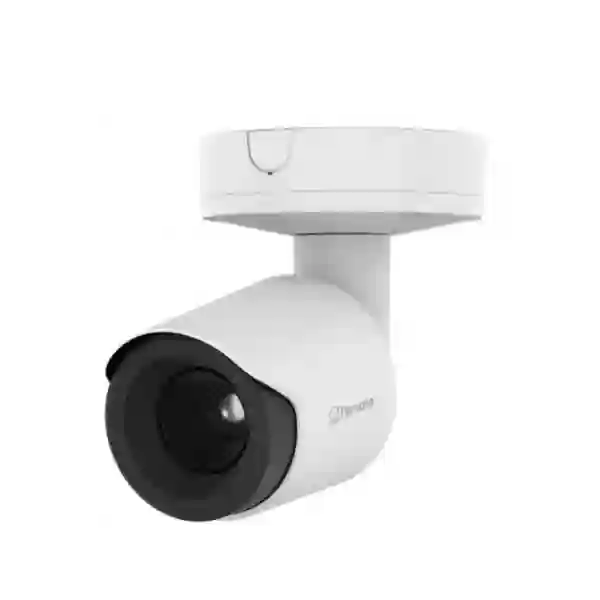
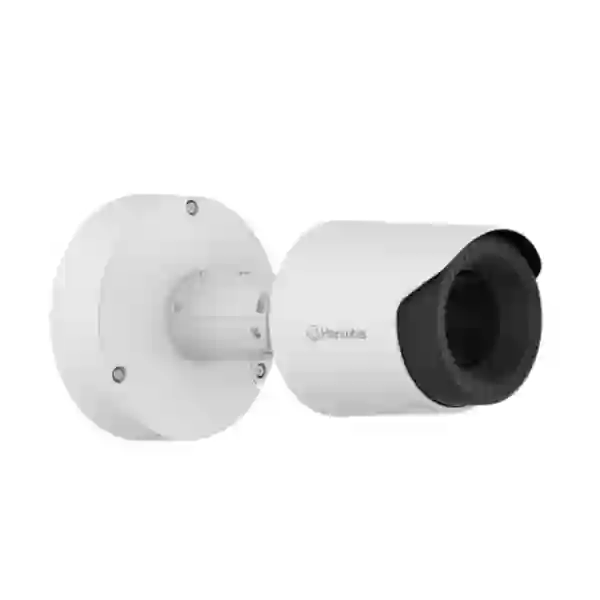
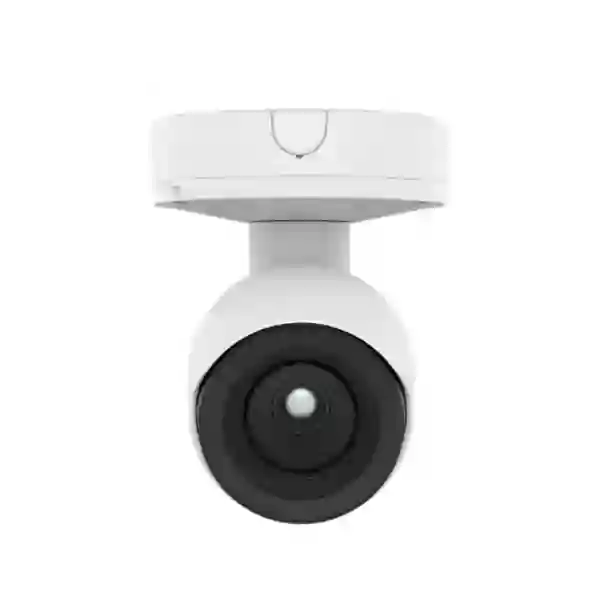
Hanwha Vision • AI thermal security
Hanwha TNO-C4050T AI Thermal Camera
Protect selected perimeters and approaches with heat-based viewing and on-camera AI classification for people, vehicles and vessels. The TNO-C4050T combines a native VGA thermal detector, a fixed 19 mm lens and robust outdoor construction. Confirm camera position, target distance, recording compatibility and local supply terms before ordering.
Technical specifications at a glance
The following values refer to the exact manufacturer-listed model. Detection distances are reference results, not guaranteed installed-site performance. Product specifications can be revised; confirm the latest model-specific document before procurement.
| Specification | Verified detail |
|---|---|
| Manufacturer / model | Hanwha Vision / TNO-C4050T |
| Camera class | AI thermal compact bullet network camera |
| Detector | Uncooled microbolometer, native 640 × 480 |
| Video outputs | Up to 1280 × 960 upscaled; 640 × 480 and other supported modes |
| Thermal sensitivity | NETD ≤16 mK at 25°C, F1.0 |
| Lens | 19 mm fixed, athermalized, F1.0 |
| Field of view | 32.8° horizontal; 24.6° vertical; 41.1° diagonal |
| Minimum object distance | 11 metres |
| AI object categories | Person, vehicle, vessel |
| AI detection references | Person up to 159 m; vehicle up to 227 m; vessel up to 542 m |
| Video codecs | H.265 / H.264 / MJPEG; up to 30 fps or 25 fps per configuration |
| Integration | RJ-45 Ethernet; ONVIF S / G / T / M; SUNAPI |
| Onboard storage | One microSD / SDHC / SDXC slot, maximum 1 TB |
| Power | IEEE 802.3af Class 3 PoE or 12 V DC |
| Maximum power consumption | 7.8 W PoE; 8.1 W at 12 V DC |
| Environmental ratings | IP66 / IP67, IK10, NEMA 4X |
| Operating temperature | -40°C to +60°C |
| Dimensions / weight | Approx. Ø107.3 × 275 mm / 2 kg |
Who this thermal camera is designed for
The Hanwha TNO-C4050T thermal camera is designed for security teams that need to detect activity based on heat contrast rather than depend only on visible-light detail. It is particularly relevant where operators monitor a boundary after dark, where conventional illumination is difficult to maintain, or where a scene combines open areas, shadows and challenging backgrounds. The 19 mm fixed thermal lens provides a defined field of view, while on-camera analytics classify people, vehicles and vessels. This combination supports security review before choosing an alarm, dispatch or verification workflow.
For a buyer planning a Tanzania deployment, the first question is not simply whether a thermal camera can see at night. It is whether the chosen field of view covers the intended approach route, whether an intruder creates sufficient contrast at the required range, and whether the surrounding infrastructure can carry and record events reliably. The TNO-C4050T is a specialist detection camera, not a substitute for every conventional CCTV view. A sound design typically pairs thermal event awareness with a visible-light camera where facial appearance, vehicle colour or detailed visual evidence matters.
What thermal imaging does differently
A thermal sensor responds to long-wave infrared radiation from a scene. It can present heat differences without relying on a streetlight or an infrared illuminator to light a subject. That is valuable at perimeter fences, dark access routes and other places where a standard optical camera may show limited contrast. Thermal scenes are still affected by conditions such as background temperature, reflections, rain intensity, occlusion and the geometry of an object. Buyers should therefore evaluate their actual site rather than assume the same detection result everywhere.
The camera uses an uncooled 640 × 480 microbolometer operating in the 8–14 micrometre spectral range. Its native sensor resolution is VGA; the option to display upscaled 1280 × 960 video does not create additional thermal detail at the sensor. The practical value comes from sensitivity, lens geometry, analytics configuration and sensible placement. The objective is to give an operator an actionable indication that something has entered or crossed a protected area, followed by an appropriate verification step.
19 mm lens: coverage before marketing distance
The built-in lens has a 19 mm fixed focal length and a stated horizontal field of view of 32.8 degrees, with a vertical field of view of 24.6 degrees. This is neither a panoramic view nor a zoom lens. It suits a deliberately selected sector in which subjects must occupy enough pixels for the intended analytic rule. A camera positioned too close to a very wide gate may miss lateral approaches; one placed too far away may capture a subject at an inadequate apparent size. The right location balances scene width, target size and possible obstruction.
Hanwha lists an approximately 11 metre minimum object distance for this lens. That specification deserves attention when a camera is mounted close to a wall or narrow entrance. Review the expected nearest and farthest targets, the mounting height, the angle to the ground, and how subjects move across the image. Ask an installer for a plan-view coverage sketch and test positions in the actual environment. Choosing a higher mounting point does not automatically improve classification if subjects become too small or overlap hot backgrounds.
Understanding the thermal sensitivity figure
The TNO-C4050T lists thermal sensitivity at no more than 16 mK under the manufacturer’s specified measurement conditions of 25°C and F1.0. NETD describes the camera’s ability to distinguish small temperature differences in the image. A lower figure can help preserve useful contrast when a subject and background have relatively similar thermal characteristics. It is an imaging sensitivity parameter, not a guarantee that all people or vehicles will be detected under any weather, terrain or operating condition.
In daily operation, the benefit is most meaningful when combined with accurate scene selection and a properly designed analytics zone. A person walking in front of heated machinery, a hot concrete surface or a tree line may create a different thermal pattern from someone crossing cooler open ground. Seasonal heat, humid air, rainfall and solar loading can change that pattern. A site acceptance test should therefore include representative day, evening and night conditions, plus the expected object directions and speeds.
AI classification for people, vehicles and vessels
The Wisenet 8 platform supports AI-based object classification for person, vehicle and vessel categories. Rather than treating every pixel change as an identical event, an operator can build rules around relevant object classes and activity zones. This can be useful for a fenced compound, vehicle movement area or waterfront where not every thermal movement demands the same response. AI is an aid to event prioritisation; it is not a proof of intent, identity or the absence of nuisance alarms.
Buyers should define what each alert means before deployment. A person crossing a restricted perimeter after hours may require immediate review, whereas an authorised vehicle using a regular route may be expected. Vessel classification may matter for a water-facing facility, but its usefulness depends on camera alignment, background, target size and the organisation’s operating procedures. Confirm whether object-specific rules will be configured within the camera, recorder or management software, and ensure personnel know how to acknowledge, investigate and close events.
Manufacturer AI distance figures explained
Hanwha publishes AI detection distances of up to 159 metres for a 1.8 metre person, 227 metres for a 1.45 metre vehicle and 542 metres for a vessel measured at 2.4 metres above the waterline. These figures are manufacturer reference values for the specified target classes, not site guarantees. They should not be used as an automatic fence-line design. Vegetation, target orientation, contrast, terrain, environmental conditions, mounting geometry and analytics settings can materially change practical performance.
These AI reference distances must also be distinguished from the separate DRI values based on Johnson’s criteria. DRI detection, recognition and identification express different image-information thresholds, and DRI detection does not imply reliable AI classification at the same range. For purchasing, ask for the distance from each proposed camera position to the critical boundary and to any likely approach route. The commissioning plan should test representative people and vehicles at those distances rather than rely on a single brochure figure.
Why DRI is not facial identification
Thermal camera brochures often provide detection, recognition and identification distances. Those terms have a specialised image-performance meaning; they do not mean a thermal image will reveal a person’s name, facial identity or licence plate. For this model, Hanwha lists person DRI detection at 652 metres, recognition at 163 metres and identification at 82 metres under the published criteria. The corresponding vehicle figures are 1,667 metres, 417 metres and 208 metres. Such numbers describe criteria-based imaging thresholds, not the camera’s AI alarm coverage.
A project specification should state which outcome the operator actually needs. If the goal is an early indication that something is approaching a secured area, thermal detection may be appropriate. If the goal is visual confirmation of clothing, face, vehicle registration or colour, a suitable optical camera and lighting strategy will be needed. A combined system can use thermal analytics to direct staff toward an event, then use other sensors or cameras for context. Each role should be stated clearly in the design.
Perimeter protection and virtual boundaries
The camera supports AI events such as virtual-line crossing, direction, intrusion, loitering, entering and exiting an area. A line can correspond to a fence approach or an invisible security boundary, while an area rule can focus attention on a particular yard, loading bay or restricted side of a facility. The important work is defining zones that match real operating rules. A line placed across an authorised staff route may generate persistent alerts and quickly reduce confidence in the system.
During commissioning, define permitted and prohibited travel directions, expected vehicle patterns and the events that should trigger a response. Test each rule with real movement at different speeds and positions. Adjust zones so trees, roads, neighbouring premises and public paths are not unnecessarily included. The best installation often uses fewer high-value, well-tested rules rather than many overlapping alarms. Record the purpose of every configured line or area so it remains understandable when security staff or site use changes.
Industrial yards and equipment facilities
Industrial compounds may contain poorly lit service roads, stacks of materials, exposed perimeters and areas that operators cannot continuously observe in person. The TNO-C4050T can contribute thermal event coverage across selected sectors where movement awareness matters. It may be considered for warehouses, distribution compounds, manufacturing boundaries, energy-related premises or restricted equipment areas, subject to a site survey. These are potential applications, not claims that the camera has already been supplied to any particular Tanzania facility.
Industrial environments also produce heat and visual obstruction. Exhaust outlets, moving machinery, reflective surfaces, hot roofs and vehicles can change the thermal scene. The installer should establish whether the security objective is detecting people, counting permitted vehicles, monitoring a crossing route or supporting operator verification. For temperature measurement, plant condition monitoring or fire detection, specify an appropriately verified system rather than assuming that the camera’s temperature-change analytic provides calibrated radiometric readings or certified fire alarm functionality.
Coastal and waterfront monitoring
Vessel detection gives this model a potential role in a maritime security design, including selected jetties, waterfront boundaries and controlled waterside approaches. Thermal contrast can be useful when visible-light observation is difficult, but it cannot remove the need for clear sightlines or account for every sea condition. Background clutter, waves, reflections, spray and small craft profiles can all influence the result. The stated vessel AI detection reference of up to 542 metres should be treated as a starting point for technical planning.
At a waterfront site, map the intended water sector and identify which targets require an alarm. A large, warm vessel and a low-profile craft can present very different thermal signatures. Check the horizon position, camera mounting stability, expected wave conditions and the point at which a target becomes a real concern. A successful installation also needs a response workflow for operators: what additional camera view is available, who reviews events and how an incident is escalated. Thermal imagery alone cannot establish vessel registration or authorisation.
Supporting night operations without promising perfect visibility
Because the sensor detects emitted infrared energy rather than ordinary visible light, the camera can operate in darkness without depending on a visible spotlight. This is useful when lighting an entire boundary would be disruptive, expensive or impractical. However, a thermal camera does not see through solid walls, dense obstacles or all atmospheric conditions equally. Rain, water on optical surfaces and heat-equilibrated scenes can reduce effective contrast. The word night-ready should never be interpreted as an unlimited performance guarantee.
Security teams planning around night shifts should decide what a good alert looks like on a monitoring screen. It may be a clear person classification at a known crossing point, a vehicle approach direction, or an area-entry alert requiring human review. Scene presets, alert priorities and display layouts should support that task. If other cameras provide colour video or close-range detail, position them so the operator can move from a thermal alert to the relevant confirming view without losing valuable time.
Image resolution, upscaling and viewing quality
The sensor captures native 640 × 480 thermal information. Supported video output resolutions include 1280 × 960 upscaling as well as 640 × 480, 640 × 360 and lower-resolution options. Upscaling can make an image more convenient to display, but should not be mistaken for a higher-resolution detector. For design calculations, the actual thermal sensor, lens angle and target pixel size remain fundamental. Buyers comparing cameras by a headline output resolution alone can easily miss this distinction.
During proof of concept, check both the live operator display and the recorded evidence. A video that looks acceptable on a small screen may not answer the incident questions asked after an event. Verify whether an NVR, VMS or workstation preserves the intended resolution, frame rate and timestamps. Confirm that operators can distinguish a moving target against typical backgrounds without needing an unrealistic level of digital zoom. If critical activity occurs outside the thermal frame, a second view or different lens option may be the right answer.
Video compression and recording design
The TNO-C4050T supports H.265, H.264 and MJPEG, with frame rates up to 30 fps or 25 fps according to the configured mains-frequency mode and format. Its AI-based WiseStream functionality can support more efficient streaming, although actual bitrate and storage needs depend on scene content, encoding choices and the recording policy. A fixed storage estimate copied from another site is not a sound basis for a purchase. Video complexity and operational demands need to be measured or appropriately estimated for the deployment.
For a new system, decide whether video should record continuously, on events or through a combination of the two. Clarify retention requirements, network bandwidth, whether audio is needed, and who is permitted to export evidence. Where multiple viewing stations need access, choose recording and stream settings that suit both the security control room and the uplink. Commissioning should check playback quality at busy times, not just a single live stream under ideal conditions. The camera’s advertised capabilities are only one part of reliable evidence handling.
Edge recording and microSD planning
Hanwha specifies a microSD, microSDHC or microSDXC slot with support for a card up to 1 TB. This can support edge-recording strategies or event-based recording designs, depending on the software and configuration used. The slot is not a guarantee that a supplied product includes a memory card. Confirm the recording format, compatible card specification, retention goals and what happens when storage becomes full. Continuous write workloads can place different demands on a card from occasional event clips.
Where a facility depends on continuous evidence, assess whether a central recorder or video management platform should remain the system of record. Edge storage may be useful during a network interruption, but recovery, reconciliation and playback behaviour need to be tested for the specific recorder and camera firmware. Account for deliberate removal, media failure and secure handling of recorded data. Ask the integrator to demonstrate where recordings appear, how authorised staff retrieve them and how a camera fault is reported before relying on the setup operationally.
Network integration and management platforms
The camera provides a shielded RJ-45 Ethernet interface and supports common IP video integration methods, including ONVIF Profiles S, G, T and M and Hanwha’s SUNAPI platform. That gives system designers recognised integration paths, but standards support alone does not establish that every feature will work identically with every recorder or VMS. Basic video, event messages, object metadata, playback, time synchronisation and camera configuration can each have different integration requirements.
Before placing an order, request confirmation against the exact VMS or NVR version intended for the site. A practical test should include live video, AI event receipt, event-to-video navigation, recording playback and evidence export. Check whether the platform exposes the camera’s person, vehicle and vessel metadata and whether each required event can create the desired response. Document firmware and software versions used in the test. If a feature is available only through a vendor-specific method, that dependency should be explicit in the project scope.
Alarm actions and response design
Available alarm functions include analytics-triggered events and configurable alarm input/output resources. Depending on the actual integration, a configured event can be used to notify operators, initiate recording, publish a message or participate in a PTZ-camera handover workflow. This makes the device useful as an event source rather than only as a picture on a monitor. However, integrations should be validated before promising automatic gates, sirens, dispatch or third-party system control.
Write a small response matrix for each important event: what starts it, where it is displayed, who acknowledges it and what should happen if no one responds. Consider scheduled access, maintenance work, delivery vehicles and public activity near a boundary. Escalation rules must be compatible with the site’s physical security arrangements and safety policy. Clear procedures reduce alarm fatigue and help staff act on the events that matter. The customer should know which actions are built into the camera and which require additional systems.
Power: PoE and 12 V DC
The manufacturer’s listed power options for the exact TNO-C4050T model are IEEE 802.3af Class 3 Power over Ethernet and 12 V DC. Its specified maximum consumption is 7.8 W via PoE and 8.1 W via 12 V DC. Do not assume that a differently named or region-specific product variant has identical power terminals. A network designer should size PoE ports, switches and power backup according to the precise installed equipment, including other loads on the switch.
Outdoor sites need dependable power as well as a suitable data path. Establish whether a switch has sufficient total PoE budget, whether cable lengths and terminations meet design limits and whether surge protection and earthing are appropriate for the building. If loss of mains supply is a risk, determine which cameras, recorder, switches and displays must remain available on backup power. Testing the entire security chain during a planned outage is more useful than confirming that a camera alone restarts after power returns.
Outdoor housing and protection ratings
Hanwha identifies IP66 and IP67 ingress-protection ratings, IK10 impact resistance and NEMA 4X among the model’s published environmental specifications. These characteristics make the camera a candidate for exposed security installations, but they do not eliminate the need for correct mounting, weatherproof cable entries or periodic inspection. The specified operating temperature range is -40°C to +60°C, with non-condensing humidity limits in the manufacturer’s documentation. Exact compliance claims should be taken from the current model-specific datasheet.
In Tanzania, exposure may include intense sunlight, dust, humidity and seasonal rain, depending on the location. These are environmental design considerations rather than evidence of any local certification or guaranteed performance. Position the unit to reduce unnecessary heat loading and water accumulation, protect accessible cabling and follow the installation guide for seals and attachments. Confirm whether a pole, wall or other surface can safely support the approximately 2 kg camera assembly and any mounting accessories under the site’s wind and vibration conditions.
Mounting height, angle and blind spots
Correct camera placement determines how much value the analytics can provide. The design team should evaluate mounting height, view angle, expected target direction, background temperature and the physical obstacles between the lens and protected area. A camera aimed too steeply may compress an approaching target into a small cluster of thermal pixels. One aimed across moving foliage may create unnecessary scene activity. At an industrial site, changing stock piles or parked equipment can introduce new blind spots after the initial installation.
Prepare a marked site plan showing the camera positions, the projected field of view and the boundaries that genuinely need coverage. Test the nearest and farthest relevant objects, including movement that partially passes behind posts or vegetation. Do not confuse the model’s mechanical pan and tilt mounting adjustment range with remotely controlled PTZ surveillance; this is a fixed-lens bullet-style device. If active tracking or high-detail close-ups are part of the requirement, design those capabilities using appropriate additional equipment.
Planning around changing weather and heat
Thermal performance depends on the temperature relationship between the subject and its surroundings. Wet ground, warmed walls, direct sun and recently operated vehicles can alter a thermal picture. The camera may provide a useful image through some difficult visibility conditions, but rain, fog, airborne particles and water films can still reduce contrast or effective range. An all-weather rating of the enclosure is not the same thing as guaranteed analytics accuracy in every weather scenario.
Plan acceptance testing to reflect the site’s actual operating conditions rather than just a sunny midday demonstration. Include high-background-temperature periods where possible, night scenes, typical vehicle movements and the closest relevant obstructions. Establish what an acceptable false-alert rate looks like for the business and how that will be measured. Security teams benefit from a documented baseline so later changes in performance can be investigated logically: lens contamination, moved objects, a revised camera angle or a changed analytics rule may be the real cause.
Video security and device hardening
The camera’s published security capabilities include secure boot, signed and encrypted firmware, HTTPS, SRTP, network authentication and access-control options. These capabilities provide a basis for a security-conscious IP-camera deployment, but they must be configured and managed. A camera with secure protocols can still be exposed by shared credentials, outdated firmware, an unnecessarily reachable management interface or weak network segmentation. Cybersecurity belongs in the installation design, not only the equipment datasheet.
Ask for individual administrator credentials, a documented password-management process and restricted access from approved management networks. Confirm current firmware compatibility before upgrading and keep a record of changes and backups. Synchronise device and recording-system time, control who can export images and review audit logs as appropriate. Where internet connectivity is involved, decide whether remote access is actually necessary and which secure access method will be used. Local policy, privacy obligations and incident-response procedures should govern retention and operator permissions.
Audio and other interfaces
The manufacturer lists a selectable microphone or line-level audio input, line-level audio output, RS-485 and two configurable alarm I/O ports. These interfaces may be useful when the larger design includes external components, but their presence should not be interpreted as proof of a built-in microphone, speaker or any particular alarm accessory supplied in the box. If a project requires sound capture or playback, specify the exact accessory, cabling, recording support and legal or policy controls before installation.
A clean bill of materials should separate the camera from accessories such as memory cards, mount adaptors, interface devices, power supplies and audio equipment. Confirm compatibility and the need for additional housings or junction fittings with the manufacturer documentation for the intended mounting method. For regulated areas or workplaces, decide whether audio collection is necessary at all and obtain the required approvals. An uncomplicated thermal-only installation may be preferable when the core need is detecting a person crossing a boundary.
Commissioning and installation preview
The model has a USB Type-C installation preview facility described by Hanwha for commissioning, with a compatible Wi-Fi dongle required for that preview method. It should not be described as a built-in wireless security camera on that basis. Network operation is through the Ethernet interface. The technician should follow the manufacturer’s installation sequence, confirm mechanical alignment and check that camera firmware, streaming, analytics and time settings match the approved configuration.
Document a final acceptance sequence covering normal power-up, link status, video at the recorder, expected alarm messages and each critical movement scenario. Include deliberate tests of entry, exit and crossing directions, plus scenarios where an alert should not occur. Record the camera location, mounting details, device identifiers and the responsible support contact in the customer’s secure asset register. A useful handover also explains how operators distinguish thermal events from confirmed incidents and how they can request a settings review when site usage changes.
Designing a layered surveillance system
The TNO-C4050T is strongest as part of a clearly defined surveillance architecture. Thermal analytics can indicate heat-signature movement, while an optical camera may supply scene colour and finer visual context. A recorder or management platform can consolidate footage and present events, and personnel can perform the necessary verification. Not every site needs every component, but the distinction between early detection and visual identification should be made before equipment is purchased.
Consider the workflow from detection through response. Does a thermal alert bring a nearby colour camera onto the operator’s screen? Can staff replay the few seconds before the event? Is the relevant fence section clearly labelled? If an operator needs to contact a patrol, will the location be unambiguous? Design success depends on these interactions more than on a camera specification considered alone. This is especially important on large perimeters, where a small number of poorly named alerts may be less useful than a well-structured set of camera sectors.
Comparing the TNO-C4050T with optical CCTV
A conventional visible-light camera typically gives richer visual detail in suitable illumination. It may show clothing colours, a painted vehicle or readable text under the right conditions. A thermal camera instead emphasises relative heat patterns and can support detection when ordinary illumination is unavailable. These are complementary capabilities, not interchangeable ways of obtaining the same picture. A buyer should compare the desired security outcome, not only megapixels, night-vision marketing labels or nominal viewing distance.
If the task is to confirm who a person is, the thermal image is not enough by itself. If the task is to alert staff that a person has entered an unlit restricted zone, a suitable thermal setup may be more appropriate. Some facilities need thermal coverage at long or difficult approaches and visible-light evidence at checkpoints. Ask vendors to describe both the alarm scenario and the verification image. Request realistic samples from comparable geometry rather than assume that one camera type can perform every job at an equally useful standard.
Choosing between lens variants
Hanwha’s thermal camera family includes different lens options for different scene widths and distances. The TNO-C4050T has the 19 mm lens; it should not be purchased on the assumption that the lens can later be zoomed electronically to gain new physical resolution. A wider field of view can be helpful for a short perimeter or broad courtyard, while a narrower view may deliver more subject pixels at a distant boundary. Both choices involve a trade-off between width and target detail.
Before selecting this specific model, provide the installer with the boundary dimensions and target locations. Ask for side-by-side coverage estimates using the relevant manufacturer-supported variants, clearly distinguishing AI-classification distances from DRI tables. Consider whether a second camera is preferable to forcing one lens to cover very near and far targets simultaneously. The correct model is the one that supports the intended use at the planned site, not automatically the model with the widest angle or the largest advertised distance.
What to include in a site survey
A worthwhile thermal-camera site survey starts with the actual security problem: a fence incursion, vehicle approach, unauthorised access to a store, or movement across a shoreline. Document the dimensions, useful fields of view, potential mounting points, cable routes, power sources and network termination. Include the times of day when detection matters, the typical background conditions and authorised activities that should not trigger alarms. Where practical, use a trial camera to evaluate representative movement before finalising quantities.
Provide a simple written definition of acceptance. For example, the operator must receive a visible event when a person crosses a specific sector under agreed test conditions, and the event should lead to the corresponding footage. Agree the response to false positives, missed events and site changes. Also consider maintenance access, cleaning, lightning exposure, secure equipment rooms and future expansion. A scope that includes these questions helps the buyer compare quotations on more than camera unit price and reduces later disagreements about what the system was meant to achieve.
Connectivity on a remote or distributed site
Where cameras are deployed on large premises or detached structures, network design can be as important as optical coverage. The TNO-C4050T has an IP network interface, so a suitable data connection must be available from the mounting point to the chosen management or recording location. Copper Ethernet, fibre infrastructure and managed network equipment may all play a role in a larger design; exact topology depends on the installation. The camera itself should not be presented as a self-contained cellular or wireless internet device.
Specify bandwidth for normal recording and peak operator use, along with time synchronisation and any network redundancy the site needs. Consider what happens when an uplink fails: can the camera or recorder buffer events, how are staff notified and what evidence remains accessible? Network separation between security and ordinary office traffic can reduce operational exposure. A reliable installation can be tested by disconnecting a noncritical link under controlled conditions and verifying that the documented recovery procedure works as intended.
Storage retention and evidence handling
Retention requirements should follow a site’s security objectives, policy and applicable obligations. A camera supporting high-efficiency compression and edge media does not determine how many days of footage will be retained. The actual answer depends on resolution, frame rate, scene activity, bitrate, continuous versus event recording, card or recorder capacity and backup arrangements. Avoid selecting storage purely from a generic online calculator unless its assumptions are reviewed against the proposed settings.
Decide who is allowed to play back or export recordings and how incidents are referenced. For a facility with multiple sectors, consistent camera names and synchronized timestamps may be just as important as the storage capacity. Confirm that exported files can be reviewed by authorised staff without exposing broader system administration privileges. If the customer relies on incident reports, agree how video and event records are retained together. Good evidence management preserves context and makes recordings useful beyond the moment an alarm appears.
Maintenance that preserves detection performance
Although thermal cameras do not require a visible-light lamp to detect heat signatures, their external surfaces and mounting hardware still need attention. Dust, spray, insects, accumulated dirt and a shifted bracket can reduce useful image quality or change where an analytic line falls. A maintenance schedule should address safe cleaning, enclosure inspection, cable protection, event-history review, storage health and software updates. Follow manufacturer guidance for cleaning the thermal front element rather than treating it like ordinary window glass.
Operators should have a straightforward way to report changes, such as frequent nuisance alerts, missing video or a shifted scene. Where conditions change seasonally, review representative events to confirm that the intended boundary remains covered. Keep configuration records so adjustments can be explained and restored. Maintenance is also a chance to test incident escalation and verify that staff understand the difference between a classified thermal event and a confirmed breach. Small routine checks help protect the investment in the overall system.
Tanzania purchasing considerations
For a customer specifying this model for a project in Tanzania, start with the exact site use and deployment plan rather than a quoted camera alone. Check the number of viewing sectors, the required mounting method, network and power infrastructure, recording system and operator workflow. A robust quotation should identify the product by its full model number and separate any optional accessories or integration services. The camera specification can be reviewed independently, while actual local stock, pricing, lead time and support terms must be confirmed for the particular offer.
Do not assume that international certification logos imply a specific Tanzanian approval, or that a worldwide product listing establishes import availability. Ask for documented confirmation of any approvals that matter to the particular project, along with the supply and service terms. Where the site is exposed to heat, dust, humidity or rain, request a mounting and protection plan suited to those conditions. A buyer should be able to understand exactly what is provided, what remains to be installed and which performance tests will be carried out.
Questions to ask before requesting a quote
An effective enquiry states the protected area, approximate dimensions, number of sectors, target types and the point where an alarm should occur. Include whether the location is a land perimeter, industrial yard, gate approach or waterfront. Explain the existing camera and recording equipment, whether a VMS is already in place, and whether the site has suitable PoE power. Note any requirement to use alarms, integrate with a PTZ camera or record events for later review.
Ask the supplier to identify the proposed field of view, anticipated target size at each critical distance and the tests that will verify classification. Request confirmation of the exact model, accessory list, recorder compatibility and any dependencies on firmware or software. Clarify installation, commissioning, training, support and warranty arrangements in the actual quotation; none should be assumed from a general online description. These details allow competing solutions to be judged on suitability, completeness and operational value rather than headline specifications alone.
A practical pre-purchase checklist
Before confirming the camera count, mark the physical boundary and write down the earliest point where the security team needs a useful alert. Measure distances from possible mounting locations to that point and to the farthest critical target. Check whether the 32.8-degree horizontal view covers the desired sector without excessive irrelevant scene. Identify potential obstructions, nearby hot machinery and authorised routes. Decide whether the system needs person, vehicle, vessel or multiple classifications.
Next, verify power and network paths, recorder compatibility, storage retention, event notifications and staff response procedures. Consider whether a visible-light camera is necessary for verification. Ask for an acceptance test under representative conditions and establish who will maintain the configuration. Confirm that all line items in the commercial offer are clearly described, including accessories that are not part of the camera body. This checklist will reveal whether the TNO-C4050T meets a real requirement or whether a different field of view or camera type would be better.
Limitations worth understanding
The TNO-C4050T is not an ordinary colour CCTV camera, a movable optical zoom unit or a universal identification device. Its 1280 × 960 output is upscaled from a 640 × 480 thermal detector. The 19 mm lens is fixed, and the 11 metre minimum object-distance specification matters for nearby targets. AI classification distances are reference conditions, not guaranteed coverage on every property. A camera may detect heat differences while still providing too little visual detail to answer an operator’s question about identity.
Temperature-change analytics should not be confused with calibrated temperature measurement or an independently certified fire detection system. Environmental housing ratings protect the equipment against defined tests but do not guarantee clear imagery through every obstruction or storm. Integration depends on recorder features and software versions, and storage depends on the selected media and settings. These boundaries are not reasons to reject thermal imaging; they are reasons to specify it accurately and combine it with the right installation, verification and response workflow.
Commissioning acceptance criteria
Before handover, agree a small set of observable performance tests. One test might involve a person walking across the approved virtual line at the farthest critical point. Another might involve an authorised vehicle taking its normal route without creating an unwanted high-priority alarm. A waterfront design could use a suitably controlled vessel test if operationally appropriate. The key is to evaluate the site’s true target cases, not rely exclusively on on-screen demonstrations with objects placed near the camera.
Capture the camera settings, weather, approximate target distances, event timestamps and whether each expected notification reached the operator. Check the recorded clip as well as the live alert. Repeat the test when a major change is made to the camera position, firmware, zones or adjacent site layout. An acceptance record gives the customer a practical baseline for maintenance and future upgrades. It also clarifies that a camera’s datasheet rating is distinct from a validated end-to-end security system.
How FourTeck Tanzania can help the buying decision
A clear request for this Hanwha TNO-C4050T thermal camera should begin with the planned security outcome. Share a simple description of your perimeter, the expected person or vehicle approach, the target distance and the existing surveillance equipment. Ask for confirmation that this exact 19 mm model is suitable, together with any needed recorder, mounts, cabling and commissioning services. Where the site is difficult to describe, a marked sketch or an appropriately shared site photograph can help frame the technical discussion.
Use the enquiry to request a specification-led proposal rather than assume stock, price, lead time or installation coverage. The proposal should identify what has been verified for your project and what still needs an on-site test. If your main objective is colour identification, calibrated thermal measurement or a different target distance, raise that requirement early so the equipment recommendation can be revised. Request a project-specific quotation and confirm availability and service terms before placing an order.
Frequently asked questions
Does the Hanwha TNO-C4050T work in complete darkness?
It uses a thermal sensor to detect relative infrared heat patterns rather than relying on visible illumination, so it can produce useful imagery in darkness. Performance still depends on target-to-background contrast, line of sight, scene conditions and correct positioning. It cannot see through solid walls or guarantee classification in every kind of weather. A field test should demonstrate the specific nighttime security scenario the customer needs.
Is the 1280 × 960 image a native thermal resolution?
No. The uncooled detector is 640 × 480. Hanwha supports an upscaled 1280 × 960 output option, but upscaling cannot create physical detail that the sensor did not collect. For coverage and distance planning, use the true detector geometry, the fixed 19 mm lens and the relevant detection criteria, not the upscaled pixel count alone.
Can it identify a person’s face or a vehicle registration plate?
That is not the purpose of this thermal detection device. Its image emphasises heat patterns and its AI can classify broad object categories. For a clear face, registration plate or vehicle colour, specify a suitable visible-light camera with the required viewing conditions. A thermal trigger can help operators decide which additional camera view to inspect.
What objects can the built-in AI classify?
The published classification categories are person, vehicle and vessel. The model also supports useful analytic events such as crossing a configured line, moving in a designated direction or entering a protected area. Results depend on the camera view, target dimensions, environment and rule setup. Classification should support a verified response process rather than be treated as an infallible decision.
How far can the camera detect a person?
Hanwha lists up to 159 metres for person AI detection under its stated reference conditions. It also publishes a separate 652-metre person DRI detection figure based on Johnson’s criteria. These are different metrics; neither means a person will always be classified correctly at that range on a real site. Ask for a target-distance and acceptance-test plan.
Can it detect a vessel on the water?
Yes, vessel is one of the specified AI object classes, and Hanwha gives an AI reference detection distance of up to 542 metres for its defined vessel target. Site-specific performance depends on craft profile, waves, contrast, alignment and other factors. A waterfront installation should be tested against representative vessel movements and the facility’s intended response rules.
Does this camera support PoE?
Yes. The exact model’s manufacturer listing specifies IEEE 802.3af Class 3 PoE and 12 V DC power. The published maximum consumption is 7.8 W on PoE and 8.1 W on 12 V DC. Ensure the selected switch, power source, cable run and backup arrangement meet the complete system design; do not assume another model’s power specifications apply.
Can it work with an existing recorder or VMS?
The camera supports ONVIF Profiles S, G, T and M along with Hanwha SUNAPI. These are useful integration options, but a recorder’s support for video does not guarantee support for every analytic event, metadata field or recording feature. Test the exact recorder or VMS version with the camera firmware and document the functions required.
Does a memory card come with the camera?
The camera has a microSD, microSDHC or microSDXC slot supporting up to 1 TB according to the manufacturer. That does not establish that a card is included in a particular offer. Ask the supplier to specify the included items and any recommended recording media. The actual retention period depends on capacity, recording mode, bitrate and operating conditions.
Is the housing suitable for outdoor projects?
The manufacturer lists IP66, IP67, IK10 and NEMA 4X protection, along with a wide operating-temperature range. Suitability still depends on correct cable entries, mounts, installation method, maintenance and local exposure. An installer should assess sun, water, dust, potential impact and the structure supporting the camera. No specific Tanzania certification or delivery service is implied by these international ratings.
Can it measure equipment temperature accurately?
Its published functions include temperature-change detection, but this should not be equated with a calibrated radiometric temperature instrument. If exact temperature measurement, process control or certified fire protection is the business requirement, choose equipment and validation procedures specified for that purpose. Discuss the measurement objective before selecting a security-oriented thermal camera.
Is the lens adjustable or remotely zoomable?
The TNO-C4050T uses a fixed 19 mm athermalized lens. Physical mounting adjustments help aim the camera, but they do not make it a remote pan-tilt-zoom camera. If a wider scene or more distant target is required, compare appropriate lens variants or use multiple cameras. Digital enlargement cannot replace sensor detail or a correctly selected optical field of view.
What information is needed for a quotation in Tanzania?
Share the complete model number, required quantity, site type, approximate viewing distances, mounting points, existing recorder, expected event rules and available power and network connections. Ask for project-specific confirmation of product availability, commercial terms, compatible accessories and any installation scope. Published manufacturer specifications do not confirm local stock, a price in Tanzanian shillings or a guaranteed delivery schedule.
What is the most important installation test?
The essential test is whether the camera triggers the required event for representative targets at the site’s critical locations and whether that alert reaches the intended operator with useful recorded context. Also test cases that should not trigger a high-priority alarm. Review performance in realistic conditions and keep the final configuration and test outcomes as an acceptance baseline.
Request a project-specific TNO-C4050T quotation
Tell FourTeck Tanzania about your protected area, critical detection distances, required quantity and existing CCTV or VMS. Ask for confirmation of the exact model, compatible accessories, commercial availability and a practical plan for testing the camera on your site. Prices, stock and delivery are not assumed.
Next step: request suitability confirmation and a detailed quote for your site.




Reviews
There are no reviews yet.